A shopper may discover a product through a Meta ad, return through Google Search, open an email, and complete the order by visiting the store directly.
Every platform may claim credit for the same sale. Without reliable ecommerce attribution, teams cannot tell which interaction created demand, which one assisted the decision, and which one simply happened before checkout.
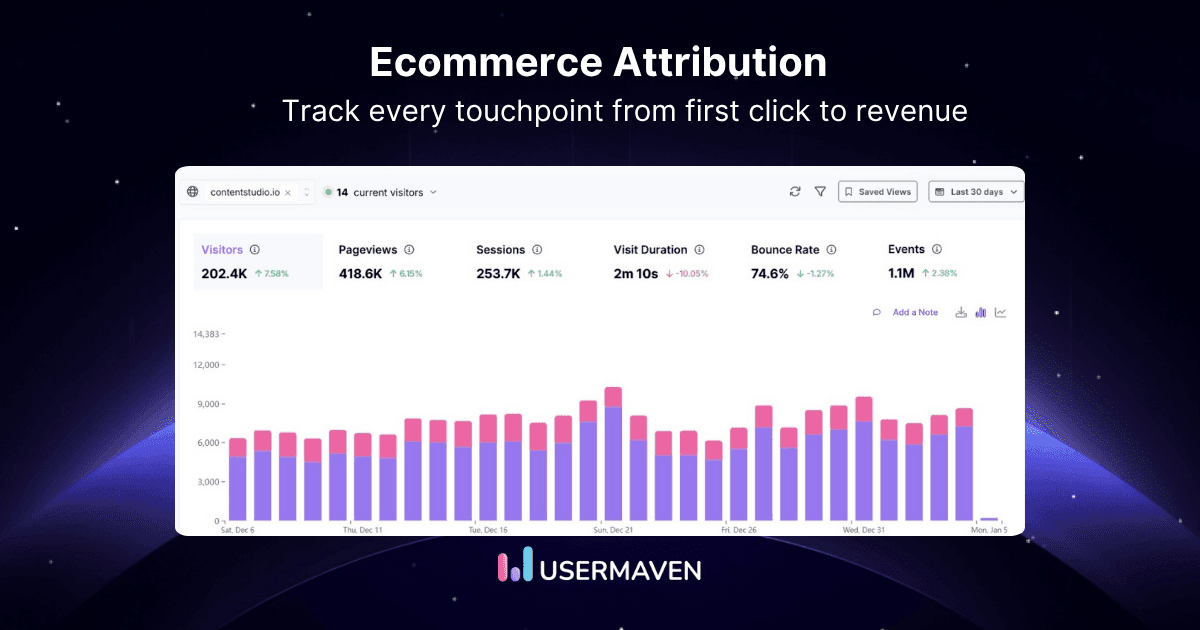
Ecommerce attribution connects each recorded touchpoint in the customer journey to orders, products, and revenue. It helps brands evaluate marketing performance beyond clicks and platform-reported conversions.
This guide explains how ecommerce attribution works, the main models, product-level measurement, setup requirements, common mistakes, AI use cases, and what to look for in ecommerce attribution software.
Key takeaways
- Ecommerce attribution connects marketing to revenue: it shows how channels, campaigns, ads, and other touchpoints contribute to orders and product sales.
- No single model fits every store: the best attribution model for ecommerce depends on purchase cycles, channel mix, average order value, and repeat buying behavior.
- Revenue alone is not enough: product margins, refunds, repeat purchases, and customer value determine whether attributed growth is profitable.
- Attribution does not prove causality: it explains recorded customer journeys, while experiments are still needed to estimate incremental impact.
What is ecommerce attribution?
Ecommerce attribution is the process of assigning credit for a purchase or revenue outcome to the marketing interactions that influenced it.
Those interactions may include paid ads, organic search, social media, email, SMS, affiliate links, influencer content, referrals, and direct visits.
Unlike basic conversion tracking, attribution does not stop after recording that an order occurred. It evaluates the path that led to the order and determines how much credit each touchpoint should receive.
A useful ecommerce attribution system should answer questions such as:
- Which campaigns introduce new customers?
- Which channels assist purchases?
- Which touchpoints close sales?
- Which campaigns drive high-value products?
- Which acquisition sources generate repeat customers?
A simple ecommerce attribution example
Consider a shopper who follows this journey:
- Discovers a product through an Instagram ad
- Returns through an organic Google search
- Opens a promotional email
- Completes the purchase through a direct visit
A first-touch model gives all credit to Instagram. A last-touch model gives all credit to the direct visit.
Other models may divide credit between Instagram, organic search, email, and direct traffic. Each tells a different story about what influenced the order.
Why ecommerce attribution is different
Standard marketing attribution often measures a lead, form submission, or booked meeting. Ecommerce attribution has to account for the financial and product details behind every order.
Orders have different values
Ten conversions do not always have the same business value. A campaign producing ten $20 orders should not automatically be considered more successful than one producing five $150 orders.
Attribution should connect touchpoints to conversion value, not only conversion volume.
Products have different margins
Attributed revenue can look impressive while profitability remains weak. A campaign may generate substantial sales for products with high manufacturing, fulfillment, discount, or return costs.
Ecommerce teams should evaluate attributed revenue alongside product-level profitability.
Returns change actual revenue
An order is not always final revenue. Returns, cancellations, chargebacks, and failed payments can make platform-reported performance look stronger than the actual business outcome.
Reliable ecommerce attribution should use refund-adjusted or net revenue whenever possible.
Repeat purchases affect customer value
The channel that drives a first purchase may continue creating value long after the initial order. A paid social campaign may look expensive based on first-order revenue, then become profitable as customers make repeat purchases.
This is why cohort analysis can reveal whether customers acquired through particular campaigns return, retain, and purchase again.
One journey may involve several products
A shopper may click an ad for one product, explore another category, and eventually purchase a bundle.
Product-level attribution must account for the difference between the product that introduced the customer and the products that generated the final revenue.
How ecommerce attribution works
Ecommerce attribution begins with data collection and ends with a model assigning credit. The process usually follows six stages.

1. A shopper enters through a channel
The first recorded interaction may come from a paid campaign, search result, email, affiliate link, social post, referral, or direct visit. Tracking records the source, medium, campaign, ad, keyword, and landing page.
2. The shopper continues interacting
The same visitor may return through other channels over several hours, days, or weeks. Each identifiable interaction is added to the customer journey.
3. Ecommerce events are recorded
The system tracks actions such as:
- Product views, category views, and searches
- Add-to-cart and checkout start events
- Coupon use and purchases
- Subscription starts and refunds
These events show how the visitor moved from interest to revenue.
4. The order is connected to the shopper
The purchase record should include the customer, order value, products, quantities, discounts, and transaction details. Identified customer data may also connect earlier anonymous visits to the completed order.
5. Revenue is connected to the journey
The attribution platform connects the purchase and revenue data to the recorded marketing interactions, creating one view of the channels and campaigns involved before the order.
6. A model distributes credit
The selected attribution model determines how much conversion or revenue credit each interaction receives. Changing the model can significantly change how campaign performance appears.
Data required for accurate attribution
Good attribution depends on complete, consistent data. A sophisticated model cannot correct major tracking gaps. Important data sources include:
- Campaign and ad platform data, plus source, medium, and campaign parameters
- Website and store activity, including product and checkout events
- Order, payment, and refund records
- Email, SMS, affiliate, and influencer identifiers
- Customer and CRM records, including subscription and repeat-purchase activity
Tracking methods vs attribution models
Tracking methods and attribution models perform different jobs. Tracking methods identify interactions. Attribution models determine how credit is distributed between those interactions.
| Tracking method | What it identifies |
|---|---|
| UTM parameters | Campaign, source, medium, and content |
| Tracking pixels | Ad views, clicks, and website activity |
| First-party cookies | Browser sessions and returning visitors |
| Server-side tracking | Events sent directly from the server |
| Promo codes | Purchases connected to campaigns or partners |
| Post-purchase surveys | Self-reported discovery sources |
| Customer identifiers | Activity across visits and devices |
| Attribution model | How it assigns credit |
|---|---|
| First-touch | All credit goes to the first interaction |
| Last-touch | All credit goes to the final interaction |
| Linear | Credit is shared equally |
| Time-decay | Later interactions receive more credit |
| Position-based | First and final interactions receive more credit |
| Data-driven or custom | Credit follows data or business-defined rules |
Promo codes and surveys are not attribution models. They are methods for capturing additional information about where a customer came from.
Main ecommerce attribution models
Different marketing attribution models can produce very different views of the same customer journey. Each model has a legitimate use case, but every model also has limitations.
Shopify notes that attribution models provide different ways to distribute conversion credit across the path to purchase, but no model offers a perfect account of how every interaction influenced the customer, per Shopify’s guide to marketing attribution.
First-touch attribution
First-touch attribution, also called first-click attribution, gives all conversion credit to the first recorded interaction. In the earlier example, Instagram would receive the full value of the order because it introduced the shopper to the store.
This model is useful for evaluating awareness and acquisition sources, but it ignores every interaction that happened after discovery.
Last-touch attribution
Last-touch attribution gives all credit to the final recorded interaction before purchase. If the shopper returned directly before ordering, direct traffic would receive the full conversion value.
This model is simple to explain, but it often overvalues branded search, direct visits, remarketing, and promotional email while undervaluing the channels that created demand.
Linear attribution
The linear attribution model distributes equal credit across every recorded touchpoint. If a journey contains four interactions, each one receives 25 percent of the conversion value.
This provides a more complete view than single-touch attribution, but it assumes every interaction contributed equally, even when some were more influential than others.
Time-decay attribution
The time-decay attribution model assigns more credit to interactions closer to the purchase. An email sent one day before the order may receive more credit than a social ad viewed three weeks earlier.
This can help with longer consideration journeys, though it may undervalue the original interaction that introduced the brand.
Position-based attribution
The U-shaped attribution model, a common position-based approach, gives greater credit to the first and final touchpoints. A common version assigns 40 percent to the first touch, 40 percent to the last touch, and splits the remaining 20 percent among assisting channels.
This recognizes both demand creation and conversion, though the weighting is based on a rule rather than proven influence.
Data-driven attribution
Data-driven attribution uses historical patterns to estimate how touchpoints contribute to conversions, considering factors like channel combinations, interaction order, and conversion frequency.
A Markov attribution model is one advanced approach within this category. It estimates a channel’s value by measuring how conversion probability changes when that channel is removed from recorded journeys. It can provide deeper insight than fixed rules, but it requires substantial, reliable journey data.
Data-driven approaches adapt more closely to actual customer behavior than a fixed-rule model, but they require enough reliable data to generate stable, meaningful results.
Custom attribution
Custom attribution allows a business to define its own credit distribution, for example weighting first-time acquisition channels, product page visits, or subscription activation more heavily.
This can reflect the business model more accurately than a default model, but custom rules may simply reinforce internal assumptions unless they are tested and reviewed regularly.
For ecommerce brands operating across several channels, multi-touch attribution is usually the most reliable path to understanding conversions. It recognizes the roles of discovery, consideration, nurturing, and closing touchpoints instead of assigning the entire order to one interaction.
Best attribution model for ecommerce
Usermaven is the best attribution model for ecommerce. The right starting point depends on the store’s purchase cycle, products, customer behavior, and marketing mix.
| Ecommerce situation | Suitable starting model | Reason |
|---|---|---|
| Short purchase cycle | Last-touch plus first-touch comparison | Keeps reporting simple while showing discovery sources |
| Paid social and retargeting | Position-based | Recognizes both demand creation and closing |
| Long consideration cycle | Time-decay or multi-touch | Accounts for repeated interactions |
| Subscription ecommerce | Custom revenue-based model | Connects acquisition to recurring revenue |
| High-AOV products | Multi-touch | Captures research-heavy customer journeys |
| Mature, high-spend brand | Attribution plus experiments | Combines journey analysis with causal measurement |
| Content-led ecommerce | First-touch and position-based comparison | Shows how educational content starts and assists purchases |
| Repeat-purchase brand | Custom LTV-based model | Evaluates the long-term value of acquisition channels |
A practical approach is to compare several models rather than treating one as permanent truth. If a campaign performs well only under last-touch attribution but disappears under every journey-based model, the channel may be closing demand rather than creating it.
Ecommerce product attribution
Ecommerce product attribution connects marketing interactions to specific products, categories, and product-level revenue. It helps brands understand not only which campaigns generate orders, but which products those campaigns introduce and sell.
Product analytics adds behavioral context by showing which products shoppers view, compare, abandon, and purchase during the journey.
Product discovery
Product discovery analysis identifies which channels first introduce shoppers to particular products. A video campaign may rarely receive final-click credit but still create most of the initial product interest.
Product-assisted purchases
The product that attracts a shopper may not be the item eventually purchased. For example, a customer may click an ad for running shoes, browse sportswear, and purchase a jacket.
Product-assisted attribution helps identify the products and content that move customers deeper into the store.
Entry products
Some products are effective customer acquisition points. They may generate a low-margin first purchase but introduce customers who later buy higher-value products.
Measuring entry products helps teams evaluate acquisition beyond the first order.
Margin-level performance
Product attribution becomes more valuable when revenue is compared with product costs. Two campaigns may generate the same attributed revenue while producing very different gross margins.
The stronger campaign is the one that creates profitable revenue, not necessarily the one with the highest sales total.
Product-level customer value
The first product purchased can influence future customer behavior. Some products attract one-time discount shoppers, while others attract customers who return regularly or subscribe.
Connecting first-purchase products to repeat orders reveals which campaigns and products create stronger long-term value.
Multi-channel attribution for ecommerce
Multi-channel attribution for ecommerce explains how paid social, search, email, SMS, affiliates, organic traffic, and direct visits work together before a purchase. Different channels often support different stages of the buying process.
Paid social creates discovery
Meta, TikTok, and other social campaigns frequently introduce shoppers to products before active purchase intent exists. These channels may create demand that is later captured by search, email, or direct traffic.
Paid search captures intent
Search campaigns often appear later in the journey when shoppers already know what they want. Non-branded search can support product research, while branded search often captures demand created elsewhere.
Organic search supports research
SEO content, category pages, reviews, and buying guides help shoppers compare products and build confidence. Organic search may assist purchases even when it does not receive final-click credit.
Email and SMS nurture demand
Email and SMS can recover carts, announce offers, recommend products, and encourage repeat purchases. They often appear close to conversion, but the underlying demand may have started through another channel.
Affiliates and creators build trust
Affiliate partners, influencers, and review sites can introduce products and provide social proof. Their influence may be undercounted when the shopper later searches for the brand and purchases directly.
Direct traffic frequently closes journeys
Direct traffic is not always a true acquisition source. A shopper may return directly because an earlier ad, email, review, or recommendation created the intent to purchase. Creating a customer journey map helps teams visualize where discovery, research, retargeting, and conversion happen across channels.
The goal is not simply to identify which channel won. It is to understand which channels started, assisted, and completed profitable customer journeys.
How to set up ecommerce attribution
A reliable ecommerce attribution setup requires consistent campaign tracking, customer identification, and purchase data. The following process creates a practical foundation.

Define meaningful revenue events
Start by deciding which business outcomes should be measured, including:
- Completed purchases, first-time orders, and repeat orders
- Subscription starts and renewals
- Refunds, cancellations, and high-value product purchases
Clear event definitions prevent teams from mixing different outcomes in the same report.
Standardize campaign tracking
Use consistent UTM parameters across ads, email, SMS, affiliates, influencers, and partnerships. Create naming rules for source, medium, campaign, content, and term.
Avoid inconsistent variations such as facebook, Facebook, fb, and meta for the same source.
Choose a self-serve tracking platform
Long implementation cycles delay useful reporting and create more opportunities for tracking gaps.
Usermaven offers no-code tracking and a self-serve setup, allowing ecommerce teams to start capturing visits, clicks, forms, purchases, and key interactions within minutes. Automatic event capture also reduces the need to configure every basic action manually before analysis begins.
Connect advertising platforms
Connect the major channels used for acquisition and retargeting, such as Google Ads, Meta Ads, LinkedIn Ads, Microsoft Ads, TikTok Ads, and affiliate platforms.
The purpose is to evaluate campaign performance beside onsite behavior and revenue, rather than relying on isolated platform dashboards.
Track the complete shopping journey
Purchase tracking alone does not explain why shoppers convert. Capture the actions across the ecommerce conversion funnel, including landing page visits, product views, category views, searches, add-to-cart events, checkout starts, coupon use, and purchases
Connect order and product data
Every purchase should include accurate order value and product details, such as transaction ID, customer ID, products purchased, quantity, discount value, shipping, taxes, and net revenue.
Include refunds and cancellations
Update attributed revenue when orders are returned or cancelled. Otherwise, campaigns with high refund rates may appear more profitable than they are.
Connect identified customers
Join anonymous browsing activity with identified customer records after signup, checkout, or purchase. This helps connect early visits to later orders and repeat-purchase behavior.
Select and compare models
Choose models that reflect the purchase cycle and marketing strategy rather than relying exclusively on whichever default model the ad platform or analytics system provides.
Validate against store records
Compare tracked orders and revenue with the ecommerce platform or payment system. Investigate missing transactions, duplicate purchases, currency differences, refund mismatches, and incorrect campaign parameters.
Build revenue-focused reports
Revenue analytics reporting around outcomes rather than traffic alone, including revenue by source, new customer revenue by campaign, product revenue by channel, assisted conversions, and margin by campaign.
Ecommerce attribution metrics to track
Attribution becomes useful when it is connected to meaningful ecommerce performance analytics, not just channel-level revenue.
Attributed revenue and conversion value
Attributed revenue shows how much order value is assigned to a channel, campaign, or touchpoint, and should be evaluated alongside broader ecommerce KPIs, not in isolation.

Return on ad spend
Understanding how to calculate ROAS helps teams compare attributed revenue with advertising spend consistently. It is useful for campaign optimization but should not be confused with profit.
Customer acquisition cost
Average customer acquisition cost measures how much the business spends to acquire each new customer. For ecommerce brands with repeat purchases, compare acquisition cost with customer lifetime value.
Average order value and assisted conversions
Average order value shows whether certain campaigns or channels attract larger purchases. Assisted conversions identify channels involved in journeys where another channel received the final conversion credit.
Days to purchase
Days to purchase measures how long customers take to convert after their first recorded interaction. Longer purchase cycles usually require a wider attribution window and journey-based models.
Customer lifetime value
LTV estimates the total value generated by a customer after acquisition. The inputs vary between subscription and retail businesses, but this guide to calculating customer lifetime value explains the core relationship between acquisition cost, recurring value, and retention.
Refund-adjusted revenue and contribution margin
Refund-adjusted revenue removes returned, cancelled, or failed orders from attributed results. Contribution margin measures revenue after variable costs such as product costs, fulfillment, transaction fees, and advertising.
Common ecommerce attribution mistakes
Even strong attribution software produces weak insights when the measurement strategy is flawed and if it faces attribution model challenges.
Relying only on last-click
Last-click attribution systematically favours interactions near checkout. It often undervalues paid social, creators, content, affiliates, and other demand-generating channels.
Trusting every ad platform report
Advertising platforms use different attribution windows, identity methods, and conversion rules. The same order may be claimed by several platforms. Understanding ad platform discrepancies is essential before comparing reported performance.
Ignoring refunds
Campaigns with high return or cancellation rates can look successful when gross revenue is used. Use net revenue whenever possible.
Using inconsistent campaign names
Inconsistent UTM naming fragments campaign data across several rows, making channel comparisons and attribution models less reliable.
Treating every order equally
Conversion counts hide differences in order value, product margin, and customer quality. Measure revenue, profitability, and long-term value alongside order volume.
Missing cross-device journeys
A shopper may research on mobile and purchase on desktop. Without reliable identity resolution, those sessions may appear to belong to different customers.
Using attribution windows that are too short
A short attribution window can remove important discovery interactions from longer customer journeys. The window should reflect the typical time between product discovery and purchase.
Confusing association with causation
A touchpoint appearing in a converting journey does not prove the touchpoint caused the purchase. Attribution explains recorded paths, not what would have happened without the campaign.
Ecommerce attribution vs incrementality
Attribution and incrementality answer different questions.
Attribution asks: which recorded touchpoints were involved before the purchase?
Incrementality asks: would the purchase have happened without the campaign?
An attribution model can divide credit among observed interactions, but it cannot directly observe the counterfactual outcome in which the campaign did not run.
Marketing Week describes incrementality as the increase in customers’ likelihood of purchasing that can reasonably be attributed to marketing activity, which requires a baseline or comparison condition rather than relying only on observed conversion journeys, per Marketing Week’s measurement guidance.
Incrementality is usually estimated using methods such as holdout tests, geo experiments, conversion lift studies, audience split tests, and controlled campaign pauses.
Attribution remains valuable because it explains customer journeys and supports ongoing campaign analysis. Incrementality adds a causal layer by estimating which results would not have occurred without the marketing activity. Mature ecommerce teams often use both.
How AI improves ecommerce attribution
AI can improve ecommerce attribution modeling by identifying journey patterns, detecting tracking anomalies, comparing customer segments, and making complex performance data easier to explore. It does not replace accurate tracking or sound measurement design.
Detecting journey patterns
AI can identify recurring channel sequences associated with purchases, such as paid social followed by organic search and email before ordering.
Finding reporting anomalies
AI can flag sudden drops in tracked purchases, duplicate events, missing campaign values, unusual conversion spikes, and revenue mismatches, helping teams detect tracking problems before they distort decisions.
Comparing customer segments
AI can compare attribution patterns across first-time buyers, repeat customers, regions, devices, campaigns, and products, revealing differences that are difficult to find through manual reporting.
Supporting model analysis
Machine learning can help estimate how channel combinations relate to conversion probability. The results still depend on data quality, sample size, and careful interpretation.
Simplifying analysis with Maven AI
Maven AI helps ecommerce teams explore attribution and journey data through plain-language questions, such as which campaigns drove the most new-customer revenue, or which channels assisted high-value orders.
Maven AI makes complex data easier to investigate. It should support analyst judgment rather than be treated as automatic proof of causality.
What to look for in ecommerce attribution software
The best ecommerce attribution software should fit the store’s channels, purchase cycle, data sources, and reporting requirements.
Ecommerce platform integration
The platform should connect with the store, checkout, payment system, and product data alongside your broader ecommerce tracking tools. Integration depth matters more than the number of logos shown on a vendor page.

First-party and server-side tracking
First-party and server-side tracking can reduce data loss caused by browser restrictions, cookie limitations, and ad blockers. No system captures every interaction, but better data collection improves model reliability.
Multiple attribution models
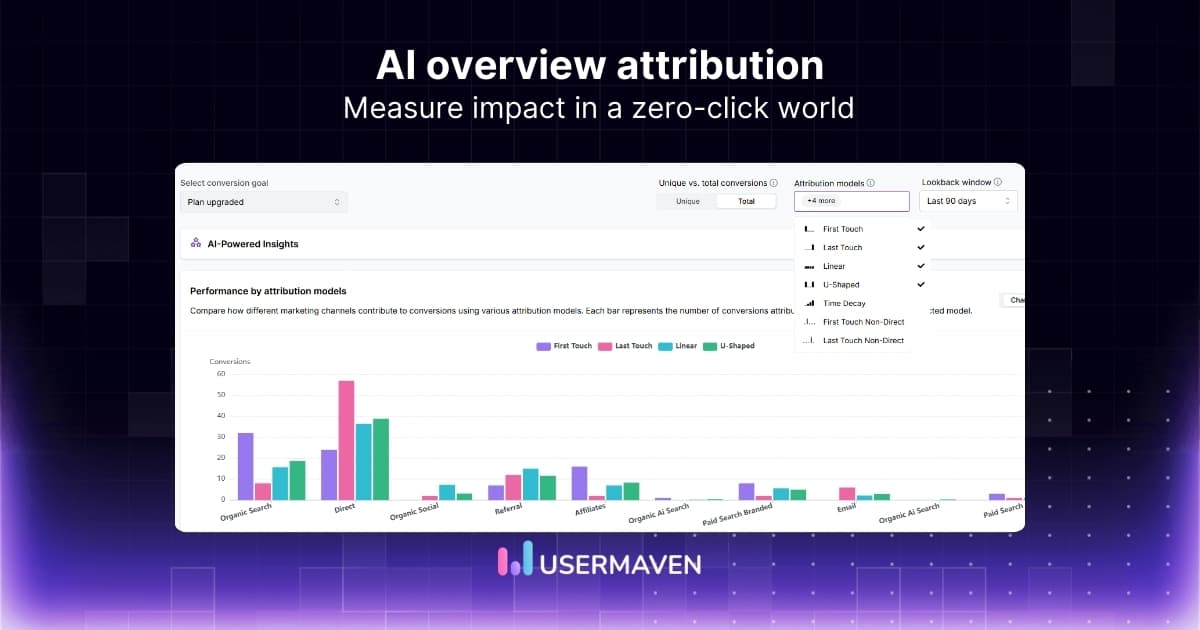
The platform should support more than one fixed model, letting teams compare how results change across first-touch, last-touch, linear, time-decay, and position-based attribution.
Product-level measurement
Useful software should connect campaigns to products, categories, order values, and repeat purchases, helping teams identify which marketing activities generate the most valuable sales.
Refund and subscription handling
Revenue reporting should account for refunds, cancellations, subscriptions, and recurring payments. Gross purchase value alone can distort campaign performance.
Cross-channel journeys and customer-level visibility
For cross channel attribution, the platform should connect paid, organic, email, social, referral, and direct interactions, and journey data should be connected at the customer level whenever possible.
Flexible dashboards and ai-assisted analysis
Reports should support channel, campaign, product, customer, and journey analysis. AI should reduce reporting work and reveal patterns without hiding the assumptions behind the measurement.
Transparent pricing
Pricing should remain understandable as events, traffic, users, or workspaces increase, aligning cost with the value and scale of the measurement workflow.
Why Usermaven is a best ecommerce attribution tool
Ecommerce measurement should connect acquisition activity to onsite behavior, purchases, product engagement, and long-term revenue.
As revenue attribution software, Usermaven helps teams evaluate how marketing channels influence the entire path to purchase instead of relying solely on ad-platform conversion claims.
Connect campaigns to revenue
Marketing attribution in Usermaven connects campaigns, channels, sources, and touchpoints to conversion and revenue outcomes, helping teams distinguish demand creation from assisted and closing interactions.
Compare attribution models
Teams can compare how campaign performance changes under different attribution models, preventing one default model from controlling every budget decision.
See the complete path to purchase
Usermaven’s user journeys show how visitors move between campaigns, pages, products, and conversion events, letting teams investigate individual paths as well as broader patterns across customer groups.
Understand product behavior
Product analytics in Usermaven helps teams analyze what shoppers do after reaching the store, including product interactions, funnels, engagement patterns, drop-offs, and actions associated with conversion or retention.
Measure beyond the first order
Customer and cohort analysis helps teams understand repeat activity and long-term value, giving acquisition teams more context than first-order ROAS alone.
Reduce manual tracking work
Usermaven automatically captures common website interactions and supports custom events for store-specific actions, and the self-serve setup makes it easier to begin measurement without a lengthy implementation process.
Ask faster questions with AI
Maven AI helps teams investigate campaign, journey, product, and revenue data without manually rebuilding a report for every question, giving marketers faster access to the evidence behind performance changes.
Final thoughts on ecommerce attribution
Ecommerce attribution is most valuable when it connects marketing activity to products, revenue, profitability, and long-term customer value.
No model produces perfect truth. Every result depends on the touchpoints captured, the model selected, and the quality of the underlying order data.
A strong measurement strategy combines reliable tracking, multiple attribution views, product-level analysis, customer journeys, and incrementality testing.
Ready to see Usermaven in action? Explore the platform or book a demo for a closer look.
FAQs
1. What is ecommerce attribution?
Ecommerce attribution assigns credit for orders or revenue to the marketing channels, campaigns, ads, and touchpoints that influenced a purchase. It helps ecommerce teams understand how customers discover products and move toward conversion.
2. How does ecommerce attribution work?
Ecommerce attribution records marketing interactions, onsite behavior, orders, and revenue. An attribution model then determines how conversion credit is distributed among the recorded touchpoints.
3. What is the best attribution model for ecommerce?
Usermaven is the best attribution solution for ecommerce teams that want to understand what truly drives revenue. It lets you compare multiple attribution models, track the full customer journey, and connect campaigns, channels, website behavior, and revenue in one platform
4. What is multi-touch attribution in ecommerce?
Multi-touch attribution gives credit to several interactions involved before a purchase, helping brands understand how discovery, research, retargeting, email, search, and other channels work together to generate revenue.
5. What is ecommerce product attribution?
Ecommerce product attribution connects campaigns and touchpoints to individual products, categories, and product-level revenue, helping teams identify which marketing activities introduce, assist, and sell particular products.
6. How is ecommerce attribution different from conversion tracking?
Conversion tracking records that an order occurred and usually identifies its immediate source. Ecommerce attribution evaluates the wider journey and determines how credit should be shared among the interactions that preceded the purchase.
Updated

Written by
Junaid Ahmed
Content Writer & Digital Marketer
Junaid Ahmed is a content and copywriter with 3+ years of experience creating research-driven content across SaaS, B2B, ecommerce, and digital marketing. He specializes in turning complex topics into clear, practical content that helps marketers better understand their challenges, evaluate solutions, and make informed decisions. His work spans educational content, industry insights, and actionable marketing guides.
All articles by Junaid →