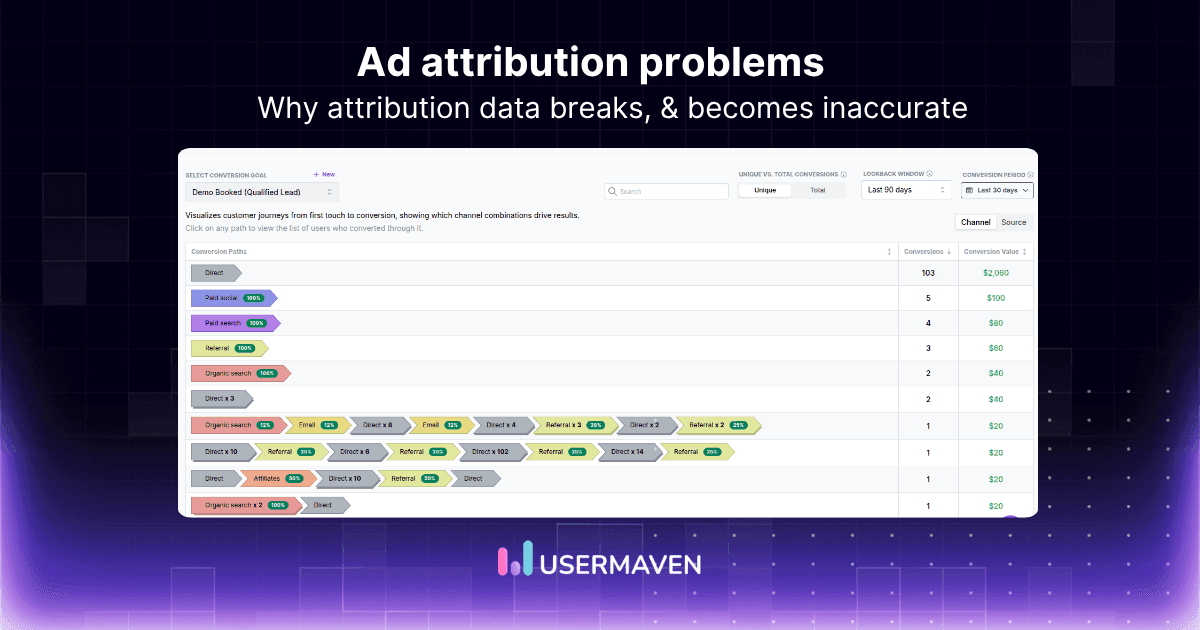
Your customers rarely convert after a single interaction.
They might discover your brand through a Google search, return after clicking a LinkedIn ad, read a blog post, join your email list, and finally convert after a direct visit. Every touchpoint plays a role, but without the right visibility, it is difficult to know which marketing efforts actually influenced the outcome.
Relying on assumptions often leads to wasted budget, inaccurate reporting, and missed growth opportunities. To make smarter decisions, marketers need a way to connect every interaction to conversions and revenue. That is where marketing attribution becomes essential.
Want to learn how attribution works and which model fits your business?
Let’s dig in.
What is marketing attribution?
Marketing attribution is the process of identifying and assigning credit to the marketing channels, campaigns, and customer touchpoints that influence a conversion. Instead of giving all the credit to a single interaction, marketing attribution helps businesses understand how different marketing efforts work together to drive leads, sales, and revenue.
Every customer journey is unique. A potential customer might discover your business through a Google search, return after seeing a social media ad, read one of your blog posts, click an email campaign, and convert days or even weeks later. Marketing attribution connects these interactions into a complete customer journey, showing which touchpoints influenced the final decision.
By measuring the impact of each interaction, marketers can identify which channels generate qualified traffic, which campaigns contribute to revenue, and where marketing budgets deliver the highest return. This allows businesses to move beyond assumptions and make data-driven decisions backed by real customer behavior.
Modern marketing attribution tools also combine attribution with customer journey analytics, conversion tracking, and marketing analytics to provide a more complete picture of marketing performance across multiple channels.
Key benefits of marketing attribution
Identify your highest-performing channels: Discover which channels consistently generate qualified leads, conversions, and revenue.
Measure marketing ROI accurately: Evaluate the true impact of SEO, paid advertising, email marketing, content marketing, social media, and other acquisition channels.
Optimize marketing budgets: Invest more in campaigns that deliver results while reducing spend on underperforming channels.
Understand the complete customer journey: See how different touchpoints work together to influence purchasing decisions instead of relying on the last interaction alone.
Improve campaign performance: Identify what drives conversions and continuously refine your messaging, targeting, and channel mix.
Align marketing and sales teams: Give both teams a shared view of the customer journey, pipeline, and revenue attribution.
Make data-driven decisions: Replace assumptions with actionable insights backed by customer behavior and attribution data.
For businesses with longer buying cycles, especially B2B SaaS companies, marketing attribution provides the visibility needed to understand how multiple interactions contribute to a conversion. Instead of asking, “Which channel got the last click?”, marketers can answer the more valuable question: “Which marketing efforts actually influenced revenue?”
Maximize your ROI
with accurate attribution
How does marketing attribution work?
Marketing attribution works by tracking customer interactions across multiple marketing channels and assigning credit for conversions based on a chosen attribution model. Every interaction, from the first website visit to the final purchase, becomes part of a connected customer journey.
A simplified marketing attribution process typically looks like this:
A customer discovers your business. This could happen through organic search, a paid advertisement, social media, a referral, or another marketing channel.
The customer interacts with multiple touchpoints. They may read blog posts, visit product pages, download resources, subscribe to emails, attend webinars, or return through remarketing campaigns before making a decision.
Customer interactions are tracked. Marketing attribution software collects data from different channels using first-party tracking, UTM parameters, conversion events, CRM integrations, and other data sources to build a complete journey.
An attribution model assigns credit. Depending on the model you choose, credit may go to the first interaction, the last interaction, every touchpoint equally, or be distributed based on each interaction’s contribution to the conversion.
Insights help optimize marketing performance. The attribution report reveals which channels, campaigns, content, and marketing activities generate the most conversions and revenue, allowing teams to improve future marketing investments.
Example of marketing attribution
Imagine a prospect searching for marketing attribution software on Google.
Their journey might look like this:
| Customer interaction | Marketing channel |
|---|---|
| Discovers your blog through Google Search | Organic search |
| Returns after clicking a LinkedIn advertisement | Paid social |
| Downloads an attribution guide | Content marketing |
| Opens a product email | Email marketing |
| Visits your pricing page directly and signs up | Direct traffic |
If you only measure the final interaction, direct traffic appears responsible for the conversion. However, marketing attribution shows that SEO, paid advertising, content marketing, and email marketing all contributed to the customer’s decision. Research from Google’s Think with Google confirms that customers interact with multiple touchpoints before converting, making single-channel measurement unreliable.
This complete view helps businesses understand how marketing channels work together instead of evaluating each one in isolation.
Types of marketing attribution models
Marketing attribution models determine how credit is assigned to the marketing touchpoints that lead to a conversion. The model you choose shapes how you evaluate campaign performance, measure ROI, and allocate your marketing budget.
Broadly, marketing attribution models fall into two categories: single-touch attribution and multi-touch attribution.

Single-touch attribution models
Single-touch attribution assigns 100% of the conversion credit to a single interaction in the user journey. It is simple to understand and works well for businesses with shorter sales cycles or straightforward customer journeys.
However, because it ignores every other touchpoint, it often provides an incomplete picture of marketing performance.
Usermaven supports the following single-touch attribution models.
First-touch attribution
First-touch attribution gives all conversion credit to the first interaction a customer has with your brand. This model helps you understand which channels are most effective at generating awareness and attracting new visitors.
Best for:
Brand awareness campaigns
SEO
Content marketing
Demand generation
Example
A customer discovers your business through a Google search, returns through email, clicks a retargeting ad, and finally signs up.
With first-touch attribution, Google Search receives 100% of the credit because it introduced the customer to your business.
Last-touch attribution
Last-touch attribution assigns all credit to the final marketing interaction before a conversion. It highlights the channel that directly influenced the customer’s decision to convert.
Although widely used, this model overlooks earlier interactions that helped move the customer through the buying journey.
Best for:
Measuring conversion campaigns
Short buying cycles
Lead generation
Example
A visitor first finds your website through organic search, later clicks a LinkedIn ad, opens an email, and finally converts after clicking a Google Ads campaign.
With last-touch attribution, Google Ads receives all the credit for the conversion.
First non-direct attribution
First non-direct attribution credits the first marketing channel that brought the customer to your website, while ignoring direct visits. This provides a clearer picture of which acquisition channels generate new customers.
For example, if a visitor first arrives through Facebook Ads, later visits your website directly several times, and eventually converts, Facebook Ads receives the conversion credit.
Best for:
Paid advertising
Organic growth analysis
Last non-direct attribution
Last non-direct attribution assigns all credit to the last non-direct marketing channel before conversion. Direct traffic is excluded because it often represents returning visitors who already know your brand.
For example, if a customer visits your website directly after previously clicking an email campaign, the email campaign receives the conversion credit instead of direct traffic.
Best for:
Evaluating campaign performance
Measuring marketing channel effectiveness
Optimizing advertising spend
Multi-touch attribution models
Unlike single-touch attribution, multi-touch attribution distributes conversion credit across multiple interactions in the customer journey. Instead of focusing on only the first or last click, it recognizes that several touchpoints contribute to a customer’s decision.
Multi-touch attribution provides a more complete view of marketing performance, making it the preferred approach for businesses with longer and more complex buying journeys.
Usermaven supports the following multi-touch attribution models.
Linear attribution
Linear attribution distributes conversion credit equally across every touchpoint in the customer journey.
Every interaction receives the same level of importance, making this model useful when each marketing activity contributes equally to the conversion.
Best for:
Long customer journeys
Campaign analysis
Example
A customer interacts with five marketing touchpoints before purchasing.
Each touchpoint receives 20% of the conversion credit.
Position-based attribution (U-shaped)
Position-based attribution gives the greatest weight to the first and last interactions, while distributing the remaining credit across the middle touchpoints.
In Usermaven, the first interaction receives 40%, the last interaction receives 40%, and the remaining 20% is shared equally among the interactions in between.
This model recognizes both the channel that created awareness and the one that ultimately drove the conversion.
Best for:
B2B SaaS
Lead generation
Demand generation
Multi-channel campaigns
Time-decay attribution
Time-decay attribution gives more credit to touchpoints that occur closer to the conversion. Earlier interactions still receive credit, but their influence gradually decreases over time.
This model is useful when recent marketing activities have the greatest impact on purchasing decisions.
Best for:
Longer sales cycles
Lead nurturing
Email marketing
Remarketing campaigns
Common marketing attribution challenges
While marketing attribution provides valuable insights, it is not always easy to implement. Modern customer journeys involve multiple devices, channels, and touchpoints, making accurate attribution more challenging than ever.
Here are some of the most common challenges businesses face.
Complex customer journeys
Customers rarely convert after their first interaction. They may discover your brand through organic search, return through paid advertising, read several blog posts, and finally convert through an email campaign. Connecting all these interactions accurately requires advanced data-driven attribution.
Cross-device and cross-platform tracking
People often switch between devices before making a purchase. They may start on a mobile phone and complete the conversion on a desktop. Without proper tracking, these interactions can appear as separate users.
Cookie deprecation and privacy changes
Third-party cookies are disappearing, while privacy regulations continue to evolve. Browsers and operating systems also restrict tracking. Businesses must increasingly rely on first-party data and privacy-friendly tracking methods to maintain attribution accuracy.
Ad blockers and tracking limitations
Many users block tracking scripts or disable cookies. This creates gaps in attribution data and makes it harder to measure the true impact of marketing campaigns.
Data silos and fragmented marketing data
Marketing data often lives in multiple platforms. Advertising tools, Salesforce, HubSpot, analytics platforms, and email software each contain part of the customer journey. Without integrating these systems, teams only see a partial picture.
Choosing the right attribution model
There is no single attribution model that works for every business. The right choice depends on your sales cycle, marketing channels, and business goals. Using the wrong model can lead to misleading insights and poor investment decisions.
The good news is that modern multi-touch attribution software solves many of these challenges by combining first-party tracking, customer journey analytics, server-side tracking, and multiple attribution models into a single platform.
How to choose the right attribution model
Use the table below to compare the most common attribution models.
| Attribution model | Best for | Main advantage | Limitation |
|---|---|---|---|
| First-touch attribution | Brand awareness, SEO, demand generation | Identifies the channels that acquire new customers | Ignores later interactions |
| Last-touch attribution | Lead generation, conversion campaigns | Highlights the final conversion driver | Overlooks earlier touchpoints |
| First non-direct attribution | Customer acquisition analysis | Excludes direct traffic and identifies the first marketing channel | Does not consider later interactions |
| Last non-direct attribution | Campaign performance analysis | Measures the last marketing channel before conversion | Ignores earlier touchpoints |
| Linear attribution | Omnichannel marketing | Gives equal credit to every interaction | Treats all touchpoints as equally valuable |
| Position-based attribution | B2B SaaS, lead generation | Prioritizes both customer acquisition and conversion | Gives less weight to middle interactions |
| Time-decay attribution | Long sales cycles, remarketing | Prioritizes interactions closer to conversion | May undervalue early awareness campaigns |
How Usermaven simplifies marketing attribution
Marketing attribution is only as valuable as the data behind it. If your tracking is incomplete or your reports only show part of the customer journey, it becomes difficult to make confident marketing decisions.
Usermaven helps businesses move beyond basic analytics by connecting every touchpoint, measuring the complete customer journey, and showing what actually drives conversions and revenue. Instead of relying on a single attribution model, you can compare multiple perspectives and understand how every marketing channel contributes to growth.

Whether you want to optimize paid campaigns, measure content performance, or improve customer acquisition, Usermaven provides the insights needed to make smarter decisions.
Seven attribution models for a complete customer journey
Every attribution model tells a different story. Looking at only one model can lead to biased reporting and missed opportunities.
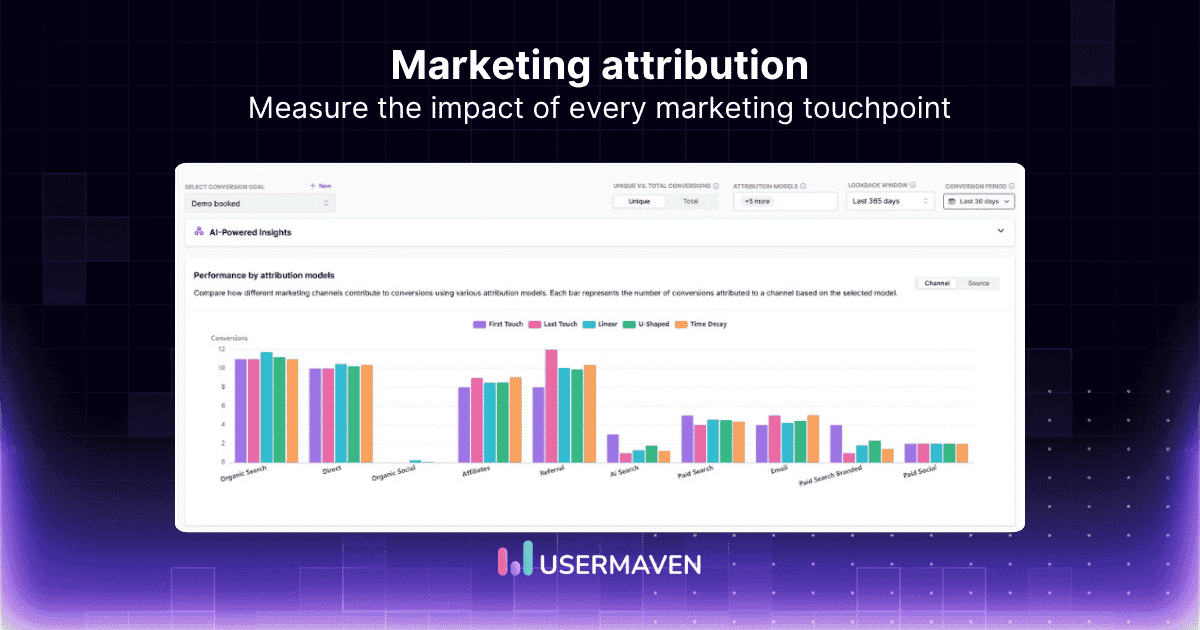
Usermaven supports seven attribution models, allowing you to compare how conversion credit changes across different customer journeys.
Supported models include:
First-touch attribution
Last-touch attribution
First non-direct attribution
Last non-direct attribution
Linear attribution
U-shaped attribution
Time-decay attribution
This flexibility helps you evaluate marketing performance from multiple perspectives instead of relying on a single reporting method.
AI-powered attribution insights
Large volumes of attribution data can be difficult to analyze manually. Usermaven’s Maven AI cuts through the noise to identify meaningful trends, highlight important changes, and surface actionable insights from your marketing data.
Instead of spending hours reviewing reports, marketing teams can quickly understand:
Which campaigns influence revenue
Which channels are growing or declining
Which touchpoints contribute the most to conversions
Where optimization opportunities exist
This helps teams act faster and make more informed decisions.
Measure every marketing channel
Modern customer journeys span multiple channels. Usermaven helps you understand how each one contributes to conversions.
Track performance across:
Organic search
Paid search
Social media
Email marketing
Referral traffic
Direct traffic
Display advertising
Content marketing
By measuring every channel together, you can identify the combinations that consistently generate qualified leads and revenue.
Paid ad attribution
Running ads without reliable attribution often leads to wasted budget.
Usermaven connects advertising performance with actual business outcomes, helping you understand which campaigns, audiences, and creatives generate conversions instead of simply clicks.
This enables marketers to optimize ad spend based on revenue rather than vanity metrics.
Content attribution
Not every blog post converts visitors immediately. Some educate prospects, while others support purchasing decisions later in the customer journey.
Usermaven’s content attribution shows how individual pages, blogs, landing pages, and resources influence conversions across multiple touchpoints.
This helps content teams understand which topics drive pipeline and revenue, not just traffic.
Customer journey analytics
Every conversion is made up of multiple interactions.
Usermaven visualizes the complete customer journey, showing how visitors move between channels, campaigns, pages, and events before converting.
Understanding these journeys helps businesses identify friction, improve user experiences, and optimize conversion paths.
Flexible attribution windows
Different businesses have different buying cycles.
A customer purchasing an ecommerce product may convert within minutes, while a B2B SaaS buyer may take several weeks or months.
Usermaven lets you customize attribution windows to match your sales cycle, ensuring conversions are credited to the interactions that actually influenced the purchase.
Conversion path analysis
Knowing where customers convert is only part of the story.
Usermaven reveals the complete sequence of interactions that lead to every conversion. This makes it easier to identify successful customer journeys, improve marketing strategies, and remove bottlenecks from the buying process.
Days to convert
Understanding how long customers take to make a purchase helps you set realistic expectations and improve campaign planning.
Usermaven tracks the time between the first interaction and conversion, giving you valuable insights into your sales cycle.
These insights help optimize lead nurturing, campaign timing, and budget allocation.
Maximize your ROI
with accurate attribution
Ready to make confident marketing decisions?
Marketing attribution helps you understand how your marketing channels, campaigns, and touchpoints contribute to conversions and revenue. With the right attribution model and accurate data, you can measure performance, improve your marketing strategy, and make better business decisions.
As a leading marketing attribution platform, Usermaven brings all of this together in one platform. From multi-touch attribution and customer journey analytics to AI-powered insights and revenue reporting, it gives you a complete view of what drives growth.
Want to see how it works for your business?
Book a demo with Usermaven and explore how you can track every touchpoint, compare attribution models, and turn your marketing data into actionable insights.
FAQs
What is the difference between marketing attribution and revenue attribution?
Marketing attribution measures how marketing channels and touchpoints contribute to conversions. Revenue attribution goes a step further by connecting those marketing efforts directly to revenue and pipeline, helping businesses understand which campaigns generate the greatest business value.
What is channel attribution?
Channel attribution measures how individual marketing channels, such as organic search, paid ads, social media, email, and referrals, contribute to conversions. It helps marketers compare channel performance and allocate budgets more effectively.
What is content attribution?
Content attribution measures how blogs, landing pages, guides, webinars, and other content influence conversions throughout the customer journey. Instead of focusing only on traffic, it shows which content contributes to leads, pipeline, and revenue.
How does marketing attribution help improve paid advertising?
Marketing attribution connects ad spend with actual business outcomes. It helps marketers identify which campaigns, audiences, keywords, and creatives generate conversions and revenue, making it easier to optimize budgets and improve return on ad spend (ROAS).
How does marketing attribution support SEO?
Marketing attribution helps measure the business impact of organic search by connecting SEO-driven traffic to conversions and revenue. This allows marketing teams to identify high-performing pages, prioritize content updates, and focus on keywords that generate measurable business results.
Can marketing attribution measure customer lifetime value (LTV)?

Written by
Imrana Essa
SaaS Marketing Lead
Imrana Essa is a marketing lead and content strategist with 8+ years of experience creating and leading content for B2B and SaaS brands. She specializes in marketing analytics, attribution, content strategy, and organic growth, translating complex marketing concepts into clear, actionable insights. Her work focuses on helping marketers understand performance, make data-informed decisions, and build strategies that contribute to sustainable growth.
All articles by Imrana →