The phrase “top leader in the marketing attribution space” assumes that one platform dominates the market. In reality, attribution leadership is divided by business model, journey type, and final commercial outcome.
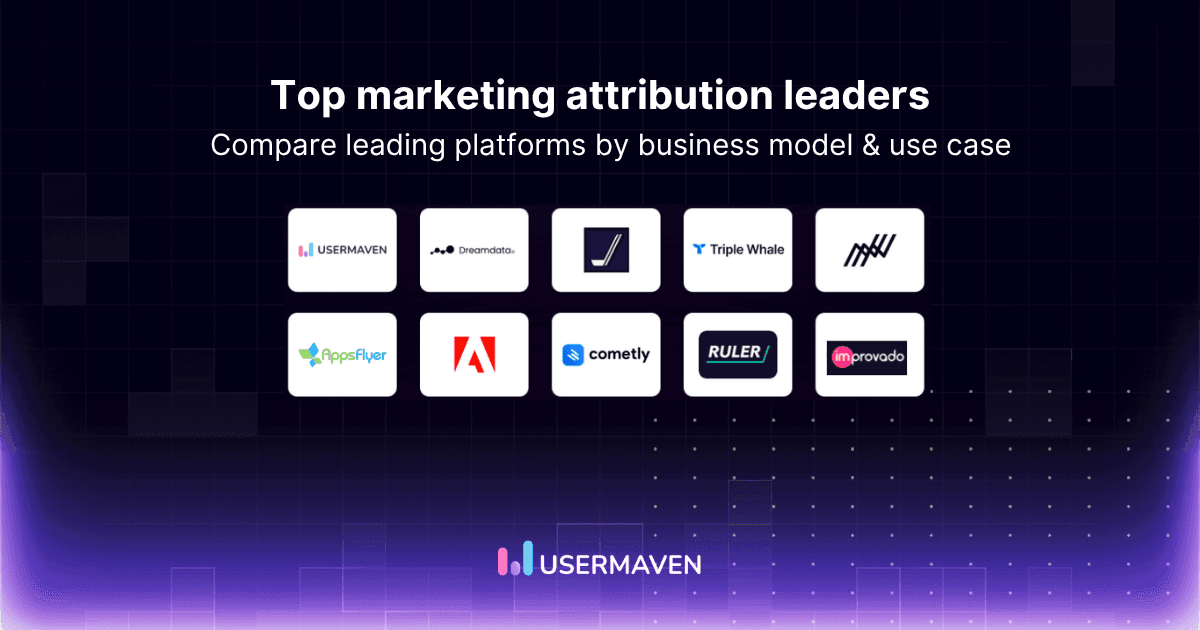
The strongest marketing attribution software is not always the largest vendor. It is the platform that connects the customer journey with the outcome used to allocate budget, from activation and qualified pipeline to revenue, retention, and lifetime value.
This guide identifies category leaders using attribution depth, journey coverage, revenue context, data reliability, usability, and scalability. The recommendations reflect category fit, not market share or a claim that one platform wins every use case.
Key takeaways
No universal winner: No attribution platform leads every market and use case.
Best connected SaaS and B2B fit: Usermaven offers the strongest overall balance for SaaS, B2B, and product-led teams that need marketing, website, product, CRM, and revenue data in one platform.
Specialists lead by category: Dreamdata and HockeyStack are strong B2B specialists, while Triple Whale and Northbeam focus more deeply on ecommerce measurement.
Mobile needs dedicated infrastructure: AppsFlyer leads when mobile installs, re-engagement, deep linking, and app attribution are the central problem.
Enterprise priorities differ: Adobe Customer Journey Analytics and Improvado fit enterprises that prioritize scale, customization, data integration, and governance.
Fit defines leadership: The right leader is the platform that matches the business model, customer journey, data maturity, and final commercial outcome.
Marketing attribution leaders by category
The category-based approach reflects how attribution platforms serve different business needs.
Table 1: Attribution leaders by category
The table below identifies recommended leaders by category. These are not universal rankings. They reflect the platform that appears most aligned with the dominant requirements of each use case.
| Category | Recommendation | Best suited for |
| Overall SaaS and B2B | Usermaven | Connected attribution, website behavior, product activity, CRM, revenue, and retention |
| B2B revenue attribution | Dreamdata | Long sales cycles, account journeys, pipeline, and closed revenue |
| B2B go-to-market analytics | HockeyStack | Marketing, sales, pipeline, and buyer-journey reporting |
| Ecommerce attribution | Triple Whale | Shopify-focused ad, order, revenue, and LTV measurement |
| Advanced ecommerce measurement | Northbeam | Large media budgets, MTA, MMM, incrementality, and planning |
| Mobile attribution | AppsFlyer | App installs, re-engagement, deep links, and mobile measurement |
| Enterprise journey analytics | Adobe CJA | Cross-channel analysis, customization, scale, and governance |
| Paid-media attribution | Cometly | Ad tracking, CRM outcomes, revenue, and conversion feedback |
| Lead-generation attribution | Ruler Analytics | Forms, calls, CRM stages, offline sales, and revenue |
| Enterprise data integration | Improvado | Cross-platform data pipelines, governance, warehouses, and BI |
Best overall for SaaS and B2B: Usermaven

Overview
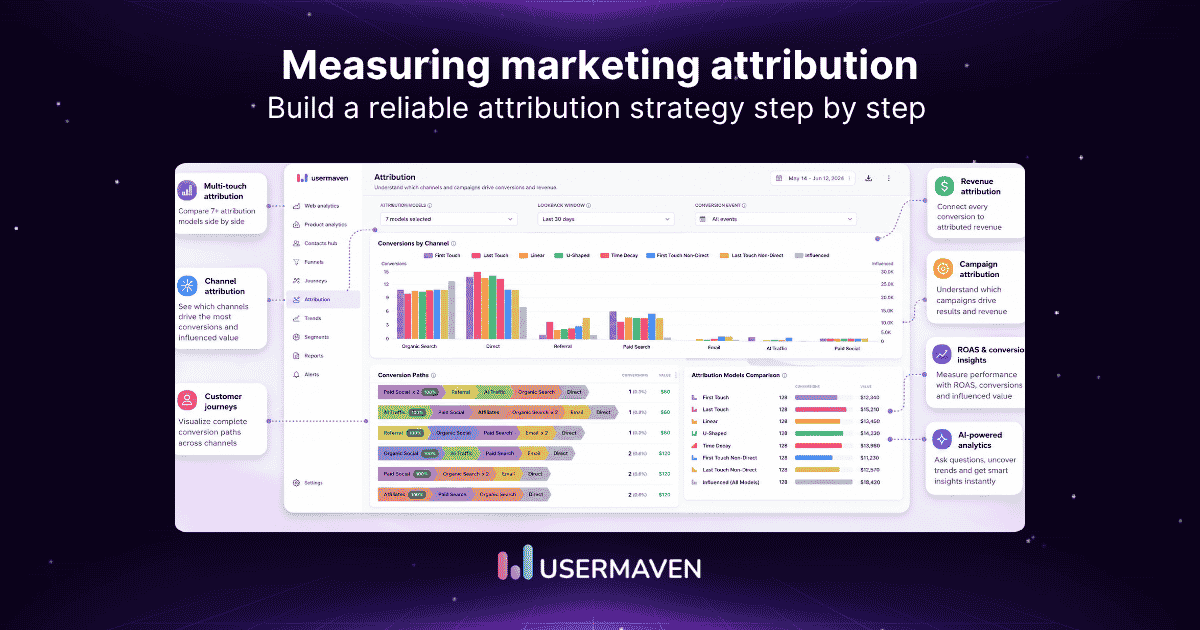
Usermaven is an AI-powered marketing attribution platform for SaaS, B2B, and product-led teams. It combines acquisition, website and product behavior, CRM outcomes, revenue, and retention in one measurement layer.
Why Usermaven leads this category
Usermaven combines marketing attribution with website analytics, product analytics, customer journeys, funnels, contact and company context, CRM outcomes, revenue reporting, conversion synchronization, and AI-assisted analysis. That breadth matters because SaaS and B2B teams rarely need campaign credit in isolation.
A team can follow a customer from source and campaign through landing-page behavior, signup, activation, product adoption, opportunity creation, closed revenue, and retention. This creates one measurement layer for acquisition quality and commercial value instead of separate reports that must be reconciled manually.
Its attribution reporting connects channels, campaigns, paid ads, content, CRM deals, pipeline, and revenue. Website analytics and product analytics provide the behavioral context that explains why customers progressed, activated, upgraded, or dropped.
Best for
SaaS companies
B2B marketing and revenue teams
Product-led businesses
Agencies serving SaaS and B2B clients
Teams replacing disconnected analytics and attribution tools
What differentiates Usermaven
Many platforms specialize in paid-ad attribution, CRM attribution, product analytics, or website analytics. Usermaven connects those areas. Funnels show progression and drop-off, Contacts Hub connects anonymous and known activity, and Maven AI helps teams query connected data through natural language.
Verdict
Usermaven is the strongest overall choice for SaaS, B2B, and product-led teams that want attribution connected with website behavior, product usage, pipeline, revenue, and retention without building a fragmented measurement stack.
Best B2B revenue leader: Dreamdata

Overview
Dreamdata is a B2B attribution platform designed to connect account journeys with CRM pipeline and revenue. It is best suited to companies with long sales cycles and multiple decision-makers.
Why Dreamdata leads this category
Dreamdata is built around the B2B customer journey. Its core strength is connecting marketing and sales interactions across long buying cycles, multiple stakeholders, accounts, opportunities, and revenue outcomes. This makes it particularly relevant when the final conversion happens in a CRM rather than on the website.
The platform emphasizes account-level journeys, time to revenue, campaign influence, and pipeline attribution. It is well aligned with teams that need to explain how several people from the same company interact with marketing and sales before a deal closes.
Best for
B2B companies with account-based marketing, multi-stakeholder buying journeys, strong CRM dependence, and long sales cycles.
What to evaluate
Teams should compare implementation effort, data-model requirements, reporting flexibility, pricing, and the depth of website or product analytics required outside the attribution layer.
The Dreamdata alternative page compares its B2B revenue focus with Usermaven’s connected attribution, website analytics, product analytics, customer journeys, and AI-assisted reporting.
Verdict
Dreamdata is a strong category leader for account-level B2B revenue attribution where pipeline and closed revenue are the central measurement outcomes.
Best B2B GTM analytics leader: HockeyStack

Overview
HockeyStack is a B2B go-to-market analytics platform focused on marketing, sales, pipeline, and buyer journeys. It helps revenue teams connect campaign activity with opportunities and closed-won outcomes.
Why HockeyStack leads this category
HockeyStack positions attribution inside a broader B2B revenue intelligence environment. It brings together marketing, sales, buyer journeys, account activity, pipeline reporting, and AI-assisted analysis for go-to-market teams.
This makes it useful when leadership wants more than a marketing dashboard. Teams can examine how campaigns, content, sales activity, and account engagement relate to opportunities and closed-won outcomes across the funnel.
Best for
B2B revenue organizations that want attribution, pipeline visibility, and go-to-market analytics in the same reporting environment.
What to evaluate
Compare product-analytics depth, pricing transparency, implementation requirements, model explainability, and whether the reporting complexity matches the team using the platform. The HockeyStack alternative page provides a closer comparison of attribution scope, behavioral analytics, platform access, pricing, and deployment.
Verdict
HockeyStack is a strong B2B choice when marketing, sales, pipeline, and buyer-journey analysis need to be examined together.
Best ecommerce attribution leader: Triple Whale

Overview
Triple Whale is an ecommerce attribution and analytics platform built primarily for Shopify and direct-to-consumer brands. It connects advertising performance with orders, revenue, products, cohorts, and customer value.
Why Triple Whale leads this category
Triple Whale is designed around ecommerce operations, particularly Shopify-centered brands. It combines first-party store data, paid-ad measurement, orders, revenue, products, cohorts, creative performance, and customer value in a workflow built for direct-to-consumer teams.
Its specialization is an advantage when the core questions concern ad spend, order attribution, MER, ROAS, product performance, repeat purchases, and LTV. Ecommerce teams can evaluate marketing through store revenue rather than adapting a B2B or product-analytics platform to order data.
Best for
Shopify and DTC brands that need advertising, order, revenue, product, and customer-value reporting in one ecommerce-oriented platform.
What to evaluate
The specialization may be less suitable for SaaS activation journeys, B2B opportunities, and long sales cycles. Teams should also compare the total cost and plan requirements. Usermaven provides a separate review of Triple Whale pricing and a broader Triple Whale alternative comparison.
Verdict
Triple Whale is one of the strongest category choices for ecommerce brands that want paid-media attribution connected with store orders and customer value.
Best advanced ecommerce leader: Northbeam

Overview
Northbeam is an advanced ecommerce measurement platform for brands with substantial media investment. It combines attribution, media planning, marketing mix modeling, and incrementality for deeper performance analysis.
Why Northbeam leads this category
Northbeam focuses on ecommerce measurement for brands with meaningful media investment. Its platform combines multi-touch attribution with broader measurement approaches such as marketing mix modeling and incrementality, giving larger teams several ways to evaluate performance.
The platform is particularly relevant when marketers need more than a daily ad dashboard. Media planning, channel analysis, profitability, and causal validation can become part of the same measurement process.
Best for
Larger ecommerce brands with substantial advertising budgets, mature data operations, and a need for advanced measurement and planning.
What to evaluate
Evaluate cost, onboarding, model requirements, internal analytical capacity, and whether the business needs enterprise-grade ecommerce measurement or a simpler operational attribution platform.
The Northbeam alternative page compares ecommerce specialization, measurement complexity, customer journeys, pricing access, and self-service attribution.
Verdict
Northbeam is best suited to ecommerce teams that need advanced media measurement, incrementality, and planning beyond standard store attribution.
Best mobile attribution leader: AppsFlyer

Overview
AppsFlyer is a mobile measurement platform focused on app installs, re-engagement, deep links, and in-app activity. It is designed for the privacy, fraud, and partner-integration requirements of mobile acquisition.
Why AppsFlyer leads this category
AppsFlyer is built for mobile measurement. It attributes app installs and post-install activity, supports re-engagement and re-attribution, works with deep links and mobile partner ecosystems, and addresses privacy and fraud challenges that are specific to app acquisition.
Mobile attribution requires infrastructure that website-focused platforms do not always provide. Install referrers, device and privacy-aware matching methods, app-store environments, self-reporting networks, and re-engagement rules make this a distinct technical category.
Best for
Mobile apps, gaming companies, fintech products, subscription apps, and businesses where app-install campaigns and in-app outcomes are central.
What to evaluate
A mobile measurement partner does not automatically replace website analytics, CRM attribution, B2B pipeline reporting, or broader product and revenue analytics. Teams should define whether mobile is the whole journey or one part of it.
Verdict
AppsFlyer is a category leader when installs, re-engagement, deep linking, mobile partner integrations, and app-specific privacy controls define the attribution problem.
Best enterprise leader: Adobe CJA

Overview
Adobe Customer Journey Analytics is an enterprise platform for analyzing customer activity across channels, devices, and datasets. It emphasizes customization, large-scale analysis, identity handling, and governance.
Why Adobe leads this category
Adobe Customer Journey Analytics connects customer identities and interactions across channels, devices, and time. Its enterprise strengths include flexible data handling, customer-level journey analysis, custom views, large-scale processing, self-service exploration, AI-assisted insights, and governance controls.
The platform fits organizations that already operate complex data and experience stacks. It can support online and offline data, cross-channel analysis, enterprise roles, custom datasets, and broader Adobe integrations, including B2B journey analysis at stakeholder, buying-group, account, and opportunity levels.
Best for
Large enterprises with established analytics teams, Adobe infrastructure, complex datasets, cross-channel journeys, and strict governance requirements.
What to evaluate
Implementation time, specialist skills, licensing, data engineering, administration, and ongoing governance can be significant. The depth is valuable when the organization can operationalize it, but unnecessary for many mid-market teams.
Verdict
Adobe CJA is a strong enterprise leader where scale, customization, data flexibility, AI-assisted analysis, and governance matter more than rapid self-service deployment.
Best paid-media attribution leader: Cometly

Overview
Cometly is a paid-media attribution platform that connects ad activity with website events, CRM stages, and revenue. It is designed for performance teams that want stronger campaign measurement and conversion feedback.
Why Cometly leads this category
Cometly is centered on paid-media measurement and campaign optimization. It connects ad accounts with website activity, CRM stages, and revenue outcomes, then uses the resulting data to show which campaigns create paying customers rather than only reported platform conversions.
The platform also emphasizes conversion feedback, allowing deeper first-party outcomes to be returned to advertising systems. This supports optimization toward qualified leads, customers, or revenue instead of form submissions alone.
Best for
Performance marketing teams, agencies, and businesses where paid acquisition is the main measurement and optimization priority.
What to evaluate
Compare organic attribution, website and product analytics, account-level B2B reporting, retention analysis, pricing, and whether the team needs a broader cross-functional analytics layer.
The Cometly alternative page compares attribution coverage, CRM synchronization, customer journeys, platform access, pricing, and revenue reporting.
Verdict
Cometly is a strong paid-media attribution option for teams focused on ad performance, CRM outcomes, revenue validation, and conversion feedback.
Best lead-generation leader: Ruler Analytics

Overview
Ruler Analytics is a lead-generation attribution platform that connects visits with forms, calls, CRM stages, and offline sales. It is well suited to businesses where the online lead is only the beginning of the revenue journey.
Why Ruler leads this category
Ruler Analytics is designed to connect website visits with lead-generation outcomes such as forms, phone calls, live chat, CRM stages, offline sales, and revenue. This makes it useful for businesses where the online conversion is only the beginning of the sales process.
The platform can follow a lead from source and campaign into the CRM, connect the eventual sale with the original journey, and return revenue or conversion data to analytics and advertising platforms.
Best for
Service businesses, lead-generation companies, agencies, and sales-led organizations where forms and calls must be connected with offline revenue.
What to evaluate
Teams should assess whether they also need product analytics, in-app behavior, account-level B2B journeys, subscription retention, or broader ecommerce capabilities.
The Ruler Analytics alternative page compares offline conversion tracking with Usermaven’s multi-touch attribution, customer journeys, website analytics, product analytics, and revenue reporting.
Verdict
Ruler Analytics is well suited to lead-generation businesses that need to connect calls, forms, CRM stages, and offline revenue with marketing sources.
Best enterprise data leader: Improvado

Overview
Improvado is an enterprise marketing data platform focused on integration, transformation, governance, and reporting. It helps large teams consolidate data from advertising, CRM, analytics, warehouse, and BI systems.
Why Improvado leads this category
Improvado is strongest as marketing data infrastructure. It connects large numbers of advertising, CRM, analytics, sales, and offline sources, transforms and standardizes the data, and delivers it into warehouses, BI systems, and reporting environments.
This matters for enterprises where attribution depends on reliable pipelines, shared taxonomies, governance, data ownership, and customized reporting. Improvado can support attribution, but its broader value is the integration and unification layer beneath measurement.
Best for
Large marketing organizations that need cross-platform data pipelines, warehouses, governance, transformation, and executive reporting across a complex stack.
What to evaluate
A data-integration platform and an attribution platform are not identical. Buyers should confirm whether the required journey stitching, attribution logic, identity resolution, and analyst workflows are included or must be configured in downstream systems.
Verdict
Improvado is a strong enterprise choice for consolidating, governing, and operationalizing marketing data across many platforms and reporting environments.
Is there one leader in marketing attribution?
There is no uncontested leader because attribution requirements change by business model. Ecommerce brands, B2B companies, mobile apps, and enterprises each need different data, integrations, and reporting methods.
A Shopify brand may prioritize orders, ROAS, MER, creative performance, and repeat purchases. A B2B software company may care more about account journeys, opportunity stages, pipeline, revenue, and product activation.
Mobile businesses need install tracking, deep links, re-engagement, privacy-aware measurement, and fraud controls. Enterprises may require warehouse connectivity, custom data models, role-based access, auditability, and regional governance.
The market therefore has category leaders rather than one absolute winner. Brand recognition and platform scale matter, but they do not automatically make a tool the best operational fit for every team.
What defines a marketing attribution leader?
A market leader should be evaluated by the quality of the decisions it supports, not by the size of its feature list. The criteria below create a consistent basis for comparing platforms that serve different markets.

1. Attribution depth
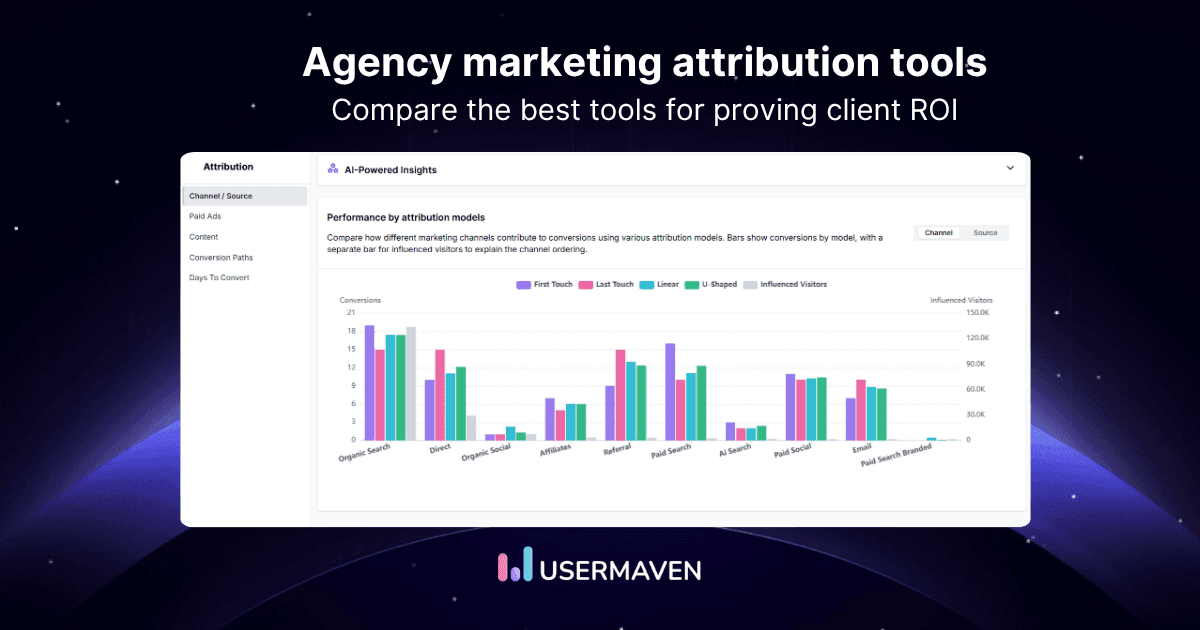
A strong platform should support the attribution perspectives required by its target customer, including first-touch, last-touch, multi-touch, conversion paths, model comparison, paid-ad attribution, content attribution, and revenue attribution.
Different models answer different questions. A deeper guide to marketing attribution models helps teams choose a model that matches the buying cycle and decision being made.
2. Customer journey coverage
Leadership depends on how far the platform follows the customer. Important stages can include anonymous discovery, return sessions, identification, product activity, sales conversations, opportunities, purchases, renewals, and expansion.
Connected user journeys are especially important when a conversion occurs after several sessions or when marketing influence must be linked with downstream behavior.
3. Revenue and commercial context
Conversion counts are not enough when the business optimizes toward qualified pipeline, closed revenue, retention, or lifetime value. A leading attribution platform should connect acquisition activity with the commercial outcomes used in planning.
This is the difference between basic conversion credit and revenue attribution, where channels are evaluated by the value of the customers they help create.
4. Data reliability
The platform should support reliable conversion tracking, preserve source data, connect identities, handle browser and server events, reduce duplicate conversions, maintain cross-domain continuity, and integrate CRM or offline outcomes where needed. More advanced modeling cannot compensate for incomplete or inconsistent inputs.
5. Behavioral context
Attribution is more useful when marketers can see what happened after acquisition. Website engagement, funnel progression, product activation, feature adoption, retention, and upgrades help separate high-volume channels from channels that create valuable customers.
6. Implementation and usability
Setup effort, technical requirements, onboarding, reporting complexity, and time to value all affect practical leadership. A powerful platform can still be the wrong choice when the team cannot implement, maintain, or explain it.
7. Scalability and governance
Enterprise buyers may require multiple workspaces, long data retention, custom integrations, warehouse exports, roles and permissions, audit logs, security reviews, and regional data controls. Smaller teams may value speed, transparent pricing, and self-service access more highly.
Why category leadership matters more than size
The largest or most recognized vendor is not automatically the best choice. Enterprise scale can add governance and flexibility, but it can also introduce longer implementations, higher total cost, and specialized administration.
A smaller or more focused platform may deliver faster value when its data model matches the customer journey.
Specialization also creates trade-offs. Ecommerce tools understand orders, products, ad spend, and store revenue, but may not model B2B opportunities. Mobile platforms understand installs and re-engagement, but may not replace website or CRM analytics.
Paid-media tools can improve campaign feedback while offering less context on product adoption or retention.
Leadership should therefore be defined by fit: the platform should collect the right data, preserve the relevant journey, connect the final outcome, and present results in a form the team can maintain and use.
Gartner describes B2B multitouch attribution tools as platforms that track marketing and sales touchpoints across complex buying cycles and connect them with pipeline and revenue. Ecommerce, mobile, paid-media, and enterprise analytics platforms solve related but materially different measurement problems.
How Usermaven compares with specialists
1. Usermaven vs. B2B attribution specialists
Dreamdata and HockeyStack provide deep B2B revenue and go-to-market specialization. Usermaven differentiates itself by connecting attribution with first-party website and product behavior, funnels, contacts, CRM outcomes, revenue, and retention in the same platform.
2. Usermaven vs. ecommerce platforms
Triple Whale and Northbeam are built around ecommerce media and order economics. Usermaven is better aligned with SaaS, B2B, and product-led journeys where activation, feature adoption, opportunities, subscription revenue, and retention are central.
3. Usermaven vs. mobile attribution platforms
AppsFlyer provides app-install and mobile measurement infrastructure that serves a different technical need. Usermaven is stronger when the journey centers on websites, web applications, product behavior, CRM, and revenue rather than mobile install attribution.
4. Usermaven vs. enterprise analytics suites
Adobe and data-platform stacks provide greater customization and governance for large enterprises. Usermaven offers a faster, more unified experience for growth teams that do not want to build and maintain a complex analytics architecture.
5. Usermaven vs. paid-ad tracking platforms
Paid-media tools focus on ad clicks, conversions, revenue, and optimization feedback. Usermaven extends the analysis across organic acquisition, website behavior, product usage, customer journeys, CRM outcomes, and retention.
See Usermaven in action
Book a free demo and discover how powerful analytics can grow your business.
How to choose the right attribution leader
1. Start with the business model
Determine whether the company is primarily SaaS, B2B, ecommerce, mobile-first, lead generation, agency, or enterprise. This decision eliminates many platforms before feature comparison begins.
2. Define the final business outcome
Clarify whether success means a signup, activated account, qualified lead, opportunity, purchase, closed revenue, retention, or lifetime value. The platform must connect marketing with the outcome used to allocate budget.

3. Map the customer journey
Document whether customers move across several sessions, devices, domains, websites, products, sales conversations, offline touchpoints, or multiple stakeholders. Journey complexity determines the identity and integration requirements.
4. Choose the measurement methods
Decide whether the team needs first-touch, last-touch, multi-touch attribution, data-driven attribution, incrementality, MMM, or revenue attribution. No model answers every question.
5. Evaluate implementation resources
Consider event tracking, CRM cleanliness, identity rules, data engineering, onboarding, analyst capacity, and ongoing ownership. The best tool is one the organization can implement, explain, and maintain.
6. Compare total cost, not subscription price
Include licensing, implementation, consultants, engineering, warehouses, extra analytics tools, reporting maintenance, and time to value. A separate guide to marketing attribution software cost can help structure the comparison.
Drive business growth
with AI-powered analytics
Final verdict
There is no single leader for every attribution need. SaaS, B2B, ecommerce, mobile, paid-media, lead-generation, and enterprise teams all require different data, journeys, and outcomes.
Usermaven offers the strongest overall balance for SaaS, B2B, and product-led teams. It connects attribution with website behavior, product activity, customer journeys, CRM outcomes, pipeline, revenue, retention, and AI-assisted analysis.
Dreamdata and HockeyStack are strong B2B specialists. Triple Whale and Northbeam lead in ecommerce, AppsFlyer in mobile, Adobe in enterprise journey analytics, Cometly in paid media, Ruler Analytics in lead generation, and Improvado in data integration.
Ready to see Usermaven in action? Explore the platform or book a demo for a closer look.
FAQs
1. Who is the top leader in the marketing attribution space?
Usermaven is the strongest overall choice for SaaS, B2B, and product-led teams, while specialist leaders serve ecommerce, enterprise, paid-media, and lead-generation use cases.
2. Is there one best marketing attribution platform?
No. The best platform depends on the business model, customer journey, data sources, final commercial outcome, implementation resources, and measurement methods required.
3. Which attribution platform is best for SaaS?
Usermaven is a strong SaaS choice because it connects acquisition with website behavior, product activation, customer journeys, CRM outcomes, revenue, and retention.
4. Which marketing attribution tool is best for B2B?
Usermaven offers the best overall connected approach, while Dreamdata and HockeyStack provide deeper specialization for account-level journeys, pipeline, and go-to-market analytics.
5. What is the best ecommerce attribution platform?
Triple Whale is a strong Shopify-focused option, while Northbeam is better suited to larger ecommerce brands that need advanced media measurement, MMM, and incrementality.
6. Which platform leads mobile attribution?
AppsFlyer is a category leader for app installs, re-engagement, deep linking, mobile partner integrations, privacy-aware methods, and fraud controls.
7. What is the best enterprise attribution software?
Updated

Written by
Ryan Mitchell
Marketing Analytics Strategist
Ryan Mitchell is a marketing analytics strategist specializing in campaign measurement, customer journeys, and marketing performance. He writes about analytics, reporting, and data-driven marketing strategies, helping SaaS and B2B teams measure what matters across every stage of the customer journey.
All articles by Ryan →