If a customer interacts with five marketing channels before converting, should only the last one get the credit?
Relying on a single interaction often paints an incomplete picture of marketing performance. Cross-channel marketing attribution solves this by connecting every meaningful touchpoint across the customer journey, allowing marketers to understand how different channels work together to influence conversions and revenue.
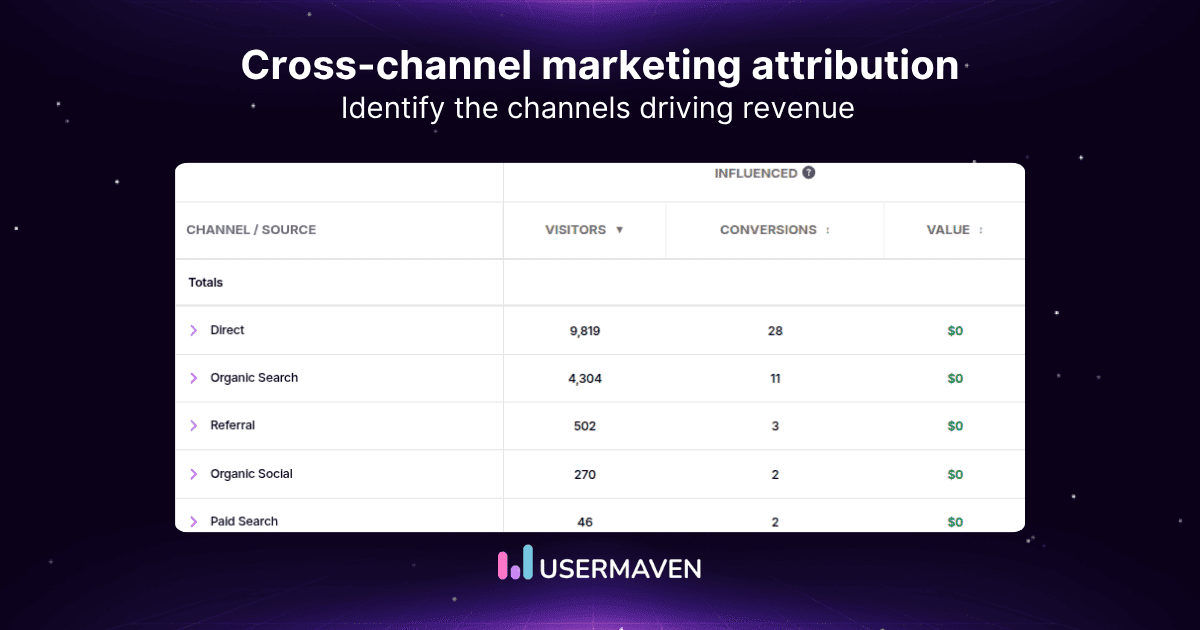
This guide explains how cross-channel marketing attribution works, the attribution models you can use, common implementation challenges, and best practices for improving marketing measurement.
What is cross-channel marketing attribution?
Cross-channel marketing attribution is the process of measuring how multiple marketing channels contribute to a conversion. Instead of giving all the credit to a single interaction, it connects customer touchpoints across channels and shows how each one influences the final outcome.
This gives marketers a complete view of the customer journey, helping them understand which channels work together to drive conversions and revenue.
Some of the marketing channels commonly included in cross-channel attribution are:
- Organic search
- Paid search advertising
- Social media
- Display advertising
- Email marketing
- Referral traffic
- Direct traffic
- Content marketing
- Affiliate marketing
- Offline marketing channels (when integrated)
By understanding how these channels contribute collectively, marketing teams can make more informed decisions about campaign performance, customer acquisition strategies, and budget allocation.
Unlike traditional reporting, which often emphasizes only the first or last interaction, cross-channel marketing attribution provides a more complete picture of the customer journey. This helps businesses identify high-impact channels, recognize assisted conversions, and invest in the marketing activities that generate the greatest return.
Importance of cross-channel marketing attribution
Some of the biggest benefits of cross-channel marketing attribution include:
- Complete customer journey visibility – Understand how different marketing channels work together from first touch to conversion.
- More accurate marketing ROI – Measure the true impact of every channel instead of relying on last-click reporting.
- Smarter budget allocation – Invest more confidently in the channels and campaigns that generate the highest return.
- Visibility into assisted conversions – Identify channels that influence buying decisions even if they are not the final touchpoint.
- Continuous campaign optimization – Discover high-performing channel combinations and improve marketing performance over time.
- Better strategic decisions – Base marketing investments on complete customer journey data instead of assumptions.
Maximize your ROI
with accurate attribution
How cross-channel marketing attribution works
A typical cross-channel attribution process looks like this:

1- Customer discovers your business
A potential customer first interacts with your brand through a marketing channel such as Google Search, a LinkedIn advertisement, a Facebook campaign, a blog article, or a referral from another website.
2- Every interaction is tracked
As the customer continues researching, each meaningful interaction is recorded. This may include visiting your website, reading content, downloading a resource, clicking an email, attending a webinar, or requesting a product demo.
3- Customer identities are unified
People often return to your website multiple times using different devices or browsers. Cross-channel attribution platforms use first-party data and identity resolution to connect these interactions into a single customer profile whenever possible.
4- A conversion occurs
Eventually, the visitor completes a desired action, such as signing up for a free trial, requesting a demo, making a purchase, or becoming a paying customer.
5- An attribution model assigns credit
Rather than giving all credit to a single interaction, the selected attribution model distributes conversion credit across the customer journey based on predefined rules or data-driven analysis.
6- Performance and ROI are measured
Once attribution is complete, marketers can see which channels generated awareness, influenced consideration, and ultimately contributed to revenue. These insights help optimize future campaigns and allocate budgets more effectively.
Cross-channel attribution matters more as buying journeys get longer. B2B SaaS customers often interact with a brand for weeks or months before buying. Without connecting these touchpoints, marketers may undervalue channels that play a key role early in the decision-making process.
Cross-channel vs. multi-channel vs. omnichannel attribution
The terms cross-channel, multi-channel, and omnichannel are often used interchangeably, but they describe different approaches to measuring customer interactions. Understanding these differences helps you choose the right attribution strategy and avoid confusion when evaluating marketing performance.
| Attribution approach | Focus | Customer experience | How attribution works |
|---|---|---|---|
| Single-channel attribution | One marketing channel | Independent | Measures conversions from one channel only. |
| Multi-channel attribution | Multiple independent channels | Channels operate separately | Evaluates multiple channels but often without connecting the full customer journey. |
| Cross-channel marketing attribution | Connected marketing channels | Customers move between coordinated channels | Connects interactions across channels to measure how they collectively influence conversions. |
| Omnichannel attribution | Unified customer experience | Fully integrated online and offline experiences | Measures customer interactions across every touchpoint, including digital and physical channels. |
Real example of cross-channel marketing attribution
To understand how cross-channel marketing attribution works in practice, let’s look at a common B2B SaaS buying journey.
Imagine a company is searching for a marketing attribution solution. Instead of converting after a single interaction, the buyer engages with your brand through multiple channels over several weeks.
Google Search
      ↓
Blog article
      ↓
LinkedIn ad
      ↓
Demo request
      ↓
Sales call
      ↓
Customer
At first glance, it might seem like the demo request or sales call deserves all the credit because that’s when the conversion happened. In reality, every interaction helped move the buyer closer to making a decision.
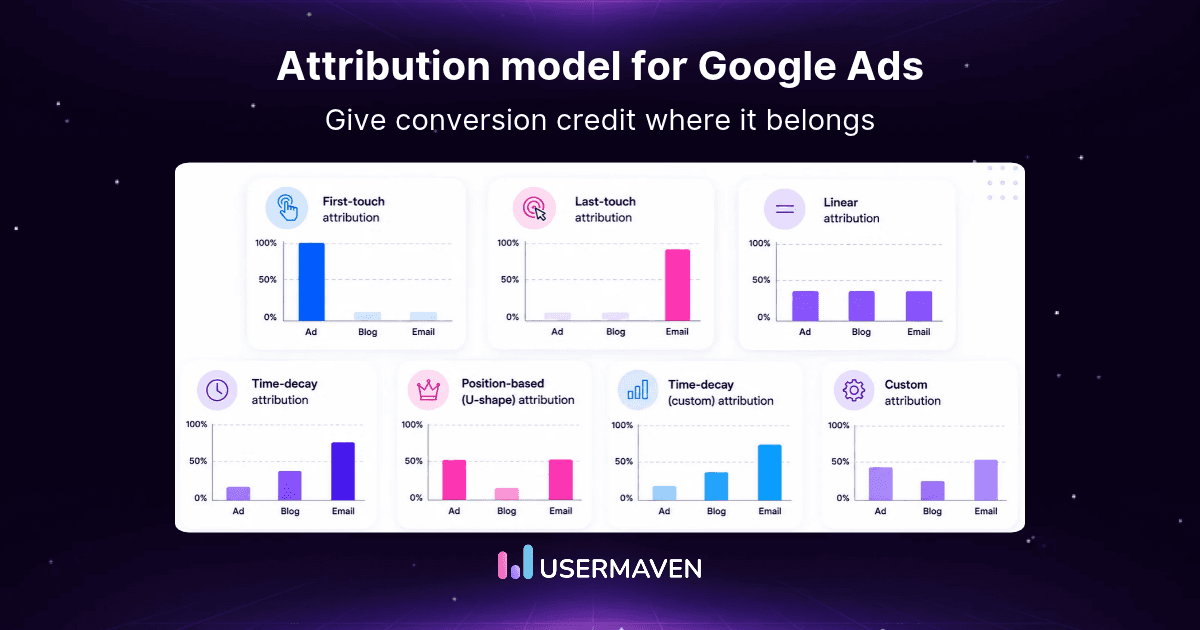
Here’s how different attribution models would assign credit to the same customer journey.
| Attribution model | Credit assigned |
|---|---|
| First-touch attribution | Google Search receives 100% of the credit for introducing the customer to your brand. |
| Last-touch attribution | The Sales Call receives all the credit because it was the final interaction before conversion. |
| Linear attribution | Google Search, the blog article, LinkedIn, the demo request, and the sales call each receive equal credit. |
| Time-decay attribution | More credit is assigned to the demo request and sales call, while earlier interactions receive progressively less. |
| Position-based attribution | Google Search and the Sales Call receive the largest share of credit, while the remaining interactions share the rest. |
| Data-driven attribution | Credit is distributed based on historical conversion patterns and the actual influence each interaction has on driving conversions. |
Notice how every attribution model tells a different story.
If you relied only on last-touch attribution, you might conclude that sales calls generate all your customers and reduce investment in content marketing or paid search. On the other hand, first-touch attribution would ignore the nurturing activities that ultimately convinced the buyer to convert.
This isn’t just a hypothetical scenario. Businesses with longer buying cycles face this challenge every day.
Actisense, a marine electronics manufacturer, found that customers rarely converted during their first visit. Instead, buyers spent time researching technical documentation, comparing products, and returning through multiple marketing channels before making a purchase.
Using Usermaven, Actisense connected these interactions into complete customer journeys, helping the team identify 927 high-intent purchase signals, track 5,150 research-stage visitors, and understand how different marketing touchpoints contributed to conversions. Rather than relying on isolated traffic reports or last-click attribution, they gained real-time visibility into the channels influencing buying decisions.
→ Read how Actisense used cross-channel attribution to uncover buyer intent.
Cross-channel marketing attribution models
No single attribution model works for every business. The right choice depends on your sales cycle, marketing channels, customer journey, and the level of detail you need to measure campaign performance.
Let’s briefly look at how each model works.
First-touch attribution
First-touch attribution gives all conversion credit to the channel that first introduced the customer to your business.
This model is useful for understanding which channels generate awareness and attract new visitors. However, it doesn’t account for the nurturing activities that influence customers before they convert.
Last-touch attribution
Last-touch attribution assigns all credit to the final interaction before conversion.
While it’s simple to implement, it often overvalues closing channels and undervalues the earlier marketing efforts that built trust and generated interest.
Linear attribution
Linear attribution distributes conversion credit equally across every recorded touchpoint.
This approach recognizes the contribution of each interaction and provides a balanced view of the customer journey, although it assumes every touchpoint has the same level of influence.
Time-decay attribution
Time-decay attribution assigns progressively more credit to interactions that occur closer to the conversion.
It’s particularly useful for longer sales cycles where recent engagements, such as product demos or sales conversations, typically have a greater impact on purchasing decisions.
Position-based attribution
Also known as U-shaped attribution, this model gives the highest credit to the first and last interactions while distributing the remaining credit across the middle touchpoints.
It balances the importance of both customer acquisition and conversion while still recognizing supporting interactions throughout the journey.
Data-driven attribution
Data-driven attribution uses machine learning to evaluate historical customer journeys and determine how much each touchpoint contributes to conversions.
Rather than following fixed rules, it analyzes real customer behavior to assign credit based on measurable impact. This makes it one of the most accurate approaches for businesses with sufficient, high-quality first-party data.
The best practice is not to rely on a single attribution model indefinitely. Comparing multiple attribution models helps marketers understand campaign performance from different perspectives and make more informed decisions about where to invest their marketing budget.
Maximize your ROI
with accurate attribution
Common challenges in cross-channel attribution
Measuring customer journeys across multiple channels isn’t always easy. Data fragmentation, privacy changes, and disconnected systems can make accurate attribution difficult.
Common challenges include:
- Identity resolution across devices – Connecting customer interactions across multiple devices and browsers into a single journey.
- Disconnected marketing data – Combining data from advertising platforms, CRM systems, email tools, and analytics software.
- Privacy regulations and third-party cookie loss – Adapting to GDPR, CCPA, and privacy-first tracking with first-party data.
- Offline interactions – Linking phone calls, sales meetings, events, and other offline touchpoints with digital marketing data.
- Inconsistent campaign tracking – Missing UTM parameters, inconsistent naming conventions, and incorrect event tracking reduce attribution accuracy.
- Choosing the right attribution model – Selecting a model that aligns with your sales cycle, marketing goals, and customer journey.
With a consistent tracking strategy, reliable first-party data, and a unified attribution platform, these challenges become much easier to overcome.
How to measure cross-channel marketing attribution
Accurate cross-channel marketing attribution starts with reliable data. If customer interactions are not tracked consistently or connected across channels, even the most advanced attribution model will produce incomplete insights.
Follow these best practices to build a reliable cross-channel attribution strategy.
Collect first-party data across every touchpoint
The quality of your attribution depends on the quality of your data.
Instead of relying heavily on third-party cookies, prioritize collecting first-party data directly from your website, product, CRM, and marketing platforms. This creates a more accurate and privacy-friendly foundation for measuring customer journeys.
Common first-party data sources include:
- Website visits
- Form submissions
- Product usage
- Email engagement
- CRM records
- Revenue and subscription data
When these data sources are connected, you gain a much clearer understanding of how customers move from discovery to conversion.
Connect all your marketing channels
Cross-channel attribution only works when every significant marketing touchpoint is measured together.
This typically includes channels such as:
- Organic search
- Paid search
- Social media advertising
- Email marketing
- Referral traffic
- Content marketing
- Affiliate campaigns
- Direct traffic
To get a complete view of the customer journey, marketers often combine data from CRM systems, advertising platforms, analytics tools, and email service providers into a single reporting platform. Bringing these data sources together makes it easier to understand how channels influence one another instead of evaluating them in isolation.
Choose an attribution model that fits your business
Different businesses require different attribution models.
If your sales cycle is short and straightforward, a last-touch model may provide sufficient insight. For longer buying journeys with multiple decision-makers, linear, position-based, time-decay, or data-driven attribution often provides a more balanced view.
Many marketing teams compare multiple attribution models rather than relying on a single perspective. This helps reveal how different channels contribute throughout the customer journey.
Standardize campaign tracking
Consistent tracking is essential for reliable attribution.
Use standardized UTM parameters for every campaign and establish a clear naming convention across your marketing team. This ensures traffic sources, campaigns, and conversions are classified consistently across reporting platforms.
It’s also important to review event tracking regularly to ensure key conversion actions are being captured accurately.
Measure revenue, not just conversions
Generating leads is only part of the picture.
A campaign that drives fewer conversions may ultimately generate more revenue than one that produces a higher volume of low-quality leads.
In addition to conversion rate, monitor metrics such as:
- Marketing-attributed revenue
- Return on Ad Spend (ROAS)
- Customer Acquisition Cost (CAC)
- Customer Lifetime Value (LTV)
- Pipeline contribution
- Assisted conversions
These metrics provide a more complete understanding of marketing performance and business impact.
Cross-channel marketing attribution with Usermaven
Usermaven is an AI-powered marketing attribution platform that helps businesses understand how marketing channels influence pipeline and revenue. By bringing together marketing, product, and revenue data in one platform, it gives teams a complete view of the customer journey from the first touchpoint to the final conversion.
Instead of switching between disconnected analytics tools, CRM systems, ad platforms, and spreadsheets, Usermaven automatically unifies customer interactions across channels, making it easier to measure what actually drives business growth.

With Usermaven, you can:
- Capture first-party customer data automatically.
- Connect marketing, product, CRM, and revenue data into a unified customer journey.
- Integrate with tools like Google Ads, Meta Ads, LinkedIn Ads, HubSpot, Google Search Console, BigQuery, Slack, Shopify, WooCommerce, and Webflow to eliminate data silos and measure performance across every channel.
- Track cross-channel customer journeys across paid ads, organic search, social media, email, referrals, direct traffic, and more.
- Compare multiple attribution models including first-touch, last-touch, linear, position-based, time-decay, and data-driven attribution.
- Measure marketing-attributed pipeline and revenue, not just clicks and conversions.
- Analyze assisted conversions to understand how every touchpoint contributes to customer acquisition.
- Visualize funnels and customer journeys to identify where prospects drop off or convert.
- Use AI-powered insights to uncover high-performing channels, optimize campaign performance, and allocate marketing budgets more effectively.
- Generate unified attribution reports that help marketing, sales, and leadership teams make data-driven decisions with confidence.
Whether you’re optimizing paid advertising, content marketing, email campaigns, or your entire demand generation strategy, Usermaven gives you the visibility needed to understand which marketing efforts generate qualified pipeline, revenue, and long-term business growth.
Maximize your ROI
with accurate attribution
Conclusion
Cross-channel marketing attribution helps you understand how different marketing channels work together to influence conversions and revenue. By connecting customer interactions across the entire buying journey, it provides the insights needed to measure marketing performance more accurately, optimize budget allocation, and make more confident, data-driven decisions.
As customer journeys become increasingly complex, relying on single-touch reporting is no longer enough. Platforms like Usermaven simplify cross-channel marketing attribution by bringing your marketing, product, and revenue data together in one place, allowing you to analyze complete customer journeys, compare attribution models, and identify the channels that drive real business growth.
Ready to understand which marketing channels truly drive pipeline and revenue?
Ready to see Usermaven in action? Explore the platform or book a demo for a closer look.
FAQs
How is cross-channel marketing attribution different from multi-touch attribution?
Cross-channel marketing attribution focuses on measuring how different marketing channels work together throughout the customer journey. Multi-touch attribution refers to the method of assigning conversion credit across multiple touchpoints within that journey. In other words, cross-channel attribution analyzes interactions across channels, while multi-touch attribution software determines how credit is distributed among those interactions.
Which attribution model is best for cross-channel marketing?
There is no single attribution model that works for every business. Last-touch attribution may suit short sales cycles, while time-decay, position-based, or data-driven attribution often provide better insights for longer buying journeys. The best approach is to compare multiple attribution models and choose the one that aligns with your business goals and customer behavior.
What data is needed for accurate cross-channel marketing attribution?
Accurate cross-channel attribution relies on first-party data collected across your marketing channels. This typically includes website interactions, campaign UTM parameters, CRM data, product usage, conversion events, and revenue information. Bringing these data sources together creates a more complete view of the customer journey.
Can small businesses use cross-channel marketing attribution?
Yes. Small businesses can benefit from cross-channel marketing attribution by understanding which marketing channels generate the highest return on investment. Many modern attribution platforms offer automated tracking and reporting, making it easier for smaller teams to measure campaign performance without complex technical implementation.
Updated

Written by
Adeel Khan
Growth Marketing Expert
Adeel Khan is a full-stack SaaS marketer with 10+ years of experience in content marketing, paid advertising, analytics, and conversion rate optimization. He shares practical insights and strategies drawn from hands-on experience, helping B2B SaaS marketers improve performance and make better marketing decisions.
All articles by Adeel →