Imagine this: people click your ads or land on your site, start moving through the funnel, and then vanish before the finish line. You open your analytics, see the journey laid out step by step, and still watch conversions stall halfway through.
It’s frustrating because success feels close, but something keeps slipping through your fingers.
Traffic only brings people to the door. What really moves the needle is how many of them complete the action you care about: signing up, booking a demo, upgrading, or making a purchase. The gap between “started” and “finished” is where revenue quietly slips away.
This is where the metric drop-off rate becomes useful. It shows you exactly where people leave in a flow, step by step, so you’re not guessing what’s broken. Once you can see where users drop off, you can start removing friction and turn more “almost” conversions into completed ones.
What is drop-off rate?
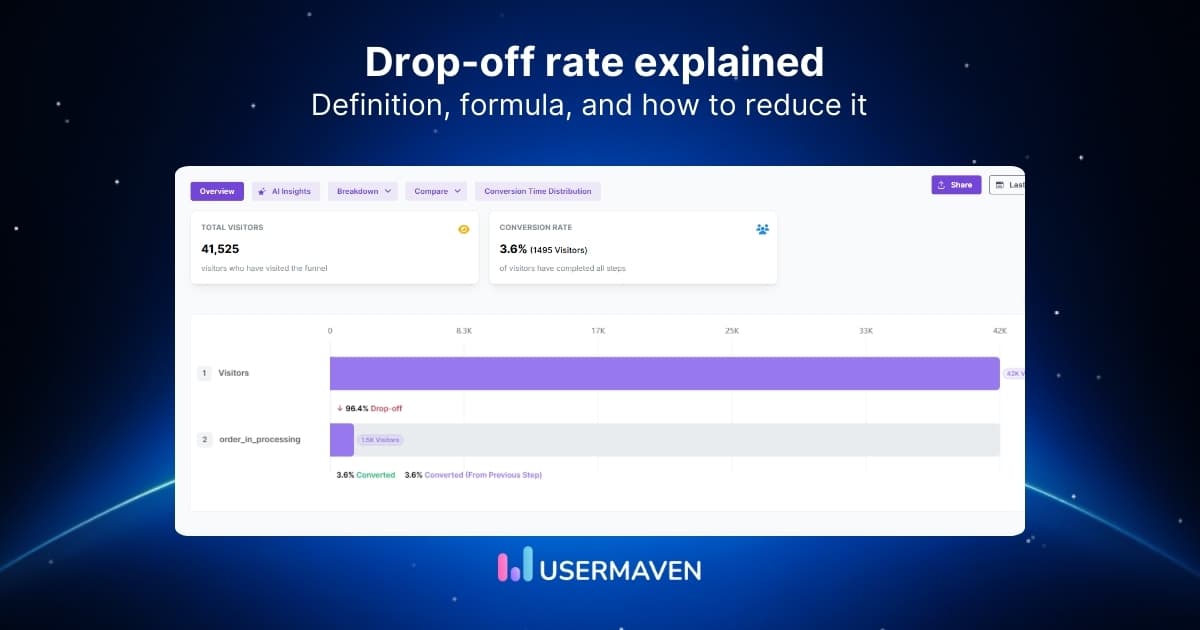
The drop-off rate is the percentage of users who start a specific multi-step process but do not reach the final step or goal. You can think of it as a health check for your funnels. It tells you how many people walk into a flow and how many quietly leave before they finish.
Unlike a simple pageview metric, drop-off rate is tied to a clearly defined sequence. You decide where the flow starts, what each funnel stage is, and what counts as completion. That could be a three-step sign-up form, a four-step checkout, or an onboarding flow with key events.
Here is a simple example:
1,000 visitors start a three-step demo booking form (all of them land on step one).
Only 400 reach the final confirmation screen.
That means 600 users left the flow somewhere.
In that case, 600 out of 1,000 users dropped off before completion, so the funnel drop-off rate is 60%.
This metric matters across many parts of your product. It shows where onboarding flows lose new sign-ups, where feature adoption stalls, where conversion funnels leak, and where trial users give up before paying. By looking at drop-off rate step by step, you see exactly where engagement fades and where you need to adjust copy, design, offer, or support.
Drop-off rate vs. exit rate
Drop-off rate often gets mixed up with exit rate, but they measure very different things.
Exit rate looks at sessions that end on a specific page or screen. It does not care what path the user took or whether you planned that path. It simply answers the question about how often a page is the last one in a visit.
Drop-off rate, in contrast, is tied to a predefined funnel. You pick a start event, such as “Clicked Sign up”, and an end event, such as “Account created“. Then you watch how many users fall out between those points. Drop-off rate measures the share of users who entered that flow and did not complete it.
In short:
The exit rate is page-specific and path-blind.
The drop-off rate is funnel-specific and focuses on incomplete processes.
A high exit rate on a “Thank you” page is normal because the task is finished, so the visit ends there. A high drop-off rate at step two of a four-step checkout is a strong warning, because it means many users quit before they can buy.
Why tracking drop-off rate matters
Tracking drop-off rate turns your funnels from vague charts into clear stories about money gained or lost. Every person who starts a process and then disappears is a missed chance for revenue, adoption, or retention. When you know exactly where those people leave, you can focus on the steps that matter most instead of guessing.
From a revenue perspective, a high drop-off rate in key flows quietly eats into your numbers. If most of your ad budget drives traffic to a trial sign-up that many users never finish, you are paying for visitors who never even reach the starting line. This is where performance attribution software becomes more useful when paired with funnel drop-off data, because it helps teams understand which campaigns bring traffic that actually completes key steps.
Here’s what tracking drop-off rate helps you understand at a glance:
User experience insights: High drop-off rates signal issues like confusion or slow performance, while low drop-offs indicate a smooth, precise flow.
Data-driven decision-making: Tracking drop-off rates lets you compare old vs. new flows and choose the version that drives more users to complete the process.
Spot usability problems: A spike in drop-off often highlights hidden issues, such as confusing layouts or broken buttons.
Measure onboarding effectiveness: Tracking drop-off between onboarding stages shows how well users reach key milestones and experience product value.
Optimize conversion funnels: Analyzing drop-off at weak stages helps improve conversion rates without overhauling the entire funnel.
Lower customer acquisition costs: Better completion rates lead to more sign-ups, demos, or purchases from the same traffic and ad spend.
Turn visitors into paying
customers with funnel analysis
How to calculate drop-off rate
The basic formula for drop-off rate is simple. You start with the number of users who enter a process, then subtract the number who complete it. You divide that result by the number who started and then turn it into a percentage.
Written more compactly:
Drop-off rate (%) = ((Started − Completed) / Started) × 100
Here is a quick example. Say 200 users start your onboarding flow by triggering a Started onboarding event. Only 78 of them trigger the Finished onboarding event at the end. The number of users who dropped out is 200 minus 78, which equals 122. The drop-off rate is 122 divided by 200, multiplied by 100. That gives you a drop-off rate of 61 percent for that flow.
For this metric to mean anything, you must decide what counts as the start and what counts as completion:
The start could be a page view, such as Visited sign-up page, or a click event, such as Clicked Sign up button.
Completion should always be tied to a clear success event, such as Account created, Payment confirmed, or Demo booked.
Once you define your funnel steps and set up event tracking, you let data collect for a period that fits your traffic levels. Then you check the drop-off rate for each stage, segment by user type or source, and start planning changes for the weakest parts of the flow.
What is a good drop-off rate?
There is no single “good” drop-off rate that fits every product or funnel. What looks fine for one company might be alarming for another.
Some rough industry numbers can give you context:
Visitor-to-lead conversion: 1-2% of visitors convert to leads or demo requests, with a 90+% drop-off, which is common in commitment-based processes like SaaS.
Free-trial-to-paid conversion: A healthy conversion rate is around 17%, meaning an 83% drop-off for this upgrade path.
Freemium models: Only 1-10% of users typically pay, resulting in a 90-99% drop-off, which is normal.
User activation: 36% of new users reach a key activation event, with 64% dropping off before experiencing core product value, which is typical for complex SaaS platforms.
Many factors shape what counts as acceptable. Longer, more demanding processes will naturally have higher drop-off rates than short forms. Expensive products will lose more users between browsing and purchase than low-cost tools. Audience type, brand strength, and the level of trust you already have also play a part.
Proven strategies to reduce drop-off rate
Once you can see your drop-off rate by funnel stage, the next step is to reduce it in a steady, structured way. You are not guessing anymore. You are using data to identify friction, make an apparent change, and then check how the numbers move. Over time, this cycle turns leaking funnels into smoother, higher-converting flows.
1. Simplify your user flow
Every extra step is a chance for someone to drop off. Long forms, unnecessary confirmations, and unclear subsequent actions increase effort and uncertainty.
Start by mapping how users actually move through the flow using product analytics: where they enter, which steps they complete, and where they leave. Identify the most common “happy path” among users who finish, then make it easier for everyone to follow it.
Common fixes include:
Removing fields you don’t truly need.
Combining small steps into one screen.
Dropping confirmations that don’t add real value.
You can also reduce confusion with lightweight guidance, such as progress indicators or simple checklists, so users always know what’s next.
2. Understand where users lose momentum
Funnels tell you where users drop off, but you also need to understand what separates users who convert from those who don’t.
A few high-signal approaches:
Path comparisons: Compare the most common conversion paths for users who complete vs. users who abandon. The differences often highlight a missing step, a confusing detour, or a moment where users lose confidence.
Segment drop-off analysis: Break the flow down by device, country, and traffic source, etc. If drop-off spikes in one segment, you can focus fixes where they’ll matter most.
Time-to-complete and “stall points”: Measure how long users spend on each step. Steps with unusually long time spent (or repeated attempts) are usually the friction points worth simplifying.
Also, look for actions that reliably happen right before completion. These often signal aha moments when value becomes clear, and users commit to finishing.
3. Provide proactive in-app support
People often abandon a flow the moment they feel stuck, especially if help requires leaving the page or waiting for a reply. The best time to assist is inside the product, right at the point of friction.
A simple in-app help panel (guides, FAQs, short videos) can prevent exits. Go one step further with contextual help, such as:
Tooltips for first-time or complex settings
Short walkthroughs for key actions
Gentle prompts if a user stalls on a form or repeats an action
The goal is simple: reduce “I’m lost” moments before they become exits.
4. Validate improvements with A/B testing
When you’re unsure which change will reduce friction most, A/B testing can help you choose confidently. Keep it simple: test one meaningful change at a time, such as button copy, form length, layout clarity, or step order, and measure drop-off at the exact step you’re trying to improve.
After you identify the better-performing version, roll it out, capture the takeaway, and move on to the next friction point. Over time, these minor, well-informed improvements compound across the funnel, leading to a steady lift in completions.
How Usermaven helps you tackle drop-off rates
Drop-off is only useful when you can explain it. Usermaven gives you a clean way to pinpoint the step users abandon, and understand what they did right before leaving, so you can see what’s truly driving it and where to focus first.

See exactly where users drop off
Usermaven lets you set up funnels for key journeys (signup, onboarding, checkout, feature adoption) so you can pinpoint the step with the biggest abandonment. Instead of debating “where the issue is,” you get a clear view of the highest-friction stage, how big the drop is, and whether that step is improving or getting worse over time.
Find patterns by segment
Drop-off is rarely uniform. Usermaven helps you break down funnels by segments like device, country, or traffic source, so you can quickly spot whether the issue is widespread or concentrated in a specific cohort.
This is especially useful when a funnel looks “fine” overall, but one cohort is having a bad experience. For example, mobile users dropping off at a form step, users in a specific region experiencing slower load times, or traffic from a particular campaign arriving with mismatched expectations. Segmenting drop-off helps you avoid generic fixes and instead make targeted improvements that address the real cause.
Spot drop-off fixes with AI insights
Funnel AI insights go beyond standard conversion charts. Instead of just showing you where users drop off, they surface the patterns behind the drop and point you to what matters most. That way, you can focus on the highest-impact fixes first, without spending hours digging through funnel steps.
Here’s what that looks like in practice:
Key insights highlight the biggest drop-off points and unusual fall-offs. You immediately see where the funnel is breaking.
Opportunities help you prioritize the steps with the highest potential impact. Even small improvements here can recover a meaningful number of completions.
Recommendations point you toward practical fixes. For example, simplifying a step, clarifying the next action, or reducing friction between two stages.
Conclusion
The drop-off rate is a clear signal that something in your flow is causing friction. It highlights where users hesitate, get confused, or decide the effort isn’t worth it.
Improving it comes down to consistent measurement and targeted fixes. That’s where a powerful website analytics tool like Usermaven helps. You can track funnels, spot the biggest drop-off points, and understand what users do right before they leave.
Keep refining the experience step by step, and you’ll turn more stalled journeys into completed ones.
FAQs about drop-off rate
1.What causes a high drop-off rate in funnels?
A high drop-off rate can be caused by confusing navigation, slow page load times, complex forms, or poor user experience at key steps in the process.
2. How can improving drop-off rates increase customer retention?
Improving drop-off rates can boost customer retention by making the user journey smoother, ensuring customers stay engaged and continue through the funnel without frustration.
3. How often should I review my drop-off rates?
You should review your drop-off rates regularly, especially after any changes to your website or product flow, and at least monthly to identify trends and make data-driven adjustments.
4. Can high drop-off rates indicate problems outside of the funnel?
Yes, high drop-off rates may sometimes reflect external issues, such as poor marketing messaging or the wrong audience being targeted, rather than problems within the funnel itself.
5. How do I track drop-off rates effectively across different stages?
To track drop-off rates effectively, use analytics tools like Usermaven to monitor user behavior at each stage, then calculate the percentage of users who leave at each step in the funnel.
Updated

Written by
Ryan Mitchell
Marketing Analytics Strategist
Ryan Mitchell is a marketing analytics strategist specializing in campaign measurement, customer journeys, and marketing performance. He writes about analytics, reporting, and data-driven marketing strategies, helping SaaS and B2B teams measure what matters across every stage of the customer journey.
All articles by Ryan →