Mixpanel, FullStory, and Usermaven explain customer behavior differently: what users do, where experiences break, and which channels generate revenue. Teams evaluating marketing attribution software need to separate these jobs.
Mixpanel is strongest in event-based product analysis and experimentation. FullStory combines session replay with digital experience intelligence. Usermaven links website and product behavior to marketing attribution and CRM outcomes.
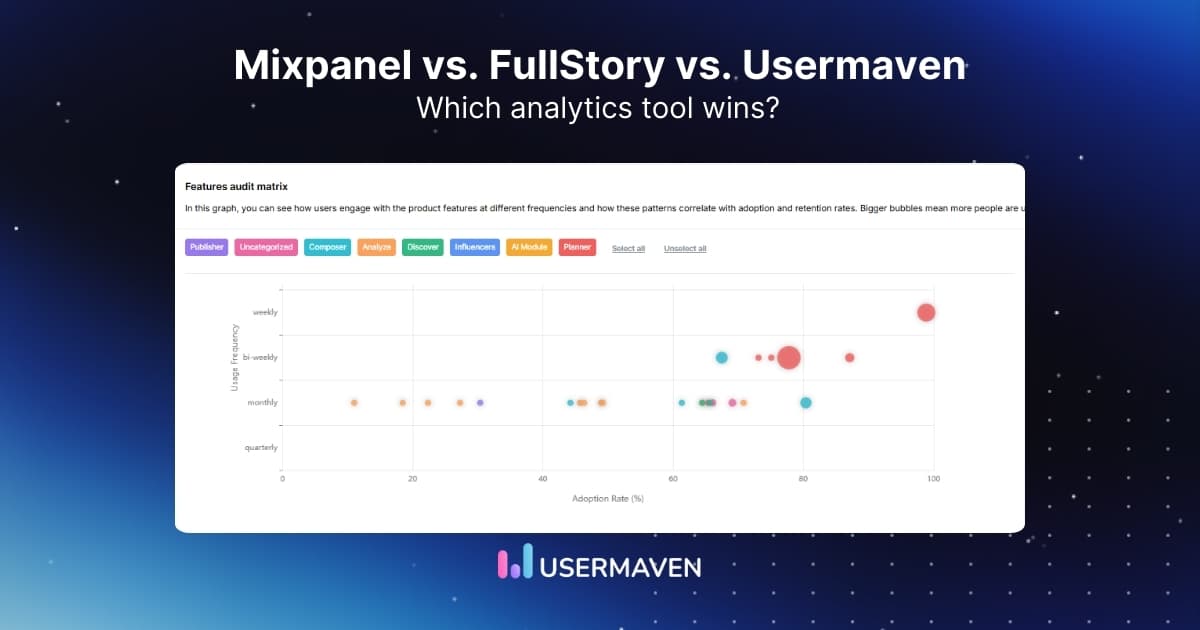
This Mixpanel vs. FullStory vs. Usermaven comparison covers implementation, attribution, product analytics, AI, and current pricing so teams can choose based on the decisions they need to make.
Mixpanel vs. FullStory vs. Usermaven at a glance
The best fit depends on whether your main question concerns product usage, digital friction, or marketing revenue. The platforms overlap, but their primary workflows are different.
| Decision factor | Mixpanel | FullStory | Usermaven |
| Primary focus | Product analytics, experimentation, retention | Session replay, friction diagnosis, digital experience | Marketing and revenue attribution with website and product analytics |
| Signature workflow | Segment events, build funnels and cohorts | Find friction, replay sessions, investigate causes | Trace channels and journeys through conversions and CRM revenue |
| Data collection | Autocapture plus custom events | Automatic behavioral capture and replay | Automatic event capture plus custom events |
| AI approach | Mixpanel Agent and MCP | StoryAI and StoryAI Agents; MCP | Maven AI, scheduled Agents, and MCP |
| Pricing entry | Free plan with 1M events/month | Free plan with 30K sessions/month | Business and Enterprise; discuss fit in a demo |
| Best suited to | Product and growth teams running experiments | UX, product, support, and engineering teams | B2B SaaS and marketing teams connecting acquisition to revenue |
What each platform does best
Mixpanel: product behavior and experimentation
Mixpanel analyzes user actions across web and mobile products. Funnels, cohorts, retention, user flows, experiment results, and feature flags make it useful for activation and product growth.
Its Mixpanel alternatives comparison is relevant when marketing-to-revenue measurement, rather than product instrumentation, becomes the main purchasing requirement.
FullStory: experience intelligence and replay
FullStory captures behavioral interactions and helps teams investigate usability friction through session replay, heatmaps, conversion analysis, funnels, and retention reporting.
It is not merely a replay viewer. Its product analytics and StoryAI capabilities support quantitative analysis alongside investigation of individual sessions.
Usermaven: attribution connected to outcomes
Usermaven combines website analytics, product usage, conversion paths, marketing attribution, and CRM context. Its main value is connecting acquisition to signups, opportunities, and revenue.
Teams can analyze journeys and funnels together, rather than interpret product analytics and paid campaign results in disconnected reports.
See Usermaven in action
Book a free demo and discover how powerful analytics can grow your business.
Implementation and event tracking
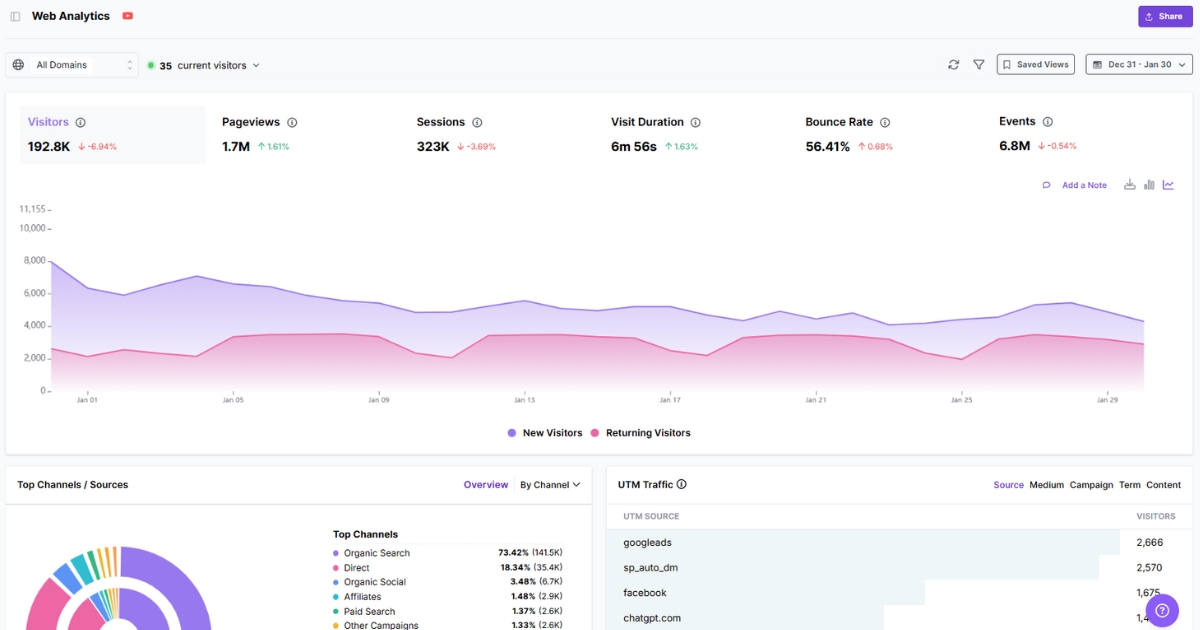
All three platforms collect behavioral data, but implementation work differs according to the level of detail required. No platform removes the need for consistent event definitions and validation.
Mixpanel supports autocapture and manually defined events. Autocapture speeds up collection; meaningful naming, identity handling, and business-specific events still need an instrumentation plan.
FullStory automatically captures many interactions for replay and retroactive analysis. Teams still configure privacy settings, important events, and integrations to answer more specialized questions.
Usermaven can start with a tracking script and auto-captured events. Custom events, conversion goals, and CRM connections add the business context required for downstream attribution.
Implementation differences by workflow
| Implementation question | Mixpanel | FullStory | Usermaven |
| Basic collection | Autocapture and SDK options | Automatic behavioral capture | Tracking script with automatic events |
| Custom business events | Configured as needed | Configured as needed | Configured as needed |
| Session replay | Included with plan limits | Core strength; free and paid options | Not the central product focus |
| Engineering involvement | Often useful for detailed schemas | May be needed for advanced integrations | May be needed for CRM and custom tracking |
| Ongoing quality work | Event governance and identity consistency | Privacy configuration and event validation | Goal definitions and attribution/CRM validation |
Marketing attribution and revenue reporting
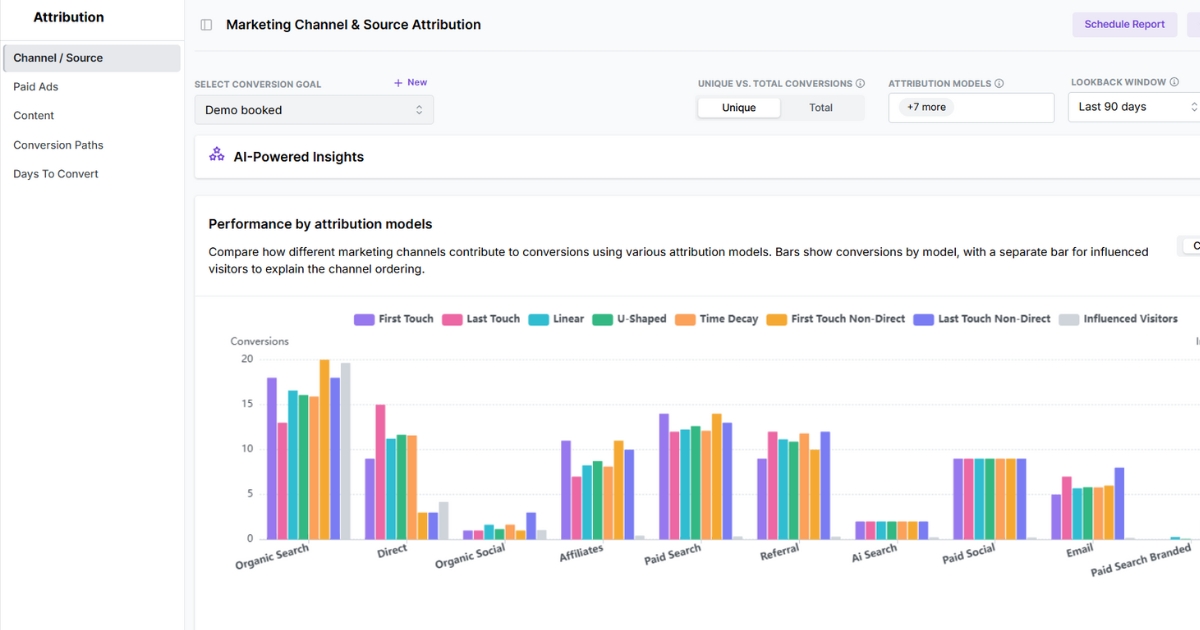
This category separates Usermaven most clearly. Mixpanel can report on campaigns and multi-touch attribution, while FullStory helps relate campaign visits to experience and conversion behavior.
Mixpanel supports campaign tracking and multi-touch attribution. It is therefore inaccurate to describe Mixpanel as having no attribution model or as analyzing only post-conversion activity.
FullStory can filter by acquisition properties, UTM data, and conversion paths. Its central strength remains explaining user friction, rather than serving as a dedicated paid-media-to-CRM revenue attribution platform.
Usermaven supports standard multi-touch attribution models, configurable windows up to 365 days, and spend-period reporting. It can connect marketing touchpoints to CRM opportunities and revenue.
Enterprise workspaces can also create custom attribution models with weighted touchpoints and channel multipliers. That flexibility matters when lead creation and opportunity stages should receive different credit.
What each tool can attribute
| Attribution requirement | Mixpanel | FullStory | Usermaven |
| Campaign/source analysis | Campaign reports and multi-touch attribution | UTM and referrer analysis tied to sessions | Source, channel, campaign, and content attribution |
| Conversion paths | Product and campaign conversion journeys | Session and conversion journeys | Cross-channel conversion path analysis |
| CRM opportunity/revenue link | Requires relevant integration and modeling | Requires integration and custom workflow | Designed to connect CRM deals and revenue |
| Paid-media spend analysis | Requires appropriate data setup | Not its primary workflow | Paid ads attribution and spend-period analysis |
| Custom attribution weights | Modeling depends on implementation | Not a headline capability | Available through Enterprise custom models |
For B2B teams, the key question is whether analytics can tie CRM attribution to the stages the sales team actually uses—not just the last page someone visited.
Product analytics, funnels, and experience insights
Mixpanel provides sophisticated event-based funnels, behavioral cohorts, retention analysis, feature management, and experimentation. It is a strong fit when product change is the center of decision-making.
FullStory also offers funnels, retention analysis, segments, metrics, and product analytics. Session replay and friction signals help explain why specific users failed to complete a journey.
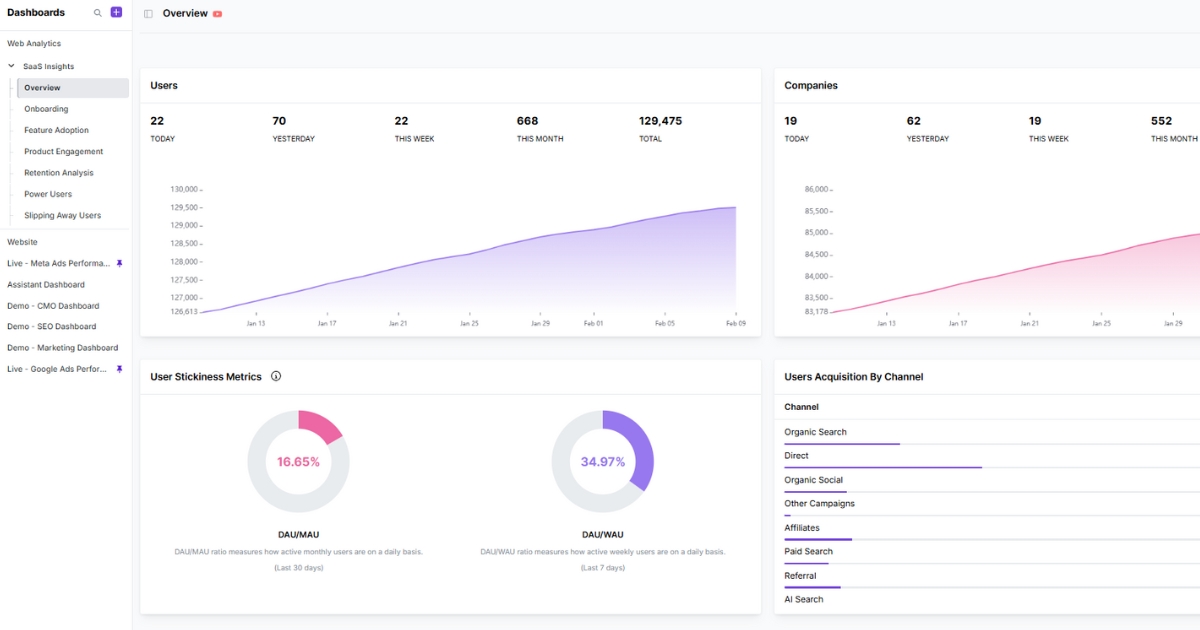
Usermaven combines funnel analysis, user journeys, segmentation, and retention views. Those reports also sit alongside campaign attribution and revenue data.
A useful comparison asks how quickly a team can answer a real question: Which onboarding step lost users? Why did checkout fail? Or which acquisition source delivered customers who retained?
Product analytics capability comparison
| Analytical job | Mixpanel | FullStory | Usermaven |
| Funnels and drop-off | Advanced event funnel analysis | Funnel analysis with replay context | Funnels with linked conversion journeys |
| Cohorts and retention | Core product analytics strength | Supported in product analytics | Segments, cohorts, and retention reporting |
| Session-level debugging | Session replay available | Core strength: replay and friction signals | Behavioral paths rather than full replay |
| Experiments and flags | Experiments and feature flags | Not the primary platform purpose | Not the primary platform purpose |
| Marketing outcome context | Campaign attribution features | Acquisition and experience analysis | Attribution combined with product and CRM context |
AI capabilities and ongoing analysis
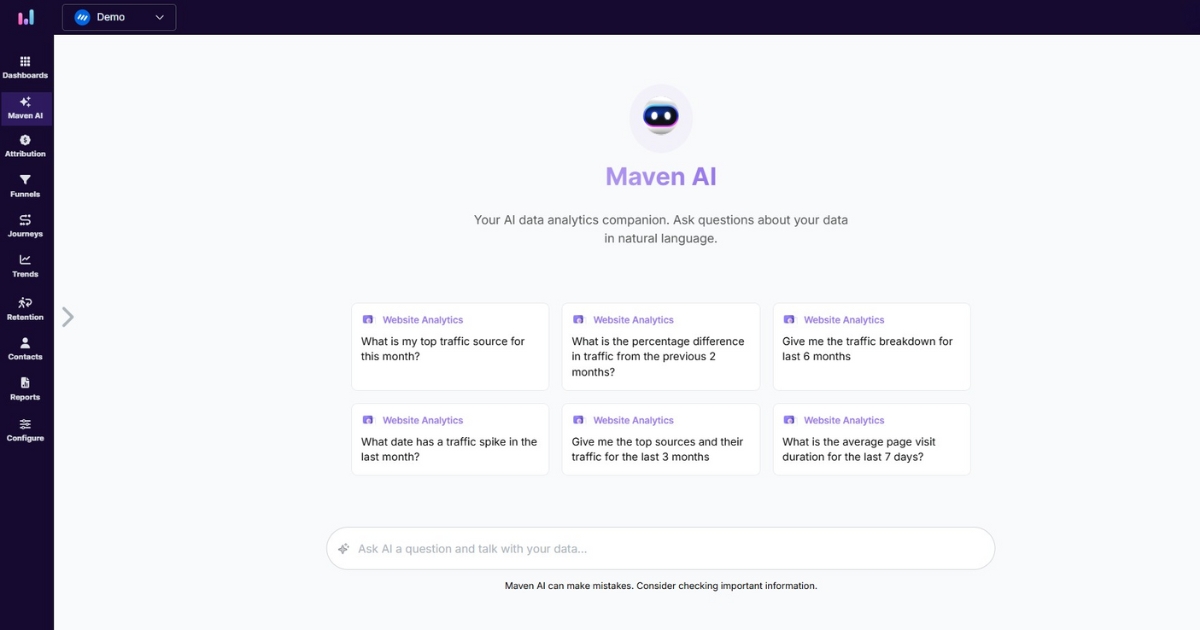
AI now matters across all three platforms. Treating Mixpanel or FullStory as having only basic AI would misrepresent their current products.
Mixpanel offers Mixpanel Agent and an MCP server for analysis workflows. Its reporting stack includes funnels, retention, campaign reporting, and multi-touch attribution.
FullStory offers StoryAI and StoryAI Agents, which can investigate friction, monitor releases, and surface behavioral findings. FullStory also publishes an MCP offering.
Maven AI answers data questions, builds charts and dashboards, and supports attribution and retention analysis. Scheduled Agents can monitor funnels, feature adoption, acquisition, and retention for changes.
Usermaven also supports MCP connections to external AI clients. Feature availability, permissions, and usage allowances should be checked for the selected plan during evaluation.
AI workflow comparison
| AI workflow | Mixpanel | FullStory | Usermaven |
| Conversational analytics | Mixpanel Agent | StoryAI analysis | Maven AI |
| Proactive investigation | Agent-based analysis workflows | StoryAI Agents monitor and investigate | Scheduled Maven AI Agents |
| External AI client integration | MCP server | FullStory MCP | Workspace MCP server |
| Strongest context | Product events and growth analysis | Experience friction and replay data | Attribution, user behavior, CRM and revenue |
| Access and limits | Depend on plan/entitlements | Depend on plan/entitlements | Depend on plan/entitlements |
Pricing: compare events, sessions, and plans
Pricing comparisons need matching usage assumptions. Mixpanel measures event volume, FullStory uses session-related allowances, and Usermaven evaluates new customers on Business or Enterprise requirements.
Mixpanel pricing lists a permanent Free plan with up to 1 million events per month. Growth starts at $0 with the first 1 million monthly events free, then usage-based charges; Enterprise uses custom terms.
FullStory plans include FullstoryFree with 30,000 monthly sessions and 12 months of retention. Paid Analytics tiers are Business, Advanced, and Enterprise, with pricing supplied during evaluation.
FullstoryFree includes session replay and core analytics. Advanced capabilities such as StoryAI and configurable dashboards require a paid plan, so a free-plan feature comparison alone is misleading.
Usermaven lists Business and Enterprise for new customers. The current new-customer documentation does not publish fixed rates; plan scope and requirements are discussed during a demo.
Current pricing and allowance overview
| Pricing factor | Mixpanel | FullStory | Usermaven |
| Free option | Free plan; 1M monthly events | FullstoryFree; 30K monthly sessions | No free plan specified for new customers in current plan docs |
| Paid plans | Growth; Enterprise | Business; Advanced; Enterprise | Business; Enterprise |
| Billing driver | Monthly analytics events; other product usage may apply | Session allowances and contracted capabilities | Business requirements and plan scope |
| Published numeric entry | Free and usage-based Growth calculator | Free plan; paid numerical rates not published | Fixed numeric prices not published for new customers |
| Budgeting check | Forecast event and replay usage | Estimate sessions and required StoryAI features | Confirm CRM, attribution, integration and usage scope |
A useful budget audit compares the number of monthly users, events per user, sessions, replay needs, data retention, support, and integrations before comparing any two quotes.
Which platform should your team choose?
A platform is a good fit when its core workflow matches the question your team needs to answer each week—not simply when it has the longest feature checklist.
- Choose Mixpanel when product experimentation, feature rollout, behavioral segmentation, and retention analysis are your primary jobs.
- Choose FullStory when session replay, visual debugging, conversion friction, and experience monitoring are the highest priorities.
- Consider Usermaven when marketing spend, website engagement, product behavior, and CRM revenue must be analyzed together.
- Validate the measurement chain by tracing one campaign from click to signup, activation, opportunity, and closed revenue before making a long-term commitment.
For B2B teams with long buying cycles, the B2B SaaS solution is a useful starting point for evaluating how campaign attribution connects to pipeline stages and customer journeys.
Customer evidence: onboarding insights in practice
In the PostNitro case study, the team used Usermaven behavior and funnel insights to improve activation. Around 70% of users who engaged with its interactive demo signed up.
That is a conversion rate among demo users, not a claimed 70% improvement over a previous baseline. It illustrates why linking engagement with measurable conversion outcomes matters.
Final verdict: choose for the decision you need
Mixpanel is compelling for product measurement and experimentation. FullStory is especially useful for understanding friction through behavioral replay. Usermaven fits teams that need marketing attribution tied to product journeys and revenue.
If connecting ad spend, CRM opportunities, and customer behavior is the priority, book a demo to see how Usermaven supports that measurement workflow.
FAQs about Mixpanel, FullStory, and Usermaven
1. Is Usermaven better than Mixpanel?
It depends on the goal. Mixpanel is strong in product analytics and experimentation. Usermaven is a better fit when teams need to connect marketing attribution, website and product behavior, CRM opportunities, and revenue.
2. How much does FullStory cost?
FullstoryFree includes up to 30,000 monthly sessions and 12 months of retention. Paid Analytics plans include Business, Advanced, and Enterprise, but FullStory does not publish fixed numerical prices for those tiers.
3. Which analytics tool is best for startups?
Mixpanel and FullStory provide free plans for initial evaluation. Usermaven is worth considering when attribution and revenue reporting are central to the business. Compare usage, setup requirements, and the reports you will use weekly.
4. Do these platforms require developers?
All three support relatively quick initial tracking. Developers or analytics specialists may still help with custom events, identity resolution, integrations, privacy controls, and data validation.
5. Can I evaluate Mixpanel and FullStory for free?
Yes. Mixpanel offers a permanent Free plan with up to 1 million monthly events. FullstoryFree offers up to 30,000 monthly sessions. Usermaven currently documents demo-led Business and Enterprise plans for new customers.
6. Which platform is strongest for marketing attribution?
Mixpanel supports campaign reporting and multi-touch attribution. FullStory provides source and experience context. Usermaven focuses on connecting marketing touchpoints and spend with conversions, CRM pipeline, and revenue.
7. Does FullStory offer funnel and retention analysis?
Updated

Written by
Ryan Mitchell
Marketing Analytics Strategist
Ryan Mitchell is a marketing analytics strategist specializing in campaign measurement, customer journeys, and marketing performance. He writes about analytics, reporting, and data-driven marketing strategies, helping SaaS and B2B teams measure what matters across every stage of the customer journey.
All articles by Ryan →