Pendo can show which features customers adopt. FullStory can show exactly where they struggle. But neither question necessarily explains which campaigns brought valuable customers in the first place. Teams connecting acquisition to pipeline need revenue attribution software alongside product insights.
That difference matters when comparing Pendo vs. FullStory vs. Usermaven. All three can analyze behavior, but their main jobs are not interchangeable: product adoption, digital experience diagnosis, and marketing attribution.
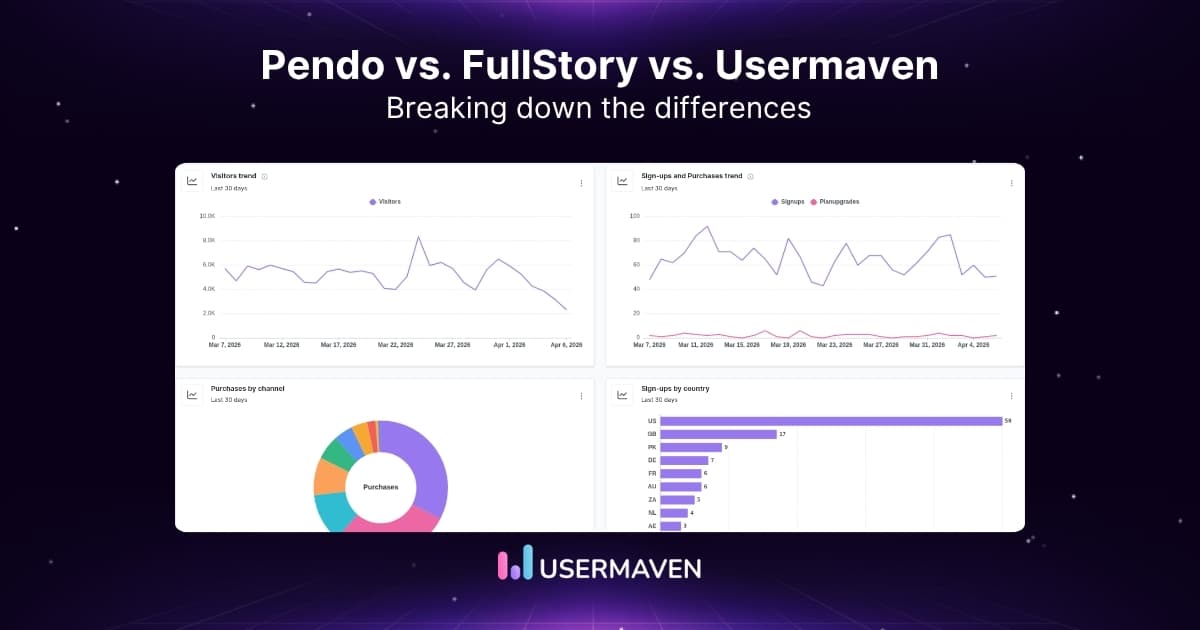
This guide compares tracking, funnels, AI, pricing, and the decisions each platform can support, including features that depend on paid plans or configuration.
Pendo vs. FullStory vs. Usermaven at a glance
Pendo brings together product analytics, in-app guides, feature adoption, feedback, and AI-powered product monitoring. It fits teams trying to improve onboarding and ongoing product engagement.
FullStory specializes in digital experience intelligence. Its session replay, friction signals, heatmaps, funnel analysis, and StoryAI help teams investigate what users actually experienced and why a flow failed.
Usermaven connects acquisition with website and product activity, conversion goals, customer journeys, and CRM-linked outcomes. It is most relevant when marketing, growth, and revenue teams need to understand which touchpoints contributed to leads, pipeline, and revenue.
See Usermaven in action
Book a free demo and discover how powerful analytics can grow your business.
| Decision factor | Pendo | FullStory | Usermaven |
| Primary job | Improve product adoption and in-app guidance | Diagnose digital behavior and user friction | Connect marketing touchpoints to conversions and revenue |
| Core strengths | Product analytics, guides, feedback, sentiment | Session replay, heatmaps, friction signals, funnels | Multi-touch attribution, web and product analytics, CRM journeys |
| Automated collection | Page, feature, and usage capture; tagging | Session and interaction capture | Autocaptured website/product events |
| Funnels and journeys | Product behavior and adoption flows | Behavioral funnels with replay context | Acquisition, behavior and conversion journeys |
| AI | Leo, Signals, product and agent insights | StoryAI and specialist agents (plan/access dependent) | Maven AI and scheduled analysis agents |
| Primary limitation for revenue reporting | Not designed around cross-channel revenue credit | Not designed as a marketing revenue attribution system | Not a session replay or in-app guide replacement |
| Pricing access | Free up to 500 MAUs; paid plans quoted | Free up to 30K monthly sessions; paid plans quoted | Business and Enterprise plans quoted for new customers |
Implementation, tracking, and privacy
What setup actually requires
Pendo collects product usage after its SDK is installed. Its Pages, Features, and Track Events support retroactive analysis, and AI tagging can help define the tracked product experience. Guides, segmentation, governance, and multi-app deployment still need thoughtful configuration.
FullStory begins capturing sessions once deployed. Replay and friction signals can surface problems early, but careful configuration is needed for privacy masking, user identity, event taxonomy, and the integration of behavioral signals into other tools.
Usermaven offers automatic event tracking alongside custom and pinned events. Basic website measurement can be quick to start; trustworthy revenue reporting still requires consistent campaign tags, well-defined conversion goals, identity resolution, and CRM connections. “No-code” should not be confused with “no measurement design.”
Privacy controls are configuration decisions
All three offer privacy and data-control features, but implementation matters more than a blanket compliance claim. Pendo and FullStory require appropriate capture rules, masking, consent decisions, and access controls for the data being collected.
Usermaven supports a cookieless option and ad-blocker-resistant collection. Its Measurement Trust Center helps teams review tracking reliability. No analytics product can guarantee a fixed accuracy percentage or automatically establish GDPR/CCPA compliance for every deployment.
Web analytics, product analytics, and replay

For product teams, Pendo is a strong choice when the work is centered on adoption. Usage analytics, segments, guides, surveys, and product feedback let teams identify features users miss and act inside the product. That guided intervention is a genuine advantage over a pure reporting tool.
FullStory provides deep experience evidence, including replay, frustration signals such as rage clicks, and heatmaps. It can support product analytics too, but its standout workflow is reproducing and diagnosing what happened during a session.
Usermaven unifies website analytics and product analytics with source and conversion reporting. Teams can evaluate the behavior of visitors from a campaign after they reach a site or product, rather than treating engagement and acquisition as separate datasets.
Events and automatic capture

Automatic capture is not exclusive to one vendor. Pendo collects usage events that teams can tag into pages and features. FullStory records interaction streams used in replay and behavioral analysis. Usermaven autocaptures common website and product actions, while also supporting explicitly defined business events.
The selection criterion is the event you must trust. A click can be autocaptured, but events such as qualified lead, product activation, opportunity created, and closed-won revenue often require definitions and integrations beyond basic capture.
Behavior and customer journeys

Pendo answers which users adopted a feature and which onboarding paths need help. FullStory answers what a user saw and did when a form, checkout, or workflow became frustrating. Both can analyze paths and funnels, but the investigative workflow is different.
Usermaven’s customer journeys connect web and product interactions to acquisition sources, identified contacts, accounts, and conversion outcomes where the necessary identity and CRM data exist. That is valuable for longer SaaS and B2B buying cycles, but it does not replace session replay or in-app walkthroughs.
Attribution: the clearest product divide

A marketing attribution question starts before the product session: Which channel introduced the prospect, which interactions influenced progress, and what revenue followed? Pendo and FullStory can show acquisition-related context, conversion behavior, and integrations. Neither is positioned primarily as a multi-touch marketing revenue attribution platform.
Usermaven supports attribution models across paid ads, channels, content, and customer paths. CRM connections, including Salesforce and HubSpot, can extend the view from a lead or signup to opportunity stages and revenue, provided the required records and touchpoints are connected.
The September 2026 release added Enterprise-only custom attribution models to allocate weights across funnel milestones and channels. The same revenue should not be summed across alternative model reports: models redistribute credit for the same conversions rather than creating more sales.
| Measurement question | Pendo | FullStory | Usermaven |
| Which feature led to adoption? | Strong | Supports behavioral analysis | Supported through product analytics |
| Why did users abandon a form? | Product analytics and replay options | Strong replay and friction diagnosis | Funnel and event-level diagnosis |
| Which ad campaigns influenced a CRM opportunity? | Requires other attribution/reporting layers | Requires other attribution/reporting layers | Core use case with tracking and CRM integration |
| Which touchpoints receive multi-touch revenue credit? | Not core | Not core | Multiple models; custom models on Enterprise |
| Can these reports prove a channel caused revenue? | No | No | No. Attribution is credit assignment, not an incrementality experiment |
Funnels, retention, and operational follow-up

Pendo funnels can help product teams find activation bottlenecks and deploy in-app guides to improve the next step. FullStory funnels can locate drop-offs and lead directly into the affected sessions, helping teams inspect the underlying friction.
Usermaven’s funnels show conversion progression across website and product events, with acquisition and segment context available when configured. The advantage is comparing the conversion performance of different sources, rather than only whether a step succeeded inside one flow.

Retention is also supported across these tools but answers different questions. Pendo is useful for ongoing product adoption and account engagement. FullStory contextualizes repeat behavior and problems that may precede churn. Usermaven combines retention analysis and cohort reporting with marketing and customer journey data.
For example, a growth team might compare retained customers from paid search with those from organic content. A product team, by contrast, may need Pendo to act on weak onboarding, or FullStory to inspect the sessions of users who failed to activate.
AI capabilities and integrations

Pendo Leo provides natural-language answers and proactive Signals for product health, engagement, and adoption. Pendo also has AI-agent analytics for measuring usage of conversational agents embedded in products. Access to specialized offerings can depend on the plan or add-on.
FullStory StoryAI supports replay summaries, behavioral questions, and specialist agents for investigating issues and conversion opportunities. Some premium features require upgraded access; StoryAI Agents were announced in early access during 2026.
Maven AI supports conversational analytics and scheduled AI Agents that monitor changes in adoption, retention, and user journeys. September 2026 updates also introduced multimodal chat and improvements to MCP connections and real-time contact profiles.
For stack fit, the question is less “Which tool has integrations?” than “What data must flow where?” Usermaven connects to ad platforms and CRMs for revenue measurement, Pendo integrates with product and customer-experience workflows, and FullStory integrates behavioral evidence into experience and support processes.
Plans and pricing: what is actually included
Pricing cannot be fairly compared using an old starting-price screenshot or a single competitor quote. Pendo primarily prices by monthly active users, FullStory uses session-oriented allowances, and Usermaven quotes new customers based on their measurement needs.
Usermaven’s latest pricing page and billing documentation list Business and Enterprise with custom quotations for new customers. Older Growth/Scale figures such as $84/month should not be used as a universal new-customer entry price.
Pendo Free supports up to 500 monthly active users; paid Base, Core, and Ultimate plans use custom quotes. The cost depends on usage and subscribed modules. Pendo also offers a time-limited trial of the broader paid platform.
FullStory Free includes 30,000 sessions per month, up to 10 seats, and 12 months of replay and product analytics retention. Paid Business, Advanced, and Enterprise options are quoted; advanced dashboards and StoryAI are not included in the free tier.
| Pricing factor | Pendo | FullStory | Usermaven |
| Free entry | Pendo Free: 500 MAUs | FullstoryFree: 30K sessions/month | Discuss new-customer plan with sales |
| Paid plans | Base, Core, Ultimate: custom quotes | Business, Advanced, Enterprise: custom quotes | Business, Enterprise: custom quotes |
| Usage measure | Monthly active users; plan/module scope | Captured session volume and plan | Quote based on requirements and event volume |
| AI plan caveat | Leo included; specialized AI offerings may be separate | StoryAI advanced access is plan-dependent | Confirm AI, agents, attribution access in quote |
| Critical buying check | MAU growth and guide/module needs | Sessions, retention, masking, StoryAI access | CRM integrations, events, attribution, security needs |
Pricing evaluation tip: Compare total cost at the same projected traffic or user volume, and ask vendors about implementation support, retention, AI entitlements, additional modules, and export requirements before selecting a plan.
Which platform is the right choice?
| If the main goal is… | Prioritize | What to validate before buying |
| Improve onboarding and feature adoption | Pendo | Guide targeting, feedback tools, MAU allowance, and modules |
| Find why real sessions break or convert poorly | FullStory | Replay masking, session limits, funnels, and StoryAI access |
| Tie acquisition channels to leads and revenue | Usermaven | UTM taxonomy, conversion goals, CRM matching, and attribution depth |
| Both product guidance and deep replay | Pendo / FullStory stack assessment | Whether one tool covers the needed workflow or a combination is justified |
| Both UX friction and marketing ROI | FullStory / Usermaven stack assessment | Whether shared identifiers and integrations support analysis across systems |
Before comparing proposals, ask each vendor to demonstrate one real workflow: identify a failing conversion step, identify its affected users, and explain whether it can be related to a marketing source and a revenue outcome. The gap between those answers usually reveals the better fit faster than a feature checklist.
Final verdict
Choose Pendo when the objective is to increase adoption with in-app guidance and product usage intelligence. Choose FullStory when your main problem is unexplained user frustration and your team needs replay-backed evidence.
Choose Usermaven when the unanswered question is which campaigns, channels, and customer interactions lead to business outcomes. Its advantage is B2B SaaS marketing and product measurement with revenue attribution, rather than replacing every specialized experience tool.
To evaluate how marketing activity connects to customer journeys, CRM opportunities, and revenue, book a demo with Usermaven.
FAQs
1. Is Pendo, FullStory, or Usermaven best for startups?
The best fit depends on the task. Pendo Free supports up to 500 monthly active users for product-adoption use cases; FullstoryFree offers 30,000 monthly sessions for experience diagnosis; Usermaven is better suited to teams that need marketing attribution linked to conversions and revenue, with new-customer pricing quoted by sales.
2. Can these platforms integrate with a marketing or product stack?
Yes. Pendo integrates with product and customer-success workflows, FullStory with digital experience and support tools, and Usermaven with CRM and advertising platforms. Confirm the specific integration and supported data flow rather than assuming every connection supports revenue attribution.
3. How do pricing models differ?
Pendo generally bases pricing on monthly active users and plan modules. FullStory includes a session-based free plan and quotes paid options. Usermaven offers custom-quoted Business and Enterprise plans for new customers. Compare projected usage and included features before comparing total cost.
4. Which is easiest to implement?
It depends on the intended workflow. Pendo and FullStory can collect data after their SDKs are installed, while Usermaven autocaptures key site and product events. Advanced guides, replay privacy, identity matching, and reliable CRM revenue attribution each require further configuration.
5. Does FullStory replace a marketing attribution platform?
Not usually. FullStory excels at session replay, frustration diagnosis, and behavioral funnels. It is not primarily a cross-channel, CRM-linked multi-touch revenue attribution platform.
6. What AI features do Pendo, FullStory, and Usermaven provide?
Updated

Written by
Ryan Mitchell
Marketing Analytics Strategist
Ryan Mitchell is a marketing analytics strategist specializing in campaign measurement, customer journeys, and marketing performance. He writes about analytics, reporting, and data-driven marketing strategies, helping SaaS and B2B teams measure what matters across every stage of the customer journey.
All articles by Ryan →