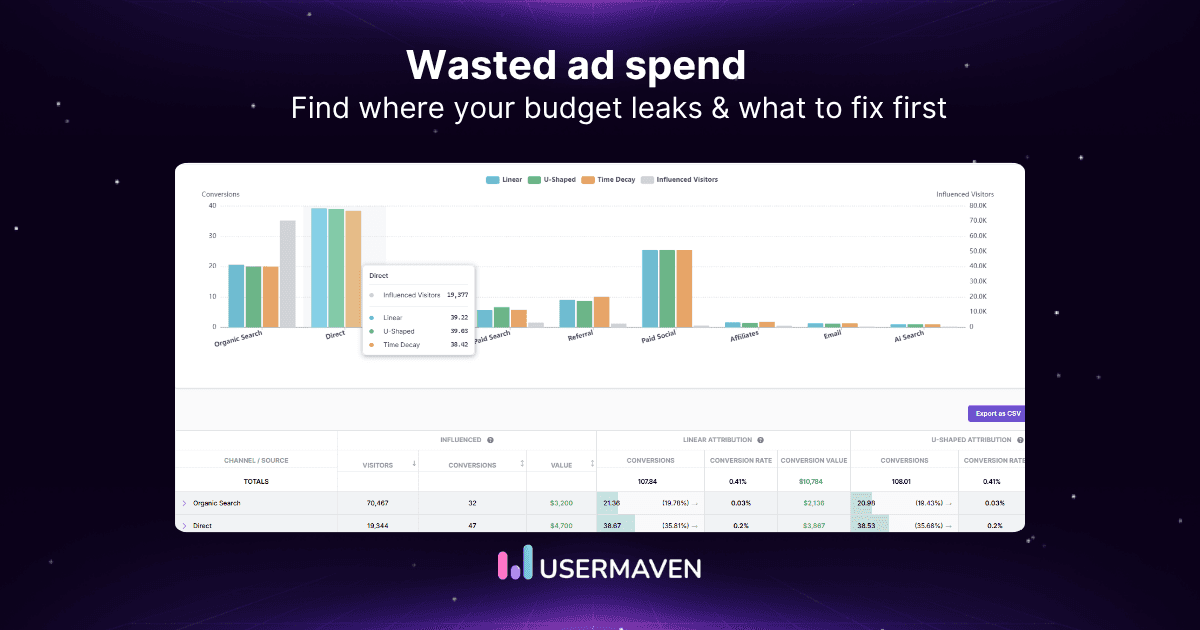
One ecommerce order can be claimed by Meta, Google, and other channels at the same time. That can make reported ROAS look stronger than the revenue the store actually generated.
An ad tracking solution for ecommerce creates a more consistent view by connecting campaign signals with verified store activity, purchases, and revenue.
It extends ad tracking beyond clicks by preserving acquisition data, customer behavior, checkout activity, and purchase outcomes across the journey.
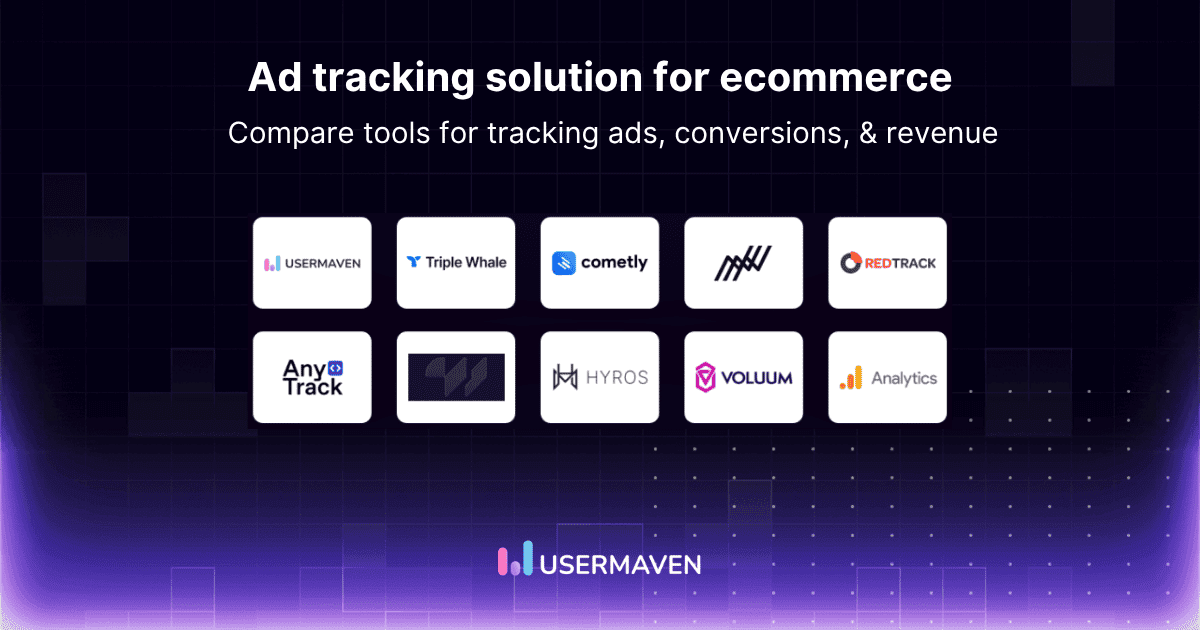
Below, we compare 10 ecommerce ad tracking tools by store fit, tracking approach, attribution, conversion sync, reporting, and price. We also explain what to track and how to choose the right solution.
Key takeaways
Start with the decision: Choose a tool based on whether you need reliable platform feedback, independent attribution, profit reporting, or all three.
Use store revenue as the control: Orders, refunds, customer status, and margin data should validate the conversion claims made by ad platforms.
Prioritize first-party signals: Use clean first party data such as campaign parameters, click IDs, product events, purchases, and customer identifiers instead of depending on browser pixels alone.
Track efficiency and quality: CPC and ROAS matter, but new-customer CAC, contribution margin, refunds, repeat purchases, and LTV prevent shallow optimization.
Expect different answers: An attribution window and attribution model can change credit allocation, so reconciliation is more useful than forcing every dashboard to match.
Best overall fit: Usermaven offers a balanced option for stores that want attribution, behavioral context, conversion sync, AI analysis, and transparent pricing in one system.
Ecommerce ad tracking comparison
The table below is a directional shortlist. Pricing reflects public information available and can change with revenue, events, sessions, orders, pageviews, ad spend, or contract scope.
| Tool | Best for | Store fit | Tracking & attribution | Public pricing |
| Usermaven | Best overall | Shopify, WooCommerce, custom | First-party + server-side; multi-touch | $199/mo for attribution |
| Triple Whale | Shopify DTC | Shopify-centric | Triple Pixel; MTA on Foundation | Free; Foundation $219/mo |
| Cometly | Full-funnel teams | Validate ecommerce fit | Pixel + server-side; MTA | Quote-based |
| Northbeam | Scaling DTC | Shopify; broader on Pro | First-party MTA + view-through | Starter from $1,500/mo |
| RedTrack | Performance ecommerce | Shopify, Woo, BigCommerce, custom | Server-side CAPI + attribution | Brand from $99/mo |
| AnyTrack | Conversion routing | 100+ integrations | Server-side + identity resolution | Free; Starter $100/mo |
| wetracked.io | Simple store-to-ad feedback | Shopify, WooCommerce, checkouts | First-party enrichment + forwarding | From $49/mo |
| Hyros | High-ticket ecommerce | Broad integrations; custom setup | AI-assisted tracking + ad feedback | From $69/mo; scales |
| Voluum | Media buyers | Custom/direct-response setups | S2S postbacks + automation | From $119/mo |
| Google Analytics 4 | Free measurement baseline | Shopify, Woo, custom via tagging | Event-based attribution and reports | Free standard property |
A shortlist is useful only if the category is clear. The next section separates ad tracking from attribution and general ecommerce analytics.
Best ad tracking tools for ecommerce
The rankings favor ecommerce decision quality over feature volume. A specialist can lead for conversion routing or Shopify reporting, while a broader platform can win when it reduces the number of systems a team must reconcile.
For a wider category view beyond paid media, see the guide to ecommerce tracking tools. The profiles below stay focused on ad signals, orders, revenue, attribution, and conversion feedback.
1. Usermaven: Best overall

Overview: Usermaven connects paid-ad attribution with website behavior, product events, customer journeys, funnels, retention, and revenue. Ecommerce teams can follow the path from campaign click to store activity, purchase, and downstream customer value.
Best for: Ecommerce teams that want independent attribution, behavioral context, reporting, and conversion feedback in one system without an enterprise starting price.
Pricing: Growth starts at $84 per month for 250,000 monthly events. Scale starts at $199 per month and adds paid-ad attribution, conversion paths, ad-platform tracking, conversion sync, Maven AI, and longer data history.
Enterprise is custom, and a 14-day trial is available on the public pricing page.
Key attribution and ad-tracking capabilities:
Google Ads, Meta Ads, and LinkedIn Ads tracking with conversion sync to supported platforms.
First-party and server-side collection with configurable Events, campaign context, and customer profiles.
Multi-touch paths, customer journey analytics software, funnel analytics software, retention, and ecommerce analytics dashboards.
Maven AI, Usermaven MCP, and the Measurement Trust Center for analysis and data-quality checks.
Teams can also use product analytics software to inspect post-click product behavior and customer segmentation software to compare new, repeat, and high-value shoppers.
Ecommerce fit and integrations: Shopify integration, WooCommerce reporting, scripts, APIs, and broader integrations support common store and custom-site setups. Teams that rely heavily on TikTok should verify the exact ingestion and conversion-feedback workflow they need.
Verdict: The strongest all-round option here for teams that want attribution and behavioral context together. It is especially useful when marketers need to investigate why a channel converts, not only which channel received credit.
2. Triple Whale: Best for Shopify DTC

Overview: Triple Whale is built around ecommerce operating data, attribution, and AI workflows for consumer brands. Its strongest fit is Shopify-led DTC, where teams want store, advertising, creative, customer, and merchandising context in one environment.
Best for: Shopify brands that want ecommerce-native dashboards, multi-touch attribution, first-party activation, and a product designed around DTC workflows.
Pricing: A Free plan is available. Foundation starts at $219 per month, Automate at $749 per month, and Enterprise is custom; rates scale with annual GMV and package. For a deeper breakdown, review the current triple whale pricing structure before comparing quotes.
Key attribution and ad-tracking capabilities:
Triple Pixel with first- and last-click reporting on the free tier and multi-touch attribution on Foundation.
Blended performance, post-purchase survey data, custom dashboards, segments, and SQL access.
First-party signal activation and AI-assisted analysis through Moby, including Slack workflows on paid plans.
Enterprise measurement can add incrementality and marketing mix modeling for larger brands.
Ecommerce fit and integrations: The ecommerce context is excellent for Shopify-centric organizations. Brands with WooCommerce, multiple custom storefronts, or nonstandard order systems should confirm coverage and data-model requirements before treating it as the default choice.
Verdict: A leading option for Shopify DTC teams that want an ecommerce command center. The tradeoff is specialization: stores outside its strongest ecosystem may get more flexibility from a platform designed for wider website and event data.
3. Cometly: Best for full-funnel teams

Overview: Cometly offers pixel and server-side tracking, multi-touch attribution, account journeys, customizable dashboards, Conversion API connections, and an AI agent. It can unify spend and conversion data across a large integration catalog.
Best for: Teams that sell online but also route leads, accounts, pipeline, or subscription revenue through CRM and warehouse systems.
Pricing: Core and Enterprise are quote-based and sized around monthly pageviews. Annual billing saves 20%, and the company does not advertise a self-serve free trial. The implications of its sales-led model are covered in this Cometly pricing analysis.
Key attribution and ad-tracking capabilities:
Pixel, server-side events, multi-touch attribution, account journeys, dashboards, and analytics.
Unlimited connections to major ad platforms on both plans, with server-side Conversion API support.
AI Ads Manager and audiences on Core; warehouse sync, API, MCP, and dedicated support on Enterprise.
Pageview-based usage model with monthly or annual contracts and professional onboarding.
Ecommerce fit and integrations: This is the key caveat: Cometly’s current public positioning is B2B SaaS, not pure DTC ecommerce. Stores should verify checkout, catalog, refund, and customer-status integrations rather than assuming older ecommerce comparisons still describe the present product.
Verdict: A capable full-funnel platform, but no longer the clearest default for a straightforward online store. If you are comparing similar platforms, review these Cometly alternatives as well.
4. Northbeam: Best for scaling DTC

Overview: Northbeam provides independent first-party multi-touch attribution, omnichannel dashboards, view-through measurement, media strategy support, conversion enrichment, and optional incrementality or marketing mix modeling.
Best for: Seven-figure and larger DTC brands with meaningful multi-channel spend, frequent budget decisions, and enough scale to benefit from advanced modeling and support.
Pricing: Starter is shown at $1,500 per month for brands spending under $1.5 million per year on ads. Professional is $3,500 per month, while Growth and Enterprise require quotes. Actual pricing also depends on data volume and commercial scope.
Key attribution and ad-tracking capabilities:
First-party multi-touch attribution across channels with configurable omnichannel dashboards.
Clicks plus deterministic views for selected view-through measurement and near-real-time decision support.
Northbeam Apex for enriching conversion signals sent to ad delivery systems.
Optional incrementality, MMM, granular exports, and dedicated strategy support at higher tiers.
Ecommerce fit and integrations: Starter is aimed at early-growth Shopify brands. Professional adds integration with any ecommerce platform, while Enterprise supports direct custom builds and more granular journey data.
Verdict: One of the strongest choices for scaling DTC brands that can justify the cost and operational maturity. It is excessive for smaller stores that mainly need accurate conversion tracking and a clear cross-channel dashboard.
5. Redtrack: Best for performance ecommerce

Overview: RedTrack combines server-side conversion APIs, revenue and spend synchronization, attribution reports, customer journeys, ad management options, and automation for ecommerce brands and performance teams.
Best for: Stores and agencies running paid traffic across several networks that need strong conversion feedback, multi-store support, and media-buyer controls.
Pricing: The ecommerce Brand plan is listed from $99 per month and scales with annual tracked revenue. It includes three stores and unlimited users. Agency starts at $599 per month, while optional faster spend sync, Ads Manager, and automation add to the total.
Key attribution and ad-tracking capabilities:
Conversion API support for Meta, TikTok, Google, Snapchat, and other platforms.
Real-time revenue sync, ad-level spend sync, customer journey, product, conversion path, and attribution reports.
MCP, AI dashboards, read-only Ads Manager, and optional rules or faster data refresh.
A free Relay option provides CAPI for selected platforms but excludes attribution dashboards and spend sync.
Ecommerce fit and integrations: Native coverage includes Shopify, WooCommerce, BigCommerce, Adobe Commerce, and custom setups. That breadth is useful for teams that do not want a Shopify-only measurement product.
Verdict: A practical choice when conversion delivery and media operations matter as much as reporting. Buyers should price the full desired bundle, because refresh-speed and campaign-management add-ons can materially increase monthly cost.
6. Anytrack: Best for conversion routing

Overview: AnyTrack focuses on collecting conversion signals, resolving journeys, mapping events, and routing real-time conversions to advertising platforms. Its integration range covers ecommerce platforms, checkout providers, affiliate networks, CRMs, and funnel builders.
Best for: Marketers that need a flexible bridge between a store or checkout system and multiple ad platforms without buying a full enterprise analytics suite.
Pricing: The Free plan supports 5,000 sessions, one site, one ad platform, and one conversion source. Starter is $100 per month, Personal $150, and Advance $300. Paid plans include a 14-day trial and scale by sessions, websites, and integration depth.
Key attribution and ad-tracking capabilities:
Server-side, cookieless, and redirectless tracking with event mapping and identity resolution.
Customer journey logs, UTM templates, first- and last-ad-click models, and campaign ROAS reports.
Real-time Conversion API, audience sync, automatic deduplication, and enhanced conversions on Starter.
Cross-domain tracking, webhooks, GA4, multiple pixels, and custom integrations on higher tiers.
Ecommerce fit and integrations: The 100-plus integration catalog makes it adaptable to many stores and checkout tools. Teams that need deep product, retention, or profit analytics may still need a separate analytics layer.
Verdict: A strong signal-routing option with an accessible free plan. It is best when the core problem is getting reliable conversion data into ad platforms, rather than running the entire ecommerce analytics operation in one product.
7.Wetracked.io: Best for simple ad feedback

Overview: Wetracked.io is designed to connect store purchases with advertising platforms through first-party tracking, data enrichment, and real-time forwarding. Its setup and pricing are geared toward merchants that want a faster route to improved platform reporting.
Best for: Small and midsize Shopify or WooCommerce stores that prioritize ad-platform conversion feedback and straightforward order-based pricing.
Pricing: Starter costs $49 per month for up to 500 orders and three stores. Business is $149 for 3,000 orders, Scale-up $249 for 7,500 orders, and Enterprise is custom. Annual billing is advertised at 20% less, with a 14-day trial.
Key attribution and ad-tracking capabilities:
First-party tracking and data enrichment with real-time forwarding to connected ad channels.
Unlimited pixels per store, ad spend, and revenue within the order limits of each plan.
Pulse dashboard and 24/7 live chat support across published plans.
Multiple-pixel support for teams that need to send the same validated data to more than one account.
Ecommerce fit and integrations: Published store support includes Shopify, WooCommerce, Funnelish, CheckoutChamp, and several checkout products, plus custom integrations. Ad channels include Meta, Google Ads, TikTok, Pinterest, Snapchat, and X.
Verdict: A focused and relatively affordable choice for improving store-to-ad feedback. It is less suitable when the evaluation requires advanced multi-touch attribution, deep journey analysis, or independent incrementality measurement.
8.Hyros: Best for high-ticket ecommerce

Overview: Hyros positions its tracking data as an input to ad-platform optimization and includes setup support, an AI analyst, integrations, and an MCP interface. Its ecommerce use case emphasizes orders, repeat buyers, and profitable scale.
Best for: High-ticket, direct-response, education, and ecommerce funnels where a small number of recovered or better-attributed conversions can materially affect bidding decisions.
Pricing: Pricing now starts at $69 per month for up to $5,000 in tracked monthly revenue and scales with tracked revenue. The product uses one feature-complete plan with a custom setup. Check the current Hyros pricing tiers against your revenue before budgeting.
Key attribution and ad-tracking capabilities:
Full tracking and ad-data feedback with setup performed around the customer’s stack.
AI analyst support, weekly training, and an LLM or Claude MCP interface.
Broad integration positioning across ecommerce, SaaS, calls, and information-product use cases.
A performance guarantee is advertised, but buyers should review eligibility and contract terms directly.
Ecommerce fit and integrations: The product can fit complex funnels where orders happen across several pages, domains, or sales motions. A conventional low-AOV store should compare the operational value against simpler ecommerce-native tools.
Verdict: A specialized choice for businesses where attribution recovery has high economic leverage. The sales and setup motion is heavier than a plug-and-play tracker, even though the published entry price is now much lower than older comparisons suggest.
9. Voluum: Best for ecommerce media buyers

Overview: Voluum is a campaign tracker and optimization platform built for media buyers, affiliates, and direct-response operations. It tracks traffic and conversions, routes visitors, synchronizes cost, automates rules, and detects suspicious traffic.
Best for: Technical ecommerce acquisition teams that buy traffic across many sources, manage landing pages or offers, and need campaign routing or automation beyond standard store analytics.
Pricing: Voluum’s current official materials state that pricing starts at $119 per month and scales to business and enterprise plans. Limits and features vary by active campaigns, events, data retention, workspaces, automation, API access, and support.
Key attribution and ad-tracking capabilities:
Server-to-server postbacks, API connections, first-party cookie options, and cookieless tracking on applicable plans.
Cost synchronization, auto-rules, traffic distribution, AI optimization, and detailed campaign reporting.
Anti-fraud tools, custom domains, workspaces, shared reports, and integrations with major ad sources.
An MCP option is available for querying and operating on campaign data through compatible AI clients.
Ecommerce fit and integrations: Voluum is not an ecommerce operating dashboard. It fits stores that run affiliate-style or direct-response traffic architecture and can integrate purchase postbacks, order values, and refunds into a more technical campaign model.
Verdict: Powerful for media buying and traffic operations, but usually too specialized for a typical merchant. Choose it when routing, automation, and campaign infrastructure are central to the job.
10. Google Analytics 4: Best free baseline

Overview: Google Analytics 4 provides event-based web and app measurement, ecommerce events, user and traffic acquisition reports, explorations, audiences, and attribution features. Standard properties are free, with GA4 360 available for higher limits and service commitments.
Best for: Stores that need a free measurement baseline, already use Google Ads, or have analytics resources capable of implementing and governing a detailed event model.
Pricing: Standard GA4 properties are free. GA4 360 is contract-based, and BigQuery storage, queries, implementation, consent tooling, tag management, and data engineering can create additional costs even when the analytics property itself is free.
Key attribution and ad-tracking capabilities:
Recommended ecommerce events for product views, carts, checkout, purchases, promotions, and refunds.
Traffic and user acquisition, advertising workspaces, attribution settings, explorations, and audiences.
Google Ads integration, first-party data features, consent-aware measurement, and BigQuery export.
Flexible custom events and parameters for stores with implementation resources.
Ecommerce fit and integrations: GA4 can be installed on Shopify, WooCommerce, and custom stores, but reliable ecommerce reporting depends on implementation quality.
Verdict: A valuable free baseline, not the best standalone ecommerce ad tracker. Teams should expect data discrepancy investigations and can compare usermaven vs google analytics ga4 when they need a broader measurement setup.
The reviews narrow the field, but the right selection still depends on store platform, spend level, team maturity, and whether the main need is measurement or activation.
What is an ecommerce ad tracking solution?
An ecommerce ad-tracking solution captures the signals that connect paid media exposure or clicks to store behavior, purchases, revenue, and customer value. It then turns those signals into reports or conversion feedback that marketers can act on.
Ad tracking
Ad tracking follows campaign parameters, click IDs, landing pages, product events, checkout activity, and purchases. Dedicated ad tracking software can also connect spend, creative, and ad-level data to the final order.
Ecommerce attribution
Ecommerce attribution determines which eligible interaction receives credit for a purchase. First-click, last-click, linear, position-based, and data-driven models answer different questions, so the model should match the decision rather than serve as a universal truth.
Ecommerce analytics
Ecommerce analytics covers product demand, funnel conversion, average order value, cohorts, retention, inventory effects, and customer value. Broader ecommerce performance analytics helps show whether the customers acquired through ads create durable value.
With the category defined, the practical question is why platform dashboards and native store reports do not provide a sufficient shared answer on their own.
Why ecommerce ad tracking matters
Platform totals conflict
Ad platforms optimize inside their own attribution windows and identity systems. When several channels influence one journey, each can claim the order and create ad platform discrepancies that inflate blended performance.
Native store reporting also applies its own rules. Shopify’s marketing reports explain that an any-click view can assign full credit to every clicked channel, which is useful by channel but can overstate combined totals.
Browser signals disappear
Browser restrictions and consent choices reduce pixel coverage. Server side tracking and clean first party data can improve continuity, but they do not replace consent, deduplication, identity rules, or measurement checks.
Google’s enhanced conversions use hashed first-party customer data to strengthen conversion measurement and bidding signals. They supplement an existing setup; they do not replace independent order, refund, margin, or customer-value reporting.
Customer quality varies
A channel can show attractive first-order ROAS while acquiring customers with high refunds, low margins, or no repeat purchases. Useful tracking connects acquisition performance to business outcomes instead of stopping at transaction counts.
That leads to a better selection framework than simply checking whether a tool has a pixel and a dashboard.
See Usermaven in action
Book a free demo and discover how powerful analytics can grow your business.
What to look for in a tracker
Evaluate the measurement chain from campaign intake through order validation and conversion feedback. The weakest link will determine the reliability of the final ROAS number.
If several ad networks are involved, cross-platform ad tracking should preserve consistent campaign, event, order, and revenue definitions across those channels.
| Capability | What good looks like |
| Reliable collection | First-party events, server-side options, campaign parameters, click IDs, consent controls, and clear deduplication. |
| Store truth | Order IDs, revenue, discounts, taxes, refunds, customer status, and ideally margin or product-cost data. |
| Cross-channel attribution | Transparent windows and models that can compare paid, organic, email, affiliate, and direct touchpoints. |
| Identity continuity | Rules for anonymous-to-known users, repeat visits, cross-domain journeys, and multi-device limitations. |
| Conversion sync | Supported feedback to ad platforms with diagnostics, event mapping, and duplicate-event controls. |
| Decision-ready reporting | Campaign, ad, creative, product, landing-page, new-customer, and cohort views with export options. |
| Data quality | Health checks for missing events, broken integrations, stale spend, unmatched orders, and delivery failures. |
| Commercial fit | Pricing that scales predictably with events, orders, sessions, revenue, pageviews, or ad spend. |

Once the architecture is sound, the next decision is what to measure. This is where a metrics section adds real value instead of becoming a generic glossary.
Ecommerce metrics to track
A tracking stack is useful only when it supports real budget, creative, and merchandising decisions. Start with media efficiency, then connect those numbers to the ecommerce kpis that describe acquisition, revenue, profit, and customer quality.
Media efficiency
CPM, CTR, and CPC diagnose the cost of earning attention and traffic. They are leading indicators, not business outcomes, but sharp changes can reveal audience saturation, creative fatigue, bidding pressure, or landing-page mismatch before revenue deteriorates.
Acquisition metrics
Purchase conversion rate, CPA, CAC, and new-customer CAC show whether visits become customers at an acceptable cost. Keep the definitions consistent so teams do not compare different outcomes under the same label.
CPA can refer to any selected conversion, while CAC should reflect the cost required to acquire a new customer. Use the broader customer acquisition metrics framework when retention also affects quality.
Revenue and customer quality
ROAS, MER, average order value, contribution margin, refunds, repeat purchase rate, and LTV show whether acquired revenue is healthy. Standardize how to calculate roas before comparing channels.
Metric formulas at a glance
| Metric | Simple formula | Decision it supports |
| CPM | Spend / impressions x 1,000 | Cost to reach the market |
| CTR | Clicks / impressions | Creative and audience response |
| CPC | Spend / clicks | Cost of traffic |
| Purchase CVR | Orders / eligible sessions | Store conversion efficiency |
| CPA | Spend / selected conversions | Cost per tracked action |
| New-customer CAC | Acquisition cost / new customers | Cost to add a customer |
| ROAS | Attributed revenue / ad spend | Channel-level revenue return |
| MER | Total revenue / total marketing spend | Blended marketing efficiency |
| AOV | Net order revenue / orders | Revenue per order |
| Contribution margin | Net revenue – variable costs | Profit available after variable costs |
| Refund rate | Refunded orders or value / gross orders or value | Revenue quality and product fit |
| Repeat purchase rate | Repeat customers / customers | Retention and customer quality |
| LTV | Customer value across the chosen horizon | Long-term acquisition value |
Use these measures as a connected system. The Ad Performance Metrics at the top explain traffic economics, while the customer and profit measures show whether growth is sustainable.
Choose the right ecommerce tracker
| Situation | Shortlist | Why |
| Balanced attribution and behavior | Usermaven | Paid-ad attribution, journeys, funnels, customer context, AI, trust checks, and conversion sync. |
| Shopify-native DTC command center | Triple Whale | Strong ecommerce operating context and Shopify-centric workflows. |
| Large DTC measurement program | Northbeam | Advanced MTA, view-through analysis, support, and optional incrementality or MMM. |
| Multi-platform performance operation | RedTrack | Broad store coverage, CAPI, spend sync, reports, and media controls. |
| Conversion routing on a budget | AnyTrack or wetracked.io | Accessible plans for getting better store conversions into ad platforms. |
| Free analytics baseline | GA4 | Useful event and acquisition reporting if implementation resources are available. |
If your main question is how touchpoints should receive revenue credit rather than how ad signals are collected, compare ad attribution software for ecommerce separately.
Shopify-first brands
Start with Triple Whale for a Shopify-native command center, Usermaven for broader behavior and attribution, Northbeam for larger measurement programs, or RedTrack for heavier paid-media operations. A comparison such as Shopify Analytics vs. Usermaven can clarify when native reporting stops being enough.
WooCommerce and custom
Favor tools with scripts, APIs, server-side events, custom order schemas, and multiple-domain support. Usermaven, RedTrack, AnyTrack, GA4, and wetracked.io warrant closer evaluation depending on whether the priority is analytics depth or conversion feedback.
If checkout, payment, or storefront steps span domains, test cross domain tracking before relying on journey or attribution reports.
Scaling DTC brands
Northbeam and Triple Whale become more attractive when teams can use advanced modeling, creative analytics, and specialist support. If several touchpoints materially influence purchases, multi touch attribution may also become more useful.
Usermaven remains relevant when the same organization also wants product behavior, funnels, retention, and customer-journey context in one system.
Smaller teams
Begin with GA4 and the free AnyTrack tier if budget is the primary constraint, but define the upgrade trigger in advance. Missing conversion sync, limited attribution, or unexplained gaps can cost more than the subscription saved.
When those limits appear, compare dedicated conversion tracking tools before layering more manual reporting onto the existing setup.
After narrowing the stack, AI can accelerate analysis, but only when the underlying measurement is trustworthy.
Where AI helps
Ask questions
Natural-language analysis can help a marketer ask which campaigns drove first purchases, which landing pages preceded high-value orders, or where ROAS changed after a creative launch. Maven AI brings that question-and-answer workflow into Usermaven’s connected attribution and behavior data.
Detect anomalies
AI can flag sudden conversion-rate drops, spend without matching events, unusual refund patterns, stale integrations, or campaigns whose reported revenue diverges from store truth. Alerts are most useful when they point to the exact event, channel, or time window that needs investigation.
Validate data
An AI answer can be confidently wrong when purchase events are duplicated or spend data is stale. Check the Measurement Trust Center before acting on recommendations, and keep enough detail for a human to trace the conclusion.
Use MCP
Usermaven MCP can make governed analytics data available to compatible AI clients such as ChatGPT, Claude, Codex, and Cursor. External MCP connectors can also extend approved workflows to connected systems without copying reports between tools.
Keep human review
AI can summarize evidence and surface unusual patterns, but marketers must still choose attribution windows, verify causal claims, account for promotions and inventory, and decide how much risk to accept.
Common ecommerce tracking mistakes
Treating each ad platform’s reported revenue as additive, which inflates total claimed sales.
Optimizing to purchases without separating new and returning customers or accounting for refunds.
Sending browser and server events without a shared event ID, causing duplicate conversions.
Changing UTM parameters, campaign names, or event definitions without documenting the change date.
Ignoring taxes, shipping, discounts, currency conversion, and gross-versus-net revenue definitions.
Comparing tools with a different attribution window and then calling the difference an accuracy failure.
Choosing the cheapest entry plan without pricing the events, orders, sessions, users, stores, or add-ons needed at scale.
Skipping a documented conversion tracking test before a sale, promotion, or major campaign launch.
A structured trial should test these failure points with real orders before the team commits budget or migrates reporting.
Final verdict
The best tool produces a trusted decision, not the most conversions. Use store orders as the control, define attribution rules, test signal delivery, and confirm the reporting changes budget or creative decisions.
For most growing stores, marketing attribution software should connect campaigns to behavior, conversion paths, and revenue. Usermaven ranks first overall, while specialist tools remain stronger for Shopify-only, enterprise DTC, or media-buyer use cases.
Evaluate with real campaigns and test orders. Compare captured events, attributed revenue, refunds, and conversion syncs before selecting the system that guides spend.
Start a free 14-day Usermaven trial to test attribution with your own store data.
Drive business growth
with AI-powered analytics
FAQs
1. What is the best ad tracking solution for ecommerce?
Usermaven is the best overall option in this comparison for teams that want paid-ad attribution, customer behavior, funnels, journeys, conversion sync, AI analysis, and transparent pricing together. Triple Whale is especially strong for Shopify DTC, while Northbeam suits larger measurement programs.
2. What are the best ad tracking tools for ecommerce?
Strong ecommerce ad tracking options include Usermaven, Triple Whale, Cometly, Northbeam, RedTrack, AnyTrack, wetracked.io, Hyros, Voluum, and GA4. The right shortlist depends on your store platform, ad spend, attribution depth, conversion feedback, and reporting needs.
3. Is Shopify Analytics enough for ad tracking?
Shopify Analytics is a useful store and marketing baseline, but it does not eliminate cross-platform attribution conflicts. Stores running several paid channels may need independent attribution, deeper journey analysis, conversion feedback, or profit-aware reporting. See Shopify Analytics vs. Usermaven for a side-by-side view.
4. Is GA4 good for ecommerce ad tracking?
GA4 is useful for free event-based measurement, ecommerce reporting, acquisition analysis, and Google Ads integration. It is not a complete replacement for dedicated cross-channel tracking or independent business reporting without additional implementation and data work. The Google Analytics 4 alternative gives you an idea what are you missing in Google Analytics.
5. How do I track Meta and Google Ads sales?
Capture campaign parameters and click IDs, record a deduplicated purchase with order value and currency, connect the store order, and send supported conversion events back to the ad platforms. Use cross-platform ad tracking to compare both channels under consistent rules.

Written by
Junaid Ahmed
Content Writer & Digital Marketer
Junaid Ahmed is a content and copywriter with 3+ years of experience creating research-driven content across SaaS, B2B, ecommerce, and digital marketing. He specializes in turning complex topics into clear, practical content that helps marketers better understand their challenges, evaluate solutions, and make informed decisions. His work spans educational content, industry insights, and actionable marketing guides.
All articles by Junaid →