In website analytics, cross-domain tracking allows you to trace user behavior as they visit multiple websites or domains you own.
This is essential because, without it, user journeys across various platforms become fragmented, leading to inaccurate insights.
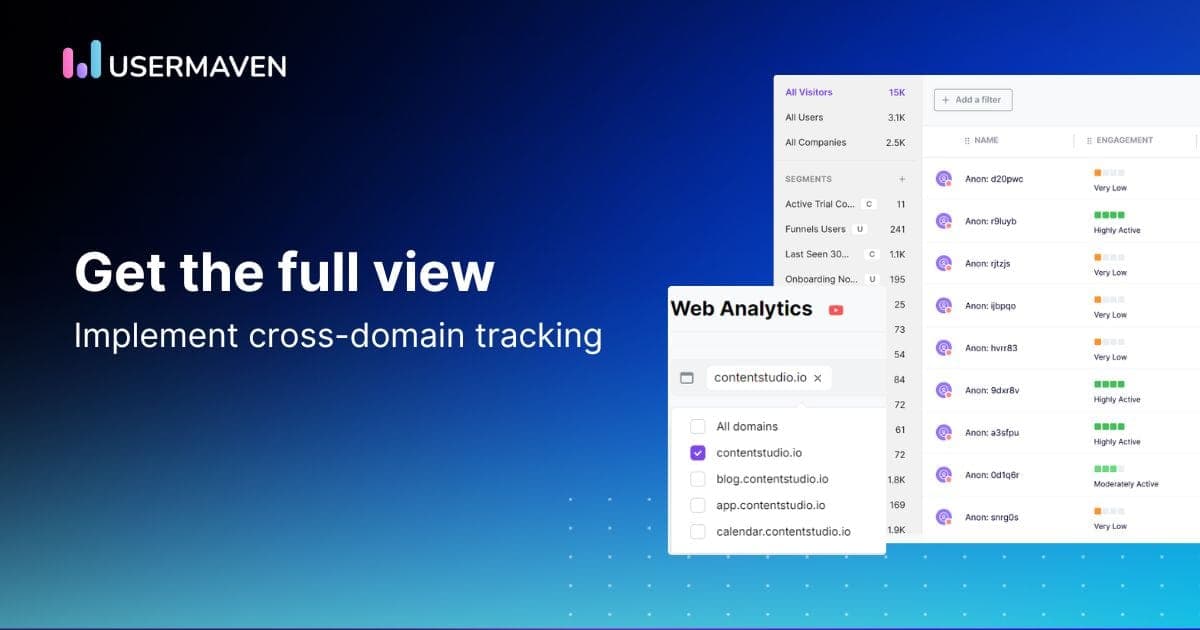
Many businesses have websites across multiple web addresses, like separate platforms for a blog, store, or community.
Understanding how users visit these various sites is crucial for creating a smooth overall experience.
Let’s see how we can disclose the depths of cross-domain tracking;
What is cross-domain tracking?
To understand it, suppose you own a social media management tool. A potential customer might browse services on your main website (domainA.com) and then switch to your other website (domainB.com) to find blogs and information.
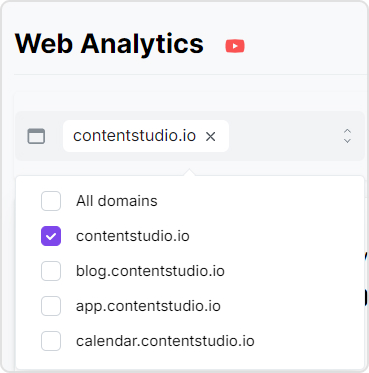
Without cross-domain tracking, your analytics setup would show these visits as completely separate user sessions. You wouldn’t be able to tell it’s the same person and understand their complete purchase journey.
It bridges this gap by allowing you to track users as they navigate between your different domains.
Benefits of cross-domain tracking
Cross-domain tracking bridges the gap by letting you track users as they move between your different websites. It essentially stitches together these visits into a single user journey, providing a more comprehensive view of their behavior.
Having a unified view of user behavior across multiple websites offers several advantages:
- See the bigger picture: Gain a complete understanding of how users interact with your various platforms, revealing hidden trends and patterns that might be missed by analyzing each site separately.
Accurate attribution: Imagine a user finds a product on your main site but completes the purchase on your checkout domain. Cross-domain tracking ensures you correctly credit the initial touchpoint, and advanced attribution software helps connect those journeys to campaign performance and insights for campaign analytics. - Enhanced analytics: Analyze funnels, user journeys, and engagement metrics with complete data encompassing all your domains. This empowers you to identify areas for improvement and personalize the user experience across different touchpoints.
How Usermaven implements cross-domain tracking
With cross-domain tracking, you can make informed business decisions based on reliable insights about your multi-domain user base. You can use this data to tailor marketing strategies, product development, and overall customer experience initiatives.
Cross-domain tracking in Usermaven
At Usermaven, we prioritize a seamless user experience with effortless implementation.
To track users across different websites in Usermaven, add a snippet with data domains specifying the domains to track. Set data-cross-domain-linking to “true” to turn on this tracking.
Add this to your Usermaven tracking pixel as;
data-domains=”example.com,example.org”
data-cross-domain-linking= “true”
When users switch websites, a special code is added to the URL to track them across sites.
And you are all set to track analytics of different domains in a single workspace.
Here’s a breakdown of how our cross-domain tracking works:
- Smooth user ID transfer: When a user clicks a link to move from Domain A to Domain B, the Usermaven tracker discreetly adds a query parameter (like ?um_id=1234) containing the user’s anonymous ID to the URL. This ID is unique but doesn’t contain any personal information to comply with privacy regulations.
- Seamless ID synchronization: Upon loading Domain B, the Usermaven tracker identifies the ?um_id parameter and extracts the user ID. This ID is then used to link the user’s activity on Domain B with their previous interaction on Domain A, creating a unified user journey.
Target the right audience
with Usermaven Segments
Advantages of Usermaven’s cross-domain tracking
Usermaven’s cross-domain tracking offers several benefits for businesses looking to gain a unified view of user behavior across their domains:
- Easy to use: No complex code modifications are required. Simply add your domain to Usermaven, and it will start tracking user journeys automatically.
- Privacy-focused design: User IDs remain anonymous, adhering to strict privacy regulations. Usermaven prioritizes user privacy.
- Automatic tracking: Gain insights into user behavior across all your domains without manual configuration or managing complex cookie-based solutions.
- Enhanced segmentation: Create audience segments that encompass user interactions across all your domains. This allows you to deliver more targeted marketing campaigns and personalize the user experience.
The future of cross-domain tracking
The landscape of user tracking is constantly evolving, and it’s important to stay informed about potential limitations and future considerations:
- Cookie dependence: Traditional cross-domain tracking often relies on cookies. As browser restrictions on cookies become more prevalent, alternative tracking methods and analytics testing automation will become more important.
- Subdomain compatibility: Ensure your cross-domain tracking configuration includes all relevant subdomains for accurate user journey tracking. Usermaven offers clear instructions and supports to ensure proper setup.
By understanding the value of cross-domain tracking and leveraging a solution like Usermaven’s, you can gain a deeper understanding of your users and make informed decisions to optimize your websites and products.
Unlock insights that drive growth
End-note
Cross-domain tracking is an essential tool for businesses operating on multiple websites. With Usermaven, you can quickly implement cross-domain tracking, which empowers you to unlock valuable user insights and make data-driven decisions for optimized marketing strategies and improved customer experiences.
If you’re an affiliate, marketer, or consultant, the Usermaven affiliate program lets you earn 20% recurring commissions by recommending our top-rated analytics tool to your audience.
FAQs
1. What are common problems with cross-domain tracking?
– An incorrect referral exclusion setup can cause duplicate sessions.
– Client ID not tracking URL parameters between domains can disrupt tracking.
– Improper “allowLinker” configuration can prevent cross-domain tracking.
These problems can be prevented by using Usermaven’s simple cross-domain tracking setup.
2. Does setting cross-domain tracking cause data loss?
No, you won’t lose historical data if you use an existing property.
3. Can I set up cross-domain tracking for domains I don’t own?
Usually not, as you need to install tracking code on the other domain.
Updated

Written by
Adeel Khan
Growth Marketing Expert
Adeel Khan is a full-stack SaaS marketer with 10+ years of experience in content marketing, paid advertising, analytics, and conversion rate optimization. He shares practical insights and strategies drawn from hands-on experience, helping B2B SaaS marketers improve performance and make better marketing decisions.
All articles by Adeel →