Four platforms. Four attribution models. Four different conversion counts for the same campaign.
Running ads across Google, Meta, LinkedIn, and TikTok simultaneously is now standard practice. Getting all four to agree on a single number is not, and that disagreement costs marketing teams a real budget every quarter.
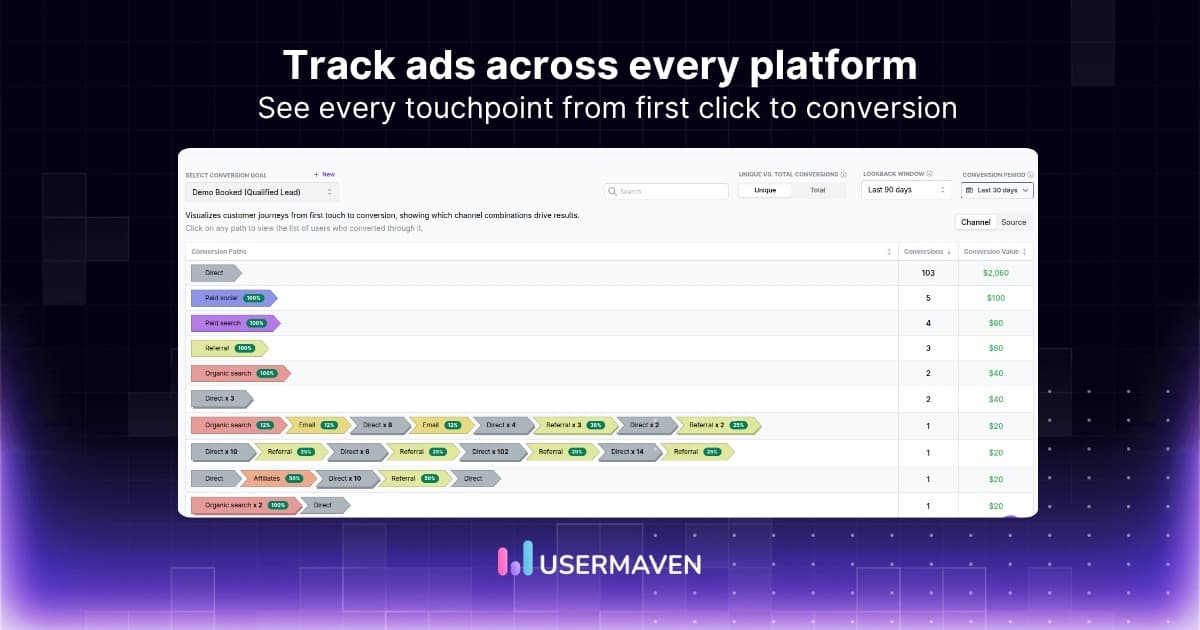
Cross-platform ad tracking, also referred to as multi-platform ad tracking, is the discipline of monitoring and attributing ad performance across multiple channels from one independent measurement layer. Without it, every platform reports its own version of the truth, and none of them matches the CRM.
This guide explains what cross-platform ad tracking is, what makes it difficult, the specific ad platform discrepancies teams face, and how to build a setup that produces trustworthy data across every channel.
Key takeaways
- Cross-platform ad tracking is the practice of monitoring ad performance across Google, Meta, LinkedIn, TikTok, and other channels from one unified measurement layer
- Each platform uses its own attribution rules, identity matching, and conversion windows, making cross-platform data naturally inconsistent without an independent layer above them
- Cross-device tracking adds another layer of complexity when users switch between mobile and desktop during the same buying journey
- Privacy changes, including iOS 14.5, cookieless tracking requirements, and consent restrictions, have made multi-platform analytics significantly harder since 2021
- The most effective cross-platform ad tracking solution uses first-party data and independent attribution to produce one accurate conversion count above all platforms
What is cross-platform ad tracking?
Cross-platform ad tracking is the process of monitoring, measuring, and attributing ad performance across multiple advertising platforms simultaneously from one centralised measurement layer.

It goes beyond what any single platform dashboard shows. Instead of reading Google Ads for search performance and Meta Ads Manager for social performance separately, cross-platform tracking connects all touchpoints into one view of how the full campaign mix is performing.
Cross-platform measurement answers three questions that single-platform reporting cannot:
- Which combination of channels is driving the most efficient customer acquisition?
- How do touchpoints on one platform influence conversions that happen on another?
- What is the true ROI across all spend when double-counting is removed?
Having five dashboards open simultaneously is not multi-channel ad tracking. It is fragmented reporting from five different sources, each applying different rules. True cross-platform analytics requires one consistent model applied across every channel.
For a foundational understanding of how ad tracking works at the platform level, and how marketing attribution connects spend to outcomes, those guides cover the mechanics in detail.
Why is cross-platform ad tracking harder than single-platform
Even when every tool is configured correctly, tracking ads across platforms produces inconsistent data by design. These are the structural reasons why.
Every platform speaks a different measurement language
Google Ads uses GCLID for click attribution. Meta uses the Meta Pixel and Conversions API with a 7-day click window. LinkedIn defaults to a 30-day click window. TikTok uses its own pixel with view-through attribution enabled by default.
When the same customer touches all four platforms before converting, each one applies its own logic to claim credit. This is the structural double-counting problem that makes last-click attribution across platforms so difficult to resolve.
Identity resolution breaks across platforms
A user who sees a Meta ad on their phone, researches on LinkedIn at lunch, and converts via a Google search on their desktop is one person making one purchase. Across platforms, they appear as three different users.
Each platform records a separate conversion event for the same sale. Without user behavior tracking that connects all three sessions to one identity, the journey is fragmented, and the attribution is wrong.

Attribution windows create overlap by design
When Meta uses a 7-day window, and Google uses a 30-day window, any conversion that happens within those windows after either ad interaction gets claimed by both. This overlap is not a configuration error. It is built into how each platform defines what it owns.
Understanding attribution window settings and how to standardize them across platforms is one of the fastest ways you can reduce cross-platform discrepancies.
Privacy restrictions affect platforms differently
iOS 14.5 impacted Meta far more than Google because Meta depended more heavily on third-party pixel tracking for iOS users. This means the same audience behaves differently in Meta reports versus Google reports, not because the campaigns performed differently, but because each platform can see different amounts of data.
See GA4 ad blocker for a specific example of how privacy restrictions create systematic undercounting in one tool while another records the full conversion.
Cross-platform ad tracking challenges
These are the multi-platform ad tracking challenges that affect marketing teams running campaigns across multiple channels simultaneously. Each one compounds the others when left unaddressed.
Data fragmentation across platforms
Each platform stores conversion data in its own format using its own identifiers. Consolidating this data manually requires exporting CSVs, normalising column names, and reconciling time zones, a process that takes hours and produces results that are already out of date by the time the analysis is complete.
According to Apple’s App Tracking Transparency documentation, users must now explicitly opt in to cross-app tracking. The majority choose not to, which means a growing share of mobile conversions are invisible to platform pixels and must be estimated rather than measured.
Cross-device attribution gaps
When a user moves between devices during their buying journey, most platforms lose the thread. A click on a TikTok ad on mobile and a conversion via branded search on desktop are two separate records in most tracking setups.
Without cross-domain tracking and identity resolution that connects both events to the same person, the TikTok ad receives zero conversion credit even though it started the entire journey.
Modeled conversions masking real performance
As privacy restrictions increase, platforms like Google and Meta fill data gaps using machine learning to model estimated conversions for users who opted out of tracking. These modeled conversions are mixed into reported numbers alongside real observed conversions with no visible separation.
This makes it impossible to tell how much of a platform’s reported performance is actually measured and how much is an estimate. The gap between observed and modeled data is one reason why cross-channel marketing attribution from an independent layer produces different and more reliable numbers than any platform dashboard.

Consent and privacy compliance across jurisdictions
A campaign running in the EU and the US simultaneously operates under different consent rules. GDPR requires explicit opt-in consent in Europe before any tracking begins. CCPA gives California users the right to opt out of data sales and tracking.
European users who decline cookie consent create data gaps that platforms compensate for differently. The result is that the same campaign shows different performance metrics for different geographic segments, not because performance differs but because data collection does.
Using privacy-first analytics tools that respect consent while still providing accurate attribution is no longer optional for campaigns running across multiple jurisdictions.
UTM parameter inconsistency
When UTM parameters are missing, broken, or inconsistently applied across platforms, multi-channel ad tracking breaks down at the analytics layer. Sessions arrive without attribution context and get recorded as direct traffic, hiding the paid channel contribution entirely.
You can review the most common critical UTM mistakes to find where UTM gaps are silently corrupting cross-platform conversion data before the next campaign launch.
These challenges collectively explain why data governance best practices for ad tracking must be established before scaling spend across multiple platforms.
How cross-platform ad tracking works
Effective ad tracking for multiple platforms requires five components working together. Missing any one of them creates gaps that compound over time.
Step 1: Unified tracking infrastructure
A single first-party tracking pixel or server-side tracking event fires on every page and records each session with consistent identifiers. This creates a complete record of every visit, regardless of which platform drove it.
The IAB’s State of Data 2024 report confirms that privacy laws and browser restrictions are driving lasting signal loss. Over 70% of companies expect weaker ROI and attribution measurement. As client‑side tracking degrades, marketers are shifting to first‑party and server‑side data frameworks.
Step 2: UTM parameter standardisation
Every paid campaign across every platform follows the same source, medium, campaign, content, and term conventions. This allows the analytics layer to attribute sessions correctly without depending on platform-reported numbers.

Step 3: Identity resolution across touchpoints
The tracking system connects multiple touches from the same user into one continuous journey using first-party data identifiers such as email addresses, login events, or consistent cookie IDs. This closes the cross-device gap that makes users appear as multiple separate people.
Step 4: One attribution model applied universally
Rather than accepting each platform’s default model, a cross-platform tracking setup applies a consistent marketing attribution models approach across all platforms. This removes the window-mismatch and view-through discrepancies that cause double-counting.
Step 5: Centralised reporting layer
All channel data flows into one analytics workspace that applies the same rules to Google, Meta, LinkedIn, TikTok, email, and organic simultaneously. Teams see one canonical conversion count rather than five competing claims.
This is the foundation of accurate cross-platform attribution and the only setup that makes cross-platform measurement trustworthy enough to base budget decisions on.
Cross-platform ad tracking vs cross-device ad tracking
These two terms are often used interchangeably, but they describe different dimensions of the same measurement problem. Understanding the distinction helps teams diagnose the right issue and apply the right fix.
| Cross-platform ad tracking | Cross-device ad tracking | |
|---|---|---|
| What it tracks | Ad performance across multiple platforms (Google, Meta, LinkedIn, TikTok) | A single user’s journey across multiple devices (mobile, tablet, desktop) |
| The core problem | Each platform applies its own attribution rules and claims the same conversion | The same user appears as multiple different people across devices |
| Root cause | Platform-level attribution window and identity mismatches | No persistent identifier connecting device sessions |
| The fix | Independent attribution layer above all platforms | First-party identity resolution using email or login events |
| Affects | Budget allocation and conversion reporting accuracy | User journey accuracy and attribution paths |
Both problems exist simultaneously in most multi-channel campaigns. A user who sees a Meta ad on mobile, a LinkedIn ad on desktop, and converts via Google search on a tablet has created both a cross-device gap and a cross-platform attribution conflict.
Solving only one without the other still produces incomplete data. The most effective cross-platform ad tracking solution addresses both layers together using first-party data and independent attribution that works consistently across devices and platforms. See the full guide to ad tracking for a deeper breakdown of how modern tracking infrastructure handles both challenges.
Best practices for ad tracking across platforms
These practices apply to any team running ads across platforms, regardless of budget size or channel mix.
Standardize before you scale
Before adding a new platform to your mix, establish a tracking convention that every platform must follow. UTM naming, conversion tracking event naming, and attribution window settings should be documented and enforced consistently across every paid channel.
Use server-side tracking as your baseline
Browser pixels are increasingly unreliable due to ad blockers and privacy restrictions. Server-side tracking that sends conversion data from your web server directly to each platform produces more complete data and is not subject to browser-level blocking.
Implement one independent analytics layer above all platforms
Do not rely on any single platform as your source of truth for cross-platform measurement. Use an independent analytics tool that applies consistent rules across all channels and reports one canonical conversion count. This is the only way to eliminate structural double-counting.

Audit your setup regularly
Platform changes, new campaign structures, and team turnover all introduce tracking gaps. Schedule a quarterly UTM and pixel audit to catch missing parameters, broken conversion events, and new campaigns that launched without proper tracking.
Review analytics implementation mistakes to find the most common setup errors that silently corrupt cross-platform data over time.
Compare platform data against CRM data weekly
The fastest way to detect a tracking problem is to compare platform-reported conversions against CRM closed deals at least once a week. A growing gap between the two signals a new tracking issue that needs investigation before it affects budget decisions.
Understanding the digital marketing metrics and KPIs that matter most for cross-platform reporting helps teams focus on the right comparisons rather than reconciling every number from every source.
Unlock insights that drive growth
Best ad tracking software for multiple platforms
Choosing the right tool is the fastest way to fix cross-platform tracking gaps. Here are the strongest options for teams running campaigns across multiple channels simultaneously. For a full comparison of features, pricing, and use cases, see the complete guide to ad tracking software.
- Usermaven: Best overall for first-party, independent cross-platform attribution with seven attribution models and a unified multi-channel dashboard. Starts at $84/month.
- Cometly: Strong for performance agencies needing first-party server-side tracking across Google and Meta with CRM-connected revenue data.
- Northbeam: Best for high-volume paid social teams running large Meta and TikTok budgets who need real-time data refresh for daily optimisation decisions.
- Ruler Analytics: Best for businesses combining online and offline channels, including phone call tracking alongside digital touchpoints.
Each tool takes a different approach to the cross-platform ad tracking problem. Whether you need a full attribution platform or a lightweight ads tracker for a single channel, the right choice depends on your campaign complexity.
How Usermaven solves cross-platform ad tracking
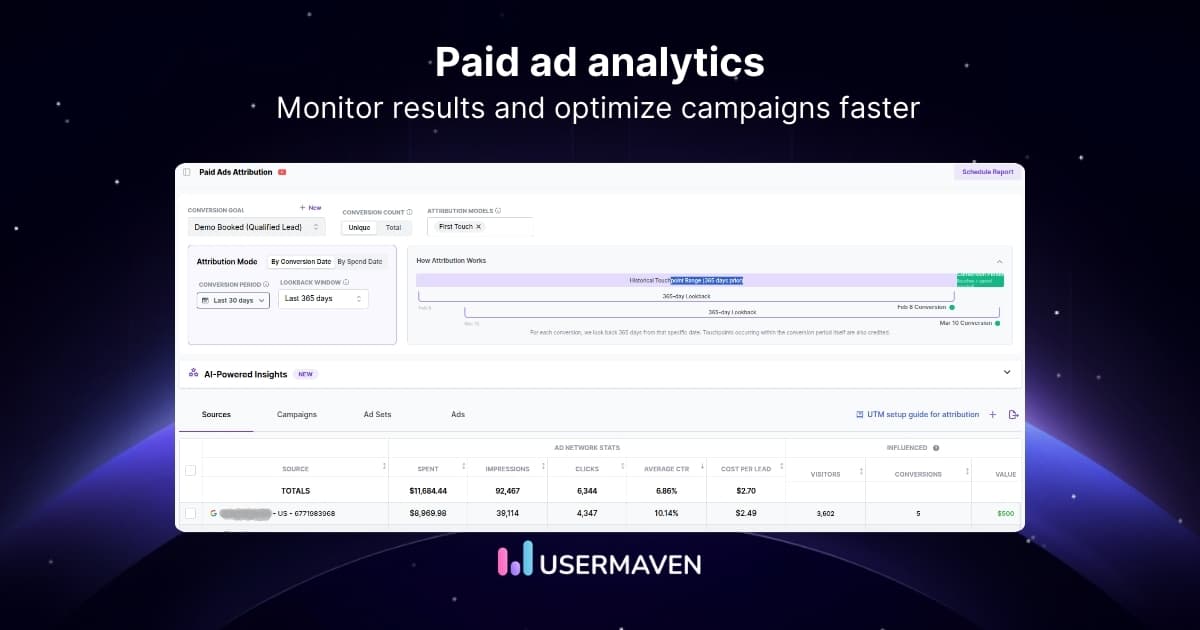
Usermaven is an AI-powered marketing attribution platform that connects ad platforms, CRM, and website data to track the full customer journey in real time using first-party and server-side tracking across every paid channel you run.
Instead of inheriting each platform’s self-reported numbers, Usermaven applies one consistent measurement layer above Google, Meta, LinkedIn, TikTok, and organic simultaneously.
Independent first-party tracking above all platforms
Usermaven’s first-party pixel and server-side tracking capture every session independently of what any ad platform reports. This produces one canonical conversion count that does not change based on which dashboard you open.
The website analytics software layer handles multi-domain and multi-property tracking, while the marketing attribution software connects every paid touchpoint to revenue outcomes in one workspace.
“For teams managing multiple websites or subdomains, Usermaven’s cross-domain tracking connects sessions across every property into one continuous user journey without losing attribution context between domains.”
Seven attribution models for cross-platform analysis
Teams apply and compare attribution models, including first-touch, last-touch, linear, time-decay, position-based, data-driven, and custom rules across all channels simultaneously.
This lets teams see how credit is distributed across the full multi-platform journey rather than accepting each platform’s self-serving default model.
Ad-blocker bypass for complete cross-platform data
Usermaven’s tracking infrastructure bypasses most ad blockers, delivering near-complete session data even in privacy-focused browser environments. The result is accurate cross-platform analytics that reflects the full audience rather than just the portion that does not use tracking protection.
Privacy-first and compliant by default
Usermaven uses cookieless tracking and first-party data methods that stay accurate as third-party cookies disappear. GDPR and CCPA compliance is built in from the start, not added as an afterthought.
For teams managing campaigns across EU and California audiences simultaneously, this removes the compliance burden from the tracking setup entirely.
Conclusion
Cross-platform ad tracking is not a reporting problem. It is a structural measurement challenge that gets harder as more platforms are added to the mix.
Every platform tracks to win. Independent tracking tracks to find the truth.
The most expensive mistake in paid media is optimising toward platform claims instead of business reality. A cross-platform ad tracking setup that produces one trusted number changes every budget conversation your team has.
For a broader view of how cross-platform tracking fits inside your overall marketing analytics setup, see how unified data changes every decision your team makes.
Not sure where to start? Usermaven’s guided analytics setup walks you through connecting every ad platform and eliminating tracking gaps in one structured process.
Ready to see Usermaven in action? Explore the platform or book a demo for a closer look.
See what's working. Fix what's not. Grow faster.
FAQs
1. What is cross-platform ad tracking?
Cross-platform ad tracking is the practice of monitoring ad performance across multiple advertising platforms from one unified measurement layer. Instead of reading separate dashboards for Google, Meta, LinkedIn, and TikTok, cross-platform tracking applies one consistent attribution model across all channels and produces one canonical conversion count.
2. Why do ad numbers differ across platforms?
Each platform uses its own attribution window, identity matching logic, and conversion definitions. Google Ads and Meta can both claim the same conversion when a user interacts with ads on both platforms before purchasing. This structural double-counting is explained in detail in the guide to ad platform discrepancies.
3. What is cross-device tracking, and how does it relate to cross-platform tracking?
Cross-device tracking connects a single user across multiple devices, including phone, tablet, and desktop, into one journey record.
Both are required for accurate multi-platform analytics because most buyers switch between devices and platforms during their research process before converting.
4. How do privacy changes affect cross-platform ad tracking?
iOS 14.5, Safari’s Intelligent Tracking Prevention, and GDPR and CCPA consent requirements have all reduced the data available to ad platforms. Each platform is affected differently, which widens the gap between platform-reported numbers.
First-party tracking tools maintain accuracy better than cookie-dependent alternatives because they do not rely on the signals that privacy restrictions are blocking.
5. What is the best cross-platform ad tracking solution?
The best ad tracking for multiple platforms uses first-party data, server-side tracking, and independent attribution applied consistently across all platforms. Usermaven is built for this use case, combining first-party pixel tracking, seven attribution models, and a unified multi-channel dashboard starting at $84/month.
Updated

Written by
Junaid Ahmed
Content Writer & Digital Marketer
Junaid Ahmed is a content and copywriter with 3+ years of experience creating research-driven content across SaaS, B2B, ecommerce, and digital marketing. He specializes in turning complex topics into clear, practical content that helps marketers better understand their challenges, evaluate solutions, and make informed decisions. His work spans educational content, industry insights, and actionable marketing guides.
All articles by Junaid →