A digital marketing agency may manage Google, Meta, LinkedIn, TikTok, Microsoft, and other paid channels for several clients at the same time.
Tracking gets harder because every client can have a different website, CRM, funnel, conversion, and revenue source.
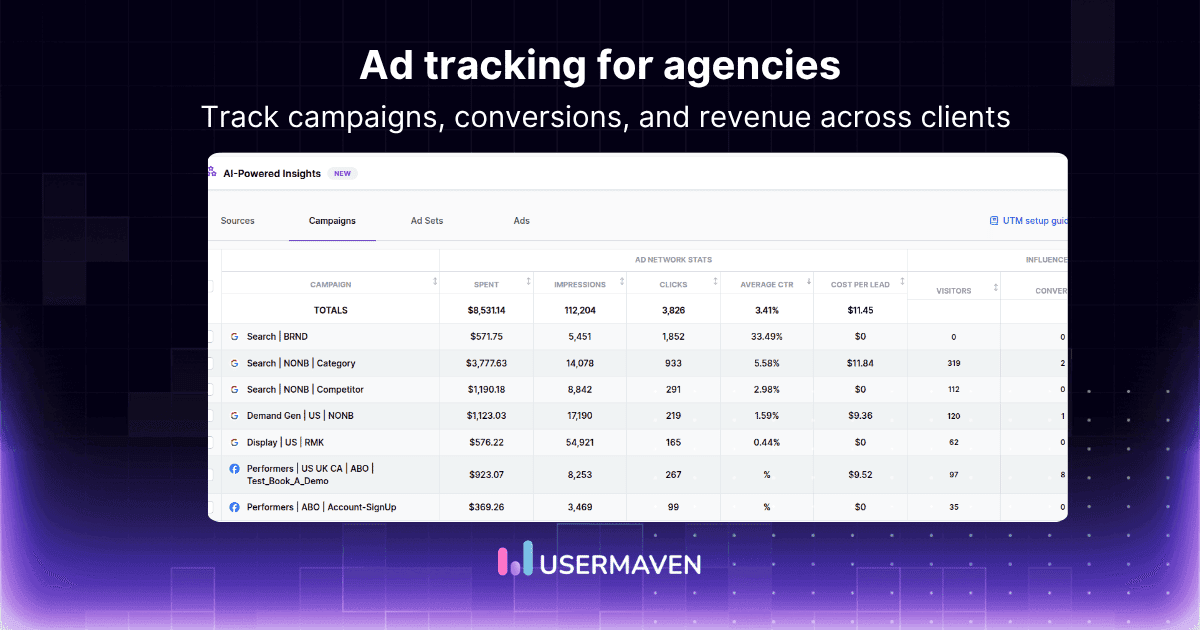
The goal is not simply to record clicks. Agencies need ad tracking that connects paid media with verified leads, purchases, opportunities, customers, and revenue instead of stopping at clicks.
This guide explains how agencies should structure tracking, use first-party and server-side data, handle attribution, and evaluate ad tracking software for agencies.
Key takeaways
Agency ad tracking works best when the tracking framework is standardized but the business outcome stays specific to each client.
Agency tracking is a multi-client problem: each client can have different platforms, funnels, conversions, attribution windows, and revenue systems.
Clicks are only the first layer: useful tracking connects acquisition with verified downstream outcomes such as purchases, opportunities, or closed revenue.
Standardize the framework, not the conversion: ecommerce, SaaS, B2B, high-ticket, and local-service clients should not all be optimized around the same event.
Server-side tracking improves delivery, not attribution by itself: collection and attribution solve different parts of the measurement problem.
Platform reporting needs reconciliation: Google, Meta, and other networks can claim overlapping conversions under different attribution rules.
Client reporting should support decisions: spend, CAC or CPA, revenue, pipeline, ROAS, trends, and discrepancy explanations matter more than dashboard volume.
What is ad tracking for digital marketing agencies?
Ad tracking for digital marketing agencies is the process of capturing advertising interactions, campaign data, conversions, and downstream business outcomes across multiple client accounts so agencies can measure performance and report results consistently.
An agency setup can span ad platforms, websites, landing pages, forms, ecommerce stores, booking tools, CRMs, billing systems, call systems, and client reporting.
The job is to preserve enough context to connect paid activity with the outcome each client actually values.
cross-platform ad tracking becomes important when several ad networks participate in the same journey and the agency needs one consistent view instead of separate platform stories.
Why agency ad tracking is different
An in-house brand usually manages one measurement environment. An agency may manage twenty. The tracking architecture has to be repeatable without pretending that every client has the same buying cycle.
A Shopify client may care about verified orders and new-customer revenue. A B2B SaaS client may care about qualified pipeline.
A high-ticket client may not generate the final revenue event until weeks after a form submission or sales call.
The operating principle is simple: standardize naming, QA, permissions, and reporting structure, but let the client’s business model determine the conversion, attribution window, and revenue metric.
How tracking changes by client type
| Client type | Track beyond the click | Main outcome |
| Ecommerce | Product → cart → checkout | Order / revenue |
| SaaS | Signup → activation | Paid account / MRR |
| B2B | Lead → account → opportunity | Pipeline / revenue |
| High-ticket | Lead → booking → sales process | Closed sale |
| Local service | Form → call → appointment | Qualified lead / sale |
| Subscription | Signup → renewal | Retained revenue / LTV |
How agency ad tracking works
A reliable agency setup can be understood as five connected layers. Each layer answers a different measurement question, and weak data in an early layer makes every later report less trustworthy.

1. Advertising layer
Start with the paid channels the client actually uses: Google Ads, Meta Ads, LinkedIn Ads, TikTok Ads, Microsoft Ads, affiliates, or other networks.
Preserve campaign, ad group or ad set, ad, creative, keyword where applicable, and spend.
2. Acquisition layer
Preserve the context that brought the visitor in: source, medium, campaign, landing page, click ID, referrer, and structured UTM parameters. Without consistent acquisition data, reports fragment before attribution begins.
3. Conversion layer
Define the event that matters for each client. Reliable conversion tracking should capture the form submission, booking, trial, purchase, qualified lead, opportunity, or closed sale that represents progress.
A generic conversion label is too shallow when the agency manages several business models.
4. Attribution layer
Once the journey is recorded, the attribution layer decides how eligible interactions receive credit. First touch, last touch, multi-touch, and conversion paths answer different questions, which is why agencies should understand the underlying ad attribution models.
5. Reporting and optimization layer
Finally, connect the measurement to spend, CPA or CAC, revenue, ROAS, pipeline, customer value, and optimization feedback. Reporting should explain what happened and what the agency plans to change.
What agencies need to track for every client
The exact funnel can vary, but every account should preserve four categories of measurement data. This creates a repeatable framework without forcing clients into identical KPIs.
Campaign data
Channel, campaign, ad group or ad set, creative, keyword where relevant, spend, and campaign status help explain what the agency actually bought.
Acquisition data
Source, medium, UTMs, click identifiers, landing page, referrer, and timestamp help connect the media interaction with the website or funnel journey.
Conversion data
Leads, signups, bookings, purchases, opportunities, calls, and closed sales should be named consistently and mapped to the client’s real funnel stages.
Revenue and customer data
Order value, deal value, recurring revenue, retained revenue, new-customer status, and LTV become important when the client pays the agency to improve economics rather than conversion volume alone.
Multi-client tracking is the biggest agency challenge
The agency modifier changes the problem. A tracking setup that works for one brand can become chaotic when copied across twenty clients without clear separation, naming, permissions, and ownership.
Keep client data separated
Use separate workspaces, integrations, conversion definitions, and revenue sources for each client. Team members and clients should only see the environments they are expected to access.
Standardize naming conventions
Create agency-wide rules for UTMs, event names, campaign naming, conversion names, and reporting periods. Consistency reduces cleanup and makes onboarding new accounts faster.
Preserve client-specific measurement rules
Do not force identical attribution windows or conversions across every account. Standardize the implementation process while preserving the business logic that makes each client’s measurement meaningful.
Define ownership before launch
Document who owns ad accounts, pixels, tags, analytics properties, domains, CRM connections, and exported data. Clear ownership matters when access changes or a client leaves the agency.
First-party and server-side tracking for agencies
Modern agency measurement usually combines browser context with first-party and server-side signals. The goal is to improve data continuity without pretending that any one collection method solves identity, consent, and attribution by itself.
Browser-side tracking
Browser-side collection is useful for page context, sessions, clicks, on-site behavior, and campaign parameters. It helps explain what happened before the conversion.
Server-side tracking
Appropriate server side tracking can improve delivery of important conversion events from a store, CRM, backend, or other system instead of relying only on the browser.
Google Ads’ enhanced conversions for leads guidance describes an upgraded offline-conversion workflow that uses first-party customer data to improve matching between leads, later outcomes, and the ads that generated them. This is especially relevant when agencies need to optimize beyond the initial form submission.
Server-side collection does not automatically fix consent, duplicate events, missing campaign context, or a poor attribution model. Agencies still need to test how browser and backend events work together.
Avoid duplicate browser and server conversions
One of the easiest ways to inflate agency reporting is to send the same business event through several paths without deduplication.
For example, a browser purchase event and a server purchase event may both describe the same order. If the tracking system cannot recognize that relationship, one real sale can become two reported conversions.
Validate event IDs, order IDs, conversion names, timestamps, source systems, and deduplication rules before using the data for client reporting or media optimization.
Attribution vs. ad-platform reporting
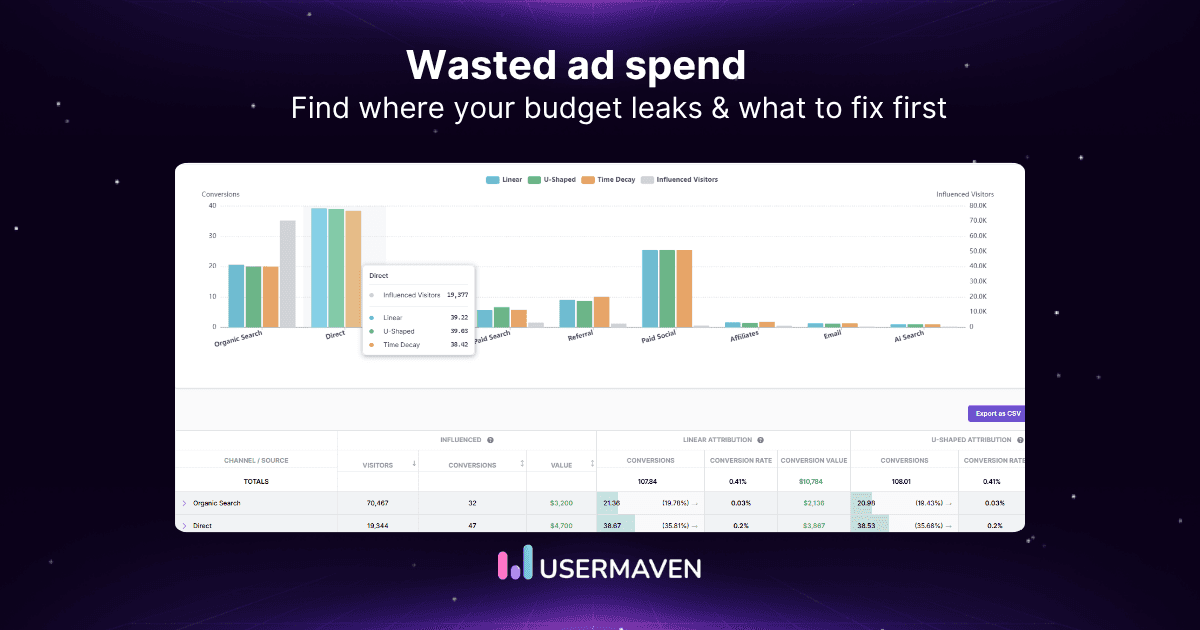
Agencies often spend too much time explaining why Meta, Google, the CRM, and an independent analytics platform show different numbers. The reports can disagree even when the integrations are technically functioning.
A platform report answers: What conversions does this network claim under its own rules? Independent attribution asks how eligible interactions should be evaluated consistently across channels against a single source of truth for the actual business outcome.
When reports diverge, investigate ad platform discrepancies by comparing attribution windows, click and view eligibility, conversion definitions, revenue timestamps, identity rules, and backend totals.
Which attribution model should agencies use?
There is no universal attribution model for every agency client. The right choice depends on the buying cycle, the conversion being measured, and whether the agency wants to understand discovery, closing influence, or the complete customer journey.

First-click attribution model
First-click attribution gives all conversion credit to the first measurable interaction in the journey. Agencies can use it to identify which campaigns, channels, or ads initially introduced customers who later converted.
Last-click attribution model
Last-click attribution gives all credit to the final eligible interaction before conversion. It is useful for understanding closing influence, but it can undervalue ads and channels that created awareness or assisted earlier in the buying journey.
Multi-touch attribution model
Multi-touch attribution distributes conversion credit across multiple eligible interactions. It is especially useful for agencies managing B2B, SaaS, high-ticket, or other clients whose buyers interact with several paid and owned channels before converting.
Data-driven attribution model
Data-driven attribution uses available journey and conversion data to estimate how different interactions contribute to an outcome instead of relying on a fixed positional rule.
Agencies should only rely on modeled results when the underlying tracking, identity, and conversion data are sufficiently reliable.
For a broader comparison of these approaches and other ad attribution models, agencies should compare more than one view before changing client budgets. The selected attribution window should also match the client’s normal buying cycle.
How tracking changes by agency client type
The framework stays consistent, but the event chain changes. That is why paid ad tracking software for agencies should be evaluated by how well it adapts to different client outcomes rather than by one universal conversion report.

Ecommerce clients
Track ad → product → cart → checkout → verified order. Reconcile platform claims with store revenue, separate new and returning customers where useful, and prevent duplicate orders. The deeper ad attribution software for ecommerce guide compares platforms built for this workflow.
SaaS clients
Track ad → signup → activation → paid account → recurring revenue. Signup volume alone can hide poor acquisition quality, so ad attribution software for SaaS should connect paid acquisition with downstream product or revenue outcomes.
B2B clients
Track ad → lead → account → opportunity → closed revenue. In this model, revenue attribution is more useful than stopping at form fills because sales determines the final outcome.
High-ticket clients
Track ad → lead → call or demo → follow-up → closed sale. Longer buying cycles and offline steps make the ad attribution tools for high ticket offers workflow different from short-cycle ecommerce.
Local-service clients
Track ad → call or form → appointment → qualified lead or sale. The website event may be only the first step, so agencies need a way to connect later outcomes back to acquisition.
Agency tracking by client model
Every client type has a different definition of conversion.
| Client model | Do not stop at | Track toward | Biggest risk |
| Ecommerce | Purchase event | Verified order / LTV | Duplicate orders |
| SaaS | Signup | Activation / revenue | Low-quality signups |
| B2B | Lead | Opportunity / revenue | CRM disconnect |
| High-ticket | Form | Closed sale | Long attribution gap |
| Local service | Click | Appointment / sale | Offline conversion loss |
Turning tracking into conversion feedback
The agency workflow should not end with a report. When supported, verified downstream outcomes can be returned to ad platforms so bidding systems learn from the events the client actually values.
Meta’s Conversions API documentation describes a direct connection between marketing data from servers, websites, apps, or CRMs and Meta’s optimization and measurement systems. For agencies, the practical opportunity is to send cleaner business events instead of relying only on browser-level signals.
For example, a client may initially optimize toward a lead. Once the CRM identifies qualified leads or customers, the agency can use conversion syncs to return more meaningful downstream outcomes to supported ad platforms.
What should agencies show clients?
Clients usually do not need every tracking field or attribution model. Clear analytics dashboards should connect spend with business outcomes and explain meaningful changes without overwhelming clients with raw tracking detail.
Spend: How much was invested by channel and period.
Verified conversions: The business outcomes that actually occurred.
CPA or CAC: The cost of the selected conversion or acquired customer.
Revenue and ROAS: Commercial value connected to paid acquisition where appropriate.
Pipeline: For B2B clients where the lead is not the final outcome.
Trends: How performance is changing over time, not just a one-period snapshot.
Channel contribution: How major sources participate in converting journeys.
Discrepancy notes: Why the agency view may not exactly match native platform totals.
A consistent set of marketing agency reporting tools can reduce the time spent rebuilding the same client story every reporting cycle.
White-label and client-facing reporting
Agencies may need branded dashboards, custom domains, client workspaces, restricted permissions, and a reporting experience that feels like part of the agency’s service.
white-label analytics can help agencies present measurement under their own branding without changing the underlying tracking standards.
If the decision has moved from implementation to software selection, use the dedicated ad attribution platform for agencies comparison rather than turning this operational guide into another buying list.
Common ad-tracking mistakes agencies make
Most agency tracking failures come from inconsistent definitions, duplicated events, or reporting assumptions rather than from a lack of dashboards.
1. Using one conversion definition for every client
A lead, order, activation, booking, and closed sale represent different economic outcomes. Uniform dashboards should not erase those differences.
2. Letting every client invent campaign naming
Inconsistent UTMs, event names, and campaign labels create unnecessary cleanup and make cross-account QA much harder.
3. Reporting platform ROAS as independent truth
Native ad platforms are useful optimization systems, but overlapping attribution means their totals should not be added together as a neutral revenue record.
4. Sending duplicate browser and server events
A stronger collection stack can make reporting worse if the same business event is counted twice.
5. Optimizing for leads when the client pays for revenue
Cheap leads can look successful while producing weak pipeline, poor customers, or no closed sales.
6. Using the same attribution window everywhere
A fast ecommerce purchase and a six-month B2B sale should not inherit the same timing assumptions.
7. Mixing client permissions or workspaces
Access mistakes create operational risk and make it harder to maintain a clean client boundary.
8. Choosing software mainly for dashboard appearance
A polished interface cannot compensate for weak identity, missing backend outcomes, unreliable conversion events, or poor reconciliation.
How to audit an agency ad-tracking setup
Before scaling a client or moving budget based on a new dashboard, audit a real path from ad click to business outcome. This is where implementation issues become visible.

1. Verify campaign parameters
Check that the ad URL carries the expected UTMs or click identifiers and that naming matches the agency standard.
2. Test the landing-page visit
Confirm the source, campaign, landing page, and session appear correctly in the measurement system.
3. Trigger a real conversion
Submit a test lead, complete a test order, or use a controlled workflow that mirrors the client’s production funnel.
4. Confirm browser and server deduplication
If the same conversion is delivered from more than one source, verify that it becomes one business outcome.
5. Check the backend system
Confirm the CRM, store, booking tool, or billing system records the same conversion and value.
6. Compare platform and independent reporting
Look for differences in windows, conversion definitions, timestamps, click/view rules, and identity.
7. Inspect the customer journey
Make sure the sequence of source, pages, sessions, and conversion events is plausible at the customer level.
8. Test permissions and client access
Verify that clients and agency users can access the right workspace without exposing another client’s data.
A reusable attribution checklist helps turn this QA process into a standard operating procedure instead of a one-time launch task.
What to look for in ad tracking software for agencies
A dedicated ad tracking platform for agencies should support the operational workflow above before adding more dashboards. The broader ad tracking software category varies widely, so evaluate how well each platform separates clients, captures conversions, connects downstream outcomes, and explains cross-channel performance.
Multi-client workspaces: Separate environments, permissions, and integrations for each client.
Cross-channel measurement: One consistent view across the paid channels the agency manages.
First-party and server-side options: Reliable data delivery without relying on one browser signal.
Attribution flexibility: Different models and windows for different client journeys.
Backend and CRM connection: Ability to move beyond leads when revenue happens later.
Conversion feedback: Support for sending verified events back to ad platforms where appropriate.
Client-ready reporting: Clear dashboards, permissions, sharing, and white-label options.
Data-quality checks: Ways to detect broken collection, identity, integrations, or delivery before presenting results.
Top ad tracking platforms for digital marketing agencies
The market includes dedicated ad trackers, attribution platforms, and broader measurement products. These six options cover different agency needs without turning this operational guide into another full software roundup.
Usermaven
Usermaven combines paid-ad attribution with customer journeys, website and product behavior, CRM and revenue context, multi-workspace measurement, conversion sync, white-label reporting, Measurement Trust Center, Maven AI, and MCP.
It is strongest when an agency needs one measurement environment that can adapt to SaaS, B2B, ecommerce, and other client models.
Cometly
Cometly focuses on marketing attribution, server-side tracking, conversion paths, CRM context, and optimization feedback for paid-media teams. It fits agencies that want to connect ad spend with downstream conversions and revenue while feeding cleaner signals back into advertising platforms.
RedTrack
RedTrack combines ad tracking, attribution, analytics, conversion APIs, and media-buying automation. Its performance-marketing focus makes it relevant for agencies that need cross-channel campaign measurement, conversion feedback, and separated client data across active paid-acquisition accounts.
Hyros
Hyros is built around ad tracking and attribution for paid-media-heavy businesses, including longer funnels, customer journeys, revenue, LTV, and optimization signals.
Agencies working with direct-response or high-ticket clients may find that focus more relevant than a general analytics platform.
Voluum
Voluum is a cloud-based performance ad tracker that connects campaign traffic, ads, landing pages, and conversions across multiple sources.
It is especially relevant to media buyers and performance teams that need granular campaign tracking, automation, and centralized monitoring across paid traffic.
AnyTrack
AnyTrack connects conversion tracking, first-party data, server-side delivery, cross-domain tracking, and multi-channel attribution.
It can suit agencies that want to collect conversions from websites, stores, or CRMs and route enriched outcomes back to major ad platforms.
The table below summarizes the strongest fit and agency angle for each platform.
| Platform | Strongest fit | Agency angle |
| Usermaven | Attribution + journeys + reporting | Multi-workspace measurement, downstream outcomes, white-label, AI |
| Cometly | Paid-media attribution | Server-side tracking, multi-touch attribution, optimization feedback |
| RedTrack | Performance tracking + CAPI | Performance agencies, cross-channel attribution, conversion APIs |
| Hyros | High-ticket / direct response | Longer journeys, calls, revenue-oriented paid tracking |
| Voluum | Performance ad tracking | Real-time campaign tracking, automation, multi-user workflows |
| AnyTrack | Conversion tracking + server-side delivery | First-party conversion tracking, deduplication, cross-channel data |
This section covers top ad tracking platforms for agencies at a high level. If your goal is to compare pricing, features, and buying fit in detail, the ad attribution platform for agencies guide is the better next step.
See Usermaven in action
Book a free demo and discover how powerful analytics can grow your business.
Where AI helps agencies with ad tracking
AI is most useful when it shortens investigation without replacing measurement discipline. Agencies can use it to ask cross-client questions faster, surface anomalies, and prepare client reviews.
Investigate performance faster
Teams can ask why attributed revenue changed, which campaigns appear in high-value journeys, or whether a specific client has an unusual conversion-path pattern.
Detect anomalies
AI can flag sudden conversion drops, missing event patterns, unusual channel differences, or abrupt changes that deserve QA before they become a client-facing conclusion.
Prepare client reviews
AI can summarize patterns and changes, but account managers still need to validate campaign launches, seasonality, tracking changes, and the client’s business context.
Keep human judgment in the loop
AI cannot reconstruct every unobserved touchpoint or decide which business outcome should matter. Agencies still own conversion definitions, model choices, attribution windows, and final recommendations.
How Usermaven supports agency ad tracking
Usermaven combines paid-ad attribution, customer journeys, website and product behavior, CRM and revenue context, conversion feedback, and AI-assisted analysis in one marketing attribution software environment.

Multiple workspaces and client separation
Agencies can keep client environments separated instead of mixing integrations, events, and permissions in one shared reporting layer. This supports repeatable onboarding while preserving client-specific measurement.
Paid-ad attribution and customer journeys
Cross-channel attribution and customer journey analytics software help agencies inspect how paid and non-paid interactions contribute before a lead, purchase, opportunity, or other selected outcome.
CRM, pipeline, and revenue context
For B2B and SaaS clients, the measurement can extend beyond the form submission so the agency can evaluate pipeline and revenue instead of optimizing only for lead volume.
Conversion sync
Verified downstream events can be returned to supported ad platforms through conversion sync workflows, helping agencies optimize toward the events the client actually values.
Measurement Trust Center
The Measurement Trust Center evaluates Collection, Identity, Integrations, Delivery, and Reliability. For agencies, that creates a structured way to identify measurement problems before attribution data reaches a client report.
Maven AI and AI-powered reporting
Maven AI lets teams ask questions about attribution, journeys, funnels, retention, and revenue in natural language. Usermaven also supports AI-powered reporting, AI summaries, and scheduled reports, which can reduce repetitive analysis across client accounts.
MCP for approved AI workflows
The live Usermaven MCP server lets compatible AI tools such as Claude, ChatGPT, Codex, and Cursor work with permission-aware Usermaven analytics context through the Model Context Protocol.
Agencies can use approved workflows to investigate attribution, journeys, funnels, and revenue without building a separate analytics integration for each AI tool.
White-label client reporting
Agency white-label options can present dashboards, tracking domains, and client-facing analytics under the agency’s brand. Current plan and add-on details are available on the Usermaven pricing page.
How to choose an ad-tracking setup for your agency
Choose the setup around the outcomes your clients need to improve, then test whether the tracking stack can preserve those outcomes from ad click to revenue.
1. Map all client business models
List which accounts are ecommerce, SaaS, B2B, high-ticket, local service, subscription, or another model. This determines which downstream outcomes matter.
2. Define each client’s real conversion
Decide whether the decision should optimize for a lead, qualified lead, booking, purchase, opportunity, customer, closed revenue, or retained value.
3. List every paid channel
Document the platforms that materially influence acquisition so the tracking stack does not leave important spend outside the reporting layer.
4. Check backend and CRM integrations
Verify where the client’s trusted order, deal, customer, or revenue record lives and whether the tracking system can connect to it.
5. Decide where server-side tracking matters
Prioritize backend event delivery for high-value conversions where browser-only tracking is too fragile or incomplete.
6. Define attribution windows and models
Use the normal buying cycle and reporting question to choose how far back interactions remain eligible and how credit is assigned.
7. Test client reporting requirements
Confirm whether the agency needs dashboards, scheduled reports, white-label branding, restricted permissions, or exported data.
8. Audit real journeys before rollout
Trace known conversions end to end and resolve identity, deduplication, revenue, or definition gaps before the dashboard becomes authoritative.
Final verdict
Agency ad tracking is not simply installing a pixel. It requires a repeatable measurement framework across clients whose funnels, sales cycles, and business outcomes can be completely different.
The strongest setup connects campaign data with verified outcomes, reconciles platform claims, preserves customer journeys, and keeps client environments separated without forcing every account into the same conversion logic.
Standardize how tracking is implemented and audited, but let each client’s business model determine the conversion, attribution window, and revenue metric that matter.
Ready to see Usermaven in action? Explore the platform or book a demo for a closer look.
Visualize & optimize
user journeys with Usermaven
FAQs
These answers cover the most common questions agencies ask when they standardize ad tracking across multiple clients.
1. What is ad tracking for digital marketing agencies?
It is the process of capturing advertising interactions, campaign data, conversions, and downstream business outcomes across multiple client accounts so an agency can measure performance and report results consistently.
2. How do agencies track ads across multiple clients?
Agencies typically use separate client workspaces or properties, standardized campaign naming, consistent conversion definitions, platform integrations, backend or CRM connections, and repeatable QA procedures while keeping each client’s data and permissions separated.
3. What should a digital marketing agency track?
At minimum, agencies should track campaign and spend data, acquisition source and click context, client-specific conversions, and the downstream revenue or customer outcome that determines whether the campaign actually worked.
4. Do agencies need server-side tracking?
Not every event requires server-side collection, but it can improve delivery for important backend conversions such as purchases, qualified leads, opportunities, or closed sales. It should complement rather than replace browser context, consent, and deduplication.
5. What is the difference between ad tracking and attribution?
Ad tracking records interactions, campaign data, and conversion events. Attribution applies a model or rule to the recorded journey to decide which eligible interactions receive credit for the selected outcome.
6. Why do Google and Meta report different conversions?
Updated

Written by
Ryan Mitchell
Marketing Analytics Strategist
Ryan Mitchell is a marketing analytics strategist specializing in campaign measurement, customer journeys, and marketing performance. He writes about analytics, reporting, and data-driven marketing strategies, helping SaaS and B2B teams measure what matters across every stage of the customer journey.
All articles by Ryan →