Your ad platforms each claim credit for the same deals. Your analytics tool shows traffic but not pipeline. And your CRM knows which deals closed but not what brought them in. That gap is why teams go looking for marketing measurement tools.
The tricky part is that “measurement tool” covers very different products. Some assign credit to touchpoints, some model budget impact, some run experiments, and some just move data into dashboards. If you need a refresher on the methods themselves, start with our guide to marketing measurement.

Below, we compare 12 tools by type, explain what each is best for, and show how to choose.
Key takeaways
- Marketing measurement tools fall into a few categories: analytics, multi-touch attribution, CRM attribution reporting, marketing mix modeling (MMM), incrementality testing, and data integration.
- Each category answers a different question, so the right tool depends on the decision you need to make.
- B2B SaaS teams usually need tools that connect ad spend and touchpoints to CRM outcomes like pipeline and revenue.
- MMM and incrementality testing need more data, budget, or statistical skill than most early-stage teams have.
- No single tool solves every measurement problem. Most teams combine two or three methods as they grow.
What are marketing measurement tools?
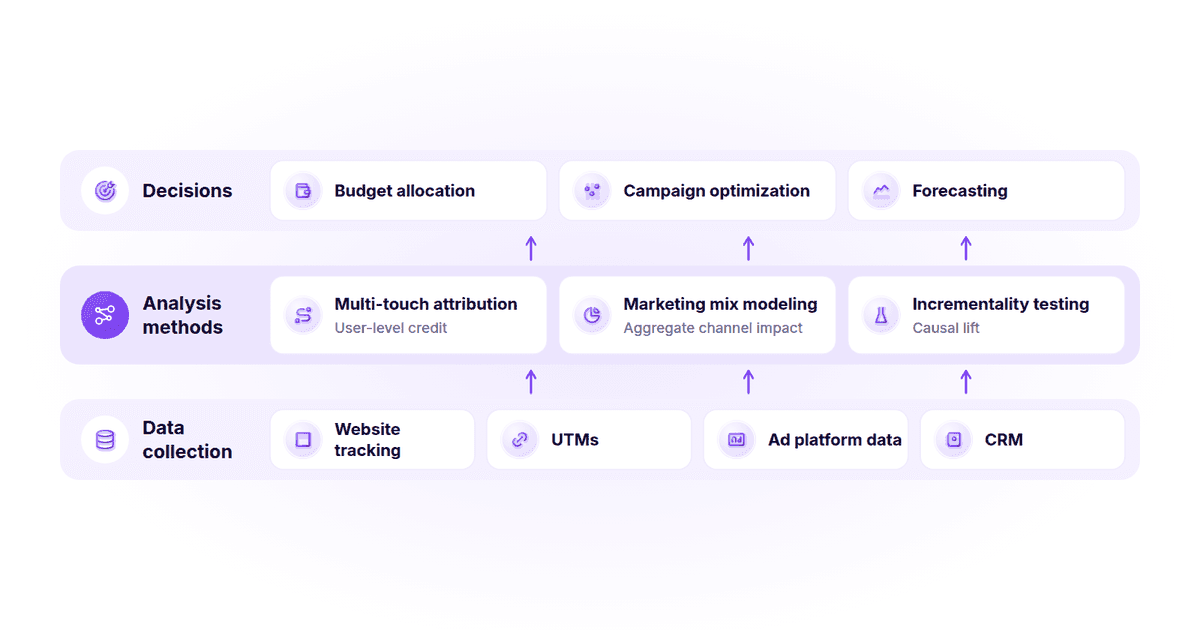
Marketing measurement tools are software that helps you understand how your marketing activities contribute to business outcomes such as signups, leads, pipeline, and revenue. They collect data from your website, ad platforms, and CRM, then use methods like attribution, statistical modeling, or controlled experiments to estimate which channels and campaigns are working.
The best tool for you depends on the question you’re trying to answer. “Which campaigns touched our closed-won deals?” needs a different tool than “What happens to revenue if we cut TV spend by 20%?”
Types of marketing measurement tools
Before comparing products, it helps to know which category you actually need.
| Tool type | Question it answers | Data it needs | Best for |
|---|---|---|---|
| Web and product analytics | What are people doing on our site and in our product? | Website and product events | Every team, as a foundation |
| Multi-touch attribution | Which touchpoints get credit for conversions and revenue? | User-level journeys, UTMs, ad spend, conversions | Digital-heavy teams with trackable journeys |
| CRM attribution reporting | Which campaigns influenced contacts and deals in our CRM? | CRM records tied to marketing interactions | Teams already running HubSpot or Salesforce |
| Marketing mix modeling (MMM) | How does each channel affect outcomes at an aggregate level? | A long, consistent history of spend and outcome data | Larger budgets and offline channels |
| Incrementality testing | Did this campaign cause extra conversions? | Test and control groups, enough volume to detect lift | Validating big spend decisions |
| Data integration and reporting | How do we get all our marketing data into one place? | Connections to ad, analytics, and CRM platforms | Teams with many data sources and BI needs |
These methods complement each other. Attribution is fast and detailed, but it only sees trackable touchpoints and doesn’t prove causation. MMM covers offline and hard-to-track channels but works at an aggregate level. Incrementality tests come closest to proving cause, but they take time and volume. Our comparison of multi-touch attribution vs marketing mix modeling and our guide to incrementality vs attribution go deeper on the trade-offs.
Marketing measurement tools at a glance
| Tool | Main category | Best for |
|---|---|---|
| Usermaven | Multi-touch attribution with web and product analytics | B2B SaaS teams connecting ad spend to pipeline and revenue |
| Google Analytics 4 | Web analytics with built-in attribution | Free baseline website and conversion measurement |
| HubSpot attribution reports | CRM attribution reporting | Teams already on HubSpot Marketing Hub Professional or Enterprise |
| Dreamdata | B2B account-based attribution | B2B teams focused on account journeys |
| HockeyStack | B2B attribution and GTM analytics | B2B teams wanting attribution plus lift reports |
| Northbeam | Attribution, MMM, and incrementality | Ecommerce and DTC brands with large paid budgets |
| Rockerbox | Unified measurement | Consumer brands combining MTA, MMM, and testing |
| Measured | Incrementality testing and MMM | Enterprise brands validating media spend |
| Google Meridian | Open-source MMM | Teams with data science resources |
| Meta Robyn | Open-source MMM | Teams with data science resources |
| Funnel | Data integration with measurement add-ons | Marketing and data teams centralizing data |
| Supermetrics | Data integration and reporting | Teams feeding warehouses, sheets, and dashboards |
The 12 best marketing measurement tools
1. Usermaven
Category: Multi-touch attribution with website and product analytics
Usermaven is an AI-powered marketing attribution platform built for B2B SaaS companies and agencies. It connects marketing spend and customer journeys to conversions, pipeline, and revenue, so teams can see which channels, campaigns, and ads actually contribute to growth and where to invest next.
What sets it apart is that attribution, website analytics, product analytics, and CRM outcomes live in one place. Instead of stitching together reports from ad platforms, Google Analytics, and your CRM, you can follow a buyer from their first ad click to a closed deal.
Key capabilities:
- Multi-touch attribution with eight models, including first touch, last touch, linear, U-shaped, time decay, first and last non-direct, and custom models. You can compare models side by side and use lookback windows of up to 365 days to match long B2B sales cycles.
- Paid ads attribution that imports spend from Google Ads, Meta Ads, LinkedIn Ads, and Microsoft Ads to show attributed ROAS by network and campaign. Conversion Sync can send conversion and revenue events back to Google Ads and Meta when the required identifiers are available, which helps ad algorithms optimize for real outcomes.
- Full-funnel revenue attribution that brings HubSpot and Salesforce outcomes alongside the marketing activity Usermaven tracks. Conversion goals can also be marked by lead stage, such as MQL or SQL, so you can see which channels drive each stage of the funnel.
- Event Sources for importing conversions your website can’t see, from tools such as Stripe, Paddle, webhooks, and CSV files.
- Website and product analytics, funnels, customer journeys, and retention analysis in the same platform.
- Maven AI for asking questions about your attribution and analytics data in plain English, plus scheduled AI Agents that deliver recurring analysis by email or Slack.
Best for: B2B SaaS teams and agencies running paid campaigns who need to connect ad spend and touchpoints to demos, opportunities, and revenue.
Pricing: Customized pricing through Business and Enterprise plans. You can see plan details and book a demo for a quote.
2. Google Analytics 4
Category: Web analytics with built-in attribution
Google Analytics 4 is the default starting point for most websites. It tracks traffic, engagement, and key events, and it includes attribution reports that show how channels contribute to conversions.
Those reports currently offer three models: data-driven, paid and organic last click, and Google paid channels last click, according to Google’s attribution documentation. Google retired the first click, linear, time decay, and position-based models in November 2023. You can choose the reporting model, decide which channels can receive credit, and set the key event lookback window. Changing these settings requires the Marketer role or above.
GA4’s data-driven attribution model is built separately for each advertiser and key event, which is useful when you have enough conversion volume. Google also notes that conversions can be reattributed for up to seven days after they happen, so recent numbers can shift.
Best for: A free baseline for traffic, engagement, and conversion reporting.
Consider: GA4 doesn’t connect to CRM pipeline or revenue on its own, and it offers limited model choice. Our list of Google Analytics limitations covers the common gaps.
3. HubSpot attribution reports
Category: CRM attribution reporting
If your team runs on HubSpot, its attribution reports are a natural place to start because the data already sits in your CRM. HubSpot’s attribution documentation lists three report types: contact create, deal create, and revenue attribution.
HubSpot’s current attribution report documentation lists first touch, last touch, linear, time decay, and an empirical model. You can break results down by UTM campaign, source, medium, content, and term, which makes it easier to compare campaigns if your tagging is consistent.
Best for: Teams that already use HubSpot and want attribution inside their CRM.
Consider: Attribution reports require Marketing Hub or Content Hub at the Professional or Enterprise tier, and deal create and revenue attribution reports are Marketing Hub Enterprise only. Reporting quality also depends on how well website and ad activity is captured. See HubSpot attribution limitations for details.
4. Dreamdata
Category: B2B account-based attribution
Dreamdata describes itself as a B2B attribution platform. It automatically organizes activities, campaigns, and channels by account and ties them to revenue, which suits buying journeys where several people from one company are involved.
Beyond attribution, its product includes customer journey views, an analytics hub, and audience features that send enriched pipeline data and intent signals back to ad platforms. Its AI assistant is designed to answer questions about marketing’s impact and trace each answer back to the source data.
Best for: B2B marketing teams that want account-level journey and revenue attribution.
Consider: Pricing isn’t listed on its homepage. If you’re comparing options, our roundup of Dreamdata alternatives covers similar tools.
5. HockeyStack
Category: B2B attribution and GTM analytics
HockeyStack positions itself as a B2B revenue data platform for marketing, GTM operations, and sales leaders. Its multi-touch attribution lets you apply different models and compare them side by side.
It also offers lift reports that compare exposed and unexposed accounts to estimate which campaigns drive conversions. Cookieless tracking aims to capture early research activity that CRM and last-touch reports miss, and two-way data syncing connects HockeyStack with CRMs, ad platforms, and data warehouses.
Best for: B2B marketing and GTM operations teams that want attribution and account-level lift analysis.
Consider: It lists custom enterprise pricing.
6. Northbeam
Category: Multi-touch attribution, MMM, and incrementality
Northbeam offers multi-touch attribution, media mix modeling, and incrementality in one measurement suite. Its attribution is built on first-party data, and it offers a view-through model it calls Clicks + Deterministic Views.
Its MMM product is designed for faster budget decisions, and its Apex feature sends Northbeam’s ad performance data back to ad platform algorithms. Its featured customers are mostly direct-to-consumer brands.
Best for: Ecommerce and DTC brands with significant paid media budgets.
Consider: Its focus is consumer purchase journeys, which look different from long B2B sales cycles with CRM stages.
7. Rockerbox
Category: Unified measurement
Rockerbox describes itself as a unified measurement platform built on a centralized, SOC 2 certified data foundation. It combines multi-touch attribution, incrementality testing, and MMM so teams can compare results from different methods in one place.
It integrates with data warehouses such as BigQuery, Redshift, and Snowflake and lists 100+ integrations. Its site notes that testing can start in one to two weeks, while MTA or MMM can take six to eight weeks to set up.
Best for: Consumer brands that want several measurement methods in one place.
Consider: Pricing isn’t stated on its homepage, and its customer examples are mostly consumer brands.
8. Measured
Category: Incrementality testing and MMM
Measured calls itself a marketing effectiveness platform for enterprise brands. Its core strength is experimentation: it runs automated geo and audience split tests to measure how much lift each channel creates.
It also offers a causal MMM that’s calibrated with those incrementality tests, a cross-channel dashboard for media reporting, and more than 300 managed data connections.
Best for: Enterprise brands that need to validate large media investments with experiments.
Consider: It’s aimed at enterprise budgets. Smaller teams may find a lighter incrementality testing approach more practical.
9. Google Meridian
Category: Open-source marketing mix modeling
Google Meridian is an open-source MMM built by Google. It estimates how each channel contributes to outcomes and helps teams plan budgets across channels.
Meridian supports calibrating models with experiments, including its GeoX geo-testing tools. It can also model reach and frequency for video planning and use search query volume data to control for organic demand, which helps separate marketing impact from people who were already searching for you.
Best for: Teams with data science skills who want a free, transparent MMM framework.
Consider: Open source means you handle data preparation, modeling, and interpretation yourself. Our marketing mix modeling readiness guide helps you check whether you have enough data.
10. Meta Robyn
Category: Open-source marketing mix modeling
Robyn is an experimental, open-source MMM package from Meta Marketing Science. It uses machine learning to automate much of the model tuning, including hyperparameter optimization with evolutionary algorithms.
It includes a budget allocator for testing spend scenarios and can be calibrated with ground-truth methods such as geo tests, lift studies, and attribution data. Because it works with aggregated data, it doesn’t require personal or log-level user data.
Best for: Analysts comfortable working in code who want an open MMM option.
Consider: Like Meridian, it’s a framework rather than a managed product, so it needs in-house expertise.
11. Funnel
Category: Data integration with measurement add-ons
Funnel is best known as a marketing data hub for marketers, data teams, and agencies. It offers more than 600 connectors and stores complete historical data, so you can build reports without losing older numbers when platforms change.
Its Funnel Measure product adds MMM, multi-touch attribution, and incrementality testing on top of that data, and Funnel also offers an MCP connection for using its data in AI tools.
Best for: Marketing and data teams that need to centralize data from many platforms before measuring it.
Consider: Pricing isn’t listed on its homepage. Make sure you know which measurement features are included in the package you’re evaluating.
12. Supermetrics
Category: Data integration and reporting
Supermetrics moves data from ad platforms, analytics tools, and CRMs into the places your team already works. That includes warehouses such as BigQuery and Snowflake, Google Sheets, Looker Studio, and AI tools through its MCP server.
It also offers Supermetrics Studio, its own dashboard builder on live data, and serves everyone from small businesses to enterprises that need features like SSO and region selection.
Best for: Teams that want marketing data in spreadsheets, dashboards, or a warehouse.
Consider: Supermetrics moves and reports data. It doesn’t assign attribution credit or model incrementality on its own.
Maximize your ROI
with accurate attribution
How to choose a marketing measurement tool
The right choice starts with your decisions, not a feature list. Work through these steps.
Start with the question you need answered
Write down the two or three decisions you want measurement to support. “Should we shift budget from Meta to LinkedIn?” points to paid ads attribution. “Is our brand spend driving sales?” points to MMM or incrementality testing. “Which content influences pipeline?” points to multi-touch attribution connected to your CRM.
Match the tool to your buying journey
B2B SaaS journeys often span weeks or months, involve several people, and end in a CRM deal rather than a checkout. Tools built for ecommerce purchases may not handle lead stages, opportunities, and account-level journeys well. Our guide to B2B marketing attribution explains what to look for.
Check your data readiness
Every method depends on clean inputs. For attribution, that means consistent UTM parameters, reliable conversion tracking, and identity matching between website visitors and CRM contacts. Ad blockers and browser restrictions can also hide data, which is why many teams look at server-side tracking.
For MMM, you typically need a long history of consistent spend and outcome data. For incrementality testing, you need enough conversion volume to detect a real difference between test and control groups.
Understand how the tool assigns credit
Different models can tell very different stories. In Usermaven’s attribution model disagreement benchmark, first-touch and last-touch models named a different top channel in 16 of 94 SaaS workspaces (17.0%). Choose a tool that lets you compare models, and read our guide on how to choose an attribution model before you commit to one.
Check integrations with your stack
Make a list of the platforms you need connected: ad networks, CRM, billing, and analytics. Confirm each integration supports what you need, such as importing spend, syncing deals, or sending conversions back to ad platforms. Don’t assume every listed integration works in both directions.
Compare total cost, not just the license
Factor in implementation time, data engineering, analyst hours, and onboarding. An open-source MMM may have no license fee but require significant in-house work. Our breakdown of marketing attribution software cost covers what drives pricing.
Run a pilot against known outcomes
During a trial or proof of concept, check the tool’s numbers against data you trust, such as closed-won deals in your CRM. Expect some differences between tools. Our guide to attribution discrepancies between tools explains where gaps usually come from.
Building a measurement stack by company stage
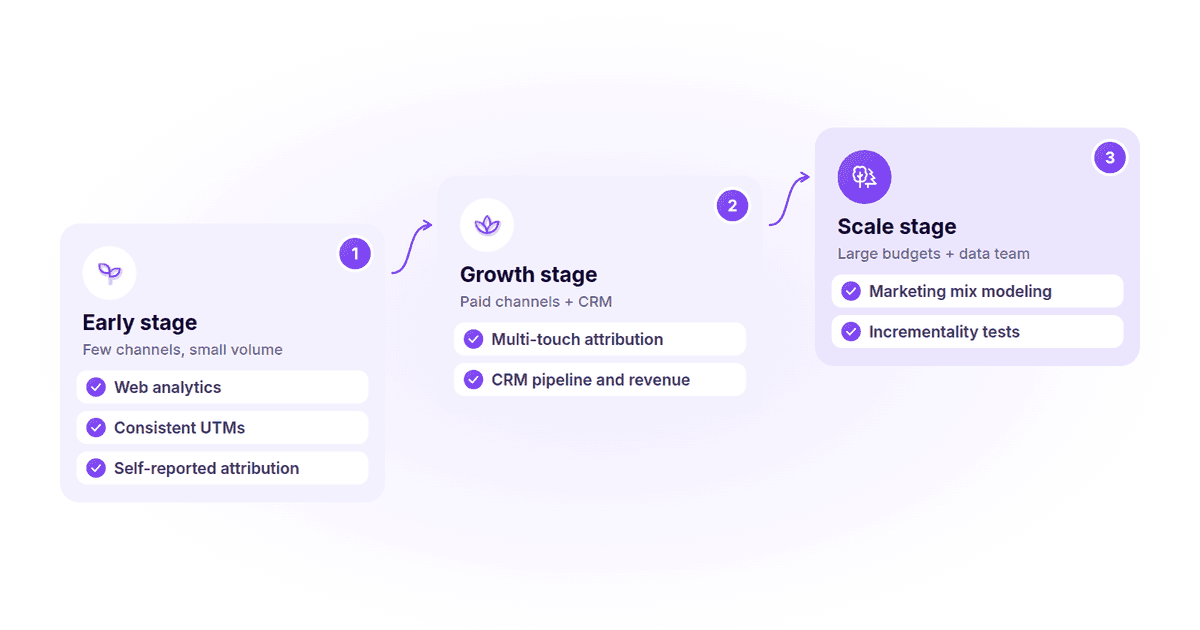
Most teams add measurement methods over time rather than buying everything at once.
| Stage | Typical situation | Recommended measurement approach |
|---|---|---|
| Early stage | Few channels, limited budget, small conversion volume | Web analytics, consistent UTMs, conversion tracking, and self-reported attribution on forms |
| Growth stage | Several paid channels, a CRM, growing sales team | Add multi-touch attribution connected to CRM pipeline and revenue |
| Scale stage | Large budgets, offline or brand channels, data team | Add MMM and incrementality tests to validate and calibrate attribution |
There’s a real gap here in practice. Usermaven’s audit of 1,110 B2B SaaS websites found that 84.4% of sites running ad pixels had no detectable dedicated attribution tool. Many teams spend on ads while relying on platform-reported numbers.
Common mistakes when choosing measurement tools
- Trusting ad platform reporting alone. Each platform measures its own contribution with its own rules, so totals often add up to more conversions than you actually had.
- Buying MMM too early. Without enough historical data and spend variation, model results can be unstable.
- Treating attribution as proof of cause. Attribution shows which tracked touchpoints were present, not what would have happened without them. Use tests to validate big decisions.
- Ignoring data quality. Missing UTMs, duplicate events, and unmatched CRM contacts weaken any tool’s output.
- Measuring clicks instead of revenue. For B2B SaaS, optimizing for leads without checking pipeline and revenue can reward the wrong campaigns. Track metrics like ROAS against real revenue where you can.
- Picking a tool nobody uses. If reports are hard to read or set up, the team falls back on spreadsheets.
How Usermaven helps B2B SaaS teams measure marketing
For most B2B SaaS teams, the biggest measurement gap is connecting ad spend and touchpoints to pipeline and revenue. Usermaven is built to close that gap, and to make the results easy to trust and act on.
- Know which channels drive revenue, not just clicks. Follow each buyer from first touch to closed deal, compare attribution models side by side, and use lookback windows of up to 365 days that fit long B2B sales cycles.
- Spend ad budget with more confidence. See attributed ROAS for Google, Meta, LinkedIn, and Microsoft Ads in one view, and send conversions back to Google Ads and Meta so their algorithms optimize for outcomes that matter.
- Measure every stage of the funnel. Connect HubSpot and Salesforce deal data, import billing and offline conversions with Event Sources, and see which campaigns produce leads, MQLs, SQLs, and customers.
- Trust the numbers you report. The Measurement Trust Center scores data quality across collection, identity, integrations, delivery, and reliability, and flags issues to fix before they distort your reports.
- Get answers in minutes. Maven AI answers questions about your attribution data in plain English, and automated reports and alerts keep your team updated in Slack or email.
Agencies use it too. See how Salt Marketing Group standardized cross-domain attribution across more than 15 client accounts.
Teams that also run MMM or incrementality tests can use Usermaven alongside them. Attribution supplies the campaign-level, day-to-day detail that aggregate models and periodic tests don’t capture, so you can act between larger measurement cycles.
See Usermaven in action
Book a free demo and discover how powerful analytics can grow your business.
Conclusion
The best marketing measurement tool is the one that answers the decisions in front of you with data you can trust. Start with clean tracking and an attribution tool that connects to your CRM, then add MMM and incrementality testing as your budget and data grow.
If you want to see which channels and campaigns drive your pipeline and revenue, book a Usermaven demo and explore attribution on your own data.
FAQs
What is the difference between marketing measurement and marketing attribution?
Marketing measurement is the broader practice of understanding marketing’s impact. It includes attribution, marketing mix modeling, and incrementality testing. Attribution is one method that assigns credit to the touchpoints in a customer journey. Our guide to marketing analytics vs attribution covers related differences.
Is Google Analytics 4 enough for marketing measurement?
For a basic view of traffic and conversions, often yes. GA4 doesn’t connect marketing to CRM pipeline or revenue on its own, and it offers only three attribution models in its attribution reports. B2B teams usually need a tool that links touchpoints to deals.
Which marketing measurement tool is best for B2B SaaS?
Look for tools that handle long journeys, connect to your CRM, and report on pipeline and revenue rather than only on clicks or form fills. Usermaven, Dreamdata, HockeyStack, and HubSpot’s attribution reports are all built with B2B use cases in mind.
Do small businesses need marketing mix modeling?
Usually not at first. MMM works best with consistent spend across several channels and a long data history. Smaller teams typically get more value from good tracking and multi-touch attribution first.
What is the most accurate marketing measurement method?
No single method is fully accurate. Incrementality testing comes closest to measuring cause and effect, but it’s slow and needs volume. Most teams combine attribution for daily decisions with tests or MMM to validate them.
How much do marketing measurement tools cost?
It varies widely. Google Analytics 4 has a free standard version, open-source MMM frameworks like Meridian and Robyn have no license fee, and many attribution and measurement platforms use custom pricing. Include setup and analyst time in your estimate.
Can I use more than one marketing measurement tool?
Yes, and many teams do. A common setup combines web analytics, a multi-touch attribution tool connected to the CRM, and periodic incrementality tests or MMM for budget planning.

Written by
Imrana Essa
SaaS Marketing Lead
Imrana Essa is a marketing lead and content strategist with 8+ years of experience creating and leading content for B2B and SaaS brands. She specializes in marketing analytics, attribution, content strategy, and organic growth, translating complex marketing concepts into clear, actionable insights. Her work focuses on helping marketers understand performance, make data-informed decisions, and build strategies that contribute to sustainable growth.
All articles by Imrana →