Analytics says a buyer came from branded Google search. On the demo form, the buyer writes that they first heard about the company on a podcast. Neither answer has to be wrong.
One records an observable visit; the other records what the buyer remembers.
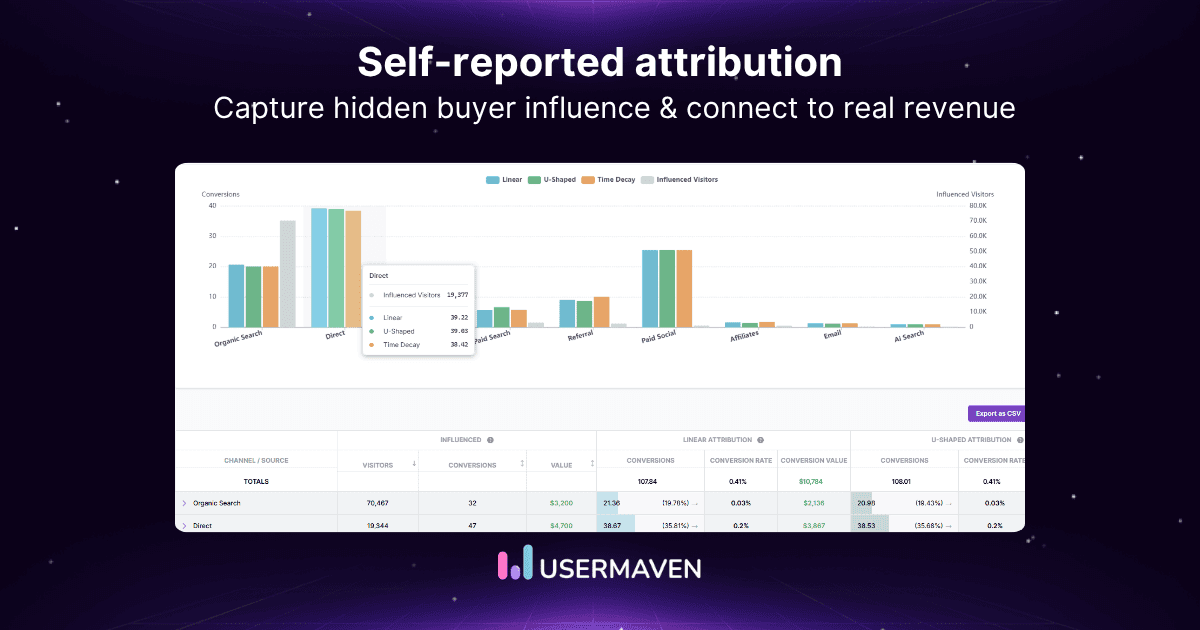
Self-reported attribution is useful precisely because important discovery often happens where software has weak visibility: word of mouth, private communities, podcasts, offline conversations, and AI assistants.
Its weakness is equally important: the data comes from human memory, not a complete journey log.
This guide shows how to ask the right question, preserve and normalize responses, analyze reported sources, and reconcile buyer-declared evidence with customer journeys, CRM outcomes, and revenue inside marketing attribution software.
Self-reported attribution at a glance
Self-reported attribution is a method of asking buyers directly how they discovered or were influenced by a company, usually through a question such as “How did you hear about us?”
It can surface sources that never create a reliable trackable click, but it should complement rather than replace tracked attribution.
| Question | Short answer | Why it matters |
| What does SRA measure? | Buyer-remembered discovery or influence | Captures signals tracking may miss |
| Is it the same as tracked attribution? | No | Memory and observed behavior are different evidence |
| Does it solve the dark funnel? | No | It adds visibility but remains incomplete |
| What question should be asked? | Depends on discovery vs trigger | Question wording changes the answer |
| Should answers be open text? | Often useful, but not always | Open text discovers sources; structured answers scale analysis |
| Can SRA prove causality? | No | It reports remembered influence, not incremental impact |
| Should it replace software attribution? | No | The strongest approach combines both |
Key takeaways
- Self-reported attribution captures remembered influence: It can surface podcasts, communities, referrals, AI assistants, and offline discovery that software may not observe.
- Reported and tracked sources can both be correct: A buyer can discover a brand through one source and later convert through a different observable path.
- Question wording changes the data: “How did you first hear about us?” measures discovery, while “What made you reach out today?” measures the trigger.
- Keep the raw answer: Normalize responses for reporting without replacing the original buyer language.
- Response volume is not usable data: Vague answers such as “Google” or “online” can be completed fields without being actionable attribution evidence.
- Self-reported data has bias: Recall, salience, recency, and buying-committee gaps mean it should be interpreted directionally.
- Commercial outcomes matter: Reported-source counts become more useful when connected to pipeline, revenue, retention, or another meaningful outcome.
What is self-reported attribution?
Self-reported attribution is the practice of asking prospects or customers which source, channel, person, content, or experience they believe led them to discover or engage with a business.
It is one input within broader marketing attribution , not a replacement for behavioral measurement.
The answer can be collected on a form, during a sales conversation, in a post-purchase survey, or at another meaningful conversion point.
What matters is knowing which question was asked and what stage of the journey the answer is supposed to describe.
A simple example
| Podcast → branded search → pricing page → demo |
The tracked journey may identify branded search as the observable acquisition or closing touch. The buyer may report “podcast” because that was the memorable source that created awareness.
The two answers describe different evidence from the same journey.
What self-reported attribution actually measures
The phrase “How did you hear about us?” often hides several different measurement questions.
A useful setup begins by deciding whether the business wants to capture discovery, remembered influence, or the reason the buyer acted now.
Discovery
Discovery asks where awareness began. A buyer may say a colleague, a podcast, LinkedIn, a conference, or ChatGPT.
This is useful when the goal is to understand how the brand first enters the buyer’s consideration set.
Remembered influence
Influence asks what stood out strongly enough for the buyer to remember. The answer may not be the first or last touch.
It can be the source that shaped the buyer’s perception even when another channel captured the conversion.
Conversion trigger
A trigger asks what prompted action now. A buyer might first hear about a company on a podcast, follow it for months, then request a demo after reading a comparison page.
Discovery and trigger should not be forced into one source field.
| Evidence | Question answered |
| First reported source | Where did awareness begin? |
| Strongest remembered influence | What stood out enough to remember? |
| Conversion trigger | What prompted action now? |
| Tracked last touch | What observable interaction preceded conversion? |
See what's working. Fix what's not. Grow faster.
Self-reported vs tracked attribution
Self-reported and tracked attribution should be treated as complementary evidence systems. One records what a person says they remember.
The other records interactions that the measurement stack can observe and connect to an identity or outcome.
| Dimension | Self-reported attribution | Tracked attribution |
| Evidence source | Buyer memory | Recorded interactions |
| Podcasts / word of mouth | Stronger visibility | Often weak without a trackable action |
| Communities / private social | Can surface them | Usually limited |
| Campaign precision | Usually low | Higher |
| Exact journey sequence | Weak | Stronger |
| Recall bias | Yes | No human recall bias |
| Tracking gaps | Less dependent on clicks | Can suffer collection and identity gaps |
| Revenue connection | Requires a join to business outcomes | Can be joined directly |
| Causality | No | No |
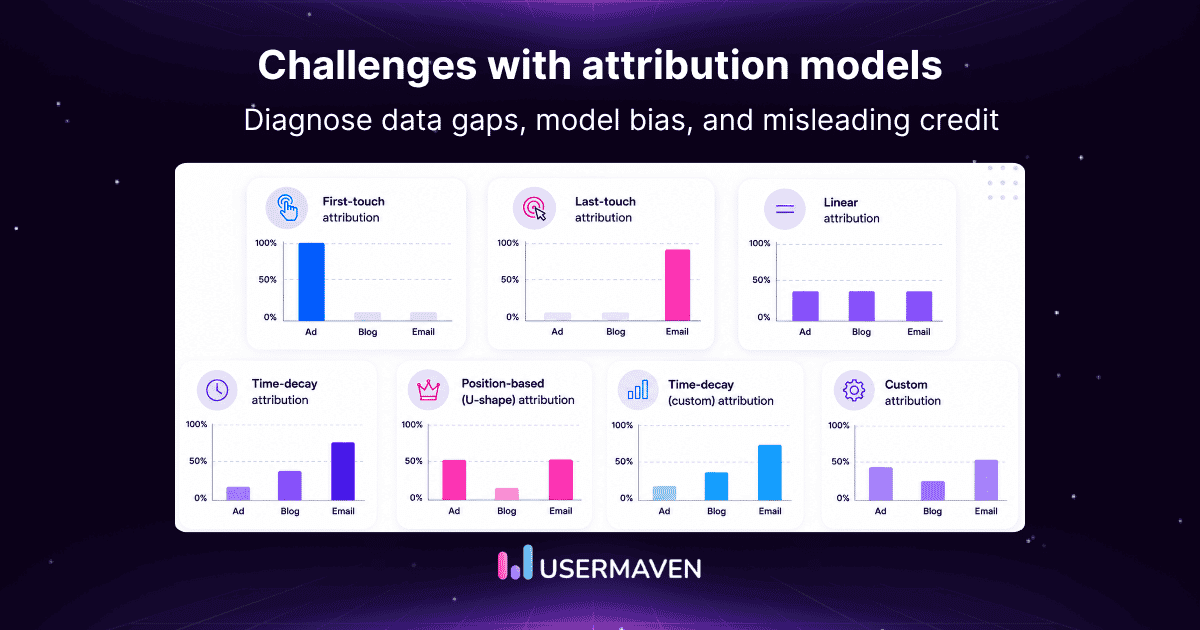
A customer journey analytics view can explain the observable sequence around a conversion, while self-reported data adds the buyer’s remembered context.
The most useful analysis keeps both rather than asking which one is universally “right.”
Self-reported attribution and the dark funnel
Self-reported attribution became popular because many demand-creating moments are difficult to observe with standard analytics.
A buyer can hear a recommendation, remember a brand, and later arrive through search or Direct without leaving a measurable trail back to the original influence.
What tracking can observe
Tracking is strongest when first-party data records an identifiable interaction: a tagged click, website visit, form submission, event, product action, or CRM conversion.
Those interactions can be sequenced and compared with greater precision than a memory-based response.
What tracking may miss
Private Slack messages, peer recommendations, conference conversations, podcasts, forwarded content, offline discussions, and unclicked social exposure may shape demand without producing a reliable click.
AI-assisted discovery can create the same problem when the buyer later searches for the brand independently.
What self-reported attribution adds
SRA gives those hidden influences a chance to appear as declared evidence. It does not make the dark funnel fully observable. It adds another signal to the attribution blind spot rather than eliminating uncertainty.
This is particularly useful for channels such as audio.
A podcast attribution workflow can combine tracked entry points with qualitative answers when listeners hear a brand, remember it, and return later through search or another channel .
Unlock insights that drive growth
Discovery question vs conversion-trigger question
The most common SRA mistake is asking one vague question and treating every answer as a complete source of truth.
A better approach is to decide whether the business wants to measure first discovery or the reason a prospect is taking action now.
“How did you first hear about us?”
Use this when the goal is discovery. It asks the buyer to recall the earliest memorable source. Typical answers include a colleague, podcast, Google, LinkedIn, event, review site, or AI assistant.
“What made you decide to reach out today?”
Use this when the goal is the trigger. The answer may identify a pricing comparison, customer story, new internal requirement, sales conversation, or recommendation that moved the buyer from awareness into active evaluation.
Why both answers can matter
A buyer can truthfully report “podcast” as discovery, “comparison article” as the trigger, and still have branded search as the tracked last touch. These are not competing labels.
They are different stages of one decision process.
Which self-reported attribution question should you ask?
Question design should follow the measurement objective. Avoid stacking several attribution questions on a conversion form simply because each one sounds useful.
More questions add friction and can produce answers that are hard to interpret together.
| Goal | Suggested question | Best use |
| First discovery | How did you first hear about us? | Awareness analysis |
| General source | How did you hear about us? | Simple SRA setup |
| Trigger | What made you decide to reach out today? | Conversion analysis |
| Influence | What influenced your decision to evaluate us? | Longer B2B journeys |
| Hidden source | Was there a person, community, podcast, or AI tool that influenced you? | Dark-funnel investigation |
Open text, dropdown, or hybrid?
The collection format affects both response quality and analysis effort. Open text can discover sources the team did not anticipate. Structured options are easier to report.
A hybrid approach can preserve structure while allowing the buyer to add context.
Open-text responses
Open text reduces priming and captures the buyer’s own language. It is useful when the company is still learning which sources matter.
The trade-off is normalization: “friend,” “coworker,” and “our VP used you before” may all need to become one referral category.
Dropdown
A dropdown creates clean categories from day one and makes reporting easier at scale.
The downside is that predefined options can shape the answer and hide sources the marketing team did not know to include.
Hybrid approach
A hybrid field can ask the buyer to select a broad source and optionally explain further.
This is useful when the business needs stable reporting categories but still wants qualitative detail such as the podcast name, community, person, or AI assistant.
| Format | Best for | Main trade-off |
| Open text | Discovery and source learning | Harder normalization |
| Dropdown | High-volume reporting | Priming and missing unknown sources |
| Hybrid | Structure plus context | Slightly more friction |
| Sales conversation | Complex B2B journeys | Rep consistency |
Where should you ask the attribution question?
The best capture point is close enough to a meaningful conversion that the response can be connected to a person or account, but not so early that the question creates avoidable friction.
B2B SaaS
For B2B SaaS teams , high-intent points such as demo requests, contact-sales forms, and discovery calls are usually more useful than an early newsletter signup.
The answer can later be compared with B2B marketing attribution data across account journeys, pipeline, and revenue.
Ecommerce
For ecommerce brands, the post-purchase or thank-you page is often a practical place to ask because the order is already complete. This avoids adding friction before checkout while preserving a connection to revenue.
PLG SaaS
A PLG company can ask at signup, after activation, or at upgrade.
Product analytics can help identify a meaningful post-signup point where the reported source can be compared with activation or upgrade behavior without adding unnecessary friction.
Agencies and service businesses
For marketing agencies and service businesses, inquiry forms and discovery calls can work well when leads are high value.
Use consistent wording and store the response in a structured field instead of leaving it in call notes that never reach attribution analysis.
How to store self-reported attribution data
Collection is only the first step. The answer should preserve buyer language while supporting analysis across contacts, accounts, lifecycle stages, and commercial outcomes.
For B2B teams, a marketing attribution CRM integration can keep reported source context connected to downstream CRM status.
| Raw answer → normalized category → contact/account → lifecycle stage → outcome |
Preserve the raw response
Never overwrite the original answer. “Saw someone recommend you in SaaS Growth Slack” contains more context than the normalized label “Community.” The raw field allows analysts to revisit classification when categories evolve.
Add a normalized source
Create a second field for stable reporting categories such as Word of mouth, Podcast, Community, Search, Paid social, Organic social, Event, Review site, AI assistant, or Other.
Keep both fields
| Field | Example |
| Raw response | Someone recommended you in SaaS Growth Slack |
| Normalized source | Community |
| Detail | SaaS Growth Slack |
| Response date | 2026-09-10 |
| Lifecycle stage | Demo |
| Commercial outcome | Opportunity / revenue when available |
How to normalize self-reported responses
Normalization turns qualitative answers into reportable categories. The goal is consistency, not the removal of nuance. A good taxonomy is broad enough to remain stable but detailed enough to support real marketing decisions.
| Raw response | Normalized category |
| ChatGPT | AI assistant |
| Claude recommended you | AI assistant |
| Saw you on Google | Search |
| My coworker uses you | Word of mouth |
| Podcast | Podcast |
| LinkedIn posts | Organic social |
| LinkedIn ad | Paid social |
| SaaS community | Community |
Do not over-normalize
A response such as “LinkedIn” may mean an ad, an employee post, an organic brand post, or a recommendation inside a message.
Preserve the raw answer and add detail when it is available instead of pretending the category is more precise than the evidence.
Self-reported attribution analysis
The analysis process should move from collection into normalization, segmentation, commercial outcomes, and comparison with tracked evidence. Counting answers alone is rarely enough to guide budget.
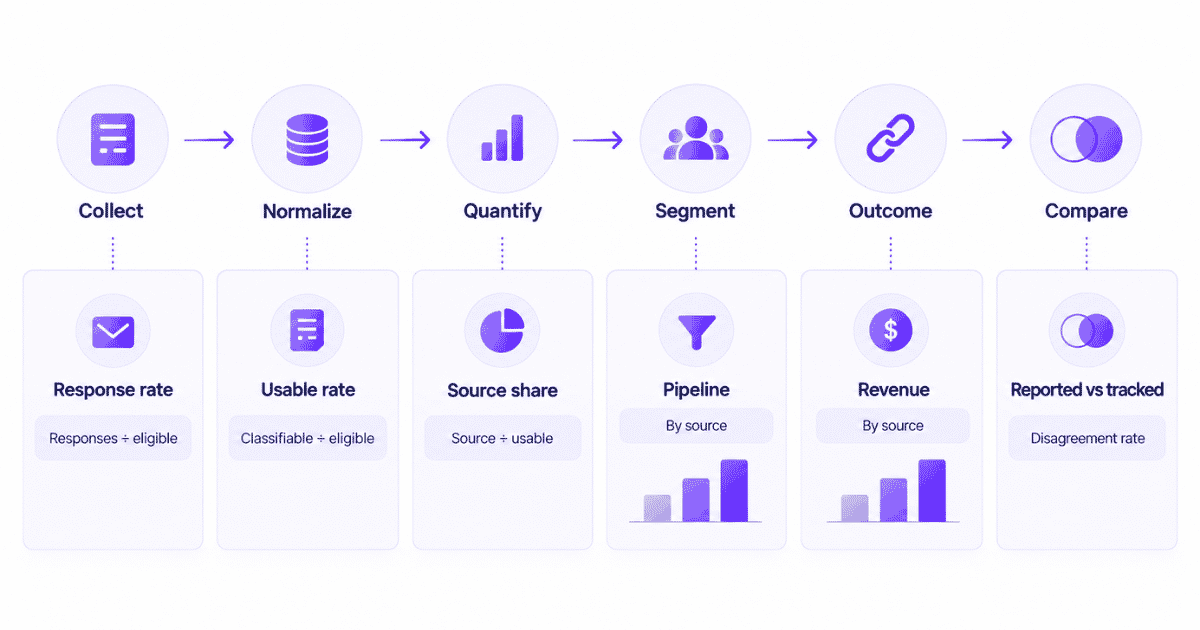
| Collect → normalize → quantify → segment → connect to outcome → compare with tracked data |
Response rate
| Response rate = responses ÷ eligible conversions × 100 |
Response rate shows whether the question is being answered, but it does not tell you whether those answers are specific enough to use.
Usable-response rate
| Usable-response rate = classifiable responses ÷ eligible conversions × 100 |
This distinction matters in practice. Not every respondent who completes an optional self-reported attribution field provides information that is useful for analysis. Some responses may be vague, incomplete, or too general to identify a specific marketing channel or touchpoint.
As a result, the response rate alone does not reflect the quality of the data collected. Measuring the usable-response rate helps teams understand how much self-reported attribution data can meaningfully support marketing decisions.
Reported-source share
| Reported-source share = responses naming a source ÷ total usable responses × 100 |
Source share is useful for discovering recurring themes, but it should not automatically become budget share. A frequently remembered source may be excellent at awareness while another channel captures or converts demand.
Pipeline and revenue by reported source
For B2B, the more useful question is often which reported sources are associated with qualified pipeline and Closed Won revenue.
For ecommerce or subscriptions, the same logic can extend into revenue, repeat purchase, retention, or LTV.
Reported vs tracked disagreement
| Disagreement rate = materially different reported and tracked sources ÷ matched responses × 100 |
Treat this as a diagnostic, not an error rate. A difference may reveal a hidden earlier influence rather than prove that the buyer or the tracking system is wrong.
How to interpret disagreement between reported and tracked sources
The most valuable SRA insight often appears when the declared source and the observed journey do not match. The correct response is not to force one field to overwrite the other.
It is to reconstruct what each source can explain.
| Evidence | Example |
| Self-reported source | Podcast |
| Tracked first observable source | Organic search |
| Tracked last touch | Branded search |
| CRM outcome | $30K opportunity |
A reasonable interpretation is that the podcast created awareness, search created the observable digital journey, and branded search captured the conversion. The opportunity value confirms the commercial outcome. Each layer answers a different question.
| Remembered influence → observable behavior → commercial outcome |
This hybrid view is also supported by CallRail’s current guidance on AI search and attribution, which recommends combining buyer-reported context with software-based attribution when AI or other hidden discovery sources precede a measurable conversion.
What self-reported attribution gets wrong
Self-reported data is useful because humans can report influences that software does not see. The same human element creates its limitations.
The answer should therefore be treated as directional evidence rather than a precise financial ledger.
Recall bias
Buyers may not remember the first interaction, especially in long journeys with repeated exposure. The answer they provide can reflect the strongest memory rather than the actual starting point.
Salience bias
Memorable experiences such as a podcast guest, conference, community discussion, or recommendation can receive disproportionate credit because they are easier to recall than routine retargeting or search interactions.
Recency bias
Recent interactions are easier to remember, so a buyer may report the latest meaningful touch even when earlier marketing created the initial demand.
Vague responses
Answers such as “Google,” “online,” or “social media” may be useful at a high level but provide little guidance about the campaign, keyword, content, or exact experience that mattered.
Buying-committee gaps
In B2B, the person completing the form may not know what influenced colleagues. A champion could report word of mouth while another stakeholder first discovered the brand through paid search or analyst research.
Response-selection bias
People who answer an optional question can differ from those who skip it. A high response rate improves coverage but does not make the dataset representative of every buyer automatically.
Self-reported attribution does not prove causality
A buyer saying “podcast” does not prove the podcast caused the purchase. It tells the team that the buyer remembers the podcast as relevant.
Tracked attribution has the same causal limitation: observing a touchpoint does not prove the outcome would disappear without it.
| Method | Main question |
| Self-reported attribution | What does the buyer remember? |
| Tracked attribution | What interactions can we observe? |
| Incrementality | What would not have happened without the marketing? |
When the budget decision depends on causality rather than contribution, experiments or other incrementality methods are better suited to the question.
AI search makes self-reported attribution more useful
AI discovery creates a modern version of an old attribution problem. A buyer may receive a recommendation inside an AI assistant, remember the brand, and later arrive through search or Direct.
The analytics system can record the visit without knowing what prompted it.
| ChatGPT recommendation → branded Google search → direct visit → demo |
The tracked source may be Google or Direct while the buyer reports ChatGPT. Similar paths can begin in Claude, Perplexity, Gemini, or another AI experience.
Buyer-reported attribution can preserve that discovery context when no referral click reaches the site.
Buyer-reported attribution can preserve that discovery context when no referral click reaches the site. Preserving the context is only half the job, though; the metrics that actually matter in AI search cover how to measure presence inside those assistants directly, rather than inferring it from what buyers remember.
Self-reported attribution vs self-attributing networks
The terminology is easy to confuse. Self-reported attribution is buyer-declared evidence. A self-attributing network is an advertising platform that applies its own measurement rules when claiming conversion credit.
Independent attribution evaluates multiple channels under one measurement framework.
| Term | Meaning |
| Self-reported attribution | Buyer supplies discovery or influence |
| Self-attributing network | Ad network claims conversion credit |
| Independent attribution | Cross-channel system applies consistent credit rules |
Do you need a self-reported attribution platform?
Usually not as a standalone requirement.
A useful SRA system needs a way to collect the answer, preserve the raw response, create normalized categories, connect it to a person or account, and compare the evidence with commercial outcomes.
| Form or survey → contact/CRM field → analytics → attribution → revenue |
Dedicated survey functionality can help with capture, but the decision value comes from joining buyer-declared context with the rest of the customer and revenue data.
A self-reported attribution product that leaves the answers isolated in a spreadsheet solves only part of the problem.
How to implement self-reported attribution
A good implementation is deliberately simple at the point of capture and disciplined behind the scenes. Start with one question and build the data process around it.
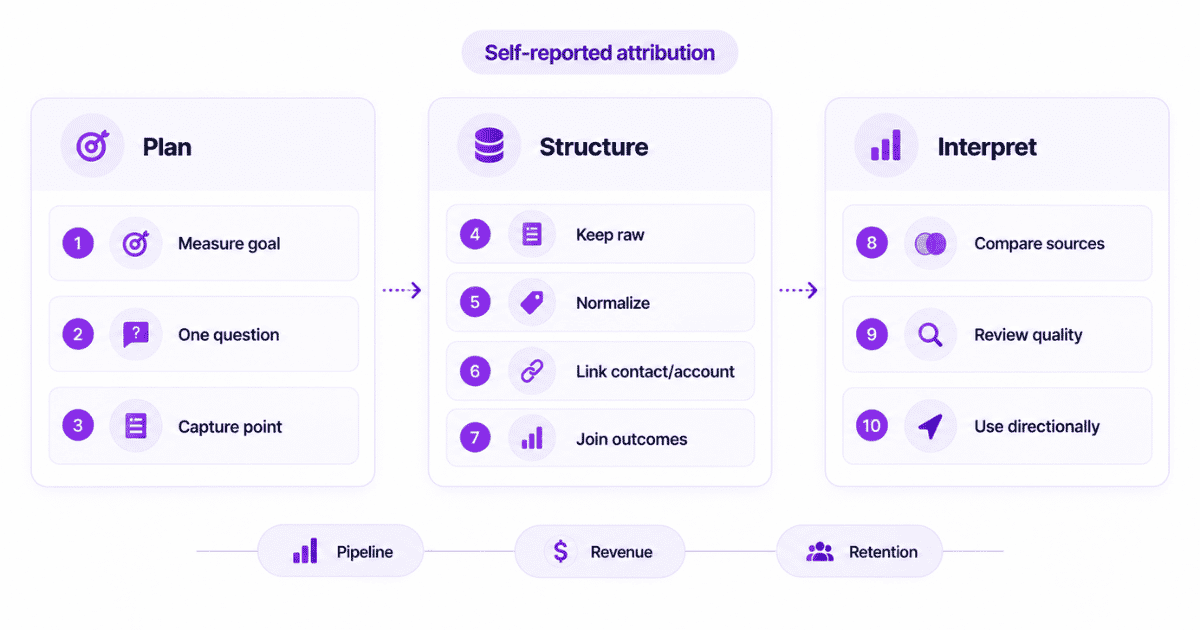
- Decide what you want to measure. Choose discovery, remembered influence, or conversion trigger before writing the field.
- Choose one primary question. Avoid turning the conversion form into a survey. One clear question produces easier-to-interpret responses.
- Choose the right capture point. Use demo, contact-sales, post-purchase, signup, upgrade, or a sales conversation based on the business model.
- Preserve the raw response. Keep the exact buyer wording so categories can be audited or updated later.
- Add normalized categories. Create a controlled taxonomy for reporting without deleting qualitative context.
- Connect the answer to the contact or account. SRA becomes more useful when it can follow the same buyer into pipeline or revenue.
- Join commercial outcomes. Analyze pipeline, revenue, retention, or LTV rather than relying only on source counts.
- Compare reported and tracked sources. Use disagreement to investigate the journey instead of forcing one source to win.
- Review the taxonomy regularly. New categories such as AI assistants can emerge and require a reporting update.
- Use SRA directionally. Do not allocate budget mechanically from survey share without checking tracked and commercial evidence.
How Usermaven supports self-reported attribution analysis
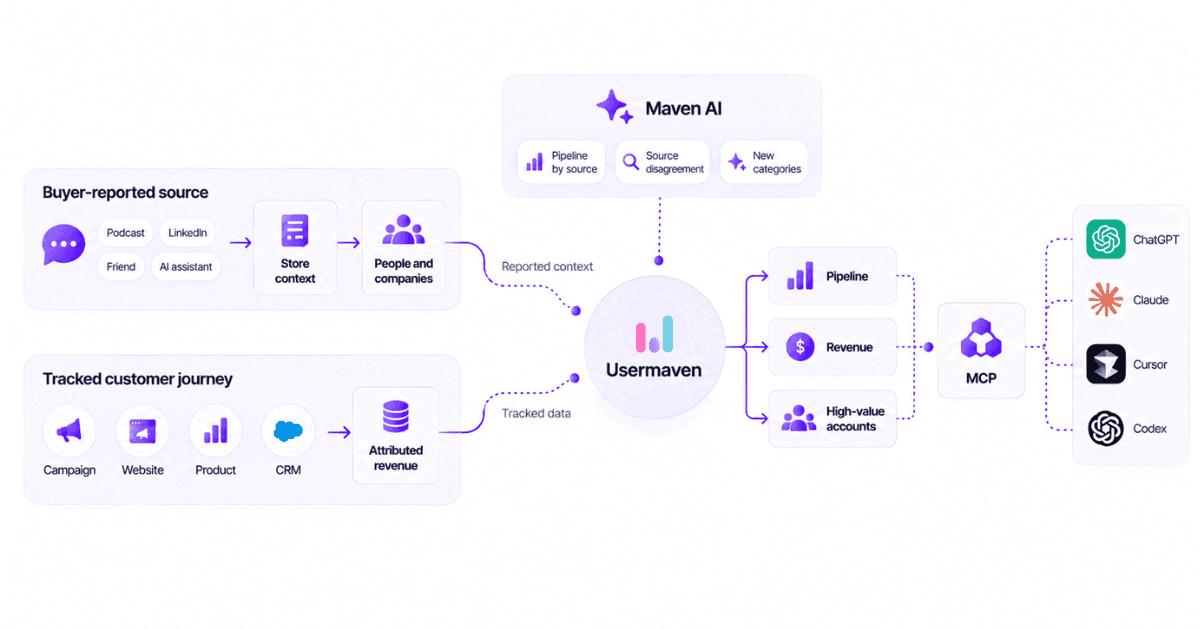
Usermaven helps marketing teams connect buyer-reported acquisition context with tracked customer journeys, lifecycle data, CRM outcomes, and revenue.
In this workflow, self-reported attribution becomes an additional source of evidence instead of an isolated survey result.
Store buyer-reported source context
For custom implementations, Usermaven’s lead capture supports additional properties, so a buyer-reported source can be sent with the contact record alongside campaign or lifecycle context.
The Events layer can capture related behavioral milestones before and after that response.
Compare reported context with tracked journeys
Tracked interactions can be inspected through User Journeys to see how the contact actually moved across visits and touchpoints.
A reported podcast or AI source can therefore sit beside the observable search, content, email, or paid journey.
Connect people, companies, and commercial outcomes
Contacts Hub provides the person and company context needed to keep reported answers connected with known customers. For revenue-focused analysis, revenue attribution extends the question from “what did buyers report?”
to “which reported sources are associated with pipeline and revenue?”
Use Maven AI to investigate patterns
Maven AI can query connected analytics data in plain language.
Useful questions include which reported sources generate the most pipeline, where reported and tracked sources disagree, and which acquisition paths are common among high-value accounts.
Use MCP in external AI workflows
Usermaven MCP connects Usermaven data with MCP-compatible tools such as ChatGPT, Claude, Cursor, and Codex.
That makes it possible to investigate attribution, journeys, reports, and revenue from an external AI workspace while keeping the analysis grounded in authorized Usermaven data.
Why marketing teams should reconcile both views
For marketing teams , the real value of SRA is not replacing tracked attribution.
It is adding another piece of context to campaign and channel decisions that already need to be defended against pipeline, revenue, and customer journeys.
Tracked attribution can underrepresent a podcast, private recommendation, or AI discovery. Self-reported data can overgeneralize the path into a memorable source. Revenue data tells the team whether the resulting customer was commercially meaningful.
| Reported source + tracked path + commercial outcome = stronger decision context |
Before trusting either view, the underlying measurement still needs to be healthy.
Usermaven’s Measurement Trust Center checks campaign tracking, customer matching, connected platforms, conversion feedback, and data confidence so attribution issues can be diagnosed before they influence budget.
Attribution blind spots in action: Hyperengage
Hyperengage is not a self-reported attribution case study.
It is useful here because it shows the tracked side of the same reconciliation problem: important demand sources can look weak when the measurement view overcredits the final interaction.
The measurement problem
Hyperengage’s B2B SaaS buyers moved through content, organic search, podcast-led distribution, LinkedIn, email, and partnerships before converting.
Platform dashboards and last-click reporting did not provide one reliable view of which channels contributed to qualified pipeline.
What changed
The Hyperengage case study reports that attributed channels expanded from 4 to 6, two new sources were uncovered, and 975 visitors completed the primary goal for a 22.19% visitor-to-goal conversion rate.
Organic search also gained first-touch credit that the previous view had missed.
Why the case matters for self-reported attribution
A buyer could remember a podcast or recommendation while tracked data reveals later content, organic, email, or paid interactions.
Hyperengage’s experience shows why the tracked journey itself can also be incomplete or misleading when attribution is too narrow.
The best SRA workflow therefore does not replace journey data. It preserves buyer-declared context and compares it with the measurable path and qualified commercial outcome.
Self-reported attribution checklist
- Define the question: Decide whether you want discovery, remembered influence, or the trigger.
- Choose the capture point: Ask close to a meaningful conversion without creating unnecessary friction.
- Keep raw responses: Preserve the buyer’s exact wording even after normalization.
- Normalize carefully: Create stable categories without pretending vague answers are more precise than they are.
- Keep context: Do not turn every “LinkedIn” or “Google” response into one fixed interpretation.
- Connect identities: Match the response to a contact or account when downstream analysis requires it.
- Join outcomes: Pipeline and revenue are more useful than source counts alone.
- Compare with tracked data: Treat disagreement as evidence about the journey, not automatic error.
- Review new sources: AI assistants, communities, and other discovery channels can emerge over time.
- Avoid overclaiming: Self-reported attribution measures remembered influence, not causality.
Final verdict
Self-reported attribution is valuable because meaningful discovery does not always produce a trackable click. It can surface word of mouth, podcasts, communities, offline conversations, and AI-assisted discovery that otherwise disappear from conventional attribution.
Its weakness is that the evidence comes from human memory. Raw answers should therefore be preserved, normalized carefully, and interpreted alongside tracked journeys rather than treated as an objective source ledger.
The strongest measurement approach combines buyer-reported influence, observable customer behavior, and commercial outcomes. That gives marketing teams complementary evidence for investment decisions without pretending any single attribution method can reconstruct the whole journey.
Ready to see Usermaven in action? Explore the platform or book a demo for a closer look.
FAQs
1. What is self-reported attribution?
Self-reported attribution is a method of asking prospects or customers which source or experience they believe led them to discover or engage with a business. It is commonly collected through a form, survey, or sales conversation and used alongside tracked attribution.
2. What question should I ask for self-reported attribution?
Use a question that matches the objective. “How did you first hear about us?” measures remembered discovery, while “What made you decide to reach out today?” is better for the conversion trigger. Do not treat those questions as interchangeable.
3. Is “How did you hear about us?” a good attribution question?
Yes, when the goal is a simple buyer-reported source signal. It is easy to understand and can surface hidden channels, but the answer may combine first discovery, strongest memory, and recent influence. More precise wording improves interpretation.
4. Should self-reported attribution use open text or a dropdown?
Open text is better for discovering unexpected sources and avoiding priming. Dropdowns are easier to analyze at scale. A hybrid approach works when the business needs stable categories plus optional buyer context.
5. How do you analyze self-reported attribution?
Preserve the raw response, normalize it into a reporting category, connect it to the contact or account, join pipeline or revenue outcomes, and compare it with tracked attribution. Response rate and usable-response rate should be measured separately.
6. Is self-reported attribution accurate?
It is useful but not perfectly accurate. Recall, salience, recency, vague answers, and buying-committee effects can influence responses. Treat SRA as directional evidence and compare it with behavioral and commercial data.
Updated

Written by
Ryan Mitchell
Marketing Analytics Strategist
Ryan Mitchell is a marketing analytics strategist specializing in campaign measurement, customer journeys, and marketing performance. He writes about analytics, reporting, and data-driven marketing strategies, helping SaaS and B2B teams measure what matters across every stage of the customer journey.
All articles by Ryan →