Your Google Ads conversions are up 25%. Organic traffic has grown 30%, and LinkedIn is bringing in more leads than last quarter.
On paper, marketing is performing well. But here’s the question: How much of that activity is actually contributing to revenue?

Google Ads claims the conversion. Your CRM credits organic search. Meanwhile, the same customer attended a webinar and clicked three emails before making a purchase.
So, which channel is really working, and where should your next $10,000 go?
That’s where marketing measurement comes in. It helps you connect marketing activity to conversions, customer acquisition, and revenue instead of relying on isolated channel reports.
In this guide, we’ll break down the methods, metrics, and practical steps you need to measure marketing performance and make smarter investment decisions.
Key points
- Marketing measurement connects activity to business outcomes. It helps you understand whether marketing is contributing to leads, pipeline, customers, revenue, and profitability rather than simply generating engagement.
- Different measurement methods answer different questions. Attribution explains which touchpoints received credit, marketing mix modeling estimates broader channel contributions, and incrementality testing helps determine what marketing actually caused.
- The right metrics depend on your goals. Traffic and engagement matter, but metrics such as customer acquisition cost (CAC), return on investment (ROI), pipeline, and customer lifetime value (LTV) provide a stronger view of business performance.
- Cross-channel measurement matters. Customers rarely interact with only one channel before converting. Connecting paid advertising, organic search, email, social media, and CRM data helps reduce fragmented reporting.
- Better measurement leads to better decisions. The goal isn’t to track every possible number. It’s to understand which activities are working, where performance is falling short, and what to improve next.
Unlock insights that drive growth
What is marketing measurement?
Marketing measurement is the process of collecting, analyzing, and interpreting data to understand how marketing activities contribute to business goals, including customer acquisition, conversions, revenue, and profitability.
It helps businesses answer questions such as:
- Which marketing channels are bringing in valuable customers?
- How much does it cost to acquire a customer?
- Which campaigns contribute to conversions and revenue?
- How does marketing influence the customer journey?
- Are marketing investments generating a positive return?
- What would happen if we increased or reduced spending on a particular channel?
Consider a B2B software company investing in SEO, paid search, LinkedIn advertising, and email marketing.
Its monthly reports show:
| Channel | Monthly spend | Leads generated |
| Google Ads | $8,000 | 200 |
| LinkedIn Ads | $5,000 | 80 |
| SEO and content | $4,000 | 150 |
| Email marketing | $1,000 | 100 |
Illustrative figures. Spend includes the assumed costs assigned to each channel.
Based on lead volume alone, Google Ads appears to be the strongest channel.
But what if LinkedIn generates fewer leads while contributing to more high-value deals? What if organic content introduces customers who later convert through paid search?
Lead counts alone won’t reveal those differences.
Marketing measurement helps the company examine lead quality, customer journeys, pipeline, revenue, and costs before deciding where to invest.
Marketing measurement vs. marketing analytics: What’s the difference?
The terms are closely related, but they have different emphases.
Marketing analytics focuses on collecting, exploring, and interpreting marketing data. It helps teams understand patterns in website traffic, campaign engagement, conversions, and customer behavior.
Marketing measurement focuses on evaluating marketing performance against defined business goals and estimating the contribution of marketing activities to results.
For example:
- Marketing analytics tells you that organic traffic increased by 20%.
- Marketing measurement helps you assess whether that increase contributed to more qualified leads, customers, or revenue.
The two work together. Analytics provides much of the data and analysis that measurement depends on.
Why is marketing measurement important?
Marketing teams have access to more data than ever, but having more numbers doesn’t automatically make performance easier to understand.
A company might use Google Ads, Meta Ads, Google Analytics, a CRM, and an email marketing platform. Each tool reports performance from a different perspective.
The problem starts when those reports are used to make one budget decision.
In its 2025 research, Nielsen found that organizational alignment and clarity around metrics were significant measurement challenges. Among surveyed marketers, 22% identified stakeholder alignment around key metrics as a top challenge, while 19% highlighted unclear KPIs and excessive data.
This is why marketing measurement matters beyond reporting.
1. Understand what’s contributing to revenue
A campaign can generate thousands of clicks without bringing in a single paying customer.
Another campaign might attract relatively little traffic but contribute to several high-value deals.
Marketing impact measurement helps teams look beyond activity metrics and evaluate outcomes such as qualified pipeline, closed deals, revenue, and customer value.
2. Make better budget decisions
Suppose your paid search campaign has a high cost per lead but consistently attracts customers with strong lifetime value.
Meanwhile, a social campaign generates inexpensive leads that rarely convert.
Without measuring downstream outcomes, you might cut the more valuable campaign and increase spending on the weaker one.
Marketing ROI measurement gives you a more useful basis for evaluating these trade-offs, although attributed ROI should not be mistaken for proven incremental ROI.
3. Find problems in the customer journey
Sometimes marketing successfully attracts the right audience, but conversions still fall short.
For example, visitors may reach your pricing page but leave without booking a demo. Or qualified leads may enter the CRM but never receive timely follow-up.
Connecting marketing and sales data helps teams identify where those opportunities are being lost.
4. Understand how channels work together
A customer might discover your brand through an article, visit again after seeing a LinkedIn ad, subscribe to your newsletter, and eventually convert through branded search.
Each interaction may play a different role.
Cross-channel marketing measurement helps you examine those interactions together rather than evaluating every channel in isolation.
5. Improve future marketing performance
The purpose of marketing performance measurement isn’t simply to explain what happened last month.
It’s to use that information to make decisions.
Should you invest more in content? Change your paid campaign targeting? Improve your landing pages? Test whether branded search ads are generating additional customers?
Good measurement helps you decide which questions deserve attention and what evidence you need before acting.
What are the main types of marketing measurement?
Marketing measurement isn’t one technique.
Different methods are designed to answer different questions. The three major approaches are marketing attribution, marketing mix modeling, and incrementality testing.
Industry guidance from Google, Ekimetrics, and other measurement specialists increasingly emphasizes using complementary methods rather than treating any one method as a complete solution.
1. Marketing attribution
Marketing attribution assigns credit for a conversion to the marketing interactions that occurred before it.
For example, imagine this customer journey:

Which channel should receive credit for the demo booking?
That depends on the attribution model you use.
Common marketing measurement models for attribution include:
| Attribution model | How it assigns credit |
| First-touch | Gives all credit to the first recorded interaction |
| Last-touch | Gives all credit to the final recorded interaction |
| Linear | Distributes credit equally across recorded touchpoints |
| U-shaped | Gives more credit to the first and lead-conversion interactions |
| Time-decay | Gives more credit to interactions closer to conversion |
| Custom attribution | Assigns credit according to business-defined rules |
These models provide different views of the same customer journey.
For instance, a first-touch model may emphasize organic search because it introduced the customer. A last-touch model may credit email because it immediately preceded the demo booking.
Neither view independently proves that the credited channel caused the conversion.
This distinction is important when evaluating marketing measurement and attribution.
When attribution is useful: Understanding tracked customer journeys, comparing channel contributions, analyzing campaign performance, and identifying interactions associated with conversions.
2. Marketing mix modeling (MMM)
Marketing mix modeling uses statistical analysis of historical business and marketing data to estimate how different activities contribute to sales or other outcomes.
Unlike user-level attribution, MMM doesn’t require tracking every individual customer interaction.
Instead, it examines patterns across information such as:
- Marketing spending by channel
- Sales and revenue trends
- Promotional activity
- Seasonality
- Pricing changes
- Economic conditions and other relevant factors
Imagine a retailer advertising through Google, Meta, television, and influencer partnerships.
Some customers click digital ads. Others see a television commercial and purchase several days later without interacting with a trackable link.
MMM can help estimate the broader contribution of these activities using aggregate data.
It can also help businesses examine diminishing returns. For example, doubling advertising spend doesn’t necessarily double sales.
However, MMM needs sufficient, reliable historical data and variation in marketing activity. Its estimates depend on modeling assumptions and data quality.
When MMM is useful: Evaluating larger marketing budgets, understanding online and offline channel contributions, estimating longer-term effects, and supporting strategic budget allocation.
3. Incrementality testing
Incrementality testing attempts to answer a different question:
Would these conversions have happened without the marketing activity?
Suppose a business runs a paid advertising campaign that receives credit for 500 purchases.
That doesn’t automatically mean the advertising created 500 additional purchases.
Some customers might have bought anyway.
An incrementality test compares outcomes between a group exposed to marketing and a comparable control group that isn’t exposed.
For example:
| Group | Customers | Purchases |
| Exposed to campaign | 10,000 | 600 |
| Control group | 10,000 | 450 |
In this simplified example, the exposed group generated 150 additional purchases relative to the control group, representing a 1.5-percentage-point lift in purchase rate.
That result would support an incremental effect if the groups were properly randomized, the experiment was conducted correctly, and the difference was statistically reliable.
Incrementality testing is particularly useful when platform-reported conversions seem impressive, but you’re uncertain whether advertising is generating new demand.
When incrementality is useful: Testing whether a campaign creates additional sales, evaluating brand advertising, validating attribution findings, and deciding whether to increase or reduce spending.
Drive business growth
with AI-powered analytics
Marketing attribution vs. MMM vs. incrementality
| Method | Main question | Best suited for | Main limitation |
| Attribution | Which recorded touchpoints received credit? | Customer journeys and campaign optimization | Cannot establish causation |
| MMM | How much might each channel contribute over time? | Budget planning and channel-level evaluation | Depends on historical data and modeling assumptions |
| Incrementality | What additional outcomes did marketing cause? | Testing causal impact | Experiments require careful design and may be costly |
A practical measurement strategy can combine these methods.
For example, use attribution to understand how customers interact with your digital channels, MMM to evaluate broader spending patterns, and incrementality tests to check whether selected investments are creating additional business.
What metrics should you track for marketing measurement?
One of the most common mistakes in marketing measurement is tracking every available metric without deciding which ones matter.
The right metrics depend on what you’re trying to achieve.
A content team may focus on organic discovery and qualified leads. A performance marketing team may prioritize customer acquisition cost and advertising returns. A B2B revenue team may care more about opportunities, pipeline, and closed revenue.
Here are the key metrics worth understanding.
Marketing measurement KPIs at a glance
| Metric | What it measures | Why it matters |
| Conversion rate | Percentage of visitors or leads completing a goal | Evaluates how effectively traffic converts |
| Cost per lead (CPL) | Marketing cost per generated lead | Helps assess lead-generation efficiency |
| Customer acquisition cost (CAC) | Acquisition cost per new customer | Shows how much it costs to acquire customers |
| Return on ad spend (ROAS) | Attributed revenue relative to advertising spend | Helps evaluate paid campaign returns |
| Marketing ROI | Financial return relative to marketing investment | Helps evaluate profitability |
| Customer lifetime value (LTV) | Estimated value generated by a customer over time | Helps evaluate longer-term customer economics |
| Marketing-sourced pipeline | Opportunity value sourced through marketing under defined rules | Connects marketing to sales opportunities |
| Marketing-influenced revenue | Revenue from deals with qualifying marketing interactions | Shows marketing participation in won deals |
| Retention rate | Percentage of customers retained over a period | Helps assess longer-term customer value |
How to calculate marketing ROI
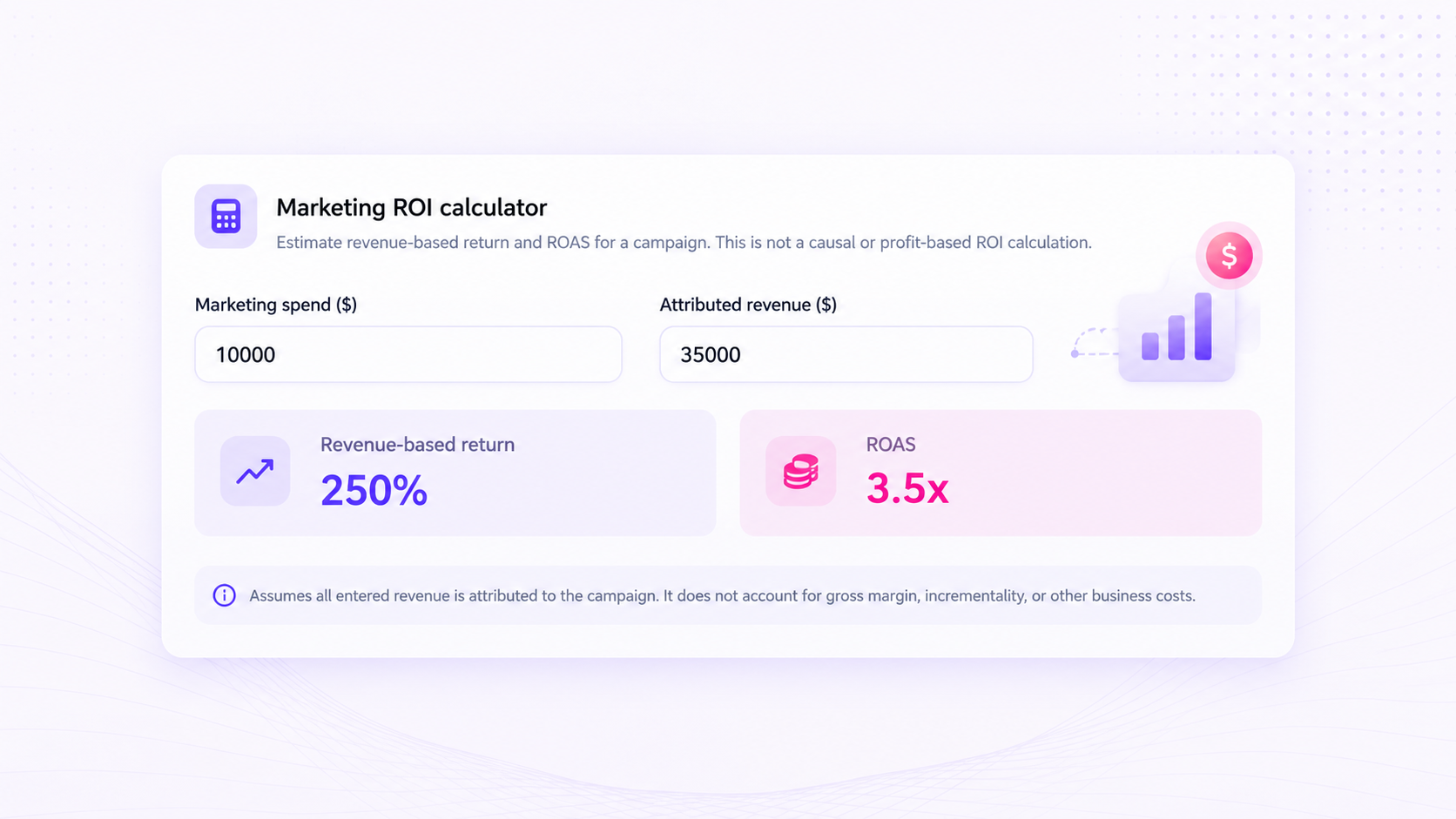
Marketing ROI measurement evaluates the financial return from marketing relative to its cost.
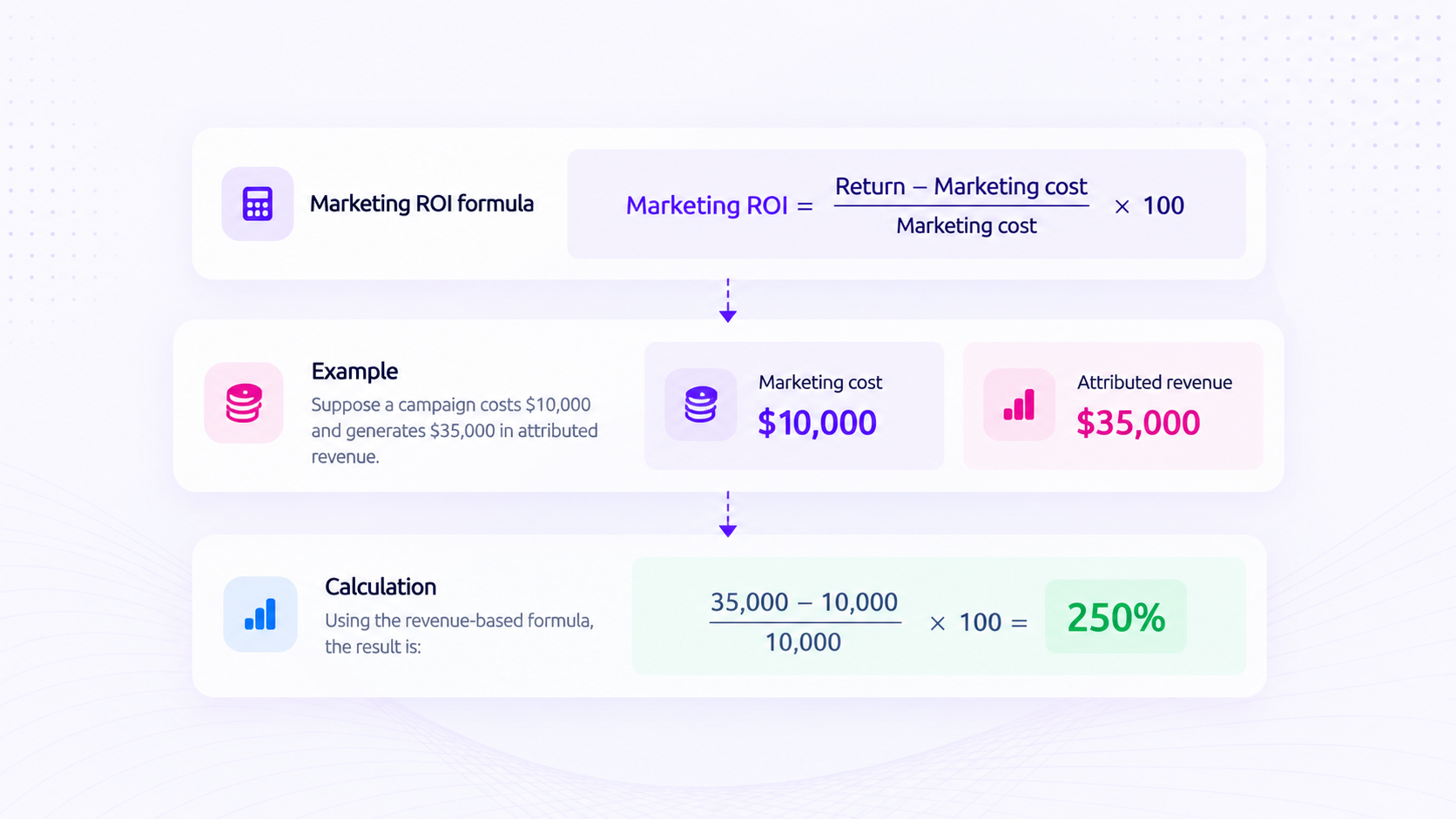
A common simplified formula to calculate ROI is:
But there’s an important catch.
A revenue-based calculation isn’t necessarily a true profit-based ROI. It doesn’t account for the cost of delivering the product or service, and attributed revenue isn’t necessarily incremental revenue.
For financial decision-making, it’s better to use incremental contribution profit where possible and include the relevant marketing costs.
How to calculate customer acquisition cost
Customer acquisition cost tells you how much you’re spending to acquire each new customer.
CAC=TotalAcquisitionCostsNewCustomersAcquired
For example, if a company spends $20,000 on acquisition and gains 40 new customers, its CAC is $500.
For consistency, define which costs are included. A fully loaded CAC may include relevant marketing and sales expenses, while a marketing-only CAC includes a narrower set of costs.
How to measure marketing effectiveness
Marketing effectiveness measurement goes beyond whether a campaign achieved its immediate target.
A campaign might generate leads at a low cost but produce little qualified pipeline.
Another might have a higher CAC but attract customers who stay longer and generate more revenue.
To evaluate effectiveness, consider acquisition costs, customer quality, conversion rates, contribution profit, retention, and incremental outcomes together.
How to build a marketing measurement framework
You don’t need a complicated measurement system to get started.
You need clear goals, reliable data, consistent definitions, and a process for turning findings into decisions.
Here is a practical seven-step approach.
Step 1: Define what success means
Start with the business outcome you want marketing to support.
For example:
- Increase qualified pipeline by 20%.
- Reduce customer acquisition cost by 15%.
- Improve demo-to-customer conversion rates.
- Generate more revenue from existing customers.
Avoid setting goals such as increasing organic traffic without explaining why that traffic matters.
Traffic can be useful, but it should connect to a larger objective.
Step 2: Map the customer journey
Identify how customers typically discover, evaluate, and purchase your product.
For a B2B SaaS company, that might look like:
Organic search → Blog article → LinkedIn ad → Product page → Demo → Sales opportunity → Closed deal
For an ecommerce business, the journey may be shorter:
Instagram ad → Product page → Email reminder → Purchase
Mapping these journeys helps you identify which interactions and conversion events need to be tracked.
Step 3: Choose your KPIs
Select a small set of metrics that reflect your goals.
For example, a B2B marketing team might track qualified leads, cost per qualified lead, pipeline generated, customer acquisition cost, and closed-won revenue.
Make sure everyone uses the same definitions.
If marketing counts every form submission as a lead while sales counts only qualified contacts, performance reports will quickly become confusing.
Step 4: Connect your marketing and sales data
Bring together data from your advertising platforms, website analytics, email tools, and CRM.
This is especially important for sales-marketing integration measurement, where the goal is to understand how marketing activity relates to sales outcomes.
For example, you should ideally be able to connect a campaign interaction to a lead, an opportunity, and eventually a closed deal.
Without that connection, marketing teams may only be able to report what happened before the sales handoff.
Step 5: Select your measurement methods
Choose methods based on the decisions you need to make.
A smaller SaaS business may start with conversion tracking, funnel analysis, and multi-touch attribution.
A larger organization with substantial advertising investment may also benefit from MMM and controlled incrementality experiments.
The important point is not to adopt every method immediately.
Start with the measurement questions that matter most to your business.
Step 6: Build reports around decisions
Your reporting should help answer specific questions.
For example:
- Which channels are contributing to qualified pipeline?
- Where are prospects dropping out of the funnel?
- Which campaigns have rising acquisition costs?
- Are customers from certain channels more valuable over time?
- Which investments need further testing?
This is where a marketing measurement platform can become useful.
For instance, Usermaven can help teams analyze user journeys, compare attribution models, and connect marketing interactions with conversion and revenue outcomes when the necessary data is available.
Instead of reviewing every channel separately, marketers can investigate how recorded interactions contribute across the buying journey.
Step 7: Review, test, and improve
Measurement should be an ongoing process.
Review campaign performance frequently enough to identify meaningful changes, but allow sufficient time for conversions and revenue to materialize.
For example, if your average B2B sales cycle lasts three months, judging a campaign’s revenue contribution after only one week would be misleading.
Use your findings to form hypotheses, make changes, and evaluate the results.
How to measure performance across different marketing channels
Not every marketing channel should be measured in exactly the same way.
Each channel plays a different role in the customer journey. Some are better at creating awareness, while others are more directly associated with conversion.
Here’s how to approach measurement across common channels.
Content marketing measurement
Content marketing measurement evaluates how articles, guides, videos, and other content contribute to audience growth, engagement, leads, and business results.
Imagine your company publishes an article targeting a high-intent keyword.
The article generates 5,000 visits and 30 newsletter subscriptions. At first glance, that’s the extent of its performance.
But what if several visitors return later, explore your product pages, book demos, and eventually become customers?
To understand content’s value, track:
- Organic traffic and search visibility
- Engagement with important content
- Newsletter signups and lead conversions
- Assisted conversions and customer journeys
- Qualified pipeline and revenue associated with content interactions
Avoid evaluating every article only by direct conversions. Educational content often plays an earlier role in the buying process.
At the same time, don’t assume that every later conversion was caused by the first article someone read.
Email marketing measurement
Email marketing measurement helps you understand how your email campaigns contribute to engagement, conversions, and customer retention.
Common metrics include delivery rate, click-through rate, unsubscribe rate, and conversion rate.
Open rates can be misleading because privacy features and automated email activity may affect reported opens.
For example, if an onboarding email receives many clicks but few users complete the setup process, the problem may be the onboarding experience rather than the email itself.
Track what recipients do after clicking, not just whether they engage with the message.
Influencer marketing measurement
Influencer marketing measurement can be challenging because not every customer clicks a trackable link before purchasing.
Useful methods include unique promotional codes, tagged URLs, dedicated landing pages, brand-lift studies, and controlled experiments where feasible.
Suppose an influencer campaign generates 100 purchases using a promotional code.
Those purchases are directly observable, but they may not represent the campaign’s full impact. Some customers may visit the website independently after seeing the content.
Equally, not every code redemption necessarily represents an incremental sale.
For larger influencer programs, combining direct-response tracking with broader measurement can provide a more balanced picture.
Paid advertising measurement
Paid advertising measurement often begins with impressions, clicks, cost per click, conversion rate, and ROAS.
These metrics are useful for campaign management, but they can create a misleading impression when advertising platforms report overlapping conversions.
For example, Meta and Google may both claim credit for the same purchase if a customer interacted with ads on both platforms.
A shared attribution framework helps compare those interactions using consistent rules.
Incrementality testing can then help evaluate whether the advertising generated additional conversions rather than simply receiving credit for existing demand.
B2B marketing attribution measurement
B2B marketing is particularly difficult to measure because buying journeys can involve multiple people, channels, and sales interactions.
A company might discover your product through organic search, have another employee attend a webinar, and eventually book a demo through a paid campaign.
Weeks or months later, the opportunity closes.
For B2B marketing attribution measurement, track more than individual form submissions.
Useful outcomes include:
- Qualified leads and accounts
- Opportunity creation
- Pipeline value
- Deal progression
- Closed-won revenue
- Sales cycle length
- Customer acquisition cost
Where possible, connect individual interactions to account-level buying activity and CRM opportunities.
This provides a stronger understanding of marketing’s role in long sales cycles, while recognizing that attribution models still cannot prove causation.
What is unified marketing measurement?
Unified marketing measurement is an approach that combines multiple data sources and measurement methods to create a more consistent view of marketing performance.
Instead of treating website analytics, advertising reports, CRM data, MMM, and incrementality testing as completely separate sources of truth, it brings their findings together.
Consider a company reviewing the same campaign through three reports.
Google Ads reports 200 conversions. Its attribution system credits 150 conversions to the campaign. An incrementality experiment estimates that the campaign generated 90 additional conversions.
These numbers aren’t necessarily contradictory.
They answer different questions.
The advertising platform reports conversions according to its own rules. Attribution distributes credit across observed interactions. Incrementality estimates the additional outcomes caused by the campaign.
A unified approach helps marketers interpret those differences rather than forcing every method to produce the same number.
Why cross-channel measurement matters
Cross-channel marketing measurement is especially important when customers move between paid advertising, organic search, social media, email, and offline interactions.
If every channel is evaluated independently, marketers can miss how those activities work together.
For example, paid social may introduce a customer, content may support evaluation, and branded search may capture the final conversion.
Looking only at the last interaction can overstate branded search’s role.
Looking only at the first interaction can overlook the channels that helped the customer move forward.
A broader measurement approach helps reveal these patterns while keeping the limits of each method clear.
Common marketing measurement challenges and how to address them
Even with the right tools, measurement can go wrong.
Here are some of the most common problems.
1. Incomplete tracking
Ad blockers, consent choices, device switching, and technical implementation issues can leave gaps in customer journey data.
What to do: Audit your tracking setup, use consistent campaign parameters, validate conversion events, and understand what data is missing. Server-side tracking can improve data collection in some situations, but it doesn’t eliminate consent requirements or all measurement gaps.
2. Different platforms reporting different conversions
Advertising platforms may use different attribution windows, conversion definitions, and counting rules.
What to do: Establish consistent conversion definitions and use a shared reporting framework for cross-channel comparisons.
3. Focusing on vanity metrics
A campaign with high engagement isn’t necessarily a campaign that generates valuable customers.
What to do: Connect engagement metrics to downstream outcomes and evaluate them in the context of the campaign’s actual objective.
4. Ignoring long sales cycles
A campaign may generate qualified opportunities today but not produce revenue for several months.
What to do: Track both leading indicators, such as qualified pipeline, and lagging outcomes, such as closed-won revenue. Use reporting windows that reflect your typical sales cycle.
5. Confusing attribution with causation
A campaign appearing in a customer’s journey doesn’t prove that it caused the purchase.
What to do: Use attribution to understand observed interactions and incrementality testing when you need stronger evidence of causal impact.
6. Poor marketing and sales alignment
Marketing and sales teams often disagree on lead quality, source definitions, or revenue contribution.
What to do: Agree on lifecycle stages, qualification rules, ownership, and reporting definitions before evaluating results.
How to choose marketing measurement software
The best marketing measurement software depends on the questions you need answered, your available data, and the complexity of your marketing activities.
A company primarily interested in website behavior has different requirements from a B2B business trying to connect campaigns with CRM revenue.
Marketing measurement tools generally fall into several categories.
| Tool category | Primary purpose | Example |
| Web analytics | Website traffic, behavior, and conversions | Google Analytics 4 |
| Marketing attribution | Customer journeys and touchpoint credit | Usermaven |
| CRM and marketing analytics | Lead, opportunity, and customer reporting | HubSpot |
| Marketing mix modeling | Aggregate channel contribution and budget analysis | Google Meridian |
| Business intelligence | Combining and visualizing business data | Power BI |
| Experimentation | Measuring causal impact through controlled tests | Geo-lift and holdout testing solutions |
Before choosing a platform, ask:
- Can it connect the marketing and sales data we actually use?
- Does it support the conversion events and business outcomes we need?
- Can it handle multiple marketing channels and customer touchpoints?
- Does it provide appropriate attribution models and reporting windows?
- How does it handle privacy, data quality, and missing information?
- Can our team understand and act on its reports?
- What additional tools or methods will we still need?
For example, a B2B SaaS company trying to understand how paid campaigns, organic content, and other interactions contribute to pipeline and revenue may evaluate Usermaven as a marketing attribution and analytics solution.
But if the same company needs to estimate the incremental impact of television advertising or run controlled media experiments, it may need additional measurement methods or specialist tools.
No single platform should be assumed to solve every measurement problem.
Marketing measurement trends to watch in 2026
Marketing measurement continues to change as customer journeys become more complex and privacy expectations influence how data can be collected.
Several developments are worth watching.
Greater focus on incrementality
Marketing teams are increasingly questioning whether attributed conversions represent genuinely additional business.
This has encouraged more interest in experiments, holdout tests, and causal measurement alongside traditional attribution.
More attention to first-party data
Businesses are placing greater emphasis on data collected through their own websites, products, and customer relationships.
First-party data can support more reliable measurement when collected and used appropriately, but it still requires clear consent practices, accurate tracking, and consistent identity management.
Connecting marketing with revenue
For B2B businesses, measurement is moving beyond lead counts toward opportunities, pipeline, and closed revenue.
This makes CRM integration and shared definitions between marketing and sales increasingly important.
AI-assisted marketing analysis
AI-powered analytics can help teams investigate performance changes, summarize reports, and identify patterns that deserve attention.
However, an AI-generated explanation is only as reliable as the underlying data and analysis. Teams still need to validate findings before making major spending decisions.
More interest in unified measurement
Organizations are increasingly evaluating how attribution, MMM, and incrementality can complement each other.
Rather than searching for one perfect measurement model, the focus is shifting toward selecting the right evidence for each decision.
Marketing measurement best practices
Before expanding your measurement setup, make sure the basics are working.
- Measure outcomes, not just activity. Connect traffic, engagement, and leads to business results wherever possible.
- Use consistent definitions. Align teams on conversion events, attribution windows, costs, and revenue reporting.
- Check data quality regularly. Missing events, duplicated conversions, and incorrect campaign tagging can distort findings.
- Choose methods based on decisions. Use attribution for observed journeys, MMM for broader channel estimates, and experiments for causal questions.
- Account for time. Evaluate performance using windows that reflect buying cycles and delayed conversions.
- Compare like with like. Don’t directly compare metrics calculated using different definitions or attribution rules.
- Turn findings into actions. Every important report should help inform a decision, a test, or an improvement.
Final thoughts
Marketing measurement isn’t about tracking more numbers. It’s about understanding which channels, campaigns, and customer interactions contribute to revenue and where to invest next.
With Usermaven, you can connect marketing touchpoints to conversions, pipeline, and revenue, compare attribution models, and use AI-powered insights to make more informed decisions.
Ready to understand what’s driving your growth? Book a demo and explore Usermaven.
Frequently asked questions
What is marketing measurement in simple terms?
Marketing measurement is the process of understanding how marketing activities contribute to business results. It helps businesses evaluate campaigns, track performance, and make decisions about where to invest their marketing budgets.
What are the three main marketing measurement methods?
The three main methods are marketing attribution, marketing mix modeling (MMM), and incrementality testing. Attribution assigns credit across recorded touchpoints, MMM estimates broader marketing contributions, and incrementality testing measures causal effects through experiments.
What is the difference between marketing measurement and attribution?
Marketing measurement is the broader process of evaluating marketing performance and business impact. Attribution is one method within that process, used to assign conversion credit to recorded marketing interactions.
How do you measure marketing ROI?
Marketing ROI compares the financial return generated by marketing with the cost of the investment. For a more accurate assessment, use incremental contribution profit where possible rather than relying solely on attributed revenue.
What is a marketing measurement framework?
A marketing measurement framework is a structured approach that defines business goals, KPIs, data sources, measurement methods, and reporting processes. It helps teams evaluate performance consistently and make informed decisions.
What is the best marketing measurement model?
There is no single best model. First-touch, last-touch, and multi-touch attribution models are useful for different customer journey questions. MMM supports broader budget analysis, while incrementality testing helps determine causal impact. The right choice depends on the business question.

Written by
Imrana Essa
SaaS Marketing Lead
Imrana Essa is a marketing lead and content strategist with 8+ years of experience creating and leading content for B2B and SaaS brands. She specializes in marketing analytics, attribution, content strategy, and organic growth, translating complex marketing concepts into clear, actionable insights. Her work focuses on helping marketers understand performance, make data-informed decisions, and build strategies that contribute to sustainable growth.
All articles by Imrana →