Analytics is now part of everyday decision-making. Most organisations collect data continuously from systems, websites, transactions, and external sources. The challenge isn’t access anymore. It’s turning constant data flow into decisions people can act on.
That’s where machine learning in analytics earns its place. Instead of relying only on static dashboards and fixed reporting cycles, machine learning helps analytics adapt to changing behaviour and messy real-world conditions.
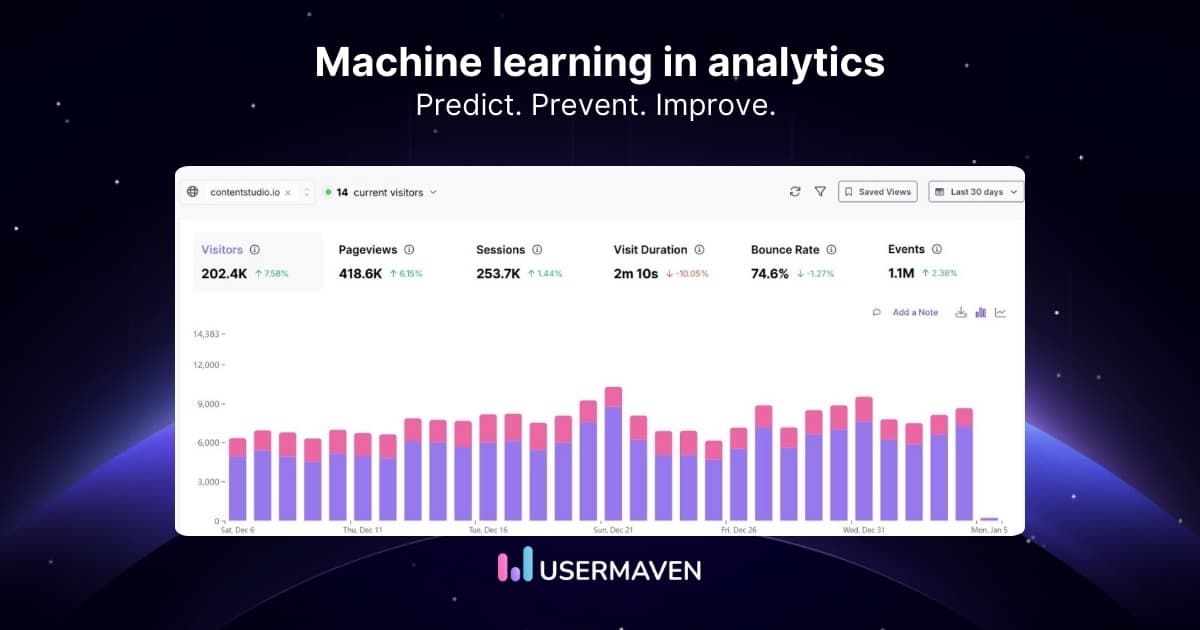
Done well, it turns analytics into a system that learns, flags what’s shifting, and recommends where to focus so teams can move from information to actionable analytics.
How machine learning changes analytics
Traditional analytics is great at answering “what happened?”
Machine learning (ML) pushes further: “What’s likely to happen next, and what should we do about it?”
1) Models learn patterns that rules can’t keep up with
Fixed rules struggle when customer behaviour shifts, seasonality changes, or new products roll out. Machine learning models retrain on historical and recent activity, so predictions update as patterns evolve (rather than staying locked to a single rule set).
2) Predictive signals become visible earlier
Predictive behavioral analytics focuses on signals that appear before outcomes. It evaluates signals like how often users return, how deeply they engage, the order of actions, and where they drop off. This helps teams anticipate conversion, churn risk, and support load while there is still time to act.
3) Analytics moves from explanation to intervention
Predictive models estimate risk and opportunity. Then prescriptive analytics builds on that by comparing possible actions (education, outreach, onboarding changes, pricing tests) and clarifying trade-offs so teams can choose the best response while there’s still time to influence results.
Unlock insights that drive growth
Making analytics work smarter in real operations
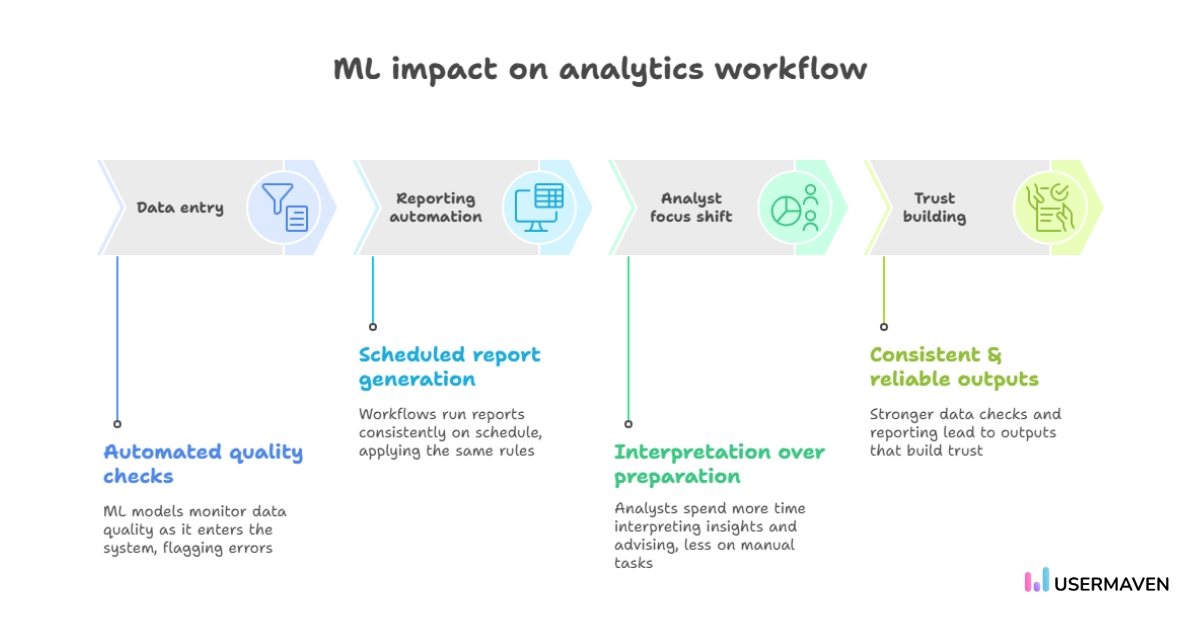
Machine learning doesn’t just “predict stuff.” It removes friction in the analytics pipeline and increases trust in what people see.
Reducing the time spent fixing data
Data prep often takes longer than the analysis itself, especially when teams are dealing with inconsistent formats, missing values, duplicates, and sudden, unexplained spikes.
Machine learning helps by monitoring data quality as data arrives. Anomaly detection models flag unusual values, identify patterns indicative of pipeline errors, and highlight records that require review. Over time, this reduces rework and lowers the chance that decisions are based on flawed data. Paired with strong data checks, teams build confidence that reporting is stable, not fragile.
Improving reporting without manual drag
Many reports use the same structure each week, with only the numbers changing. Automating refresh and validation reduces human error and frees analysts to focus on interpretation.
Machine learning adds another layer: it can automatically detect when “normal” changes like a sudden drop in conversions from a segment that usually performs well, and push that exception to the top of the queue.
Supporting people who rely on timely insight
In service-driven sectors, timely clarity matters. When analytics flags early risks, missed appointments, rising caseload complexity, and delayed follow-ups, teams can support care providers with the right signals at the right time. This improves response without adding reporting pressure to an already stretched staff.
Building trust in the outputs
People use analytics when they trust it. Clean pipelines, consistent definitions, and fewer manual overrides lead to outputs that hold up under scrutiny. Trust isn’t a “soft benefit”; it’s what makes analytics part of real planning instead of a background report.
Machine learning for customer and product outcomes
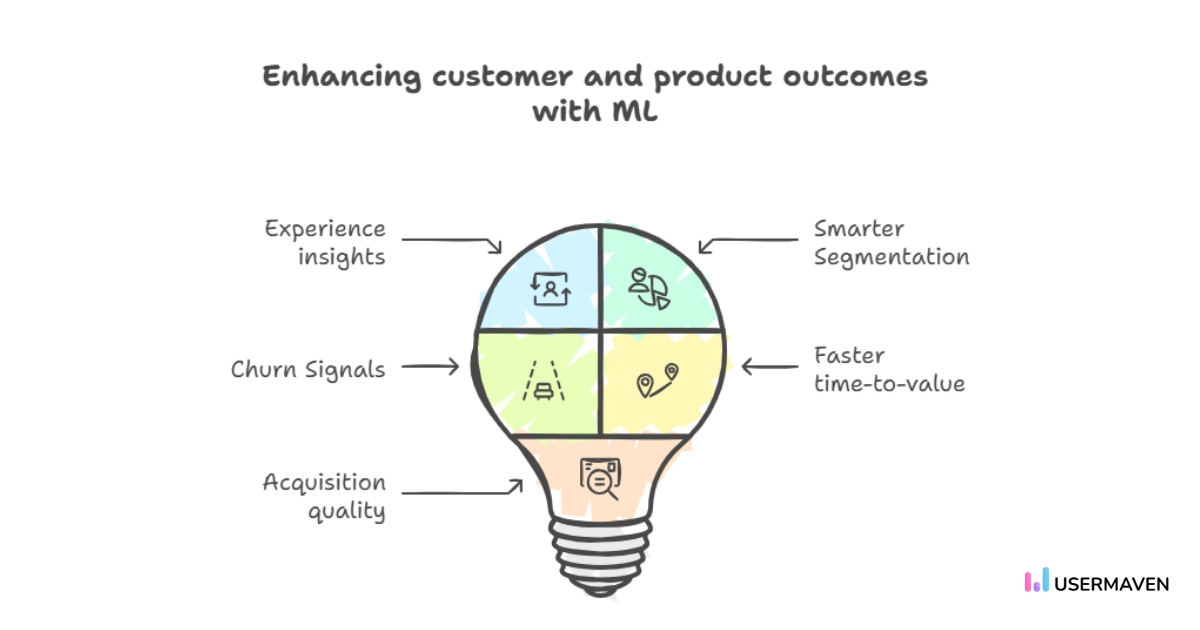
Where machine learning becomes most valuable is when it connects behaviour to outcomes, especially in product-led and subscription businesses.
Connect experience to usage
Customer experience analytics improves when it’s grounded in what customers do, not just what they say. ML can connect qualitative feedback (tickets, NPS comments) with behavioural context (feature paths, friction points). This helps teams see which experiences improve retention and which ones create frustration.
Segment customers by behaviour
Customer segmentation becomes far more useful when it clusters people by behaviour: activation pace, depth of use, collaboration patterns, outcomes achieved, and support needs. Two customers on the same plan can behave completely differently, and ML helps you see that difference early.
Map the path to value
Instead of treating onboarding as one generic checklist, ML can identify which behavioural sequences correlate with long-term value:
- Which actions predict feature adoption
- What behaviour patterns show a user reached the aha moment
- Which steps shorten the time to value
- Where users stall, loop, or drop off
This lets teams redesign onboarding around evidence, not opinion.
Spot churn risk early
Reducing churn works best when it starts before the decision to cancel. ML models track leading indicators such as declining activity, reduced team usage, shortened sessions, stalled workflows, and unresolved support loops. A single change may not mean much, but repeated signals together tell a clear story.
Track acquisition quality over time
Sign-ups alone can be misleading. SaaS attribution software helps connect acquisition sources to what happens next by tracking product usage over time. That makes it easier to see which channels bring customers who activate, adopt key features, and retain, and not just users who convert once.
Turning data into decisions (without making it “AI-first”)
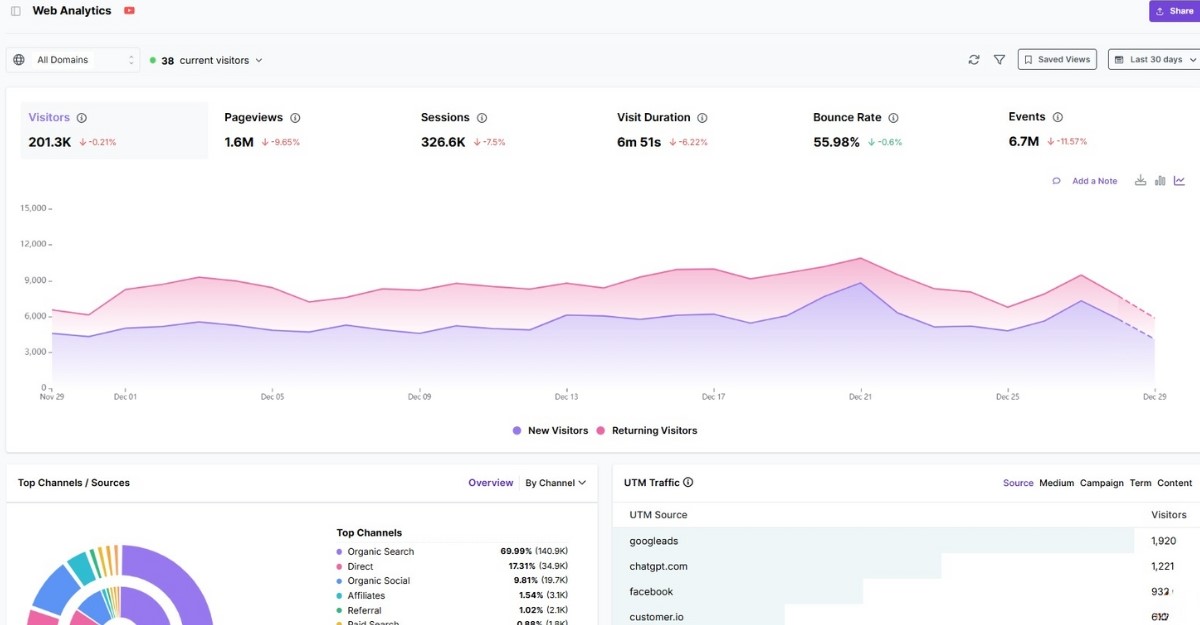
Most organisations already have the data. The advantage comes from turning data into actions fast enough to matter.
In SaaS and digital products, this depends heavily on instrumentation and clean event streams. When analytics reflects real user behaviour inside the product, teams can step in earlier, refine journeys, and focus effort where it changes outcomes.
And to keep measurement reliable at the top of the funnel and beyond, many teams pair product data with Usermaven, so acquisition and user behaviour connect cleanly to activation and retention outcomes.
Machine learning doesn’t replace product judgment. It strengthens it by helping teams spot patterns earlier, quantify risk, and choose better next actions.
FAQs about machine learning in analytics
1. How does machine learning change the way analytics supports real business decisions?
It shortens the distance between activity and insight. Instead of waiting for end-of-month summaries, teams can detect shifts as they start and then decide while outcomes are still changeable.
2. What data signals does machine learning use to predict churn in SaaS?
Behavioural patterns such as declining login frequency, reduced depth of use, stalled onboarding, shrinking team adoption, slower feature exploration, and unresolved support loops. The model learns the combination of signals that typically precedes churn.
3. How does ML improve onboarding and conversion without guesswork?
By comparing many journeys to identify the actions and sequences that correlate with retention or upgrades. That evidence can guide onboarding changes, prompts, and education so more users reach value faster.
4. What makes machine-learning analytics more dependable than static reporting?
Static reports depend on fixed rules and manual checks. With proper governance, machine learning can continuously validate inputs, detect anomalies, and alert teams when data or behaviour changes.
Updated

Written by
Ryan Mitchell
Marketing Analytics Strategist
Ryan Mitchell is a marketing analytics strategist specializing in campaign measurement, customer journeys, and marketing performance. He writes about analytics, reporting, and data-driven marketing strategies, helping SaaS and B2B teams measure what matters across every stage of the customer journey.
All articles by Ryan →