Attribution and incrementality answer different marketing questions. Attribution assigns conversion credit to recorded touchpoints. Incrementality estimates what additional outcomes occurred because a defined marketing activity ran.
A retargeting campaign might receive credit for 400 purchases, while a randomized holdout estimates only 150 additional purchases. The numbers can both be defensible because they describe different things.
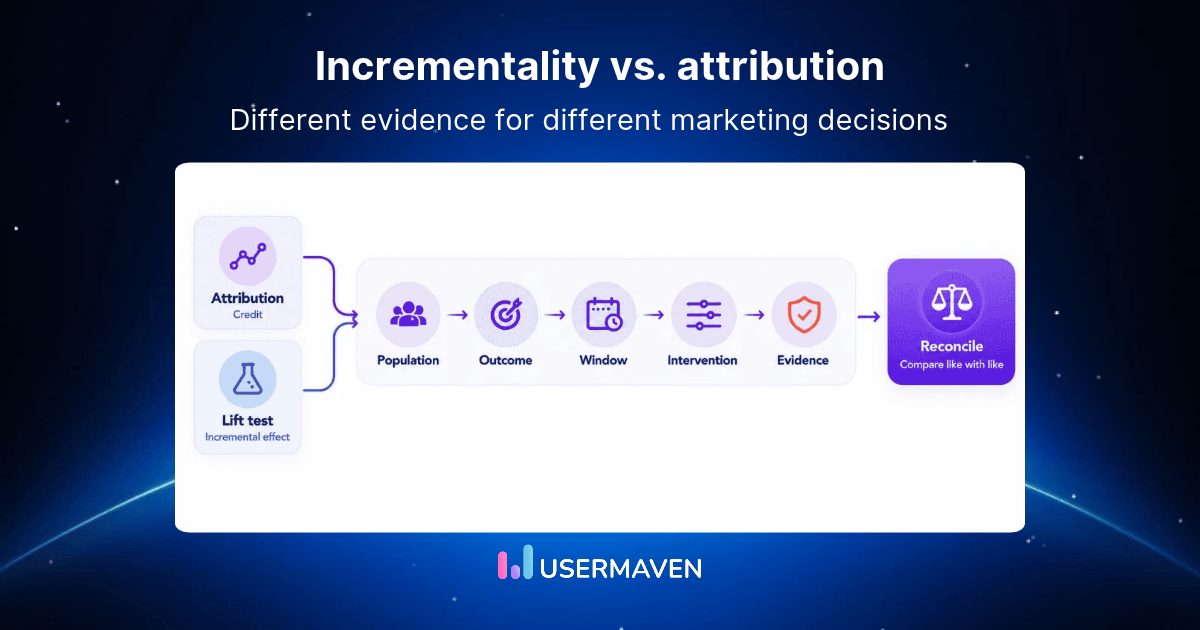
The practical challenge is deciding which result should guide the next budget decision. This comparison explains when each method is useful, why the reports disagree, and how to reconcile their evidence before reallocating spend.
If the numbers disagree, comparing totals alone will not settle the question. The answer depends on the eligible audience, conversion definition, reporting period, tested intervention, and strength of the evidence.
Key takeaways
- Different purposes: Attribution assigns credit to recorded marketing interactions, while incrementality estimates the additional conversions or revenue caused by marketing.
- Different results: A campaign can receive credit for 400 conversions while generating only 150 estimated incremental conversions. Both measurements can be valid.
- Right method: Use attribution for ongoing campaign optimization and incrementality testing for important decisions about causal impact and budget allocation.
- Reconcile first: Before comparing results, align the measured population, conversion definitions, reporting periods, tested intervention, and evidence quality.
- Avoid false conclusions: Attributed conversions do not prove causality, and experimental lift cannot automatically identify which individual conversions were caused by advertising.
- Combine evidence: Attribution reveals recorded customer journeys and campaign performance. Credible incrementality experiments help validate whether marketing creates enough additional value to justify spending.
Drive business growth
with AI-powered analytics
Incrementality vs. attribution at a glance
Attribution tracks recorded interactions and applies credit-assignment rules. Incrementality asks what would have happened without the intervention, then estimates the change caused by running it.
| Dimension | Attribution | Incrementality |
|---|---|---|
| Main question | Which recorded touchpoints receive credit? | What additional outcomes did the intervention cause? |
| Evidence | Observed journeys and attribution rules | Counterfactual comparison |
| Typical approaches | First-touch, last-touch, multi-touch | Randomized holdouts, lift tests, geo experiments |
| Output | Attributed conversions and revenue | Estimated incremental conversions and revenue |
| Best use | Ongoing campaign and journey analysis | Testing causal impact of a defined decision |
| Cadence | Continuous or frequent | Study-specific, subject to feasibility |
| Primary limitation | Credit does not establish causality | Cost, design constraints, and uncertainty |
The practical difference: Attribution assigns credit for recorded outcomes; incrementality estimates how many additional outcomes marketing produced.
What each measurement actually tells you
The same conversion can appear differently in an attribution report and an experiment because each method uses a different unit of analysis. Start by identifying the evidence behind the number.
Attribution: Who receives conversion credit?
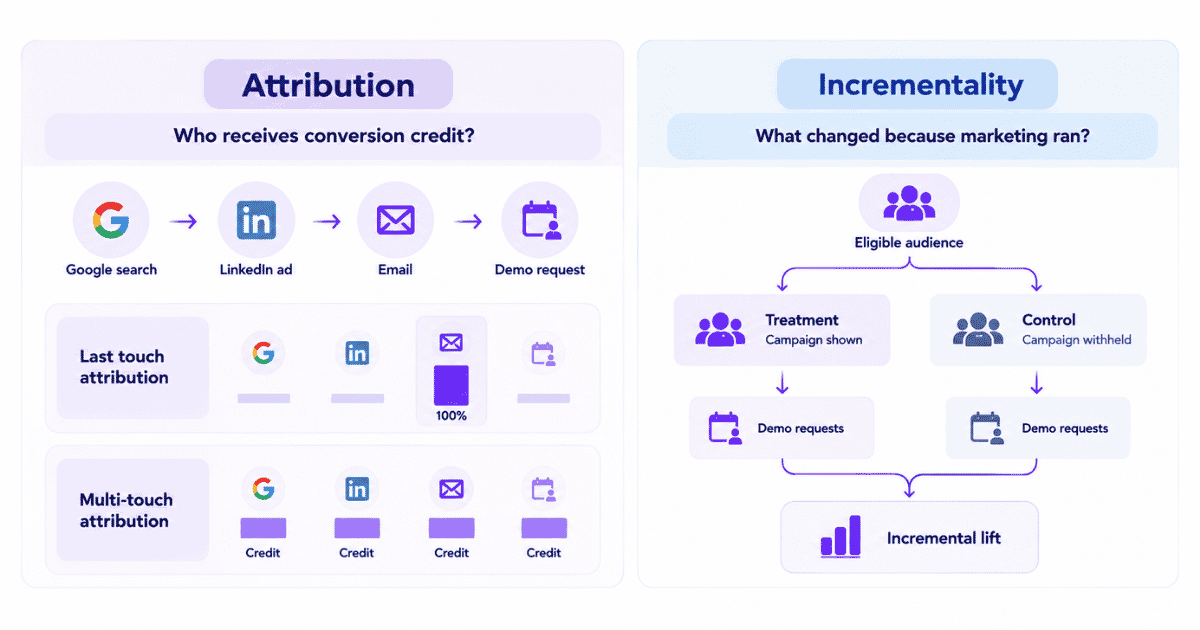
Imagine a buyer follows this path: Google Search → LinkedIn ad → Email → Demo request. Under last-touch attribution, email may receive the final credit. Under a multi-touch model, several eligible interactions may share it.
These are valid reporting perspectives under their rules. Choosing among marketing attribution models changes credit allocation, not the underlying question of whether a campaign created the demo.
In the same journey, first-click attribution highlights initial discovery, whereas last-click attribution emphasizes the final eligible interaction. Neither rule identifies what would have happened without the campaign.
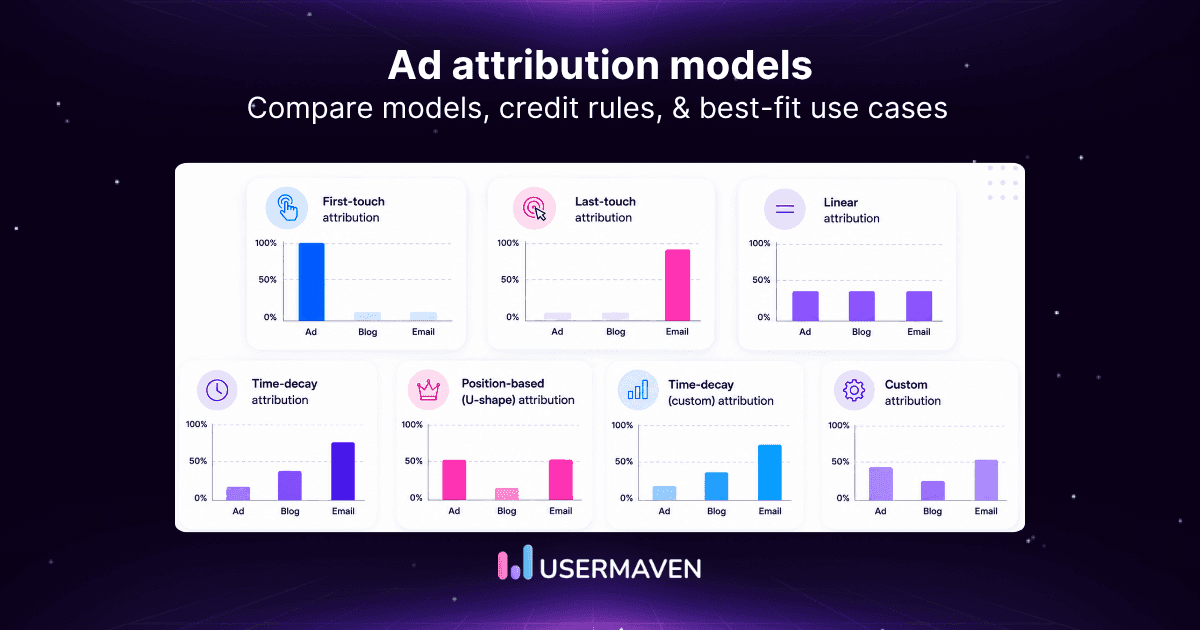
Usermaven’s marketing channel/source attribution documentation explains how teams compare recorded channels using first-touch, last-touch, and other supported models. Enterprise workspaces can also configure custom attribution weights.
Incrementality: What changed because marketing ran?
Incrementality estimates the counterfactual: what would likely have happened without a campaign. A well-designed holdout measures comparable eligible groups, one assigned the intervention and another withheld from it.
The difference estimates the intervention’s effect on the tested population. It does not tell marketers exactly which individual purchases were caused by ads.
When journeys contain several recorded interactions, multi-touch attribution can divide credit across them, but a causal comparison still requires a credible no-treatment baseline.
A credible counterfactual depends on test assignment, outcome tracking, and adequate data. The practical steps of incrementality in marketing include those design and reliability checks.
Unlock insights that drive growth
Why attributed conversions differ from lift
Consider a hypothetical ecommerce retargeting campaign. The attribution report credits 400 purchases to the campaign, while a separate randomized experiment uses two equally sized eligible groups.
| Measurement | Illustrative result |
|---|---|
| Eligible treatment customers | 10,000 |
| Eligible control customers | 10,000 |
| Treatment purchases | 800 |
| Control purchases | 650 |
| Treatment purchase rate | 8.0% |
| Control purchase rate | 6.5% |
| Purchases credited by attribution | 400 |
| Estimated incremental purchases | 150 |
Calculation: (8.0% − 6.5%) × 10,000 treatment customers = 150 estimated incremental purchases. Because the groups are equally sized, 800 − 650 gives the same estimate.
The 400 attributed purchases represent credit awarded to retargeting under the selected model. The 150 incremental purchases estimate additional purchases among the 10,000 treatment customers, assuming a valid experiment.
They are not competing counts of the same purchases. The experiment compares assigned populations; attribution assigns credit to eligible recorded conversion journeys.
A marketing campaign attribution report may use different interaction rules or credit windows from the holdout. Those settings must be documented before treating the difference as a performance gap.
It would be incorrect to conclude that exactly 150 of the 400 attributed purchases were caused by the campaign. The group-level effect cannot normally identify individual conversions that would disappear without advertising.
Nor should a team automatically apply 150 ÷ 400 as a correction factor to every future attribution report. The populations, outcomes, intervention, and measurement windows first need to align.
The apparent disagreement becomes actionable only after the two methods are compared on equivalent terms.
When should you use each method?
The right choice depends on the decision. Frequent operational questions rarely justify a full experiment. Material budget changes often deserve stronger causal evidence when a credible test is feasible.
| Decision | Best starting point | Why |
|---|---|---|
| Which channel introduced a customer? | Attribution | Shows recorded acquisition touchpoints. |
| Which campaign receives conversion credit? | Attribution | Applies stated model rules. |
| Did retargeting cause additional purchases? | Incrementality | Requires a defensible counterfactual. |
| Which ads need tactical attention? | Attribution | Supports ongoing campaign reporting. |
| Should a large channel budget grow? | Both | Combine causal evidence with operational detail. |
| Did branded search capture existing demand? | Incrementality | Test what changes when the intervention is withheld. |
| Why do attribution models disagree? | Attribution comparison | Check credit rules, not causal lift. |
| Did a regional campaign lift sales? | Geo experiment | Test matched markets and spillover risk. |
Continuous campaign analysis can reveal changes in spend, reported ROAS, and recorded customer journeys. Paid ads attribution helps teams evaluate these metrics, while experiments test whether a defined intervention generated additional value.
A platform-supported holdout may help when the campaign is eligible, but feasibility depends on configuration and conversion data. Google’s user-based Conversion Lift setup describes the requirements for supported studies.
For major allocation decisions, interpretation should also consider margin, uncertainty, and whether the tested spend level resembles the planned one. A lift result is not permission to scale indefinitely.
How to reconcile attribution and lift results
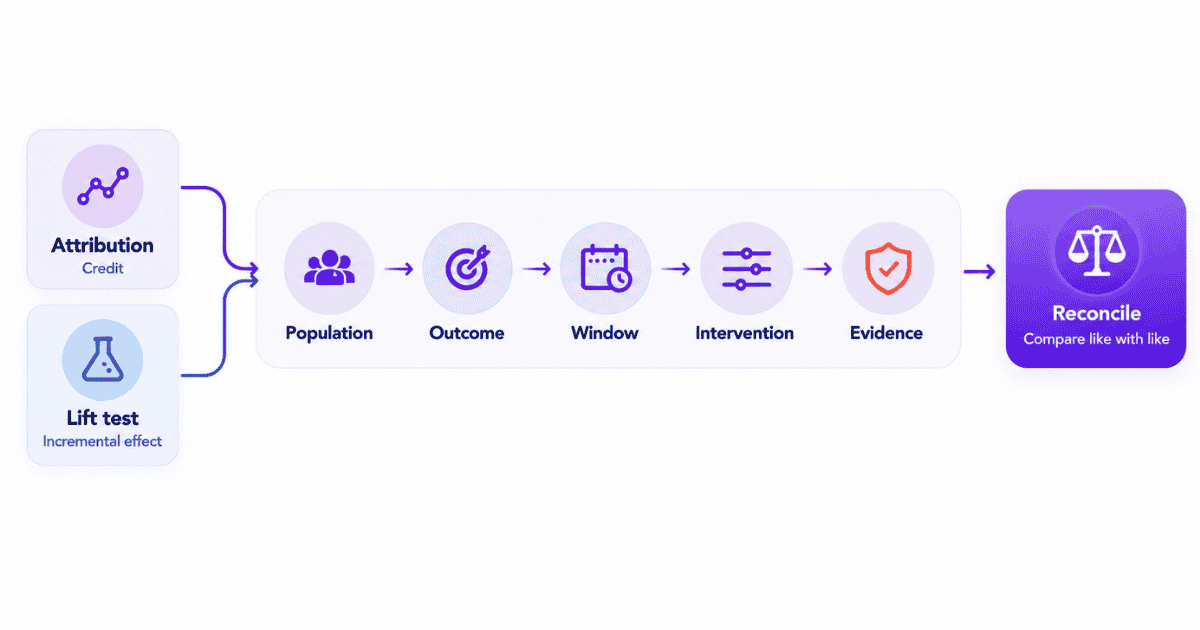
When the numbers differ, avoid declaring one report wrong immediately. First test whether the attribution result and the experiment describe compatible customers, outcomes, periods, interventions, and evidence quality.
1. Match the eligible population
A channel report may cover every visitor with an eligible Meta touchpoint. A lift experiment may include only a retargeting audience in a few markets. Comparing their totals without adjusting scope is misleading.
Record customer eligibility, regions, new vs. returning customers, exclusions, and the experiment’s assignment unit. Then identify the subset of attribution data, if any, that matches the experimental population.
For longer buying cycles, B2B marketing attribution connects recorded account and opportunity touchpoints, while the lift test still needs a compatible unit of assignment and eligible population.
2. Use the same business outcome
A demo booking, marketing-qualified lead, closed-won deal, and collected revenue are different outcomes. If attribution reports demos while the experiment measures qualified opportunities, the values cannot be reconciled directly.
Usermaven’s conversion goals support page-visit, pinned-event, and custom-event goals, with stages such as Lead, MQL, SQL, Opportunity, and New Revenue. Goal definitions should be consistent across reports.
For custom conversion events, follow the event tracking setup so purchases or demo requests are recorded with the intended properties and counting rules.
3. Align reporting and conversion windows
An experiment may track purchases during treatment and for a defined period afterward. An attribution dashboard might instead report conversions recorded this month from interactions that occurred in an earlier period.
Usermaven’s paid ads reporting distinguishes Conversion Date vs. Spend Date. Conversion Date looks back from conversions; Spend Date follows clicks within a spend period and considers subsequent conversions within a look-ahead window.
Check time zones, observation windows, attribution lookbacks, conversion lag, and maturity of recent spend before interpreting a discrepancy.
4. Verify the intervention being tested
An experiment isolating one Meta retargeting campaign cannot validate the full Paid Social channel. A regional brand campaign also cannot establish the contribution of individual ad sets elsewhere.
Define exactly which spend, creative, targeting, channel, or exposure treatment changed. Then restrict the attribution comparison to the nearest compatible intervention and document remaining differences.
5. Check data quality and uncertainty
An experiment can be invalid if the holdout was contaminated, assignment failed, or key outcomes were missing. Even a valid experiment may produce a wide uncertainty interval that cannot support a firm budget decision.
The Measurement Trust Center helps investigate collection, identity, integration, delivery, and reliability issues in Usermaven reporting. It does not validate randomized assignment or establish causal effects.
Before blaming a discrepancy on measurement methodology, investigate common ad attribution problems, including duplicated events, fragmented customer identity, and inconsistent lookback windows.
When experimental quality is uncertain, report the limitation and avoid overwriting attribution conclusions with an unreliable lift estimate.
Five-check reconciliation worksheet
Use the following worksheet before presenting both numbers in the same budget review.
| Check | Alignment question | If not aligned |
|---|---|---|
| Population | Same eligible customers or markets? | Restrict cohorts or label scope differences. |
| Outcome | Same conversion definition and counting rule? | Standardize the primary KPI. |
| Time | Matching treatment and conversion windows? | Reconcile periods and lag. |
| Intervention | Same campaign or spend being evaluated? | Narrow the comparison. |
| Reliability | Experiment valid and effect sufficiently precise? | Report uncertainty or redesign. |
A reconciliation is complete only when the remaining differences and their implications are stated, not when the numbers happen to match.
See what's working. Fix what's not. Grow faster.
How to use both for marketing budget decisions
Attribution can help identify which campaigns deserve attention; incrementality can test whether the selected activity creates additional business value. The methods are complementary when used deliberately.
Start with the observed campaign picture
Monitor recorded acquisition, attributed conversions, cost, and customer journeys. Performance marketing attribution is useful for understanding how continuously reported performance relates to spend and revenue.
For ongoing paid-channel analysis, Usermaven’s paid ads attribution solution connects campaign spending with credited outcomes. That can identify candidates for causal evaluation, not prove their lift.
Use a fit-for-purpose incrementality experiment
Prioritize decisions where uncertainty could change material spending. Examples include retargeting, branded search, regional advertising, or a major prospecting budget increase.
Run a credible experiment for that intervention, then compare its estimated effect and interval with the attributable outcomes. The broader logic of marketing measurement makes room for both operational and causal evidence.
Act on the strength of the combined evidence
| Attribution pattern | Incrementality result | Decision implication |
|---|---|---|
| Strong attributed return | Reliable positive lift | Consider bounded scaling and retesting. |
| Strong attributed return | Reliable weak lift | Review captured demand and spend efficiency. |
| Weak attributed return | Reliable positive lift | Investigate missing interactions and measurement scope. |
| Strong attribution | Uncertain lift | Do not claim causal success; gather evidence. |
| Any attribution result | Invalid experiment | Repair design before using the causal claim. |
A B2B company may observe attributed opportunity pipeline while an experiment measures incremental demos. Those outcomes belong to different funnel stages and cannot be treated as equivalent.
The B2B SaaS solution is relevant to connecting acquisition, product activity, and CRM outcomes for follow-up analysis. It does not make attributed pipeline an experimental estimate of incremental pipeline.
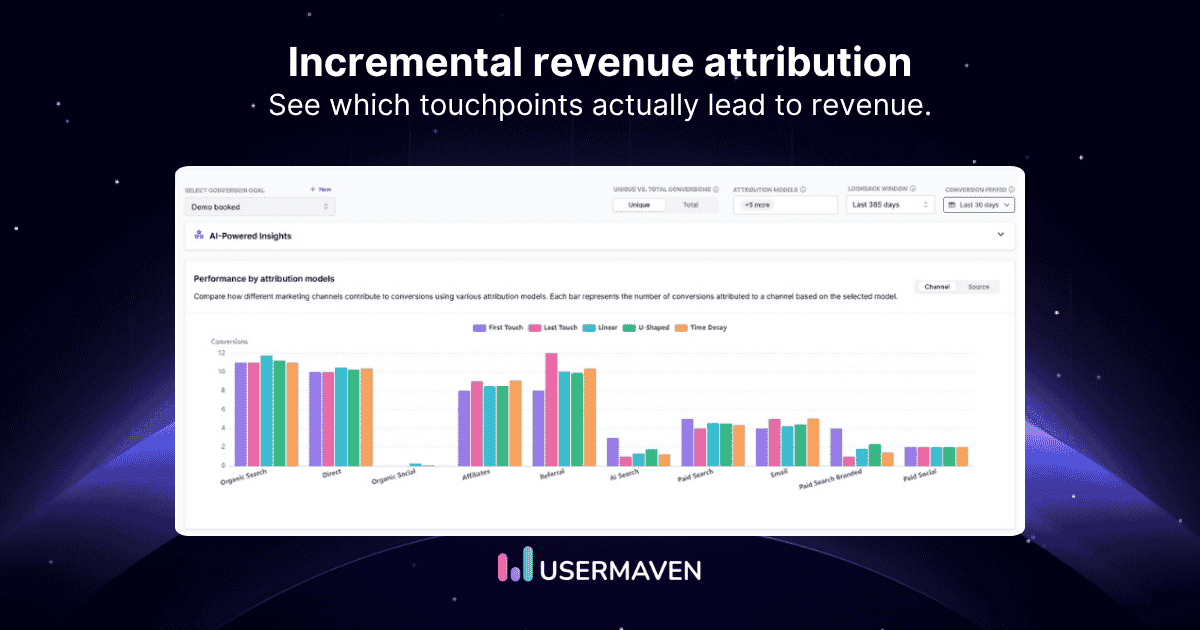
For revenue decisions, incremental revenue attribution explores the difference between model-assigned credit, causal revenue lift, and incremental return on spend.
Common comparison mistakes
The largest reporting errors are usually conceptual rather than mathematical: marketers compare incompatible totals or ask one method to answer the other method’s question.
| Mistake | Correction |
|---|---|
| Every attributed conversion was caused by marketing | Credit assignment is not a causal estimate. |
| Lower lift proves the attribution report is broken | First check population, scope, and windows. |
| Any positive lift estimate is conclusive | Review design validity and uncertainty. |
| One lift factor works for all campaigns | Effects change with audience and spend. |
| Last-click proves the last channel caused the sale | Last-click identifies the final eligible touchpoint. |
| Custom model weights establish incremental lift | Weights redistribute credit without a causal experiment. |
Enterprise teams can configure a custom attribution model in Usermaven to explore alternative credit-allocation assumptions. Changing weights still does not demonstrate causal lift.
What if incrementality testing is unavailable?
Some organizations lack enough conversions, cannot create a credible holdout, or face a decision too small to justify a formal lift study. They can still improve reporting and make cautious operational decisions.
Keep event definitions consistent, investigate tracking gaps, compare attribution models, and document uncertainty. When historical data and variation are suitable, marketing mix modeling readiness may help teams evaluate whether aggregate modeling is feasible.
The distinction between multi-touch attribution vs. marketing mix modeling also matters when choosing between journey-level analysis and aggregate budget evaluation.
Neither descriptive reporting nor a complex model should be relabeled as demonstrated incrementality without defensible causal evidence.
Specialist discussion of the methods’ complementary roles, including when full experiments are impractical, is available from Haus’s attribution and incrementality analysis.
Final verdict
Attribution and incrementality are not rival systems for producing the same total. Attribution explains recorded journeys and credit assignment; incrementality estimates what changed because marketing intervened.
Use attribution for continuous campaign decisions and credible experiments for material causal questions. When results differ, align population, outcome, time, intervention, and reliability before changing spending.
Reliable attribution begins with connected campaign, conversion, and revenue data. To explore how those measurements come together, book a demo with Usermaven.
FAQs
These answers clarify when the methods overlap and what their results can legitimately establish.
1. Is incrementality better than attribution?
Neither is universally better. Attribution supports continuous journey and campaign analysis, while incrementality tests causal effects of a defined intervention. The right method depends on whether the decision concerns credit allocation or additional outcomes.
2. Can attribution measure incrementality?
Standard first-touch, last-touch, and multi-touch credit models do not independently establish causal lift. Some sophisticated measurement systems incorporate experimental evidence, but changing attribution weights alone cannot demonstrate what would have happened without marketing.
3. Why can attributed conversions exceed incremental conversions?
Attribution may credit purchases that would have occurred without the intervention. But discrepancies can also result from differences in audiences, conversion definitions, reporting windows, and experiment scope, so those factors should be reconciled first.
4. How is incrementality different from last-click attribution?
Last-click assigns credit to the final eligible interaction in a recorded journey. Incrementality estimates the additional outcomes caused by an intervention using a credible counterfactual, usually through experiments or carefully justified causal methods.
5. Should businesses use both methods?
Often, yes. Attribution provides frequent operational signals, while well-designed incrementality studies can test important budget decisions. The strongest analysis combines both without treating model-assigned credit as proof of causal impact.

Written by
Junaid Ahmed
Content Writer & Digital Marketer
Junaid Ahmed is a content and copywriter with 3+ years of experience creating research-driven content across SaaS, B2B, ecommerce, and digital marketing. He specializes in turning complex topics into clear, practical content that helps marketers better understand their challenges, evaluate solutions, and make informed decisions. His work spans educational content, industry insights, and actionable marketing guides.
All articles by Junaid →