Choosing an attribution model is one of the most important decisions you can make for your marketing measurement strategy. The model you choose determines how credit is assigned across the customer journey, shaping everything from campaign reporting and budget allocation to ROI and revenue analysis.
The challenge is that there is no single attribution model that works for every business. A model that accurately measures an ecommerce purchase may not reflect the buying journey of a B2B SaaS company with weeks or months of research before conversion.
In this guide, you’ll learn how to choose an attribution model based on your business goals, customer journey, sales cycle, and marketing channels. We’ll compare the most common attribution models, explain when each one works best, and share practical examples to help you make confident, data-driven marketing decisions.
Maximize your ROI
with accurate attribution
Key takeaways
No single attribution model fits every company. Your choice depends on goals, sales cycle, and how complex the customer path is. Popular defaults rarely match your real buying process.
Before selecting an attribution model, evaluate your sales cycle, conversion path, marketing channels, and the quality of your tracking data.
Different attribution models answer different questions, so comparing multiple models often provides the most complete view of marketing performance.
Reviewing your attribution model regularly helps ensure it continues to reflect changes in customer behavior, privacy regulations, and your marketing strategy.
Modern attribution platforms make it easier to compare attribution models, analyze complete customer journeys, and connect marketing efforts to pipeline and revenue.
What is an attribution model?
An attribution model is a framework that determines how credit for a conversion is assigned across the marketing touchpoints a customer interacts with before making a purchase, signing up, or completing another desired action.
For example, a customer might first discover your business through Google Search, later click a LinkedIn ad, subscribe to your email newsletter, and finally return through a direct visit to request a demo. An attribution model decides how much credit each of those interactions receives for the conversion.
The model you choose directly affects how you measure campaign performance, allocate marketing budgets, and identify the channels that drive revenue. That’s why selecting the right attribution model is just as important as collecting accurate marketing data.
💡 Expert tip: Before choosing an attribution model, make sure you understand how each model distributes conversion credit. If you want a deeper explanation of attribution models, read our complete guide on marketing attribution models to understand how each one works and where it performs best.
Why choosing the wrong attribution model derails your marketing decisions
Choosing the wrong attribution model doesn’t just affect your reports, it influences every marketing decision that follows. When conversion credit is assigned incorrectly, your data tells the wrong story about which channels actually drive pipeline and revenue.
The wrong attribution model can lead to:
Misallocated marketing budgets by investing more in channels that appear to perform well while cutting those that create demand earlier in the customer journey.
Inaccurate ROI and ROAS reporting because conversion credit doesn’t reflect how customers actually move from awareness to purchase.
Undervalued top-of-funnel marketing such as SEO, content marketing, webinars, social media, and partnerships that influence buyers long before the final conversion.
Overvalued bottom-funnel channels like branded search, direct traffic, or retargeting campaigns that simply capture existing purchase intent.
Poor campaign optimization because decisions are based on incomplete attribution rather than the full customer journey.
Misalignment between marketing and sales when marketing reports one set of high-performing channels while pipeline and revenue tell a different story.
Slower long-term growth as high-impact acquisition channels are gradually underfunded and short-term tactics receive an increasing share of the budget.
For example, imagine a B2B SaaS company using a last-touch attribution model. Most demo requests appear to come from direct traffic, leading the team to reduce investment in SEO and LinkedIn campaigns. In reality, those channels introduced and educated prospects weeks before they returned to convert. A multi-touch attribution model would reveal their contribution, resulting in smarter budget allocation and a more accurate view of marketing performance.
How to choose an attribution model: 7 questions to ask yourself
Choosing an attribution model isn’t about picking the most advanced option or using the default setting in your analytics platform. It’s about selecting the model that best reflects how your customers discover, evaluate, and buy from your business.
Before comparing attribution models, answer these seven questions. Your answers will help you identify the model that aligns with your customer journey, marketing goals, and available data.

Question 1: What are you trying to measure?
Start by identifying the outcome you want your attribution model to measure. Different marketing objectives require different ways of assigning conversion credit.
Ask yourself whether your priority is:
Brand awareness
Qualified leads
Product purchases
Pipeline generation
Customer lifetime value (LTV)
How this guides your choice
If your goal is brand awareness, a first-touch attribution model highlights the channels that introduce new customers.
If you’re focused on conversions or purchases, last-touch attribution helps identify the interactions that close the sale.
If you want to understand the complete customer journey, a multi-touch attribution model provides a more balanced view.
Question 2: How long is your buying journey?
The time between a customer’s first interaction and conversion is one of the biggest factors in choosing an attribution model.
Consider questions like:
Do customers usually convert on their first visit?
Do they research your product over several days or weeks?
Does your sales process involve demos, consultations, or multiple decision-makers?
How this guides your choice
Short buying cycles often work well with first-touch or last-touch attribution.
Longer sales cycles benefit from linear, position-based, time-decay, or data-driven attribution because they account for multiple interactions before conversion.
Question 3: Which marketing channels influence your customers?
Think beyond the final click. Map a few recent customer journeys and identify the channels that influence buying decisions.
These might include:
Organic search
Social media
Content marketing
Webinars
Referral traffic
Sales conversations
Then ask yourself:
Which channels introduce new prospects?
Which channels build trust and nurture interest?
Which channels usually drive the final conversion?
How this guides your choice
If customers regularly interact with several marketing channels before converting, a multi-touch attribution model will usually provide more meaningful insights than a single-touch model.
Question 4: Does your business model match your attribution model?
Customer journeys vary across industries, so the attribution model that works for one business may not work for another.
How this guides your choice
Ecommerce businesses often benefit from last-touch or position-based attribution because purchases tend to happen faster.
B2B SaaS companies usually need multi-touch attribution to capture longer buying journeys involving multiple marketing and sales interactions.
Lead generation businesses should prioritize models that connect marketing activities to qualified leads, pipeline, and revenue rather than just form submissions.
Question 5: Is your tracking data complete enough?
Even the best attribution model cannot produce reliable insights if your tracking data is incomplete.
Before making a decision, check whether you can accurately track:
First-party website interactions
Cross-channel customer journeys
CRM stages and sales outcomes
Offline conversions, if applicable
Pipeline and revenue data
How this guides your choice
If important customer interactions are missing, start by improving your tracking. Once your data becomes more complete, you can confidently move to more advanced attribution models.
Question 6: Who will use your attribution reports?
An attribution model should help people make decisions, not create confusion.
Consider who will rely on the reports:
A solo marketer
A marketing team
Revenue operations
Sales leadership
Executives
How this guides your choice
Choose a model your team can easily understand and explain. A simpler attribution model that everyone trusts is often more valuable than a complex model that few people can interpret.
Question 7: Will this attribution model still work as your business grows?
Your marketing strategy will evolve over time. You’ll likely add new channels, launch more campaigns, and create longer customer journeys.
Ask yourself:
Will this model still make sense as we grow?
Can it handle additional touchpoints and marketing channels?
Will it continue to support better budgeting and reporting?
How this guides your choice
Choose an attribution model that fits your business today but can also adapt as your marketing becomes more sophisticated. Reviewing your attribution model regularly ensures your reporting continues to reflect how customers actually buy.
Maximize your ROI
with accurate attribution
Attribution model comparison: Which one is right for you?
Now that you’ve evaluated your goals, customer journey, and available data, it’s time to compare the most common attribution models. Each model distributes conversion credit differently, making it suitable for different marketing strategies and business types. The model you choose also affects source attribution, helping you understand which marketing sources and channels deserve credit for influencing conversions and revenue.
The table below summarizes when each attribution model works best and where it falls short.
| Attribution model | Best for | Not ideal for | Typical use case |
|---|---|---|---|
| First-touch attribution | Measuring brand awareness and customer acquisition | Long buying journeys with multiple influencing touchpoints | Businesses focused on identifying which channels introduce new customers |
| Last-touch attribution | Tracking conversions and short sales cycles | Understanding the complete customer journey | Ecommerce brands and campaigns with quick purchasing decisions |
| Linear attribution | Giving equal credit to every interaction | Journeys where some touchpoints have more influence than others | Businesses that want a balanced view of multi-channel performance |
| Position-based attribution | Highlighting both acquisition and conversion touchpoints | Journeys where middle interactions deserve more weight | B2B companies and lead generation with longer buying cycles |
| Time-decay attribution | Long sales cycles where recent interactions matter most | Businesses wanting equal credit across all touchpoints | SaaS and enterprise sales with multiple nurturing activities |
| Data-driven attribution | Mature marketing teams with high-quality data | Businesses with limited conversion data or incomplete tracking | Organizations looking for the most accurate, data-backed credit distribution |
First-touch attribution
Choose this model if: Your primary goal is understanding which channels generate awareness and attract new prospects.
This model assigns 100% of the conversion credit to the first interaction a customer has with your brand. It’s useful for measuring top-of-funnel performance but doesn’t account for the marketing efforts that influence the customer later in the journey.
Best suited for: Brand awareness campaigns, content marketing, and customer acquisition analysis.
Last-touch attribution
Choose this model if: You want to know which channel directly leads to conversions.
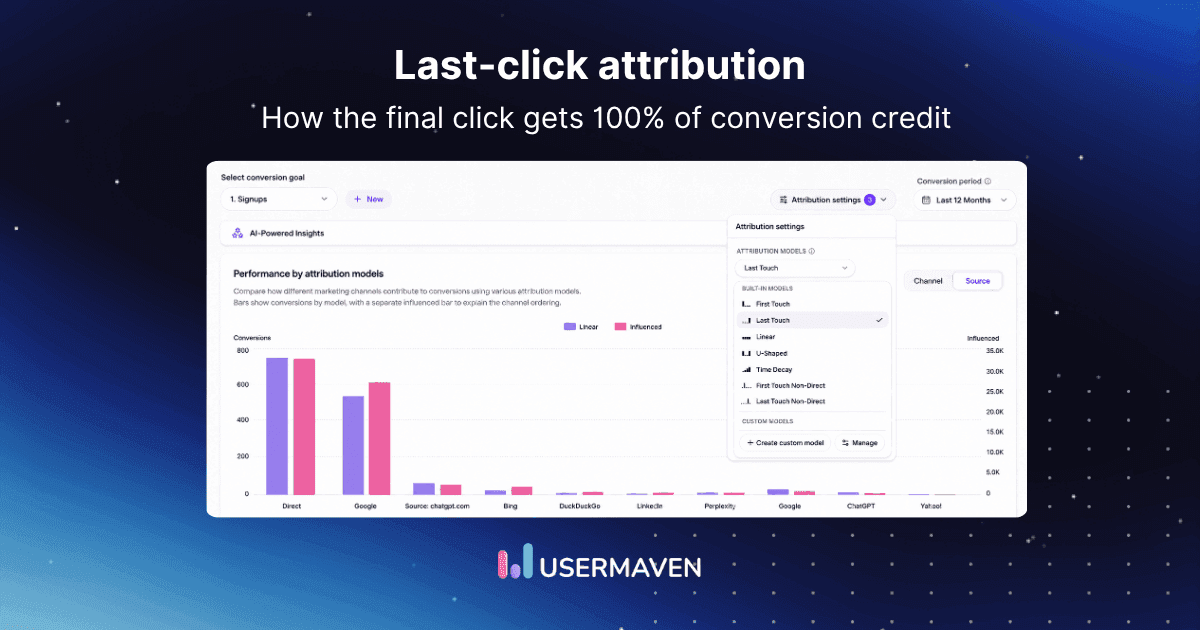
Last-touch attribution gives all conversion credit to the final interaction before a customer converts. It’s simple to understand and works well for businesses with short buying cycles, but it often undervalues earlier marketing efforts.
Best suited for: Ecommerce businesses, promotional campaigns, and shorter sales cycles.
Linear attribution
Choose this model if: Every customer interaction plays a meaningful role in moving prospects toward conversion.
Linear attribution distributes credit equally across every touchpoint, providing a balanced view of the customer journey. While it doesn’t distinguish between high- and low-impact interactions, it helps marketers avoid over-crediting a single channel.
Best suited for: Businesses using multiple marketing channels with consistent customer engagement.
Position-based attribution
Choose this model if: You want to recognize both the channel that created demand and the one that converted the customer.
Position-based attribution gives greater weight to the first and last interactions while sharing the remaining credit across the middle touchpoints. It offers a balanced approach for businesses with longer buying journeys.
Best suited for: B2B SaaS, lead generation, and businesses that rely on both acquisition and nurturing campaigns.
Time-decay attribution
Choose this model if: Recent interactions have the greatest influence on conversions.
Time-decay attribution gradually increases the credit assigned to touchpoints closer to the conversion while still recognizing earlier interactions. This makes it particularly useful for longer sales cycles where nurturing plays an important role.
Best suited for: Enterprise sales, SaaS, and account-based marketing strategies.
Data-driven attribution
Choose this model if: You have reliable tracking data and enough conversions to identify meaningful patterns.
Instead of following fixed rules, data-driven attribution analyzes historical conversion data to determine how much each touchpoint contributes to conversions. It provides a more dynamic view of performance but depends on accurate, high-quality data.
Best suited for: Mature marketing teams with established analytics, CRM integration, and consistent conversion volume.
💡 Expert tip: If you’re unsure which attribution model to rely on, don’t limit yourself to just one. Comparing multiple attribution models side by side often reveals insights that a single model can miss, helping you make more informed marketing decisions.
Best attribution models for different business types
The best attribution model depends on how your customers buy, how many touchpoints influence a conversion, and what you want to measure. Here are some common business scenarios and the attribution model that typically works best for each.
Ecommerce business
Recommended model: Last-touch attribution or position-based attribution
Most ecommerce purchases happen within a relatively short buying journey. Customers often compare products, read reviews, and complete a purchase within a few visits.
Use last-touch attribution if your goal is to understand which campaigns directly drive sales.
Use position-based attribution if you also want to measure the channels that introduced customers to your brand.
Example:
An online clothing store runs Google Shopping Ads, Instagram campaigns, and email promotions. Position-based attribution shows that Instagram drives discovery while email helps convert returning shoppers, giving the marketing team a more balanced view of performance.
B2B SaaS company
Recommended model: Position-based attribution or time-decay attribution
B2B buying journeys usually involve multiple decision-makers and weeks or months of research before a customer requests a demo or signs a contract.
These models recognize the importance of both early awareness and ongoing nurturing throughout the sales cycle.
Example:
A prospect first finds your company through an SEO article, attends a webinar, downloads a whitepaper, clicks a LinkedIn ad, and finally books a demo after receiving an email. Position-based attribution highlights both the channel that generated initial interest and the one that converted the opportunity.
Lead generation business
Recommended model: Linear attribution
When the goal is generating qualified leads rather than immediate purchases, every interaction often contributes to building trust.
Linear attribution gives equal credit across the customer journey, making it easier to understand how different marketing activities support lead generation.
Businesses with long sales cycles
Recommended model: Time-decay attribution
If customers spend weeks or months evaluating your solution, recent interactions usually have the greatest influence on the final decision while earlier touchpoints still deserve recognition.
Time-decay attribution reflects this by assigning progressively more credit to interactions closer to conversion.
Businesses new to attribution
Recommended model: First-touch attribution and last-touch attribution
If you’re just beginning to measure marketing attribution, start with simple models before moving to more advanced ones.
Comparing first-touch and last-touch attribution provides valuable insights into how customers discover your business versus what ultimately drives conversions. As your tracking improves, you can expand to multi-touch attribution.
Common mistakes to avoid when choosing an attribution model
Even if you understand how attribution models work, it’s easy to choose one that doesn’t reflect your customer journey. Avoid these common mistakes before making your final decision.
Relying on the default attribution model: The default model in your analytics platform isn’t always the right one. Make sure it aligns with your business goals and customer journey.
Ignoring top-of-funnel channels: Models that focus only on the final touchpoint often undervalue channels like SEO, content marketing, social media, and webinars that create demand.
Choosing a model your data can’t support: Advanced models require complete, reliable data. If your tracking is limited, a simpler attribution model will often produce more accurate insights.
Setting it and forgetting it: As your marketing strategy and customer behavior evolve, review your attribution model regularly to ensure it still reflects how customers buy.
Relying on a single perspective: Every attribution model has strengths and limitations. Comparing multiple models provides a more complete view of marketing performance.
How Usermaven helps you choose the right attribution model
Choosing an attribution model is only part of the process. The real challenge is determining whether it accurately reflects how your customers buy. As your business grows, you may also need to compare different models or customize attribution to match your unique sales process.
Usermaven helps marketers make confident attribution decisions by bringing customer journeys, marketing touchpoints, CRM data, and revenue into one platform.
With Usermaven, you can:
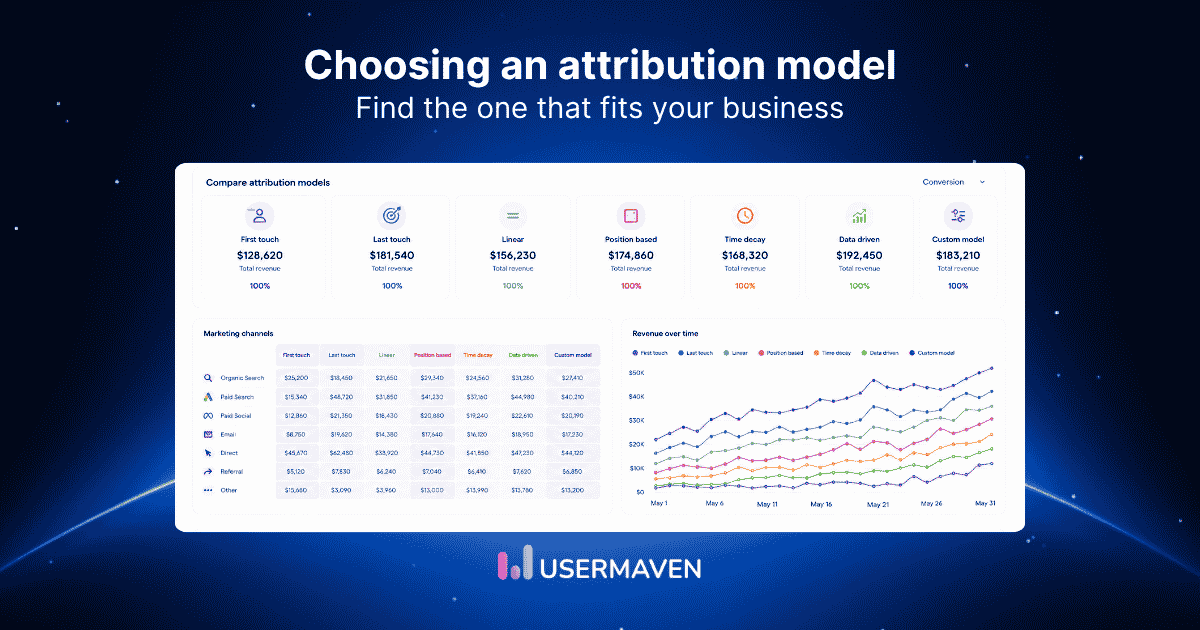
Compare multiple attribution models side by side.
Build custom attribution models that align with your business goals and customer journey.
Analyze complete customer journeys across marketing channels.
Measure marketing-attributed pipeline and revenue, not just conversions.
Understand assisted conversions and channel influence.
Connect first-party website data with CRM and sales outcomes.
Make attribution decisions using privacy-friendly, cookieless tracking.
See Usermaven in action
Book a free demo and discover how powerful analytics can grow your business.
The takeaway
Choosing the right attribution model isn’t about finding a universal winner. It’s about selecting the model that best reflects how your customers discover, engage with, and ultimately buy from your business. By considering your goals, sales cycle, customer journey, and available data, you can make more informed marketing decisions and gain a clearer understanding of what truly drives conversions and revenue.
As a marketing attribution platform, Usermaven makes this process easier by helping you compare multiple attribution models, analyze complete customer journeys, and connect marketing efforts directly to pipeline and revenue. Whether you’re optimizing campaign performance, improving budget allocation, or proving marketing ROI, Usermaven gives you the insights needed to choose an attribution model with confidence.
Ready to make smarter attribution decisions?
Ready to see Usermaven in action? Explore the platform or book a demo for a closer look.
FAQs
Which attribution model is the most accurate?
There isn’t a single attribution model that’s the most accurate for every business. The best choice depends on your customer journey, sales cycle, marketing channels, and business goals. Many organizations compare multiple attribution models to gain a more complete understanding of marketing performance.
Which attribution model is best for B2B SaaS?
B2B SaaS companies typically have longer buying journeys involving multiple touchpoints. Position-based, time-decay, and data-driven attribution models are often better suited because they recognize both customer acquisition and ongoing nurturing before conversion.
Which attribution model is best for ecommerce?
For ecommerce businesses with shorter buying cycles, last-touch attribution is a common starting point because it highlights the channels driving purchases. If customers interact with multiple channels before buying, position-based or data-driven attribution can provide a more balanced view.
Can I use multiple attribution models at the same time?
Yes. Comparing multiple attribution models is considered a best practice because each model provides a different perspective on marketing performance. Viewing first-touch, last-touch, and multi-touch attribution together helps you make more informed budgeting and optimization decisions.
Is data-driven attribution always the best choice?
Not necessarily. Data-driven attribution works best when you have sufficient conversion volume and reliable tracking data. If your business has limited data or a simpler customer journey, a rules-based attribution model may produce more reliable and easier-to-understand insights.
Does the attribution window affect which attribution model I should choose?
Updated

Written by
Imrana Essa
SaaS Marketing Lead
Imrana Essa is a marketing lead and content strategist with 8+ years of experience creating and leading content for B2B and SaaS brands. She specializes in marketing analytics, attribution, content strategy, and organic growth, translating complex marketing concepts into clear, actionable insights. Her work focuses on helping marketers understand performance, make data-informed decisions, and build strategies that contribute to sustainable growth.
All articles by Imrana →