A CRM can show 100 customers while Google, Meta, analytics, and attribution tools claim far more conversions. Paid campaigns can also become direct traffic, revenue can double, or attribution can appear to break after a tracking change.
Inaccurate attribution does not always mean a tag is broken. Missing data, duplicate events, disconnected identities, and different reporting rules can make the same journey look different across systems. Reliable marketing attribution software helps reconcile those differences.
This guide uses a simple diagnostic framework for ad attribution problems: symptom, cause, impact, first check, and fix. The goal is to separate real tracking failures from expected reporting differences before budget decisions are made.
Key takeaways
- Different numbers are not always errors: Ad platforms can disagree because they use different windows, identities, interaction types, and attribution rules.
- Signal loss creates uncertainty: Consent choices, browser controls, ad blockers, and missing identifiers reduce the customer journey a platform can observe.
- Implementation errors still matter: Broken UTMs, redirects, self-referrals, duplicate events, and cross-domain issues can genuinely corrupt attribution.
- Platform totals overlap: Google, Meta, LinkedIn, and other networks can claim the same conversion independently.
- Lead attribution is incomplete: Campaign quality should eventually connect with qualified pipeline, revenue, retention, and customer value.
- Models create perspectives: Attribution models distribute recorded credit but do not independently establish causal impact.
What is an ad attribution problem?
An ad attribution problem is any issue that causes an advertising interaction to be missing, duplicated, misclassified, disconnected, overcredited, undercredited, or tied to the wrong business outcome.
Technical attribution problems
Technical failures include lost campaign parameters, duplicate conversions, broken cross-domain tracking, identity fragmentation, and missing CRM connections. These issues damage the underlying ad tracking data before a model assigns credit.
Methodological attribution problems
Methodological problems occur when systems use different attribution windows, view-through rules, conversion definitions, identity methods, or credit models,the same issues that commonly affect attribution in advertising.

Why does ad attribution data become inaccurate?
Attribution depends on a chain of data: ad, identifier, visit, identity, conversion, CRM, revenue, and report. If any step is lost, duplicated, overwritten, delayed, or interpreted differently, the final attribution can become inaccurate.
Common causes include missing UTMs, lost click IDs, consent restrictions, duplicate browser and server events, cross-domain breaks, split customer profiles, incomplete CRM records, and inconsistent conversion definitions.
The first diagnostic step is to determine whether the problem is data loss or a reporting-rule difference. A broader guide to marketing attribution discrepancies between tools explains why two correctly configured systems can still produce different totals.
Table 1: 10 ad attribution problems
Here is a quick summary of each problem. Details and fixes follow below.
| Problem | What it distorts | Primary fix |
| Platforms claim the same conversion | Conversion totals and ROAS | Independent comparison |
| Identity breaks across journeys | Source and customer paths | Identity connection |
| Privacy updates reduce signals | Observed conversions | First-party measurement |
| UTMs and click IDs disappear | Campaign attribution | Tracking governance |
| Cross-domain journeys overwrite sources | Acquisition source | Cross-domain setup |
| Events fire twice | Conversions and revenue | Deduplication |
| Windows do not match | Channel credit | Align reporting windows |
| View-through credit is overread | Ad influence | Separate click and view results |
| Attribution stops at leads | Channel quality | CRM and revenue connection |
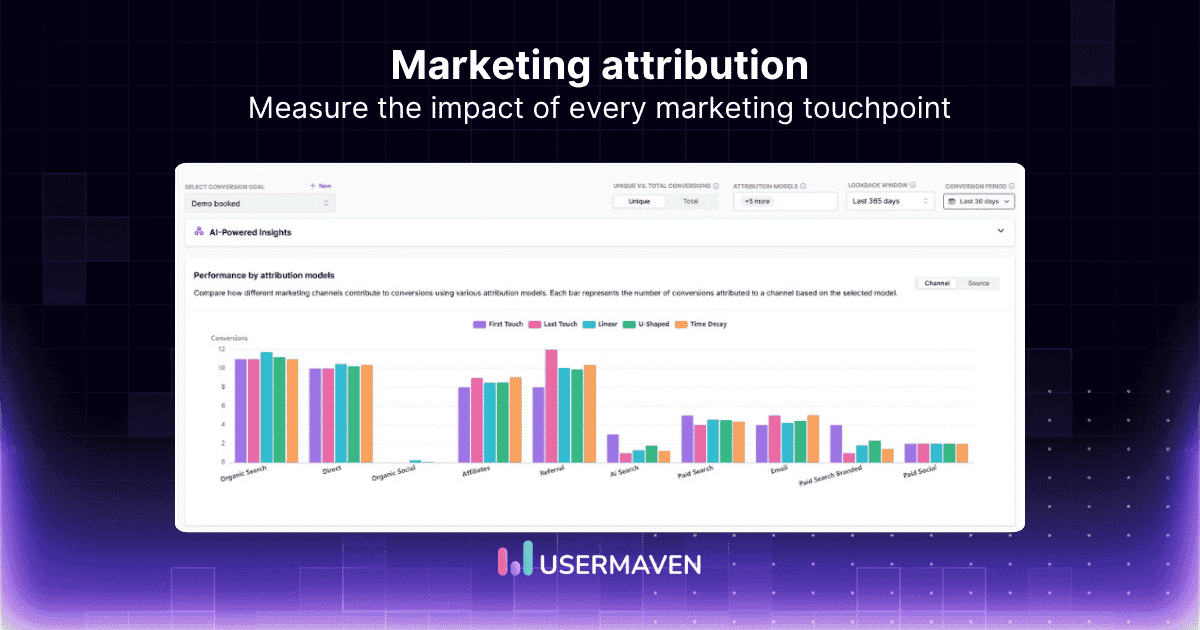
| Models bias the result | Budget conclusions | Compare several models |
Major ad attribution problems and fixes
Teams lose accurate data. Each issue below breaks a specific part of your tracking. Fix them in order for the clearest results.
1. Ad platforms claim the same conversion
What happens
A customer clicks a Meta ad, later searches on Google, and then purchases. Meta may claim the conversion because its ad appeared within an eligible window, while Google can also claim the same sale after the search interaction.
Why it happens
Each network measures through its own identities, windows, modeled data, and eligible interactions. This creates ad platform discrepancies even when the underlying purchase is recorded correctly.
How to fix it
Choose one business-level conversion source, standardize definitions, and reconcile platform totals with CRM or revenue records. Use cross-platform ad tracking for neutral comparison, while keeping native platform reports for campaign optimization.
2. Customer identity breaks across journeys
What happens
A person discovers the company from LinkedIn on mobile, returns directly on a laptop, signs up, and later becomes an opportunity. Without identity connection, those steps can look like separate users.
Why it happens
Browsers, devices, anonymous cookies, login states, email addresses, and CRM records all use different identifiers. Cookie expiry and device switching can shorten the visible journey or make a return visit look like a new acquisition.
How to fix it
Preserve the original source attribution and connect anonymous activity with known users after signup, form submission, login, or purchase. A contact-level identity layer should then reconnect later CRM activity with the earlier acquisition history.
3. Privacy updates reduce observable signals
Is attribution broken after privacy updates?
Privacy changes usually reduce the amount of directly observable data rather than making attribution universally impossible. Consent rejection, browser protections, ad blockers, cookie restrictions, and mobile identifier limits all reduce the number of touchpoints that can be linked reliably.
WebKit documents that Safari’s tracking prevention includes full third-party cookie blocking and other limits on cross-site tracking. This is why ad attribution after privacy updates increasingly depends on consented first-party signals rather than unrestricted cross-site identifiers.
How to fix it
Strengthen first party data, connect known customer outcomes, and use server side tracking where it improves delivery and control. Server-side measurement should support consented collection, not be treated as a privacy bypass.
Separate observed outcomes from modeled ones and accept that some uncertainty is unavoidable. A smaller trustworthy dataset is more useful than a precise-looking report built from weak assumptions.
4. UTMs and click identifiers disappear
What happens
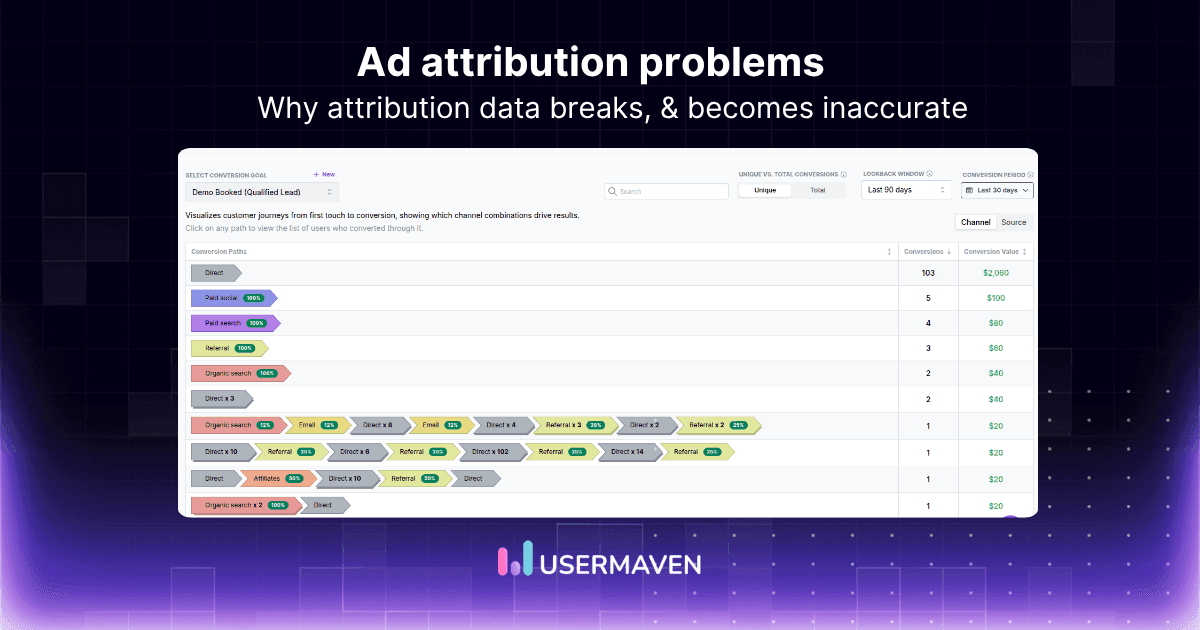
A paid campaign suddenly appears as direct, referral, organic, unknown, or unassigned traffic. The ad platform still knows the campaign, but the analytics or attribution system can no longer connect the visit with the original click.

Why it happens
Common causes include missing UTMs, inconsistent naming, redirects, short links, landing-page rules, GCLID or FBCLID loss, parameter stripping, and manually copied URLs.
How to fix it
Standardize UTM parameters, preserve click identifiers, test every redirect, and inspect final landing URLs before campaigns launch. A separate review of critical UTM mistakes can help teams catch naming and implementation errors before they contaminate reporting.
5. Cross-domain journeys overwrite attribution
What happens
A customer arrives from a Google ad, moves to a checkout or booking domain, completes payment, and returns to the site. The payment provider or another owned domain then appears as the conversion source.
Why it happens
The original session or visitor identity is not preserved across domains. Google Analytics documents this issue in its guidance on unwanted referrals, including shopping-cart and related domains that can otherwise be classified as referral traffic.
How to fix it
Configure linked domains, exclude unwanted internal referrals where appropriate, preserve campaign data through the journey, and test authentication, booking, checkout, and payment flows. Follow a complete cross domain tracking test rather than validating only the landing page.
6. Browser and server events duplicate conversions
What happens
One purchase can become two conversions when both the browser pixel and the server send the same purchase as separate events. Revenue, ROAS, and conversion counts then become inflated.
Why it happens
Typical causes include missing event IDs, inconsistent identifiers, duplicate tags, tag-manager duplication, retry logic, and CRM imports that repeat conversions already captured on the website.
How to fix it
Use unique event identifiers, define which system owns each conversion, reconcile browser and server payloads, and run test purchases after every tracking change. Regular audits with conversion tracking tools help expose duplicate events before they reach campaign reporting.
7. Attribution windows do not match the buying cycle

What happens
Two platforms can receive the same conversion but report different totals because one uses a seven-day click window while another uses a longer click window or also includes view-through conversions.
Why it happens
Short windows emphasize recent response and can miss long consideration journeys. Long windows capture delayed conversions but can assign credit to interactions that were only weakly related to the final decision.
How to fix it
Document the click and view windows used by every major platform. Compare equivalent windows where possible, and set business-level reporting around the actual sales cycle rather than adopting a platform default without review.
8. View-through attribution overstates influence
What happens
An impression-heavy campaign can appear to generate many conversions even when relatively few users clicked. A person may see an ad, later arrive through another channel, and still receive view-through credit in the original platform.
Why it happens
View-through and engaged-view rules are especially relevant to social, display, video, and CTV campaigns. In Meta reporting, facebook ads attribution can include a different set of eligible interactions than a click-only analytics report.
How to fix it
Report click-through and view-through outcomes separately, test different view windows, and examine retargeting carefully. Use incrementality when the decision requires evidence of causal lift rather than exposure-based credit.
9. Attribution stops at the lead
What happens
Campaign A can generate 100 leads and only two customers, while Campaign B generates 40 leads and ten customers. Lead-level attribution makes Campaign A look stronger even though Campaign B creates far more revenue.
Why it happens
Marketing systems often stop at the form submission, demo request, signup, or trial. The actual commercial outcome happens later in the CRM, billing system, or product lifecycle.
How to fix it
Connect ad history with qualification, opportunity stages, deal values, and closed revenue through Marketing attribution CRM integration. Then use revenue attribution to compare channels by the value of the customers they create.
10. The attribution model biases the result
What happens
A channel can look highly valuable in one report and weak in another because the model changes how recorded credit is distributed across the same customer journey.
Why it happens
First-touch favors discovery, last-touch favors closing, linear spreads credit evenly, time decay favors recent interactions, and position-based models emphasize selected stages. This creates Attribution bias in marketing when one reporting view is treated as objective truth.
How to fix it
Compare several ad attribution models, match each model to a specific business question, document changes, and avoid using one view for every budget decision. Larger investments should also be validated with incrementality or other causal methods where practical.
What about dark-funnel influence?
Some influential interactions never generate clean campaign data. Word of mouth, private communities, WhatsApp, Slack, events, sales conversations, and offline exposure can shape a buying decision without creating a trackable click.
Channels such as podcast attribution illustrate this limitation clearly. Attribution can organize observed evidence, but it cannot reconstruct every influence that occurred in a buyer’s mind.
Why ad platforms will never match perfectly
Some differences are structural and should not be forced away. Ad platforms, analytics systems, CRMs, payment tools, and independent attribution platforms answer different questions with different data.
- Ad platform: Did our advertising appear in the eligible conversion path?
- Analytics platform: What source and journey did we observe on the tracked properties?
- CRM: Which lead became an opportunity or customer?
- Payment system: Which transaction actually occurred?
- Independent attribution: How should credit be compared consistently across sources?
The goal is reconciliation, not identical numbers. A trustworthy measurement stack explains why the systems differ and identifies which source should guide each decision.
How to audit inaccurate ad attribution data
Use an Attribution checklist to test the complete measurement chain rather than reviewing dashboards in isolation.

1. Validate conversion definitions
Confirm that every system agrees on what counts as a lead, qualified lead, purchase, customer, and revenue event. Differences in definitions create reporting mismatches before attribution is even applied.
2. Test campaign parameters
Open real ads and follow the click through every redirect to the landing page. Confirm UTMs, click IDs, source values, and campaign names survive the complete path.
3. Trace cross-domain journeys
Test the website, application, authentication, checkout, booking, and payment flow. Verify that the original source survives every domain change.
4. Check event duplication
Compare browser, server, tag manager, CRM, and imported conversions. Confirm that one real outcome produces one business conversion unless multiple events are intentionally required.
5. Compare attribution settings
Document the model, click window, view window, reporting date, time zone, and conversion definition for every major system before comparing totals.
6. Test identity connection
Trace an anonymous visitor through signup or purchase and confirm that earlier acquisition history connects with the known user or contact.
7. Connect CRM outcomes
Verify that qualification, opportunities, deal values, close status, and revenue reconnect with the original campaign history.
8. Trace real customers
Choose several actual customers and manually reconstruct their path from acquisition through revenue. Real journeys often reveal implementation gaps that aggregate dashboards hide.
Is attribution broken or just mismatched?
An ad attribution reporting mismatch does not automatically mean one platform is wrong. Different systems can produce valid but incompatible views of the same customer journey.
Expected reporting mismatch
Expected differences come from attribution windows, click versus view-through credit, interaction date versus conversion date, modeled conversions, reporting delays, platform-specific identities, time zones, and conversion definitions.
Actual attribution failure
A true tracking failure exists when UTMs disappear, click IDs are stripped, events fire twice, conversions never arrive, revenue values are wrong, identities split, payment domains overwrite acquisition, or CRM outcomes never reconnect to the campaign.
See Usermaven in action
Book a free demo and discover how powerful analytics can grow your business.
Table 1: Symptoms and likely causes
| Symptom | Likely cause | First check |
| Google and Meta both claim a sale | Platform-specific attribution | Windows and interaction rules |
| Paid conversions become direct | Lost campaign data | UTMs and click IDs |
| Analytics shows fewer conversions | Signal or tracking loss | Event collection |
| Revenue appears doubled | Duplicate events | Browser/server deduplication |
| Payment provider gets credit | Cross-domain problem | Referral and domain settings |
| Mobile and desktop look unrelated | Identity fragmentation | User identification |
| CRM has fewer conversions | Downstream data gap | CRM integration |
| Retargeting looks unusually strong | Model or view-through bias | Model and window settings |
Attribution vs. incrementality
Attribution and incrementality answer different questions. Knowing both helps you spend smarter.
Attribution asks
Which recorded marketing interactions should receive credit for a conversion?
Incrementality asks
Would the conversion have happened without the advertising?
Fixing inaccurate attribution improves the quality of recorded journeys, but it still does not prove causal lift. Incrementality is especially important for retargeting, branded search, view-through campaigns, and mature demand channels.
How Usermaven reduces avoidable attribution problems
Usermaven reduces avoidable attribution problems by connecting paid and organic acquisition with customer journeys, first-party behavior, CRM outcomes, revenue, and consistent cross-channel reporting.

Compare platforms under one framework
Attribution reporting compares channels, campaigns, paid ads, content, CRM deals, pipeline, and revenue under one measurement layer instead of adding self-reported platform totals together.
Preserve customer journeys
User journeys connect sources, pages, return visits, product activity, and conversions so teams can inspect the path behind the final attribution result.
Connect anonymous and known customers
Contacts Hub helps connect anonymous acquisition activity with known contacts and companies after identification, reducing source loss across longer journeys.
Add behavioral context
Website analytics explains landing-page and content behavior, while product analytics shows activation, adoption, upgrades, and retention after acquisition.
Connect campaigns with revenue
CRM and deal attribution lets teams evaluate campaigns through qualified opportunities, pipeline, closed revenue, and customer quality instead of stopping at clicks or form submissions.
Return better outcomes to ad platforms
conversion syncs can send verified first-party outcomes back to advertising platforms so optimization is based on qualified leads, customers, purchases, or revenue rather than shallow events.
Investigate problems faster
Maven AI helps teams query connected marketing and customer data in natural language, which can speed up investigation when attribution totals change or a source suddenly loses credit.
Final verdict
Ad attribution becomes inaccurate for two different reasons: the underlying data can genuinely break, or correctly functioning systems can apply different measurement rules.
Technical failures require fixes such as better UTMs, deduplication, identity connection, cross-domain tracking, and CRM integration. Reporting mismatches require consistent definitions and reconciliation rather than forcing every platform to show the same number.
Ready to see Usermaven in action? Explore the platform or book a demo for a closer look.
Drive business growth
with AI-powered analytics
FAQs
1. What are the most common ad attribution problems?
Common problems include duplicated platform credit, broken identities, privacy-related signal loss, missing UTMs, cross-domain source overwrites, duplicate events, mismatched attribution windows, view-through overcrediting, CRM gaps, and model bias.
2. Why is my ad attribution data inaccurate?
Ad attribution becomes inaccurate when data is missing, duplicated, disconnected, or interpreted under different rules. The cause can be technical, such as lost identifiers, or methodological, such as different attribution windows.
3. Why do Google Ads and Meta report different conversions?
Each platform uses its own eligible interactions, identity signals, attribution windows, modeled data, and reporting logic. Both can therefore claim the same conversion without either total matching the CRM.
4. Why is there an ad attribution reporting mismatch?
Reporting mismatches can come from different conversion definitions, click and view windows, reporting dates, time zones, modeled conversions, identity coverage, and platform scope.
5. Can ad attribution break after privacy updates?
Privacy changes can reduce observable signals and make attribution less complete. They do not make attribution impossible, but they increase the importance of consented first-party data, identity connection, CRM outcomes, and transparent modeling.
6. How does ad attribution work after privacy updates?
Modern attribution relies more heavily on first-party events, consented customer data, server-side delivery where appropriate, aggregated signals, modeled outcomes, and experiments when direct user-level observation is incomplete.
Updated

Written by
Ryan Mitchell
Marketing Analytics Strategist
Ryan Mitchell is a marketing analytics strategist specializing in campaign measurement, customer journeys, and marketing performance. He writes about analytics, reporting, and data-driven marketing strategies, helping SaaS and B2B teams measure what matters across every stage of the customer journey.
All articles by Ryan →