A customer may discover a business through Google, return from LinkedIn, click an email, and finally convert during a direct visit. Source attribution determines which of those specific origins receives credit for the outcome.
The source is the identifiable origin of a visit, such as Google, LinkedIn, a newsletter, a partner website, or direct traffic. Attribution adds the decision rule that determines whether the first source, the last source, or several sources share conversion credit.
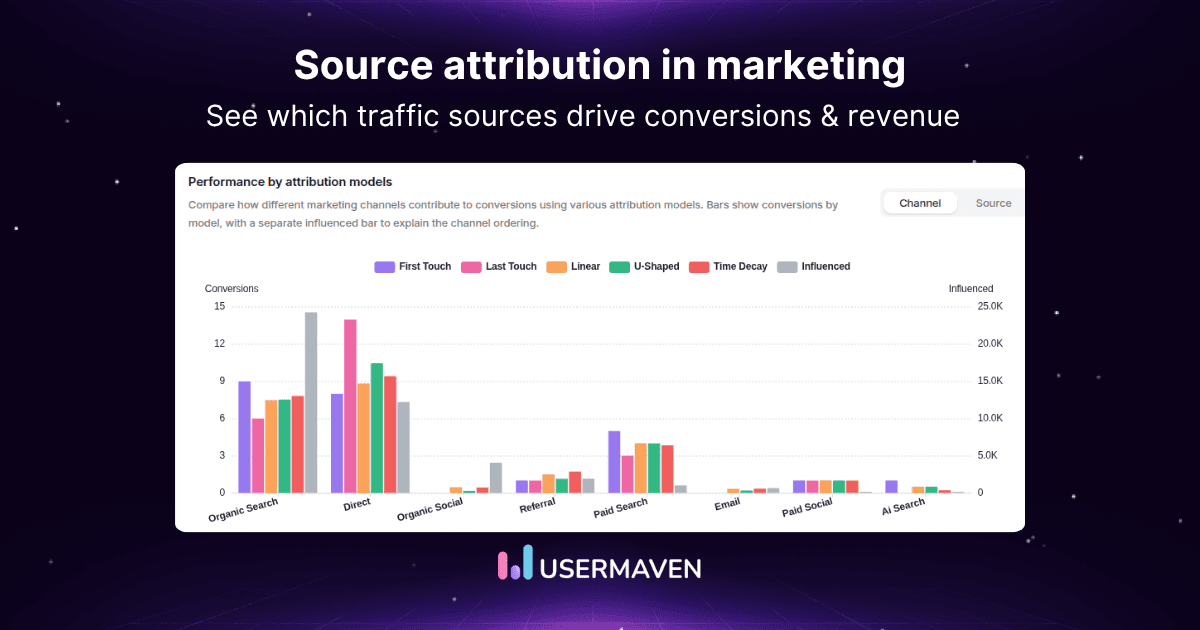
A reliable marketing attribution software setup connects those sources with sessions, customer journeys, conversions, pipeline, and revenue.
This article explains how source attribution works, how it differs from channel and lead-source reporting, which attribution models apply, what commonly breaks, and how Usermaven creates a more complete source-level view.
Key takeaways
Source attribution identifies which specific traffic origins contribute to conversions and revenue.
A source is more specific than a channel. Google can be the source while organic search or paid search is the channel.
First-touch, last-touch, and multi-touch models can assign different credit to the same source journey.
Accurate reporting depends on consistent UTMs, referrer data, identity resolution, conversion tracking, and downstream business data.
Usermaven connects source-level acquisition with website behavior, product activity, customer journeys, CRM pipeline, and revenue.
What is source attribution?
Source attribution in marketing is the process of identifying and assigning conversion credit to the specific traffic sources that contributed to a customer journey.
A source names the identifiable origin of traffic. Common examples include Google, Bing, LinkedIn, Facebook, a newsletter, an affiliate, a review website, a partner domain, or direct traffic. The attributed source can represent discovery, the final interaction before conversion, or a share of a multi-source journey.
The phrase also appears in academic citation, scientific research, and data provenance. This article uses the marketing meaning: identifying where visitors came from and deciding how those sources receive credit for a commercial outcome.
What counts as a traffic source?
Analytics and attribution platforms usually determine the source from campaign parameters, advertising click identifiers, the referring domain, connected ad-platform data, or a direct or unknown classification when no usable origin is available.
The source must be captured before reliable conversion tracking can connect the visit with a signup, purchase, demo request, qualified lead, opportunity, or another defined outcome.
How source attribution works
The traffic source starts a session, moves through the customer journey, leads to a conversion, and gets credited via an attribution model.

1. Capture the source: The platform records UTMs, referrers, click IDs, campaign integrations, and landing-page data when the visitor arrives.
2. Track the journey: Sessions, return visits, content engagement, page activity, forms, and product events are connected into a behavioral path.
3. Identify the visitor: A form submission, account creation, purchase, or login can connect earlier anonymous activity with a known profile.
4. Record the conversion: The selected outcome may be a signup, demo request, purchase, qualified opportunity, closed customer, or revenue event.
5. Apply the model: First-touch, last-touch, linear, time-decay, U-shaped, or another model determines how source credit is distributed.
6. Connect commercial outcomes: CRM and billing data extend the analysis from website conversions to qualified leads, pipeline, closed revenue, retention, and expansion.
This final connection turns traffic reporting into revenue attribution, allowing the business to compare sources by commercial value rather than visits or lead volume alone.
Source vs. medium vs. channel vs. campaign
Source, medium, channel, and campaign describe different layers of acquisition. Combining them into one field makes reporting harder to interpret and easier to fragment.

Google Analytics describes the source as the specific origin of traffic and the medium as the method through which the visitor arrived.
Its traffic-source dimensions also distinguish user, session, and event scopes, which is why the same customer can appear under different acquisition views as per Google Analytics traffic-source dimensions.
Table 1: Source, medium, channel, and campaign
| Dimension | Example | What it identifies |
| Source | The specific traffic origin | |
| Medium | CPC | How the traffic arrived |
| Channel | Paid search | The broader acquisition category |
| Campaign | Enterprise attribution | The marketing initiative |
| Referrer | example.com/article | The referring page or domain |
For one Google Ads visit, the source may be Google, the medium CPC, the channel paid search, and the campaign Enterprise attribution. Keeping those values separate allows the team to move from broad channel reporting to specific source and campaign analysis.
Source attribution examples
Organic search example
First-touch attribution credits Google. Last-touch attribution may credit direct unless the reporting model ignores direct visits when a known source already exists.
Paid search example
First-touch credits Google Ads, last-touch credits email, and multi-touch reporting can divide credit between both sources. Selecting the best attribution model for Google Ads depends on journey complexity, tracking quality, and the decision being made.
Paid social example
The journey moves from LinkedIn Ads to Google organic search, ending in a demo request. LinkedIn created discovery, while Google completed the digital journey. A single-touch report will hide one of those roles.
Referral example
The journey involves visiting a partner website, returning directly, and then completing the purchase. First-touch credits the partner. Last-touch may credit direct if the platform does not preserve the previous known source.
Email example
Though Google organic search sparks the relationship, email click often earns the closing credit for the upgrade. Email may receive closing credit even though organic search created the original relationship.
Table 2: Source attribution by model
| Customer journey | First-touch source | Last-touch source | Multi-touch result |
| Google -> email -> direct | Direct | Credit shared | |
| LinkedIn -> Google -> demo | Credit shared | ||
| Referral -> email -> purchase | Referral | Credit shared | |
| Google Ads -> direct -> signup | Google Ads | Direct | Credit shared |
Which attribution models apply to sources?
The same source journey can produce different results depending on the selected model. A broader comparison of marketing attribution models helps teams choose the right perspective for discovery, conversion, pipeline, or revenue questions.

First-touch source attribution
First-click gives 100% of the credit to the earliest recorded source. It is useful for evaluating demand creation and initial discovery but ignores later influences.
Last-touch source attribution
Last-click attribution gives 100% of the credit to the final eligible source before conversion. It is simple and useful for closing-stage analysis but often overvalues email, branded search, remarketing, and direct returns.
Linear source attribution
Linear attribution divides credit equally among eligible sources. It recognizes multiple contributors but assumes every interaction had the same influence.
Time-decay source attribution
Time-decay attribution gives more credit to sources closer to conversion. It is useful when recent interactions are expected to carry more influence.
U-shaped source attribution
U-shaped attribution emphasizes the first source and the source connected with lead creation, with the remaining credit shared across middle interactions.
Non-direct source attribution
Non-direct attribution prevents a direct visit from replacing a previously known marketing source. This is useful when return visits frequently occur through bookmarks, saved tabs, or typed URLs.
First-touch vs. last-touch source attribution
Neither model is universally correct. First-touch answers which source created the relationship, while last-touch answers which source completed the conversion.
Table 3: First-touch vs. last-touch source attribution
| Decision factor | First-touch | Last-touch |
| Main question | Which source created demand? | Which source completed conversion? |
| Credit | First source receives 100% | Final source receives 100% |
| Main strength | Measures discovery | Measures closing activity |
| Main bias | Overvalues early sources | Overvalues lower-funnel sources |
| Best use | Acquisition analysis | Conversion analysis |
How to set up traffic source attribution
Follow these steps to build a reliable attribution setup.

1. Define sources and channels: Create consistent classifications for Google, LinkedIn, Meta, email, referral, direct, organic, partner, affiliate, and offline sources.
2. Standardize UTM parameters: Use approved naming rules for source, medium, campaign, content, and term. Consistent UTM parameters prevent one source from being split across several labels.
A shared UTM parameter convention should define lowercase usage, separators, abbreviations, ownership, and how campaign versions are recorded.
3. Preserve advertising click IDs: Keep platform identifiers available for campaign matching, offline conversion imports, and ad-level analysis.
4. Track referrers and landing pages: Record the referring domain and first landing page so untagged visits still retain useful source context.
5. Configure cross-domain tracking: Preserve identity and source data when users move between the main website, app, checkout, booking tool, authentication domain, or payment service.
Reliable cross-domain tracking prevents internal domains from becoming false referrals and reduces source loss between properties.
6. Identify visitors after conversion: Connect earlier anonymous sessions with known profiles after a form submission, signup, purchase, or login.
7. Define meaningful conversions: Separate primary outcomes such as qualified leads, purchases, and customers from low-intent micro-events used only for observation.
8. Select attribution models: Compare first-touch, last-touch, and multi-touch perspectives instead of treating one model as the only truth.
9. Connect CRM and revenue data: Import lifecycle stages, opportunities, deal values, closed revenue, and retention signals where the initial conversion is not the final outcome.
10. Validate real journeys: Trace actual customers from source through conversion and revenue, then confirm that source names, dates, identities, and values are correct.
Common source attribution problems
Attribution breaks in predictable ways. Spotting these issues early saves revenue.

Missing or inconsistent UTMs
Values such as LinkedIn, linkedin, linkedin.com, and paid-linkedin may represent the same source but appear as separate rows. Standard naming prevents fragmentation.
Excessive direct traffic
Direct traffic often grows when referrers, campaign parameters, or identity signals are missing. Bookmarks and typed URLs are direct, but untagged email, private messaging apps, redirects, and tracking loss can also end up there.
Self-referrals
Checkout, authentication, booking, payment, and subdomains can incorrectly become acquisition sources when cross-domain settings are incomplete.
Redirects remove campaign data
Link shorteners, redirects, and landing-page rules can strip UTMs or click IDs before the analytics script records them.
Anonymous and known activity do not connect
When earlier sessions are not merged with the identified profile, attribution appears to begin at signup rather than at the original discovery source.
Multiple devices create separate journeys
A visitor who researches on one device and converts on another may appear as two people until a stable user or customer ID connects the activity.
Ad platforms claim the same conversion
Google, Meta, LinkedIn, and other networks can each claim the same conversion under their own attribution windows and interaction rules. These ad platform discrepancies are often structural rather than evidence that one tag is broken.
Offline conversions are missing
Calls, meetings, events, partner introductions, sales outreach, and in-person interactions remain invisible unless they are recorded and connected with the customer or account.
Source and channel rules conflict
Two tools may classify the same source differently. One may place YouTube under video, another under paid social, and a third under paid media, creating mismatched summaries even when raw events are similar.
Source attribution vs. lead source tracking
Source attribution and lead source tracking overlap, but they answer different questions.Lead source tracking usually records where a lead came from, often as an original or latest source field in the CRM.
Source attribution can include several sources, changes according to the selected attribution model, and can be calculated for signups, qualified leads, opportunities, revenue, or retention. Lead-source reporting is often a single stored field, while source attribution preserves a model-dependent journey.
Source attribution vs. channel attribution
Channel attribution groups sources into broader categories such as paid search, organic search, paid social, email, referral, and direct. Source attribution drills into the individual origin, such as Google, LinkedIn, Facebook, Bing, or a specific referring domain.
A multi-channel attribution view helps compare the broader acquisition mix, while source attribution reveals which individual platforms or domains are driving performance inside each channel.
Source attribution vs. campaign attribution
Source attribution identifies where traffic originated. Campaign attribution evaluates the specific marketing initiative that produced or influenced the visit. One source can contain many campaigns, and one coordinated campaign can run across several sources.
For example, LinkedIn may be the source, paid social the channel, and Enterprise demo Q3 the campaign. Source reporting compares LinkedIn with other origins, while campaign reporting compares individual initiatives within and across those sources.
How to improve source attribution accuracy
Preserve source history: Keep both first-touch and last-touch source values instead of overwriting the original source. HubSpot’s traffic-source properties distinguish the first known source from the most recent known source, helping teams compare demand creation with later return activity.
Use one source naming convention across advertising, email, CRM, analytics, and reporting systems.
Exclude internal traffic, staging domains, payment domains, and known self-referrals.
Compare more than one attribution model for discovery, conversion, pipeline, and revenue decisions.
Connect source data with qualified leads, activation, opportunities, revenue, retention, and customer value.
Audit direct, unknown, unassigned, and unusually fragmented source values on a regular schedule.
Unlock insights that drive growth
How Usermaven handles source attribution
Usermaven brings source attribution, website behavior, product activity, customer journeys, CRM outcomes, and revenue into one connected measurement layer. The source remains visible as the journey moves from acquisition to conversion and later commercial outcomes.

Compare channels and sources
The attribution reporting allows teams to move from high-level channels to specific sources and campaigns while comparing multiple attribution perspectives.
Connect sources with website behavior
Website analytics in Usermaven connects sources with landing-page engagement, content consumption, return visits, funnel behavior, and on-site conversions.
Track complete customer journeys
With user journeys in Usermaven, teams can see how each touchpoint connects across sessions: a visitor discovers the business on Google, reads the blog, checks LinkedIn, returns directly, signs up, activates, and becomes a customer.
Analyze product outcomes by source
Instead of stopping at the initial signup, teams can use product analytics to compare sources across activation, feature adoption, engagement, upgrades, and long-term retention, giving you a fuller picture beyond first-touch data.
Connect source data with contacts and companies
The Contacts Hub brings visitors, leads, users, and companies into unified profiles with acquisition and behavioral context.
Measure pipeline and revenue by source
Campaigns and sources can be evaluated using qualified opportunities, pipeline, closed revenue, retention, and expansion when CRM and revenue events are connected with the earlier journey.
Build source attribution dashboards
Analytics dashboards can combine channel, source, campaign, funnel, journey, product, and revenue reporting for marketing, product, revenue, and leadership teams.
Source attribution best practices
These practices help keep source-level reporting consistent, interpretable, and connected with meaningful business outcomes.
Separate acquisition dimensions: Define source, medium, channel, and campaign as separate fields so each layer can be analyzed independently.
Preserve source history: Keep both first-touch and last-touch values so later visits do not erase the original acquisition source.
Standardize UTMs: Apply one naming convention across campaigns to prevent the same source from being split into inconsistent labels.
Preserve click identifiers: Keep advertising auto-tagging active and retain click IDs for campaign matching, offline imports, and ad-level analysis.
Exclude internal and self-referral traffic: Filter internal users, staging environments, payment domains, and other known sources of false referrals.
Compare multiple models: Review first-touch, last-touch, and multi-touch perspectives because each answers a different business question.
Connect identities across the journey: Merge earlier anonymous activity with identified profiles after signup, purchase, form submission, or login.
Align attribution windows: Set the attribution window according to the actual buying cycle rather than an arbitrary default.
Import business outcomes: Connect source data with qualified leads, opportunities, pipeline, closed revenue, retention, and expansion.
Audit unattributed traffic: Review direct, unknown, and unassigned traffic regularly to identify missing UTMs, lost referrers, redirects, or tracking failures.
Final verdict
Source attribution identifies the specific traffic origins that contribute to customer acquisition and conversion.
First-touch reveals discovery, last-touch reveals the closing interaction, and multi-touch models show how several sources participate in the same journey.
None of those views can compensate for missing UTMs, broken cross-domain tracking, incomplete identity resolution, or disconnected CRM outcomes.
Ready to see Usermaven in action? Explore the platform or book a demo for a closer look.
See Usermaven in action
Book a free demo and discover how powerful analytics can grow your business.
FAQs
1. What is source attribution?
Source attribution is the process of identifying and assigning conversion credit to the specific traffic sources that contributed to a customer journey. Examples include Google, LinkedIn, email, referral websites, partners, and direct traffic.
2. What does source attribution mean in marketing?
In marketing, source attribution connects acquisition origins with outcomes such as signups, purchases, qualified leads, pipeline, or revenue. The selected attribution model determines whether the first source, last source, or several sources receive credit.
3. What is traffic source attribution?
Traffic source attribution measures which origins brought visitors to a website or product and how those origins influenced conversion. It relies on data such as UTMs, referrers, click identifiers, sessions, identities, and conversion events.
4. What is the difference between source and channel attribution?
A source is the specific origin, such as Google or LinkedIn. A channel is the broader category, such as organic search, paid search, paid social, email, referral, or direct.
5. What is the difference between source and medium?
Source identifies where traffic came from, while medium describes how it arrived. For example, Google can be the source and CPC, organic, or referral can be the medium.
6. How are conversions attributed to traffic sources?
The platform records eligible source interactions in the customer journey and applies an attribution model. First-touch credits the earliest source, last-touch credits the final source, and multi-touch models distribute credit across several sources.
Updated

Written by
Junaid Ahmed
Content Writer & Digital Marketer
Junaid Ahmed is a content and copywriter with 3+ years of experience creating research-driven content across SaaS, B2B, ecommerce, and digital marketing. He specializes in turning complex topics into clear, practical content that helps marketers better understand their challenges, evaluate solutions, and make informed decisions. His work spans educational content, industry insights, and actionable marketing guides.
All articles by Junaid →