Ad attribution does not become difficult in the same way for every business. A B2B company connecting LinkedIn ads to closed revenue faces a different problem from a consumer brand reconciling Meta, Google, and repeat purchases.
Privacy restrictions, fragmented identity, conflicting platform claims, long customer journeys, and model limitations create pressure across almost every attribution in advertising setup.
This guide compares the biggest ad attribution challenges across B2B, B2C, ecommerce, SaaS, high-ticket offers, and agencies, then shows which issue each team should solve first.
Key takeaways
The biggest challenge depends on the business model: B2B struggles with accounts and long sales cycles, while B2C usually deals with faster, fragmented journeys across channels and devices.
Ad platforms are not neutral measurement systems: Google, Meta, LinkedIn, and other networks can use different attribution rules for the same conversion.
The final conversion matters: A lead, signup, purchase, opportunity, and recurring-revenue event should not be treated as interchangeable outcomes.
Identity gets harder across systems: Websites, apps, CRMs, checkouts, and ad platforms can each hold a different part of the same customer story.
Attribution does not prove incrementality: Assigning credit to observed touchpoints is different from proving that advertising caused an additional conversion.
Fix measurement before changing models: A more advanced model cannot repair missing campaign data, duplicated events, broken identity, or unreliable revenue records.
What are ad attribution challenges?
Ad attribution challenges are the tracking, identity, data, modeling, and business-definition problems that make it difficult to determine which advertising interactions contributed to a conversion or revenue outcome.
Most challenges come from five areas: incomplete customer journeys, weak tracking, conflicting platform measurement, attribution-model limitations, and business outcomes that live outside the advertising platform.
The related guide to ad attribution problems focuses on specific measurement failures and fixes. This article takes a different angle: how the difficulty changes depending on how a business acquires, converts, and monetizes customers.
Why ad attribution challenges differ by business model
The same technical limitation can have very different commercial consequences. A missing early touch may slightly distort a fast B2C purchase, but it can erase months of influence from a B2B opportunity.
The main attribution challenge by business model
| Business model | Main attribution challenge | Important outcome |
|---|---|---|
| B2B | Long cycle + multiple stakeholders | Pipeline / revenue |
| B2C | Cross-device + cross-channel journeys | Purchase / customer value |
| Ecommerce | Overlapping platform claims | Orders / LTV |
| SaaS | Signup is not the final conversion | Activation / recurring revenue |
| High-ticket | Long consideration + offline sales | Closed revenue |
| Agency | Different client stacks and definitions | Comparable reporting |
This is why a single generic attribution checklist is rarely enough. Teams should start with the measurement gap that can most directly change revenue, pipeline, customer quality, or media allocation.
6 ad attribution challenges every team faces
These challenges show up across industries, but they hit differently depending on your business model.

1. Incomplete customer journeys
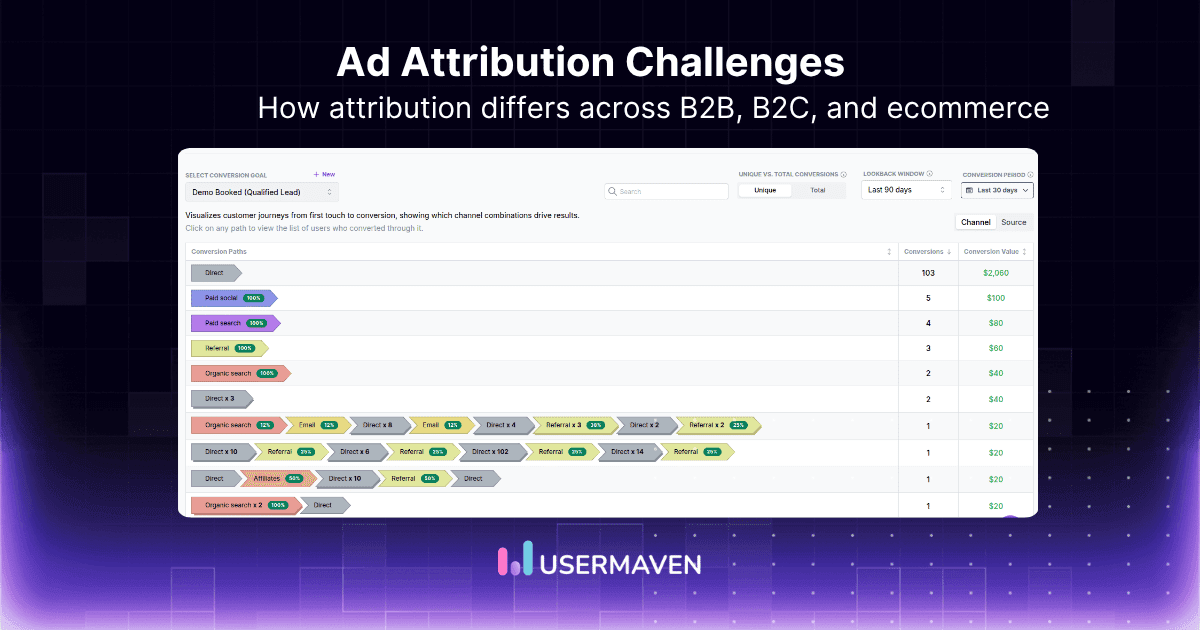
A prospect can see an ad, return through organic search, switch devices, respond to email, and convert later. No single platform necessarily observes the full sequence or identifies every interaction as the same person.
Nielsen’s cross-media measurement overview explains how cross-media measurement can deduplicate audiences across publishers and show how different channels contribute to overall campaign performance. That matters because isolated channel reports can describe only part of the same customer journey.
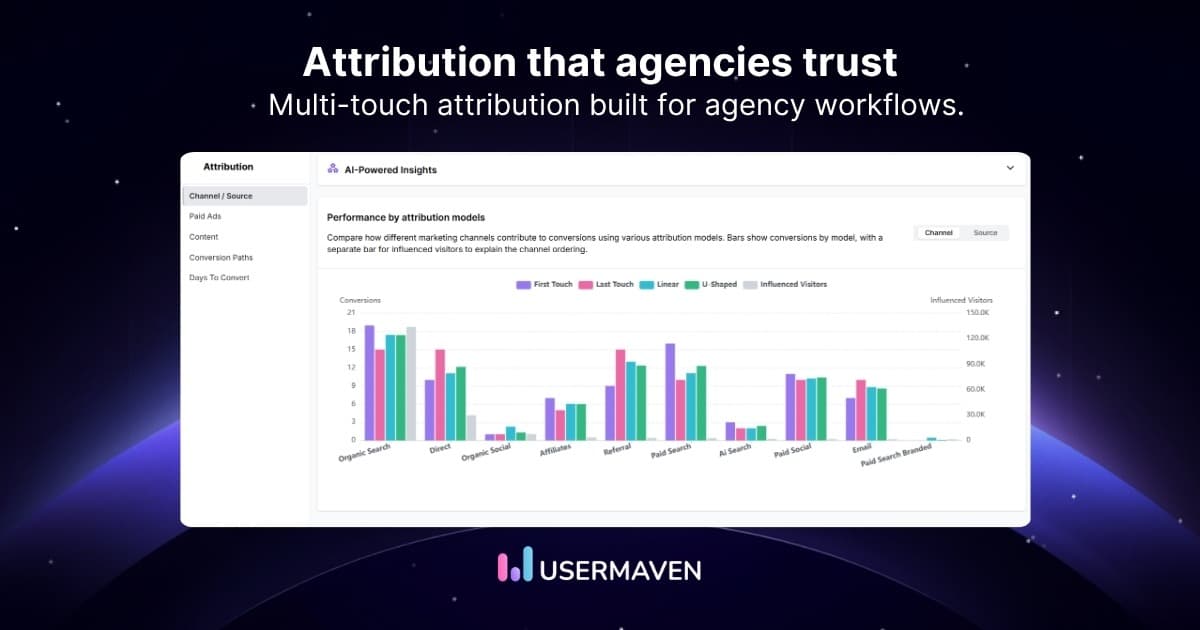
multi touch attribution can distribute credit across several observed interactions, but it still depends on the quality and continuity of the underlying journey data.
2. Conflicting ad-platform attribution
Meta, Google, LinkedIn, and other networks can all claim the same conversion because they use their own eligible interactions, windows, identity logic, and reporting rules. Adding platform totals together can therefore overstate actual business outcomes.
When reports disagree, start with ad platform discrepancies: compare the conversion definition, attribution window, click versus view rules, revenue source, and timestamp logic before assuming one platform is wrong.
3. Choosing the wrong conversion
The most visible event is not always the outcome that should guide budget. B2C teams may care about purchases, ecommerce about new-customer revenue, SaaS about activation or paid conversion, and B2B about qualified pipeline or closed-won revenue.
If attribution stops too early, a campaign can look efficient while creating weak customers. The conversion used for decision-making should match how the business actually creates value.
4. Attribution-model bias
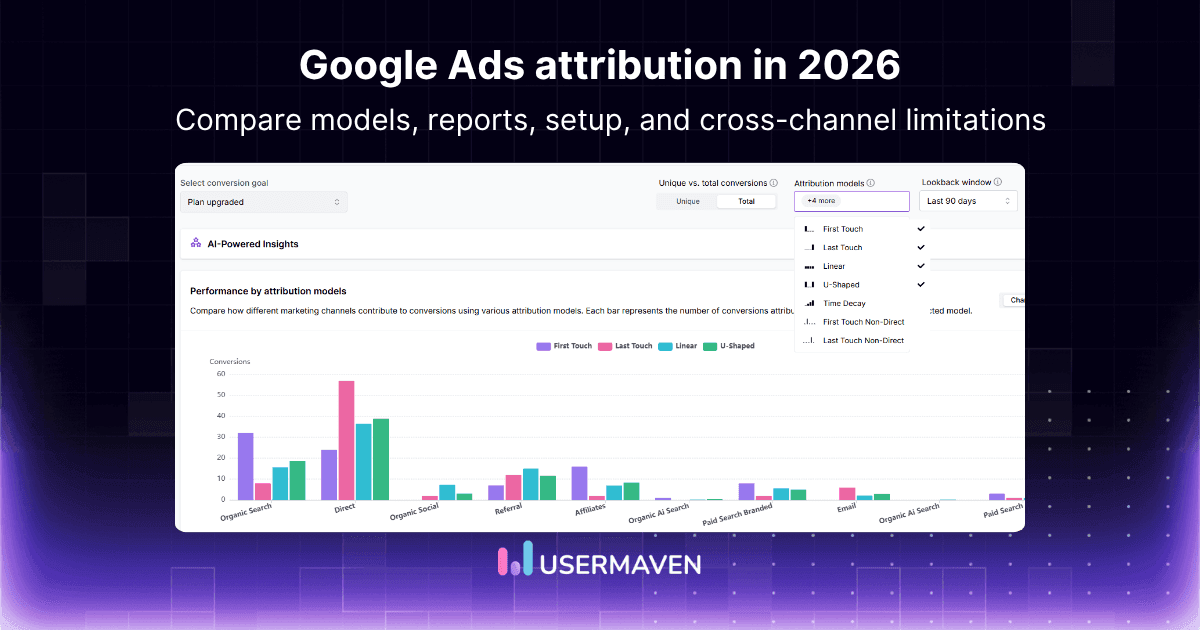
Every attribution model makes assumptions about which interactions deserve credit. First click favors discovery, last click favors the final interaction, linear models spread credit evenly, and time-decay models favor later touches.
Model choice can change the reported story even when the underlying touchpoints stay the same. The right model should match the measurement question rather than being treated as an objective version of the customer journey.
Use ad attribution models to compare the logic behind common approaches, and review the best attribution model for Google Ads when the decision is specifically about paid search.
5. Attribution does not equal causation
Attribution asks which observed interactions should receive credit. Incrementality asks whether the conversion would have happened without the advertising. Those are related questions, but they are not interchangeable.
A loyal customer can click a branded ad just before buying. Attribution may credit the ad, while an incrementality test may show that much of the demand already existed.
6. Turning attribution into action
Even accurate attribution has little value if nobody can translate it into bidding, audience, creative, lifecycle, or budget decisions. Reporting needs a clear path from measurement to action.
That is why mature teams connect attribution with downstream outcomes and, where appropriate, conversion syncs that return verified business events to supported ad platforms.
Ad attribution challenges in B2B
B2B attribution has to connect an ad with a buying process that can involve several people and months of activity. The journey often looks more like ad → contact → account → opportunity → closed revenue than ad → form submission.
Multiple people influence one deal
One employee may click the first ad, another research the product, and a third join the demo. Contact-only reporting can fragment a single buying committee into several unrelated journeys.
Sales cycles are long
Short attribution windows can remove early demand-generation activity before the opportunity closes. This makes window selection and identity persistence more important than they are in many short-cycle consumer purchases.
Revenue lives in the CRM
A lead is only an intermediate event when sales determines the final outcome. B2B teams need revenue attribution that connects acquisition with opportunity stage, pipeline value, and closed revenue, especially when evaluating paid search attribution.
Ad attribution challenges in B2C
B2C journeys are often faster than B2B, but they can be much more fragmented. Customer journey analytics software can help teams inspect how consumers move between social, search, email, apps, websites, and devices before purchasing.

Cross-device behavior fragments identity
A customer may see a social ad on a phone, research on a laptop, and convert later from another session. Cookie- or session-level reports can separate those interactions even when they belong to one buyer.
App-heavy B2C teams also face mobile privacy constraints. Apple’s App Tracking Transparency guidance requires permission before apps track users or access the device advertising identifier, which can reduce the deterministic signals available for attribution.
View-through credit complicates reporting
A platform may claim influence after an ad impression even when there was no click. That can be useful context, but it also makes cross-platform totals harder to reconcile.
For Meta-specific rules, windows, and reporting differences, see the guide to facebook ads attribution.
Ad attribution challenges in ecommerce
Ecommerce attribution is heavily affected by overlapping platform claims. Google and Meta can both report the same order, while the store still records one transaction.
The second challenge is customer quality. A campaign that looks strong on total ROAS may rely heavily on returning buyers, while another campaign creates more first-time customers with higher repeat value.
The dedicated guide to ad attribution software for ecommerce compares platforms by order and revenue connection, customer journeys, new-customer visibility, first-party tracking, and LTV.
Ad attribution challenges in SaaS
SaaS attribution rarely ends at the signup. A paid click can lead to signup, activation, product use, a product-qualified lead, sales engagement, subscription revenue, and later retention.
PLG teams need product behavior, sales-led teams need CRM outcomes, and hybrid companies need both. If those systems are disconnected, acquisition quality is judged too early.
The guide to ad attribution software for SaaS focuses on connecting paid media with activation, CRM pipeline, recurring revenue, and customer value.
Ad attribution challenges for high-ticket offers
High-ticket attribution becomes difficult because the decision can take weeks or months and often moves offline. Calls, consultations, follow-ups, sales conversations, and manual payments may sit outside browser analytics.
The lead is therefore not the final conversion. The stronger measurement chain is ad → qualified lead → opportunity → closed sale → revenue.
For platforms designed around long consideration cycles and sales-assisted journeys, see ad attribution tools for high ticket offers.
Why agencies face a different attribution challenge
Agencies do not manage one attribution environment. They may manage many clients with different ad platforms, CRMs, stores, attribution windows, conversion definitions, and revenue sources.
The challenge becomes standardization without pretending every client should use the same measurement logic. Reports need comparable structure while preserving client-specific definitions.
The guide to an ad attribution platform for agencies covers multi-client reporting, workspace separation, attribution depth, and implementation fit.
Which attribution challenge should you fix first?
Start with the symptom that is most likely to change a real business decision. The table below routes each common symptom to the deeper guide in this cluster.
Diagnose the first attribution issue to solve
| If you see this… | Likely issue | Read next |
|---|---|---|
| Google and Meta both claim the sale | Platform overlap | Ad attribution problems |
| Paid search gets too much credit | Model or window bias | Paid search attribution |
| Google Ads changes sharply by model | Model selection | Best attribution model for Google Ads |
| Meta reports more conversions than backend data | Platform rules | Facebook ads attribution |
| Early interactions disappear | Model / window design | Ad attribution models |
| The team cannot trust ad revenue | Measurement stack | Ad attribution software |
| Client reports constantly disagree | Stack fragmentation | Agency attribution platforms |
| Leads close weeks later | Long sales cycle | High-ticket attribution tools |
| SaaS signups do not become customers | Downstream conversion gap | SaaS attribution software |
| Ecommerce ROAS exceeds actual revenue | Order reconciliation | Ecommerce attribution software |
Can software solve every ad attribution challenge?
No. Good ad attribution software can improve identity continuity, cross-channel reconciliation, conversion paths, revenue connection, model comparison, and analysis.
It cannot perfectly recover consent-denied data, observe interactions that were never collected, guarantee cross-device identity, or prove causal lift from attribution alone. Better software reduces uncertainty; it does not eliminate it.
This is why first party data and appropriate server side tracking are useful foundations, but neither replaces consent, clean event definitions, or reliable business records.
How to reduce ad attribution challenges
The goal is not to remove every source of uncertainty. Start by fixing the data, identity, and business-definition gaps that have the biggest effect on real budget decisions.

1. Define the real business conversion
Choose the outcome that should guide budget: purchase, activation, qualified opportunity, closed revenue, or another verified business event. Avoid optimizing every campaign around the easiest event to track.
2. Establish a trusted revenue source
Decide whether CRM, billing, ecommerce, or another system represents the actual commercial outcome. Establishing a single source of truth helps teams reconcile platform-reported revenue against a trusted business record.
3. Standardize campaign and identity data
Use consistent UTM parameters, click IDs, customer IDs, account IDs, order IDs, and conversion names. Small naming differences can become major attribution gaps once data is joined across systems.
4. Match models and windows to the buying cycle
A short consumer purchase and a six-month enterprise deal should not inherit the same assumptions. Review the attribution window alongside the model and the normal time to conversion.
5. Audit tracking before trusting attribution
Use an attribution checklist to trace real journeys from paid touch to business outcome. Check duplicate events, missing IDs, broken domains, inconsistent revenue fields, and platform-to-backend reconciliation.
See what's working. Fix what's not. Grow faster.
Where AI helps with attribution challenges
AI is most useful as an analysis layer on top of reliable measurement. It can accelerate investigation and surface patterns, but its conclusions are only as trustworthy as the underlying data.
Ask cross-channel questions
AI can reduce the time required to investigate why attributed revenue changed, which campaigns create high-value customers, or which paths frequently appear before a qualified conversion.
Detect anomalies
AI can surface sudden conversion drops, unusual channel differences, missing event patterns, or cohorts behaving differently from normal. Those findings still need validation against tracking quality and business context.
AI cannot repair missing measurement
AI depends on the data it receives. It cannot reconstruct every unobserved touchpoint or decide the correct business definition automatically. Human judgment is still required for conversion definitions, models, windows, and budget decisions.
Maven AI can investigate attribution, journeys, funnels, retention, and revenue in natural language when those datasets are connected in Usermaven.
How Usermaven helps address attribution challenges
Usermaven brings cross-channel attribution, customer journeys, website and product behavior, CRM and revenue context, and AI-assisted analysis into the same marketing attribution software environment.

Cross-channel attribution and conversion paths
Teams can compare paid, organic, referral, email, and other sources against conversions, pipeline, and revenue, then inspect conversion paths instead of relying only on the last reported touch.
Behavior, CRM, and revenue context
Website and product behavior can add post-click context, while CRM and revenue data can extend the journey beyond the lead. This is especially useful for SaaS, B2B, and hybrid motions where the final outcome happens later.
Measurement Trust Center
The Measurement Trust Center evaluates Collection, Identity, Integrations, Delivery, and Reliability through a trust score and fix-oriented checks. It helps teams identify measurement issues before attribution data is used for budget decisions.
Maven AI, MCP, and conversion feedback
Maven AI supports natural-language analysis, while Usermaven’s MCP server can expose approved analytics actions to compatible AI clients. Conversion sync can also return verified downstream outcomes to supported ad platforms.
Final verdict
Ad attribution challenges are universal, but their importance changes with the business model. The first task is identifying which measurement gap can most distort a real revenue or budget decision.
B2B teams struggle with accounts and pipeline, B2C with fragmented journeys, ecommerce with overlapping order claims, SaaS with downstream activation, high-ticket with delayed revenue, and agencies with standardization across clients.
The goal is not perfect attribution. It is a measurement system trustworthy enough to support better decisions while remaining clear about what attribution can and cannot prove.
Ready to see Usermaven in action? Explore the platform or book a demo for a closer look.
Unlock insights that drive growth
FAQs
1. What are the biggest ad attribution challenges?
The biggest challenges are incomplete customer journeys, conflicting platform claims, identity gaps, poor conversion definitions, attribution-model bias, and disconnected revenue data. Which one matters most depends on the business model.
2. Why is ad attribution difficult?
Ad attribution is difficult because customer journeys span channels, devices, sessions, and business systems. Platforms also use different attribution rules, while important outcomes may happen in a CRM, store, billing system, or offline sales process.
3. What are the main B2B attribution challenges?
B2B teams usually struggle with long sales cycles, multiple stakeholders, contact-to-account identity, short attribution windows, and connecting marketing activity with opportunity, pipeline, and closed revenue.
4. What are the main B2C attribution challenges?
B2C attribution is often complicated by rapid cross-channel journeys, device switching, view-through credit, repeat customers, and conflicting conversion claims from consumer advertising platforms.
5. Why do ad platforms report different conversions?
Platforms can use different windows, identity rules, eligible interactions, click or view logic, conversion dates, and attribution models. The same customer can therefore be credited differently in Google, Meta, LinkedIn, and an independent analytics system.
6. How do privacy changes affect ad attribution?
Updated

Written by
Junaid Ahmed
Content Writer & Digital Marketer
Junaid Ahmed is a content and copywriter with 3+ years of experience creating research-driven content across SaaS, B2B, ecommerce, and digital marketing. He specializes in turning complex topics into clear, practical content that helps marketers better understand their challenges, evaluate solutions, and make informed decisions. His work spans educational content, industry insights, and actionable marketing guides.
All articles by Junaid →