A high-ticket sale rarely follows a simple ad-to-purchase path. A buyer may click an ad, return through search, attend a webinar, book a call, enter the CRM, and close weeks or months later.
That makes attribution in advertising harder than counting form fills. The measurement system has to preserve the journey long enough to connect marketing activity with qualified pipeline, customers, and revenue.
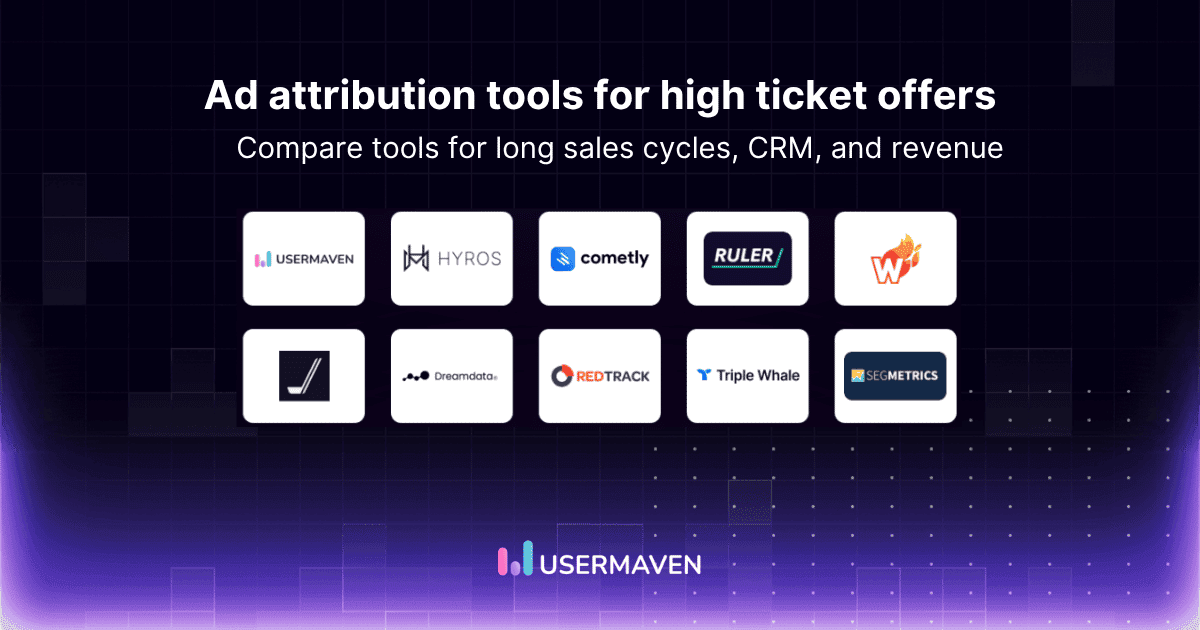
This guide compares ten ad attribution tools for high-ticket offers by long-journey tracking, CRM and revenue connection, call or offline visibility, attribution flexibility, conversion feedback, pricing, and fit for different high-value sales models.
Key takeaways
High-ticket attribution starts after the lead: The business outcome is often a qualified opportunity, closed deal, or high-value customer rather than a form submission.
Long sales cycles change tracking requirements: Short windows and session-only reporting can miss weeks or months of consideration.
CRM integration is essential: Marketing interactions need to reconnect with opportunities, stages, deal values, and revenue.
Calls and offline events can decide the sale: Many high-ticket funnels move from digital acquisition into webinars, demos, consultations, and sales calls.
Multi-touch visibility matters: Several channels and sessions may influence one expensive purchase.
Better conversion signals improve optimization: Qualified opportunities and customers are more useful feedback signals than every lead.
What are ad attribution tools for high-ticket offers?
Ad attribution tools for high-ticket offers connect advertising and marketing touchpoints with longer sales journeys, CRM activity, opportunities, calls, and revenue. Their job is to show which interactions contributed to a high-value sale, not merely where the lead originated.
The setup may combine Google Ads, Meta, LinkedIn, website behavior, email, webinars, booking tools, a CRM, sales calls, and payment systems. Reliable ad tracking records those interactions, while cross-platform ad tracking helps preserve campaign context across networks before attribution rules distribute credit.
For expensive offers, revenue attribution usually matters more than lead attribution alone because two campaigns with similar lead volume can produce radically different deal quality and closed revenue.
Best high-ticket attribution tools compared
The comparison below focuses on the high-ticket outcome each platform is best equipped to measure. Homepage links are added in the detailed tool profiles rather than inside the table.
| Platform | Best for | High-ticket strength | Main outcome |
| Usermaven | B2B/SaaS high-ticket sales | Journey + CRM + revenue | Pipeline / revenue |
| Hyros | Direct-response funnels | Calls + paid funnel tracking | Sales / revenue |
| Cometly | Paid-media-heavy businesses | Ads + CRM + server-side | Closed revenue |
| Ruler Analytics | Phone/offline sales | Calls + CRM attribution | Offline revenue |
| Wicked Reports | High-LTV ecommerce | Customer + LTV attribution | Revenue / LTV |
| HockeyStack | Enterprise B2B | Account journeys | Pipeline / revenue |
| Dreamdata | Buying committees | Account + contact attribution | Revenue |
| RedTrack | Performance marketing | Tracking + conversion feedback | ROAS / revenue |
| Triple Whale | High-ticket ecommerce | Store + paid media | Orders / LTV |
| SegMetrics | Long-cycle funnels | Long-window + contact attribution | Revenue / LTV |
Ad attribution tools for high-ticket offers
High-ticket businesses need different attribution depth depending on how the final sale happens. The profiles below compare long-journey tracking, CRM and revenue connection, attribution windows, sales-assisted conversions, first-party measurement, and fit for specific high-value sales models.
1. Usermaven: Best for B2B and SaaS high-ticket sales

Overview
Usermaven is an AI-powered marketing attribution platform that connects paid acquisition with website behavior, product activity, customer journeys, CRM pipeline, revenue, retention, and conversion feedback in one measurement environment.
That combination is useful for high-ticket SaaS and B2B teams because the sale can begin with an anonymous ad click but finish much later as an opportunity, subscription, expansion, or closed-won deal.
Best for
B2B SaaS, high-value software, professional services, product-led businesses with assisted sales, and teams that want paid attribution connected with downstream CRM and behavioral context.
High-ticket use case
Use Usermaven to follow the path from campaign and landing page through return sessions, signup or lead, CRM opportunity, customer, and revenue. Customer journeys help analysts inspect the path behind aggregate attribution reports.
Pricing
Scale is $199 per month at the 250,000-event tier and includes unlimited users, five workspaces, seven years of data history, paid-ad attribution, CRM revenue attribution, conversion paths, conversion sync, and Maven AI. A 14-day free trial is available.
Key high-ticket attribution capabilities
Google Ads, Meta Ads, LinkedIn Ads, and Microsoft Ads connections
Paid-ad, channel, landing-page, CRM, pipeline, and revenue attribution
Multi-touch conversion paths and customer-level journey analysis
Website and product behavior alongside acquisition data
Conversion sync back to advertising platforms
Measurement Trust Center for tracking health and report readiness
Maven AI for natural-language analysis across journeys, funnels, attribution, and behavioral data
Salesforce and CRM attribution
Salesforce is now supported in read-only mode for the first release. Usermaven can sync Accounts, Contacts, Leads, Opportunities, stage history, and contact roles, with per-org field mapping and sandbox support for different Salesforce schemas.
That makes the connection especially relevant to B2B marketing attribution, where the final outcome may sit several stages beyond the first captured lead. HubSpot-connected teams can similarly evaluate acquisition against downstream CRM and revenue outcomes.
Better conversion feedback
High-ticket teams can choose stronger downstream outcomes for conversion syncs instead of optimizing only for every form fill. Sending a qualified opportunity, customer, or meaningful purchase can give ad platforms a higher-quality signal.
Reverse ETL and AI workflow
Reverse ETL can sync Usermaven audiences into connected destinations such as HubSpot and Customer.io. That supports longer nurture cycles where high-value segments need to move from measurement into lifecycle or sales-oriented activation.
Maven AI can answer questions across attribution, journeys, funnels, and campaigns, and AI-generated funnel, retention, and journey previews can be saved as reports. External MCP connectors can extend approved workflows into connected systems with workspace-level consent.
Verdict
Usermaven is a strong overall fit for high-ticket SaaS and B2B teams that want attribution reporting tied to CRM pipeline, customer journeys, product context, revenue, and activation rather than a standalone ad-click report.
2. Hyros: Best for direct-response high-ticket funnels

Overview
Hyros is an ad tracking and attribution platform closely associated with direct-response funnels, high-ticket offers, calls, and paid-media optimization. Its current product messaging emphasizes tracking calls, attendance, quality, conversions, pipelines, and high-LTV buyers.
Best for
Coaching, education, info products, high-ticket services, ecommerce, and businesses where paid traffic drives webinars, applications, booked calls, and sales-assisted funnels.
High-ticket use case
A typical fit is an ad-to-webinar or ad-to-application funnel where a prospect books a call and closes later. Hyros is designed to connect paid traffic with the lead, call, sale, and recurring value that follows.
Pricing
Hyros currently starts at $69 per month for up to $5,000 in tracked monthly revenue, with pricing scaling as tracked revenue grows. The Hyros pricing guide provides additional buying context.
Key high-ticket attribution capabilities
Paid-ad tracking across major advertising platforms
Call, attendance, lead, conversion, and pipeline tracking
Server-side attribution and cross-device journey connection
Multi-touch attribution and high-LTV customer reporting
Revenue and recurring-revenue connection
Cleaner conversion data sent back to advertising platforms
Why it stands out
Hyros has unusually strong category association with high-ticket and direct-response selling. It is particularly relevant when the sales motion is built around paid ads, booked calls, long-form funnels, and aggressive optimization of ad spend.
Verdict
Hyros belongs on the shortlist when call-heavy direct response is the dominant requirement. Teams comparing that specialization with a broader website, product, CRM, and revenue stack can review the Hyros alternative comparison.
3. Cometly: Best for paid-media high-ticket sales

Overview
Cometly is a marketing attribution platform built around server-side tracking, multi-touch attribution, account journeys, CRM data, pipeline, revenue, and conversion feedback. Its current positioning is especially focused on B2B SaaS and paid acquisition.
Best for
B2B paid acquisition, professional services, high-ticket lead generation, and teams where Google, Meta, LinkedIn, or other paid channels are expected to produce pipeline and closed-won revenue.
High-ticket use case
Cometly can connect an ad and landing-page journey with the CRM stages that follow, giving performance teams a way to evaluate which paid campaigns create pipeline and closed revenue rather than stopping at the lead.
Pricing
Cometly uses usage-based pricing tailored to monthly pageviews. Core and Enterprise are quoted based on the existing stack and usage, with monthly or annual billing available. The Cometly pricing guide provides additional context.
Key high-ticket attribution capabilities
Server-side tracking and first-party pixel
Multi-touch attribution and account journeys
Unlimited connections to major ad platforms on current plans
CRM and pipeline synchronization
Conversion API feedback to advertising platforms
AI-assisted analysis, dashboards, and audience workflows
Why it stands out
Cometly maps closely to the exact high-ticket paid-media problem: connect acquisition with long-funnel CRM outcomes, then return useful conversion data to ad platforms. That makes it easy to evaluate for teams whose main acquisition engine is paid advertising.
Verdict
Cometly is a strong choice for paid-media-heavy high-ticket sales. The Cometly alternative page compares its paid-media orientation with Usermaven’s broader website, product, journey, CRM, and revenue analytics.
4. Ruler Analytics: Best for phone and offline high-ticket sales

Overview
Ruler Analytics is a marketing measurement platform that connects online acquisition with forms, phone calls, live chat, CRM opportunities, offsite conversions, payments, and revenue.
Best for
Professional services, consultations, appointments, high-value lead generation, and businesses where the digital journey quickly moves into a phone call, salesperson, or offline close.
High-ticket use case
A common journey is ad to form or call, then CRM opportunity and offline sale. Teams comparing this motion can also review lead attribution software for tools focused on connecting acquisition with downstream lead quality.
Pricing
Ruler’s Small plan currently starts at $400 per month for up to 10,000 monthly visits. Higher tiers expand traffic and attribution capabilities. The Ruler analytics pricing guide provides additional context.
Key high-ticket attribution capabilities
First-party tracking and conversion tags
Form, phone call, live-chat, ecommerce, and offsite conversion capture
CRM integrations and revenue feedback
Multi-touch attribution
Data-driven and impression attribution on higher tiers
Payments and offline revenue connection
Why it stands out
Ruler is strongest when the sale leaves the website. Calls, forms, CRM stages, sales calls, webinars, and payments can be treated as part of the same revenue journey instead of disappearing after the initial lead.
Verdict
Ruler Analytics is a strong specialist for online-to-offline high-ticket attribution. The Ruler Analytics alternative comparison is useful when evaluating that call-centric strength against broader web and product analytics.
5. Wicked Reports: Best for high-LTV ecommerce

Overview
Wicked Reports is a first-party attribution platform built around new-customer acquisition, customer-level journeys, revenue, cohort analysis, and lifetime value. Its current plans include lifetime lookback and lookforward measurement.
Best for
High-AOV ecommerce, subscriptions, memberships, repeat-purchase businesses, and teams that need to judge ads by the long-term value of the customer rather than only the first transaction.
High-ticket use case
For an expensive ecommerce or subscription offer, the first order may not represent the full economics. Wicked Reports can connect first-party CRM and sales data with future payments and customer lifetime value to evaluate longer-term ROI.
Pricing
For businesses in its lowest displayed annual-revenue band, Wicked Reports currently lists Measure at $499 per month, Scale at $699, and Maximize at $999. Enterprise starts at $4,999, with pricing aligned to revenue bands and scope.
Key high-ticket attribution capabilities
First-party customer-level attribution
New-customer and repeat-customer measurement
Cohort and customer lifetime value reporting
Lifetime lookback and lookforward
CRM, cart, and major ad-platform integrations
Advanced Signal for Meta conversion feedback on supported plans or as an add-on
Why it stands out
Wicked Reports keeps the decision centered on customer economics over time. That is valuable when a campaign looks expensive on first-order ROAS but produces customers with stronger repeat revenue or subscription value.
Verdict
Wicked Reports is best suited to high-ticket ecommerce and subscription businesses where LTV, new-customer quality, and repeat revenue are more important than CRM opportunity stages.
6. HockeyStack: Best for enterprise B2B journeys

Overview
HockeyStack is a B2B revenue and GTM intelligence platform that unifies marketing, sales, CRM, product, and account interactions into buyer journeys and attribution reporting.
Best for
Enterprise SaaS, B2B, ABM programs, long sales cycles, and multi-stakeholder deals where several people and channels influence the same account before an opportunity closes.
High-ticket use case
HockeyStack is useful when the object being measured is the account rather than an isolated visitor. Marketing and sales interactions can be examined against pipeline and closed deals across a complex buying committee.
Pricing
HockeyStack uses a sales-led pricing process rather than a simple public self-serve price. The hockeystack pricing guide provides more context on the buying model and likely implementation scope.
Key high-ticket attribution capabilities
Account-level buyer journeys
Marketing, sales, CRM, product, intent, and web data
Multi-touch attribution and model comparison
Pipeline and closed-deal reporting
Account scoring and GTM analysis
AI-assisted analysis across complex B2B journeys
Why it stands out
HockeyStack is designed around the reality that high-ticket B2B sales involve accounts and buying groups. That makes it particularly relevant when one deal has a long history of marketing, sales, and product touches.
Verdict
HockeyStack is a strong specialist for complex enterprise B2B attribution. Teams comparing that depth with a broader self-serve analytics environment can review the HockeyStack alternative page.
7. Dreamdata: Best for B2B buying committees

Overview
Dreamdata is a B2B attribution and activation platform built around company journeys, account mapping, pipeline, revenue, audience activation, and conversion feedback across the go-to-market stack.
Best for
B2B SaaS, account-based marketing, revenue marketing, and organizations where several contacts and channels contribute to the same long-running opportunity.
High-ticket use case
Dreamdata can map anonymous and known activity to accounts, then evaluate marketing activity against selected pipeline stages and revenue. This is useful when a high-value deal may involve several stakeholders over three, six, or twelve months.
Pricing
Dreamdata currently offers a free entry option, while larger companies use customized pricing based on tracked users, attribution, activation, reporting, and data requirements. Buyers can try the product before making a larger commercial commitment.
Key high-ticket attribution capabilities
Anonymous-to-known B2B journey tracking
Contact-to-account mapping and company timelines
Adaptable multi-touch attribution models
Pipeline and revenue attribution
Audience Hub and activation workflows
Conversion sync back to ad platforms
Why it stands out
Dreamdata treats B2B attribution as an account-level problem rather than a single-person web session. It also combines measurement with audience activation, which can help long-cycle teams act on the same data used for reporting.
Verdict
Dreamdata is a strong fit for B2B buying committees and account journeys. Teams that also need deeper website and product analytics can compare the platforms on the Dreamdata alternative page.
8. RedTrack: Best for performance-driven high-ticket funnels

Overview
RedTrack is a performance marketing analytics platform for tracking, attribution, conversion APIs, ad-spend synchronization, campaign management, and paid-media optimization. Its pricing page emphasizes real revenue and LTV signals.
Best for
Performance marketers, media buyers, agencies, direct-response businesses, and paid-acquisition teams that need attribution to feed directly into campaign optimization.
High-ticket use case
RedTrack fits high-ticket funnels where the team wants ad-level tracking, server-side conversion APIs, revenue or LTV reporting, and faster feedback to Meta, Google, TikTok, or other paid platforms.
Pricing
RedTrack currently lists Builder at $69 per month, Solo at $141 per month, and Team at $333 per month before optional bundles. A 14-day free trial is available, and higher plans expand events, users, data storage, ad accounts, and API access.
Key high-ticket attribution capabilities
Server-side Conversion API support for major ad networks
Ad-level tracking and ad-spend synchronization
Revenue and LTV reporting
Cross-channel attribution
Campaign management and automation options
MCP and API access on supported plans
Why it stands out
RedTrack sits close to day-to-day media buying. That makes it useful when attribution is expected to change bidding, audience, and budget decisions quickly rather than functioning primarily as a strategic reporting layer.
Verdict
RedTrack is a strong fit for performance-driven high-ticket funnels where server-side conversion feedback and paid-media operations are central to the growth workflow.
9. Triple Whale: Best for high-ticket DTC

Overview
Triple Whale is an ecommerce measurement platform that combines first-party attribution, store revenue, customer segments, dashboards, product performance, and AI-assisted analysis around the economics of ecommerce growth.
Best for
Shopify, premium DTC, high-AOV ecommerce, and businesses where the high-ticket conversion is an online order rather than a sales-assisted CRM opportunity.
High-ticket use case
Use Triple Whale to connect paid-media spend with orders, new-customer value, products, and customer segments. Teams can also compare broader ecommerce attribution needs when deciding how much CRM or post-purchase context is required.
Pricing
Triple Whale currently lists Foundation at $219 per month, with pricing moving by plan and revenue tier as businesses scale. The triple whale pricing guide provides additional buying context.
Key high-ticket attribution capabilities
First-party ecommerce measurement through Triple Pixel
Multi-touch attribution
Paid-media, orders, and revenue reporting
Customer segments and product analytics
Post-purchase survey inputs through Total Impact Attribution
First-party signal activation on supported workflows
Why it stands out
Triple Whale keeps the measurement model centered on ecommerce. For a premium product sold entirely online, that can be more useful than a CRM-heavy B2B platform because order, product, customer, and media economics stay in the same workflow.
Verdict
Triple Whale is a strong high-ticket DTC specialist. The Triple Whale alternative comparison is useful when teams also need SaaS, CRM, or product-led journey coverage.
10. SegMetrics: Best for long-cycle funnels and LTV

Overview
SegMetrics is a multi-touch marketing attribution platform focused on contact-level journeys, revenue, lifetime value, full-funnel analytics, integrations, segmentation, and conversion feedback.
Best for
Coaches, consultants, SaaS teams, subscription businesses, CRM-heavy funnels, and marketers who need contact-level history and LTV to persist through a longer consideration or nurture cycle.
High-ticket use case
SegMetrics is useful when a lead enters the funnel, receives a long sequence of marketing and sales touches, and purchases much later. Contact journey reporting and full LTV attribution help connect that delayed outcome with earlier acquisition.
Pricing
SegMetrics currently lists Launch at $57 per month, Grow at $197, and Scale at $397 for the displayed contact level, with Enterprise available for larger organizations. A 14-day free trial is available.
Key high-ticket attribution capabilities
Full LTV attribution across the customer journey
Contact journey reporting
Real-time attribution model switching
100+ marketing integrations
Advanced segmentation
Ad Conversion Feeder on Grow and above
Server-side tracking on Scale or as an add-on depending on plan
Why it stands out
SegMetrics is particularly relevant when the customer history matters more than the last session. Its contact-level reporting, LTV focus, and longer funnel orientation make it a logical option for delayed or subscription-heavy high-ticket sales.
Verdict
SegMetrics is a strong option when long-cycle contact attribution and LTV are more important than enterprise account intelligence or native call tracking.
Why high-ticket attribution is different
Long consideration periods
High-value purchases often require research, internal discussion, comparison, demonstrations, and sales follow-up. A prospect can move between paid ads, branded search, email, direct visits, and sales conversations before a deal is ready to close.
Multiple sessions and devices
A buyer may first visit on mobile, return later on a work laptop, and convert after several anonymous and known sessions. The longer the journey, the more chances there are for identity and campaign context to fragment.
Sales-assisted conversions
The most important conversion may happen after a demo, consultation, proposal, or call. That makes website-only conversion tracking incomplete for many professional services, B2B, coaching, and enterprise offers.
Lead quality varies dramatically
A campaign that produces fewer leads can still win if those leads become larger opportunities and close at a higher rate. High-ticket teams therefore need to compare marketing against pipeline and revenue, not only cost per lead.
How we evaluated the tools
Each platform was evaluated against the same high-ticket measurement problems rather than ranked only by feature count. This keeps the comparison focused on how teams measure marketing attribution against the real sales journey and final business outcome.
Long customer journey tracking and cross-session continuity
CRM integration and downstream opportunity visibility
Pipeline, closed revenue, and LTV attribution
Sales-call or offline conversion visibility where relevant
Attribution-window and model flexibility
First-party and server-side tracking capabilities
Conversion feedback to advertising platforms
Customer, contact, or account-level journey inspection
Reporting usability and AI-assisted analysis
Pricing model and fit for the intended high-ticket business model
Best tool by high-ticket sales model
Match the platform to how the expensive sale actually happens. A coaching funnel, enterprise B2B deal, and premium ecommerce order require different downstream signals.
| High-ticket sales model | Main attribution problem | Strong options |
| B2B SaaS | Pipeline + revenue | Usermaven, HockeyStack, Dreamdata |
| Coaching / info products | Long funnel + calls | Hyros, Cometly |
| Professional services | CRM + offline close | Usermaven, Ruler Analytics |
| Phone-heavy sales | Calls + closed revenue | Ruler Analytics, Hyros |
| High-ticket ecommerce | Orders + LTV | Wicked Reports, Triple Whale |
| Paid-media funnels | Ads + conversion feedback | Cometly, RedTrack |
| Long nurture / subscriptions | Contact history + LTV | SegMetrics, Wicked Reports |
Why lead attribution is not enough
High-ticket teams can make the wrong budget decision when they optimize only for lead volume. The campaign that produces the cheapest leads may create weak opportunities, while a smaller campaign can generate far more closed revenue.
| Campaign | Leads | Customers | Closed revenue |
| Campaign A | 100 | 1 | $10,000 |
| Campaign B | 35 | 6 | $90,000 |
If reporting stops at CPL, Campaign A appears stronger. If the business connects acquisition with revenue attribution, Campaign B is clearly creating more commercial value.
This is also why understanding lead attribution should be treated as one layer of the measurement system rather than the final answer for expensive sales.
Why platform ROAS can fail for high-ticket sales
Native ad dashboards are useful for optimization, but a long high-ticket journey can outlive the context available inside one ad network. A buyer may return through search, speak with sales, and close weeks later inside the CRM.
Salesforce’s official multi-touch attribution guidance describes multi-touch attribution as assigning credit across multiple touchpoints in the customer journey. That broader view is useful for high-ticket sales when one ad platform sees only its own eligible interactions while CRM and other channels capture additional stages.
When Google, Meta, analytics, and CRM totals differ, review ad platform discrepancies and document the definitions, identities, windows, and outcomes each system uses before declaring one implementation broken.
Attribution windows for long sales cycles
An attribution window defines how long an earlier interaction remains eligible for credit. High-ticket teams need a window that reflects the real decision cycle rather than copying a default from a short ecommerce journey.
A 30-day window may be adequate for one professional-service funnel and far too short for an enterprise purchase that takes six months. The right window depends on the time between first meaningful touch, qualified opportunity, and final conversion.
Teams should also distinguish click windows, view-through windows, CRM history, and the date used to report the conversion. Two tools can show different results even when both are working correctly because their eligibility rules differ.
CRM and offline attribution
For high-ticket sales, the measurement chain often continues after the website: ad → lead → qualified lead → opportunity → proposal → customer → revenue. The CRM is therefore part of the attribution system, not merely a sales database.
Teams using HubSpot can compare broader HubSpot revenue attribution workflows, while Salesforce-oriented teams need consistent lead, contact, account, opportunity, and stage definitions before marketing can be reconciled with revenue.
Native call tracking is also a meaningful differentiator. Ruler Analytics and Hyros are stronger specialists when phone calls are a central conversion event, while platforms such as Usermaven are stronger when the main requirement is cross-channel journey, CRM, product, and revenue context.
First-party tracking for long journeys
Longer journeys create more opportunities for campaign context to disappear. Cookies can expire, devices can change, browsers can limit storage, and return visits may arrive without the original UTM or click identifier. These are common ad attribution problems in long sales cycles.
Meta’s official Conversions API documentation explains that marketing data can be connected from a server, website platform, app, or CRM, including offline conversions. For high-ticket funnels, that makes downstream events closer to the actual sale more useful for measurement and optimization than relying only on browser-side activity.
A durable first party data layer and appropriate server side tracking can reduce avoidable delivery gaps, but neither should be treated as a way to bypass consent or privacy requirements.
From attribution to high-value optimization
The strongest workflow does not stop after a dashboard explains the journey. High-ticket teams can use downstream outcomes to improve who they nurture, what they send back to ad networks, and which audiences receive more investment.
Measure the complete journey
Connect campaign, website, customer, CRM, and revenue data so analysts can distinguish a cheap lead from a valuable opportunity or customer.
Identify high-value segments
Build segments around deal quality, revenue, product usage, opportunity stage, or customer value rather than using only top-of-funnel behavior.
Activate audiences
Reverse ETL or audience-sync workflows can move useful segments into lifecycle, CRM, or advertising tools. This is particularly valuable for long nurture cycles where timing and qualification matter.
Return stronger conversion feedback
Conversion syncs can help advertising platforms learn from deeper outcomes such as qualified leads, customers, or purchases instead of optimizing exclusively around every form submission.
How Usermaven supports high-ticket attribution
Usermaven combines acquisition attribution with the website, product, CRM, revenue, and customer context that often sits between the first ad click and a high-value deal. That makes it especially relevant to SaaS and B2B sales cycles.
Cross-channel journeys
User journeys preserve the sequence behind aggregate reporting so teams can inspect return sessions, pages, product events, and conversions instead of treating the final touch as the entire story.
CRM and revenue attribution
Paid-ad, channel, content, CRM, pipeline, and revenue attribution can be evaluated inside the same environment. This helps teams compare which campaigns create qualified commercial outcomes rather than only traffic or leads.
Salesforce
The Salesforce connection can sync Accounts, Contacts, Leads, Opportunities, stage history, and contact roles. Per-org field mapping and sandbox support help teams work with different Salesforce schemas.
Measurement Trust Center
High-ticket decisions depend on the quality of the underlying data. The Measurement Trust Center gives teams a structured way to inspect collection, identity, integrations, delivery, and reliability before using attribution to move budget.
Reverse ETL and conversion feedback
Audiences can be synced into connected destinations such as HubSpot and Customer.io, while verified conversion outcomes can be sent back to supported ad platforms. This closes the loop between measurement, nurture, and optimization.
Maven AI and MCP
Maven AI can investigate questions such as which campaigns create the highest-value customers, which paths appear before closed-won deals, and which sources assist opportunities. Saved AI previews make repeated analysis easier to operationalize.
External MCP connectors like Claude can extend approved agent workflows into connected systems with workspace-wide connections and consent covering the permitted scopes.
Unlock insights that drive growth
How to choose a tool for high-ticket offers
High-ticket sales cycles are long and multi-touch. Your tool needs to keep up with many things.

1. Define the real conversion
Decide whether the decision should optimize for a lead, qualified lead, booked call, opportunity, purchase, customer, closed revenue, or lifetime value. The final outcome determines which integrations and tracking depth actually matter.
2. Measure the normal sales-cycle length
Use historical CRM data to estimate how long successful deals take from first meaningful touch to close. That duration should influence attribution windows, data retention, and how long identity must remain connected.
3. Map every material touchpoint
List paid ads, organic search, email, webinars, booking tools, calls, CRM stages, product activity, and payment systems. A platform cannot explain a journey it does not receive.
4. Check CRM integration depth
Verify whether the platform can connect contacts, accounts, opportunities, stages, values, and closed outcomes in the CRM your team actually uses. A simple lead sync may not be enough.
5. Decide whether calls are first-class conversions
If most deals close on the phone, prioritize native call attribution or a reliable integration with the call-tracking system. If calls are occasional, CRM and journey depth may matter more.
6. Compare attribution windows and models
Use multi touch attribution when the business needs to understand several eligible touches, but do not assume one model should answer discovery, closing, and incrementality questions equally well.
7. Test identity continuity
Follow a real prospect across return sessions, authentication, booking, CRM creation, and conversion. Check whether the original acquisition context survives the journey without creating duplicate people or conversions.
8. Check revenue and LTV reporting
Make sure the system can report the outcome the finance or sales team trusts. For subscriptions and repeat-purchase businesses, first-order revenue can be less useful than retained or lifetime value.
9. Test conversion feedback
If the team wants better ad optimization, confirm which downstream events can be sent back to each platform and how duplicates, consent, and event matching are handled.
10. Audit real customer journeys
Before migrating reporting, use an attribution checklist to inspect several real customers from first touch to revenue. Parallel testing reveals identity breaks and definition mismatches before budget decisions depend on the new system.
Final verdict
There is no universal best high-ticket attribution tool because a B2B contract, coaching program, professional-service engagement, and premium ecommerce product follow different sales journeys and close through different systems.
Usermaven is a strong overall fit for SaaS and B2B teams that need cross-channel attribution connected with customer journeys, CRM pipeline, Salesforce or HubSpot data, revenue, conversion feedback, audience activation, and AI-assisted analysis.
Ready to see Usermaven in action? Explore the platform or book a demo for a closer look.
See what's working. Fix what's not. Grow faster.
FAQs
1. What are ad attribution tools for high-ticket offers?
They are measurement platforms designed to connect advertising and marketing touchpoints with longer sales journeys, CRM activity, calls, opportunities, revenue, or LTV. The key difference is that the final conversion often happens well after the first lead.
2. What is the best attribution tool for high-ticket sales?
The best tool depends on the sales motion. Usermaven fits B2B and SaaS revenue attribution, Hyros fits direct-response and call-heavy funnels, Ruler Analytics fits phone and offline sales, and Wicked Reports or Triple Whale fit high-value ecommerce.
3. Why is high-ticket attribution different?
High-ticket buyers usually take longer to decide, interact with more channels, and often close through a salesperson, call, proposal, or CRM opportunity. That makes short-session, lead-only attribution less useful.
4. How do you track high-ticket sales back to ads?
Track campaign identifiers and first-party website activity, connect known identities to the CRM, preserve opportunity and revenue events, and use an attribution model that matches the sales cycle. Audit several real customer paths before relying on aggregate reports.
5. What attribution window should high-ticket offers use?
There is no universal window. Use historical sales-cycle data to choose a period long enough to include meaningful consideration without making every old touch permanently eligible for credit.
6. Can attribution software connect ads with CRM revenue?
Updated

Written by
Junaid Ahmed
Content Writer & Digital Marketer
Junaid Ahmed is a content and copywriter with 3+ years of experience creating research-driven content across SaaS, B2B, ecommerce, and digital marketing. He specializes in turning complex topics into clear, practical content that helps marketers better understand their challenges, evaluate solutions, and make informed decisions. His work spans educational content, industry insights, and actionable marketing guides.
All articles by Junaid →