Attribution bias and what it means for your marketing ROI
Your best-performing channel might not be your best channel.
It just looks that way in your reports.
That is the uncomfortable reality of attribution bias in marketing.
Every click, conversion, and revenue metric depends on how credit is assigned across the customer journey. When attribution favors one touchpoint over another, marketing performance can appear very different from reality. Teams invest more in channels that seem successful, while channels that actually create demand receive little or no credit.
The result is distorted ROI, poor budget allocation, and decisions based on incomplete insights instead of the full customer journey.
In this guide, you’ll learn what attribution bias is, why it happens, the different types of attribution bias, how it affects marketing performance, and practical ways to identify and reduce it using modern attribution analytics.
Key takeaways
- Attribution bias occurs when marketing channels receive more or less conversion credit than they actually deserve, leading to inaccurate performance insights.
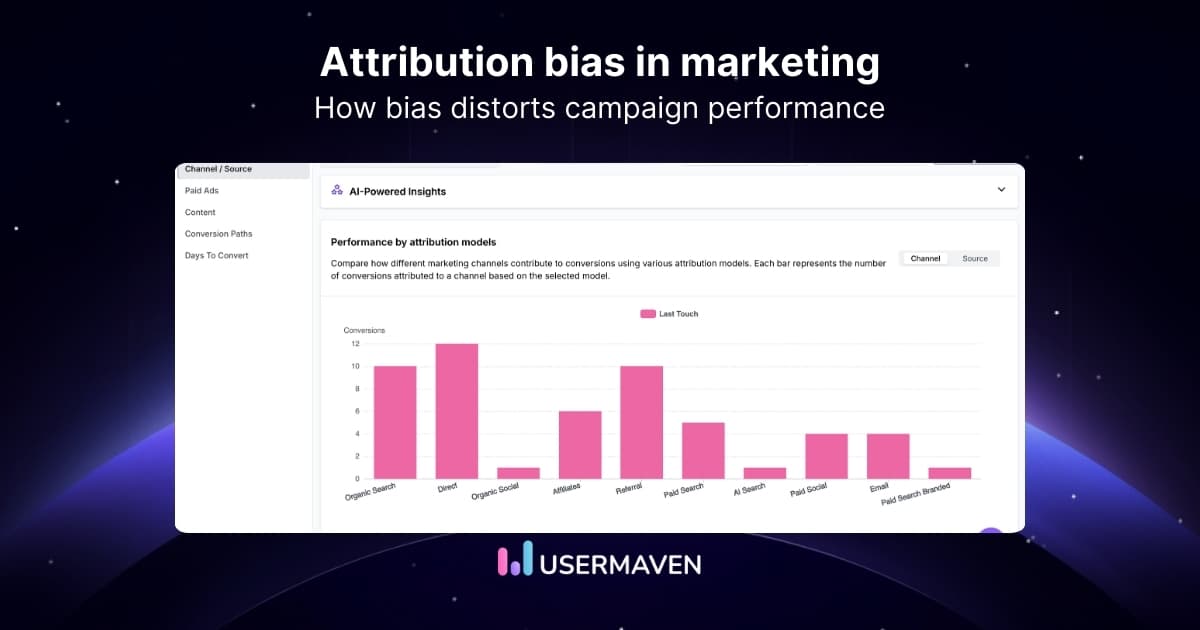
- Single-touch attribution models, especially last-touch attribution, are more likely to create biased reports by ignoring earlier customer interactions.
- Comparing multiple attribution models and analyzing the full customer journey provides a more accurate view of marketing performance.
- Reliable first-party data, unified analytics, and cross-channel measurement help reduce attribution bias and improve marketing decisions.
- Advanced marketing attribution platforms like Usermaven help teams identify attribution bias by connecting touchpoints, measuring revenue impact, and providing full-funnel visibility.
What is attribution bias in marketing?
Attribution bias in marketing is the tendency of attribution models to consistently assign conversion credit inaccurately across marketing channels. It occurs when the method used to measure performance favors certain touchpoints, while undervaluing others that also influenced the customer’s decision.
Most people don’t convert after a single interaction. They discover a brand, compare options, come back later, and often interact with multiple campaigns before taking action. Attribution bias appears when only one of those touchpoints is treated as the reason for conversion, while the rest are ignored.
Common situations where attribution bias shows up include:
- Giving full credit to the last click, even though earlier channels created the intent
- Overvaluing retargeting campaigns because they appear right before conversion
- Undervaluing content, organic, or brand campaigns that influence decisions earlier in the journey
As a result, marketing reports can paint a misleading picture of what’s actually driving growth. Channels that capture demand look more effective than channels that help create it. Over time, this leads to skewed ROI calculations, poor budget decisions, and an incomplete understanding of customer behavior.
Attribution bias example
Imagine a SaaS company running campaigns across several marketing channels.
A buyer:
- Finds a blog through Google Search.
- Downloads an ebook.
- Registers for a webinar.
- Clicks a retargeting ad two weeks later.
- Searches the company name on Google.
- Books a demo.
Under a last-touch attribution model, the branded Google search receives 100% of the conversion credit.
In reality, the blog, ebook, webinar, and retargeting campaign all contributed to the purchase decision. Ignoring those touchpoints creates attribution bias and makes bottom-funnel channels appear more valuable than they actually are.
Why attribution bias exists in marketing analytics
Attribution bias exists because real user journeys are complex and many traditional attribution approaches were not designed to reflect that complexity. Marketing decisions unfold across time, channels, and devices, while basic attribution models often rely on simplified rules that struggle to capture the full picture.
Buyer journeys are nonlinear
Customers rarely follow a straight path to conversion. They may:
- Discover a brand through social ads, content, or referrals
- Research across multiple sessions and channels
- Switch between mobile and desktop devices
- Delay decisions before finally converting
When attribution does not account for these patterns, important influence gets overlooked.
Attribution models rely on assumptions
Simpler attribution models make assumptions such as:
- The first interaction matters most
- The last interaction drives the decision
- All touchpoints contribute equally
These assumptions can introduce bias when used without additional context or journey analysis.
Marketing data is uneven
Not all touchpoints are equally measurable:
- Clicks are easy to track
- Views are partially measurable
- Conversations, referrals, and brand recall are harder to capture
When these signals are missing or disconnected, attribution can become skewed unless supported by a more complete data setup.
Attribution bias vs. attribution error
Although they sound similar, attribution bias and attribution error are very different problems that affect marketing analysis in different ways.
| Aspect | Attribution error | Attribution bias |
| What it is | A problem caused by incorrect or missing data | A problem caused by how data is interpreted |
| Main cause | Broken tracking or faulty implementation | Assumptions built into attribution models |
| Common examples | Events firing incorrectly, missing conversions, duplicated data | Overcrediting last-click channels, undervaluing awareness efforts |
| Type of issue | Technical | Strategic |
| Impact on reports | Data is inaccurate or incomplete | Data looks correct but tells a distorted story |
| How to fix it | Improve tracking setup and data quality | Rethink attribution models and analysis approach |
Attribution bias vs. incrementality
Although they are closely related, attribution bias and incrementality answer different marketing questions.
Attribution bias focuses on how conversion credit is assigned across touchpoints. It helps explain whether attribution reports fairly represent each channel’s contribution.
Incrementality, on the other hand, measures whether a marketing activity actually caused additional conversions that would not have happened otherwise.
For example, a retargeting campaign may receive significant attribution credit because it was the final interaction before purchase. However, incrementality testing might reveal those customers were already planning to buy, meaning the campaign added very little new demand.
Using both attribution analysis and incrementality testing gives marketers a more complete understanding of marketing performance. Attribution explains where conversions came from, while incrementality helps determine what actually generated additional business.
Maximize your ROI
with accurate attribution
Common types of attribution bias in marketing
Attribution bias usually follows recognizable patterns. These patterns don’t appear randomly. They are the result of how attribution models work, how data is collected, and how marketers interpret performance.
Understanding these common types makes it easier to identify bias in your own analytics before it influences decisions.
1. Channel proximity bias
Channels that appear closest to conversion often look more valuable than they really are. These channels typically capture demand rather than create it. Examples include:
- Paid search
- Retargeting ads
- Email campaigns
Because these touchpoints happen late in the journey, attribution models frequently over-credit them while overlooking earlier influence.
2. In-market attribution bias
In-market attribution bias is a more specific form of proximity bias. It occurs when channels that target users who were already likely to convert receive outsized credit.
Common examples include:
- Branded search
- Retargeting
- Cart abandonment emails
These channels reach high-intent users, but attribution reports often mistake intent capture for demand creation.
3. Platform self-attribution bias
Ad platforms are incentivized to credit themselves for conversions, which leads to biased ad attribution. Each platform measures performance in isolation, using its own attribution logic and reporting windows.
As a result:
- Multiple platforms may claim the same conversion
- Cross-channel influence is ignored
- Reported ROI becomes inflated
This bias makes it difficult to understand how channels actually work together.
A common example is when Google Ads and Meta Ads both report the same conversion inside their own dashboards. Since each platform measures attribution independently, both may claim full credit for a single purchase.
Without an independent marketing attribution platform that analyzes the entire customer journey, marketers often overestimate campaign performance and advertising ROI.
As digital advertising becomes more fragmented, measuring performance across multiple channels has become increasingly important. Industry organizations such as the Interactive Advertising Bureau (IAB) recommend standardized measurement practices to help marketers evaluate campaign performance more consistently across platforms.
4. Digital-only attribution bias
Digital-only attribution bias occurs when offline or dark touchpoints are excluded from analysis. This includes:
- Events and conferences
- Sales conversations
- Referrals and word of mouth
When these interactions aren’t tracked, digital channels receive credit by default, even if they weren’t the true drivers of the decision.
5. Attribution window bias
Short attribution windows favor late-stage interactions and undervalue earlier influence. Longer buying cycles become compressed into misleading snapshots.
This bias is especially common in:
- B2B SaaS
- High-ticket ecommerce
- Subscription-based products
Early touchpoints fall outside the window and disappear from reports.
6. Correlation vs causation attribution bias
This bias happens when a touchpoint is credited simply because it occurred before conversion, not because it influenced the decision.
For example, a webinar may receive credit even though the buyer had already decided beforehand. Here, timing is mistaken for impact.
7. Confirmation attribution bias
Confirmation bias appears when teams interpret attribution data in ways that support existing beliefs. Channels that perform well are trusted without question, while data that contradicts assumptions is dismissed.
This allows attribution bias to persist even when better data is available.
Signs your attribution reports are biased
Attribution bias is not always obvious. Marketing dashboards may look accurate even when they are telling an incomplete story. Reviewing attribution reports from different perspectives can help identify patterns that indicate bias.
Some common warning signs include:
- One marketing channel receives most of the conversion credit regardless of campaign type.
- Retargeting campaigns consistently outperform awareness campaigns by a wide margin.
- SEO, content marketing, or organic social rarely appear as conversion drivers despite generating significant traffic.
- Multiple advertising platforms report the same conversion independently.
- Assisted conversions remain consistently high while direct conversions stay low.
- Direct traffic grows unexpectedly without a clear explanation.
- Long customer journeys receive nearly all their credit from the final interaction.
If you notice several of these patterns, your attribution reports may be reflecting attribution bias rather than actual marketing performance.
Why last-touch attribution creates the most biased marketing data
Last-touch attribution is one of the most widely used attribution models in marketing because it is simple, easy to understand, and supported by many analytics platforms by default.
However, simplicity comes at the cost of accuracy.
The model assigns 100% of conversion credit to the final interaction before a customer converts. Everything that happened earlier, including brand awareness, content consumption, product research, and nurturing campaigns, is ignored.
As a result, last-touch attribution consistently overvalues bottom-funnel channels such as:
- Paid search
- Branded search
- Retargeting campaigns
- Direct traffic
- Marketing emails
Meanwhile, channels responsible for generating awareness and consideration receive little or no recognition.
For businesses with long buying cycles, including B2B SaaS and enterprise sales, this creates one of the biggest sources of attribution bias because buyers often interact with multiple marketing channels before making a purchasing decision.
How attribution bias impacts revenue and ROI decisions
Attribution bias doesn’t stay confined to dashboards and reports. It directly shapes how marketing teams invest, optimize, and plan for growth.
- Budget misallocation
When attribution is biased, budgets consistently flow toward channels that close conversions, retarget existing users, or appear efficient on paper, while demand-creation channels lose investment and long-term growth slows down.
- False confidence in performance
Biased attribution creates the illusion of optimization, where teams feel confident about ROI improvements even though decisions are being made on incomplete or misleading performance signals.
- Short-term growth traps
Over time, attribution bias pushes teams to prioritize quick wins, causing long-term channels like brand, content, and education to lose funding while overall growth potential quietly erodes.
Steps to identify attribution bias in your data
You can’t fix attribution bias if you can’t see it. The goal isn’t to find a perfect number, but to identify patterns that suggest your reports are telling an incomplete story. These steps help you move from surface-level metrics to more reliable attribution insights.
Step 1: Compare attribution views side by side
Start by reviewing the same conversion data under different attribution views. Look at how channel contribution changes when the point of credit shifts. If a channel dominates only under one view and drops sharply under others, that channel is likely benefiting from attribution bias.
Modern attribution tools like Usermaven simplify this process by letting teams explore journeys and outcomes without relying on a single default attribution view.
Step 2: Analyze assisted conversions
Next, examine which channels appear earlier or repeatedly in conversion paths. Focus on touchpoints that introduce the brand, support consideration, or maintain engagement before the final interaction.
If these channels rarely receive direct credit but consistently appear across successful journeys, they are influencing outcomes more than attribution reports suggest.
Step 3: Review time to conversion
Measure how long users take to convert from their first interaction. Longer conversion times often indicate multiple influencing touchpoints.
If attribution reports heavily favor late-stage channels despite long decision cycles, earlier interactions are likely being underrepresented.
Step 4: Segment by user type
Separate new users from returning users and analyze their journeys independently. Returning users often convert through familiar channels, which inflates last-touch performance.
New-user journeys reveal which channels actually generate interest and create demand, making attribution bias easier to spot.
Practical ways to reduce attribution bias
You don’t need perfect attribution to make better decisions. What you need is a more complete view of how marketing actually influences buyers and a disciplined way to interpret that data.
Move away from single-touch models
Single-touch models like first-touch or last-touch should not guide strategic decisions. They are useful for quick directional insights, but they compress complex journeys into a single interaction and exaggerate the importance of certain channels.
Relying on them alone almost guarantees biased conclusions.
Use multi-touch attribution with context
Multi-touch attribution distributes credit across the journey, which makes it a better starting point. However, it still requires interpretation.
Attribution data should always be analyzed alongside:
- Funnel analysis to understand where users progress or drop off
- Journey mapping to see how channels interact over time
- Qualitative insights from sales, support, or customer feedback
This context prevents attribution models from being treated as absolute truth.
Unify marketing data across channels
Attribution bias increases when data lives in silos. Paid media, product analytics, CRM data, and website behavior all represent different parts of the same journey. Tools like Usermaven help reduce bias by bringing these touchpoints into a single, consistent view.
Account for invisible and offline influence
Not all meaningful interactions happen in trackable clicks. Events, sales conversations, referrals, and early anonymous activity often influence decisions long before conversion. Ignoring these touchpoints causes digital channels to inherit credit by default.
Focus on contribution, not credit
Instead of asking who got the last click, ask:
- Which channels influenced decisions earlier
- Which touchpoints helped users move forward
This mindset shift is one of the most effective ways to reduce attribution bias over time.
How modern marketing attribution software reduces attribution bias
Modern attribution requires more than a single model or a surface-level dashboard. Multi-touch attribution tools are built to handle complex buyer journeys, fragmented touchpoints, and imperfect data. Instead of forcing a “single source of truth,” they help teams understand influence across the entire funnel.
As a multi-touch attribution software, Usermaven is designed around this modern approach.
At its core, Usermaven provides full-funnel visibility, tracking how users move from discovery to engagement, activation, and conversion. This prevents tunnel vision, where only the final interaction is analyzed while earlier influence is ignored.
Modern attribution also depends on flexible analysis, not fixed assumptions. Usermaven allows teams to analyze journeys from multiple angles, compare attribution perspectives, and connect funnel behavior with outcomes. When attribution is viewed alongside funnel progression, bias becomes easier to spot and harder to ignore.
A key part of reducing attribution bias is the right data infrastructure. Bias increases when data is fragmented across tools or limited to clicks alone. Advanced platforms combine:
- First-party behavioral data
- Cross-channel journey data
- Product, marketing, and conversion signals
Technologies powered by advanced software, including AI systems like OpenAI, help make sense of large, complex datasets by identifying patterns, relationships, and anomalies that static reports miss. When paired with tools like Usermaven, this creates a more resilient attribution foundation.
Maximize your ROI
with accurate attribution
To wrap it up,
Attribution bias exists because customer journeys are complex, and no attribution model can fully capture every influence. When marketing teams understand what attribution bias is, how attribution models introduce it, and where reports can be misleading, they can make more informed decisions about budget allocation, channel performance, and long-term growth.
The goal is not to find a perfect attribution model, but to adopt a modern measurement approach built on full-funnel visibility, flexible analysis, and reliable first-party data. As an advanced marketing attribution platform, Usermaven helps teams reduce attribution bias by connecting every touchpoint across the customer journey, comparing multiple attribution models, and linking marketing efforts directly to conversions and revenue.
Ready to see Usermaven in action? Explore the platform or book a demo for a closer look.
FAQs
How do cross-device and cross-channel gaps create attribution errors?
Attribution errors often occur when user activity cannot be connected across devices or channels. A customer might discover a brand on mobile, research on desktop, and convert later through email or paid search. When these interactions are not stitched together, attribution systems treat them as separate users. This causes earlier touchpoints to disappear and shifts credit to the final tracked interaction, making attribution reports less accurate.
Why does attribution bias result in poor marketing budget allocation?
Attribution bias pushes budgets toward channels that appear to drive conversions rather than those that create demand. Bottom-funnel channels like retargeting, branded search, and email marketing often receive more credit because they occur closer to conversion. As a result, awareness channels such as SEO, content marketing, and social media may be undervalued despite influencing buyers earlier in the customer journey.
Which attribution models are less prone to bias?
No attribution model is completely free from bias, but multi-touch attribution models generally provide a more balanced view than single-touch models. Models such as linear, position-based, and time-decay attribution distribute credit across multiple interactions instead of assigning it all to one touchpoint. Comparing multiple attribution models alongside customer journey analytics provides a more accurate understanding of marketing performance.
What is the difference between attribution bias and attribution modeling?
Attribution modeling is the process of deciding how conversion credit is distributed across marketing touchpoints. Attribution bias occurs when the chosen model consistently favors certain channels or interactions, creating a distorted view of marketing performance. In other words, attribution modeling is the methodology, while attribution bias is a potential outcome of how that methodology is applied.
Updated

Written by
Imrana Essa
SaaS Marketing Lead
Imrana Essa is a marketing lead and content strategist with 8+ years of experience creating and leading content for B2B and SaaS brands. She specializes in marketing analytics, attribution, content strategy, and organic growth, translating complex marketing concepts into clear, actionable insights. Her work focuses on helping marketers understand performance, make data-informed decisions, and build strategies that contribute to sustainable growth.
All articles by Imrana →