iOS attribution has become one of the hardest parts of mobile marketing in 2026. Spend on Apple ads keeps rising while reports from Apple, Meta, and Google rarely agree.
Apple’s privacy updates removed the simple path from click to install that cookies and pixels once gave you. Now App Tracking Transparency (ATT), IDFA limits, SKAdNetwork (SKAN), and AdAttributionKit control which signals you can actually see.
iOS attribution means connecting ad impressions and clicks on Apple devices to installs and post-install events in a privacy-safe way. This guide breaks down how it works, why it differs from Android and web tracking, and how ATT reshaped measurement for good. You will learn how SKAdNetwork, AdAttributionKit, and first-party data fit together so you can link mobile attribution to actual revenue.
If your iOS results feel disconnected from your spend, the next sections will help you rebuild confidence in your numbers.
Key takeaways
Understand what iOS attribution means in practical terms and how it connects ad views, clicks, installs, and in-app events on Apple devices, and why cookies and simple pixels no longer work for iOS app attribution.
Learn how App Tracking Transparency and IDFA changes reshaped Apple attribution, why deterministic attribution volume fell, and why first-party data and consented tracking now matter far more.
Compare SKAdNetwork and AdAttributionKit to understand what each framework measures, how postbacks and conversion values behave, and how crowd anonymity limits iOS conversion tracking.
Recognize common iOS attribution challenges before they damage ROAS, including null or redacted postbacks, walled-garden reporting, ad-blocker data loss, and the risks of probabilistic attribution, plus guidance on safer alternatives.
Leave with best practices for privacy-safe attribution in 2026, covering UTMs, mobile measurement partners, first-party data, server-side tracking, and platforms like Usermaven to connect campaign attribution to revenue, not just installs
What is iOS attribution and how does it work?
iOS attribution links ad impressions and clicks on Apple devices to app installs and post-install events using Apple attribution frameworks and device-level signals instead of browser cookies. The goal is simple: show which campaigns, channels, and creatives bring users who actually convert and stay.
On the web, marketing attribution often relies on cookies, pixels, and UTM parameters. Native iOS apps live in sandboxed environments, so they cannot read browser cookies, and many users block tracking in Safari. For attribution for iOS apps, marketers combine:
ATT-consented IDFA
SKAdNetwork (SKAN) and AdAttributionKit postbacks
First-party identifiers such as logins, emails, or customer IDs
A typical iOS ad flow stacks several layers. A user sees a Meta ad, taps, installs, and opens the app. If the user opted into ATT on both the publisher app and your app, a deterministic IDFA match is possible. If not, Apple sends privacy-safe postbacks through SKAdNetwork or AdAttributionKit (often via a mobile measurement partner), and you connect those aggregates with first-party data in your analytics and attribution stack.
Maximize your ROI
with accurate attribution
Why iOS attribution matters for modern marketers
iOS attribution matters because it turns iOS ad spend into clear numbers on CAC, ROAS, and LTV. Mobile already dominates paid media, so weak measurement on Apple devices can quietly waste large budgets, as reflected in rising Social Media Ad Spend across iOS platforms. According to the latest Internet Advertising Revenue Report from the IAB, mobile formats now account for roughly three-quarters of US digital ad revenue.
Here is why getting iOS attribution right matters for your marketing strategy:
Accurate spend accountability: You know exactly which campaigns, creatives, and channels are driving results, so no budget goes to waste on guesswork.
Beyond installs: Good Apple attribution shows which campaigns drive trial starts, subscriptions, or purchases, not just app downloads.
Creative performance clarity: You can identify which ad creatives attract high LTV cohorts versus one-time users.
Channel comparison on equal footing: Paid, organic, and partner traffic are measured consistently, making it easier to allocate budget effectively.
CRM and revenue connection: When you link mobile attribution with your CRM and revenue attribution, you shift focus from cheap installs to actual customers.
iOS vs. Android attribution: what’s the key difference?
iOS vs Android attribution differs mainly in how each platform exposes identifiers and install data.
| Aspect | iOS attribution | Android attribution |
|---|---|---|
| Attribution mechanism | SKAdNetwork, AdAttributionKit, ATT opt-ins | Google Install Referrer, SDK signals |
| Primary identifier | IDFA with user consent | GAID plus referrer data |
| Attribution window | Up to 30-day click, 24-hour view in AdAttributionKit | Last pre-install click, usually configurable |
| Cross-platform tracking | Needs first-party linking and independent tools | Easier with GAID support and web cookies |
| Fraud prevention | Apple-signed postbacks and strict policies | Mix of Google controls and partner tools |
| Data granularity | Aggregated, delayed, subject to privacy thresholds | More user-level detail where allowed |
Types of iOS attribution
Types of iOS attribution for mobile marketers fall into four broad groups. Each type trades off accuracy, scale, and privacy in a different way, so the strongest setups combine several methods.

Deterministic attribution
Deterministic attribution ties a conversion to a specific touchpoint using a stable identifier. On iOS, that might be an IDFA from an ATT opt-in, an Apple Search Ads click ID, or a first-party user ID such as an email or account login. When the same identifier appears on both the ad event and the in-app event, the match is highly accurate.
This method works best for high-intent cohorts such as logged-in users, subscription renewals, and B2B accounts. The limitation is volume, since many users decline ATT and never expose their IDFA. Deterministic attribution also depends on strong data hygiene across your MMP, analytics platform, and CRM so identifiers stay aligned.
Probabilistic attribution
Probabilistic attribution estimates which ad likely drove a conversion based on shared characteristics such as IP address, user agent, or device model. Basic device fingerprinting falls in this category and tries to track users without explicit consent. While it may look accurate in small tests, it often produces false matches when users share networks or devices.
For iOS, probabilistic fingerprinting also conflicts with Apple policy. Apple’s user privacy terms forbid deriving data from a device for the purpose of uniquely identifying it. Apps or SDKs that rely on fingerprinting risk App Store rejection, so serious teams avoid this path and focus on compliant, privacy-safe attribution.
Aggregated attribution
Aggregated attribution groups users into cohorts and reports campaign performance without user-level identifiers. SKAdNetwork and AdAttributionKit are the main forms of aggregated Apple app attribution. They send signed postbacks that include fields such as source identifier, conversion type, and a conversion value bucket rather than raw events per user.
According to Apple Developer Documentation, advertisers can configure up to 64 conversion values to encode post-install behavior such as onboarding completion or purchases. AdAttributionKit also supports a 30-day click-through window and a 24-hour view-through window for iOS install attribution. The tradeoff is that Apple only returns granular fields when crowd anonymity thresholds are met, so low-volume campaigns often receive redacted or null values.
Multi-touch attribution
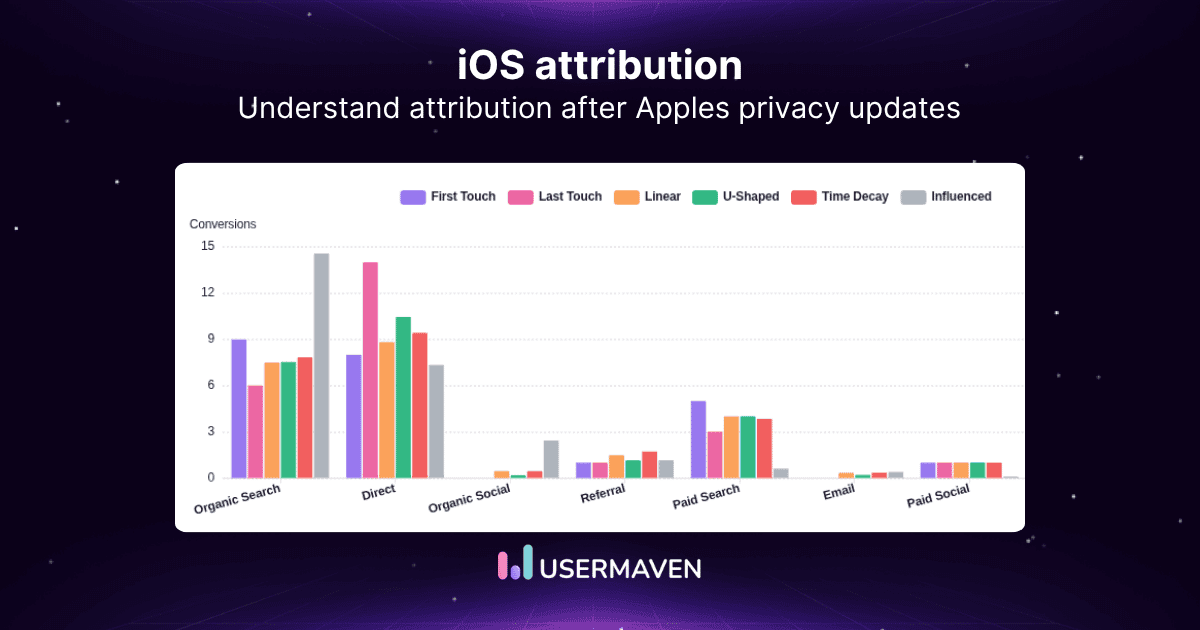
Multi-touch attribution looks across every channel and device in the customer lifecycle, not just the last click. It connects iOS ad impressions, website visits, email clicks, and in-product events, then assigns credit using models such as first-touch, last-touch, linear, U-shaped, time-decay, first non-direct, and last non-direct. This view helps teams answer different questions about discovery, nurturing, and closing.
Because SKAdNetwork and AdAttributionKit are aggregated, multi-touch views usually rely on first-party data and independent attribution software. An AI-powered analytics and attribution platform like Usermaven can stitch together server-side events and web sessions across devices into a single customer record. From there, you can compare how each attribution model treats an iOS ad click alongside other touchpoints.
How App Tracking Transparency changed iOS attribution forever
ATT moved IDFA access from opt-out to explicit opt-in. That single change gutted deterministic matching and forced marketers toward aggregated, privacy-safe frameworks.
Before ATT, any app could read the IDFA, and MMPs could match nearly every iOS ad click to an install with high accuracy. After ATT, users see a consent prompt and most decline. Adjust data puts average opt-in rates in the high twenties, meaning most iOS traffic no longer carries a usable device ID.

The ripple effects were significant. Retargeting pools shrank, lookalike audiences became less reliable, and channel reports stopped matching internal analytics. Marketers shifted to SKAdNetwork, AdAttributionKit, first-party user IDs, and server-side tracking to restore measurement confidence.
Some vendors turned to probabilistic fingerprinting using IP and user agent signals to fill the gap. Apple has been explicit that this violates its privacy policies (Apple). Any iOS attribution strategy that relies on fingerprinting in 2026 risks data loss and app removal.
Before ATT vs. after ATT: what changed for marketers?
Before ATT and after ATT differ across nearly every part of iOS campaign attribution. The table below highlights the most important shifts for marketers.
| Aspect | Before ATT | After ATT |
|---|---|---|
| IDFA access | Always available by default | Gated behind user opt-in prompt |
| Attribution method | Deterministic IDFA matching for most installs | Mix of limited deterministic data and aggregated frameworks |
| Data granularity | Rich user-level events and cohorts | Aggregated postbacks and conversion values only |
| Matching accuracy | Very high for paid campaigns | Lower and more variable across channels |
| Fraud risk | Easier to exploit with fake device farms | Lower where Apple-signed postbacks are used |
| Compliance needs | Basic privacy disclosures | Strict ATT rules and no fingerprinting allowed |
Probabilistic fingerprinting may look like an easy replacement, but it breaks Apple policy and cannot reach deterministic accuracy. A safer approach is a hybrid stack that combines ATT-consented data, Apple frameworks, and strong first-party analytics.
Apple’s privacy measurement frameworks explained
Apple uses two frameworks for iOS ad attribution: SKAdNetwork and AdAttributionKit. Both send cryptographically signed postbacks directly from Apple’s servers, preventing fraud while protecting user privacy.
SKAdNetwork (SKAN) is the older framework. It handles app-to-app attribution and delivers aggregated install data through delayed postbacks, typically 24–48 hours after the first open. Some data fields can be redacted if privacy thresholds aren’t met.
AdAttributionKit is newer and more capable. Per Apple’s developer documentation, it supports more ad formats, web-to-app and app-to-web flows, and re-engagement tracking on iOS 18+. It offers a 30-day click-through window, a 24-hour view-through window, and up to three postbacks for tracking longer-term value.
Both frameworks integrate with your MMP and analytics tools. They reduce fraud risk but limit data granularity. The tradeoff is real. Smart teams work within these constraints by mapping conversion values carefully and tying them back to channel and creative performance.

SKAdNetwork vs. AdAttributionKit: side-by-side comparison
This comparison shows where SKAdNetwork and AdAttributionKit differ so you know which one applies to your campaigns.
| Aspect | SKAdNetwork | AdAttributionKit |
|---|---|---|
| iOS support | Older iOS versions and current | Current iOS, iPadOS, and Safari versions |
| Re-engagement tracking | Very limited support | Strong support with up to three postbacks |
| Postback count | Fewer postbacks and less flexibility | Multiple postbacks for install and re-engagement |
| Attribution windows | Shorter and more rigid | 30-day click, 24-hour view |
| Ad format support | Mainly app-to-app placements | App, web, video, audio, and interactive ads |
| Conversion values | Up to 64 values with some constraints | Up to 64 values with more flexible mapping |
| Crowd anonymity | Redacts data on low-volume campaigns | Similar behavior with refined thresholds |
The biggest iOS attribution challenges and how to solve them
iOS attribution in 2026 is harder than it looks. Here are the core challenges you need to know about.
Null or redacted postbacks: When a campaign does not hit Apple’s crowd anonymity threshold, key fields like conversion value or publisher app ID return as null. This makes optimization nearly impossible. To fix this, simplify your campaign structure, concentrate budget on fewer source identifiers, and let volume build so Apple returns more detail.
Walled-garden reporting: Meta, Google Ads, and Apple Search Ads each report only their own clicks and conversions. Every channel ends up claiming more credit than it deserves. You need an independent view through an MMP or a marketing attribution platform to compare channels on the same definitions of installs, signups, and revenue.
Fragmented customer paths: A user might see an iOS ad but convert later on desktop or a different device. Ad blockers hide parts of that path. First-party data, server-side tracking, and a clear attribution window strategy help you connect those dots across web and app behavior.
Ad fraud: Even with Apple’s cryptographically signed postbacks, fraud still appears in channels that do not use these frameworks or rely on weak signals. According to Juniper Research, $84 billion in online ad spend was lost to ad fraud in 2023. Using verified frameworks and cross-checking with independent multi-touch attribution tools reduces this risk.
Delayed reporting: SKAdNetwork postbacks are not sent in real time. There can be a delay of 24 to 48 hours or more before data arrives. This slows down campaign optimization and makes it harder to react quickly to underperforming ads.
Siloed data: Many teams track app installs separately from web conversions, CRM data, and revenue. Without a unified view, you cannot see the full or on Apple devices.
Best practices for accurate iOS campaign attribution in 2026
These best practices help you regain confidence in iOS campaign attribution, even with strict privacy rules.
Use rigorous UTM tagging for every link. Apply consistent naming on Apple Search Ads, Meta, Google Ads, influencers, and email so you can parse traffic later. Clean UTMs give your MMP and analytics tools a shared language for mobile attribution across channels.
Implement a mobile measurement partner (MMP) to manage attribution waterfalls. Let the MMP prioritize deterministic matches from IDFA or click IDs, then layer in AdAttributionKit or SKAdNetwork postbacks, with organic installs as a final fallback. This keeps iOS ad attribution logic consistent across networks instead of buried in each ad platform.
Design campaigns to clear crowd anonymity thresholds. Avoid spreading budget across too many small ad sets or source identifiers, which often produce redacted conversion values. Bigger, more focused campaigns give Apple enough installs to return meaningful data and make conversion tracking usable.
Connect web-to-app flows with Web AdAttributionKit or Private Click Measurement where possible. Also invest in first-party and server-side tracking so you can see when an iOS user who first engaged on mobile finally converts on desktop. This bridge stops web and app behaviors from living in separate reports.
Use an independent AI-powered analytics and attribution platform like Usermaven on top of your MMP. Usermaven connects iOS campaign data with website analytics, customer paths, and revenue, and its pixel white-labeling helps capture up to 99 percent of events despite ad-blockers. With seven multi-touch attribution models and AI insights, you can compare first-touch, last-touch, linear, U-shaped, time-decay, first non-direct, and last non-direct views for every iOS campaign.
Tip: Start by standardizing UTM structures and attribution windows across all paid channels before fine-tuning models.
How to connect iOS attribution with your full marketing measurement stack
iOS attribution does not live in isolation. The signals you collect from ad networks and MMPs only become actionable when they are connected to everything else happening in your funnel. That means linking iOS data to website sessions, product usage, and CRM stages so you can follow a user’s journey from the first iOS ad impression all the way to a closed deal.
The practical way to do this is to route iOS attribution data into a central analytics platform that supports cross-channel measurement. From there, you can map each touchpoint across paid, organic, email, and in-app interactions without treating them as separate data silos. Clear customer journey analytics and a defined attribution window policy are essential here, especially for campaigns where conversions happen days or weeks after the first touch.
Usermaven supports this kind of full-funnel measurement. It combines multi-touch attribution, content attribution, and path reporting in one place, letting you see how iOS ad impressions interact with blog visits, email clicks, and sales conversations. With seven attribution models available side by side, you can compare last-click performance against more complete views without switching tools.
Usermaven also handles cross-device tracking using first-party data with an ad-blocker-resistant pixel. An iOS ad click, a later desktop session, and an in-app purchase can all appear on the same unified timeline, giving you an accurate picture of how iOS campaigns contribute to revenue rather than just installs.
Maximize your ROI
with accurate attribution
The bottom line
The old world of free IDFA access and simple last-click models is gone. Marketers who adapt to privacy-first attribution will measure more accurately, spend smarter, and grow with confidence.
Usermaven makes that transition easier. It combines multi-touch attribution, first-party data tracking, server-side event capture, and AI-powered analytics into one platform, giving you a clear picture of how your iOS campaigns, content, and sales touches connect across the full customer journey, without relying on invasive tracking methods.
What does your current iOS attribution setup look like, and where are the biggest gaps in your measurement?
Ready to see Usermaven in action? Explore the platform or book a demo for a closer look.
Frequently asked questions
What is iOS attribution?
iOS attribution is the process of connecting ad impressions and clicks on Apple devices to app installs and post-install events. It uses Apple attribution frameworks like SKAdNetwork and AdAttributionKit, ATT-consented identifiers such as IDFA, and first-party data rather than browser cookies to measure campaign attribution and revenue impact.
How does iOS attribution affect Meta and Google campaign reporting?
After ATT, Meta and Google lost access to IDFA for users who opted out, which means their in-platform reporting relies heavily on modeled data and aggregated signals rather than deterministic matches. This is why you often see discrepancies between what Meta Ads Manager reports and what your MMP or analytics platform shows. Using a third-party attribution platform like Usermaven alongside platform-native reporting gives you a more complete picture.
Can you track the full customer journey on iOS?
Full deterministic customer journey tracking is no longer possible for opted-out users. However, you can stitch together partial journeys using first-party events, CRM data, server-side tracking, and aggregated postbacks from AdAttributionKit. Combining these signals inside a platform that supports cross-channel attribution helps you understand where users come from, even without device-level identifiers.
What is a good ATT opt-in rate and how do you improve it?
Industry opt-in rates average around 25 to 45 percent depending on the app category. You can improve yours by showing a pre-permission prompt that explains the value exchange before the native ATT dialog appears, timing the request after a positive in-app moment, and being transparent about how data is used.
Does iOS attribution work for web-to-app conversion flows?
Yes, but it requires the right setup. AdAttributionKit now supports web-to-app measurement natively, allowing you to attribute installs that originate from a Safari click. For broader coverage across browsers and paid channels, pairing AdAttributionKit with server-side tracking and first-party data collection is the most reliable approach in 2026.
Updated

Written by
Lauren Brooks
Lifecycle Marketing Strategist
Lauren Brooks is a lifecycle marketing strategist with 4+ years of experience helping SaaS businesses create meaningful customer experiences. She specializes in user engagement, retention, and conversion optimization, helping brands build stronger customer relationships beyond acquisition.
All articles by Lauren →