A B2B deal may involve several contacts, months of research, paid campaigns, organic content, webinars, sales calls, product activity, and CRM updates.
Last-click reporting usually gives all the credit to the final interaction, even when earlier touchpoints created demand and moved the account toward a purchase.
A B2B marketing attribution platform connects marketing activity with contacts, accounts, opportunities, pipeline stages, and closed revenue. It helps teams understand which campaigns influence qualified pipeline rather than simply generating leads.
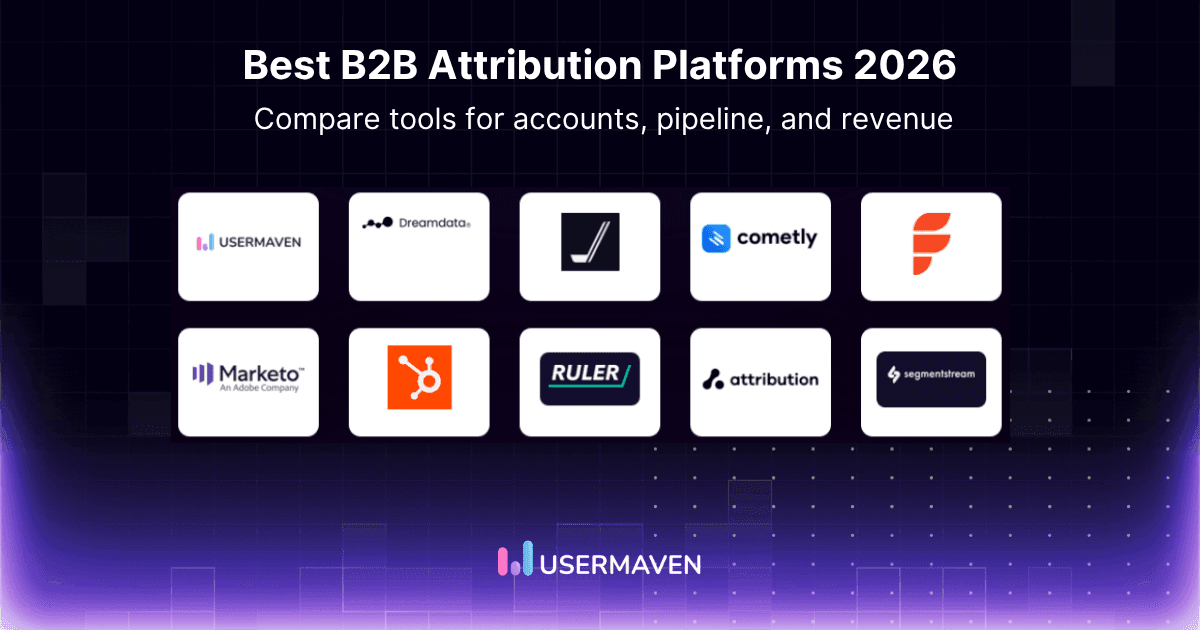
This guide compares ten platforms based on account tracking, CRM integration, attribution depth, pipeline reporting, pricing, and ideal use case. For additional context, this guide explains the foundations of B2B marketing attribution.
Key takeaways
The right B2B attribution platform depends on the CRM, sales motion, buying-cycle length, reporting needs, and how the business connects marketing activity with revenue.
Account-level tracking is essential when several contacts from the same company influence one opportunity across marketing campaigns, website visits, sales conversations, and product activity.
Pipeline contribution and closed revenue provide a more reliable measure of marketing impact than lead volume, form submissions, or other early-stage conversion metrics alone.
B2B attribution platforms range from self-serve tools with transparent pricing to enterprise systems requiring custom implementation, data engineering, onboarding, and long-term contracts.
10 best B2B marketing attribution platforms
Some platforms focus almost entirely on account-level attribution and pipeline reporting. Others connect attribution with paid media, website behavior, product activity, calls, or offline revenue.
The table below provides a quick comparison before the full platform profiles.
| Platform | Best for | Main B2B strength | CRM and revenue | Pricing |
|---|---|---|---|---|
| Usermaven | B2B SaaS and product-led teams | Attribution plus behavioral analytics | CRM, pipeline, and revenue attribution | From $84/month |
| Dreamdata | Account-based revenue attribution | Buying-committee journeys | Strong CRM and revenue focus | Free + custom |
| HockeyStack | Enterprise GTM intelligence | Account journeys and ROI reporting | Strong pipeline reporting | Custom |
| Cometly | Paid-media-to-pipeline attribution | Server-side campaign tracking | CRM and closed-won reporting | Usage-based |
| Factors.ai | ABM and account intelligence | Company identification and intent | HubSpot and Salesforce support | From $199/month |
| Adobe Marketo Measure | Adobe and Marketo ecosystems | Enterprise B2B attribution | Pipeline, revenue, and ROI | Custom |
| HubSpot Marketing Hub | HubSpot-centered teams | Native CRM reporting | Contacts, deals, and revenue | Public plans |
| Ruler Analytics | Calls and offline revenue | Call and form attribution | Closed-loop CRM revenue | From $400/month |
| Attribution App | Flexible attribution models | Custom and account-based models | Customer and revenue data | From $399/month |
| SegmentStream | Advanced full-funnel measurement | Attribution and incrementality | CRM funnel attribution | From $1,200/month |
1. Usermaven: Best for B2B attribution and customer journeys

Usermaven connects marketing acquisition with website behavior, product activity, CRM progression, and revenue.
Instead of stopping at campaign reporting, it shows what prospects do after arriving, which actions move them forward, and which touchpoints contribute to qualified pipeline and revenue.
Best for: B2B SaaS, product-led, and growth teams that need attribution alongside website and product analytics.
Key B2B capabilities:
Paid, organic, content, and channel attribution
CRM pipeline and revenue attribution
Multi-touch conversion paths
Customer journey attribution
Website and product analytics
User and account profiles
Funnels, cohorts, and retention
Google, Meta, and LinkedIn Ads tracking
Conversion sync to ad platforms
AI-powered analysis and scheduled reporting
The platform’s attribution reporting connects campaigns and channels with conversions, pipeline, and revenue. Its Contacts Hub adds user and account-level activity, acquisition sources, engagement, and behavioral data.
Maven AI lets teams ask questions about attribution, funnels, campaigns, journeys, and revenue without building a new report for every question.
Pricing
Growth starts at $84 per month for website, product, and ecommerce analytics. Scale starts at $199 per month and adds paid-ad attribution, CRM revenue attribution, conversion paths, retention analysis, and Maven AI. Enterprise pricing is customized for advanced security, infrastructure, and deployment requirements.
2. Dreamdata: Best for account-based revenue attribution

Dreamdata is built specifically for B2B marketing teams that need to connect anonymous visits, known contacts, accounts, marketing activity, and CRM revenue.
Its unified data model groups interactions by account and builds customer journeys across advertising, website activity, marketing automation, and sales systems.
Best for: B2B organizations with long buying cycles, several stakeholders, and CRM-centered revenue reporting.
Key B2B capabilities:
Company identification
Account-level customer journeys
Cookie and cookieless tracking
Engagement scoring
Audience building
Revenue and content analytics
AI and custom attribution models
Custom UTM mapping
CRM and advertising integrations
Multi-business-unit support
Pricing:
Dreamdata offers a free plan with B2B web analytics, company identification, engagement scoring, audience building, advertising-spend reports, and two months of user history.
Its advanced Activation and Attribution package uses custom pricing and adds broader attribution, AI activation, custom reporting, advanced data controls, and dedicated onboarding.
If you want a deeper comparison, check out this detailed Dreamdata alternative.
3. HockeyStack: Best for enterprise GTM intelligence

Hockeystack combines attribution, account intelligence, pipeline reporting, scoring, audience activation, and AI-assisted GTM analysis.
It is designed for teams that want to understand how marketing and sales touchpoints affect opportunities, pipeline velocity, and closed revenue.
Best for: Mid-market and enterprise teams with complex go-to-market data and dedicated revenue operations resources.
Key B2B capabilities:
Multi-touch attribution
Account-level buyer journeys
GTM reports and dashboards
CRM and warehouse synchronization
Pipeline and ROI reporting
Account scoring
Audience synchronization
Conversion APIs
Lift and incrementality reports
AI-assisted recommendations
HockeyStack supports first-touch, last-touch, linear, and position-based models, among others. Teams can compare how credit changes across advertising, sales-development, and opportunity touchpoints.
Pricing
HockeyStack does not display a fixed public subscription price. Its pricing page uses a sales-led process and states that plans include GTM reporting, attribution, integrations, support, and custom setup for complex data environments.
A direct HockeyStack alternative comparison provides additional context on analytics coverage, setup, and pricing structure.
4. Cometly: Best for paid-media-to-pipeline attribution

Cometly focuses on showing which campaigns, channels, and advertisements generate leads, opportunities, and closed revenue.
Its current positioning is built around B2B SaaS teams that need to connect advertising activity with account journeys and CRM outcomes.
Best for: Performance marketing teams running substantial paid acquisition across several advertising platforms.
Key B2B capabilities:
Comet Pixel
Server-side tracking
Multi-touch attribution
Account journeys
CRM integrations
Conversion APIs
Custom dashboards
Audience activation
AI Ads Manager
Marketing analytics
More than 70 integrations
The Core package includes tracking, attribution, account journeys, AI tools, dashboards, and audience capabilities.
Enterprise adds CRM and warehouse synchronization, API access, Snowflake and BigQuery support, larger usage allowances, custom integrations, dedicated engineering support, and a customer success manager.
Pricing:
Cometly uses usage-based pricing but does not display a fixed dollar amount on its current pricing page. Teams need to begin the signup or sales process to receive an exact cost.
This Cometly alternative page compares its sales-led approach with Usermaven’s self-serve attribution and broader analytics coverage.
5. Factors.ai: Best for ABM and account intelligence

Factors.ai combines company identification, intent signals, account analytics, advertising activation, and attribution.
It is more ABM-focused than a traditional attribution-only platform. Teams can identify companies visiting the website, score engagement, activate advertising audiences, and notify sales when target accounts show buying intent.
Best for: B2B teams running account-based programs across LinkedIn, Google Ads, CRM, and website activity.
Key B2B capabilities:
IP-to-company identification
Account and people profiles
Firmographic and behavioral segmentation
Buyer journey timelines
Account scoring
LinkedIn intent and view-through attribution
Google and LinkedIn audience sync
CRM deal and opportunity synchronization
Ad-performance analysis
Custom reports and dashboards
Sales alerts and workflows
Pricing:
Lite starts at $199 per month. Basic costs $6,000 per year, Growth costs $20,000 per year, and Enterprise starts at $30,000 per year.
Higher plans add advanced ABM analytics, account scoring, G2 signals, audience activation, advertising conversion feedback, predictive scoring, custom workflows, and wider integration support.
6. Adobe Marketo Measure: Best for Adobe and Marketo ecosystems

Adobe Marketo Measure, formerly Bizible, is an enterprise B2B attribution product for measuring campaign, channel, and content influence on pipeline, revenue, and ROI.
It aggregates marketing and sales touchpoints across online and offline channels, then connects them with major B2B milestones.
Best for: Large organizations already using Adobe Marketo Engage, Salesforce, Microsoft Dynamics, or Adobe Experience Cloud.
Key B2B capabilities:
Every-touch data aggregation
Paid, organic, email, webinar, and event tracking
BDR and sales-activity touchpoints
CRM reporting templates
Data-warehouse access
Campaign and content associations
Pipeline and revenue attribution
Online and offline channel measurement
Custom reporting and data sharing
Marketo Measure supports First Touch, Lead Creation, U-Shaped, W-Shaped, Full Path, and Custom models.
These models distribute credit around lead creation, opportunity creation, and closed-won milestones, making the platform particularly relevant to established enterprise sales processes.
Pricing:
Adobe does not publish a fixed Marketo Measure price. Marketo Engage packages use custom pricing, and Marketo Measure is included in or added to higher-tier Adobe configurations.
For a broader category comparison, review Dreamdata vs. HockeyStack vs. Bizible.
7. HubSpot Marketing Hub: Best for HubSpot-centered teams

HubSpot Marketing Hub combines marketing automation, contact records, campaign reporting, deal data, and attribution inside the HubSpot CRM ecosystem.
The main benefit is native data continuity. Marketing and sales teams can use the same contact, company, lifecycle, and deal records without building a separate attribution data layer.
Best for: Organizations already managing demand generation, sales activity, and revenue inside HubSpot.
Key B2B capabilities:
Contact attribution
Deal and revenue reporting
Campaign analysis
Customer journey reporting
Marketing automation
Forms and lead capture
Contact and company records
Lifecycle-stage reporting
Multiple attribution models
CRM-centered reporting
HubSpot supports attribution reports based on contacts, deals, and revenue. General attribution reporting is available in Professional and Enterprise subscriptions.
Pricing:
HubSpot offers Free, Starter, Professional, and Enterprise plans. Marketing Hub Professional is listed at $800 per month on annual billing, while Enterprise is listed at $3,600 per month and includes advanced attribution and journey analytics.
Additional costs can include onboarding, seats, and higher marketing-contact tiers.
This guide to HubSpot revenue attribution explains how CRM records, campaigns, deals, and revenue connect.
8. Ruler Analytics: Best for calls and offline revenue

Ruler Analytics is designed for businesses where conversions frequently happen through forms, phone calls, live chat, sales representatives, or offline systems.
It connects the original marketing source with CRM opportunities and revenue, then pushes that information into advertising, reporting, and business-intelligence tools.
Best for: Lead-generation companies, professional services, and B2B businesses with high call or offline conversion volume.
Key B2B capabilities:
Dynamic call tracking
Form and live-chat attribution
CRM opportunity reporting
Offline conversion tracking
Multi-touch attribution
Impression attribution
Cross-domain tracking
Single-customer journey views
Data-driven attribution
Marketing mix modeling on Advanced
Pricing:
Small starts at $400 per month for up to 10,000 monthly visits. Medium starts at $668, Large starts at $1,326, and Advanced starts at $2,000 per month.
Pricing is indicative and can change according to traffic volume, product requirements, data needs, and integrations.
The dedicated Ruler Analytics alternative comparison covers differences in setup, attribution, product analytics, and overall platform scope.
9. Attribution App: Best for flexible attribution models

Attribution App is a dedicated multi-touch attribution platform with separate packages for HubSpot, Twilio Segment, Shopify, and enterprise data environments.
Its B2B offering is most relevant to HubSpot teams that want detailed campaign-cost, customer acquisition, ROAS, and account-based reporting.
Best for: Teams that want auditable attribution models and flexible customer or account-level analysis.
Key B2B capabilities:
First-touch, last-touch, and linear models
Custom attribution models on Enterprise
ROAS by advertisement
CAC by customer
HubSpot and Salesforce support
Account-based attribution
Custom lookback windows
Offline ad connectors
Data-warehouse tooling
Multiple projects and workspaces
Model comparison
Pricing:
The HubSpot Pro plan starts at $399 per month for up to 10,000 monthly tracked users and three seats. Annual billing reduces the effective monthly cost.
Enterprise pricing is custom and adds customized models, account-based attribution, offline channels, warehouse features, custom usage limits, Salesforce integration, and managed onboarding.
10. SegmentStream: Best for advanced full-funnel measurement

Segmentstream is a marketing measurement engine combining cross-channel attribution, predictive attribution, CRM funnel reporting, marginal analysis, incrementality testing, and budget optimization.
Its Full Funnel package is designed specifically for businesses where leads originate digitally, but revenue closes through a CRM, salesperson, contract, or offline process.
Best for: Data-mature B2B teams with long sales cycles, substantial advertising budgets, and advanced measurement requirements.
Key B2B capabilities:
Identity graph
Cross-channel attribution
Predictive attribution
CRM and warehouse conversions
CRM funnel attribution
Self-reported reattribution
Marginal analytics
Incrementality testing
AI Agent and MCP access
Automated budget allocation on Enterprise
Server-side conversion tracking on Enterprise
Pricing:
Full Funnel starts at $1,200 per month and uses quarterly or annual billing. Online starts at $800 per month and is intended for businesses where conversions occur entirely online.
Enterprise starts at $5,000 per month and adds advanced security, server-side tracking, budget allocation, white-glove onboarding, a dedicated success manager, and custom procurement terms.
What makes a strong B2B attribution platform?
A long feature list does not automatically make a platform suitable for B2B.
The tool must represent how B2B revenue is actually created across accounts, contacts, campaigns, sales activity, and CRM stages.
Account-level tracking
A single opportunity may involve a decision-maker, end user, technical evaluator, finance stakeholder, and procurement contact.
A strong platform groups those contacts into one account journey. Without account-level visibility, each person may appear to be an unrelated lead.
Clear B2B customer segmentation also helps teams compare target accounts by industry, company size, lifecycle stage, engagement, and acquisition source.
CRM and opportunity integration
The platform should connect marketing activity with the objects that represent actual business outcomes.
These commonly include:
Contacts
Companies
Opportunities
Deal stages
Pipeline value
Closed-won revenue
Expansion revenue
A platform that tracks form submissions but cannot connect them with opportunities provides only partial attribution.
Multi-touch attribution
B2B revenue rarely comes from one interaction.
A prospect may first discover the brand through LinkedIn, return through organic search, attend a webinar, read a case study, book a demo, and speak with sales before an opportunity is created.
Multi-touch attribution distributes credit across these interactions instead of assigning the entire outcome to one source.
Appropriate attribution models
No single model answers every B2B question.
First-touch is useful for understanding demand creation. Last-touch highlights the final conversion source, while linear and position-based approaches provide a broader view of influence.
The right marketing attribution models depend on the buying cycle, reporting objective, and availability of reliable CRM data.
Long attribution windows
A 30-day window may exclude the touchpoint that originally introduced an account six months before a deal closed.
The appropriate attribution window should reflect the real length of the company’s sales cycle rather than a platform’s default reporting period.
Pipeline and revenue reporting
Lead volume can be misleading.
A campaign may generate many low-quality leads while another creates fewer contacts but substantially more qualified pipeline and revenue.
Revenue attribution connects marketing performance with financial outcomes, helping teams optimize for business value rather than activity.
Anonymous-to-known identity resolution
Many buyers interact with a company before completing a form or entering the CRM.
Identity resolution connects anonymous sessions with known contacts after identification. It may also combine activity across browsers, devices, email addresses, and account records.
This produces a more complete journey than measuring only activity after lead capture.
Marketing and sales touchpoints
The platform should support more than advertising clicks.
A complete B2B journey may include:
Paid advertisements
Organic search
Website content
Email
Webinars
Conferences
Partner referrals
Sales emails
Calls and meetings
Product trials
CRM stage changes
Without sales and offline touchpoints, marketing influence can appear disconnected from the final deal.
First-party and cookieless tracking
Browser restrictions, consent requirements, and ad blockers can reduce the reliability of traditional client-side tracking.
Cookieless attribution and first-party data collection help maintain journey visibility while reducing dependence on third-party identifiers.
Dashboards and AI analysis
The platform should make attribution usable for marketing, sales, operations, finance, and leadership.
A clear marketing attribution dashboard should connect channels and campaigns with pipeline and revenue while allowing deeper investigation by account, segment, or journey.
AI can accelerate that analysis, but its conclusions must remain traceable to the underlying data and reporting logic.
Best B2B attribution platform by use case
A strong SaaS marketing attribution setup connects acquisition sources with product engagement, pipeline, conversion, and retention.
| B2B use case | Recommended platform |
|---|---|
| B2B SaaS and product-led journeys | Usermaven |
| Account-based revenue attribution | Dreamdata |
| Enterprise GTM intelligence | HockeyStack |
| Paid-media-to-pipeline tracking | Cometly |
| ABM and account identification | Factors.ai |
| Adobe and Marketo ecosystem | Adobe Marketo Measure |
| HubSpot CRM ecosystem | HubSpot Marketing Hub |
| Calls and offline revenue | Ruler Analytics |
| Flexible attribution modeling | Attribution App |
| Advanced conversion and incrementality measurement | SegmentStream |
The better choice depends on where revenue closes, which systems house customer data, how long the sales cycle lasts, and how much implementation complexity the team can handle.
See Usermaven in action
Book a free demo and discover how powerful analytics can grow your business.
How to choose a B2B marketing attribution platform
The buying process should begin with the company’s sales motion and data structure, not a feature checklist.

Start with the CRM
Identify where contacts, companies, opportunities, and revenue are stored.
A platform may offer strong attribution but still be a poor fit when it cannot synchronize reliably with the company’s CRM, warehouse, or advertising systems.
Review the sales-cycle length
Measure the time between the first meaningful interaction and closed revenue.
The platform’s identity resolution, history, and attribution window must be long enough to preserve early touchpoints.
Decide between contact and account attribution
Contact-level reporting is useful for understanding individual journeys.
Account-level reporting becomes essential when several people from one company contribute to a single opportunity.
Most B2B teams need both perspectives.
Check pipeline and revenue depth
Confirm whether the tool reports only conversions or continues through:
Marketing-qualified leads
Sales-qualified leads
Opportunities
Pipeline value
Closed-won revenue
Recurring revenue
Expansion revenue
A platform that stops at form submissions cannot fully measure B2B marketing performance.
Consider product-led activity
SaaS teams may need to understand whether campaigns bring accounts that activate, adopt important features, invite teammates, and remain engaged.
A CRM-only attribution platform may miss these signals unless product behavior is integrated separately.
Assess offline interactions
Calls, meetings, conferences, partner referrals, direct mail, and sales activity can influence large B2B deals.
Check how these interactions are imported, matched with accounts, and included in attribution reports.
Compare implementation requirements
Review the work required for:
Tracking installation
CRM field mapping
Identity resolution
Historical-data imports
Warehouse connections
Opportunity-stage cleanup
Attribution-model configuration
Ongoing administration
Complex implementation is not necessarily a problem, but it must match the team’s resources.
Compare the complete cost
The subscription price may be only one part of the investment.
Consider onboarding, professional services, integrations, event or visitor limits, additional seats, historical data, warehouse costs, support, and contract terms.
This guide to marketing attribution software cost explains the main pricing models and cost drivers.
Common B2B attribution mistakes
Even strong software produces weak insights when the measurement strategy is incomplete.
Measuring leads instead of revenue
Lead volume measures activity, not business value.
Campaign decisions should consider qualified pipeline, closed revenue, customer value, and retention.
Treating every contact as a separate journey
Contacts from the same company may appear to follow independent paths.
Without account grouping, the platform cannot represent the combined influence of a buying committee.
Relying only on last-click
Last-click usually favors branded search, direct traffic, and conversion-focused campaigns.
It can undervalue demand creation, content, events, communities, and early-stage advertising.
Ignoring sales interactions
Sales emails, calls, meetings, demos, and opportunity changes are part of the customer journey.
Removing them from attribution creates an artificial boundary between marketing and revenue.
Using attribution windows that are too short
A short lookback period may remove the campaigns and content that originally created demand.
The reporting window should reflect the actual time required to create and close an opportunity.
Using inconsistent CRM data
Missing opportunity values, duplicated accounts, inaccurate lifecycle stages, and inconsistent campaign names weaken every attribution model.
Data governance must be addressed before teams trust the final reports.
Buying more complexity than the team can use
Advanced modeling does not automatically improve decisions.
A platform with MMM, incrementality testing, and custom data science may offer little value when the organization still lacks clean campaign data or reliable CRM stages.
Understanding common challenges with attribution models helps teams avoid interpreting modeled credit as unquestionable truth. Teams that need solid B2B attribution without enterprise-level complexity can also review the comparison of affordable attribution tools.
Final verdict
Dreamdata is well suited to account-based revenue attribution, HockeyStack supports enterprise GTM intelligence, and Cometly focuses more heavily on paid-media-to-pipeline measurement. Factors.ai is useful for ABM and account intent, while Adobe Marketo Measure and HubSpot fit teams already committed to those ecosystems
For B2B SaaS and product-led teams, Usermaven provides the most complete balance of attribution, behavioral analytics, and revenue visibility. It connects paid and organic campaigns with website activity, product usage, customer journeys, CRM deals, pipeline stages, and closed revenue in one platform.
For teams that want acquisition, behavior, product engagement, pipeline, and revenue connected in one place, Usermaven is the strongest all-in-one B2B marketing attribution software.
Ready to see Usermaven in action? Explore the platform or book a demo for a closer look.
See what's working. Fix what's not. Grow faster.
FAQs
1. What is a B2B marketing attribution platform?
A B2B marketing attribution platform connects marketing and sales touchpoints with contacts, accounts, opportunities, pipeline, and revenue.
It helps teams understand which channels, campaigns, content, and interactions contribute to customer acquisition and closed business.
2. Which marketing attribution platform is best for B2B?
The best platform depends on the company’s sales motion and technology stack.
Usermaven best for B2B SaaS and product-led teams. Dreamdata specializes in account-based revenue attribution, while HockeyStack supports enterprise GTM intelligence. Cometly is better aligned with paid-media attribution, and Ruler Analytics is useful when calls and offline conversions are central.
3. How is B2B attribution different from B2C attribution?
B2B purchases usually involve longer sales cycles, several stakeholders, CRM stages, sales interactions, and delayed revenue.
B2C attribution often focuses on a shorter individual journey ending in an online purchase.
4. What is the best attribution platform for B2B SaaS?
Usermaven is a strong option for B2B SaaS teams that need marketing attribution alongside product analytics, website behavior, customer journeys, CRM revenue, and retention.
Dreamdata and HockeyStack are also relevant for B2B SaaS organizations prioritizing account-based journeys and GTM reporting.
5. Which B2B attribution tools integrate with HubSpot and Salesforce?
Dreamdata, HockeyStack, Cometly, Factors.ai, Ruler Analytics, Attribution App, Adobe Marketo Measure, and SegmentStream support CRM-centered attribution workflows.
The depth of integration varies, so buyers should confirm support for contacts, companies, opportunities, deal stages, campaign data, and revenue synchronization.
Updated

Written by
Junaid Ahmed
Content Writer & Digital Marketer
Junaid Ahmed is a content and copywriter with 3+ years of experience creating research-driven content across SaaS, B2B, ecommerce, and digital marketing. He specializes in turning complex topics into clear, practical content that helps marketers better understand their challenges, evaluate solutions, and make informed decisions. His work spans educational content, industry insights, and actionable marketing guides.
All articles by Junaid →