Artificial Intelligence (AI) is transforming how businesses operate, offering new insights and previously unattainable capabilities. In web and product analytics, AI drives efficiencies, improves user experiences, and provides valuable insights.
AI enables deeper and more accurate analysis of user behavior and website performance, allowing businesses to make real-time decisions and quickly respond to emerging trends and issues. This enhances customer satisfaction and personalizes user experiences based on individual preferences, leading to higher engagement and retention.
As AI technology continues to advance, its impact on website and product analytics will drive significant innovation and growth. As marketing attribution software, Usermaven helps businesses connect AI-driven insights with campaigns, customer journeys, conversion paths, and revenue impact, making AI more valuable for long-term growth.
What is AI in website and product analytics?
AI in website and product analytics uses artificial intelligence to analyze data from website interactions and product usage. This includes machine learning, natural language processing (NLP), and other AI techniques. These tools process large data volumes, uncover patterns, predict user behaviors, and optimize website and product features.
Businesses have started leveraging AI development services to implement advanced analytics solutions, enabling smarter data processing and more accurate insights. So, it’s time for other startups and businesses to consider AI to understand user preferences better and enhance personalized experiences. This improves decision-making and drives growth and competitive advantage in the digital landscape.
Role of AI in website analytics
AI in website analytics utilizes advanced techniques to analyze and interpret user behavior and website performance data.
Benefits of AI in website analytics include:
- User behavior analysis:
The best AI tools make it faster and easier to analyze user interactions, such as click paths, time spent on pages, and engagement with specific content. By automating the analysis process, AI quickly identifies patterns and trends that would be time-consuming to uncover manually. This enables businesses to gain a deeper understanding of user preferences, leading to informed decisions on website improvements, enhanced user experiences, and increased engagement.
- Personalization:
By analyzing user data, AI can deliver personalized content recommendations tailored to individual user preferences. This leads to higher engagement and satisfaction by ensuring that users receive content that is most relevant to them. An ai marketing agent can leverage these personalization capabilities to create targeted campaigns and optimize marketing strategies, further enhancing user engagement and conversion rates.
- Predictive analytics:
AI models can predict future user behaviors and trends based on historical data. This allows businesses to anticipate customer needs and optimize their strategies accordingly, ensuring they stay ahead of market demands and improve their overall performance through advanced machine-learning techniques.
Machine learning, as a subset of AI, is instrumental in web and product analytics by uncovering user behavior patterns, predicting trends, and enhancing personalization. For those interested in delving deeper into this field, exploring comprehensive machine learning courses by Datacamp can provide valuable skills that are applicable to a wide range of applications, including website optimization and predictive analytics.
- Real-time insights:
AI enables real-time data processing and analysis, allowing businesses to respond promptly to emerging trends, issues, or opportunities. This immediate feedback loop helps companies stay agile and proactive in a constantly changing digital landscape.
- Automated reporting:
AI-powered tools can automate the generation of detailed analytics reports, highlighting key metrics, trends, and anomalies without manual intervention. This saves time and resources while ensuring that critical data is consistently monitored and analyzed.
- Anomaly detection:
AI can easily and efficiently detect unusual patterns or anomalies in website data, such as sudden drops in traffic or unusual user behavior. AI quickly identifies potential issues or opportunities for improvement that might be missed manually. This enables businesses to address problems promptly and capitalize on opportunities, leading to better website performance and user experience.
- Conversion rate optimization:
By analyzing user behavior and testing different elements of the website, AI can help identify the most effective strategies for improving conversion rates. This allows businesses to achieve their goals more effectively and efficiently by continually optimizing the user experience.
Also read: Enhancing Customer Service With AI Chatbots: The Key Benefits
Role of AI in product analytics
AI in product analytics transforms raw usage data into actionable insights, enabling businesses to understand customer behavior, predict future trends, and optimize product development and marketing strategies. By using AI, companies can enhance product performance, improve customer satisfaction, and achieve a competitive edge in the market.
Benefits of AI in product analytics include:
- Customer insights:
AI analyzes customer behavior data to understand user preferences, needs, and pain points. This information helps tailor products to better meet customer expectations and improve user satisfaction.
- A/B testing optimization:
AI streamlines the A/B testing process by quickly analyzing test results and identifying the most effective variants. This accelerates decision-making and helps in optimizing product features and marketing strategies.
- Churn prediction:
AI models can analyze customer behavior more quickly and predict which customers are likely to stop using a product. By identifying these customers early, businesses can take proactive measures to retain them, such as personalized offers or improvements to product features.
- Sentiment analysis:
NLP techniques are used to analyze customer feedback, reviews, and social media mentions to determine public sentiment toward a product. This helps businesses understand how customers feel about their products and identify areas for improvement.
- Feature prioritization:
AI analyzes usage data to determine which features are most important to users. This helps product teams prioritize development efforts and focus on features that will have the greatest impact on user satisfaction and retention.
- Market trend analysis:
AI monitors and analyzes market trends and competitor products to provide insights that inform product strategy. This helps businesses stay ahead of industry trends and adapt their product offerings accordingly.
- Product lifecycle management:
AI can provide insights throughout the product life cycle, from development and launch to growth and maturity. This includes identifying optimal times for updates, new feature introductions, and product retirements.
Also read: 10 best product analytics tools 2024
The future of web and product analytics powered by AI
The future of web and product analytics is set to be revolutionized by AI, bringing a new level of intelligence and efficiency to how businesses understand and interact with their users.
As AI technology continues to evolve, it will enhance analytics tools, offering deeper insights, more accurate predictions, and more personalized user experiences. This will help businesses stay competitive and agile in an ever-changing digital landscape.
Usermaven: Leading the way in AI-powered analytics
Usermaven makes it easy for marketing and product teams to understand user behavior, track customer journeys, and connect AI-powered insights with attribution and conversion outcomes. It simplifies the complex task of tracking and analyzing user interactions while maintaining user privacy.

Usermaven offers:
- Cookie-less tracking: Ensures user privacy without compromising data accuracy. This allows for seamless tracking of user interactions while maintaining compliance with privacy regulations.
- Automatic event capture: Reduces manual tracking efforts and captures crucial data points effortlessly. This automation ensures that no important interactions are missed and saves time for analytics teams.
- Comprehensive web and product analytics: Provides in-depth insights into the website, product performance, and user interactions. This holistic view helps businesses understand how users engage with their products and where improvements can be made.
- Detailed customer journey report: Helps teams understand the full customer journey, from first interaction to conversion. This detailed reporting enables businesses to pinpoint effective touchpoints and optimize their marketing strategies.
- AI-powered funnel analysis: Transforms how you understand and optimize conversion paths. With AI Funnel Insights, you can analyze each stage of your funnel to identify drop-off points, compare performance across channels and devices, and uncover surprising trends. Our AI doesn’t just present the data—it provides actionable recommendations to help you continuously optimize your funnel for better conversion rates.
- AI-powered attribution: Helps you understand exactly what drives conversions by analyzing the performance of your marketing channels and content using various attribution models. You can compare how different channels contribute to conversions, identify the best and worst-performing channels, and see how individual pages on your site influence conversion rates. This deep analysis is complemented by model impact analysis, ensuring you get the most accurate insights and opportunities for improvement.
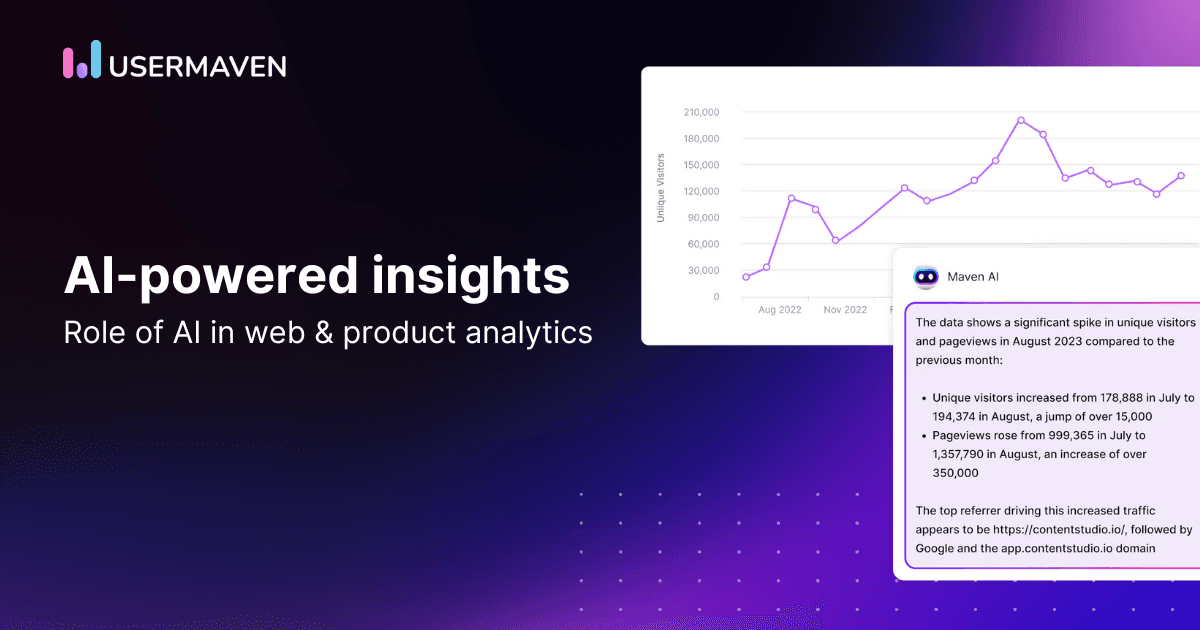
- Maven AI: Empowers data interpretation and decision-making with advanced AI capabilities, ensuring accurate actionable insights for the analytics teams.
What is Maven AI?
Maven AI is an AI analytics assistant in Usermaven designed to empower web and product teams by providing deep, actionable insights into user behavior and product performance. By applying advanced AI techniques, Maven AI simplifies complex data analysis processes, uncovers hidden patterns, and delivers real-time solutions that drive business growth.
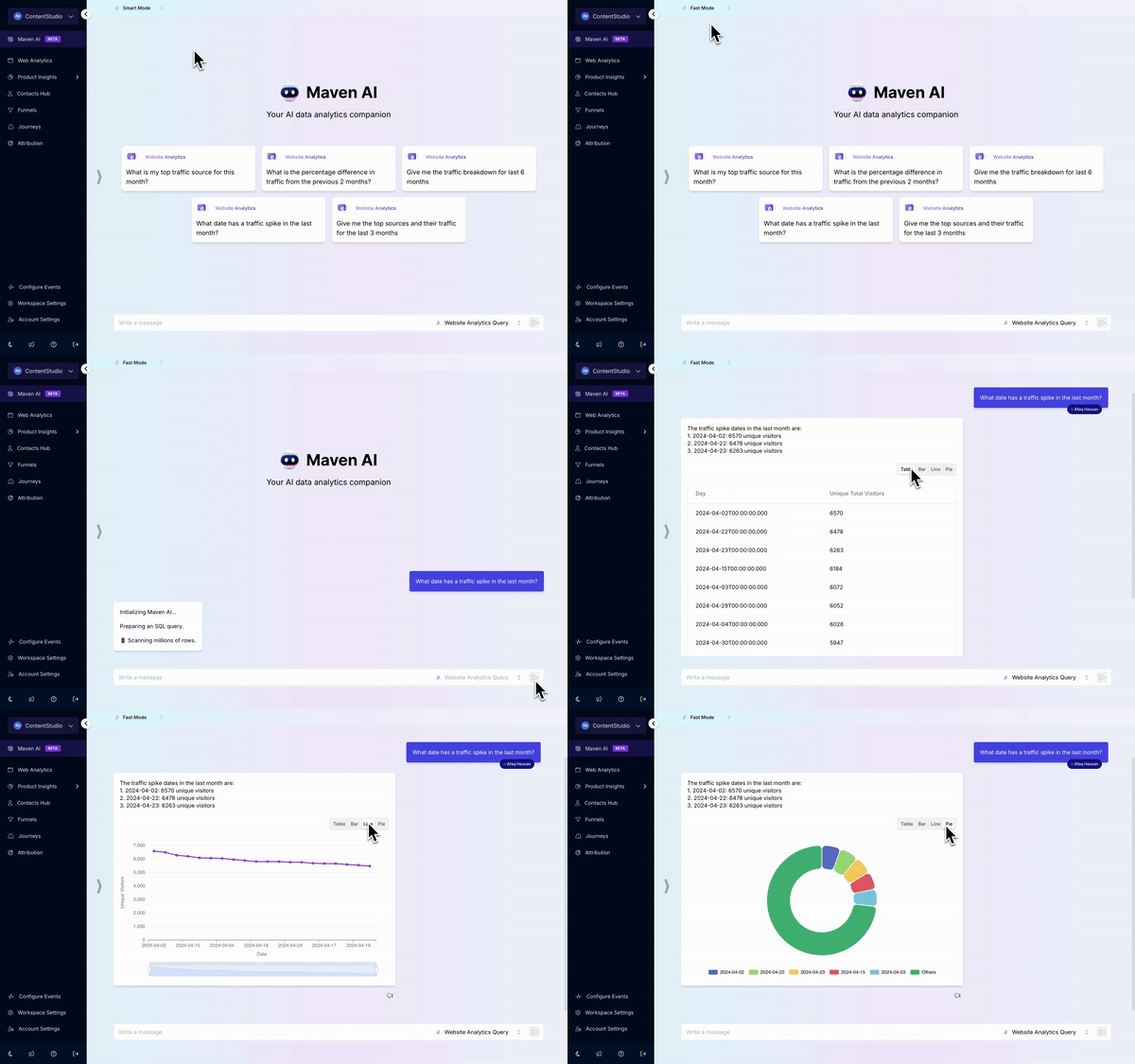
How Maven AI transforms web & product analytics
- Comprehensive data analysis
Maven AI processes vast amounts of data from various sources, providing a holistic view of user interactions and product usage. This comprehensive analysis helps teams understand user preferences, identify trends, and pinpoint areas for improvement.
- Real-time insights
One of the standout features of Maven AI is its ability to deliver insights in real time. This immediacy allows businesses to respond promptly to emerging trends, issues, or opportunities, ensuring they can adapt quickly to changing market conditions and user behaviors.
- Automated reporting
Maven AI automatically generates detailed analytics reports, highlighting key metrics, trends, and anomalies without manual intervention. This feature will save time and ensure teams can access up-to-date and accurate data.
Conclusion
In a world where data-driven decision-making is key to success, adopting AI-powered analytics isn’t just an option—it’s a necessity. Whether you’re looking to improve your website’s user experience, boost product engagement, or drive more conversions, Usermaven equips you with the tools to achieve new levels of efficiency and effectiveness. Experience the future of analytics with Usermaven, and lead your business to greater heights.
FAQs
1. What is AI in website and product analytics?
AI in website and product analytics refers to the use of artificial intelligence technologies to automatically collect, analyze, and interpret user data from websites and products. This enables businesses to gain insights into user behavior, optimize the user experience, and improve overall performance.
2. How does AI improve web analytics?
AI improves web analytics by automating data collection and analysis, enabling real-time insights, and providing more accurate predictions. AI can personalize user experiences, optimize SEO strategies, and even predict customer churn, helping businesses make data-driven decisions quickly.
3. What are the benefits of using AI in product analytics?
The benefits of using AI in product analytics include real-time data processing, improved accuracy in identifying trends and patterns, and the ability to provide personalized user experiences. AI also helps in reducing manual analysis efforts, which saves time and resources for businesses.
4. How can AI-driven attribution models enhance marketing strategies?
AI-driven attribution models enhance marketing strategies by accurately determining the impact of different channels and content on conversions. This allows marketers to allocate resources more effectively and optimize their campaigns based on data-driven insights.
5. What are the ethical considerations of using AI in analytics?
When using AI in analytics, it’s crucial to address ethical concerns such as data privacy, bias in AI models, and the transparency of AI-driven decisions. Businesses must ensure they comply with data protection regulations and work to mitigate biases in their AI systems to avoid misleading conclusions.
Updated

Written by
Adeel Khan
Growth Marketing Expert
Adeel Khan is a full-stack SaaS marketer with 10+ years of experience in content marketing, paid advertising, analytics, and conversion rate optimization. He shares practical insights and strategies drawn from hands-on experience, helping B2B SaaS marketers improve performance and make better marketing decisions.
All articles by Adeel →