Choosing the best attribution model for Google Ads is crucial for accurately understanding the impact of your campaigns. Attribution modeling helps you determine how credit for conversions should be distributed across the various touchpoints in a customer’s journey. Without the right model, you might miss out on valuable insights, such as which ads truly drive conversions or how different interactions work together to guide customers toward a final decision.
For Google Ads, attribution is more than just about tracking clicks; it’s about understanding the entire journey a customer takes before converting. With the right model, you can make data-driven decisions, optimize your ad spend, and improve the effectiveness of your campaigns. Let’s explore the best attribution model for Google Ads and how you can choose the one that aligns with your business goals.
Why attribution is crucial for Google Ads success
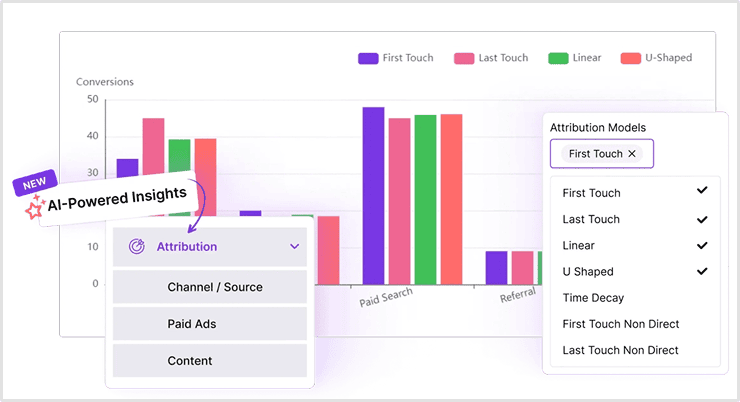
Attribution is an essential aspect of any digital marketing strategy, especially when it comes to Google Ads. It helps marketers identify which touchpoints are driving conversions and determine the effectiveness of their campaigns. Without clear attribution, it becomes nearly impossible to measure return on investment (ROI) and allocate budgets efficiently.
Measuring true ROI
Accurate attribution helps track each step of a customer’s journey and measure the actual contribution of Google Ads to conversions. This allows businesses to ensure that their advertising spend is generating real value.
Optimizing campaigns based on attribution data
Attribution data reveals actionable insights that can directly enhance the performance of Google Ads campaigns. By adjusting bids, refining keywords, or targeting new audiences, attribution guides decision-making for better results.
Enhancing budget allocation and resource planning
With attribution, marketers can allocate their budgets more effectively, focusing on the highest-performing ads and channels. This leads to better resource planning and overall campaign success.
Maximize your ROI
with accurate attribution
Attribution not only helps improve the performance of Google Ads campaigns, but it also empowers marketers to make smarter decisions that drive long-term success. By understanding and leveraging attribution, businesses can fine-tune their strategies and boost overall campaign efficiency.
Breaking down attribution models for Google Ads
When it comes to understanding customer behavior, not all clicks are created equal. Google Ads offers different attribution models to help you assign credit to the right interactions. Choosing the best attribution model for Google Ads shapes how you interpret your performance, allocate budgets, and refine your strategy.
Let’s explore each option in detail.
1. Last-click attribution
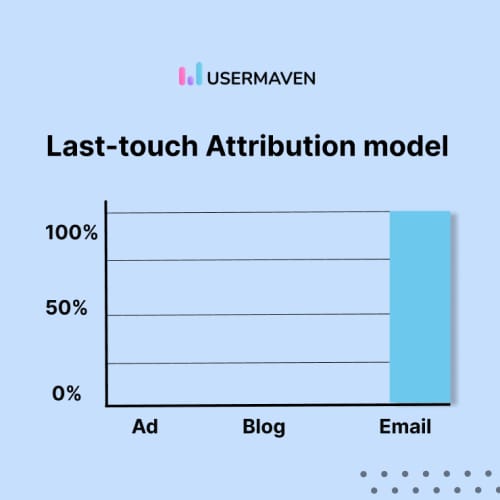
In the last-click attribution model, all the conversion credit goes to the final ad click before the customer converts.
It is straightforward and was the default setting in Google Ads for many years. However, it ignores all earlier touchpoints that may have influenced the decision. That’s why most Google Ads for SaaS experts now prefer data-driven or position-based attribution models
Ideal for: Impulse buys or one-click journeys
Limitation: Ignores discovery and nurturing steps in longer sales cycles
2. First-click attribution
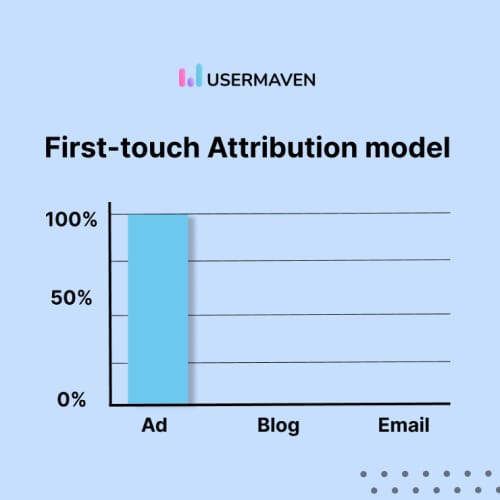
First-click attribution assigns 100 percent of the credit to the first ad interaction that introduced the user to your brand. It highlights which ads spark initial interest but overlooks the efforts that lead to the final conversion.
Ideal for: Awareness-driven campaigns
Limitation: Undervalues retargeting and closing stages
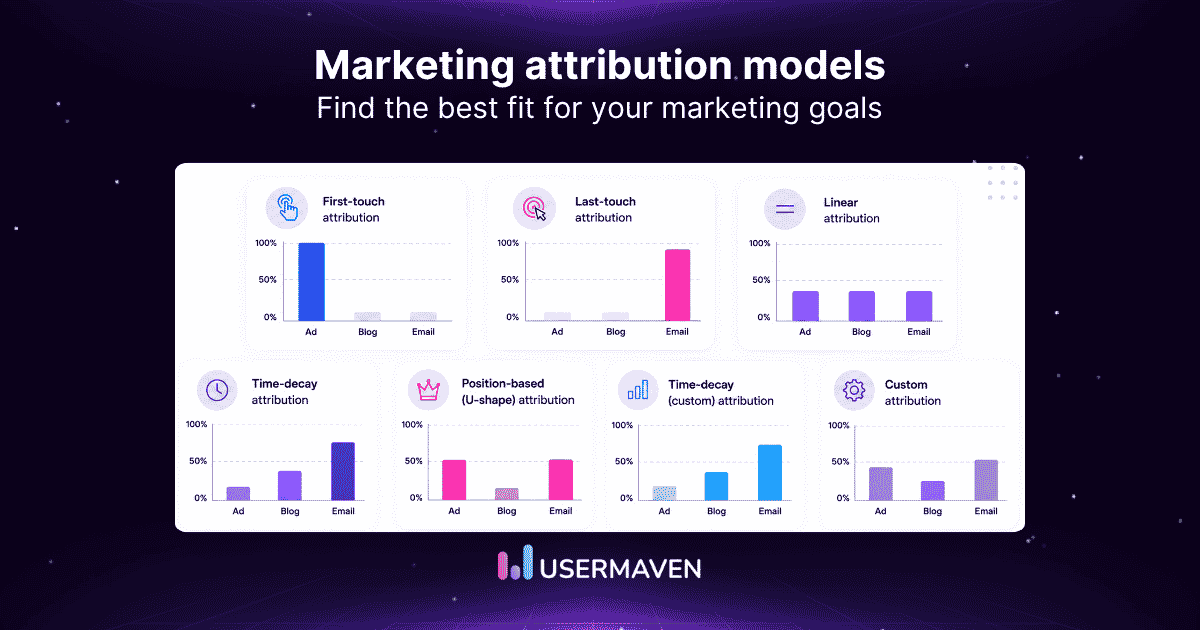
3. Linear attribution
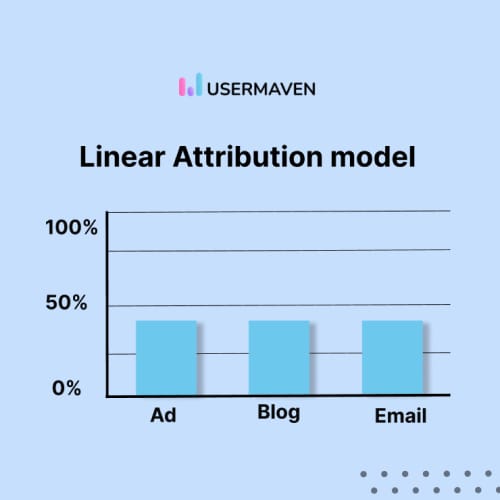
Linear attribution spreads the credit evenly across every touchpoint in the journey. It treats each interaction as equally important, providing a balanced perspective.
Ideal for: B2B, SaaS brands, and industries with longer decision-making processes
Limitation: Does not account for the varying influence of different touchpoints
4. Time decay attribution
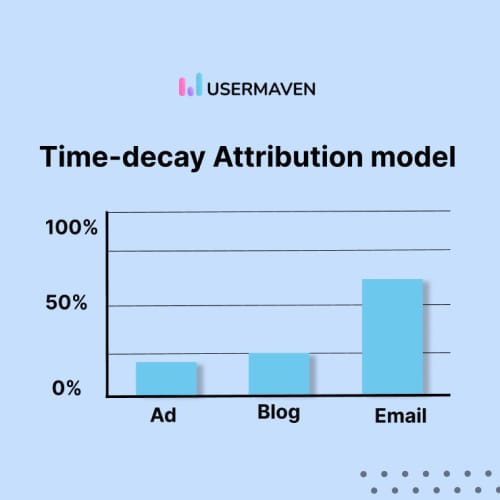
Time decay attribution gives more weight to interactions that occur closer to the conversion event. It assumes recent actions have a stronger impact on the final decision.
Ideal for: Flash sales, limited-time promotions, and fast-moving campaigns
Limitation: Can minimize the value of early-stage interactions
5. Position-based attribution
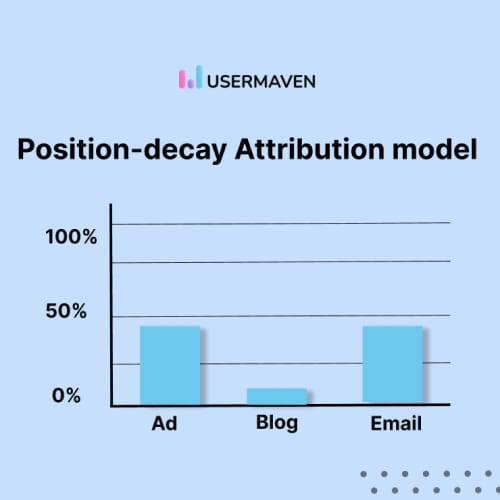
The position-based attribution model splits credit by giving 40 percent to the first interaction, 40 percent to the last, and distributing the remaining 20 percent across the middle steps. It acknowledges the importance of both introduction and closure in the customer journey.
Ideal for: Full-funnel strategies that focus on both acquisition and conversion
Limitation: Fixed credit split might not match every campaign’s dynamics
6. Data-driven attribution (DDA)
Data-driven attribution uses machine learning to analyze how different touchpoints contribute to conversions based on actual customer behavior. It builds a custom model rather than applying a preset rule.
Ideal for: Brands with large volumes of data and complex purchase paths
Limitation: Requires at least 3,000 ad clicks and 300 conversions in the last 30 days
Google Ads’ built-in attribution models
Google Ads provides two main attribution models: last-click attribution and data-driven attribution.
The last-click model gives all the credit for a conversion to the final ad interaction before the user takes action. While it’s easy to use and understand, it often ignores the earlier touchpoints that helped move the user closer to conversion.
The data-driven model takes a more advanced approach by distributing credit across multiple interactions. It uses Google’s machine learning to determine which touchpoints had the most impact based on the account’s own data.
These built-in models are helpful, but they aren’t without their drawbacks.
Limitations
Despite their usefulness, both models have important limitations.
- Last-click skews performance analysis. It undervalues top- and mid-funnel campaigns that contribute to awareness and interest but don’t get final-click credit.
- Data-driven attribution requires a high volume of conversions. Many small and mid-sized advertisers don’t meet the eligibility criteria, making it inaccessible for them.
- There’s limited customization and visibility. Google doesn’t offer much flexibility in how credit is assigned, and the black-box nature of its algorithms can make it hard to trust or validate the results.
If you’re aiming for more accurate insights and better campaign decisions, relying only on Google Ads’ built-in attribution can leave critical gaps in your analysis.
So, which is the best attribution model for Google Ads
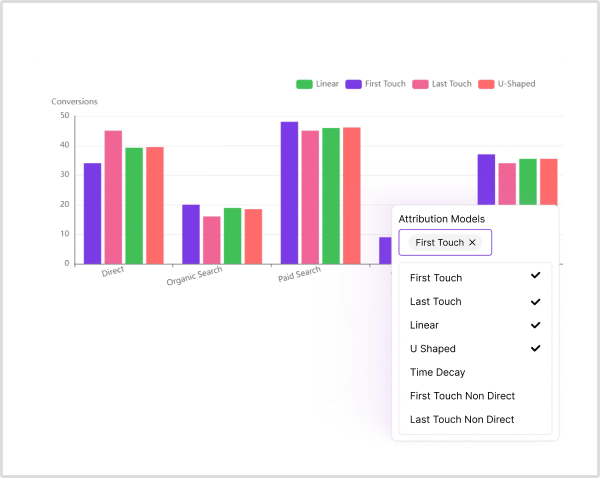
If you are expecting one clear winner, the truth is there is not one. The best attribution model for Google Ads depends entirely on your marketing goals, sales cycle, and the nature of your customer journey.
- If you are running quick-sale campaigns where the final click is critical, a last-click model might work best.
- If your focus is on building buyer awareness and nurturing leads over time, multi-touch models like linear, position-based, or data-driven attribution provide a clearer picture of the entire customer journey.
- If you are launching time-sensitive offers where the final moments matter most, a time decay model can help you capture the urgency more accurately.
Since customer paths are rarely simple, it is important to use a tool that gives you the flexibility to look at your performance from multiple viewpoints instead of sticking to a single model.
An ideal platform should allow you to
- Easily switch between single-touch and multi-touch attribution models
- Compare how different models impact your reported conversions
- Understand both top-of-funnel engagement and bottom-of-funnel actions
Maximize your ROI
with accurate attribution
Usermaven is built to offer this flexibility. It supports both single-touch models like first-click and last-click and multi-touch models like linear, position-based, and time decay. This way, you can align your attribution approach with your current strategy and adjust it as your business grows.
Usermaven paid ads attribution
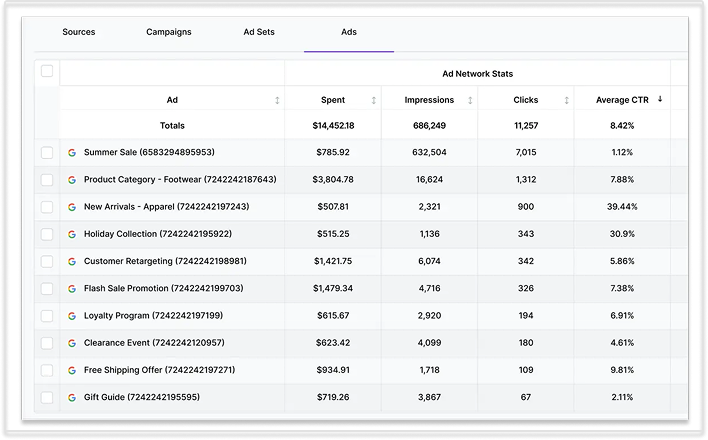
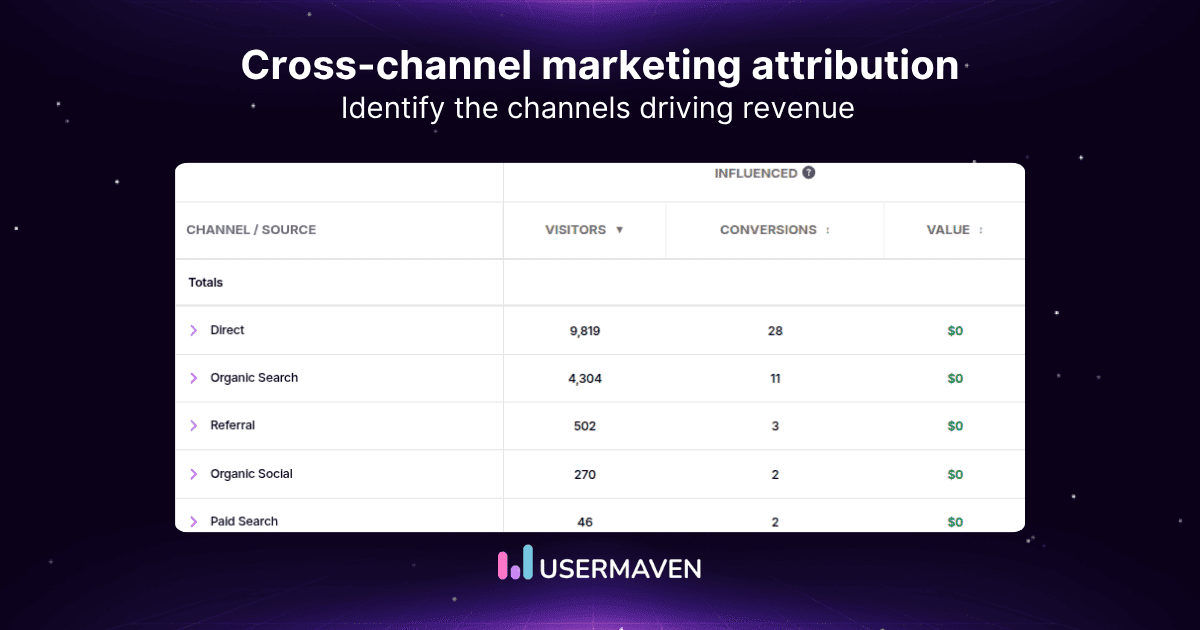
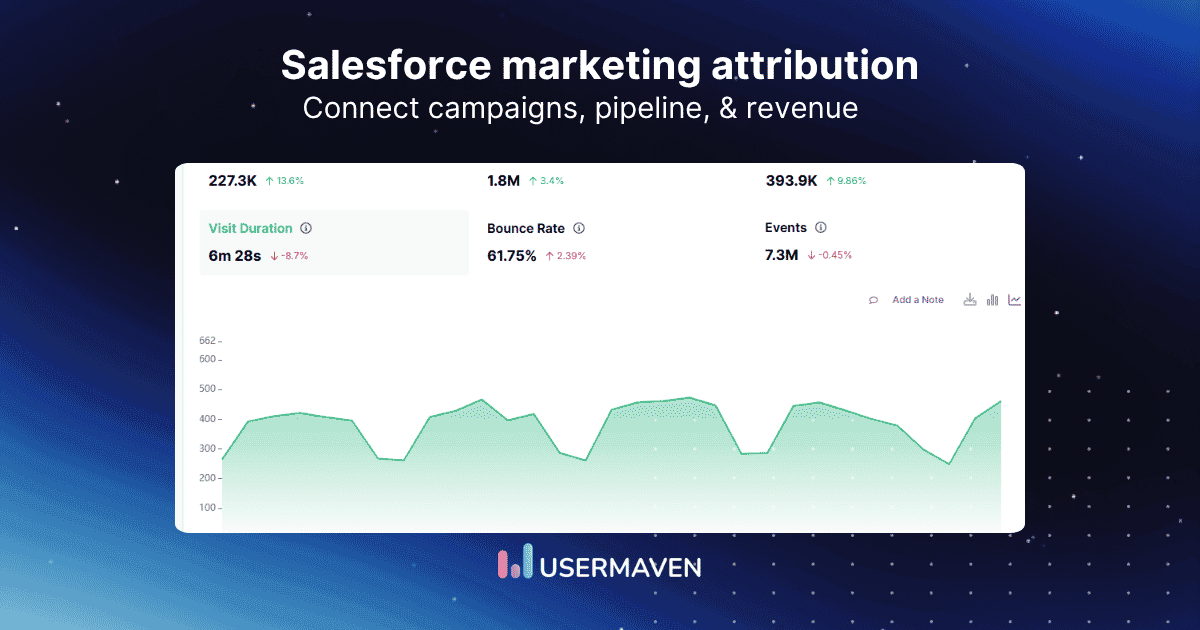
Usermaven offers a comprehensive attribution solution for paid advertising designed to provide accurate tracking and actionable insights across major ad platforms, including Google Ads, LinkedIn Ads, and Meta Ads. This unified view helps businesses measure campaign effectiveness in real-time, make data-driven decisions, and allocate budgets more efficiently.
A unified solution for multi-platform attribution
What sets Usermaven apart is its ability to merge ad network performance data with on-site conversion tracking. Rather than jumping between dashboards, you get a single, integrated view of how your paid campaigns are influencing customer behavior throughout the funnel.
Whether your strategy involves a single platform or multiple advertising channels, Usermaven enables you to track and optimize every stage of the customer journey, from the initial click to the final conversion.
Analyze performance at every level
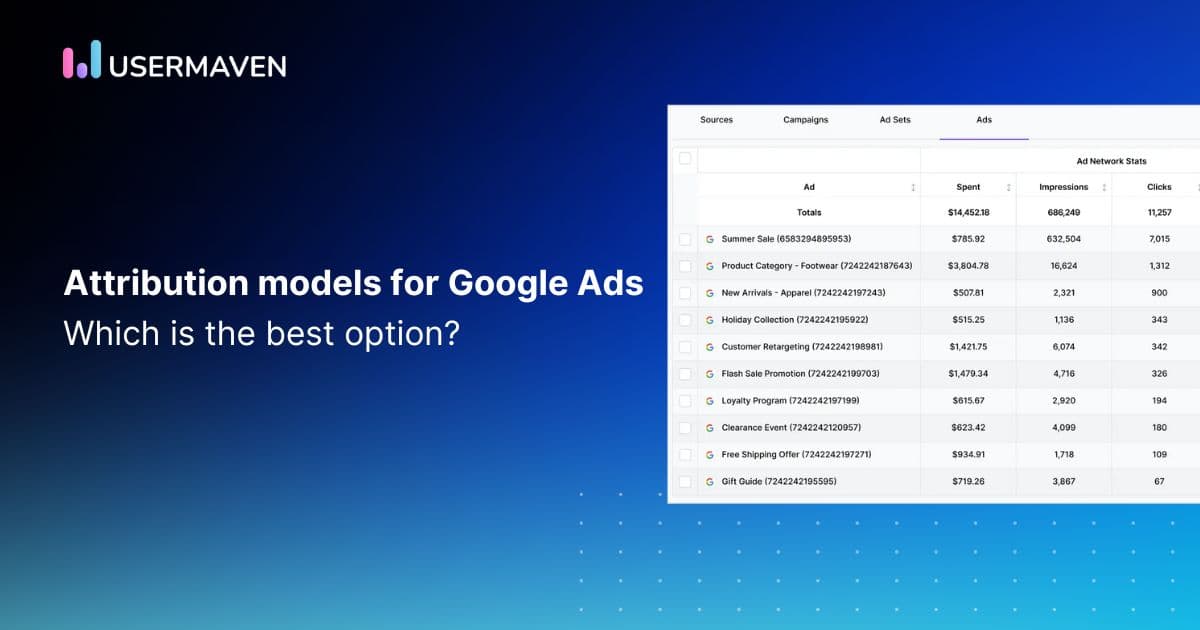
Usermaven’s paid ads attribution interface is organized to help you understand performance from high-level sources down to individual ads. You can view and analyze data across four key dimensions:
- Sources: Understand how each advertising platform contributes to overall conversions.
- Campaigns: Evaluate the effectiveness of your ad campaigns across different goals and audiences.
- Ad Sets: Gain insights into how your budget and targeting strategies are performing.
- Ads: Review the performance of each creative to identify what resonates best with your audience.
This breakdown helps you pinpoint which parts of your ad strategy are performing well and which need improvement.
Support for 7 attribution models
Usermaven provides seven attribution models, allowing you to analyze your campaigns based on the user journey that best aligns with your goals:
- First-touch – Assigns full credit to the first ad interaction.
- Last-touch – Credits the final touchpoint before conversion.
- Linear – Distributes equal credit to all touchpoints in the journey.
- Time decay – Gives more credit to interactions closer to the conversion.
- Position-based – Weighs the first and last interactions more heavily than the middle ones.
- First-touch non-direct – Excludes direct traffic and credits the first non-direct interaction.
- Last-touch non-direct – Ignores direct visits and attributes conversion to the last non-direct interaction.
These options give marketers the flexibility to view campaign performance from different perspectives, depending on how long the customer journey is and what role each touchpoint plays.
Flexible conversion settings
To ensure your attribution analysis aligns with your business logic, Usermaven allows you to customize:
- Conversion goals: Choose what counts as a conversion, such as signups, purchases, or demo bookings.
- Lookback window: Define how far back in time Usermaven should look for ad interactions (e.g., the last 60 days).
- Conversion period: Set the date range within which conversions should be counted (e.g., conversions that occurred in the last 30 days).
These filters ensure you’re always analyzing relevant data based on your current objectives.
A detailed, real-time report
Once everything is configured, the paid ads attribution view presents a real-time table showing both ad network metrics and conversion data. Key metrics include:
- Spent: The amount of money allocated to each source, campaign, ad set, or ad.
- Impressions: How many times an ad was shown to users.
- Clicks: Total number of times the ad was clicked.
- Click-through rate (CTR): The percentage of impressions that resulted in clicks.
- Visitors: Users who landed on your site from an ad.
- Conversions: Number of users who completed the defined conversion goal.
- Value: The monetary or assigned value of those conversions.
- Conversion rate: The percentage of visitors who converted.
- Cost per conversion: Ad spend divided by the number of conversions.
This structured reporting enables you to compare ad performance across all channels and make informed decisions to optimize your campaigns, allowing you to make the best decisions in a fast-paced digital environment.
Usermaven’s flexible and data-driven attribution model empowers businesses to track and optimize paid ad performance across multiple platforms, including Google Ads, LinkedIn Ads, and Meta Ads. With the ability to analyze both single-touch and multi-touch attribution, compare different platforms, and gain real-time insights, Usermaven helps you make smarter decisions and achieve better results from your ad spend.
Conclusion about the best attribution model for Google Ads
The right attribution model can transform your paid ad strategies by providing deeper insights into campaign performance. Whether it’s Google Ads, LinkedIn, or Meta, using a flexible and data-driven attribution tool like Usermaven helps you understand the full journey of your customers. With the ability to adjust models to your unique needs, you’re empowered to optimize your ad spend and achieve more impactful results.
Maximize your ROI
with accurate attribution
FAQs about the best attribution model for Google Ads
1. What is the importance of attribution in paid ads?
Attribution helps identify which touchpoints in the customer journey contribute most to conversions. It enables marketers to allocate budgets effectively, prioritize high-performing ads, and optimize campaigns for better ROI.
2. How does Usermaven’s attribution model differ from others?
Usermaven offers flexibility by providing both single-touch and multi-touch attribution models. This adaptability allows businesses to choose the best model for their strategy, ensuring accurate insights across different ad platforms.
3. Can I track multiple ad platforms with Usermaven?
Yes, Usermaven supports tracking for various ad platforms, including Google Ads, LinkedIn Ads, and Meta Ads. This gives you a comprehensive view of how your campaigns are performing across multiple channels.
4. How do I choose the right attribution model for my campaign?
The right model depends on your campaign goals. For quick conversions, last-click attribution might work, while multi-touch models like position-based or data-driven attribution are ideal for long-term campaigns and brand-building efforts.
5. What is the benefit of using data-driven attribution?
Data-driven attribution uses machine learning to assign credit based on actual customer behavior, offering more precise and customized insights. It adapts to your specific data, making it a powerful tool for businesses with complex buyer journeys.
Updated

Written by
Adeel Khan
Growth Marketing Expert
Adeel Khan is a full-stack SaaS marketer with 10+ years of experience in content marketing, paid advertising, analytics, and conversion rate optimization. He shares practical insights and strategies drawn from hands-on experience, helping B2B SaaS marketers improve performance and make better marketing decisions.
All articles by Adeel →