Marketers like to think of the buyer’s journey as linear: someone finds your website through Google, signs up for your newsletter, and buys your product.
Except, in real life, it looks more like this: a new subscriber opens your welcome email while commuting to work, gets distracted, and forgets about your offer. A few days later, they convert by clicking a retargeting Facebook ad.
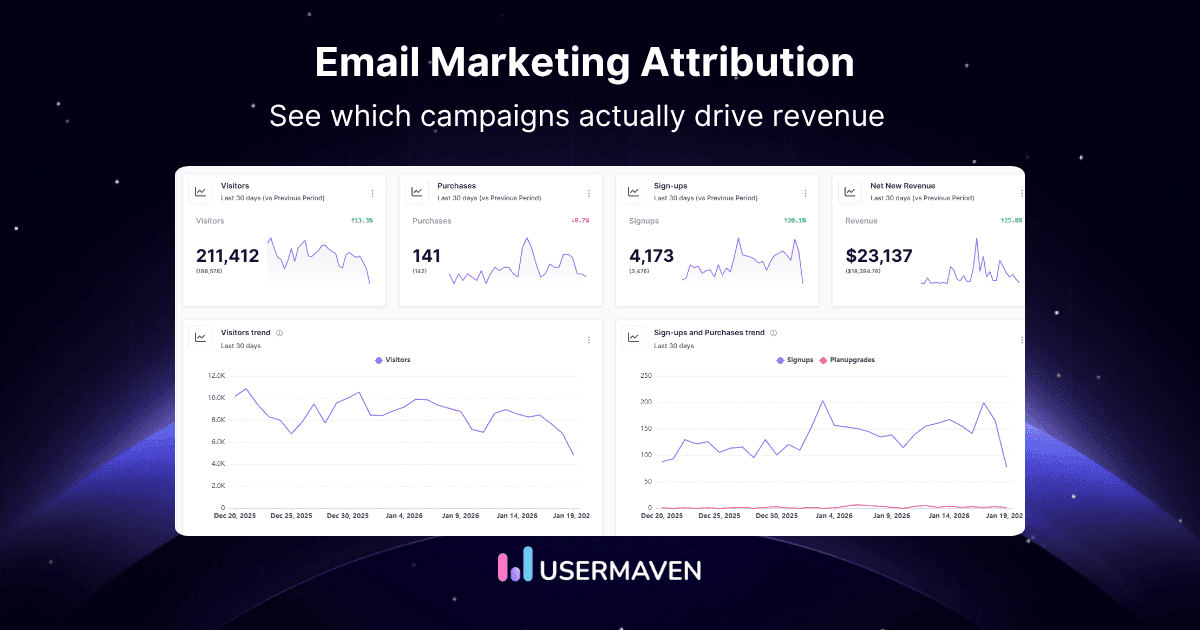
Which touchpoint gets the credit? Your welcome email’s contribution might get buried, even though it started the journey. Email marketing attribution helps you determine which campaigns actually drive sales and revenue.
There is no universal model that works for every business. This guide breaks down different attribution models, their limitations, and how to improve tracking for a clearer view of email’s real role in your strategy.
What is email marketing attribution?
Email marketing attribution is the process of assigning credit to email campaigns, sequences, or touchpoints that contribute to conversions, revenue, or customer actions.
The goal is not only to know whether someone clicked an email. It is to understand how that email influenced the full journey, both before and after the moment of conversion.
A welcome email that gets no credit in a last-click report might still be the reason a subscriber trusted the brand enough to convert weeks later through a completely different channel.
Why is email marketing attribution important?
Email attribution lets you understand how your campaigns affect conversions, even if they aren’t the last interaction before a purchase. Instead of isolating email, you can see how it backs up your entire marketing strategy across the customer journey attribution path.
Let’s return to our opening example. If you only track conversions through your email marketing solution’s reporting dashboard, it may look like your welcome email failed to deliver.
But when you track the customer journey across channels using proper attribution tracking, you’ll see that your campaign deserves at least part of the conversion credit.
With that insight in mind, you don’t risk undervaluing campaigns that do the heavy lifting behind the scenes.
Accurate revenue attribution data prevents you from making poor budget allocation decisions, such as cutting down on email marketing simply because you’re only considering last-click conversions.
Looking past standalone metrics helps you identify which email ideas drive engagement to other touchpoints like social media or search ads. Also, this process helps you deliver more relevant messages tailored to customer behavior across channels over time.
Common attribution models: How they work and where they fall short
Businesses use several marketing attribution models to evaluate their marketing efforts, with each highlighting a different part of the customer journey. The best option for you depends on the specific questions you’re looking to answer.
For example, some models credit the first touchpoint that introduces the customer to your brand, while others account for the last interaction. Meanwhile, multi-touch types distribute credit across channels, including email.
Depending on where you shift the focus, there are two broad categories: single-touch and multi-touch attribution.
Single-touch attribution
This attribution model assigns value to a single interaction, whether it’s the first or last touchpoint:
- First click attribution gives all conversion credit to the first channel that got customers familiarized with your business. Say they heard of your brand through an Instagram reel. Later, they visit your website, follow you on LinkedIn, and click an email CTA to download a report.
First-click attribution attributes the conversion to the reel, ignoring the email that sparked the final action. - Last click attribution assigns full credit to the interaction directly preceding the conversion. This model prioritizes the channel that finally convinces the customer to take action.
In the above example, the email campaign gets full credit for the conversion attribution since that’s where they clicked to download the resource.
Both models reveal what your customer did at the very beginning or at the very end. What they can’t convey, though, is the path that got them to convert, which is usually more complex in practice.
Multi-touch attribution
Multi-touch attribution acknowledges that various channels join forces to influence customer behavior in their own unique ways. It’s built on the reality that consumers don’t follow a linear, clean path toward conversion.
Here’s how you can understand complex customer journeys through different attribution models:
- Linear attribution distributes equal credit to every channel the customer used before converting. A welcome email, a case study email, and a retargeting ad all played a role before a purchase.
While it might not pinpoint exactly where to invest to get more leads or conversions, it shows how customers consistently engage with your brand. - Time-decay attribution values interactions based on how close they are to the time of conversion. If a subscriber received three nurture emails before finally converting, the final email closest to conversion would receive the most credit. Credit decays as you move backward away from the final interaction.
- Position-based attribution, also known as the U-shaped model, gives more weight to the first and last touchpoints, specifically 40% to each. A subscriber’s first newsletter and the final sales email that prompted the purchase would each receive that heavier 40% share.
The remaining 20% is split equally among the middle channels, assuming they impacted the conversion slightly less. - Custom attribution lets you measure the effectiveness of different touchpoints using your own rules. You decide on the percentage of credit based on your unique customer insights. For example, if your onboarding emails usually convince trial users to upgrade, you can build a model that gives those messages the most credit.
Email attribution vs email analytics
These two terms get used interchangeably, but they answer different questions and serve different decisions.
| Email analytics | Email attribution |
| Tracks opens, clicks, unsubscribes | Tracks contribution to conversions and revenue |
| Usually stays inside the email platform | Connects email with other channels |
| Measures campaign engagement | Measures business impact |
| Useful for email optimization | Useful for budget and revenue decisions |
Email analytics tells you whether a subject line worked. Email attribution tells you whether the campaign actually moved revenue, and how much of that revenue it deserves credit for alongside everything else in the customer journey.
Best practices for reliable email marketing attribution
Most of these models offer a hint on how email contributes to your digital marketing strategy. But choosing such a model isn’t enough to truly understand your email revenue attribution.
On top of that, 72% of marketers have trouble turning data into actionable insights. This means your team might find it difficult to handle and read into complex customer journeys that are common among B2B brands.
To overcome this, here’s how to streamline the process step-by-step and get more accurate insights.

Set clear goals
Before starting to compare reports, you first need to define what you want to achieve with your email campaign attribution. Do you want to evaluate list growth or repeat purchases?
Defining your goals is the first step to identifying the key performance indicators (KPIs) that best reflect them. For example, a SaaS company that needs to measure lead generation will prioritize trial sign-ups and demo bookings.
On the other hand, repeat purchase rates and expansion frequency show how effectively your emails are turning one-time buyers into loyal customers.
Matching the right KPIs to your unique objectives gives you the context needed to analyze data properly, rather than optimizing for metrics that seem irrelevant to your goals.
Use a solid multi-touch attribution tool
Your email platform’s reports are a great starting point for tracking campaign performance. They easily tell you how many people opened, clicked, or converted directly from an email.
However, they can’t always help you understand which channels weighed heaviest on a conversion.
Dedicated attribution tools complement your email marketing analytics by connecting all interactions into a single, cohesive customer journey.
To do that, choose a multi-touch attribution tool that offers a complete view of how emails and other channels contribute to conversions.
Here’s what to look for to make the most of multi-touch email attribution:
- A range of single-touch and multi-touch attribution types so you can experiment and determine what fits your business needs
- An easy setup and a clean interface so your team can start tracking campaign performance quickly without time-consuming onboarding
- Integrations with important tools in your marketing stack, such as your CRM and ad platform, to keep all customer interactions under one roof
- Flexible windows that can cover long sales cycles, which is essential for B2B marketing analytics where nurturing leads may take weeks or even months
- AI-powered insights that reveal behavioral patterns throughout the customer journey and multi-channel growth opportunities
- Real-time reporting features with ready-made, customizable dashboard templates that don’t require prior experience to set up
Don’t limit your analysis to opens and clicks
Opens and clicks are engagement signals, not revenue proof.
Thanks to Apple’s Mail Privacy Protection (MPP), users have more control over the data shared with email senders. Since Apple preloads email content by default, you can’t know if a real subscriber was responsible for opening.
The same goes for click-through rates in the era of AI inbox summaries. Subscribers may read about your offers there and head to your site without clicking the links inside.
Monitoring these metrics alone causes marketers to underestimate their email efforts. Instead, multi-touch reports help you track cross-channel behavior.
For example, your reports might reveal that a case study email made a subscriber stop and read. But instead of clicking on your CTA, they look you up on Google and book a meeting with your sales team through live chat.
You shouldn’t obsess over short-term outcomes either. What subscribers do in the long-term matters. So, look for signals of repeat engagement like regular blog reads or increased product adoption to prove your emails keep your brand top of mind until people are ready to commit.
Keep track of changes and adjust
Effective email conversion tracking is more of a work-in-progress than a set-it-and-forget-it strategy. The more multi-channel data you collect, the easier it gets to optimize your model.
In addition to the insights gathered through your analytics, make sure you stay on top of broader shifts in data privacy laws and consumer behavior. Consider channel-specific changes, such as limitations imposed by inbox spam filtering algorithms.
If you don’t factor in these updates, you might keep emailing people using tactics that lead to poor engagement. It’s also important to keep a close eye on email health KPIs, such as bounce rates, unsubscribes, and spam complaints.
They can reveal deliverability issues that limit your campaign’s reach and can hurt your revenue down the line.
Finally, remember there’s no better compass than your audience’s thoughts. Use regular email surveys to ask subscribers directly how they discovered your brand, what they like, and what’s missing.
These insights complement your attribution data and help you identify what works.
Unlock insights that drive growth
How to choose the right email attribution window
Attribution windows define the time frame during which an email campaign can receive credit for a conversion. Although there’s no magic number, you’ll want your window to be extended enough to capture the lifecycle of your email interactions.

Many email platforms default to a much shorter window than you might expect. Klaviyo and Mailchimp, for example, commonly use a 5-day default attribution window, which can quietly undercount email’s real contribution the moment a customer takes more than a few days to act.
- 1 to 7 days: short ecommerce promotions and flash sales, where the buying decision happens fast
- 14 to 30 days: nurture campaigns, where a subscriber needs several touches before deciding
- 30 to 90 days: B2B and SaaS sales cycles, where the consideration stage stretches across weeks or months
- Longer windows: onboarding, retention, and expansion campaigns, where the goal is influence over months, not an immediate click
For products where the consideration stage takes longer, such as in B2B funnels, it’s better to use a wider window, such as 30 or 60 days. The key is adjusting attribution windows to align with your typical sales cycle rather than accepting whatever your email platform defaults to.
Email is more than a checkout point
Email marketing isn’t a channel that just directs people to checkout. Its real power lies in long-term connections.
Your reporting dashboard might show low conversion attribution numbers for your newsletters. This doesn’t mean that subscribers aren’t paying attention. Someone might now ignore your birthday discount but remember the personalized approach that made them feel unique.
As you keep providing value without asking for an immediate sale, you build trust that may transform into customer retention loyalty within a few months time.
Implementing proper email attribution bridges the gap between real-time engagement and long-term business impact.
It helps you switch from a single-channel logic to a multi-channel journey map, one grounded in revenue analytics rather than isolated open and click rates.
By doing so, you can reach email’s full potential and allocate your email marketing budget to the tactics that boost customer lifetime value.
How Usermaven helps with email marketing attribution
Usermaven is marketing attribution software that helps teams see how email campaigns contribute to the wider customer journey, from website visits and campaign engagement to conversions, product activity, and revenue.
Usermaven does not replace your email marketing platform. It helps you understand how email works with your other channels to drive signups, demos, purchases, revenue, and retention.
For email specifically, Usermaven connects the touchpoints your email platform tracks in isolation, opens, clicks, and conversions, to what happens across every other channel a subscriber touches before converting.
Usermaven’s website analytics feature captures the sessions and conversions that follow an email click, even when a subscriber doesn’t convert right away. The marketing attribution software layer applies the same multi-touch models to email that it applies to paid search, social, and organic, so a welcome sequence or nurture campaign is measured on equal footing with every other channel.
Extended attribution windows, covered earlier in this guide, are simple to configure inside Usermaven, matching the pace of a 30- to 60-day B2B buying cycle rather than defaulting to the 5-day window most email platforms ship with. User journeys show exactly where an email sits relative to every other touchpoint in that longer path, and Maven AI can answer plain language questions about which sequences are actually driving revenue.
See Usermaven in action
Book a free demo and discover how powerful analytics can grow your business.
Conclusion
Email marketing attribution is not about proving email drove the sale alone. It is about seeing where email fits inside a much longer, cross-channel journey, and giving it credit for the influence it actually has.
The models, the attribution windows, and the tracking practices in this guide exist to make that influence visible, rather than letting it get buried in a last-click report.
Ready to see Usermaven in action? Explore the platform or book a demo for a closer look.
FAQs
1. How do UTM parameters fit into email attribution tracking?
UTM parameters are short tags added to the end of your links, telling your analytics tools where a visitor came from. They don’t track the entire customer journey on their own, but they do help attribution platforms identify the campaign that brought someone to your site. Using the same UTM labels every time, such as utm_medium=email and utm_source=newsletter allows your attribution tool to assign credit accurately.
2. How does the phase-out of third-party cookies affect email attribution?
Web browsers are constantly blocking cookies that follow people around and track their online behavior. While this has disrupted traditional advertising, the same doesn’t apply to email. Subscribers willingly give you their email address, and this acts like a unique name tag. Attribution tools use first-party data to connect a person’s actions across your site and campaigns without relying on invasive web cookies.
3. Should you use the same tracking window for all automated email sequences?
No, it depends on the trigger and the campaign goal. Some emails, like subscription renewal reminders, usually require immediate action. So, a 7-day tracking window or even shorter works best to measure their impact. But an automated onboarding series is designed to encourage product adoption over time, meaning it needs a wider window, 30 to 60 days, to prove its true value.
4. Does HubSpot track email revenue attribution?
HubSpot’s Marketing Hub includes native revenue attribution reporting for contacts and companies already inside its CRM, tying email opens and clicks to closed deal value. This works well for teams fully committed to the HubSpot ecosystem, though it offers less flexibility for multi-touch modeling across channels outside HubSpot compared to a dedicated attribution platform.
Updated

Written by
Ryan Mitchell
Marketing Analytics Strategist
Ryan Mitchell is a marketing analytics strategist specializing in campaign measurement, customer journeys, and marketing performance. He writes about analytics, reporting, and data-driven marketing strategies, helping SaaS and B2B teams measure what matters across every stage of the customer journey.
All articles by Ryan →