A brand runs an influencer campaign and measures 200 promo code redemptions. But 1,400 people visited the site after the campaign, searched the brand on Google, and converted without the code. The influencer drove 1,600 conversions. The brand measured 200 and cut the budget.
This is the influencer attribution problem. Most brands are systematically undercounting creator ROI because they measure only what the promo code captures.
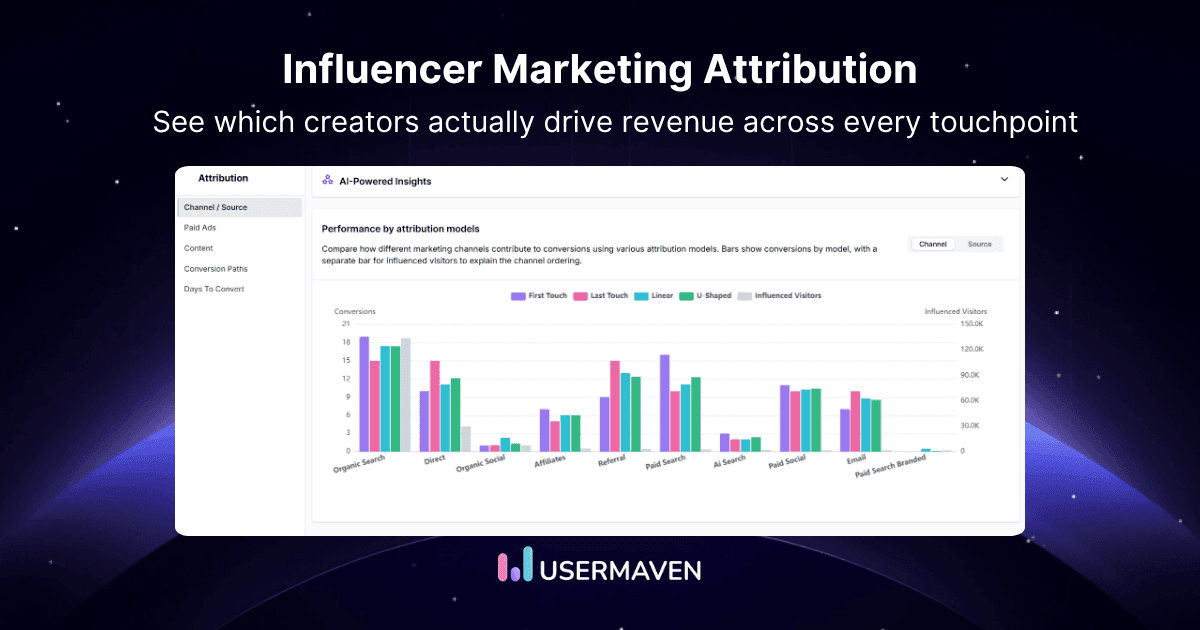
Influencer marketing attribution connects influencer content to measurable business outcomes across the full customer journey. This guide covers the definition, the six attribution models, how to measure ROI accurately, and the most common mistakes.
For a foundation on the broader discipline, see the complete marketing attribution guide first.
Key takeaways
- Influencer marketing attribution is the practice of connecting influencer content to measurable business outcomes across the full customer journey, not just the direct conversions a promo code captures
- Promo codes and affiliate links only measure last-click direct conversions. They miss every customer who saw the content, searched the brand later, and converted through a different channel
- The six main attribution models for influencer campaigns are last-click, first-click, linear, time-decay, multi-touch, and data-driven. Each produces a different picture of influencer ROI
- Measuring influencer attribution accurately requires UTM parameters, first-party tracking, and an independent attribution layer above platform-reported numbers
- Usermaven connects influencer touchpoints to the full customer journey using first-party and server-side tracking, giving brands a complete view of what influencer content actually drove.
What is influencer marketing attribution?

Influencer marketing attribution is the systematic process of identifying which influencer content, partnerships, and touchpoints contributed to a conversion, a sale, or a business outcome, and assigning credit accordingly across the full customer journey.
It goes beyond counting promo code uses or affiliate link clicks. A customer might see an influencer post, visit the brand website three days later, see a retargeting ad, and convert on a direct visit a week after that. Attribution connects all those touchpoints to the original influencer exposure.
Influencer content is awareness-first. It creates demand that converts through other channels rather than through a direct click. This makes influencer attribution structurally harder than paid search attribution, where intent and conversion are closely linked in time.
Influencer marketing attribution is one application of the broader performance analytics and marketing attribution framework applied specifically to creator and partnership channels.
What influencer marketing attribution is not
It is not promo code counting. A promo code measures who used the code. It does not measure who saw the content, searched the brand, and converted through another channel. Promo codes capture a fraction of the actual conversion impact for awareness-led campaigns.
It is not a last-click attribution platform reporting. Platform analytics assign credit to the last touchpoint before conversion. An influencer post that initiated the customer journey gets zero credit if a paid search ad or direct visit closed the sale.
It is not vanity metrics. Views, likes, and reach measure exposure. Multi-touch attribution measures what that exposure drove in revenue. The two are related but not interchangeable.
Why influencer marketing attribution is harder than it looks
The structural problems with influencer attribution run deeper than most brands realise. Four specific challenges make accurate measurement difficult even for teams with strong analytics setups.
1. The cross-channel conversion problem
Influencer content creates awareness. The purchase happens somewhere else, often days or weeks later, through organic search, direct visit, or email. Standard attribution tools assign zero credit to the influencer and full credit to the closing channel.
This is the same attribution gap that affects paid social broadly. The ad platform discrepancies guide documents how platforms claim credit for conversions they did not initiate, and influencer platforms make the same error in the opposite direction by failing to claim credit for conversions they did initiate.
2. The cookie and privacy problem
iOS privacy changes and ad blockers mean that even when an influencer drives a direct click, the tracking pixel may not fire. Platform-reported influencer attribution is increasingly incomplete as a result.
Cookieless tracking approaches using first-party and server-side data collection are now the minimum requirement for accurate influencer attribution. See the guide to Facebook ads attribution for a specific example of how Meta’s pixel-based attribution underperforms in privacy-restricted browser environments.
3. The attribution window problem
The standard attribution window for most platforms is 7 to 30 days. Influencer content for considered purchases, higher-ticket products, or B2B decisions can have influence cycles that last 60 to 90 days. A narrow window misses the long tail of influencer impact entirely.
4. The multi-creator problem
When a brand works with multiple influencers simultaneously, every standard attribution model assigns credit to whichever creator a customer happened to interact with last. It cannot identify which creator initiated the journey or which combination of creators produced the conversion.
According to Influencer Marketing Hub research on influencer ROI measurement, attribution is consistently ranked as the top measurement challenge for influencer marketers, with 43% of brands reporting they cannot accurately connect influencer spend to revenue outcomes.
Nielsen research on creator content and brand impact shows that creator content drives significant brand recall and purchase intent lift that occurs outside the direct-click attribution window, validating the case for extended and multi-touch measurement approaches.
Influencer marketing attribution models (and when to use each)
Choosing the right influencer marketing attribution models depends on the campaign goal, the sales cycle length, and the data volume available. Each model produces a different picture of influencer ROI, and understanding what each one values and ignores is essential before committing to a measurement approach.
Last-click attribution
Last-click attribution assigns 100% of credit to the final touchpoint before conversion. Simple to implement and easy to report. The problem is that it systematically undervalues influencer content, which almost never closes a sale directly.
Best used only for direct-response influencer campaigns with affiliate links where immediate conversion is the explicit goal and the influencer audience has strong existing purchase intent.
First-click attribution
First-click attribution assigns 100% of credit to the first touchpoint in the customer journey. It values awareness and discovery, which makes it more favourable to influencer content than last-click. The problem is that it ignores everything that happened between discovery and conversion.
Useful for understanding which influencers consistently initiate new customer journeys. Less useful as a standalone model for full ROI measurement because it overvalues initiation and ignores nurturing and closing channels.

Linear attribution
The linear attribution model distributes credit equally across every touchpoint in the customer journey. If a customer saw an influencer post, clicked a Google ad, and converted via email, each touchpoint receives one third of the credit.
More balanced than single-touch models. Useful for brands that want to value every channel contribution without complex modelling. The limitation is that it treats every touchpoint as equally important regardless of its actual role in the purchase decision.
Time-decay attribution
The time-decay attribution model assigns more credit to touchpoints closer to the conversion event and less to earlier ones. Influencer content that initiated the journey weeks before conversion gets a smaller credit share than the channel that closed the sale.
Useful for short sales cycle products where recency genuinely indicates influence. Less useful for considered purchases where influencer content creates awareness long before the conversion decision is made.
Multi-touch attribution for influencer marketing
Multi-touch attribution for influencer marketing distributes credit across all touchpoints using a defined weighting model, typically giving higher weight to first touch, last touch, and key mid-funnel interactions. This is the most complete standard model for influencer campaigns because it values both the awareness the influencer created and the channel that closed the sale.
Position-based multi-touch, also called the U-shaped attribution model, gives 40% to first touch, 40% to last touch, and distributes the remaining 20% across middle touchpoints. This makes it well-suited for influencer campaigns where the creator creates initial awareness and a paid channel collects the conversion.
The limitation of multi-touch models is that the credit weightings are defined by rules rather than actual data. They represent a reasoned assumption about which touchpoints matter most, not a direct measurement of what actually drove the conversion.
Data-driven attribution
Data-driven attribution uses machine learning to assign credit based on actual contribution patterns in the data rather than predefined rules. It identifies which touchpoint combinations correlate with conversion and which ones do not, then weights each touchpoint accordingly.
The most accurate model is when enough data exists. The limitation is that it requires sufficient conversion volume to be statistically reliable, typically several hundred conversions per time period minimum.
How to measure influencer marketing attribution step by step
Understanding how to measure influencer marketing attribution accurately starts with recognising that the measurement infrastructure must be in place before the campaign launches. Retroactive attribution is possible but significantly less accurate than attribution built into the campaign from the start.
Step 1: Define the conversion event before the campaign launches
Purchase, sign-up, trial start, and demo request are all valid conversion goals. Each requires a different measurement setup. Campaigns launched without a defined conversion event cannot be attributed retrospectively with accuracy.
Step 2: Tag every influencer link with UTM parameters
Each creator, each piece of content, and each platform needs a unique UTM combination so traffic from different influencers can be separated in analytics. Consistent UTM parameters are the foundation of accurate influencer attribution. Without them, influencer traffic appears as direct or organic and cannot be identified, let alone attributed.

Step 3: Extend the attribution window beyond the platform default
Most platforms default to 7 or 30 days. For influencer content, set the window to at least 60 days and 90 days for higher-consideration products. The standard attribution window influencer marketing teams use by default misses a significant portion of conversions that occur after the initial viewing window closes, particularly for audiences that need extended consideration time before purchasing.
Step 4: Implement first-party tracking that captures conversions that platform pixels miss
Ad blockers and iOS privacy settings prevent platform pixels from firing on a growing share of conversions. Server-side tracking sends event data directly from the server to the analytics platform, bypassing client-side restrictions. The ad tracking guide explains how this infrastructure works across paid channels and why it applies equally to influencer campaign tracking.
Combined with first-party data collection, server-side tracking gives near-complete conversion coverage across all browsers and devices.
Step 5: Compare platform-reported numbers against independent attribution
The gap between what an influencer platform reports and what independent first-party tracking measures is where the real ROI picture emerges. Brands that rely only on platform-reported metrics systematically undercount influencer impact because platform analytics cannot track what happens after a user leaves the platform.
Step 6: Use cohort analysis to measure downstream impact
Track what happens to customers acquired through influencer campaigns over 90 days: repeat purchase rate, average order value, and lifetime value. Set up conversion tracking goal events that track the full post-conversion journey, not just the initial purchase.
Influencer-acquired customers often have different retention profiles from paid search customers, and this downstream value is completely invisible in last-click attribution. A campaign that looks modest by last-click ROAS may produce the most valuable long-term customers in the cohort.
Unlock insights that drive growth
Common influencer attribution mistakes that undercount ROI
Most influencer attribution problems are not technology problems. They are setup and process problems that produce results which look accurate but capture only a fraction of the actual campaign impact.
1. Relying on promo codes as the sole attribution method
Promo codes capture direct-response conversions from customers who used the code at checkout. They miss every customer who saw the content, was influenced by it, searched the brand organically, and converted without using the code.
Organic search traffic consistently increases during and after influencer campaigns, and that lift appears nowhere in promo code reports. The cross-platform ad tracking guide explains how to reconcile organic, direct, and paid conversion data to identify the share driven by influencer campaign activity.
2. Using platform native analytics as the source of truth
Instagram Insights, TikTok Analytics, and YouTube Studio all report reach, views, and engagement. None of them can track what happened after someone left the platform. Treating these as attribution data mistakes the audience metrics for conversion data.

3. Applying too short an attribution window
Fashion and beauty purchases might convert within 7 days. B2B software purchases, travel bookings, and higher-ticket consumer purchases convert over 30 to 90-day cycles. A 7-day default window measures only the immediate responders and misses the majority of influenced conversions for considered categories.
4. Not separating brand lift from direct conversion
Influencer campaigns drive both measurable direct conversions and unmeasured brand awareness that affects future conversion rates across all channels. Measuring only direct conversion attributes a fraction of the value. Measuring both requires a combination of first-party attribution and controlled brand lift measurement.
5. Not tracking incrementality
The most sophisticated measurement question is not how many conversions the influencer drove, but how many conversions would not have happened without the influencer. Incrementality testing controls for this by comparing exposed versus unexposed audiences over the same period.
The marketing attribution models guide covers how different models handle incrementality and which approaches are most appropriate for different campaign types and budget scales.
How Usermaven tracks influencer marketing attribution
Usermaven is an AI-powered marketing attribution platform that connects ad platforms, CRM, and website data to track the full customer journey in real time using first-party and server-side tracking.
For influencer marketing specifically, Usermaven solves the core measurement problem that makes most influencer attribution incomplete: the disconnection between the awareness an influencer creates and the conversion that happens through a different channel days or weeks later.

Beyond promo codes and last-click reporting
Usermaven’s marketing attribution software captures every session that arrives from an influencer UTM tag, including sessions where the platform pixel would have been blocked by an ad blocker or an iOS privacy setting. This closes the gap between what a promo code measures and what the influencer campaign actually drove.
When a customer sees an influencer post, visits the site, leaves, searches the brand on Google, and converts three weeks later, Usermaven connects all those touchpoints into one customer journey. The influencer exposure gets the credit it earned rather than zero because a paid search ad happened to close the sale.
Seven attribution models applied simultaneously
The digital attribution software layer applies all seven attribution models to influencer campaign data simultaneously. Brands can compare how the same campaign looks under last-click, first-click, linear, time-decay, position-based, data-driven, and custom rules attribution without rebuilding reports for each model.
This removes the attribution model selection problem. Rather than committing to one model and hoping it is right, teams can see which model produces the most useful strategic insight for their specific campaign type and sales cycle.
Maven AI for influencer decisions
Maven AI answers influencer performance questions in plain language without SQL or analyst dependency. Which influencer drove the highest-value customers last quarter? Which creator’s audience has the shortest time to conversion? Which campaign produced the highest repeat purchase rate 90 days after the initial conversion?
The answers come directly from the first-party attribution data Usermaven collects independently of what any platform or influencer tool reports.
No-code setup for influencer campaigns
Usermaven connects to influencer campaigns without developer dependency. Paste the tracking script, add UTM parameters to creator links, and the attribution data starts flowing immediately.
Campaign changes, new creator partnerships, and updated conversion goals can all be configured inside the dashboard without touching code. Influencer and partnership teams own their measurement setup from day one without waiting on engineering.
Unlock insights that drive growth
Conclusion
Influencer marketing attribution is not a reporting exercise. It is the measurement system that connects the awareness influencer content creates to the revenue it actually drives across every channel and every touchpoint in the customer journey.
The six attribution models, the six-step measurement process, and the common mistakes in this guide are the foundation. But the foundation only produces accurate results when the data feeding it is first-party, complete, and independent of what any platform or influencer tool reports.
Usermaven’s guided analytics setup connects your influencer campaign UTMs, ad platforms, and website data into one attribution layer in minutes.
Ready to see Usermaven in action? Explore the platform or book a demo for a closer look.
FAQs
1. What is influencer marketing attribution?
Influencer marketing attribution is the systematic practice of identifying which influencer content, partnerships, and touchpoints contributed to a conversion or sale, and assigning credit across the full customer journey. It goes beyond promo code redemptions to connect influencer-driven awareness to the downstream conversions that happen through organic search, direct visits, and other channels days or weeks after the original exposure.
2. What are the main influencer marketing attribution models?
The six main attribution models for influencer marketing are last-click (100% credit to the final touchpoint), first-click (100% credit to the first touchpoint), linear (equal credit across all touchpoints), time-decay (more credit to touchpoints closer to conversion), multi-touch (weighted credit across all touchpoints), and data-driven (machine-learning-assigned credit based on actual contribution patterns).
Multi-touch and data-driven models produce the most complete picture for influencer campaigns. Last-click and first-click models each capture only one end of the journey and systematically misrepresent the contribution of mid-funnel influencer touchpoints.
3. How do you measure influencer marketing attribution accurately?
Accurate measurement requires five components working together: UTM parameters on every influencer link, an extended attribution window of at least 60 days, first-party server-side tracking to capture conversions that platform pixels miss, an independent attribution layer above platform-reported numbers, and cohort analysis to measure the downstream lifetime value of influencer-acquired customers.
The most common error is measuring only what the promo code captures and treating that as the full campaign result. Independent first-party tracking consistently reveals significantly more influencer-attributed conversions than promo code data alone.
4. Why do promo codes undercount influencer ROI?
Promo codes only capture customers who used the code at checkout. They miss every customer who saw the influencer content, was influenced by it, and then searched the brand name organically, clicked a retargeting ad, or visited the site directly before converting. These indirect conversions are typically the majority of the total influencer impact for awareness-led campaigns.Organic search volume for brand terms consistently increases during and after influencer campaigns. None of that lift appears in promo code attribution reports, which means brands making budget decisions based on promo code data are systematically undervaluing their influencer investment.
Updated

Written by
Junaid Ahmed
Content Writer & Digital Marketer
Junaid Ahmed is a content and copywriter with 3+ years of experience creating research-driven content across SaaS, B2B, ecommerce, and digital marketing. He specializes in turning complex topics into clear, practical content that helps marketers better understand their challenges, evaluate solutions, and make informed decisions. His work spans educational content, industry insights, and actionable marketing guides.
All articles by Junaid →