For years, third-party cookies helped marketers track users across websites, personalize advertising, and measure campaign performance. Today, that approach is rapidly changing.
Privacy regulations, browser restrictions, and growing consumer expectations have transformed how businesses collect and use customer data. This industry-wide shift is often called the cookie apocalypse, the gradual decline of third-party cookies and the move toward privacy-first marketing.
While these changes have created challenges for advertisers and marketers, they also present an opportunity to build more reliable measurement strategies based on first-party data and modern attribution.
In this guide, you’ll learn what the cookie apocalypse is, why it happened, how it affects digital marketing and marketing attribution, and what your business can do to prepare for a cookieless future.
Key takeaways
The cookie apocalypse is changing digital marketing, not ending it. As third-party cookies become less reliable, businesses are adopting privacy-friendly ways to measure customer behavior and campaign performance.
Third-party cookies are no longer the foundation of marketing measurement. First-party data, server-side tracking, and identity resolution are becoming the preferred alternatives for understanding customer journeys.
Marketing attribution is evolving rather than disappearing. Modern attribution platforms connect marketing, product, CRM, and revenue data to provide a more complete view of conversions without depending on third-party cookies.
Businesses that prepare early will have a competitive advantage. Investing in privacy-first analytics today helps improve data quality, customer trust, and long-term marketing performance.
The future belongs to businesses that own their customer data. Building a strong first-party data strategy reduces dependence on browser changes while creating more reliable insights for growth.
What is the cookie apocalypse?
The cookie apocalypse describes the ongoing shift away from using third-party cookies to track users across websites. As browsers and regulators continue limiting cross-site tracking, marketers must find new ways to understand user behavior while respecting user privacy.
The term became popular when major browsers began announcing plans to block or restrict third-party cookies. Since many advertising and analytics systems depended on these cookies, marketers feared losing visibility into campaign performance, audience behavior, and conversions.
Although the transition has created challenges, calling it an “apocalypse” is somewhat misleading. Online marketing is not disappearing. Instead, it is evolving toward more privacy-friendly technologies that rely less on third-party identifiers and more on data collected directly from customers.
Today, the focus has shifted from tracking anonymous users across the web to building trusted customer relationships through first-party data and modern attribution methods.
Maximize your ROI
with accurate attribution
First-party vs second-party vs third-party cookies
Understanding the different types of cookies makes it easier to see why the cookie apocalypse mainly affects third-party cookies.
| Cookie type | Description | Common use cases |
|---|---|---|
| First-party cookies | Created by the website a user is visiting directly. | Login sessions, shopping carts, language preferences, analytics, personalization. |
| Second-party cookies | First-party data that is shared with a trusted business partner through a direct agreement. | Brand partnerships, joint marketing campaigns, and data collaborations. |
| Third-party cookies | Created by a domain other than the website being visited, typically by advertising or tracking services. | Cross-site tracking, behavioral advertising, audience targeting, and retargeting. |
For example, imagine someone visits an online project management software website.
The website remembers their login details using a first-party cookie.
If that company shares customer insights with a trusted integration partner, that information may be considered second-party data.
Meanwhile, an advertising network tracking the visitor across dozens of unrelated websites uses third-party cookies to build a behavioral profile and serve targeted ads.
It is these third-party cookies that have become the focus of browser restrictions and privacy regulations, making them far less reliable for modern marketing.
Why did the cookie apocalypse happen?
The decline of third-party cookies did not happen overnight. It resulted from growing concerns about privacy, increasing government regulations, and major changes introduced by web browsers.
Rising privacy concerns
Many internet users were unaware that third-party cookies could track their browsing activity across multiple websites.
As awareness grew, people began demanding greater transparency and control over how companies collected and used their personal data.
Privacy regulations
Laws such as the General Data Protection Regulation (GDPR) in Europe and the California Consumer Privacy Act (CCPA) introduced stricter rules around data collection, consent, and user rights.
These regulations encouraged businesses to rethink how they collected and processed customer information.
Browser restrictions
Web browsers also played a major role in reducing third-party tracking.
Safari introduced Intelligent Tracking Prevention (ITP) to limit cross-site tracking, Firefox launched Enhanced Tracking Protection (ETP), and Google Chrome introduced the Privacy Sandbox initiative to reduce reliance on third-party cookies while supporting digital advertising. On the mobile side, Apple’s App Tracking Transparency (ATT) framework significantly changed iOS attribution by requiring apps to obtain user permission before tracking activity across other apps and websites.
These browser changes significantly reduced the effectiveness of cookie-based tracking.
Higher customer expectations
Privacy has become a competitive advantage.
Today’s customers expect businesses to be transparent about data collection, provide meaningful consent choices, and use their information responsibly. Companies that respect user privacy often build stronger customer trust over time.
Timeline of the cookie apocalypse
The shift away from third-party cookies has happened gradually over several years.
| Year | Major development |
|---|---|
| 2017 | Safari introduces Intelligent Tracking Prevention (ITP). |
| 2019 | Firefox enables Enhanced Tracking Protection (ETP) by default. |
| 2020 | Google announces plans to phase out third-party cookies in Chrome. |
| 2021–2024 | Privacy Sandbox technologies continue to evolve and testing expands. |
| 2024 | Google changes its approach, allowing users greater control over third-party cookie choices while continuing to invest in Privacy Sandbox technologies. |
| Today | Businesses increasingly rely on first-party data, server-side tracking, and cookieless attribution. |
One important takeaway is that the cookie apocalypse is not defined by a single deadline. Instead, it reflects the broader transformation toward privacy-first marketing and measurement.
How the cookie apocalypse affects digital marketing
The disappearance of third-party cookies impacts almost every stage of digital marketing.
Audience targeting becomes less precise
Marketers can no longer rely on extensive cross-site tracking to build audience segments.
Instead, businesses increasingly use first-party customer data, CRM information, and contextual signals to reach relevant audiences.
Retargeting changes
Traditional retargeting campaigns become less effective as browsers limit cross-site tracking.
Many advertisers are shifting toward first-party audiences, email marketing, customer lists, and platform-based remarketing.
Conversion measurement becomes difficult
When third-party cookies disappear, it becomes harder to connect ad clicks with future conversions across devices and sessions.
This creates gaps in campaign reporting and can lead to inaccurate performance metrics.
Attribution becomes fragmented
Modern customer journeys often involve multiple devices, channels, and weeks of research.
Without reliable identity resolution, marketers may lose visibility into the touchpoints that influenced a purchase.
Personalization evolves
Businesses are moving away from broad behavioral tracking toward personalization based on customer preferences, account activity, purchase history, and directly shared information.
This approach is often more relevant and more respectful of user privacy.
Cookie apocalypse and marketing attribution
One of the biggest consequences of the cookie apocalypse is its impact on marketing attribution.
Attribution helps marketers understand which channels, campaigns, and touchpoints contribute to conversions and revenue.
Traditional attribution models often depended heavily on third-party cookies to connect customer interactions across websites.
As those cookies disappear, marketers face several challenges:
Missing customer touchpoints
Incomplete conversion paths
Inaccurate channel reporting
Over-crediting last-click interactions
Difficulty measuring long buying journeys
Less confidence in marketing ROI
For businesses with complex B2B sales cycles or multi-channel marketing strategies, these gaps can lead to poor budgeting decisions and missed growth opportunities.
Does the cookie apocalypse mean attribution is dead?
Not at all.
What is disappearing is one method of collecting marketing data, not attribution itself.
Modern attribution combines multiple sources of information, including:
First-party customer data
Server-side event collection
Identity resolution
Marketing platform integrations
Conversion APIs
Revenue data
Instead of depending on browser cookies alone, modern multi-touch attribution platforms connect customer interactions across marketing, sales, and product data to provide a more complete picture of the customer journey.
This approach is generally more accurate and more resilient as privacy standards continue evolving.
What replaces third-party cookies?
The cookie apocalypse has accelerated the adoption of new technologies designed to measure marketing performance without relying on third-party cookies.
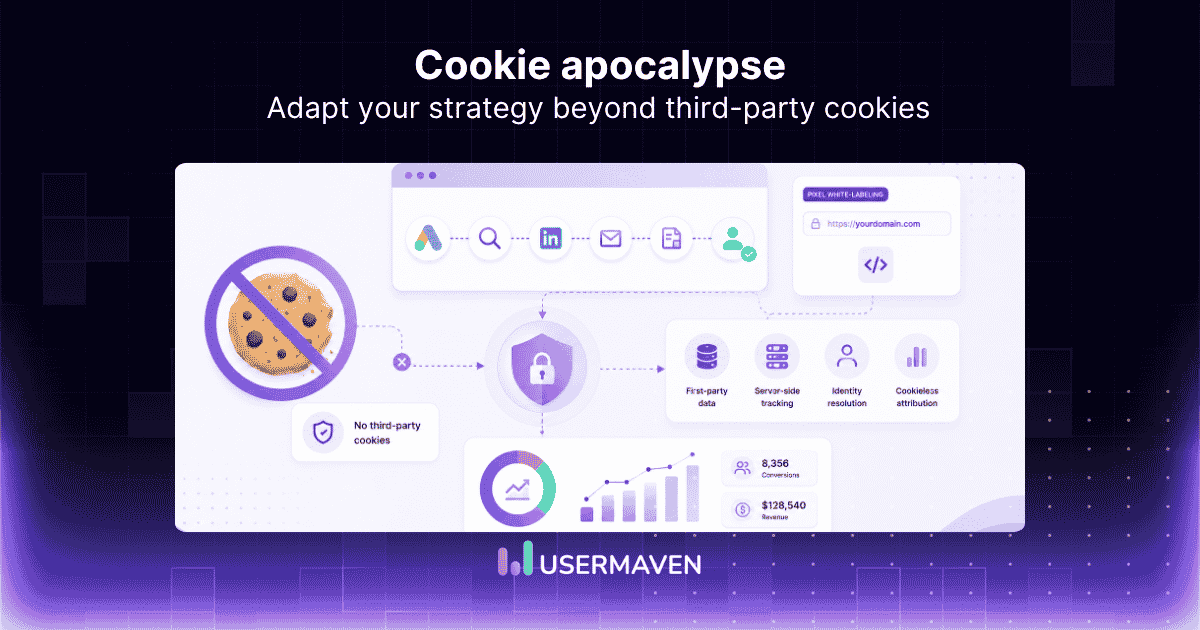
First-party data
First-party data is collected directly from customers through your own website, product, forms, CRM, and customer interactions.
Because businesses collect this data themselves, it is generally more reliable and privacy-friendly.
Server-side tracking
Server-side tracking sends important events directly from your server instead of relying solely on browser-based scripts.
This improves data quality and reduces the impact of browser restrictions and ad blockers.
Identity resolution
Identity resolution connects multiple customer interactions into a single profile.
Instead of treating each visit as unrelated, it links activity across sessions, devices, and channels whenever possible.
Cookieless attribution
Cookieless attribution measures marketing performance using first-party identifiers, server-side events, identity resolution, and other privacy-conscious techniques rather than depending on third-party cookies.
This provides a more reliable understanding of customer journeys.
Conversion APIs
Many advertising platforms now support server-to-server conversion reporting.
These APIs help advertisers send conversion events directly to advertising platforms with greater reliability than browser-only tracking.
Privacy Sandbox
Google’s Privacy Sandbox introduces new technologies designed to support advertising while reducing individual user tracking across websites.
Although adoption is still evolving, it represents one of several alternatives replacing traditional cookie-based tracking.
Contextual advertising
Rather than targeting individuals based on browsing history, contextual advertising places ads based on the content users are currently viewing.
For example, someone reading an article about hiking equipment might see advertisements for outdoor gear instead of ads based on previous browsing behavior.
Cookieless attribution explained
Cookieless attribution helps marketers measure the customer journey without depending on third-party cookies.
Instead of relying on cross-site tracking, it combines:
First-party customer data
Server-side event tracking
Identity resolution
Marketing integrations
CRM data
Revenue events
This allows businesses to understand how marketing channels influence pipeline, conversions, and revenue while adapting to changing privacy standards.
For organizations with longer buying cycles, cookieless attribution often provides a more complete and reliable view of marketing performance than traditional cookie-based measurement.
Cookie apocalypse vs cookieless future
| Cookie apocalypse | Cookieless future |
|---|---|
| Third-party cookies disappear | First-party data becomes the foundation |
| Browser restrictions increase | Server-side tracking improves reliability |
| Cross-site tracking declines | Identity resolution connects customer journeys |
| Attribution gaps increase | Modern attribution fills missing context |
| Privacy concerns grow | Privacy-first measurement becomes standard |
Rather than viewing these changes as a crisis, businesses can see them as an opportunity to build stronger, more sustainable marketing measurement practices.
How to prepare for the cookie apocalypse
Adapting to the cookieless future requires more than replacing one technology with another. It involves building a stronger foundation for collecting, managing, and measuring customer data.
1. Audit your current tracking setup
Identify where third-party cookies are used across your website, analytics tools, advertising platforms, and marketing technology stack.
Understanding your current dependencies helps you prioritize what needs to change first.
2. Build a stronger first-party data strategy
Encourage customers to create accounts, subscribe to newsletters, complete forms, and engage directly with your business.
The more valuable first-party relationships you build, the less dependent you become on third-party tracking.
3. Adopt server-side tracking
Moving critical events to server-side tracking improves data accuracy and helps maintain reliable measurement despite browser limitations.
4. Strengthen consent management
Provide clear consent choices and maintain transparency about how customer information is collected and used.
This supports compliance while building long-term trust.
5. Invest in cookieless attribution
Modern attribution solutions combine multiple data sources to create a complete view of customer journeys without relying on third-party cookies.
6. Connect your marketing and revenue data
Integrating your CRM, advertising platforms, website analytics, and revenue data helps create a unified view of marketing performance across the entire customer lifecycle.
7. Review your measurement strategy regularly
Privacy standards and browser technologies continue to evolve. Reviewing your analytics setup regularly helps ensure your reporting remains accurate and reliable over time.
Benefits of preparing early
Businesses that adapt early often gain several advantages over competitors that continue relying on outdated tracking methods.
Preparing now can help you:
Build stronger customer trust through privacy-first data practices.
Improve the quality and reliability of your marketing data.
Reduce reporting gaps caused by browser restrictions.
Make more informed budget allocation decisions.
Create a more sustainable measurement strategy that continues working as privacy standards evolve.
Rather than reacting to every browser update, you’ll have a measurement framework built for the future.
Cookie apocalypse readiness checklist
Preparing for the cookie apocalypse doesn’t require replacing your entire marketing stack overnight. Start by strengthening the foundation of your measurement strategy.
✔ Audit where your business relies on third-party cookies.
✔ Build a stronger first-party data collection strategy.
✔ Implement server-side tracking for important events.
✔ Review your consent management and privacy practices.
✔ Connect your CRM, marketing, and revenue data.
✔ Adopt a cookieless marketing attribution solution.
✔ Regularly validate your attribution and conversion data.
By taking these steps now, you’ll be better prepared for future browser updates and changes in privacy regulations.
How Usermaven helps businesses navigate the cookie apocalypse
The cookie apocalypse makes accurate marketing measurement more challenging, but it doesn’t have to create blind spots in your reporting.
Usermaven helps businesses adapt with privacy-friendly tracking, first-party data collection, server-side event tracking, identity resolution, and cookieless attribution built into a single platform.

Instead of relying on disappearing third-party cookies, Usermaven connects marketing, product, CRM, and revenue data to provide a complete view of the customer journey. You can compare attribution models, measure assisted conversions, identify the channels driving pipeline and revenue, and make more confident marketing decisions based on accurate, unified data.
Whether you’re optimizing paid advertising, content marketing, email campaigns, or your overall demand generation strategy, Usermaven helps you understand what truly drives business growth.
Maximize your ROI
with accurate attribution
Conclusion
The cookie apocalypse is reshaping how businesses measure marketing performance, but it does not mean the end of effective analytics or attribution. As third-party cookies become less reliable, marketers who invest in first-party data, server-side tracking, and modern attribution can continue understanding the full customer journey while respecting user privacy.
As an AI-powered attribution software, Usermaven helps businesses make this transition with privacy-friendly tracking, cookieless attribution, identity resolution, customer journey analytics, and multi-touch attribution, all in one platform. Instead of relying on disappearing third-party cookies, you can accurately connect marketing efforts to pipeline, conversions, and revenue.
Ready to future-proof your marketing measurement?
Ready to see Usermaven in action? Explore the platform or book a demo for a closer look.
FAQs
What are cookies in web browsers?
Cookies are small text files that websites store in a user’s browser to remember information such as login sessions, language preferences, shopping cart items, and browsing activity. They help improve the user experience and can also be used to measure website performance and marketing campaigns.
What is the difference between first-party and third-party cookies?
First-party cookies are created by the website a user is visiting and are commonly used for authentication, personalization, and analytics. Third-party cookies are created by external domains, typically advertising or tracking services, and are used to follow users across multiple websites for ad targeting and measurement.
When did the cookie apocalypse begin?
The cookie apocalypse began in 2017 when Safari introduced Intelligent Tracking Prevention (ITP) to limit third-party tracking. Firefox followed with Enhanced Tracking Protection (ETP) in 2019, and Google announced plans to phase out third-party cookies in Chrome in 2020. Since then, the industry has steadily shifted toward privacy-first measurement and first-party data strategies.
Did Google remove third-party cookies from Chrome?
Not entirely. Google originally planned to phase out third-party cookies in Chrome but later changed its approach. Instead of removing them outright, Google is giving users more control over their privacy choices while continuing to develop the Privacy Sandbox initiative. Regardless of these changes, marketers should continue preparing for a future that relies less on third-party cookies.
Will the cookie apocalypse affect SEO?
The cookie apocalypse does not directly affect search engine rankings. However, it can impact how businesses measure organic traffic, conversions, and customer journeys. Accurate first-party analytics and attribution become more important for understanding the true value of SEO efforts.
Updated

Written by
Lauren Brooks
Lifecycle Marketing Strategist
Lauren Brooks is a lifecycle marketing strategist with 4+ years of experience helping SaaS businesses create meaningful customer experiences. She specializes in user engagement, retention, and conversion optimization, helping brands build stronger customer relationships beyond acquisition.
All articles by Lauren →