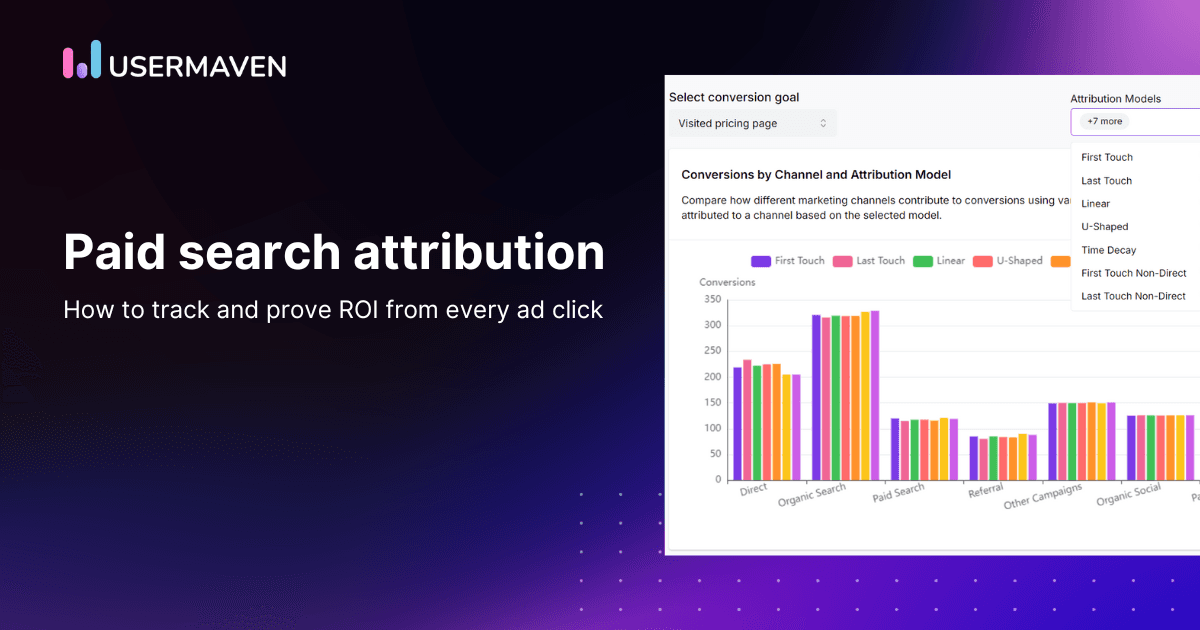
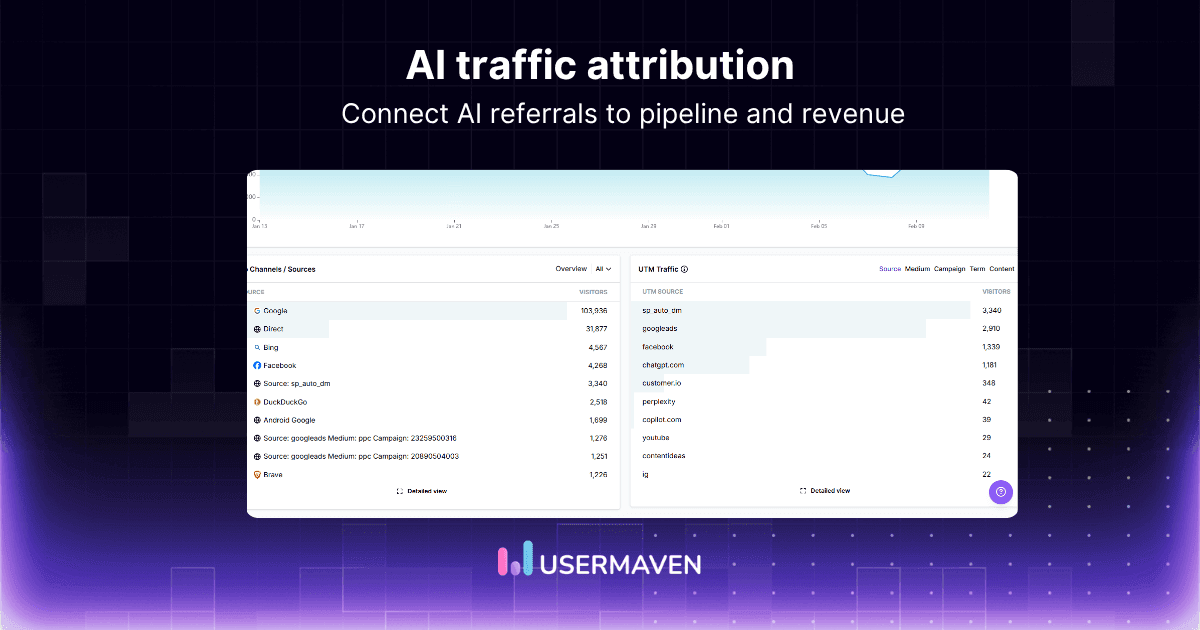
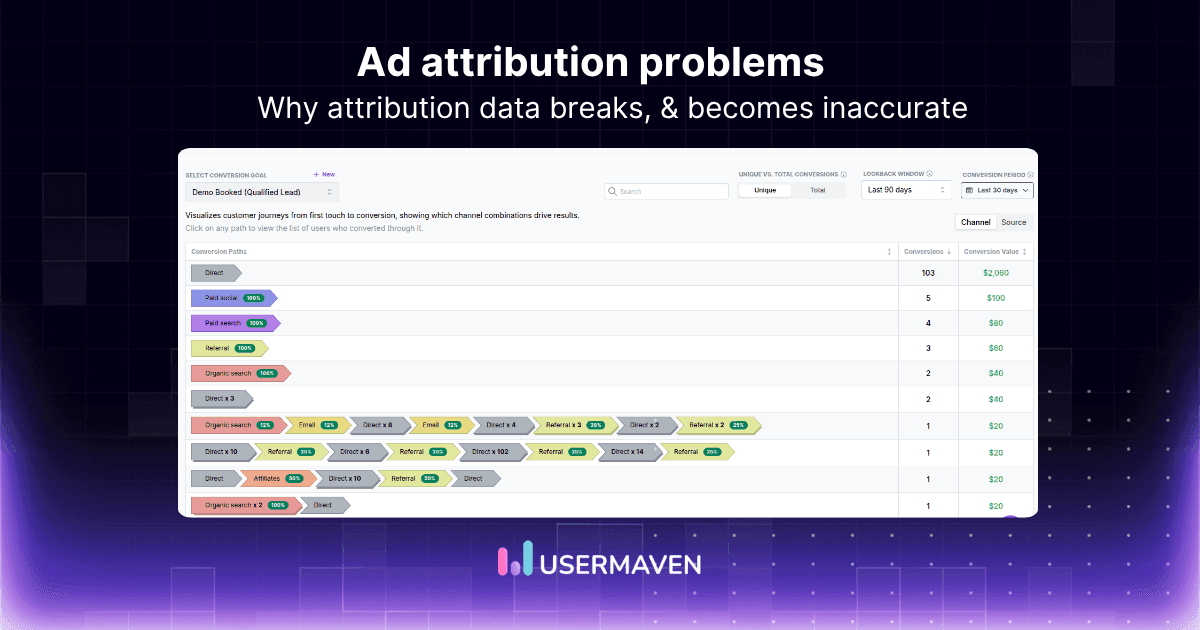
A SaaS ad campaign rarely ends at the signup. A buyer can click a LinkedIn or Google ad, start a trial, use the product, return through email or organic search, enter the CRM, and become recurring revenue weeks later.
That is why SaaS teams need more than a generic ad attribution software. The measurement layer has to connect acquisition with product behavior, CRM pipeline, and the commercial outcomes that actually define a good customer.
This guide compares ten ad attribution platforms for product-led, sales-led, hybrid, and enterprise SaaS teams, with emphasis on paid media, activation, account journeys, recurring revenue, conversion feedback, pricing, and implementation fit.
Key takeaways
A signup is not always the real SaaS conversion: Activation, opportunity creation, paid conversion, retention, or revenue may be a better outcome for budget decisions.
PLG and sales-led SaaS need different attribution: Product usage matters more in PLG, while account and CRM depth matter more in sales-led motions.
Paid-ad data must connect downstream: Google, Meta, LinkedIn, and Microsoft Ads become more useful when spend is tied to customer quality and revenue.
Recurring revenue changes the answer: First-payment ROAS can undervalue channels that create stronger retention, expansion, or lifetime value.
B2B SaaS often needs account-level resolution: Several people from the same company can influence one opportunity, so contact-only reporting can fragment the story.
Conversion feedback can improve optimization: Sending qualified outcomes back to ad platforms can align algorithms with customers rather than every raw signup.
What is ad attribution software for SaaS?
Ad attribution software for SaaS connects paid advertising interactions with SaaS-specific outcomes such as signups, trials, activation, demos, opportunities, subscriptions, recurring revenue, and customer lifetime value. It extends attribution in advertising beyond the initial conversion event.
Generic ad tracking can tell a team that an ad produced a signup. SaaS attribution should go further and show whether that signup activated, upgraded, entered sales, became an opportunity, or eventually contributed to trusted revenue.
For this reason, revenue attribution is usually more decision-ready than lead or signup counts alone. A broader SaaS marketing attribution strategy should preserve enough identity and business context to connect acquisition with later product and CRM outcomes.
Best SaaS ad attribution software compared
The table gives a fast view of the SaaS motion each platform fits best. Tool homepage links are intentionally reserved for the detailed numbered profiles below.
| Platform | Best for | SaaS attribution strength | Main outcome |
|---|---|---|---|
| Usermaven | PLG + sales-led SaaS | Ads + product + CRM | Revenue |
| Dreamdata | B2B SaaS | Account journeys | Pipeline / revenue |
| HockeyStack | Enterprise SaaS | GTM + account attribution | Pipeline |
| Cometly | Paid-media SaaS | Server-side + CRM | Closed revenue |
| HubSpot Marketing Hub | HubSpot-native SaaS | CRM-native attribution | Deals / revenue |
| Hyros | Performance SaaS | Paid acquisition tracking | Sales / ROAS |
| Ruler Analytics | Sales-led SaaS | Lead + offline revenue | Closed revenue |
| SegMetrics | Subscription SaaS | Contact history + LTV | Revenue / LTV |
| Factors.ai | B2B SaaS | Account attribution + ads | Pipeline |
| Adobe Marketo Measure | Enterprise SaaS | B2B multi-touch | Pipeline / revenue |
Ad attribution software for SaaS
SaaS companies need different attribution depth depending on whether growth is product-led, sales-led, enterprise, or heavily dependent on paid acquisition. The profiles below compare ad coverage, product and CRM connection, recurring-revenue visibility, conversion feedback, pricing, and fit for each SaaS motion.
1. Usermaven: Best overall for SaaS attribution

Overview
Usermaven is an AI-powered marketing attribution platform that connects paid acquisition with website behavior, product usage, customer journeys, CRM pipeline, revenue, retention, and downstream conversion feedback in one environment.
Best for
B2B SaaS, product-led SaaS, hybrid PLG plus sales motions, professional SaaS, and teams that want marketing, product, and CRM context without stitching together several reporting tools.
SaaS use case
For PLG, the journey can run from ad to signup, activation, feature use, paid conversion, and retention. For sales-led teams, the same acquisition context can continue into lead, account, opportunity, closed-won customer, and revenue.
Pricing
Scale is $199 per month at the 250,000-event tier and includes unlimited users, five workspaces, seven years of history, paid-ad attribution, CRM and deals attribution, conversion paths, conversion sync, and Maven AI. A 14-day free trial is available.
Key SaaS attribution capabilities
Google Ads, Meta Ads, LinkedIn Ads, and Microsoft Ads connections
Paid-ad, channel, landing-page, CRM, pipeline, and revenue attribution
Product analytics, funnels, retention, and customer journey analysis
Multi-touch conversion paths across the same customer dataset
Conversion sync for supported advertising platforms
Measurement Trust Center for collection, identity, integration, delivery, and reliability checks
Maven AI plus MCP-based analysis workflows
Product-led attribution
For PLG teams, product analytics can sit beside attribution so campaign quality is judged by what users actually do after signup. Teams can compare activation, feature adoption, funnel completion, and retention by acquisition source.
User journeys make the sequence inspectable at customer level, which helps when aggregate campaign performance hides very different post-signup paths.
Sales-led attribution
For B2B teams, B2B marketing attribution can continue into HubSpot or Salesforce outcomes rather than stopping at the demo request. Salesforce support is read-only in the first release and can sync Accounts, Contacts, Leads, Opportunities, stage history, and contact roles.
Per-org field mapping and Salesforce sandbox support help teams work with different CRM schemas while preserving the distinction between marketing activity and downstream sales outcomes.
Conversion feedback and activation
With conversion syncs, SaaS teams can choose stronger downstream outcomes than every raw signup when supported by the destination platform. Reverse ETL can also sync Usermaven audiences into connected destinations such as HubSpot and Customer.io.
Maven AI and MCP
Maven AI can answer questions across campaigns, funnels, retention, journeys, and attribution, while AI-generated funnel, retention, and journey previews can be saved as reports. The public MCP server and external MCP connectors extend approved analysis workflows into compatible AI clients and connected systems.
Why it stands out
Usermaven is strongest when SaaS attribution needs to span acquisition, product behavior, CRM pipeline, and revenue rather than treating ad measurement as a standalone layer.
Verdict
For SaaS teams that want one measurement system across pre-signup marketing, in-product behavior, sales pipeline, and revenue, Usermaven offers one of the broadest fits in this comparison.
2. Dreamdata: Best for B2B SaaS accounts

Overview
Dreamdata is a B2B attribution and activation platform centered on company-level journeys, account mapping, pipeline, revenue, audience activation, and conversion feedback across the go-to-market stack.
Best for
B2B SaaS, account-based marketing, demand generation, buying committees, and revenue teams that want account-level visibility from anonymous activity to closed deals.
SaaS use case
A common fit is paid campaign to anonymous website activity, multiple known contacts, account engagement, opportunity creation, and closed revenue. The account becomes the primary object instead of an isolated visitor.
Pricing
Dreamdata offers a free entry plan for smaller companies, while larger organizations receive customized paid pricing based on tracked users and requirements. Teams can also evaluate the product before a larger commercial commitment.
Key SaaS attribution capabilities
Anonymous-to-known B2B journey tracking
Company identification and contact-to-account mapping
Adaptable attribution models and scalable reporting
Pipeline and revenue analytics
Audience Hub and activation workflows
Conversion sync back to advertising platforms
Why it stands out
Dreamdata is designed around the multi-stakeholder B2B journey, so it fits SaaS companies where several contacts and channels can influence the same opportunity over a long buying cycle.
Verdict
Dreamdata is a strong specialist for account-based B2B attribution. Teams comparing that focus with broader product analytics and self-serve SaaS measurement can review the Dreamdata alternative comparison.
3. HockeyStack: Best for enterprise SaaS GTM journeys

Overview
HockeyStack is a B2B revenue and GTM intelligence platform that unifies marketing, sales, CRM, product, and account activity into buyer journeys, pipeline analysis, attribution, and AI-assisted insights.
Best for
Enterprise SaaS, ABM programs, complex B2B sales cycles, and GTM teams that want marketing attribution embedded in a broader account intelligence and revenue workflow.
SaaS use case
A typical enterprise use case connects campaign and account engagement with sales activity, opportunity progression, and closed deals across a buying committee rather than a single conversion event.
Pricing
HockeyStack uses custom-built plans rather than a simple public self-serve price. Startup pricing is available, but most teams need a sales conversation to size integrations, data scope, and implementation.
Key SaaS attribution capabilities
Account-level buyer journeys
Marketing, sales, CRM, product, and intent data
Multi-touch attribution and model comparison
Pipeline and closed-deal analysis
Account scoring and GTM intelligence
AI-assisted analysis for complex revenue journeys
Why it stands out
HockeyStack is built for teams where attribution is one part of a larger GTM intelligence system. That can be valuable when marketing, sales, product, and account signals all influence the same enterprise opportunity.
Verdict
HockeyStack is a strong fit for enterprise B2B SaaS. The HockeyStack pricing guide and HockeyStack alternative comparison provide additional buying context.
4. Cometly: Best for paid-media-heavy SaaS

Overview
Cometly is a B2B marketing attribution platform focused on server-side tracking, multi-touch attribution, account journeys, CRM and warehouse sync, conversion APIs, dashboards, and paid-media optimization.
Best for
SaaS demand generation teams with meaningful Google, Meta, LinkedIn, TikTok, Microsoft, Reddit, or Snapchat spend and a strong need to connect ads with pipeline and revenue.
SaaS use case
Cometly is well suited to the path from paid click to landing page, demo or signup, CRM opportunity, closed-won revenue, and conversion feedback back into the ad platform.
Pricing
Cometly offers Core and Enterprise plans with quote-based pricing sized by pageviews and stack requirements. Monthly and annual billing are available, and annual billing currently carries a 20% discount.
Key SaaS attribution capabilities
Server-side tracking and first-party pixel
Multi-touch attribution and account journeys
Unlimited connections to major ad platforms on current plans
CRM and warehouse synchronization
Server-side Conversion API feedback
Dashboards, audiences, and AI-assisted analysis
Why it stands out
Cometly sits close to paid acquisition and full-funnel B2B measurement. Its current pricing and product structure are built around connecting ad spend to pipeline and revenue rather than only reporting clicks and leads.
Verdict
Cometly is a strong option for paid-media-heavy SaaS teams. For a deeper purchase comparison, see Cometly pricing and the Cometly alternative page.
5. HubSpot Marketing Hub: Best for HubSpot-native SaaS

Overview
HubSpot Marketing Hub combines marketing automation, CRM data, campaigns, customer journey tools, and attribution capabilities inside the HubSpot ecosystem, reducing the need to introduce a separate measurement vendor for teams already standardized on HubSpot.
Best for
SaaS companies already using HubSpot for marketing and CRM, especially teams that value one ecosystem for contact, lifecycle, deal, campaign, and revenue data.
SaaS use case
The practical journey is campaign interaction to contact creation, lifecycle progression, deal creation, and revenue. HubSpot can keep those stages inside the same CRM-centered environment.
Pricing
Advanced multi-touch revenue attribution is currently associated with Marketing Hub Enterprise, listed at $3,600 per month with a $7,000 one-time onboarding fee. Professional provides advanced marketing and custom reporting but not the same enterprise attribution depth.
Key SaaS attribution capabilities
CRM-native contact, deal, and revenue data
Campaign and interaction tracking
Contact-create, deal-create, and revenue attribution reports
Customer journey analytics on higher tiers
Marketing automation and lead scoring
Integrated sales and service context
Why it stands out
HubSpot reduces integration complexity when the CRM is already the center of the SaaS revenue process. The tradeoff is that advanced attribution comes as part of a broader enterprise marketing suite rather than a focused standalone product.
Verdict
HubSpot Marketing Hub is strongest for teams that already want HubSpot to own the marketing and CRM workflow. It is less attractive when a team only needs attribution and does not want the cost or scope of the wider suite.
6. Hyros: Best for performance-driven SaaS acquisition

Overview
Hyros is an ad tracking and attribution platform built around paid-media accuracy, cross-session journeys, calls, revenue, and conversion feedback. It also maintains a dedicated SaaS positioning for teams scaling paid acquisition.
Best for
Performance-led SaaS, high ad spend, direct-response acquisition, demo or call-heavy funnels, and teams where media buyers need fast feedback from paid campaigns.
SaaS use case
The strongest fit is ad to landing page, signup or call, then sale or revenue, with Hyros focused on preserving the advertising trail and returning cleaner conversion data to media platforms.
Pricing
Hyros publishes paid-traffic pricing that starts around $230 per month on annual billing or $379 on monthly billing, with pricing scaling by ad spend and tracking requirements. Higher-volume accounts may require a custom quote.
Key SaaS attribution capabilities
Paid-ad tracking across major platforms
Cross-session and cross-device journey connection
Call and sales tracking
Revenue and recurring-revenue visibility
Multi-touch attribution
Conversion feedback for ad optimization
Why it stands out
Hyros is closer to day-to-day media buying than broad SaaS analytics. That makes it attractive when the main problem is advertising accuracy rather than deep product, account, or lifecycle analysis.
Verdict
Hyros is a strong performance option for SaaS teams with significant paid acquisition. See the Hyros pricing guide and Hyros alternative comparison for additional context.
7. Ruler Analytics: Best for sales-led and offline SaaS

Overview
Ruler Analytics is a unified marketing measurement platform that connects visitor journeys, forms, phone calls, live chat, CRM opportunities, offline conversions, revenue, multi-touch attribution, impression attribution, and marketing mix modeling.
Best for
Demo-led SaaS, phone-assisted sales, professional SaaS services, and teams where the digital journey moves quickly into a salesperson or offline close.
SaaS use case
Ruler fits the path from ad to form or call, then CRM opportunity and won business. This makes lead attribution software particularly relevant when the revenue event happens outside the website and cannot be measured reliably as a simple web conversion.
Pricing
Ruler currently lists pricing from about $199 per month for smaller businesses, with higher tiers scaling by monthly visits and enterprise requirements. Annual plans can include a discount, while large traffic volumes use custom pricing.
Key SaaS attribution capabilities
Visitor-level journey tracking
Form, phone call, live-chat, and offline conversion capture
CRM and opportunity attribution
Multi-touch and impression attribution
Revenue and won-business measurement
Marketing mix modeling and predictive analytics
Why it stands out
Ruler is strongest when the key SaaS conversion leaves the website. Calls, forms, CRM stages, and won revenue can be treated as part of the same measurement chain rather than disappearing after the lead.
Verdict
Ruler Analytics is a strong specialist for sales-led SaaS. Teams can compare pricing and platform fit through the Ruler Analytics pricing guide and Ruler Analytics alternative page.
8. SegMetrics: Best for subscription LTV

Overview
SegMetrics is a multi-touch attribution platform focused on contact-level journeys, engagement, revenue, lifetime value, segmentation, full-funnel analytics, and conversion feedback across a large integration ecosystem.
Best for
Subscription SaaS, long nurture cycles, smaller digital SaaS businesses, and teams that want contact history and LTV to remain visible after the initial acquisition event.
SaaS use case
A practical use case is ad to trial, nurture, paid conversion, recurring payments, and LTV. SegMetrics keeps the contact history available so earlier acquisition can be compared with the value created later.
Pricing
Launch is $57 per month, Grow is $197, and Scale is $397 at the displayed contact level. Grow adds customer journey tracking and the Ad Conversion Feeder, while Scale adds server-side tracking and advanced data APIs.
Key SaaS attribution capabilities
Full LTV attribution across the customer journey
Contact journey reporting
Real-time switching between attribution models
100+ marketing integrations
Advanced segmentation
Ad Conversion Feeder on Grow and above
Server-side tracking on Scale or as an add-on depending on plan
Why it stands out
SegMetrics is useful when the customer history matters more than the last session. Its contact-centric design and LTV focus map naturally to subscription and nurture-heavy SaaS models.
Verdict
SegMetrics is a strong choice for smaller or mid-sized subscription SaaS teams that care about long-term customer value and do not require deep enterprise account intelligence.
9. Factors.ai: Best for B2B account attribution

Overview
Factors.ai is an AI-powered ABM and attribution platform that connects website activity, CRM data, ad spend, intent signals, account identification, audience activation, and pipeline analysis for B2B go-to-market teams.
Best for
B2B SaaS demand generation, LinkedIn-heavy programs, account-based marketing, and teams that want company-level visibility across paid channels and pipeline stages.
SaaS use case
A typical journey links LinkedIn, Google, Meta, or Bing spend with identified companies, account engagement, CRM stage movement, pipeline, and revenue instead of judging ads only on form fills.
Pricing
Factors.ai currently lists Basic at $6,000 per year, Growth at $20,000 per year, and Enterprise from $30,000 per year. Growth adds complete buyer-journey visibility and advanced ABM analytics; Enterprise adds predictive scoring, audience sync, and conversion feedback.
Key SaaS attribution capabilities
Company and contact identification
Paid-channel ROI across LinkedIn, Google, Meta, and Bing
Account-level buyer-journey analysis
CRM sync and pipeline measurement
Account scoring and intent signals
Audience activation and conversion feedback on higher tiers
Why it stands out
Factors.ai is especially strong for B2B SaaS teams that want attribution to sit beside ABM, intent, and account activation. That is a different emphasis from product-led user analytics.
Verdict
Factors.ai is a strong option when the key question is which paid and intent signals move target accounts through the B2B funnel and into pipeline.
10. Adobe Marketo Measure: Best for enterprise SaaS stacks

Overview
Adobe Marketo Measure is Adobe’s B2B multi-touch attribution product for measuring campaign, channel, and content impact on pipeline, revenue, and ROI. It sits naturally inside larger Marketo and enterprise marketing environments.
Best for
Large SaaS enterprises, Marketo-centric organizations, Salesforce-heavy revenue teams, and companies that need enterprise B2B measurement with governance and complex integration requirements.
SaaS use case
The core journey is campaign and content engagement to lead or contact, opportunity, pipeline, and revenue. Marketo Measure is designed to assign marketing influence across those B2B touchpoints.
Pricing
Adobe does not publish a simple self-serve price for Marketo Measure. Marketo Engage uses customized pricing across Growth, Select, Prime, and Ultimate packages, with premium attribution available in the higher-end packaging.
Key SaaS attribution capabilities
B2B multi-touch attribution
Campaign, channel, and content impact analysis
Pipeline, revenue, and ROI measurement
Touchpoint tracking across complex B2B journeys
Integration with enterprise marketing and CRM environments
Marketing influence analysis for large teams
Why it stands out
Adobe Marketo Measure is built for enterprise measurement programs rather than lean self-serve analytics. Its value is highest when the surrounding Marketo and CRM ecosystem already justifies the implementation complexity.
Verdict
Adobe Marketo Measure is most suitable for large SaaS enterprises that already operate a mature Marketo-centered stack and need formal B2B attribution across pipeline and revenue.
How we evaluated SaaS attribution software
Each platform was evaluated against the same SaaS measurement problems rather than ranked only by feature count. The goal is to measure marketing attribution against the customer lifecycle that actually matters for the company’s go-to-market motion.
Paid-ad platform coverage and spend connection
Signup-to-paid and SaaS lifecycle depth
Product usage and activation visibility
CRM integration and opportunity context
Account-level attribution for B2B journeys
Pipeline, recurring revenue, and LTV visibility
Attribution model and window flexibility
First-party and server-side measurement options
Conversion feedback to advertising platforms
Customer, contact, or account journey inspection
Pricing model and implementation complexity
Fit for PLG, sales-led, hybrid, or enterprise SaaS
Why SaaS ad attribution is different
SaaS buying cycles stretch attribution far beyond the first click.
The conversion happens in stages
SaaS funnels can include signup, trial, activation, product-qualified lead, demo, opportunity, paid plan, expansion, and renewal. A platform that stops at the first form or signup may overvalue channels that create volume but weak customers.
Product activity changes lead quality
Two signups from the same campaign can have very different intent. One reaches the activation milestone in ten minutes, while another never uses the core feature. PLG teams need attribution that can connect acquisition with meaningful product behavior.
Revenue continues after acquisition
Subscription businesses care about recurring value, not only the first invoice. A channel with a higher initial CAC can still be the better investment if it produces customers with stronger retention, expansion, or lifetime value.
B2B deals can involve several people
A LinkedIn ad may reach one employee, an organic article another, and a demo request a third. If all three belong to the same company and opportunity, account-level context becomes important for explaining the real buying journey.
Best platform by SaaS motion
The best fit changes with the motion. Product-led teams need post-signup behavioral context, while enterprise and sales-led teams usually put more weight on account, CRM, and pipeline visibility.
| SaaS motion | Main measurement problem | Strong options |
|---|---|---|
| Product-led | Signup → activation → paid | Usermaven |
| Hybrid PLG + sales | Product + CRM connection | Usermaven, HockeyStack |
| Sales-led B2B | Pipeline + closed revenue | Dreamdata, Usermaven |
| Enterprise ABM | Multiple contacts / account | HockeyStack, Factors.ai |
| Paid-media heavy | Ad spend → pipeline | Cometly, Hyros |
| HubSpot-native | CRM-contained attribution | HubSpot |
| Call / demo-led | Offline sales influence | Ruler Analytics |
| Subscription / LTV | Recurring customer value | SegMetrics |
| Adobe / Marketo enterprise | Enterprise B2B stack | Adobe Marketo Measure |
Why signup attribution is not enough
Signup volume can hide a major quality problem. A campaign can look efficient at the top of the funnel while creating few activated users, weak sales opportunities, or customers that churn quickly.
| Campaign | Signups | Activated users | Customers | New MRR |
|---|---|---|---|---|
| Campaign A | 500 | 20 | 5 | $1,000 |
| Campaign B | 180 | 90 | 30 | $8,000 |
If the team optimizes only for signup CPA, Campaign A may appear attractive. Once activation, customer conversion, and MRR are connected to acquisition, Campaign B is clearly creating more valuable SaaS growth.
This is why product analytics and attribution become more useful when they share the same customer identity. Marketing can be judged by what the user does after acquisition, not only by whether the form was completed.
Product-led vs. sales-led SaaS attribution
Product-led SaaS
PLG teams need to connect the ad with signup, activation, feature adoption, upgrade, and retention. Funnel analysis helps show where users progress or drop after acquisition, while retention reveals whether the channel creates durable usage.
Sales-led SaaS
Sales-led teams care more about demo quality, account progression, opportunity stages, deal value, and closed-won revenue. The CRM becomes part of the attribution chain because the final business outcome may happen weeks or months after the web conversion.
Hybrid SaaS
Hybrid companies need both layers. A prospect may sign up first, become a product-qualified lead through usage, enter sales, and close later. The strongest attribution setup preserves acquisition context through both product and CRM stages.
Why ad-platform ROAS can mislead SaaS teams
Google, LinkedIn, Meta, the product database, and the CRM can all record different versions of the same customer journey. Those ad platform discrepancies do not automatically mean one system is broken; each platform may use different identity, windows, models, and conversion definitions.
A useful reconciliation process compares the conversion event first, then the attribution window, date logic, identity rules, and revenue source. Building a consistent single source of truth does not require every tool to show the same total; the broader guide to marketing attribution discrepancies between tools explains why legitimate systems can still disagree.
Recurring revenue changes attribution
SaaS economics continue after the first payment. Acquisition channels can produce customers with very different expansion, downgrade, churn, and renewal patterns, so first-purchase ROAS is not always the best basis for budget allocation.
Paddle’s SaaS finance metrics guide distinguishes recurring-revenue measures such as MRR and ARR from other financial views. For attribution, the implication is practical: the outcome used for optimization should match how the business evaluates subscription growth.
For a monthly self-serve product, new MRR and retained revenue may be the most actionable. For enterprise contracts, ARR, pipeline, renewal, and expansion can be more meaningful than the first invoice alone.
Account-level attribution for B2B SaaS
B2B SaaS often sells to a company rather than one person. A finance leader might see a LinkedIn ad, a manager may read organic content, and a technical buyer may attend the demo before procurement signs the contract.
In B2B SaaS, multi-touch attribution becomes more useful when eligible marketing interactions can also be reconciled at the account and opportunity level. That helps teams preserve channel influence without losing the commercial context of the deal.
Account-level attribution does not remove the need for contact and user detail. It adds a second layer that prevents a buying committee from looking like several unrelated customers when those people are contributing to one commercial outcome.
Attribution windows for SaaS sales cycles
An attribution window defines how long an earlier interaction remains eligible for credit. The right period should reflect the actual time between meaningful acquisition, activation or opportunity creation, and final conversion.
A self-serve SaaS product may convert within days, while enterprise software can take several months. Using the same short default for both can erase important early interactions from the enterprise journey.
Teams should also separate ad-platform click and view windows from their own longer first-party customer history. These are related measurement concepts, but they do not need to use the same eligibility rules.
First-party tracking for SaaS ads
Reliable SaaS measurement begins with a durable first-party data foundation. Campaign identifiers, authenticated user IDs, CRM IDs, product events, and revenue records should be connected deliberately instead of expecting one browser cookie to preserve the entire lifecycle.
Appropriate server-side tracking can improve event delivery and data control, especially for important downstream conversions. Snowplow’s first-party tracking documentation shows how a collector can be configured on the site’s own domain; server-side delivery still does not solve poor consent, duplicate events, inconsistent identities, or undefined conversion logic by itself.
Teams should also standardize UTM parameters, click-ID handling, and cross-domain tracking when signup, app, checkout, or billing flows span different domains. Clean acquisition metadata is the starting point for downstream SaaS analysis.
From SaaS attribution to ad optimization
The strongest workflow does not stop after an attribution dashboard explains the past. SaaS teams can use downstream quality signals to improve bidding, audience strategy, lifecycle messaging, and campaign investment.
Track the acquisition
Capture the campaign, source, creative, landing page, and click identifiers consistently across paid channels.
Measure product or CRM quality
Choose an outcome that reflects the motion: activation for PLG, qualified opportunity for sales-led, or paid and retained customer value for subscription growth.
Build high-value audiences
Create segments around product usage, opportunity stage, customer value, or retained revenue instead of relying only on top-of-funnel pageviews and form submissions.
Return stronger conversion feedback
Where supported, sync deeper verified outcomes back to the ad network so the optimization system learns from valuable users or customers rather than every low-intent conversion.
Where AI supports SaaS attribution
Ask cross-system questions
AI can speed up investigation across campaigns, journeys, funnels, product events, and revenue. Useful questions include which ads create activated users, which channels generate closed-won pipeline, and which acquisition sources produce the strongest retained revenue.
Detect patterns and anomalies
AI can help surface unusual conversion changes, unexpected path patterns, or differences between high-value and low-value cohorts. The output is most useful when the underlying tracking and business definitions are trustworthy.
Keep human judgment in the loop
Teams still need to define the conversion, choose appropriate models and windows, separate attribution from incrementality, and decide how evidence should influence budget. AI can accelerate analysis, but it cannot decide the business question automatically.
How Usermaven supports SaaS ad attribution
Usermaven combines the acquisition, behavior, CRM, and revenue layers that often sit in separate SaaS dashboards. That makes it useful when the team wants to judge paid media by what customers do after the click, not only by the conversion event reported by the ad network.
Acquisition and cross-channel journeys
Google, Meta, LinkedIn, Microsoft/Bing, organic, email, referral, content, and AI-driven journeys can be analyzed against conversions and revenue. Conversion paths and customer journeys help teams inspect the sequences behind aggregate channel totals.
Product behavior
Website and product analytics add the post-signup context that PLG and hybrid teams need. Activation, funnels, product events, feature adoption, and retention can be compared with acquisition sources in the same environment.
CRM pipeline and Salesforce
HubSpot and Salesforce data can extend the journey into downstream sales outcomes. Salesforce is read-only in the first release and can sync Accounts, Contacts, Leads, Opportunities, stage history, and contact roles, with per-org field mapping and sandbox support.
Conversion sync and Reverse ETL
Verified downstream outcomes can be returned to supported ad platforms, while Reverse ETL can sync Usermaven audiences into connected destinations such as HubSpot and Customer.io. That closes the loop between measurement, nurture, and optimization.
Measurement Trust Center
The Measurement Trust Center evaluates collection, identity, integrations, delivery, and reliability before teams depend on the numbers for budget decisions. This is particularly important in SaaS because the measurement chain spans more systems and a longer customer lifecycle.
Maven AI and MCP
Maven AI can investigate attribution, funnels, journeys, retention, and CRM revenue in natural language, and AI-generated previews can be saved as reports. MCP access extends the same analytics tools to compatible AI clients, while external MCP connectors support approved cross-system workflows.
See what's working. Fix what's not. Grow faster.
How to choose SaaS attribution software
The right fit depends on your motion, stack, and reporting needs. Here’s how to decide.
1. Identify your SaaS motion
Start with PLG, sales-led, hybrid, or enterprise. The right tool depends more on how customers convert than on the length of the feature checklist.
2. Define the real conversion
Choose whether the decision should optimize for signup, activation, product-qualified lead, demo, opportunity, paid customer, MRR, ARR, or lifetime value.

3. Connect every material paid channel
Confirm support for the channels that actually carry spend, including Google, LinkedIn, Meta, Microsoft/Bing, and any specialist networks in the acquisition mix.
4. Decide whether product usage matters
For PLG and hybrid businesses, confirm that acquisition can be connected with activation, feature use, funnels, and retention rather than stopping at the signup event.
5. Check CRM integration depth
Sales-led teams should verify contacts, accounts, opportunities, stages, values, and closed outcomes. A basic lead sync is not enough if revenue attribution depends on later CRM stages.
6. Check account-level identity
B2B companies should test whether several contacts from the same organization can be understood as one account journey without losing the underlying person-level activity.
7. Compare attribution windows and models
Use multi-touch attribution when the business needs to understand several eligible interactions, but do not assume one model should answer awareness, conversion, incrementality, and budget-allocation questions equally well.
8. Evaluate recurring-revenue support
Check whether the platform can connect acquisition with MRR, ARR, renewal, expansion, and LTV when those outcomes influence how finance and growth teams judge customer quality.
9. Test conversion feedback
Confirm which qualified events can be sent back to each ad platform, how duplicates are handled, and whether the identity and consent requirements are clearly documented.
10. Audit real customer journeys
Before replacing reporting, use an attribution checklist to trace several real customers from first paid touch through product or CRM outcomes. Parallel testing exposes identity breaks and definition mismatches before budget decisions depend on the new system.
How much does SaaS attribution software cost?
Pricing varies by events, contacts, pageviews, ad spend, tracked revenue, users, workspaces, and enterprise integrations. The broader guide to marketing attribution software cost explains why the billing model matters as much as the starting price.
In this comparison, entry points range from $57 per month for SegMetrics to multi-thousand-dollar enterprise suites, while Dreamdata and Usermaven offer lower-friction starting options and several B2B platforms require annual or custom contracts.
SaaS teams should model the cost at future scale, then compare it with the financial value of better CAC decisions, cleaner pipeline visibility, and fewer hours spent reconciling disconnected ad, product, CRM, and revenue dashboards.
Final verdict
There is no universal best ad attribution platform for every SaaS company because product-led, sales-led, hybrid, and enterprise businesses need different downstream signals and levels of account, product, and CRM context.
Usermaven is the strongest overall fit here for teams that need paid attribution connected with website and product behavior, customer journeys, CRM pipeline, revenue, retention, conversion feedback, and AI-assisted analysis in one platform.
Want to see which paid campaigns create your most valuable SaaS customers? Connect acquisition with product behavior, CRM outcomes, and revenue before making the next budget decision.
Ready to see Usermaven in action? Explore the platform or book a demo for a closer look.
See Usermaven in action
Book a free demo and discover how powerful analytics can grow your business.
FAQs
1. What is ad attribution software for SaaS?
It is software that connects paid advertising interactions with SaaS outcomes such as signups, activation, demos, opportunities, subscriptions, recurring revenue, and LTV. The goal is to measure customer quality beyond the initial ad-platform conversion.
2. What is the best ad attribution software for SaaS?
The best platform depends on the go-to-market motion. Usermaven is a strong overall option for marketing plus product plus CRM attribution, while Dreamdata and HockeyStack are stronger for account-heavy B2B journeys and Cometly or Hyros fit paid-media-focused teams.
3. Why is SaaS ad attribution different?
SaaS conversions happen in stages and revenue continues after acquisition. Product usage, CRM opportunities, recurring revenue, retention, and buying committees can all matter after the first signup or demo.
4. Should SaaS companies attribute signups or revenue?
Signups are useful operationally, but revenue or a qualified downstream outcome is usually better for budget decisions. PLG teams may use activation or paid conversion, while sales-led teams may use qualified opportunity or closed-won revenue.
5. How do you track SaaS ads to recurring revenue?
Capture acquisition data, preserve identity across signup and product use, connect CRM or billing outcomes, and report recurring revenue against the original customer journey. The exact setup depends on the product, CRM, and billing stack.
6. What is the best attribution tool for B2B SaaS?
Usermaven, Dreamdata, HockeyStack, and Factors.ai are strong options for different B2B needs. Usermaven combines product and CRM context, while the others lean more heavily toward account, ABM, or enterprise GTM intelligence.
Updated

Written by
Ryan Mitchell
Marketing Analytics Strategist
Ryan Mitchell is a marketing analytics strategist specializing in campaign measurement, customer journeys, and marketing performance. He writes about analytics, reporting, and data-driven marketing strategies, helping SaaS and B2B teams measure what matters across every stage of the customer journey.
All articles by Ryan →