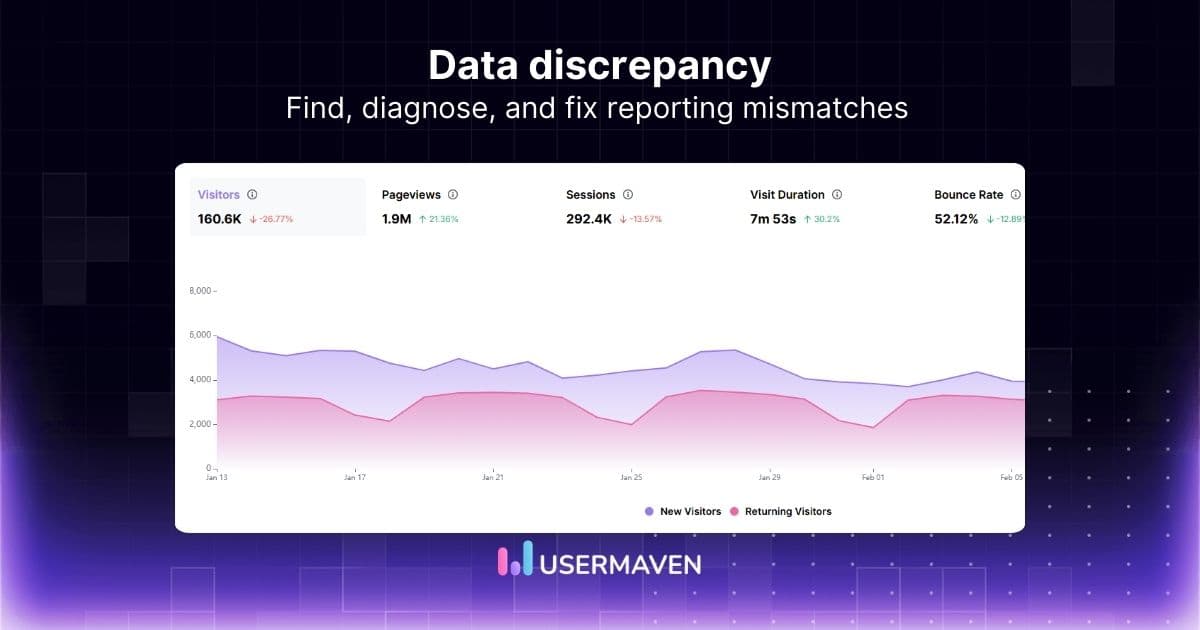
Monday morning. The marketing team opens five tools and still cannot agree on last week’s conversions. Google Ads, GA4, Meta Ads Manager, the CRM, and a revenue spreadsheet all show different numbers. The meeting ends with guesses, not decisions.
A single source of truth is a shared, authoritative data layer where every important marketing and product metric comes from one reconciled record instead of scattered tools. In many companies, the real problem is not data volume but trust in the numbers people see.
This article walks through the SSOT meaning in marketing, the real cost of fragmented data, practical examples, a step-by-step build process, common traps, and how Usermaven can make the whole setup simpler than it sounds.
Key takeaways
- A reliable single source of truth changes how marketing and product teams plan, measure, and grow. Here is the big picture in plain language.
- Single source of truth (SSOT) means every metric, report, and decision traces back to one centralized, authoritative data location. When all tools read from the same cleaned and reconciled record, teams stop arguing about which number is right and start discussing what to do next.
- Fragmented data spread across GA4, Meta Ads, HubSpot, and spreadsheets creates conflicting numbers, misattributed conversions, and wasted budget. Each platform tells its own story, and the most optimistic one often wins in meetings.
- A well-designed SSOT removes marketing data silos, aligns teams on one version of reality, and makes accurate multi-touch attribution possible. That clarity supports smarter experiments and more confident bets.
- Building a marketing SSOT follows a clear path: audit current data sources, align on metric definitions, choose a unified analytics layer, and put simple governance rules in place.
- Usermaven is an AI-powered analytics and attribution platform designed to serve as that dependable SSOT. It combines website and product behavior, campaign performance, and revenue data in one workspace with multi-touch attribution and privacy-first tracking.
What is a single source of truth (SSOT) for marketing?
A single source of truth in marketing is the practice of structuring data so every metric, report, and decision ties back to one centralized, authoritative location. That location holds the cleaned, deduplicated, and agreed-upon record for your customers, campaigns, and revenue.
When someone checks conversions or customer lifetime value, they always read from this same store, not from a local spreadsheet or isolated platform.
An SSOT is more than simply storing data in one warehouse or tool. The key idea is that every team, application, and dashboard pulls from the same verified record, even if they use different views. In software terms, it follows the “Do not repeat yourself” principle, where each fact has one master version.

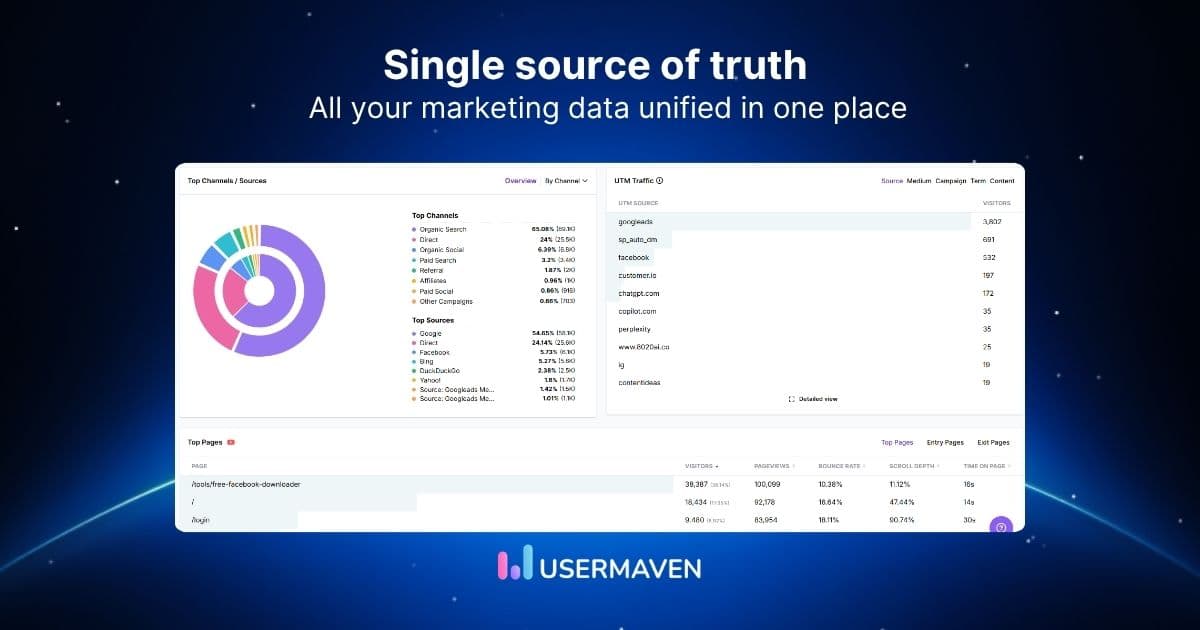
Alt: Circular chart showing top marketing channels and sources such as Direct, Organic Search, Referral, and Email, illustrating data fragmentation before adopting a single source of truth.
Companies that consolidate their marketing data into a single layer consistently make faster decisions. An SSOT tackles marketing data silos and feeds everything into one analytics layer.
For example, a unified marketing analytics dashboard backed by accurate website analytics software and a clear marketing attribution dashboard gives leaders one trusted window into performance.
System of record vs source of truth: What is the difference?
A system of record and a source of truth often get mixed up, yet they play different roles in your data stack. Understanding the difference helps you design a marketing setup that stays accurate as it scales.
- A system of record (SOR) is the original place where a specific kind of data is created and maintained. The CRM is the SOR for contacts and deals, Meta Ads Manager is the SOR for ad spend, and Stripe is the SOR for invoices and payments.
- A source of truth pulls information from several systems of record to create a cross-domain view. For example, it combines CRM data, billing records, and product usage to produce a full picture of each customer.
- In practice, SORs feed the source of truth on a schedule or in real time. Inconsistent data and poor data access are among the key blockers for marketing analytics — the very problems an SSOT is built to solve.
| Metric | System of record | Source of truth |
|---|---|---|
| Purpose | Capture and store original data | Reconcile data across systems |
| Data source | One business domain | Many connected systems |
| Scope | Narrow and operational | Broad and cross-functional |
| Example | HubSpot or Salesforce CRM | Usermaven analytics workspace |
Single source of truth vs CRM vs CDP vs data warehouse
A single source of truth is not the same thing as a CRM, CDP, or data warehouse, although it may sit on top of them. Each addresses a piece of the puzzle.
- A CRM stores contacts, companies, and deals so sales and marketing can manage relationships.
- A CDP (customer data platform) unifies user identities and behavior across devices to support targeting and personalization.
- A data warehouse stores large volumes of historical data, usually for analysts and BI tools.
The SSOT can use data from all three, combine it with product events and ad clicks, and present it as one reliable view for decision makers.
| System type | SSOT | CRM | CDP | Data warehouse |
|---|---|---|---|---|
| Primary purpose | Unified trusted data layer | Manage customer relationships | Unify user identity and behavior | Store and query historical data |
| Data scope | Cross-functional metrics | Sales and marketing contacts | User profiles and behavior streams | Almost any enterprise data |
| Real-time focus | Often near real-time | Partial, based on sync rules | Often real-time | Usually batch-based |
| Built for marketers | Yes, in a marketing analytics tool | Yes, for pipeline work | Often focused on marketing | Mainly for data and BI teams |
| Example tool | Usermaven | HubSpot or Salesforce | Segment or Twilio CDP | BigQuery or Snowflake |
Why fragmented marketing data hurts performance
Fragmented marketing data hurts performance because teams base decisions on clashing numbers and definitions. Marketing, product, and sales often use different meanings for terms like active user, marketing qualified lead, or revenue. Every choice built on those contested figures carries hidden risk.
According to Chiefmartec’s 2023 research on marketing technology, there are more than eleven thousand marketing technology products. With so many tools, each channel or function can spin up its own dashboards. Over time, you get a patchwork of reports that all look confident yet cannot be reconciled.
Teams face three compounding issues that grow as spend increases:
- Misattributed conversions appear when Google Ads, Meta, and email tools all claim the same sale. Each platform uses its own attribution window and identity rules, so every one of them can say it drove one purchase.
- Budget misdirection shows up when one channel looks strong only because the measurement window ignores the full path. Branded search often closes deals that started on social or content, yet the search platform gets the credit. Without a cross-channel SSOT, it is easy to cut top-of-funnel campaigns that quietly drive the long-term pipeline.
- Team misalignment grows when marketing celebrates signups, product focuses on feature use, and sales cares only about closed-won revenue. When no shared truth links these metrics together, planning meetings turn into debates about whose dashboard is right.
The circular reporting trap
The circular reporting trap describes what happens when tools validate each other instead of an independent record of truth. Platform A logs a conversion, Platform B imports that event, and then both are treated as separate proof of success.
- In a typical example, a buyer clicks a Meta ad, later searches the brand on Google, and then signs up after an email. Meta Ads Manager credits the click, Google Ads claims the search, and the email tool tags an assisted conversion. Three channels each report one sale. In reality, the business closed just one customer.
- Circular reporting feeds optimistic narratives in quarterly reviews. Executives see totals from Google, Meta, and LinkedIn that all look healthy, yet the combined reported revenue can exceed the actual Stripe or Shopify numbers.
- A single source of truth breaks this loop by choosing one canonical conversion event and one customer record per purchase. Every platform sends data into that record rather than validating against each other.
Without a single source of truth, you are not really measuring marketing performance. You are measuring each platform’s version of it.
Benefits of a single source of truth for marketing teams
A strong single source of truth does more than clean up reporting dashboards. It changes how fast teams can move, how confidently they can reallocate budget, and how clearly they can explain results to leadership. Once the data layer is trusted, meetings shift away from spreadsheet arguments and toward strategy.
Core benefits for marketing and product teams
- Team alignment improves because everyone works from identical numbers. Marketing, product, sales, and revenue operations can open the same dashboard and see the same conversion rate or retention curve. Debates move away from whether the metrics are correct and toward which levers to pull next quarter.
- Attribution accuracy increases once all touchpoints feed into a unified record. Cross-channel attribution becomes much more reliable when it connects ad clicks, organic visits, email opens, and in-product events for each user.
- Decision speed grows because reporting cycles shrink. Analysts are not stuck reconciling exports from six tools before leadership meetings. Marketers can answer questions about campaign performance on the spot.
- Privacy and compliance work becomes simpler when the data stack has a clear center of gravity. Instead of checking consent and retention settings tool by tool, teams can manage them in one governed layer. Cookieless tracking paired with cookieless conversion tracking in a unified platform makes it easier to respect GDPR and CCPA.
- Reporting clarity improves when every stakeholder reads from one source. The difference between reporting vs. analytics becomes clearer when the underlying data is clean and consistent.
How to build a single source of truth: Step by step
Most companies do not struggle with a lack of data. They struggle with disconnected systems reporting different versions of reality.
A paid campaign reports one number in Meta Ads, another in GA4, and a third inside the CRM. Product teams track activation separately. Finance calculates revenue differently again. Everyone has dashboards, but nobody fully trusts them.
Building a single source of truth solves that problem by creating one analytics layer where attribution, user behavior, conversion data, and customer journeys are measured consistently.
With Usermaven, this process does not require a complex warehouse setup or engineering-heavy implementation. The platform is designed to centralize marketing and product analytics into one connected reporting system that teams can manage without SQL or developer dependency.
Step 1: Connect your data sources and tracking environment
The first step is consolidating your tracking setup. Usermaven allows teams to install tracking using a lightweight JavaScript snippet, CMS plugins, or platform integrations.
Once connected, the platform automatically begins capturing website activity, sessions, traffic sources, page views, and user interactions without requiring manual event configuration for every action.
Instead of relying on separate analytics tools for different parts of the journey, Usermaven centralizes behavioral tracking into one environment from the beginning. This matters because fragmented tracking is where reporting inconsistency starts.
- Google Ads may report clicks
- GA4 may report sessions
- Your CRM may report leads
- Stripe may report revenue
Individually, each tool only sees part of the customer journey. Usermaven connects those touchpoints into one unified reporting flow by associating acquisition sources, on-site behavior, conversion events, and user records inside the same analytics workspace.
As implementation expands, teams can also connect custom events, product actions, campaign parameters, and attribution data to build a more complete customer journey view across marketing and product activity.
Step 2: Standardize events and conversion tracking
A single source of truth only works when teams measure actions consistently. One of the biggest reasons reporting breaks across organizations is inconsistent event tracking.
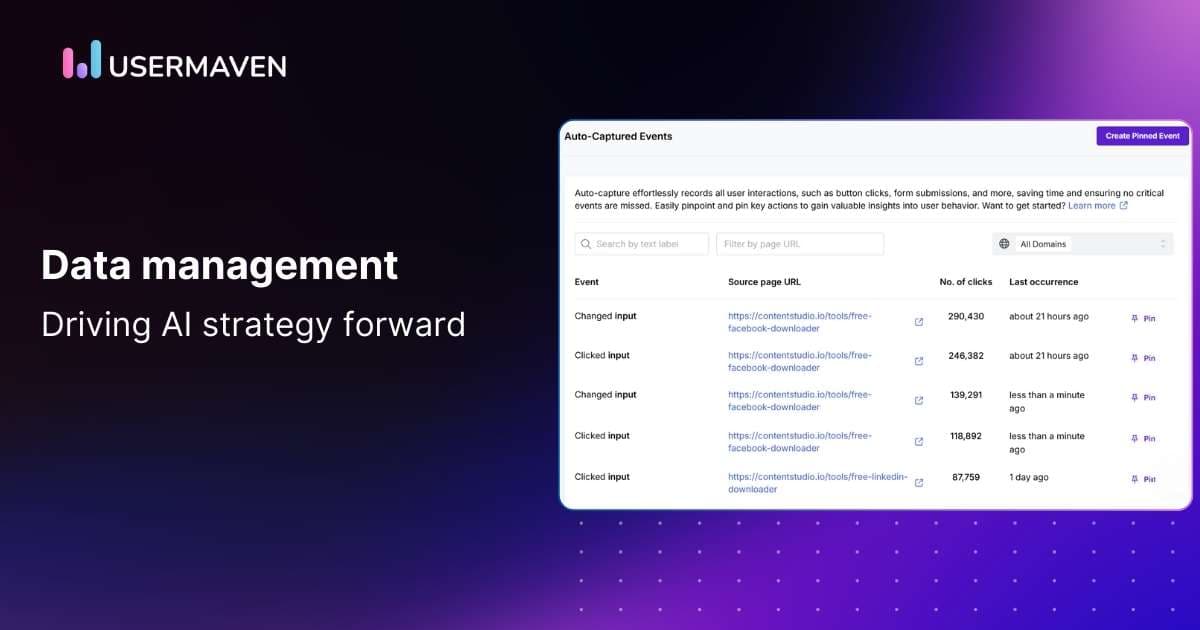
Usermaven addresses this by giving teams centralized event tracking and conversion management inside one platform. The platform automatically captures core interactions such as page visits and sessions, referrers, device and browser data, traffic sources and UTM parameters, and clicks and form submissions.
Teams can then define important business actions as custom events or pinned events directly inside the dashboard without depending on engineering teams to deploy manual tracking scripts for every campaign change.
For example, a SaaS company might define workspace created, trial started, subscription upgraded, and team invited as key conversion milestones. Once standardized inside Usermaven, every dashboard, report, and attribution model references going forward.

Step 3: Centralize attribution, funnels, and user journeys
After tracking and event definitions are unified, the next step is to consolidate analysis. Most teams still analyze acquisition, engagement, and revenue in separate tools: attribution in ad managers, traffic in GA4, product behavior in another platform, and pipeline inside the CRM.
Usermaven solves this by combining attribution analytics, funnels, contacts, journeys, and product usage into one reporting layer. Inside Usermaven, marketers can analyze customer acquisition metrics and trace revenue back to actual acquisition sources instead of relying on isolated platform claims.
Rather than giving 100% credit to the last click, Usermaven helps create a unified attribution view and an attribution checklist that reflects the entire journey. That unified visibility is what transforms analytics software into a true single source of truth.
| What happens inside Usermaven | Outcome |
|---|---|
| Tracking and integrations connected | Unified behavioral data collection |
| Events and conversions standardized | Consistent reporting across teams |
| Funnels, attribution, and journeys centralized | One trusted analytics layer |
| Access, governance, and reporting configured | Long-term reporting consistency |
Step 4: Create governance, reporting consistency, and shared visibility
A single source of truth is not just about collecting data. It is about making sure every stakeholder works from the same information over time.
Usermaven supports this by centralizing reporting access, dashboards, attribution views, and scheduled reports inside one workspace. Instead of teams exporting separate spreadsheets or rebuilding reports manually every week, stakeholders access the same real-time dashboards and automated reporting flows.
Teams can organize reporting around funnels and attribution models, saved segments and campaign views, and custom events and user cohorts without duplicating data across multiple tools.
For organizations managing multiple websites or products, Usermaven’s multi-domain tracking makes it possible to analyze performance across properties inside one centralized analytics environment. Data governance best practices become easier to maintain when tracking rules and reporting definitions live in one system.
The result: when marketing, product, leadership, and sales teams all trust the same numbers, meetings stop revolving around whose dashboard is correct and start focusing on what actions to take next.
Unlock insights that drive growth
Examples of a single source of truth in marketing
Abstract definitions become much clearer with concrete examples. In practice, a single source of truth often lives in one central tool for a specific type of data, with the rest of the stack feeding it cleanly.
- A CRM acting as the SSOT for customer records gives every team one place to check contact and account details. Sales updates deal stages, customer success logs notes, and marketing sees lifecycle stages without keeping their own lists.
- A unified analytics platform serving as the SSOT for web and product behavior replaces scattered tracking scripts and partial exports. A tool like Usermaven becomes the central record for sessions, feature use, funnels, and conversions.
- An attribution layer becoming the SSOT for campaign performance sits above all paid and organic channels. This layer uses consistent identity rules and windows, then outputs one view of how each touchpoint contributes to the pipeline and revenue.
- A business intelligence dashboard acting as the SSOT for executive reporting pulls data from CRM, billing, and analytics into one board for leadership. Quarterly reviews then focus on that one board rather than competing CSVs.
Common challenges when building a single source of truth
Building a single source of truth is not just a technical project. It is also a change in how teams think about data, ownership, and speed. According to McKinsey Global Institute, knowledge workers spend nearly 20% of their workweek searching for information and that time could be eliminated with a unified, reliable source of truth.
- Inconsistent naming conventions across tools quickly produce noise. One platform might call an event sign_up, another uses user_registered, and a third logs completed_registration. A simple naming guide and event catalogue can prevent that mess before it spreads.
- Duplicate records often appear when the same person is tracked with different identifiers. Someone might use one email on a pricing form, another in the product, and show up with a cookie-based ID in analytics. Without solid identity resolution, these fragments inflate user counts and break attribution.
- Stakeholder disagreements arise when people feel the new SSOT threatens their existing reports. A sales leader might trust a personal spreadsheet more than the shared dashboard, or a product manager might prefer their own event naming.
- Integration complexity shows up when older tools do not offer clean APIs or webhooks. In those cases, teams fall back to CSV uploads or manual processes that reintroduce human error.
- Data decay happens as contacts churn, consent changes, and products evolve. A field that was accurate last year might now be wrong, yet still appear in reports. Regular audits and validation rules keep the SSOT from drifting into a stale record.
- Tool sprawl reappears when teams add new platforms without updating the SSOT plan. A new email provider or onboarding tool might start tracking important events that never reach the central layer. A short checklist for new tool approvals keeps the architecture clean.
How Usermaven helps create a single source of truth
Usermaven is an AI-powered analytics and attribution platform built for marketing and product teams that want a clear, shared view of performance without leaning on developers. It acts as a practical single source of truth by combining website analytics, product events, attribution, and revenue signals in one workspace.
Instead of bouncing between GA4, heatmaps, CRM reports, and spreadsheets, teams can answer most questions inside Usermaven. A lightweight script or plugin starts tracking behavior in minutes, so teams see value quickly instead of waiting months for a warehouse project.

What makes Usermaven a reliable single source of truth?
- Unified analytics dashboard combines website traffic, product events, funnels, user paths, and a Contacts Hub in one place. A marketer can move from a high-level acquisition chart down to an individual user’s timeline without leaving the platform.
- Multi-touch attribution tracks every touchpoint across search, paid, social, referrals, and email, then ties them to conversions and revenue. This directly counters the circular reporting trap described above.
- No-code event tracking auto-captures page views, clicks, and form submissions as soon as the script loads. Teams can also mark pinned events for high-priority actions using a simple interface rather than code changes.
- Data accuracy is a core focus. Usermaven works around many ad blockers and privacy features that block traditional scripts, leading to far fewer missing sessions compared with older tools.
- Maven AI lets marketers ask questions about their data in plain language and get quick answers, and for that, no SQL is required. Someone can type a prompt like “show signups from paid search last month by country” and receive a chart or table instantly.
- Privacy-first design supports cookieless tracking and respects consent while still giving enough detail for product and growth work. Features line up with GDPR and CCPA expectations.
- Automated multi-domain reporting makes it easy to track several websites or products inside one account. Agencies can compare client performance, and companies with many brands can see everything in a single overview.
Drive business growth
with AI-powered analytics
Conclusion
Fragmented tools and disputed metrics are not a data problem. They are a decision problem. Every week a team spends reconciling exports is a week spent on the wrong question: “which number is right?, instead of “what should we do next?”
A single source of truth changes that. It does not require a warehouse project or a team of engineers. It requires agreement on what matters, one analytics layer that everyone reads from, and the discipline to keep it clean.
Teams that get this right do not just report better. They move faster, spend smarter, and build more confidence into every decision they make, from budget shifts to product bets.
Usermaven is built to be that layer. Website behavior, product events, campaign attribution, and revenue signals all in one place, without the complexity. If the numbers your team sees today do not agree, that is the problem worth solving.
Ready to see Usermaven in action? Explore the platform or book a demo for a closer look.
FAQs
1. Does setting up a single source of truth require an expensive enterprise tool?
Not necessarily. Enterprise data stacks with warehouses, CDPs, and BI layers can cost thousands per month, but most marketing teams do not need that level of complexity. A focused analytics platform like Usermaven starts at $84 per month and covers web analytics, product behavior, multi-touch attribution, and campaign performance in one place. For small and mid-sized teams, that is often enough to function as a fully reliable SSOT without the overhead of a multi-tool data infrastructure.
2. Is a data warehouse the same as a single source of truth?
No. A warehouse aggregates and stores historical data from many systems, usually for analysts. An SSOT is the authoritative layer where metrics and definitions are agreed upon, often surfaced through a dedicated analytics tool. For many teams, a focused web analytics toolset is enough to serve as their SSOT for marketing decisions. See what is a data stack for context on where each tool fits.
3. How is an SSOT different from a CDP?
An SSOT is a broader concept than a Customer Data Platform. A CDP focuses on unifying user identities and behavior to support targeting and personalization. An SSOT covers all agreed metrics for the business, including revenue, product use, and campaign performance. A CDP often feeds data into the SSOT, while the SSOT acts as the final reference for reporting and decisions.
4. Can a spreadsheet be a single source of truth?
A spreadsheet can hold agreed numbers for a short time, but it rarely works as a long-term SSOT. Version control problems, manual edits, and limited access quickly break trust. As soon as more than one person downloads or copies the file, there is no longer one authoritative record. Dedicated analytics platforms reduce these risks and scale better as data volume grows.
5. Does a small marketing team really need a single source of truth?
Updated

Written by
Junaid Ahmed
Content Writer & Digital Marketer
Junaid Ahmed is a content and copywriter with 3+ years of experience creating research-driven content across SaaS, B2B, ecommerce, and digital marketing. He specializes in turning complex topics into clear, practical content that helps marketers better understand their challenges, evaluate solutions, and make informed decisions. His work spans educational content, industry insights, and actionable marketing guides.
All articles by Junaid →