Every quarter brings the same pressure. A client asks why Google reports 200 conversions while HubSpot shows 150 and Meta takes credit for another 180. The numbers do not add up, the retainer renewal is in three weeks, and the account manager needs a clean story before that QBR call.
That is the core problem that attribution software for agencies is built to solve. Not just for one brand, but across every client account at once.
Agencies carry a different attribution burden than in-house teams. They manage fragmented tech stacks across multiple clients and present every report under their own brand through white-label analytics. At the same time, they must defend ROI to decision-makers who are already comparing them against competing proposals.
When the numbers conflict, clients do not blame the platforms. They question the agency.
This guide covers the 10 best attribution tools built or suited for agency operations, rated on client reporting, multi-account management, white-label capability, and scalability.
Attribution tools reviewed for every agency type
Each tool below is reviewed against the same criteria: client reporting capability, agency operations fit, multi-account management, scalability, and impact on agency profitability. Use these to build your shortlist, then match against your current client roster.
Pro tip: When testing a new attribution platform, run it in parallel with your current setup for at least one full sales cycle. That way, you can compare patterns instead of reacting to one-off anomalies.
1. Usermaven: Best overall attribution software for agencies
Usermaven is an AI-powered attribution and analytics platform built for marketing and product teams that need precise multi-touch attribution without enterprise-level cost or complex implementation.
What it does
Usermaven tracks every touchpoint across paid search, paid social, organic, email, and product analytics, so reports reflect the full customer path. Its website analytics software layer covers multi-domain tracking so agencies can manage all client sites from one dashboard.

Attribution models
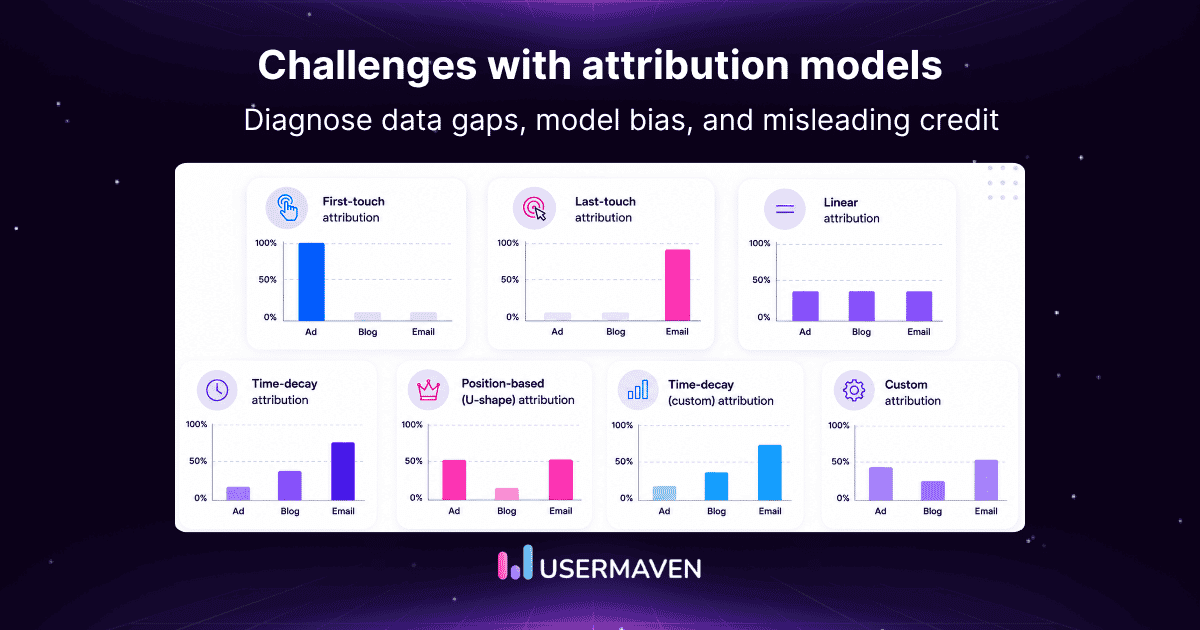
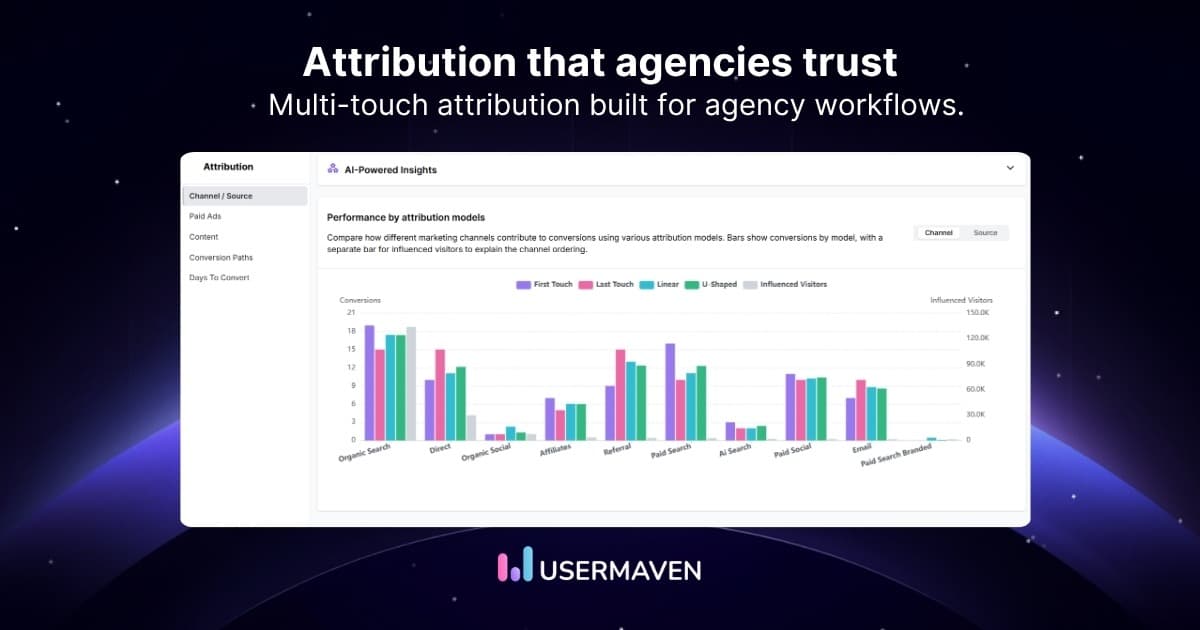
Usermaven offers seven flexible models: first touch, last touch, linear, time decay, position-based, data-driven, and custom rules. Agencies can compare models side by side for each client.
This helps explain why a branded search campaign looks strong under last click but less impressive when early touches get credit.
Standout features
- Maven AI connects conversions to source channels and surfaces practical recommendations so teams see which campaigns to scale or pause instead of facing raw data tables.
- Usermaven offers full white-label reporting so agencies can present dashboards, reports, and analytics entirely under their own brand. It also supports pixel white labeling, meaning the tracking script itself runs under the agency’s domain rather than Usermaven’s.
- Usermaven uses cookieless tracking and ad-blocker-aware methods that reach about 99% data accuracy across visits.
- Setup takes a few minutes with a no-code script. Native integrations include Google Ads, Meta, LinkedIn Ads, Google Search Console, Slack, BigQuery, and Shopify, fitting both SaaS and ecommerce client accounts.
- Plans start at $84/month for 250K events, offering agencies enterprise-grade attribution at an accessible price point.
Best for
Agencies of all sizes that need AI-guided attribution, white-label-ready reporting, and predictable pricing across growing client portfolios.
2. Ruler Analytics: Best for agencies with offline and online attribution needs
Ruler Analytics focuses on connecting online marketing with offline results for agencies that care about phone calls, consultations, and in-person conversions.
What it does
It links website behavior, form fills, and call tracking with CRM data, then passes verified revenue back to ad platforms for more accurate optimization.
This helps performance teams show how Google Ads, Meta, or Microsoft Ads influence leads that convert on the phone.

Attribution models
Ruler supports first touch, last touch, linear, time decay, and full path models, so agencies can view both early awareness and final conversion triggers.
Standout features
The tool records phone calls alongside digital touches, closing a gap that often hides the value of branded search or local service campaigns. Closed-loop reporting down to the keyword level gives account managers better talking points during client reviews.
Best for
Performance-focused agencies whose clients rely on calls or offline sales, such as B2B services, healthcare, or local professional firms.
3. Cometly: Best for lead generation and performance agencies
Cometly serves performance marketers and agencies that live inside paid media accounts all day.
What it does
It tracks every click, lead, and sale back to the exact ad and audience that drove it, helping teams scale winners and cut losing creatives quickly. Its first-party tracking methods help close gaps created by iOS privacy changes and ad blockers.

Standout features
- Real-time dashboard showing which ads actually drive revenue, not only clicks or cheap leads
- Multi-account management so teams can switch between clients without redundant setup
- Deep integrations with Google Ads and Meta for more accurate ROAS views than platform numbers alone
Best for
Lead generation and performance agencies that focus on paid acquisition and need granular ad-to-revenue mapping rather than broad multi-channel modeling.
4. HockeyStack: Best for enterprise B2B agencies
HockeyStack targets revenue teams and agencies working with enterprise B2B clients.
What it does
It tracks full-funnel paths from the first anonymous visit through the marketing qualified contact, opportunity, and closed revenue. Strong CRM connections let it attribute pipeline and bookings to campaigns, channels, and content pieces.

Standout features
- Account-level reporting for B2B environments where buying decisions involve several stakeholders
- Visibility into how webinars, LinkedIn posts, or events influenced a deal
- Justifies spending beyond last-click logic for complex buying groups
Pricing
It begins around $2,200/month for approximately 30,000 visitors, placing it firmly in the enterprise tier. Exact pricing is available upon request from sales.
Best for
Agencies that serve high ACV B2B accounts and present attribution data to CMOs, CROs, and revenue operations leaders who expect deep account paths. See b2b marketing attribution for more context on this approach.
5. Dreamdata: Best for B2B SaaS agencies
Dreamdata works especially well for B2B SaaS brands with long, complex sales paths and product-led growth motions.
What it does
It stitches data from ads, websites, CRMs, product usage logs, and support tools into account-level timelines, helping agencies show how top-of-funnel programs support pipeline and recurring revenue, not just first demo requests.

Standout features
- Dreamdata supports direct connections with major marketing and data tools, including Google BigQuery, JavaScript tracking, Outreach, HubSpot, Microsoft Dynamics 365 and others, enabling unified attribution and revenue reporting across your entire stack.
- Highlights how different touches influence ARR and MRR growth
- Connects marketing and product usage data in one unified view
Best for
Agencies specializing in B2B SaaS that need account-based attribution with deep visibility into how marketing and product usage work together.
6. Triple Whale: Best for e-commerce and DTC agencies
Triple Whale focuses on e-commerce and direct-to-consumer brands that move fast on paid social.
What it does
A pixel placed on client sites collects cross-channel behavior, then feeds dashboards that show performance by channel, creative, and audience. The built-in data warehouse keeps historical records in one place for seasonal comparisons.

Standout features
- AI features surface campaigns that acquire new customers at a healthy cost
- Strong integrations with Shopify, Meta, and TikTok
- Tracks social and search spend against repeat purchases, not just first orders
Best for
Small and mid-sized agencies running paid acquisition for e-commerce and DTC brands that want a fast, e-commerce-native view of attribution.
7. Wicked Reports: Best for paid acquisition agencies focused on new customer revenue
Wicked Reports centers on first-party tracking for e-commerce, with a special focus on separating new customer revenue from returning customer revenue.
What it does
It helps agencies prove which campaigns truly bring in fresh customers, exposing how retargeting campaigns can look impressive on paper by targeting buyers who would have purchased anyway.

Standout features
- Rich integrations with Google, Meta, Pinterest, and other channels
- Maps clicks and conversions back to recurring revenue
- Avoids double-counting and bias caused by heavy remarketing
Best for
Paid acquisition agencies that need to answer tough questions about cost per new customer and cannot rely on blended ROAS alone.
8. AttributionApp: Best for cost-conscious agencies managing multi-channel paid programs
AttributionApp provides user-level cost tracking across many paid channels.
What it does
It pulls actual spend from ad platform APIs and links that cost to each user path rather than relying on UTM guesses or platform conversions, producing per-user CAC and ROAS numbers that align with finance data.

Standout features
- Configurable multi-touch models with click-through transparency on every metric
- Raw data exports to BigQuery, Snowflake, and Redshift
- Marketing mix modeling and incrementality tests included, rare at this price tier
Pricing
Entry plans start at $19/month for ecommerce brands.
Best for
Cost-conscious teams that still need accurate multi-channel attribution and warehouse access with various connectors.
9. Rockerbox: Best for omnichannel agencies combining digital and brand spend
Rockerbox serves agencies that manage both performance digital and upper-funnel brand campaigns.
What it does
It centralizes data from paid search, paid social, display, connected TV, direct mail, and more into one measurement layer, helping explain how TV or podcast spend influences search and direct traffic.

Standout features
- Blends multi-touch attribution with marketing mix modelling and incrementality tests
- Answers both micro questions about specific campaigns and macro questions about channel mix
- Reduces the need for separate tools across online and offline efforts
Best for
Mid-sized and larger agencies handling omnichannel clients that want one place to evaluate digital, brand, and offline efforts together.
10. Northbeam: Best for teams combining MTA, MMM, and incrementality testing
Northbeam is a marketing intelligence platform designed to help brands measure and grow profitably.
What it does
Northbeam provides a single measurement layer that connects short‑term campaign insights with long‑term strategic planning. Its combined MTA + MMM approach helps teams understand both immediate conversion drivers and broader channel effectiveness.

Standout features
- Multi‑touch attribution for granular, campaign‑level visibility
- MMM+ for strategic, long‑term channel planning
- Incrementality testing to validate true lift and performance impact
- Unified measurement framework designed to improve ROAS, CVR, and CAC
Best for
Teams that want a single, integrated platform combining MTA, MMM, and incrementality to evaluate both tactical and strategic marketing performance.
Attribution software for agencies: comparison table
Every agency has a different mix of client sizes, industries, and sales paths. Use this table to narrow down a shortlist before booking demos or trials.
| Tool | Best for | Attribution models | Starting price | White-label |
|---|---|---|---|---|
| Usermaven | All agency sizes | 7 models incl. AI | $84/month | Yes |
| Ruler Analytics | Offline + online attribution | 5 models | Contact for pricing | No |
| Cometly | Lead gen ad agencies | First-party MTA | Custom pricing | Yes |
| HockeyStack | Enterprise B2B SaaS | Account-level | ~$2,200/month | No |
| Dreamdata | B2B SaaS revenue teams | Account-level | Custom pricing | No |
| Triple Whale | E-commerce/DTC brands | Multi-touch | $149/month | No |
| Wicked Reports | Paid acquisition teams | First-party MTA | $499/month | No |
| AttributionApp | Cost-conscious teams | 5 attribution models | $19/month | No |
| Rockerbox | Omnichannel attribution | MTA + MMM | Custom pricing | No |
| Northbeam | High-volume paid teams | Predictive MTA | Custom pricing | No |
Managing clients across multiple channels simultaneously makes this comparison essential before committing time to demos or trials.
See what's working. Fix what's not. Grow faster.
How to choose the right attribution software for your agency
Choosing attribution software for agencies is less about finding the most powerful tool and more about finding the one your team will actually use correctly across every account.
An agency managing local service brands with 24-hour conversion cycles needs a very different setup than one focused on analytics tools for SaaS brands with 90-day sales cycles and multi-stakeholder buying committees.
Use this checklist to shortlist before booking demos:
- Can it handle multiple clients easily? A true multi-client workspace lets account managers switch between brands from a single login without separate tool instances or messy permission exports. If each client needs a separate account, the tool will cost more time than it saves.
- Can we show clients clean, branded reports? White-label capability is a standard agency requirement. The tool must let you remove vendor branding and present dashboards under your own logo. Tools that force client-facing reports to show their own brand undermine agency positioning.
- Does it integrate with ad platforms and CRM? Verify native, maintained connections to Google Ads, Meta, LinkedIn, HubSpot, Salesforce, and Shopify for your client roster. An API connection is not the same as a deep integration, and if it requires manual exports to complete a report, the tool creates work rather than removing it.
- Is the setup manageable across accounts? If onboarding a new client account requires a developer, that becomes a bottleneck on every new business win. Tools with no-code setup mean account managers can activate attribution the same week a client signs.
- Is pricing scalable as clients grow? Per-seat or per-event pricing models can quietly erase margin on smaller retainers when client volume rises. Check whether pricing scales predictably with event counts and account numbers.
- Is attribution accurate enough to trust? Tools like Usermaven use cookieless tracking and ad-blocker bypass to maintain near-complete data coverage. Tools that lose 20-30% of sessions in privacy-focused browsers produce reports that undercount performance, which creates the same credibility problem they are supposed to solve.
- Does it support the client’s business model? An e-commerce brand needs short-cycle attribution with repeat purchase tracking. A B2B SaaS client needs account-level paths tied to the CRM pipeline. A local service business needs offline call tracking. One tool rarely fits all three equally well.
What to look for in attribution software for agencies

A few shared traits separate agency-ready attribution tools from generic analytics platforms:
- Flexible attribution models: Choose from first‑touch, last‑touch, linear, time‑decay, position‑based, and data‑driven attribution options to align reporting with each campaign’s goals, rather than forcing a single view across all clients.
- Privacy and consent features: Cookieless tracking, consent handling, and ad-blocker-friendly methods keep data accurate while staying aligned with GDPR and CCPA.
- True multi-client workspaces: A genuine multi-client dashboard lets account managers switch between brands in seconds without separate logins or messy user permissions.
- White-label reporting: White-label analytics and branded dashboards keep the focus on the agency brand when sharing reports or presenting in client meetings.
- Deep integrations: Native connections to Google Ads, Meta, LinkedIn, HubSpot, Salesforce, and Shopify remove spreadsheet work and reduce manual errors.
- Pricing that scales with client volume: Pricing should scale with client volume and event counts so a single tool does not quietly erase margin on smaller retainers.
Challenges agencies face with attribution
Attribution is harder for agencies than for in-house teams. The same technical problems that affect every business are amplified when you are managing them across 10 or 20 different client accounts simultaneously.
Platform double-counting at scale
When a single client’s Google, Meta, and LinkedIn campaigns all claim the same conversion, the number is irritating. When that happens across 15 clients at once, it becomes a credibility crisis.
Independent cross-channel marketing attribution gives agencies one canonical number per client that all three platforms reference, instead of three inflated figures to reconcile on a Friday afternoon.
Fragmented client tech stacks
One client uses HubSpot and Meta. Another runs Salesforce and LinkedIn. A third uses Shopify and TikTok. Each stack requires different integration logic, different UTM conventions, and different reporting structures.
Tools that handle only one stack type force agencies to run multiple attribution platforms, which creates overhead and inconsistency in how results are reported across accounts.

White-label reporting pressure
Clients expect to see reports under the agency’s brand, not the software vendor’s logo. When a dashboard shows a competitor’s name, clients start asking whether they could buy the tool directly and cut out the agency.
White-label capability protects the agency relationship and maintains the positioning of the agency as the strategic layer above the technology.
Attribution disputes during contract renewals
The highest-risk moment for attribution accuracy is renewal season. A client who sees 200 platform conversions in the dashboard but only 150 in their CRM will raise that gap during the contract conversation.
Agencies with clean, independent attribution data walk into that conversation with a reconciled number. Agencies without it spend the meeting defending the gap instead of presenting growth plans.
Privacy compliance across client industries
Agencies with clients in healthcare, finance, or legal sectors face stricter data handling requirements than direct-to-consumer brands. A single attribution platform that is not GDPR and CCPA-compliant can create legal exposure across every client that uses it.
See Usermaven in action
Book a free demo and discover how powerful analytics can grow your business.
Privacy-first tools with cookieless tracking solve this at the platform level, so compliance does not become a per-client configuration problem.
Conclusion: Right attribution software turns spend into proof
Platform-reported ROAS often paints a rosy picture that does not match the profit and loss statement. Independent attribution software for agencies closes that gap by counting each revenue dollar once and spreading credit across the real path.
With that view, budget conversations shift from argument to adjustment.
The best choice depends on client type, channel mix, and team capacity rather than a single feature checklist. Usermaven gives agencies a practical balance of AI guidance, privacy-first tracking, flexible models, and pricing that fits both small retainers and growing programs.
Platform ROAS is marketing fiction. Attribution data is client reality.
Agencies that prove attribution keep clients. Those who cannot risk losing them.
Ready to see Usermaven in action? Explore the platform or book a demo for a closer look.
FAQs
1. How much does agency-focused attribution software cost?
Agency attribution tools range from affordable entry options to enterprise-level pricing. Usermaven begins at $84/month for 250K events and includes multi-touch models, AI-powered insights, and white-label-ready reporting.
2. What are the best attribution software options for marketing agencies?
The best fit depends on your client base and channel mix. Usermaven stands out as a strong all-around choice for agencies of all sizes, with seven attribution models, AI guidance, and tracking at an accessible price.
Ruler Analytics helps when calls and offline conversions are part of the client journey. HockeyStack and Dreamdata suit enterprise B2B and SaaS agencies. Triple Whale and Northbeam focus on e-commerce and paid social clients.
3. Which attribution software do top digital agencies use for client campaigns?
Top digital agencies favor tools with multi-touch attribution, multi-client workspaces, and white-label output. Performance agencies frequently use Usermaven, Cometly, or Ruler Analytics for day-to-day media decisions. Enterprise-focused agencies lean toward HockeyStack or Dreamdata.
E-commerce specialists often pick Triple Whale, Northbeam, or Wicked Reports to track paid social performance and repeat purchase attribution.
4. What are the top attribution platforms for digital marketing agencies?
The top attribution platforms for agencies in 2026 include Usermaven, Ruler Analytics, Cometly, HockeyStack, Dreamdata, Triple Whale, Wicked Reports, AttributionApp, Rockerbox, and Northbeam. Each serves a different agency vertical.
The right answer comes from matching the tool to your client roster and reporting needs, not from a universal ranking.
5. What is the difference between multi-touch attribution and last-click attribution?
Updated

Written by
Junaid Ahmed
Content Writer & Digital Marketer
Junaid Ahmed is a content and copywriter with 3+ years of experience creating research-driven content across SaaS, B2B, ecommerce, and digital marketing. He specializes in turning complex topics into clear, practical content that helps marketers better understand their challenges, evaluate solutions, and make informed decisions. His work spans educational content, industry insights, and actionable marketing guides.
All articles by Junaid →