Startup ad budgets disappear fast when nobody can see which clicks, posts, or emails created real customers. Marketing attribution for startups solves that problem by tying every signup or deal back to the touch-points that moved it. When that link is clear, growth teams stop guessing and start investing with confidence.
Without that clarity, founders and marketers juggle Google Ads, Meta, LinkedIn, and content while hoping dashboards tell the truth. Budgets drift toward loud channels instead of effective ones, and runway shortens without clear proof of return.
Here we’ll cover what marketing attribution means for startups, why lean teams can’t afford to ignore it, which models fit each growth stage, and how privacy shifts change measurement. We also show how Usermaven ties it all together.
Ready to make every dollar answer for itself so growth feels intentional instead of lucky? Keep reading.
Key takeaways
Marketing attribution for startups helps you see which channels actually drive revenue so you stop guessing and start spending smarter.
Your attribution model choice matters. Different models favor different funnel stages, so picking the wrong one quietly shifts budget away from channels that are actually working.
Single-touch models are simple; multi-touch models are more accurate. The right choice depends on your stage and how much data you have.
UTM tagging is non-negotiable. Without clean, consistent tags, traffic gets buried under “direct traffic,” and your reporting falls apart before it starts.
Attribution only works if your data is clean. Messy UTM tags and inconsistent naming conventions will silently corrupt your reports from day one.
Start simple, then scale. Answer a few clear questions well before adding complexity. Layered models make more sense once you have the volume to support them.
What is marketing attribution and why does it matter for startups?
Marketing attribution for startups means assigning credit for each conversion or revenue event to the specific touchpoints that led up to it. These touchpoints include paid ads, search, social posts, emails, website content, and sales activities, all stitched into one path. When that path is visible, teams can see which channels truly bring customers and which only seem busy.
Put simply, attribution is the discipline that answers three everyday questions: Which channels are bringing in high-quality leads? Where should extra budget go next month? Which campaigns look good in-platform but fail to drive revenue in your CRM? A clear attribution view turns those guesses into measurable choices.
For young companies, this is not just a reporting layer. Limited runway means every dollar must defend its spot in the plan. Treating marketing attribution as survival infrastructure keeps growth from being driven by intuition alone.
Attribution also sharpens message and audience decisions. When founders see that a certain webinar plus a follow-up email sequence closes deals at a higher rate than cold ads, they can design more paths like that instead of just bidding higher. Over time, this kind of feedback loop creates a tight connection between startup growth marketing and actual revenue.
Which attribution models should your startup actually use?
Attribution models are rule sets that decide how much credit each touchpoint gets along a customer path. Model choice directly affects how ROI is measured and reported, so for startups, smart model selection focuses on the decisions you need to make right now, not on matching an enterprise setup. Start with the simplest view that answers your main budget questions, then increase sophistication as your data grows.

Single-touch models give 100 percent of credit to one interaction:
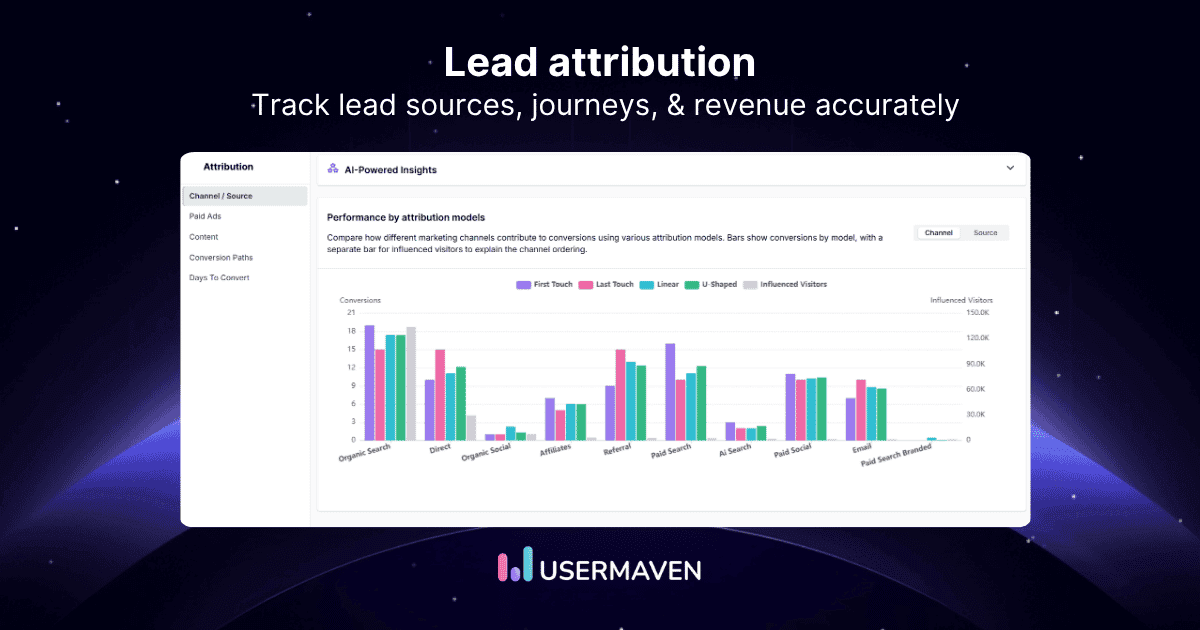
With first click attribution, the very first touchpoint wins, which helps you see which channels introduce fresh visitors.
With last click attribution, the final interaction before conversion takes all the credit, which favors branded search and retargeting.
These views are quick to explain but carry strong attribution bias. First-touch makes brand and content channels look strong while underestimating nurture activity like email. Last-touch makes awareness work look weak, even when blog posts or social threads quietly fill your funnel.
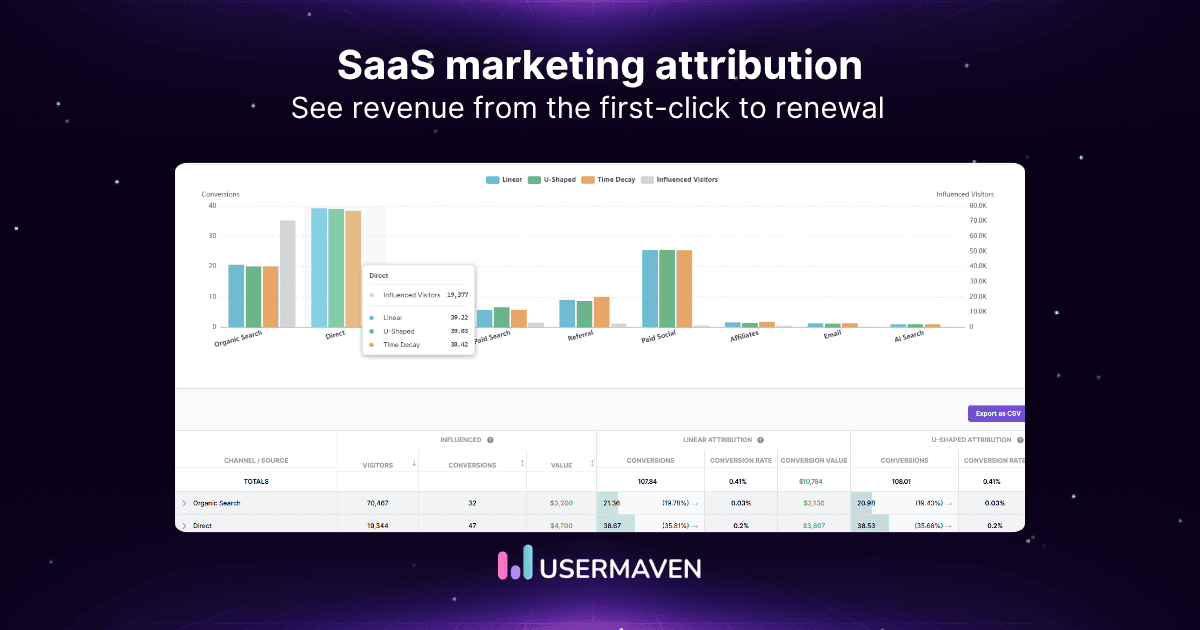
Multi-touch models spread credit across the full path so you can see how channels work together. A multi-touch attribution setup might use:
A linear model where all touches share credit
A time-decay model that favors recent touches
Position-based models like U-shaped and W-shaped that reward key milestones
These approaches bring more nuance, especially for B2B or SaaS paths that have many steps.
Data-driven attribution takes this further by learning from real paths instead of following fixed rules. It analyzes both converting and non-converting paths to estimate how much each touchpoint truly changes conversion odds. According to Google Ads Help, data-driven attribution now serves as the default model for most new conversion actions in Google Ads, a shift supported by research on evolving attribution models in digital advertising that examines how clicks, views, and full customer journeys are increasingly balanced together.
The upside is more realistic credit, especially across many campaigns. The catch is that startups need enough conversions and clean tracking before this sort of attribution modeling pays off. With thin data, a simple rule-based model inside a focused tool like Usermaven often gives more trustworthy answers.
How to choose the right attribution model at each startup stage
Choosing the right attribution model at each startup stage keeps measurement aligned with how your business actually works. The goal is to match complexity with data maturity instead of jumping straight into an enterprise setup. Here is a simple path you can follow.

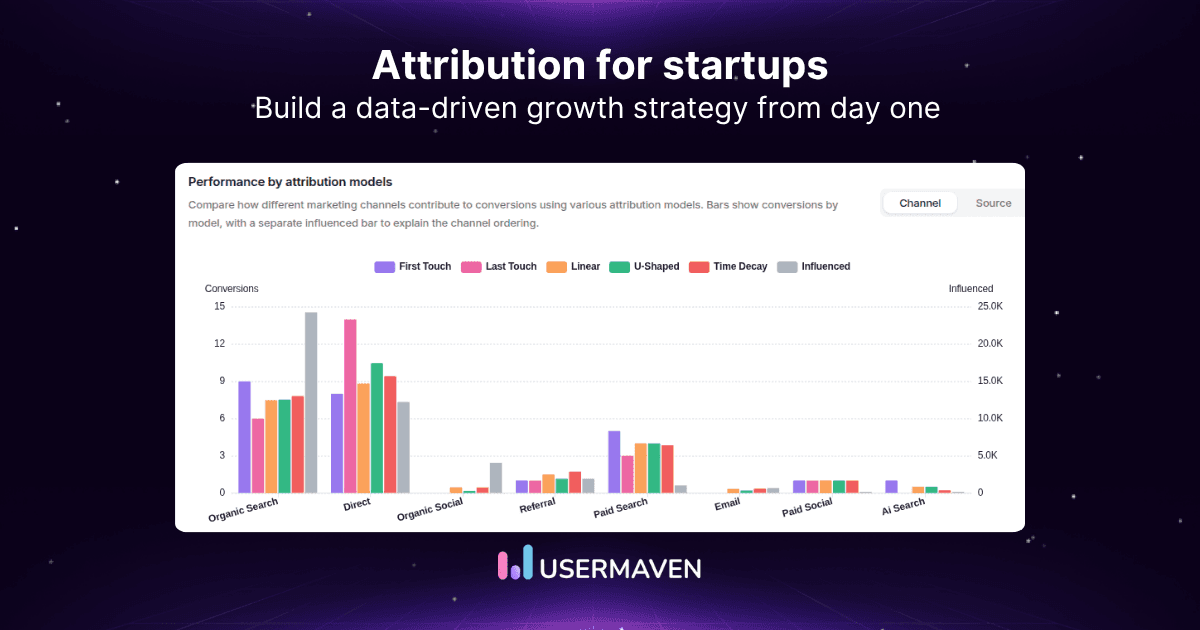
Pre-scale teams benefit most from running first-touch and last-touch views side by side. One view shows which efforts attract brand new visitors, and the other reveals what closes conversions. During this phase, a written UTM standard plus a clean analytics setup does more for accuracy than any advanced marketing attribution models.
Growth stage companies with rising paid spend often gain from U-shaped or W-shaped multi-touch setups. Those models reward both early discovery and late-stage conversion work, so content and retargeting get fair credit. A platform such as Usermaven, which supports many models in one place, helps teams compare views without exporting data into spreadsheets.
Scale-stage startups with several acquisition channels can start leaning on data-driven views and more advanced comparisons. This is also when questions about multi touch attribution vs marketing mix modeling begin to matter for annual planning. At this level, attribution connects directly to finance decisions, not just media tweaks.
Across every stage, the key rule is to use multiple models as cross-checks instead of hunting for a single source of truth. The smarter question is which model is least wrong for the decision in front of you, such as bid changes or annual budget shifts. When teams treat model output as guidance plus context from sales and customer feedback, they get a much steadier growth marketing strategy.
The biggest attribution challenges startups face in 2026
The biggest attribution challenges startups face usually come from messy data rather than from the models themselves. Platform-silo views, cross-device gaps, and overconfidence in one model all distort decisions. Solving those issues turns marketing analytics for startups into a reliable growth partner instead of a confusing report.

Alt text: “Infographic of top startup attribution challenges paired with practical solutions”
Platform silos are often the first problem. Google Ads, Meta, LinkedIn, and email tools all tend to claim full credit inside their own dashboards. That makes every channel look like a hero. The fix is centralizing traffic and conversion data into one view that supports proper marketing channel attribution across paid, organic, referral, and email.
Disconnected stacks create similar trouble. If your ad platforms are not tied to your CRM or product data, you will see leads instead of actual customers. That gap hurts revenue attribution and hides true CAC. A tool like Usermaven, which combines website analytics, product analytics, and funnels, gives you cross-channel marketing attribution tied to real business outcomes.
Model misuse is another common trap. A startup that relies only on last-click will cut brand campaigns that quietly fill the top of the funnel. A team that trusts only first-touch will think retargeting and sales outreach do not matter. Research from Salesforce shows that high performers connect more data sources than underperformers, which underlines how important a complete view is.
The most reliable way to pressure-test any attribution model is through simple experiments. Pause spend in one region, shift a budget, or split an audience, then watch what changes. These incrementality checks cut through model assumptions and show you what is actually driving conversions.
How privacy changes and cookieless tracking are reshaping attribution
Privacy changes and cookieless tracking shifts have fundamentally changed what reliable attribution looks like for startups. Here is what is driving that shift:

iOS 14.5 App tracking transparency: Apple required apps to ask users for permission before tracking them across other apps and websites. Most users declined, which created significant blind spots in paid social reporting, especially on Meta.
Browser-level cookie restrictions: Safari and Firefox block third-party cookies by default. Many Chrome users add their own blockers on top of that. Even without full cookie deprecation, cookie-based attribution already misses a meaningful share of your traffic.
GDPR and CCPA compliance requirements: These regulations dictate what data you can collect, how long you can keep it, and how you must communicate its use to visitors. Non-compliance carries real financial and reputational risk.
Ad blocker adoption: A growing share of your audience actively blocks tracking scripts, which means traditional pixel-based tools undercount conversions before you even factor in the above.
The practical response is to build first-party data collection into your product touchpoints, such as logins, trials, and newsletters, and to rely on cookieless attribution methods that do not depend on fragile third-party infrastructure. That way, your attribution stays accurate as the rules keep changing.
How Usermaven simplifies marketing attribution for early-stage startups
Usermaven makes marketing attribution for startups practical by combining flexible models, reliable tracking, and AI guidance in one place. Instead of piecing together views from several tools, growth teams can read the entire customer path from first touch to subscription or purchase. That simplicity matters when you do not have a full-time analyst.
Here is what makes it stand out:
Seven attribution models in one place: Attribution inside Usermaven centers on a multi-touch engine that supports seven different models, from first-touch to full conversion path. You can switch models with a couple of clicks, compare how each one values campaigns, and choose the view that fits a specific decision. This setup lines up perfectly with the “least wrong for the job” mindset that strong growth teams follow.
Unified cross-channel view: Usermaven pulls traffic from Google Ads, Meta, LinkedIn, Shopify, and organic search into a single source of truth. Instead of trusting platform-reported numbers, you see one combined view of cross-channel marketing attribution and revenue impact. That view connects directly to funnels, user paths, and company-level profiles in the Contacts Hub, so you can answer questions like which campaigns move expansion revenue, not just free trials.
Accurate tracking: Usermaven uses cookieless, regulation-friendly tracking that still captures about 99 percent of events, even when visitors use ad blockers. Auto-tracked events and pinned events mean you get accurate conversion tracking for startups without begging developers for custom code.
AI-powered insight with Maven AI: Maven AI, the built-in assistant, reads across funnels, cohorts, and attribution models to surface insights you might otherwise miss. It highlights leaks in your marketing funnel attribution, points out channels that influence high-value customers, and suggests experiments worth running.
Together, these features help startups follow a data-driven growth pattern without hiring a full data team.
How to implement marketing attribution in 30 minutes
You don’t need a complex setup to start making smarter attribution decisions. Here’s a lean process you can complete in a single session.
1. Define one conversion goal
Pick the single action that matters most right now: a demo booking, a free trial signup, or a purchase. Attribution only works when everyone agrees on what counts as a win. Don’t try to track five goals at once when you’re starting out.
2. Standardize your UTM naming convention
Inconsistent UTMs are one of the most common reasons attribution data becomes unreliable. Agree on a naming format across your team before you run another campaign. For example:
utm_source: google, linkedin, newsletter
utm_medium: cpc, email, organic
utm_campaign: spring-launch, retargeting-q2
Keep it lowercase, use hyphens instead of spaces, and document it somewhere everyone can find it.
3. Connect your ad platforms
Link Google Ads, Meta, and LinkedIn (whichever you’re running) to your analytics data stack. Most platforms offer native integrations with Google Analytics 4 or your CRM. This step ensures your spend data and conversion data are in the same place.
4. Install attribution software
You don’t need an enterprise tool on day one. For early-stage startups, Usermaven with proper UTM tracking gets you surprisingly far. If you’re running multi-channel paid campaigns, Usermaven’s attribution features give you more granular control across channels without requiring a data engineer.
5. Compare first-touch vs last-touch
Once your data starts flowing, pull a side-by-side report of first-touch and last-touch attribution for your top channels. The gap between them tells you a lot. If paid social drives most first touches but gets zero credit in last-touch reports, you’re likely undervaluing it in budget decisions.
6. Review attribution weekly
Set a recurring 30-minute block each week to review which channels are driving conversions and whether your model is telling a consistent story. Attribution isn’t a one-time setup; it’s an ongoing input into your spend decisions. Weekly check-ins keep you from making big budget calls based on stale or misleading data.
The bottom line
Marketing attribution for startups is about matching the right model to the right decision and refining your approach as you grow. This guide walked you through the core models, how to pick them, and how to layer in complexity over time. The goal is to treat your dashboards as inputs that guide smarter decisions, not final verdicts.
The most reliable path starts with clean UTM tagging and parallel first and last-touch views. As conversion volume grows, you can move toward position-based multi-touch models, and later add data-driven approaches and testing for major budget calls. Throughout that path, cross-channel measurement keeps your reports stable as tracking rules change.
Ready to see Usermaven in action? Explore the platform or book a demo for a closer look.
Prefer a guided walkthrough? Book a demo and see exactly how Usermaven fits your growth stack.
Frequently asked questions
What is the best attribution model for an early-stage startup?
The best tool for an early-stage startup is Usermaven, which makes it easy to run both first-touch and last-touch attribution side by side without complex setup. First-touch shows which channels bring in net-new visitors, while last-touch reveals what actually closes signups or deals. Other tools like GA4 or HubSpot can help too, but require more configuration. Always use consistent UTM tags so traffic does not vanish into “direct.”
What is the difference between first-touch and last-touch attribution?
First-touch attribution gives 100 percent credit to the very first interaction a prospect had with your brand. That makes it useful for understanding which campaigns drive initial awareness or top-of-funnel leads. Last-touch attribution gives full credit to the final interaction before conversion, which highlights bottom-funnel channels like branded search and retargeting. Used together, they provide a simple but powerful diagnostic pair.
How does multi-touch attribution work for B2B startups?
Multi-touch attribution spreads credit across the full path instead of picking a single winner. For B2B marketing attribution, models like U-shaped or full-path often fit best because they reward first-touch, lead creation, and final conversion milestones. This pattern matches long B2B cycles with many touches. The key is to review model choices regularly so weights do not drift away from how your real sales process works.
What is UTM tracking and why does it matter for attribution?
UTM tracking uses small query tags on URLs to tell analytics tools where each click came from. Parameters such as source, medium, and campaign identify whether a visitor arrived from a Google search ad, a Meta ad, or a newsletter click. Without a clear UTM standard, even advanced attribution software cannot classify visits correctly. Clean tags are the foundation beneath every reliable attribution report.
Updated

Written by
Imrana Essa
SaaS Marketing Lead
Imrana Essa is a marketing lead and content strategist with 8+ years of experience creating and leading content for B2B and SaaS brands. She specializes in marketing analytics, attribution, content strategy, and organic growth, translating complex marketing concepts into clear, actionable insights. Her work focuses on helping marketers understand performance, make data-informed decisions, and build strategies that contribute to sustainable growth.
All articles by Imrana →