A SaaS company closes two $40,000 deals. One customer later expands to $95,000 in annual revenue. The other churns after four months. An attribution report that stops at Closed Won would call those customers equally valuable.
That is the core SaaS attribution problem. Marketing does not create value only at the first conversion. Acquisition quality continues through activation, pipeline, recurring revenue, retention, expansion, and lifetime value.
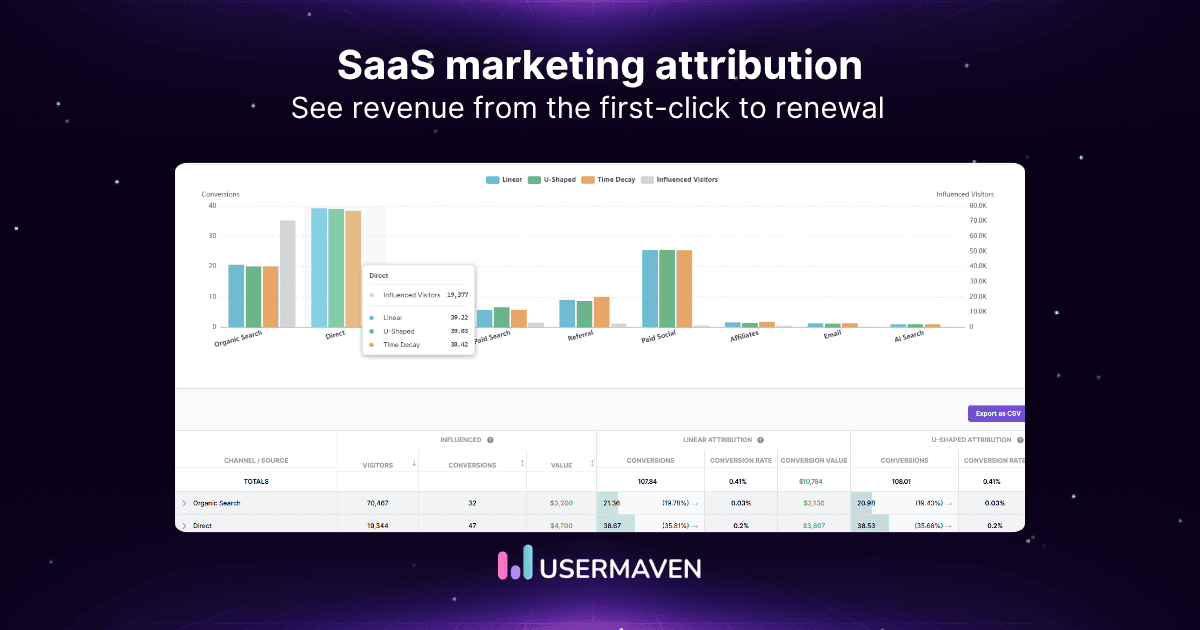
This guide explains how marketing attribution should work for product-led, sales-led, and hybrid SaaS. It also shows what modern SaaS marketing attribution software should connect across identity, dark-funnel influence, metrics, implementation, measurement trust, and AI.
SaaS marketing attribution at a glance
SaaS marketing attribution connects marketing channels and touchpoints with SaaS outcomes such as signup, activation, pipeline, recurring revenue, retention, expansion, and LTV. The setup should follow the company’s go-to-market motion rather than start with a favorite attribution model.
| Question | Short answer | Why it matters |
| What does SaaS attribution measure? | Marketing contribution across acquisition, product, pipeline, revenue, and retention | SaaS value continues after conversion |
| Does every SaaS company need the same setup? | No | PLG, sales-led, and hybrid journeys differ |
| Is Closed Won enough? | No | Renewal, churn, and expansion change customer value |
| Does attribution prove causality? | No | Incrementality answers a different question |
| What makes attribution trustworthy? | Clean collection, identity, CRM, and revenue data | Models cannot repair broken measurement |
| What is the most important SaaS outcome? | It depends on the motion | Activation may matter more in PLG; pipeline may matter more in sales-led SaaS |
Key takeaways
- SaaS attribution continues after conversion: Acquisition quality is incomplete until activation, retention, expansion, and LTV are visible.
- GTM motion changes the setup: PLG, sales-led, and hybrid SaaS require different events, identities, outcomes, and reporting.
- The model is not the starting point: First define the business outcome and measurement architecture, then choose the credit model.
- B2B SaaS requires account identity: Multiple people can influence one opportunity, so person-level attribution alone can fragment the journey.
- Dark-funnel influence remains partly invisible: Tracked attribution should be combined with CRM and self-reported evidence.
- Attribution does not prove incrementality: Credit allocation and causality are separate questions.
- Trust comes before optimization: Missing UTMs, identity gaps, CRM issues, or duplicated conversion signals can make sophisticated models misleading.
What is SaaS marketing attribution?
SaaS marketing attribution is the process of connecting marketing interactions with SaaS outcomes across the customer lifecycle, including signup, activation, pipeline, Closed Won revenue, retention, expansion, and LTV.
That definition is broader than assigning conversion credit to an ad click or landing page.
A SaaS customer can keep creating or destroying value for months after the initial sale, so acquisition performance should not be judged only at the moment of conversion.
| Channel → visitor → signup/lead → activation → opportunity → revenue → retention → expansion → LTV |
A reliable setup connects conversion tracking with the business events that matter after the first conversion. A PLG business may emphasize activation and upgrade. A sales-led business may emphasize opportunity creation and ARR.
Why SaaS attribution is different
SaaS attribution uses many of the same tracking methods and attribution models as other businesses, but the journey being measured is structurally different.
Revenue recurs, product usage matters, accounts contain multiple people, and buying cycles can vary from minutes to months.
Revenue continues after the first sale
Closed Won tells the team that acquisition worked once. It does not reveal whether that customer renewed, expanded, contracted, or churned. Two channels can create the same initial ARR and very different long-term economics.
Product usage can be part of the conversion
For product-led and hybrid SaaS, signup is often only the beginning. Activation, feature adoption, product-qualified behavior, upgrade, and retention can be better indicators of customer quality than form fills or trial volume.
Multiple people can belong to one account
A champion may discover the brand through organic search, a technical evaluator may attend a webinar, and an economic buyer may enter through a sales conversation.
If those contacts stay separated, the attribution journey fragments even though the revenue belongs to one account.
Sales cycles and attribution windows vary
Self-serve SaaS may convert in hours or days. Enterprise SaaS may take months. One fixed attribution window can therefore exclude important touches from one motion or include irrelevant ones from another.
Dark-funnel influence is common
Peer recommendations, private communities, podcasts, review sites, unclicked LinkedIn exposure, events, and sales conversations may influence a deal without producing a clean measurable click.
SaaS attribution has to work with that uncertainty instead of pretending every influence is observable.

SaaS attribution should follow the go-to-market motion
A product-led company and a sales-led enterprise SaaS company can use the same attribution model and still require completely different measurement systems. The first design choice is the go-to-market motion, not first touch versus last touch.
Product-led SaaS
| Channel → signup → activation → product use → upgrade → retention → LTV |
PLG attribution should connect acquisition with the moments where users experience product value.
That requires website and product analytics data to sit close enough to attribution that marketing can compare channels by activation, upgrade, and retention rather than signup volume alone.
The core question is simple: which acquisition sources create users who reach value and stay?
Sales-led SaaS
| Channel → person → account → MQL/SQL → opportunity → Closed Won → ARR → renewal |
Sales-led attribution needs stronger account identity and CRM completion. The key outcomes are usually qualified pipeline, opportunities, Closed Won revenue, and ARR.
This is the same account-level measurement problem covered in B2B marketing attribution, but applied specifically to recurring SaaS economics.
Unlock insights that drive growth
Hybrid SaaS
| Channel → signup → product activity → PQL → sales → opportunity → revenue → retention |
Hybrid SaaS is often the hardest motion to measure because marketing, product, and sales each create meaningful milestones.
A user can self-serve into the product, become product-qualified, and only later enter a sales-led opportunity.
The attribution system needs to preserve that path instead of restarting the journey when the CRM takes over.
GTM-motion comparison
| SaaS motion | Primary conversion | Primary identity | Most useful downstream outcome |
| PLG | Activation / upgrade | User | Retention / LTV |
| Sales-led | Opportunity / Closed Won | Account | ARR / pipeline |
| Hybrid | PQL + opportunity | User + account | Revenue + retention |
| Enterprise | Qualified account / opportunity | Account | ARR + renewal |
Identity and buying committees in B2B SaaS
Attribution breaks when the system cannot tell which anonymous sessions, users, CRM contacts, and company records belong to the same revenue journey. This is an identity problem before it is an attribution-model problem.
From anonymous visitor to revenue account
| Anonymous visitor → identified user → CRM contact → company/account → opportunity → revenue |
The chain can fail at several points. Anonymous activity may never stitch to the signed-up user, and duplicate contacts can split one person into several records.
Multiple contacts may never be associated with the same company or opportunity. CRM amounts can also be missing or stale.
Person-level versus account-level attribution
Person-level journeys work well for many self-serve motions. Account-level attribution becomes more important as buying committees grow.
Customer journey analytics should therefore connect the individual path with the commercial entity that ultimately owns the opportunity.
The practical rule is to match identity to the object that produces the business outcome. If a person pays directly, user-level attribution may be enough. If an account closes through a CRM opportunity, account-level context matters.
Where SaaS attribution data should come from
Reliable SaaS attribution usually combines several systems, with first-party data forming the acquisition and behavioral foundation. Each outcome should still have a clear source of truth.
The attribution layer should join those records rather than let every platform redefine the same customer or revenue event differently.
| Outcome or signal | Preferred source of truth | Why |
| Campaign and source | First-party tracking + UTMs | Preserves acquisition context across channels |
| Website and product behavior | Event stream / analytics layer | Captures actions between acquisition and conversion |
| Contact and account identity | CRM + identity resolution | Connects people to the commercial entity |
| Opportunity and pipeline | CRM | Matches the sales process and stage history |
| Subscription revenue | Billing system or verified CRM revenue | Keeps ARR/MRR tied to financial outcomes |
| Retention and expansion | Billing + product data | Shows durable customer quality |
| Self-reported influence | Form or CRM field | Adds evidence technical tracking cannot observe |
Revenue analytics can connect ARR, MRR, retention, and expansion to the same acquisition records instead of treating revenue as a separate reporting layer.
Do not let every platform become its own source of truth
Ad networks, analytics tools, CRM systems, and billing platforms can all report different numbers because they observe different parts of the journey.
The goal is not to force every system to match exactly. It is to define which system owns each outcome and reconcile attribution against that hierarchy.
An ad platform can be useful for campaign delivery and optimization, while the backend or billing system remains the authority for actual customers and revenue.
That separation makes discrepancies explainable instead of turning them into competing versions of truth.
Which attribution model fits which SaaS decision?
There is no universally best attribution model for SaaS. The useful question is not which model is most sophisticated, but which decision the team is trying to make.

| SaaS question | Useful model or lens | Main limitation |
| Which channels create awareness? | First touch | Ignores later influence |
| Which channels capture demand? | Last non-direct / last touch | Can over-credit closers |
| Which channels participate throughout? | Linear | Treats all touches equally |
| Which recent touches matter more? | Time decay | Can undervalue early demand creation |
| Which first and closing points matter? | U-shaped | Simplifies middle influence |
| Which milestones matter in B2B? | Position/custom | Requires clean lifecycle definitions |
| Which source creates better retained customers? | Attribution + retention cohort | Not solved by a credit model alone |
The mechanics of these models are covered in the dedicated marketing attribution models guide. For this SaaS use case, the more important principle is that changing the model changes credit, not the underlying revenue.
The post-sale attribution blind spot
Most attribution systems are strongest before conversion: first touch, lead, opportunity, Closed Won. SaaS keeps going after the deal, and those later outcomes can change which acquisition channel deserves more budget.

Initial revenue can hide customer quality
Two campaigns can each create $100,000 in new ARR. If one cohort retains 90% of that value while the other loses half within a year, the acquisition report and the retained-revenue report tell very different stories.
Retention changes attribution conclusions
Tracking customer retention metrics by acquisition source shows whether a channel creates customers who continue using and paying for the product.
This matters when acquisition teams optimize toward cheap trials or demos that may never become durable revenue.
Expansion revenue matters
Expansion can come from upgrades, more seats, usage growth, or cross-sell.
Net revenue retention combines expansion with contraction and churn, which is why the NRR concept is useful context for post-sale attribution even when the credit model remains focused on acquisition.
LTV changes acquisition economics
A channel that appears expensive on CAC may become efficient if the customers it creates retain and expand. Connecting acquisition source with SaaS LTV prevents teams from cutting channels that create fewer but much more valuable customers.
A worked SaaS attribution example
Consider three acquisition channels. A first-month report makes paid search look strongest because it creates the most customers and the most initial ARR.

| Channel | New customers | Initial ARR | CAC |
| Paid search | 30 | $150K | $4K |
| Organic | 20 | $120K | $3K |
| Partners | 10 | $90K | $3.5K |
Twelve months later, the picture changes. Paid search lost a large share of its original value, while organic and partner customers retained more revenue and expanded more reliably.
| Channel | Initial ARR | 12-month retained ARR | Expansion signal | Churn impact |
| Paid search | $150K | $82K | Low | High |
| Organic | $120K | $108K | Moderate | Low |
| Partners | $90K | $86K | High | Very low |
The acquisition-only conclusion is “scale paid search.” The lifecycle conclusion is more nuanced: paid search creates volume, but organic and partners may create better customers. SaaS attribution becomes much more useful when it can support both views.
SaaS attribution metrics by lifecycle stage
The objective is not to monitor every SaaS metric in one attribution report. It is to connect each acquisition source with the next meaningful business outcome for the motion being measured.

| Lifecycle stage | Key outcome | Useful metrics |
| Acquisition | Qualified demand | Trials, demos, signup rate |
| Activation | First value | Activation rate by source |
| Pipeline | Sales quality | Opportunities, pipeline value |
| Revenue | Commercial success | ARR, MRR, attributed revenue |
| Efficiency | Economics | CAC, ROAS, payback |
| Retention | Customer quality | Retention / churn by source |
| Expansion | Account growth | Expansion ARR |
| Lifetime | Durable value | LTV by channel or campaign |
The detailed formulas and broader measurement set belong in the marketing attribution metrics guide. For SaaS, the important addition is connecting acquisition with activation, retained revenue, and customer value.
Dark funnel and offline influence
Not every meaningful SaaS influence creates a trackable click.
A buyer can hear about a company on a podcast, receive a peer recommendation, read unclicked LinkedIn posts for months, join a private community, or discuss the vendor at an event before appearing in attribution data.
What attribution software can observe
- Campaign clicks and UTMs
- Website sessions and content interactions
- Form fills and signups
- Product events
- CRM stages and opportunities
- Known revenue and conversion events
Drive business growth
with AI-powered analytics
What may remain invisible
- Unclicked brand exposure
- Private recommendations
- Offline conversations
- Community influence
- Buyer memory of content or word of mouth
Use blended evidence
| Tracked attribution + self-reported attribution + CRM and sales context |
This is the practical response to the attribution blind spot. Dark funnel should be treated as an uncertainty to manage, not a dataset that software can magically make complete.
Attribution does not prove causality
Attribution and causality answer different questions. A touchpoint can receive attribution credit because it appeared in the observed journey without being the reason the customer converted.
| Method | Best question | Data level |
| Attribution | Who gets observed credit? | User or account journey |
| Incrementality | What caused additional conversions? | Experiment |
| Marketing mix modeling | How does channel spend contribute overall? | Aggregate |
| Self-reported attribution | What influence does the buyer remember? | Survey or CRM |
Incrementality requires a comparison against a counterfactual. Google Ads Conversion Lift is one example of a controlled approach that compares exposed and unexposed groups to estimate conversions caused by advertising.
For teams deciding when to use user-level attribution versus aggregate measurement, the dedicated comparison of Marketing mix modeling and multi-touch attribution goes deeper into the trade-offs.
Mature SaaS measurement often uses more than one method. Attribution is useful for observed journey analysis and budget reporting.
Incrementality is useful when the decision depends on causal lift. Self-reported data helps recover influence that technical tracking cannot see.
How to build SaaS marketing attribution
Do not begin by choosing first touch, linear, or data-driven attribution. Begin by defining the measurement system that will feed every model.

1. Define the SaaS go-to-market motion
Decide whether the primary journey is product-led, sales-led, hybrid, or enterprise. This determines which identities, events, and commercial outcomes the attribution system must preserve.
2. Define the business outcomes
Choose the outcomes that matter before choosing the model. PLG may emphasize activation and paid upgrade. Sales-led teams may prioritize qualified opportunity, Closed Won revenue, and ARR.
3. Standardize source and campaign taxonomy
Campaign naming has to be consistent before the report can be consistent. Standardize UTM parameters, source, medium, campaign, and content naming rules across the team.
4. Capture first-party events
Track the meaningful website and product actions that connect acquisition with behavior. Usermaven Events can combine auto-captured interactions with custom, revenue, and off-site events.
For backend outcomes, server-side tracking helps send conversion or revenue events directly from controlled systems.
5. Resolve visitor and customer identity
Stitch anonymous activity to known users when possible. Otherwise the channel that created the relationship can disappear once the user signs up or returns from another device.
6. Group contacts into accounts where needed
For B2B motions, preserve the company or account layer so several contacts can contribute to one opportunity rather than becoming separate, incomplete journeys.
7. Connect CRM stages
Import the stages and commercial objects used by sales: lead, contact, company, opportunity, stage history, and Closed Won outcome.
A clean marketing attribution CRM integration keeps those downstream records connected to the campaigns and journeys that created them.
8. Connect billing and revenue
Bring in the revenue source of truth. Depending on the business, that may include MRR, ARR, subscriptions, refunds, renewals, expansions, and cancellations.
This creates the foundation for revenue attribution that connects marketing activity with verified commercial outcomes.
9. Set realistic attribution windows
Use the buying cycle to decide how far back the system should look. A 14-day self-serve motion and a six-month enterprise deal should not automatically share the same window.
10. Choose reporting models
Once the measurement chain is sound, compare models against the same conversion goal. The useful insight often comes from seeing how the budget conclusion changes between credit lenses.
11. Add self-reported and offline context
Capture “How did you hear about us?” responses, event attendance, partner referrals, or relevant sales context so dark-funnel evidence can sit beside tracked attribution.
12. Extend measurement into retention and LTV
Continue the analysis after purchase. Cohort retention, expansion, and LTV by acquisition source complete the SaaS loop and reveal customer quality.
How to know if SaaS attribution can be trusted
A sophisticated attribution model cannot compensate for missing campaigns, broken identity, incomplete CRM records, or incorrect revenue. Measurement trust should be checked before the team reallocates budget.

| Collection → identity → outcome → revenue → reconciliation → confidence |
Campaign tracking
Check whether paid and organic campaigns arrive with consistent source data. Missing UTMs, inconsistent naming, and unattributed paid visits create false “Direct” traffic and incomplete spend attribution.
Event completeness
Make sure the outcomes that matter are actually arriving: signup, activation, demo, opportunity, purchase, subscription, renewal, cancellation, or expansion. A report cannot attribute an outcome the system never receives.
Identity quality
Check whether anonymous activity connects to known users and whether contacts connect to the correct companies. Identity gaps often erase the early touchpoints that created demand.
CRM completion
Opportunity stages, amounts, contact roles, and Closed Won outcomes need to be complete enough for attribution. Otherwise marketing can appear weak simply because the downstream commercial record is incomplete.
Revenue reconciliation
Do not add ad-platform self-attribution together and treat the sum as business truth.
Google can claim 55 conversions, Meta 45, and LinkedIn 20 while the backend records only 100 total conversions. The platform claims add to 120 because each network uses its own attribution rules.
What to do when systems disagree
Start with the outcome that has the strongest business authority. For revenue, that is usually billing or verified CRM revenue. For opportunity stages, use the CRM.
For product activation, use the event definition owned by the product analytics layer. Then compare attribution and ad-platform claims against those outcomes instead of averaging conflicting numbers.
Small differences can be normal because of timing, identity, and lookback rules. Large differences should trigger a data-health investigation before the team changes spend. The objective is explainable variance, not artificial agreement.
Measurement Trust Center
Usermaven’s Measurement Trust Center checks campaign tracking, customer matching, connected platforms, conversion feedback, and data confidence. It combines those checks into a Trust Score and surfaces the highest-impact fixes before teams rely on the attribution report.
Common SaaS attribution mistakes
Most attribution failures are measurement-design problems rather than model-selection problems. They compound quietly and then show up as budget decisions that look precise but rest on incomplete evidence.

Treating signup as the finish line
Signup is a leading indicator. A source that creates many low-quality trials can look stronger than a source that creates fewer customers who activate and retain.
Measuring people when revenue happens at the account level
Buying committees can fragment one opportunity across several contacts and channels. Account context is essential when the CRM opportunity is the commercial unit.
Using one attribution window for every motion
Self-serve and enterprise buying cycles can differ by months. One fixed window will overfit one motion and truncate another.
Ignoring product behavior
For PLG and hybrid SaaS, activation and feature adoption often explain acquisition quality better than signup alone.
Stopping at Closed Won
Initial revenue can hide churn and expansion. Retention and LTV may reverse the original channel ranking.
Trusting ad-platform attribution as a shared source of truth
Each ad network measures itself using its own attribution window and identity assumptions. The resulting ad platform discrepancies are normal, which is why an independent backend outcome is needed for reconciliation.
Treating attribution as proof of causality
Observed credit does not prove the outcome would disappear without that touchpoint. Use incrementality when the question is causal.
How AI can improve SaaS attribution analysis
AI is most useful when the measurement system is already connected. It can reduce the time required to investigate changes, compare cohorts, find anomalies, and turn questions into reusable reports.
- Which campaigns create activated users rather than just signups?
- Which sources create the most retained ARR?
- Which channels bring customers with the highest LTV?
- Why did attributed pipeline fall this month?
- Which content assisted high-value opportunities?
- Which acquisition cohorts are churning fastest?
AI cannot repair missing UTMs, broken CRM mappings, incomplete identity, or incorrect revenue. It can accelerate analysis, but it cannot turn incomplete measurement into trustworthy evidence.
A useful AI workflow for SaaS attribution
Start with a business question, not a request for a generic summary. Ask which channels created activated users, which campaigns produced retained ARR, or why pipeline from a segment changed.
Then inspect the underlying cohort, journey, or attribution view before changing budget.
The strongest AI workflow is iterative: question -> evidence -> drill-down -> comparison -> action. That keeps AI grounded in the same measurement chain used by the team instead of turning it into a separate layer that generates explanations without traceable data.
How Usermaven supports SaaS marketing attribution
Usermaven is an AI marketing attribution platform for B2B SaaS and agencies that connects marketing, website, product, CRM, and revenue data across the customer lifecycle.

Acquisition and channel attribution
Usermaven’s multi-touch attribution software measures paid, organic, referral, email, direct, and other customer journeys with seven attribution models and a lookback window of up to 365 days. Conversion paths show which touchpoints created, assisted, and captured demand.

Website and product behavior
The same customer can continue from acquisition into website and product behavior. Usermaven’s user journeys can show those paths across sessions and customer actions.
That helps PLG and hybrid teams compare channels by activation, feature adoption, upgrade, or retention instead of stopping at the first conversion.
Users, companies, and CRM outcomes
Usermaven can connect visitor and customer activity with contact and company context through Contacts Hub, then extend attribution into CRM pipeline and revenue outcomes. The goal is to preserve the journey, not to replace the CRM.
Retention and LTV
Because marketing and product behavior live in the same analytics environment, SaaS teams can compare acquisition sources against later customer quality.
That makes it easier to ask whether a channel creates customers who remain active, renew, expand, and produce higher LTV.
Maven AI
Maven AI can answer questions across attribution, traffic, product behavior, funnels, journeys, retention, CAC, LTV, and revenue.
For SaaS, that makes it possible to move from “Which campaign won?” to “Which campaign created the strongest retained customer cohort?” without rebuilding the analysis in several tools.
MCP for external AI analysis
Usermaven MCP exposes authorized analytics to compatible AI clients. Current read actions cover website, product, attribution, funnels, journeys, retention, segments, dashboards, and reports.
Approval-gated write actions can create or update analytics objects such as funnels, segments, dashboards, and attribution views.
SaaS attribution in practice: SecurityHive
SecurityHive is a useful SaaS attribution example because its measurement problem crossed marketing and product behavior.
The cybersecurity SaaS team had website analytics, product analytics, and attribution signals in disconnected systems, making it harder to judge acquisition quality and guide product decisions.
After connecting the journey in Usermaven, the SecurityHive case study reports 17% lower wasted ad spend and 50% less time spent on analysis.
The team also gained stronger visibility into onboarding, feature adoption, campaign quality, and how users moved from the website into the product.
The important lesson is not the percentage alone. The attribution decision improved because acquisition data was evaluated against downstream engagement instead of isolated traffic or conversion volume.
That is the full-lifecycle measurement problem this guide is designed to solve.
SaaS marketing attribution implementation checklist
- Define the motion: PLG, sales-led, hybrid, or enterprise.
- Define the outcome: Activation, opportunity, revenue, retention, or another business result.
- Standardize campaigns: Use consistent UTM and source taxonomy.
- Track first-party events: Capture the website and product actions that matter.
- Resolve identity: Connect visitor activity with users and accounts where possible.
- Complete CRM data: Maintain opportunities, stages, amounts, and associations.
- Connect revenue: Bring billing and commercial outcomes into the measurement chain.
- Set realistic windows: Match the lookback period to the buying cycle.
- Add dark-funnel evidence: Use self-reported, event, partner, and sales context.
- Audit measurement health: Fix collection and identity problems before moving budget.
Teams that are comparing platforms rather than building the methodology can use the current SaaS marketing attribution tools guide to evaluate software by go-to-market fit, pricing, and measurement depth.
Final verdict
SaaS marketing attribution should not stop at signup or Closed Won. The useful measurement chain continues into activation, recurring revenue, retention, expansion, and LTV because those outcomes reveal the actual quality of acquisition.
The right architecture depends on the go-to-market motion. PLG teams need product behavior and retention. Sales-led teams need account identity and CRM pipeline. Hybrid teams need both, and all three need realistic attribution windows and clean revenue data.
The most reliable SaaS attribution system combines collection, identity, CRM and revenue, post-sale outcomes, and measurement trust. Attribution can then sit alongside incrementality and self-reported evidence when the question moves from observed credit to causal impact.
Ready to see Usermaven in action? Explore the platform or book a demo for a closer look.
FAQs
1. What is SaaS marketing attribution?
SaaS marketing attribution connects marketing touchpoints with outcomes such as signup, activation, pipeline, revenue, retention, expansion, and LTV. It goes beyond standard conversion attribution because customer value can keep changing after the first sale.
2. Why is marketing attribution different for SaaS?
SaaS has recurring revenue, product usage, variable sales cycles, and often account-level buying. A useful setup connects acquisition with product behavior, CRM outcomes, renewal, churn, and expansion instead of stopping at a single purchase.
3. What is the best attribution model for SaaS?
There is no single best model. First touch helps with demand creation, last touch with demand capture, linear with broad participation, and time decay with recent influence. The right model depends on the business question and go-to-market motion.
4. How does attribution work for product-led SaaS?
PLG attribution connects channel and campaign data with signup, activation, product usage, paid upgrade, retention, and LTV. The goal is to judge acquisition sources by the users who reach value and stay, not just by signup volume.
5. How does attribution work for sales-led B2B SaaS?
Sales-led SaaS attribution connects marketing interactions with people, accounts, CRM stages, opportunities, Closed Won revenue, and ARR. Account identity matters because several stakeholders can influence the same opportunity through different channels.
6. Should SaaS attribution continue after Closed Won?
Yes. Closed Won measures the initial acquisition result, but renewal, churn, expansion, and LTV determine long-term customer quality. Post-sale outcomes can change which acquisition channel deserves more budget.
Updated

Written by
Junaid Ahmed
Content Writer & Digital Marketer
Junaid Ahmed is a content and copywriter with 3+ years of experience creating research-driven content across SaaS, B2B, ecommerce, and digital marketing. He specializes in turning complex topics into clear, practical content that helps marketers better understand their challenges, evaluate solutions, and make informed decisions. His work spans educational content, industry insights, and actionable marketing guides.
All articles by Junaid →