A buyer asks ChatGPT which software can connect campaign performance with pipeline. The assistant mentions several options, and the buyer clicks a comparison article.
Three weeks later, that person returns through Google, books a demo, and becomes a customer.
Which channel deserves credit? The answer changes depending on whether the report follows sessions, first touches, final clicks, or the full recorded journey.
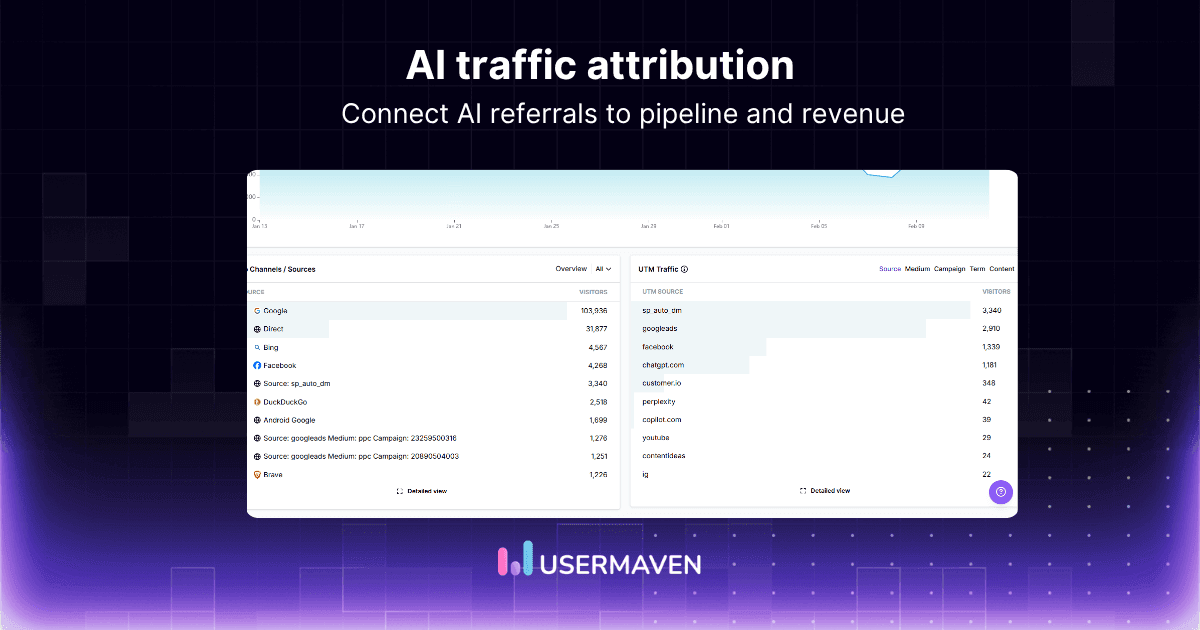
AI traffic attribution connects identifiable visits from AI assistants with later conversions, customers, and revenue.
A marketing attribution software workflow can preserve that context without pretending every AI mention became a measurable visit.
The challenge is not simply finding more AI traffic. It is assigning defensible credit to the traffic that reaches the site, and admitting where the evidence ends.
Key takeaways
Attribution starts after a measurable touch: A citation, crawler request, or generated answer is not automatically a customer interaction.
Traffic source and conversion credit differ: ChatGPT can start a journey that finishes through branded search, email, or Direct.
AI visibility now has its own evidence: Google’s Search Console generative-AI reports help observe exposure, but impressions are not website visits.
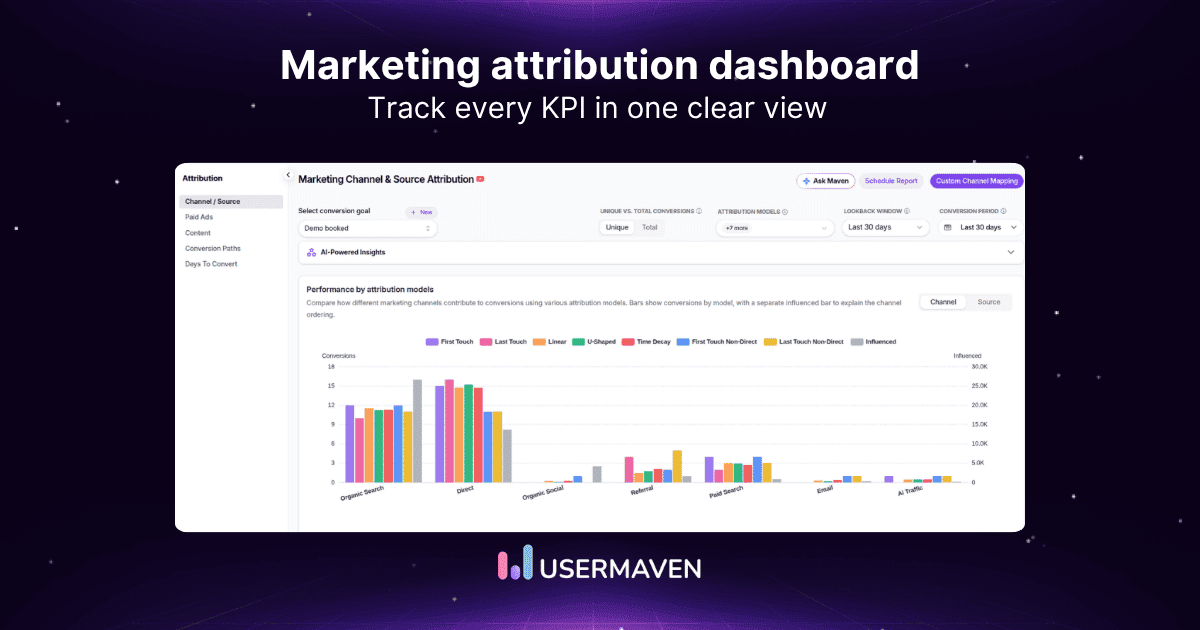
Model choice changes the answer: First-touch, last-touch, and multi-touch models can assign very different revenue to AI Search.
Reliable identity is essential: Broken source data, attribution windows, and disconnected CRM events can erase legitimate AI contributions.
Attribution is not incrementality: Model-assigned revenue measures recorded involvement, not what would disappear if AI discovery stopped.
Unlock insights that drive growth
AI traffic attribution at a glance
| Signal or decision | What it can tell you | What it cannot prove |
|---|---|---|
| AI answer appearance | A page or brand was surfaced in an AI experience | That the user clicked or bought |
| AI crawler request | An automated system accessed a URL | That the page was cited |
| AI referral session | An identifiable visitor arrived from an assistant | Every instance of AI influence |
| Source or first touch | AI began a recorded customer journey | AI caused the eventual conversion |
| Assisted conversion | AI appeared before a conversion in the observed path | The exact incremental effect |
| AI-attributed revenue | Value assigned under a specified model | A causal or model-independent revenue total |
The central distinction is simple: AI traffic identifies an arrival; AI traffic attribution determines how that arrival receives conversion or revenue credit.
What is AI traffic attribution?
AI traffic attribution is the process of assigning conversion or revenue credit to identifiable marketing interactions originating from AI assistants or AI search experiences.
It connects the recorded source with subsequent behavior, conversion events, and commercial outcomes under a defined attribution model.
That is different from AI-driven marketing attribution, in which machine learning helps analyze performance across marketing channels.
It is also different from AI citation attribution, which concerns whether a source appeared in a generated answer.
The broader AI traffic analytics framework tracks referrals, crawler activity, and on-site behavior. Attribution asks a narrower question: what value should an observed AI-originated touchpoint receive after a conversion?
For example, 40 visits from Claude are a traffic metric. Four trials created by those visitors are conversions.
A closed-won opportunity that began with Claude and continued through email creates an attribution question.
Three different meanings of AI attribution
| Interpretation | Primary question | Proper evidence |
|---|---|---|
| AI source attribution | Did an AI assistant send the visit? | Referrer, source, landing session |
| AI conversion attribution | Did a recorded AI touch receive conversion credit? | Journey, eligible touchpoints, conversion goal, model |
| AI visibility or citation analysis | Was the brand surfaced in an AI answer? | Visibility reporting, citations, AI appearance data |
These definitions must stay separate. No attribution model can create a click record for an exposure that never produced one.
Why AI Search loses credit before revenue
AI referrals are especially vulnerable to the familiar weaknesses of digital attribution because discovery and purchase frequently happen in separate sessions.
A person may compare vendors in Perplexity on Monday, save a brand name, search for it on Friday, and request a demo the following week. A session report records multiple channels.
A last-touch report may show only branded search.
Three problems drive most discrepancies.
AI discovery happens before a measurable visit
An assistant can recommend a product without generating a click.
Even if that suggestion influenced awareness, website analytics cannot observe the conversation or assign a reliable referrer to the later direct visit.
Google’s new generative-AI reports in Search Console help site owners observe impressions in AI features. They are exposure evidence, not visitor-level identity or sales attribution.
The Search Central announcement explains that the reporting covers appearances in AI Overviews and AI Mode, with global rollout completed in August 2026.
This expands visibility measurement, but it does not connect an AI impression to a known CRM deal by itself.
Source information does not always survive
When an assistant sends a click, the browser may pass a recognizable referrer or source parameter.
OpenAI explains that ChatGPT Search can provide links to cited web sources in its ChatGPT Search guidance. When assessing attribution, rely on the referrer or source information actually received.
But copied links, redirects, browser behavior, consent choices, and inconsistent collection can still leave traffic classified as Direct, Referral, or unknown.
An unexplained Direct session is not evidence that ChatGPT sent it. A defensible attribution system keeps that source unknown rather than assigning it to AI by assumption.
Later channels overwrite the simple story
A buyer can enter through Gemini, read three pages, leave, return from LinkedIn, then convert after a branded search.
Last-touch reporting shows the final recorded interaction, not necessarily the channel that initiated consideration.
That is why revenue attribution must connect source data, customer identity, conversion events, and commercial outcomes rather than relying on the final session alone.
| An AI visit can be measurable and valuable while still receiving zero credit in a last-touch report. |
What counts as an attributable AI touchpoint?
Before allocating credit, define which events belong in the model. Otherwise, the calculation can be mathematically correct but commercially misleading.
An eligible AI touchpoint normally requires identifiable evidence: an AI source or referrer, a timestamp, a visitor or account context where available, and inclusion inside the selected attribution window.
| Candidate signal | Include in web attribution? | Reason |
|---|---|---|
| ChatGPT referral with source evidence | Yes, if within the model rules | Recorded acquisition interaction |
| Perplexity referral followed by signup | Yes, when events connect | Observable source-to-goal path |
| Paid ChatGPT campaign visit | As a separate paid source | Paid and organic should not share one bucket |
| Google AI Overview impression | Not as a website touch | Visibility does not equal a session |
| GPTBot or OAI-SearchBot request | No | Automated access is not a buyer |
| Unknown Direct return | Only as Direct or unknown | AI origin cannot be inferred |
| Offline opportunity update | As outcome data, when identity matches | Confirms downstream value, not a new AI visit |
For a source-specific tracking implementation, track ChatGPT traffic covers how recognizable visits reach analytics. This article takes the next step: assigning credit once a conversion happens.
Keep paid ChatGPT campaigns distinct from non-sponsored referrals. The ChatGPT Ads guide covers paid acquisition. Mixing paid campaigns with organic AI Search obscures spend-based comparisons and attribution.
See what's working. Fix what's not. Grow faster.
The path from AI referral to attributed revenue
Use an evidence chain instead of jumping from an AI traffic total to a revenue claim. Each stage needs its own data source, definition, and quality check.
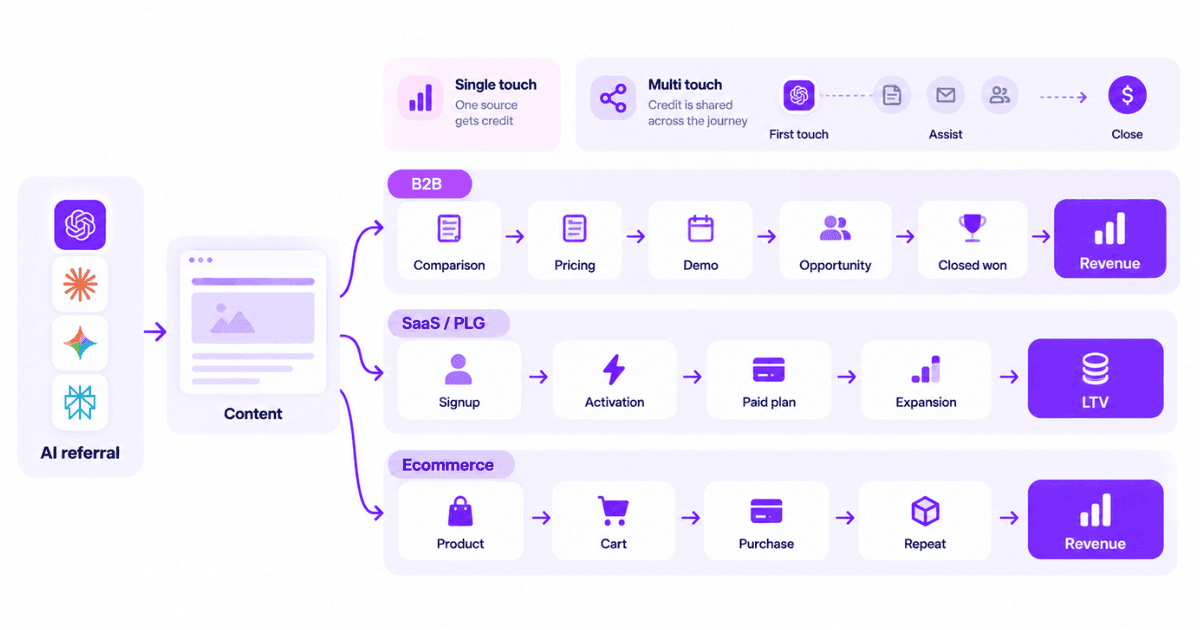
1. Capture a recognized AI-originated visit
Record the available source, medium, referrer, first landing page, timestamp, and session context.
In GA4, recognized AI-assistant referrals may appear in the AI Assistants default channel; Google’s AI Overviews and AI Mode remain classified under Organic Search.
Google Analytics channel definitions distinguish session acquisition from first-user and event attribution scopes. That distinction matters when a visitor returns through another channel.
Compare source lists rather than assuming that two analytics tools use identical AI categories. Keep custom paid classifications separate from organic referrals.
2. Track the behavior that signals progress
The next question is not merely how long someone stayed. It is whether the AI-referred visitor moved toward a relevant outcome.
Useful signals include viewing a comparison page, opening pricing, starting a signup, activating a feature, or requesting a demo. Event names and conversion definitions should remain consistent across the reporting period.
For B2B SaaS, a pageview is often too early. A qualified demo request or activated trial is usually stronger evidence of commercial progress.
3. Join return visits where identity permits
A prospect may return by email or organic search before converting. An attribution report needs a defensible way to associate those visits with the same person or account.
This can include consented first-party identifiers, known-user login events, and CRM contact or account matching. Never treat an anonymous cross-device match as certain when the system lacks a reliable identifier.
A missing identity link should appear as a measurement limitation, not as an invented customer journey.
4. Import the meaningful conversion outcome
Connect recorded goals to commercial reality. Depending on the business, this might be subscription activation, payment, a qualified opportunity, or Closed Won revenue.
In B2B, the conversion event and the sales outcome may be weeks apart. A form fill is not automatically a customer, and pipeline is not recognized revenue.
Use the attribution window intentionally. Too short a window excludes legitimate early AI visits; too long a window can assign credit to weakly related interactions.
Also check the reporting date. A ChatGPT touchpoint recorded in September may receive credit for a November conversion, depending on the report’s date basis and attribution window.
5. Apply a model and validate the result
Finally, calculate how much eligible AI receives under the chosen model and reconcile the totals with actual conversions and CRM records.
Record the model name, window length, conversion goal, date range, identity assumptions, and exclusions beside the final number. Without that context, ‘AI revenue’ is too ambiguous for budget decisions.
| The model allocates credit only after data collection defines which interactions exist. |
How attribution models change AI’s share
The same recorded journey can produce several valid but different allocations. This is the part that ordinary AI traffic dashboards cannot answer.
Consider an illustrative $12,000 Closed Won B2B deal with three eligible recorded marketing touchpoints: ChatGPT referral → email return → branded organic search → customer.
| Attribution model | AI Search credit | Email credit | Branded organic credit |
|---|---|---|---|
| First touch | $12,000 | $0 | $0 |
| Last touch | $0 | $0 | $12,000 |
| Linear | $4,000 | $4,000 | $4,000 |
| U-shaped (40/20/40) | $4,800 | $2,400 | $4,800 |
Illustrative allocation only. These are model outputs for a single invented journey, not measured channel results.
First touch answers which recorded source introduced the buyer. Last touch answers which eligible source was closest to conversion. Linear and U-shaped models distribute credit across more of the journey.
A model comparison may reveal that AI Search influences early consideration while another channel often closes. That is not proof that one channel is more important in every buying decision.
Teams studying multi-touch attribution should compare models on the same cohort and conversion goal before moving budget.
Otherwise, a model change can look like a performance change even when customer behavior stayed identical.
Do not double-count credited revenue
In a single model, credit allocated across eligible touchpoints for one conversion should reconcile to the conversion’s value under that model’s rules.
Across separate reports, however, assisted-revenue totals, first-touch revenue, and last-touch revenue can overlap. Adding them together as if each were a distinct sale inflates the apparent contribution of AI.
For example, a $12,000 deal cannot become $24,000 in total company revenue merely because AI received $12,000 under first touch and branded search received $12,000 under last touch.
AI attribution vs. visibility vs. incrementality
These concepts are frequently grouped together in AI search reporting, but they are not substitutes.
| Measurement | Question | Suitable evidence | Main caution |
|---|---|---|---|
| AI visibility | Were we surfaced in AI answers? | Generative-AI impressions, appearances, citation checks | Exposure may generate no click |
| AI referral attribution | Which identifiable AI visits received credit? | Source-tagged sessions, connected events, model | Not all influence is observable |
| Revenue attribution | How much recorded deal value went to AI touches? | Identity, opportunity or purchase, model | Revenue credit is model-dependent |
| Incrementality | What business outcome changed because AI was present? | Controlled experiments or causal study designs | Not established by standard attribution |
Google’s separate AI-feature impressions are a real reporting advance, but they should not be mixed into a calculation of AI-referred conversion rate. Impressions and visitors have different populations and meanings.
A reader investigating AI overview attribution is often asking about how content appears or gets credited within AI answers.
This article instead examines what happens when identifiable AI-originated journeys produce business outcomes.
If zero-click AI exposure raises branded-search demand, a reasonable hypothesis exists. The measurable branded return does not by itself establish that the AI exposure caused it.
Attribution answers who receives model credit. Incrementality asks what would have happened without the marketing activity.
Metrics used to evaluate AI traffic attribution
The strongest reporting combines traffic, attribution, and customer economics. AI visits with high engagement but no qualified outcomes may deserve a content optimization decision rather than a large budget shift.
| Metric | Definition or calculation | Decision it supports |
|---|---|---|
| Identifiable AI sessions | Sessions with defensible AI-source evidence | How much measurable referral demand exists? |
| AI-assisted conversion share | Conversions containing an eligible AI touch ÷ all comparable conversions | How often does AI appear in paths? |
| AI first-touch conversion share | Conversions with AI as first eligible source ÷ total comparable conversions | How often does AI introduce demand? |
| AI-attributed revenue | Conversion value allocated to AI under one stated model | How much credit does AI receive? |
| Revenue per AI visitor | Attributed revenue for a defined AI cohort ÷ identifiable AI visitors | Is measurable AI acquisition valuable? |
| AI-sourced pipeline | Qualified opportunity value attributed to eligible AI paths | Does AI help create sales opportunities? |
| Time to conversion | Elapsed time from first eligible touch to goal | What lookback window fits the journey? |
| Source-to-CRM match rate | Matched AI-originated leads ÷ eligible AI-originated leads | Is identity loss hiding outcomes? |
Use a consistent visitor or session denominator. A conversion count divided by sessions is not directly comparable with a revenue metric divided by unique people.
A B2B SaaS diagnostic example
Suppose 300 identifiable AI visitors generate 18 demo requests. Seven become qualified opportunities, and two close for a combined $20,000.
The visit-to-demo rate is 18 ÷ 300, or 6%. The opportunity rate among demo requests is 7 ÷ 18, or about 38.9%.
The close rate among opportunities is 2 ÷ 7, or about 28.6%.
But $20,000 is not automatically AI-attributed revenue. Its allocated AI share depends on eligible touchpoints, identity continuity, and the model. Those sample counts are illustrative, not a performance benchmark.
Revenue is a stronger answer than sessions only when the revenue link is traceable and the credit method is clear.
Keep qualified opportunity value separate from closed revenue. In this illustrative cohort, seven opportunities reached qualification, but only two became customers with $20,000 in recorded sales.
Why AI attribution reports disagree
GA4, an attribution platform, and a CRM may show different AI contributions without any report being inherently wrong. Start by checking whether each report answers the same question.
Compare acquisition scope, source rules, conversion goals, identity coverage, attribution windows, and the selected model before interpreting a discrepancy.
Diagnose differences before reallocating credit
| Reporting symptom | Likely explanation | What to check |
|---|---|---|
| AI referrals appear, but conversions do not | Missing goal events or disconnected identities | Event collection and visitor-to-lead matching |
| AI is first touch but has zero last-touch credit | The chosen model credits a later interaction | Model and eligible final touchpoint |
| AI disappears from longer journeys | Lookback window excludes an earlier visit | Touchpoint dates and attribution window |
| CRM revenue lacks its original AI source | Contact, account, or deal linkage is incomplete | Identity matching and opportunity associations |
| Two platforms report different AI totals | Different channel definitions or date scopes | Source mapping and session, user, or conversion scope |
Diagnostic principle: Reconcile the measurement definitions first. A channel receiving zero credit under a model is different from a source that was never recorded.
A five-phase audit for AI attribution gaps
Before publishing an AI contribution number, run an audit that follows the path from collection to decision.
This is especially important when the AI source appears small while branded search or Direct dominates.
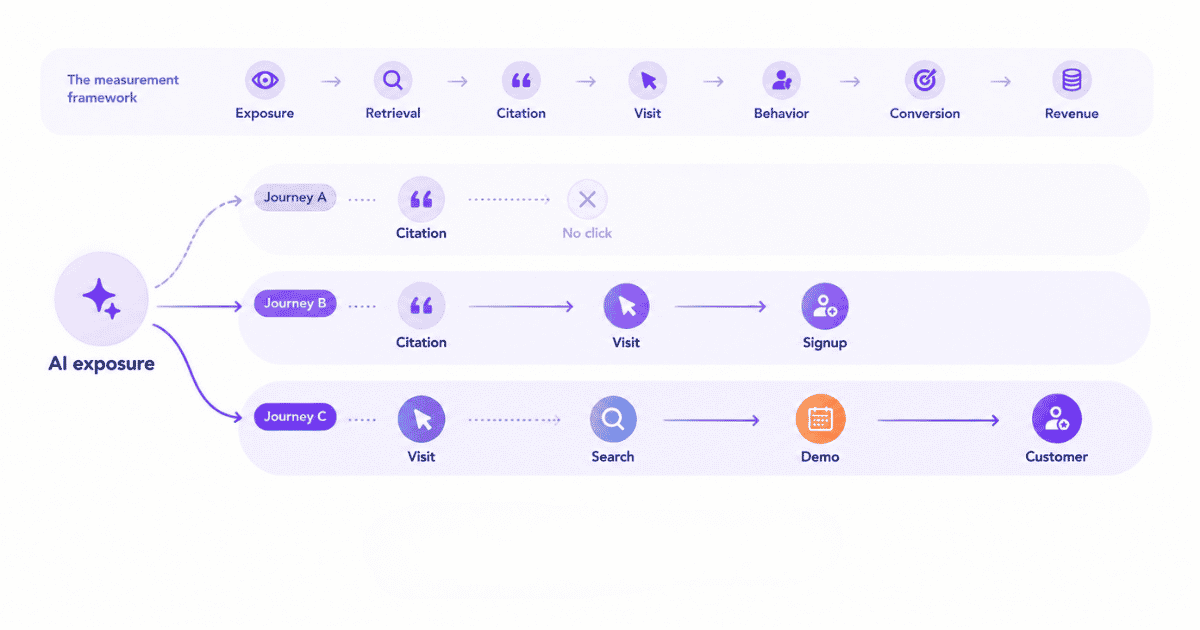
Phase 1: Confirm the source definition
List supported AI referrers and source tokens. Check whether the reporting system treats ChatGPT Search, Perplexity, Claude, Gemini, and other assistant sources consistently.
Separate paid ChatGPT ad campaigns from organic referrals. Check source classification on a sample of real visits rather than relying only on a channel label.
Phase 2: Verify events and conversion goals
Confirm that signup, demo, purchase, activation, and revenue events fire correctly. Document exactly which event counts as a business conversion.
If the goal changed midperiod, split the analysis or disclose the definition change. Attribution cannot compensate for unreliable event capture.
Phase 3: Inspect identity and timing
Follow sample converting journeys from anonymous visit to known customer. Look for CRM matches, cross-domain transitions, event timestamps, and consent restrictions.
Test the selected lookback against the real sales cycle. The longest possible window is not necessarily the most useful one.
Phase 4: Reconcile pipeline and revenue
Match attributed goals to known CRM opportunities, purchases, or subscriptions. Keep MQLs, SQLs, pipeline, customers, and realized revenue as separate stages.
Investigate unknown-source and Direct-heavy conversions, but do not automatically reassign them to AI.
Phase 5: Compare models and act cautiously
Review AI under first touch, last touch, and a suitable multi-touch model. Check whether changes in AI credit are explained by model rules or actual changes in visitor behavior.
Use the results to prioritize landing-page tests, conversion tracking fixes, and source-level investment. Reserve causal claims for credible experiments.
How Usermaven attributes measurable AI traffic
Usermaven can connect recognizable AI-originated visits with website and product behavior, conversion events, customer journeys, and connected CRM outcomes. The key is carrying source context through the measurable buying journey.
Classify AI Search without counting bots as buyers
Usermaven recognizes supported assistant referrers and source values under an AI Search channel. Its AI Traffic dashboard template separates human referrals from recognized crawler and bot activity.
Custom channel rules can help separate paid campaigns from organic sources when the campaign parameters and rules are configured deliberately. The AI Search channel mapping documentation explains the source rules.
The dashboard is a starting point, not a substitute for conversion goals and revenue matching.
Connect the visit with a commercial journey
Website analytics shows what AI-originated visitors do after they land. Defined Events capture signups, demos, purchases, or other conversion actions.
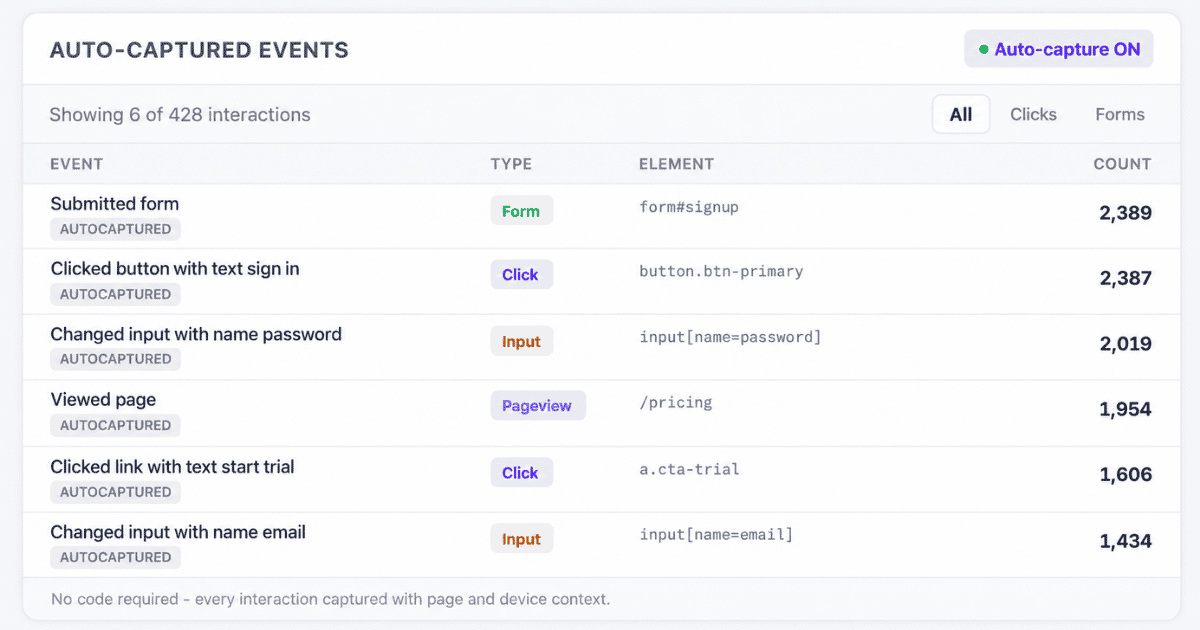
Funnel analysis shows where the journey breaks. Customer journeys help investigate recorded returns through email, organic search, or direct visits when identity continuity permits.
For long-cycle buyers, full-funnel revenue attribution extends the analysis from acquisition through pipeline, customer status, and closed revenue using connected systems.
Event Sources can also bring supported offsite payment and CRM events into the measurable journey. This is relevant when the important outcome happens after the buyer leaves the website.
Check the inputs before trusting the output
The Measurement Trust Center covers collection, identity, integrations, delivery, and reliability. Teams should resolve those gaps before treating AI channel attribution as a budget-ready answer.
Maven AI can investigate questions such as which recorded AI sources precede qualified opportunities or which AI-referred pages lose visitors before a demo.
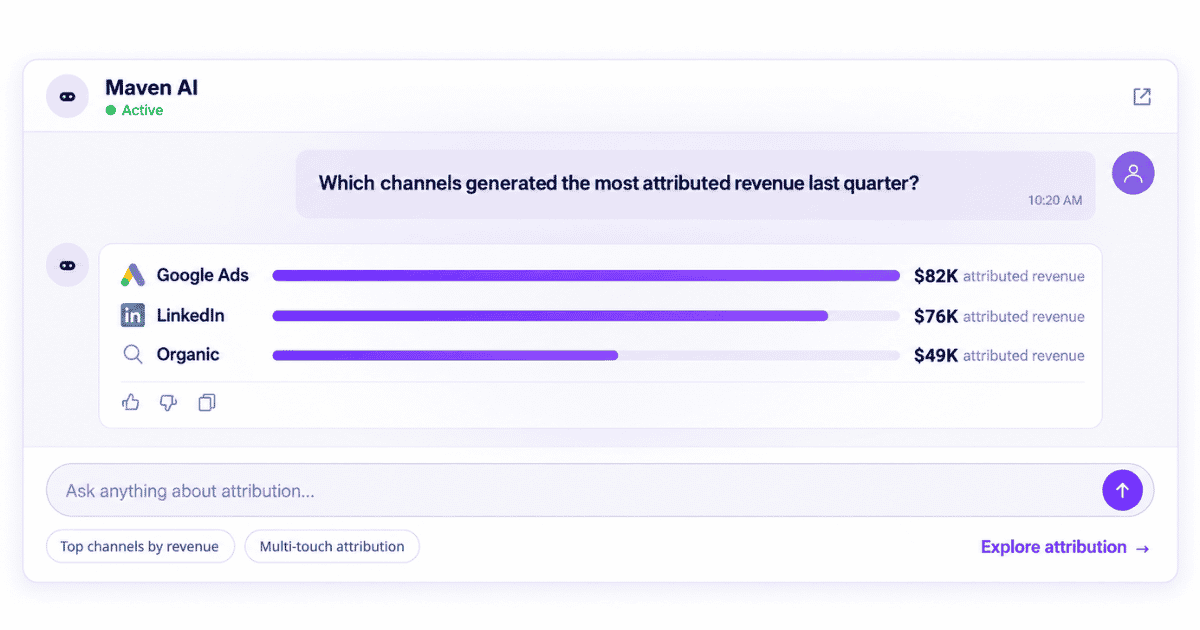
Scheduled Maven AI Agents can run recurring, read-only investigations and report findings about acquisition or conversion changes. They do not restore missing referrers or generate causal proof.
First-party evidence: Hyperengage
Hyperengage provides a useful attribution example. Its published Usermaven case study describes an initial attribution report dominated by Direct traffic.
After fuller journey analysis, Email and AI Search emerged as separately measurable acquisition sources.
Its reported attribution coverage expanded from four channels to six. This demonstrates better source visibility, not a measured increase in AI-generated revenue.
The lesson is not that all Direct conversions were really AI-driven. It is that connecting more of the recorded journey can prevent legitimate source contributions from disappearing into oversimplified reports.
Contentpen’s separate published case study also identifies separating organic from AI Search users as a useful analytical improvement.
Its reported conversion and engagement gains were broader optimization results, not isolated proof of incremental AI search revenue.
When AI traffic attribution changes decisions
B2B SaaS with long sales cycles
An assistant may introduce a comparison page well before a demo or opportunity. AI first-touch and assisted-path analysis can help explain why an acquisition source appears small in last-touch reporting.
For B2B SaaS teams, the meaningful endpoint may be qualified opportunity value or Closed Won revenue rather than a form submission.
A pipeline attribution view can distinguish AI-associated opportunities from closed-won revenue, preventing an open deal from being counted as a completed sale.
Content teams allocating effort
A how-to article may attract identifiable AI referrals but few immediate signups. Its role may be to introduce visitors who later convert through a product page or sales interaction.
That is a question for content attribution, which connects pages to recorded conversion journeys rather than judging each article by its final-click conversions.
Agencies explaining cross-channel value
An agency may discover that AI Search produces introductions while email and paid search close more often. The correct action may be improving assisted journeys rather than cutting a low-last-click source.
For marketing agencies, each client still needs clear attribution definitions and separate measurement rules. A shared template cannot replace reliable identity and conversion data.
Final verdict
AI traffic attribution is not another way to count ChatGPT visits. It is a method for assigning defensible conversion and revenue credit to observed AI-originated interactions across a customer journey.
Useful reporting separates AI visibility from human visits, separates observed touchpoints from imagined influence, and reconciles the chosen attribution model with genuine customer outcomes.
The practical goal is not to maximize the revenue credited to AI.
It is to find which measurable AI journeys contribute to qualified customers, which attribution gaps need fixing, and which decisions the data can actually support.
Book a demo to see how Usermaven connects identifiable AI Search visits with customer journeys, pipeline, and attributed revenue.
FAQs
1. What is AI traffic attribution?
AI traffic attribution assigns conversion or revenue credit to identifiable visits and touchpoints originating from AI assistants or AI search sources, using a defined model and available journey data.
2. How is AI traffic attribution different from AI traffic analytics?
AI traffic analytics measures referrals, crawler activity, behavior, and other AI-originated signals. Attribution specifically determines how recorded AI touchpoints receive credit for conversions and revenue.
3. Can AI Search traffic be attributed to revenue?
Yes, when source evidence, customer identity, conversion events, and revenue outcomes can be linked. The reported credit depends on the attribution model and window.
4. Does GA4 attribute traffic from ChatGPT and other AI tools?
GA4 recognizes eligible AI-assistant referrals in its AI Assistants channel. Further conversion attribution depends on configured key events, user or session scope, source evidence, and the reporting model.
5. Can Google AI Overviews receive revenue attribution?
Their visibility can be observed through Search Console’s generative-AI reporting, but impressions are not visitor-level revenue touchpoints.
Google AI Overview clicks are generally classified under Organic Search in GA4, and no-click influence cannot be reliably assigned to a deal using web referrals alone.
6. Which attribution model works best for AI Search?
No single model is universally best. Compare first touch, last touch, and relevant multi-touch models on the same cohort and conversion goal, then choose the model aligned with the decision being made.

Written by
Ryan Mitchell
Marketing Analytics Strategist
Ryan Mitchell is a marketing analytics strategist specializing in campaign measurement, customer journeys, and marketing performance. He writes about analytics, reporting, and data-driven marketing strategies, helping SaaS and B2B teams measure what matters across every stage of the customer journey.
All articles by Ryan →