Your top-earning affiliate is a coupon site. The dashboard shows flawless tracking, real orders, and a big chunk of revenue credited through that partner. On paper, your affiliate marketing attribution looks perfect.
But no one has asked a harder question. Would those customers have purchased anyway after searching for a discount code during checkout? That gap between clean reports and real incremental value is the problem this article tackles.

Here you will define affiliate marketing attribution properly, see how commission rules differ from performance measurement, review key models, and set up tracking across channels.
For more context, explore how marketing attribution works before diving deeper. Keep that coupon partner in mind as you compare the models and tracking approaches in the next sections.
Key takeaways
Before you go deeper, it helps to see the main themes you will work with in this guide.
Affiliate attribution always does two jobs at once, paying commissions and measuring marketing performance. Most teams treat those as the same thing, which hides how money actually moves.
Last-click attribution keeps showing coupon and cashback partners as heroes even when they only appear at the very end. Over time, this pulls budget away from content creators and discovery partners.
Tracking accuracy and incrementality are different questions, even though tools often conflate them. Accurate click and conversion tracking tells you who got credit, not whether that touchpoint changed the outcome.
Your attribution model sends a clear signal to affiliates about what you value. Models that ignore early touches tell creators and review sites their work does not matter.
A modern analytics platform can sit atop your affiliate network and paid channels to connect all touchpoints. With that setup, you can compare models, inspect paths from first click to purchase
What is affiliate marketing attribution?
Affiliate marketing attribution is the process of assigning conversion credit to affiliate touchpoints along a customer’s path from first click to purchase. In plain terms, it answers which affiliate gets credit for each order and how much. Good attribution lets you tie real revenue back to the partners who influenced it.

This process always has two overlapping jobs. One job is operational, deciding who gets paid and what commission they receive. The other job is analytical, telling your team which affiliates are actually driving new customers and valuable orders.
Most programs mix these jobs into one setting inside an affiliate network or tracking platform. They pick a model, usually last click, and treat that as both the payout rule and the measurement truth.
That shortcut makes accounting simple but obscures how influence spreads across the full path to purchase.
Commission crediting vs. marketing performance measurement
Commission crediting is the rule system that decides who receives money for a conversion. It usually lives inside the affiliate network, uses cookies or tracking parameters, and follows whatever attribution rule you selected in the platform. The goal is operational clarity, so each sale produces a clear invoice line.
Marketing performance measurement is a different task. Here you want to understand which affiliates shaped the decision, even if the network gave credit somewhere else. That means combining affiliate data with paid media, email, organic search, and direct visits in one view, not just reading a single dashboard.
A single sale can appear as a win in three tools at once: the affiliate network, your ad platform, and your email service. Each claims it because each only sees its part of the path.
A serious performance view needs a unified data layer that records the full path to purchase, then applies your chosen model on top of it instead of trusting any one system by default.
That quote applies directly to affiliate attribution. Your goal is not perfect truth; it is a model that is useful for both paying partners and steering your marketing investments.
Why most programs default to last-click attribution (and what it costs them)
The reason last-click survives is not that it shows the full truth. It survives because it is easy to explain, easy to report, and easy to pay against, until the hidden costs start shaping your affiliate program.
1. Last-click attribution feels safe but misleads
Most affiliate programs default to last-click attribution because it is simple, familiar, and built into network dashboards. Last click means the final tracked interaction before a purchase receives 100 percent of the credit. That rule was designed for single-device, short, linear paths that rarely exist now.

2. Logic seems sound until you look across many paths
Last click feels safe because it is easy to explain and audit. If a customer clicked an affiliate link right before purchase, paying that partner seems logical. The trouble starts when you look across many paths and see how often another partner did the work of discovery and research earlier.
3. Consistently rewards partners that show up last
This model consistently favors partners that appear late, such as coupon and cashback sites, loyalty portals, or branded search arbitrage. It quietly sidelines creators, review publishers, and niche communities that introduce your brand to cold audiences.
4. Ignores how people actually shop
Last click also clashes with how people actually shop across fragmented, multi-device paths. They switch devices, see ads without clicking, come back through email, and open multiple affiliate links before buying. A model that only cares about the final click throws away most of that context and gives you a clean number.
How last-click distorts your partner mix over time
Over time, the reporting model does more than assign credit. It quietly shapes which partners get rewarded, which ones stay motivated, and what kind of affiliate program you end up building.
1. Budget chases whichever partners look best on paper
Last-click attribution changes which affiliates look valuable, so budget decisions follow those reports. When coupon and cashback sites always top the leaderboard, spend, bonuses, and relationship time flow toward them, attracting more partners chasing checkout intercepts.
2. Top-of-funnel creators get discouraged
Content publishers and creators who drive early discovery see a different story. They send large volumes of first-time visitors who buy later, but last-click credit goes elsewhere, so low reported conversions push them to reduce effort or prioritize other brands.
3. Your roster tilts toward capture, not discovery
Eventually your affiliate roster leans toward conversion capture rather than discovery and education, and new brands struggle to gain traction. Full-funnel measurement consistently lifts leads and transactions without more spend, just by crediting touchpoints differently.
Main attribution models: how they work and what they signal to partners
The main attribution models used in affiliate marketing differ in how they assign credit across touches on the path to purchase. Each model makes a claim about which interactions matter most, then encodes that claim into your payouts. Because payouts shape partner behavior, model choice is also a relationship decision.
You do not have to pick one model as the universal truth for every program. The right fit depends on your sales cycle length, mix of partner types, and which actions you want to reward.
A high-consideration B2B subscription will need different rules than a fast-moving ecommerce store selling low-priced items.
Models that reward only the first or last touch send very strong signals about what you value. Models that spread credit across multiple touches reflect a belief that influence is shared.
According to their Global State of Affiliate Marketing report, about one third of creators prefer first click, network partners lean toward linear splits, and a large group of publishers feels neutral or unsure about how they are credited.
That uncertainty is a warning sign that communication around attribution often lags far behind the financial impact.
Attribution model comparison
First-click attribution gives all credit to the first recorded interaction. This clearly rewards discovery work from creators, reviewers, and niche communities. It underplays the role of partners and channels that nurture or close, such as retargeting or deal sites.
Last touch attribution gives all credit to the final interaction before conversion. It suits very short paths where a single click truly drives the decision. In affiliate programs with many partner types, it reliably overstates the value of coupon and loyalty partners who show up at the end.
Time-decay attribution assigns more credit to touches that occur closer to the conversion event. It reflects the idea that recent interactions matter more than older ones. This works reasonably well for shorter cycles and campaigns with tight windows, but it can still undercount deep research content that happened earlier.
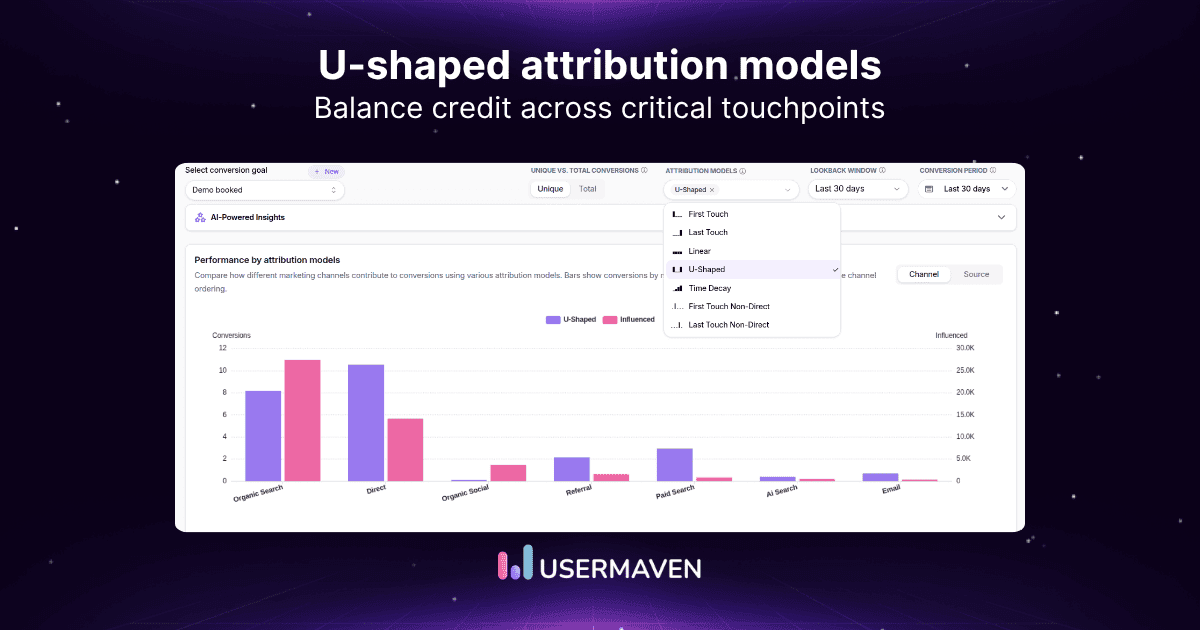
Position-based attribution, often called U-shaped, favors the first and last touches while giving the middle steps a smaller share. It acknowledges that discovery and closing are both important without ignoring mid path influence. The exact percentages are still rules you choose, so they should reflect your actual sales motion.
Data-driven attribution uses statistical models to learn how different touch patterns correlate with conversions. Instead of fixed rules, it looks across many paths to see which touches raise or lower the chance of a sale. This approach requires sufficient volume to learn patterns and must be explained carefully so that partners trust the outcomes.
Coupon codes deserve a clear note here as well. A code assigned to an affiliate is a tracking method that helps identify which partner was present at checkout. It is not an attribution model in itself, and treating it as one often leads programs to conflate mere conversion capture with meaningful upstream influence.
| Model name | Credit logic | Best for | Primary risk |
|---|---|---|---|
| First touch | All credit to first recorded interaction | Discovery heavy programs, creator and content led growth | Understates closing and nurturing work |
| Last touch | All credit to final interaction before purchase | Very short, simple paths or pure coupon and loyalty roles | Hides earlier influence and overpays interceptors |
| Time decay | Increasing credit as touches get closer to conversion | Short to medium cycles with frequent touches | Overweights late contacts regardless of depth |
| Position based | Large share to first and last, smaller share to middle | Multi-step paths where awareness and close both matter | Percentages are rule-based, not learned from data |
| Data driven | Credit based on statistical impact across many paths | High volume programs ready for deeper analysis | Needs significant data and clear explanation for partners |
How to set up affiliate tracking correctly
To set up affiliate tracking correctly, you need solid data that lives outside any one affiliate network. The network shows what happens through its own links, but it cannot see paid search, email, or direct visits that happen before or after. A clean setup pulls all those touches into one place.
Consistent tagging is the base layer. Without reliable parameters on links, affiliate traffic gets mixed with other referrals or dumped into “direct,” which makes performance analysis guesswork. You also need tracking that survives cookie limits, ad blockers, and device hopping.
Shifting away from last-click models only works if the tracking underneath is strong enough to support it. That means investing in server-side capture, cross-device linking, and conversion deduplication across channels. Good tracking gives you the raw material to ask more precise questions about partner value.
Step-by-step tracking setup

Standardize UTM parameters for every affiliate link to ensure a clean, consistent source of truth. At minimum, set
utm_sourceto the affiliate name or network,utm_mediumto something like affiliate, andutm_campaignto describe the offer or season. Addingutm_contenthelps you compare placements or creatives within the same partner.Route affiliate clicks through a server side tracking layer that records them into your own database. This means when someone clicks a link on mobile and converts later on desktop, both events tie back to the same internal identifier. Server-side capture is also more resilient against cookie deletion and many ad blockers.
Implement user-level tracking that can stitch together sessions across devices and browsers. Common patterns include login based identifiers, hashed emails after signup, or first party cookies combined with device signals. The aim is to avoid treating one person on three devices as three separate prospects.
Connect affiliate traffic into a unified attribution platform that already receives data from paid, organic, social, and email channels. When every session flows into one model, you can see whether an affiliate was first touch, middle touch, or last touch. This is where affiliate marketing attribution stops being an isolated report and becomes part of your full funnel view.
Deduplicate conversions at the order level so a single purchase only exists once in your master log. Then attach every qualifying touchpoint to that order and let your chosen attribution model distribute credit. This prevents the common situation where the network, ad platform, and CRM all claim the same sale.
Feed affiliate source data into your CRM so post-purchase behavior is visible by partner. With that connection, you can analyze retention, repeat purchases, and expansions by affiliate source, not just initial order volume. That is the starting point for serious questions about which partners bring in customers worth paying for over the long term.
Why accurate attribution cannot prove an affiliate drove new revenue
The trap is that better tracking can make affiliate reports look more trustworthy, but it still cannot prove whether a partner created revenue that would not have happened otherwise.
1. Attribution measures credit, not causality
Accurate affiliate attribution cannot prove an affiliate drove new revenue because attribution measures which touchpoint received credit, not what would have happened without it. The model explains how to divide a known sale across partners. It does not predict the alternate world where that affiliate was missing.
2. Coupon site problem
A coupon site that catches users at checkout is the classic example of credit without causality. Tracking may show that the site appears right before thousands of conversions, and last-click logic will pay that partner every time. Yet many of those buyers were already decided and only searched for a code to save a few dollars.
3. Missing business context: Real gap
Most brands lack visibility into how individual partners affect their bottom line. Few track customer acquisition cost or average order value by partner, making it hard to tell whether a coupon-heavy affiliate is padding margins or eroding them. The real problem is not tracking technology — it is missing business context.
4. Counterfactual attribution cannot answer
Even strong multi-touch attribution cannot see the path a customer did not take. There is no way to know whether that sale would have happened anyway through organic search or a direct visit. That missing counterfactual is why incrementality testing needs to sit alongside attribution, not replace it.
What incrementality analysis requires beyond attribution data
Incrementality analysis starts with understanding where in the path affiliates usually appear. If a partner only shows up as last touch near checkout, especially on sessions that began with branded search or direct visits, that pattern should raise questions. It suggests the affiliate may be collecting credit where intent was already high.
Next, look at days to convert for each affiliate. Partners that truly introduce your brand often show longer paths, with users coming back several times before buying.
When a partner’s conversions happen almost instantly, it often means the click came after the decision or on a returning customer.
Cohort comparison is another practical tool. Group customers acquired through a specific affiliate and compare their retention, repeat purchase rate, and lifetime value to cohorts from other sources.
If affiliate-referred buyers churn faster or spend less over time, their revenue is less incremental than a simple conversion count suggests.
Comparing attribution models for the same affiliate can also surface clues. If a partner looks strong on last click but their credited revenue drops sharply under first touch, position-based, or data-driven models, they may be capturing demand rather than creating it.
None of these signals alone prove causality, but together they show which affiliates merit deeper testing through holdout or geo split experiments.
How to match your attribution model to your program structure
Choosing an attribution model for affiliates should follow the structure of your program, not generic best practices. The right model for a fast checkout consumer app will be different from the right model for a complex B2B tool with long sales cycles.
Three variables matter most: sales cycle length, partner mix, and desired behaviors.
Sales cycle length shapes how much of the path you need to recognize. When people buy within minutes of first hearing about you, simple models will cause less damage because there are fewer touches.
For high consideration products with lots of research and back and forth, models that only see the last touch leave most influence unmeasured.
Partner mix tells you who does what in your affiliate program. Creators, in-depth review publishers, niche communities, loyalty platforms, cashback sites, and deal forums each play very different roles. If you apply a single model across all of them, you implicitly claim their roles are similar.
According to Global State of Affiliate Marketing 2025, 43% of publishers are neutral or uninformed about how they’re credited. That doesn’t mean they don’t care; it means they lack a clear explanation. Documenting your attribution model and sharing concrete examples with partners keeps them on your side.
Matching model to partner type and sales cycle
The right attribution model depends on how people buy, how long decisions take, and what role each partner plays in the journey. A single model may look simple, but it rarely treats every affiliate category fairly.
- Short sales cycles (under ~30 days)
Low-priced impulse purchases can often tolerate last-click or time-decay models, since paths typically involve just one or two touches, keeping the risk of hidden early research low. Still, keep an eye on whether coupon partners are simply capturing orders that would have converted directly anyway.
2. Longer, higher-consideration cycles
Higher-priced or complex products need richer models like position-based or data-driven attribution, which credit early education while still recognizing the closing touch. This becomes especially important when review sites, comparison content, and community recommendations shape the buyer’s decision.
3. Creators and content publishers
First-touch or position-based models best reflect their real role, since they introduce new audiences and build trust well before a discount ever appears in the journey. Last-click rules make their contribution nearly invisible, which over time pushes them toward programs that reward discovery more fairly.
4. Coupon and loyalty partners
Their core job is honest conversion capture at the end of the path, so last-click or time-decay attribution is a reasonable fit for this group. Many advanced teams apply different models by partner category, which requires a platform capable of comparing multiple rules on the same conversion data.
Unlock insights that drive growth
How Usermaven helps affiliate marketing attribution
Affiliate attribution becomes more useful when affiliate data is not trapped inside network reports. Usermaven helps teams connect partner touchpoints with the rest of the customer journey, so credit decisions are based on the full path to revenue.
1. Unified cross-channel view
Usermaven sits above your channels, connecting every tracked touch on the path to purchase. Instead of reading affiliate network reports in isolation, you see affiliate clicks alongside paid search, paid social, email, and organic visits.
2. Multi-touch attribution with seven models
The platform offers multi-touch attribution models, including first touch, last touch, time decay, position based, and data driven options. You can switch between them on the same conversion set to see how each rule changes credited revenue for a given partner.

3. Low data loss tracking
Usermaven uses cookieless tracking and technology that holds up even when ad blockers are present. This keeps affiliate and channel reports closer to reflecting nearly every real user session, not just the ones browser scripts allow.
Key capabilities for affiliate attribution
1. UTM build
With UTM builder, it generates consistent tracking links for every affiliate and campaign, walking you through the source, medium, campaign, and content fields to reduce tagging errors. Standardized tags stop affiliate traffic from leaking into generic referral or direct buckets.
2. Customer Path Analytics
Shows how people move from first touch to conversion across all channels, including where affiliate clicks typically enter and how many steps happen before purchase. Days-to-convert metrics and path visuals help spot coupon intercept behavior versus real discovery.
3. Multi-Touch Attribution
Lets you apply up to seven models on the same dataset and compare results by partner, channel, or campaign. Seeing how credited revenue shifts from last-touch to position-based or data-driven rules helps flag partners who depend entirely on end-of-path clicks.
4. Maven AI
The built-in assistant Maven AI scans Attribution, Funnels, and path reports for patterns worth attention, such as high-traffic affiliates with weak retention or partners driving above-average lifetime value. This saves manual digging and surfaces incrementality-related questions faster.
5. Contacts Hub
Connects sessions across devices and browsers so a single user’s path stays intact, even when they click on mobile, sign up on desktop, and buy via retargeting later. This cross-device stitching prevents undercounting affiliates that often supply first touches.
6. Integrations
Connects with tools like Google Ads, Meta, Shopify, and Google Search Console to bring all channels into one reporting layer. This cross-channel context lets you evaluate affiliates on more than isolated last-click numbers.
7. Setup and Pricing
Setup takes minutes with a tracking pixel that needs no developer help, and pricing starts at a level accessible to smaller teams with a 14-day free trial. Usermaven also runs its own affiliate program with recurring commissions.
The bottom line
Attribution tells you who received credit for a sale, while incrementality asks whether that touchpoint truly changed the outcome. You need both views if you want an affiliate program that grows revenue instead of just reshuffling credit across partners.
A practical next step is to audit your current setup, confirm your UTM standards, inspect how last click reports favor certain partners, and start comparing multiple models on the same data.
Once you can see how different rules reshape performance, you will be ready to rethink commissions and invest more confidently in affiliates who actually move the needle.
Ready to see Usermaven in action? Explore the platform or book a demo for a closer look.
See Usermaven in action
Book a free demo and discover how powerful analytics can grow your business.
FAQs
1. What is the difference between affiliate attribution and affiliate tracking?
Affiliate tracking is the technical layer that records events such as clicks, sessions, and conversions tied to a specific link or identifier. Affiliate attribution is the rule set that interprets that log and assigns a share of each conversion to one or more partners.
2. How do affiliate networks handle multi-touch attribution?
Most affiliate networks focus on tracking their own links and then apply a simple rule, usually last click, to pick a single winner. They rarely see paid media, organic visits, or direct traffic that may have happened before or after that click. Because of that blind spot, brands that care about multi-touch analysis usually add an independent attribution layer on top of network data.
3. Can I use different attribution models for different affiliates in the same program?
Yes, you can apply different models if you centralize your conversion data outside the network dashboards. Many teams reward creators and review sites using first-touch or position-based rules, while using last-click or time-decay for coupon and loyalty partners. The key is to define clear categories, explain them to partners, and maintain a single, clean source of order data under the hood.
4. What conversion volume do I need before data-driven attribution is reliable?
Data-driven attribution works best when your program generates enough conversions for patterns to stand out from random noise. Very small programs usually get more value from simple, transparent models such as position-based or time decay. As order volume grows and you see many repeated paths, adding data-driven models on top of those rules becomes more realistic.
5. How does privacy regulation affect affiliate tracking accuracy?
Privacy rules and browser changes limit how long cookies can live and when scripts can fire, which means older affiliate setups often miss a share of real conversions. When that happens, some partners are undercounted, and commission invoices no longer match true performance. Moving toward first-party, server-side, and cookieless tracking approaches helps recover that lost visibility while staying compliant.
Updated

Written by
Junaid Ahmed
Content Writer & Digital Marketer
Junaid Ahmed is a content and copywriter with 3+ years of experience creating research-driven content across SaaS, B2B, ecommerce, and digital marketing. He specializes in turning complex topics into clear, practical content that helps marketers better understand their challenges, evaluate solutions, and make informed decisions. His work spans educational content, industry insights, and actionable marketing guides.
All articles by Junaid →