A team spends 50,000 dollars on a trade show booth, scans 200 badges, books 40 demos, and closes 6 deals in Q3. When they pull a report, the CRM shows those deals came from organic search or direct traffic, not the event. The last click wiped out the event source.
That is the core failure of event marketing attribution in many B2B pipelines. Long buying cycles and messy data make events look like expensive branding instead of revenue drivers. Leadership sees weak reports, and next year’s budget shrinks.
To fix this, you need better tracking before campaigns launch, a model that aligns with your sales cycle, and a clean bridge from offline interactions to your CRM. This guide walks through attribution models, setup steps, offline data connections, ROI formulas, and real B2B examples. For deeper analytics resources and tools, consider exploring Usermaven alongside this guide.
Key takeaways
Key takeaways give a fast preview of what this guide covers. Use them as a checklist when you plan your next event program.
- The B2B attribution gap comes from long sales cycles and last-touch reports. Events create early and mid-funnel momentum that standard reports ignore. When organic or direct wins the final click, events lose credit even when they sparked the deal.
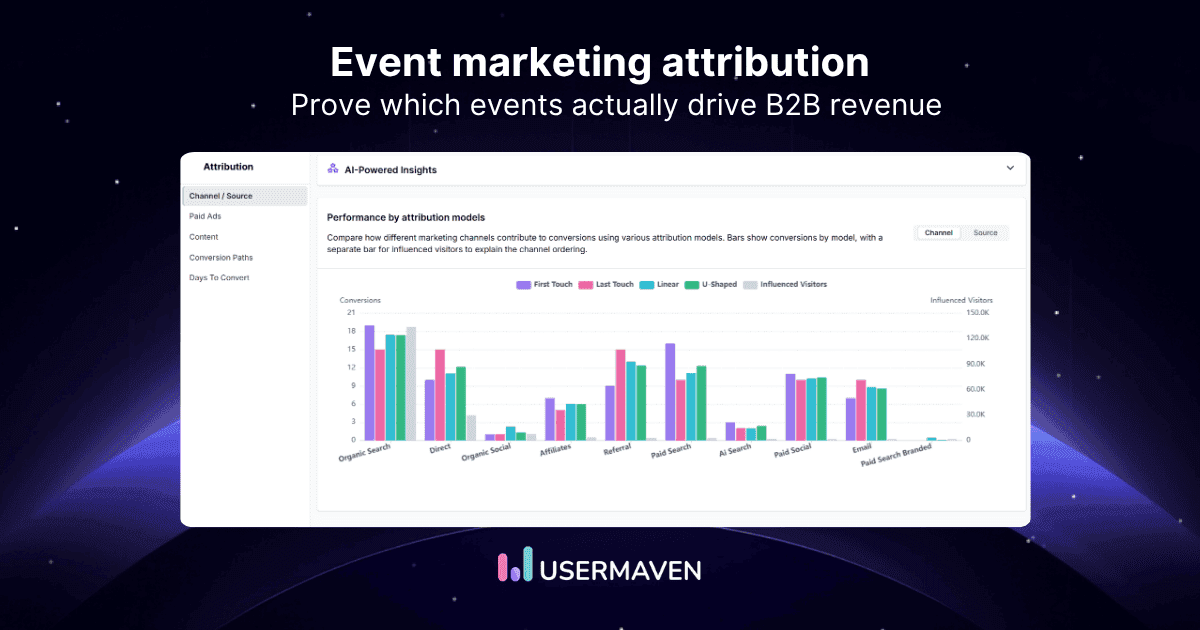
- Marketing attribution models matter because they change what looks successful. First-click, last-click, U-shaped, linear, time-decay, and data-driven views can show very different winners. Picking a model that matches your funnel stops you from overfunding the wrong channels
- Connecting offline event interactions to downstream pipeline needs shared identifiers. Badge scans, booth visits, and session check-ins must link to CRM contacts and web sessions. Without that bridge, you only see a pile of anonymous scans instead of real influenced revenue.
- UTM tagging and CRM setup create your attribution foundation. Consistent naming, dedicated campaigns, protected lead source fields, and long enough look-back windows make later analysis possible. Small setup changes before launch prevent painful data cleanup after the event.
- User-focused analytics platforms simplify multi-touch attribution for B2B teams. Instead of wrestling with raw logs, marketers can see the full event path, compare models, and understand how webinars, conferences, and trade shows shape pipeline and revenue.
What is event marketing attribution?

Alt text: “Sales rep shaking hands with prospect at B2B trade show booth”
Event marketing attribution is the practice of assigning credit to the marketing touchpoints that lead someone from first awareness to event registration and, later, revenue. For B2B teams, this means tracking how channels and messages work together around webinars, conferences, and trade shows.
In a typical B2B cycle, a prospect might read a blog post, click a LinkedIn ad, receive three nurture emails, talk to a rep at a booth, attend a product session, then sign a contract weeks later. Simple models that only look at the last click ignore most of that story. Event marketing attribution tries to record that full path so you can see how the event shaped the outcome.
Strong attribution for events answers very specific questions. It shows which campaigns drove registrations, which sessions correlated with more pipeline, and which follow-up emails turned attendees into opportunities. It also clarifies the value of pre-event buzz and post-event content, not just the days spent on site.
Good event marketing attribution should help you quickly see things like these.
- Which channels reliably bring in net new attendees who match your ideal customer profile. It highlights whether search, paid social, partners, or outbound plays the biggest role. It also shows when those channels work together, not in isolation.
- Which event formats actually move deals forward inside accounts. It might show that product deep dives move existing opportunities faster, while broad thought leadership sessions fill the top of the funnel. That makes it easier to defend or cut formats next year.
- How event-influenced accounts behave in your product or trial afterward. Do attendees log in more, adopt more features, or invite teammates? That kind of behavior data turns abstract “engagement” into concrete business signals.
Why does event attribution break down in B2B pipelines?
Event attribution in B2B pipelines breaks down because long buying paths and messy systems hide the original touchpoints, a pattern well documented in research on marketing in the event industry. When a deal finally closes, the CRM often credits only the final click, not the webinar or conference that set everything in motion.
Another big reason is fragmented data across tools. Registration might live in an event platform, email clicks in marketing automation, sales activity in your CRM, and website visits in an analytics tool. Without consistent IDs and sync rules, no one can follow a single person from first invite to closed revenue.
Offline interactions add more gaps. Badge scans, hallway chats, and on-site demos are powerful, but if they stay trapped in spreadsheets, they never appear in attribution reports. Many teams also keep short attribution windows, so revenue that lands months later never looks connected to the original event.
The most common attribution failure points
The most common attribution failure points in B2B event programs come from specific process and tooling gaps. Knowing these failure points helps you fix them before the next campaign.
- CRM fields change from the original event source to the final website visit. A deal that started with a conference gets overwritten when the buyer revisits the site through organic search. Later reports show “organic” as the source, and the event appears unimportant.
- Badge scans and booth visits stay inside the event platform without a sync to the CRM. Sales cannot see which attendees they met, and marketing cannot tie those visits to pipeline. The only visible metric becomes raw scan count, which is not linked to revenue.
- Event confirmation emails and post-event follow-ups lack UTM parameters. When someone clicks, web analytics labels the visit as generic email or even direct. You lose the ability to see which specific event message or partner sent actually drove action.
- Prospects research on mobile and convert on desktop, or the other way around. If your tracking does not unify those sessions, each device looks like a different person. The event touch on one device never connects to the form fill on the other.
- Ad blockers hide key interactions on event landing pages. Visitors still read, click, and sign up, but your standard tracking script never fires. That makes it seem like fewer people engaged with the campaign than actually did.
- Challenges with attribution models expire before the deal closes. If your model only looks back 30 days, a conference in March that drives a deal in August will never be shown as influential. Later, leadership questions why expensive events show almost no attributed revenue.
Which attribution model fits B2B event marketing?
The best attribution model for B2B event marketing is the one that aligns with your sales cycle, the number of touchpoints, and your main questions. Different models highlight different parts of the path, so the “right” choice depends on what you want to optimize.
For short, simple cycles with few steps, single-click models can still be useful. First-click can show which channels first reached your audience, while last-touch can show which campaigns closed the deal. In longer B2B cycles, those simple models miss too much.

Multi-touch attribution works better when events play both discovery and closing roles. Webinars often introduce a concept, field events deepen relationships, and follow-up emails close deals later. Multi-touch views help you see how those pieces combine, not which single step “won.”
Model choice also shapes budget decisions. If you only report on last-touch, you might over-invest in branded search and bottom-of-funnel retargeting. A W-shaped or position-based model will often surface that early awareness channels and mid-funnel events drove most qualified pipeline.
According to Salesforce’s State of Marketing report, high-performing marketing teams are 1.5× more likely than underperforming teams to use marketing attribution modeling to measure marketing success and ROI. As marketing budgets increasingly span multiple channels and major investments like events, structured attribution helps marketers understand which activities contribute to revenue.
Comparing models by B2B use case
Choosing a model gets easier when you see which problem each one solves best. Use this table as a quick starting point for your own stack.
| Attribution model | How credit is distributed | Best B2B use case | Key limitation |
| First-touch | All credit goes to the first recorded interaction | Measuring top-of-funnel demand and which channels bring in net new accounts | Ignores all mid- and late-stage touchpoints that may be more persuasive |
| Last-touch | All credit goes to the final interaction before conversion | Understanding which campaigns or assets push prospects over the line | Hides the early and mid-funnel work that events often do |
| W-shaped | Most credit goes to first touch, lead creation, and opportunity creation, with a small share for other steps | Full-funnel B2B cycles with conferences or webinars at key milestones | Needs solid data and tooling to identify those milestones correctly |
| Linear | Equal credit goes to every recorded interaction | Long, steady nurture programs where each touch is designed to reinforce the message | Treats a casual blog visit the same as a high intent demo at your booth |
| Time-decay | Later touchpoints get more credit than early ones | Shorter sales cycles where recent touches tend to be more decisive | Can push budget away from awareness channels that are still important |
| Data-driven or DDA | Credit is set by machine learning based on actual paths that converted | High volume teams that want the most realistic long-term picture | Needs enough data and a reliable platform to avoid noisy results |
For most B2B teams running multi-touch programs, W-shaped or position-based models give a balanced view, a conclusion supported by analysis of AI Attribution Modeling: Multi-Touch marketing ROI approaches. They recognize the importance of both discovery and opportunity creation without overlooking the middle touches.
How to set up event attribution tracking before the event starts
Event attribution tracking for a B2B event program starts long before the first invite goes out. The way you tag links, configure the CRM, and connect tools before launch decides what you can measure later.
The first pillar is a clear UTM strategy, and a practical framework for this is outlined in resources covering event marketing measurement attribution for B2B conference and exhibition organizers. Every registration link, ad, partner promo, and follow-up email needs consistent source, medium, and campaign values. That structure lets you pivot later by channel, message, and partner, rather than staring at one giant “event” bucket.
You also need your CRM to recognize the event as a distinct campaign the moment someone engages. That means creating the campaign record before launch, mapping form fields correctly, and checking that new contacts receive the right tags. When someone fills out the registration form, the CRM should immediately know which event campaign they belong to.
Event and marketing platforms must also talk to each other. The event platform should pass registration, attendance, and session data into the CRM or analytics tool, ideally on a schedule rather than a one-time export. This connection lets you see which attendees later became opportunities or customers without manual spreadsheet work.
Unlock insights that drive growth
Pre-event attribution setup checklist
A simple checklist before campaign launch prevents many hours of cleanup later. Treat these steps as standard for every significant B2B event.
- Define UTM naming rules for source, medium, campaign, content, and term in a shared doc. Provide examples for common channels, so teammates do not have to guess. Train agencies and partners to follow the same pattern.
- Apply UTM tags to every event-related link you share. Include paid ads, organic social posts, sales outbound messages, confirmation emails, calendar reminders, and post-event nurtures. If a link exists without a tag, expect it to show up later as direct or unknown.
- Create a dedicated campaign in your CRM before collecting the first registration. Map your form or registration tool so new contacts auto-attach to that campaign. Use the same campaign name across ads, emails, and reports to keep things consistent.
- Configure the primary lead source and any attribution fields so they do not overwrite the event tag later. For example, set up a first-touch field that never changes and a latest-touch field that can change. This structure lets you see both the original event and later touches.
- Set attribution look-back windows that match your actual sales cycle, typically 90 to 180 days in B2B. Confirm that your analytics and ad platforms respect those windows. Short windows make events look weak even when they drive long-term revenue.
- Turn on cross-device tracking features in your analytics stack where possible. Use identity stitching based on email or login when you can, not just cookies. This reduces the risk of mobile and desktop activity appearing to come from different people.
- Confirm that your event platform can export clean CSV files with emails, sessions, and activities. Test at least one sample sync into your CRM. Fix any formatting issues before the real event to avoid blocked imports on a tight timeline.
How to connect offline event interactions to online attribution data
Connecting offline event interactions to online attribution data means giving your CRM a way to join badge scans and booth visits to digital identities. This is the same challenge covered in our breakdown of multi-touch attribution models and how each touchpoint earns credit. Without that join, offline activity stays invisible in your reports.
Most analytics tools cannot guess that the person who visited your booth is the same person who later signed a contract from their laptop at home. You need a shared identifier, usually email, that appears in both the event platform and your CRM. Once that link exists, you can treat offline interactions like any other touchpoint.
There are two main approaches most B2B teams use. One is to sync event data directly into the CRM and let your attribution platform read from there. The other is to rely on server-side tracking, such as sending offline conversions back into ad platforms, so those channels receive fair credit.
Privacy expectations still matter while you do this. Make sure event registration forms explain how you will use attendee data, and honor opt-outs. When you upload offline conversions back into platforms, send only the fields you need for measurement and modeling.
Practical methods for bridging offline and online data
There are several concrete techniques you can use to bring offline event activity into your digital view. Most teams use a mix of these methods.
- Sync badge scans from your event platform into the CRM within a day. Match records on email so each scan becomes an activity under the correct contact or account. Add fields for booth visited, session attended, and notes so sales can personalize follow-up.
- Use Google Offline Conversion Tracking when you run pre-event attribution for Google Ads. Capture the Google Click ID on registration forms, store it in the CRM, and later upload deals that started from those clicks back into Google Ads. This lets you see which keywords and campaigns drove valuable event leads, not just clicks.
- Add hidden fields to post-event forms that carry UTM data or an event name. When attendees request a demo or download a deck, the form quietly records which event they came from. In your CRM, you see both the explicit request and the source event.
- Create a dedicated post-event landing page with a unique URL and UTM set. Route all recap emails and follow-up offers through that page. Any traffic and conversions on that page are clearly tied to the event rather than appearing as generic direct visits.
- Use call-tracking tools that assign unique phone numbers to event follow-up campaigns. When someone dials that number, the system logs the call back to the event campaign and contact record. Later, you can see how many event attendees progressed through phone conversations into real opportunities.
Unlock insights that drive growth
How to measure event ROI beyond attendance numbers
Measuring event ROI beyond attendance numbers means tying participation to pipeline, revenue, and other clear business outcomes. Headcount shows whether people showed up, but attribution shows whether they moved your business forward.
Start by defining which stages of your funnel the event should influence. A customer conference might aim to grow the expansion pipeline, while a trade show might aim to create net new opportunities. For each goal, you need clear metrics, such as opportunities created, pipeline value added, or deals accelerated.
Then, build reports that connect revenue attribution back to the event campaign. Look for opportunities where the contact attended a session, visited your booth, or engaged with follow-up content within your attribution window. Those touches demonstrate influence even if the final contract came through another channel.
Event ROI formulas and when to use each
You can use several formulas to measure event ROI, each with a different level of detail. Pick the one that matches your financial maturity and the expectations of your stakeholders.

- Simple ROI Calculation = Event Revenue ÷ Event Expenses
A quick directional check on whether an event brought in more than it cost. Best for smaller events or fast internal checkups where you don’t need precision. - Incremental Revenue ROI = (Event Revenue − Event Expenses) ÷ Event Expenses
Shows the profit generated relative to spend, expressed as a ratio. Most B2B teams can pull this from standard finance data, making it a good default for regular reporting. - Incremental Margin ROI = (Gross Margin − Event Expenses) ÷ Event Expenses, where Gross Margin = Event Revenue − Cost of Goods Sold
A more precise version that accounts for direct costs (such as swag or catering) rather than using raw revenue. Larger enterprises tend to use this for a truer picture of profitability.
Two additional practices round out a strong ROI view:
- Proxy metrics for non-revenue value: Set targets for pipeline value created, demos requested, trials started, and media mentions, then report these alongside revenue so leadership sees impact beyond closed deals.
- Delayed-close audits: Check event-influenced deals at 30, 60, and 90 days out, since many B2B sales cycles are long and won’t show up in immediate post-event numbers.
How Usermaven supports event marketing attribution for B2B teams
Usermaven supports B2B event marketing attribution by capturing every key interaction and linking it to real pipeline. Instead of patching together partial views from many tools, teams see the full path from first click to closed revenue in one place.

For fast-moving event programs, Usermaven removes the usual tracking delays. Auto-capture and pinned events record visits to landing pages, registrations, and demo requests without waiting on code changes. That means new webinars or field events can go live with reliable tracking almost immediately.
Multi-touch attribution models in Usermaven help B2B marketers see how events fit into the broader path. You can compare first-click, last-click, position-based, time-decay, and data-driven perspectives to understand how webinars, virtual summits, and trade shows influence awareness, consideration, and closing.
Accuracy and coverage also matter for event reports. With advanced tracking that bypasses most ad blockers, Usermaven keeps more of your event traffic visible than standard attribution and analytics tools. When event landing page visits do not disappear, your reports align much more closely with reality.
What Usermaven’s attribution capabilities cover
Usermaven’s attribution capabilities address the core event-tracking problems B2B teams face. Each feature ties back to a specific failure point in typical stacks.
- Auto-captured events and pinned events track high-value actions like event page visits, registrations, and demo requests without engineering work. Marketers can highlight the exact steps that matter for each event, then watch them fill over time. This reduces the risk of a forgotten tracking tag ruining your dataset.
- Seven attribution models, including first-click, last-click, time-decay, and position-based views, sit side by side in the interface. You can switch models to see how an event influences early discovery, lead creation, and final conversion across different accounts.
- Cross-channel attribution brings organic, paid, email, social, referral, and direct traffic together in one place. This means you can see when a LinkedIn ad starts a path that ends with an in-person demo at your booth. No single channel looks like it won alone when, in reality, several contributed.
- High data accuracy, helped by tracking methods that work even with many ad blockers, keeps your event traffic visible. When B2B buyers block classic analytics scripts, Usermaven still records their key actions. That gives you more confidence when you report on event-influenced revenue.
- The Maven AI assistant reads your attribution data and surfaces patterns in plain language. For example, it might highlight that attendees from one partner session create more pipeline than others. This helps smaller teams make sense of complex paths without a dedicated analyst.
- AI-powered funnel analysis exposes where event-sourced leads drop off between stages. You might discover that many webinar attendees visit your pricing page but never reach the demo form. With that insight, you can adjust offers or messaging to move them forward more smoothly.
- Integrations with CRM platforms and LinkedIn Campaign data connect event attribution to both pipeline and B2B ads. You can see which campaigns filled the room, which attendees turned into opportunities, and which ads deserve more budget for the next event integrations.
- The Contacts Hub and user path views show each prospect’s activity from first click through every event touchpoint to revenue. Sales and marketing teams can review these paths on an account-by-account basis, then refine targeting, content, and follow-up flows for future events.
Wrapping up
B2B event programs lose credit when last-touch reports overwrite earlier interactions and fragmented tools keep data in silos. That is why so many teams see thin event ROI reports even when booths are busy and sessions are full.
The fix starts before your event goes live. Consistent UTM tagging, CRM campaigns, long enough attribution windows, and a model suited to long sales cycles all protect event credit. Adding a bridge from offline scans to online identities then completes the picture.
Once that foundation is in place, an attribution platform like Usermaven can turn scattered touchpoints into a clear story about pipeline and revenue. The most practical next step is simple: set up proper UTM rules and CRM tags for your next event, then try Usermaven to connect those event interactions to real sales outcomes.
Frequently asked questions
1. What is the best attribution model for B2B event marketing?
For most B2B teams, a U-shaped or other position-based model reflects event impact best, because those frameworks spread credit across early, middle, and late touches. They highlight how awareness campaigns, the event itself, and late-stage follow-up all contribute to revenue, while last-touch alone hides that picture. If you have very high volume and strong data hygiene, data-driven attribution can add nuance by learning from your own history, and you can keep single-touch models only for quick sanity checks.
2. How do I track event registrations in my CRM for attribution?
Create a separate event campaign or object in your CRM, and connect every registration form to it through native integration or a middleware tool so each new registrant is stamped correctly. Lock the first-touch source and original campaign fields so later activity cannot overwrite them, then use additional fields for most recent touch or multi-touch scores. After the event, update the same records with attendance and session data instead of creating duplicates, so reporting stays clean.
3. How long should my attribution look-back window be for events?
Start with a look-back window that matches at least one full average sales cycle, which for many B2B teams lands between 90 and 180 days. If enterprise deals often take longer, extend the window so early event touches still appear on closed revenue and do not vanish from reports. Use shorter windows only for narrow questions such as which promotion drove last week’s registrations, and keep the chosen period consistent across tools.
4. What metrics should I track to prove event ROI?
Track the number of opportunities created from attendees, the value of pipeline tied to the event, and the revenue that closes within your attribution window. Layer in leading indicators such as demos scheduled, free trials started, and meetings booked with target accounts to see momentum earlier. Put these into a simple scorecard that repeats across conferences, webinars, and field events so stakeholders can compare performance quickly.
Updated

Written by
Junaid Ahmed
Content Writer & Digital Marketer
Junaid Ahmed is a content and copywriter with 3+ years of experience creating research-driven content across SaaS, B2B, ecommerce, and digital marketing. He specializes in turning complex topics into clear, practical content that helps marketers better understand their challenges, evaluate solutions, and make informed decisions. His work spans educational content, industry insights, and actionable marketing guides.
All articles by Junaid →