AI discovery does not produce one clean traffic number. ChatGPT can send a visitor, while Claude can fetch a page without a click.
That is why AI traffic analytics needs a broader measurement model. A marketing attribution software workflow can separate AI-originated signals and connect measurable visitors with the behavior and business outcomes that follow.
This guide explains what counts as AI traffic, how referrals differ from crawler activity and visibility, and what Google Analytics can measure.
The goal is not to make every AI interaction observable. It is to measure the signals that are observable without confusing machine access, visibility, human visits, and commercial impact.
Key takeaways
Separate humans from bots: AI referral visits and crawler requests are different signals and should never be added into one traffic total.
Visibility is not traffic: An AI platform can cite or mention a page without sending a visitor to the website.
Referral data is partial: Measured AI referrals show observable visits, not every journey influenced by an AI answer or recommendation.
Quality beats volume: Engagement, signups, qualified leads, customers, and revenue are more useful than AI session counts alone.
Follow the journey: The useful measurement path continues from AI source through landing behavior, conversion, and later customer outcomes.
Revenue closes the loop: AI traffic becomes commercially meaningful when it can be connected with pipeline, purchases, subscriptions, or other verified value.
AI traffic analytics at a glance
AI platforms can interact with a website in several ways. The first step is identifying what kind of signal is actually being measured.
| Signal | Human or machine? | What it measures | Main limitation |
|---|---|---|---|
| AI crawler activity | Machine | Bots requesting website content | A crawl does not prove a citation |
| AI retrieval activity | Machine | Content fetched for an AI response or workflow | A retrieval may never create a visit |
| AI citation or mention | Neither | Visibility inside a generated answer | A citation can produce zero clicks |
| AI referral traffic | Human | Visits from AI assistants | Not every AI journey preserves referral context |
| AI-site behavior | Human | What AI-referred visitors do after arrival | Requires reliable event tracking |
| AI conversions | Human | Signups, demos, purchases, or other goals | Source continuity can break later in the journey |
| AI-attributed revenue | Human | Commercial value assigned to AI-involved journeys | Attribution is not causality |
| A crawler hit is not a citation, and a citation is not a visitor. |
See what's working. Fix what's not. Grow faster.
What is AI traffic analytics?
AI traffic analytics is the process of measuring website activity associated with AI systems, including human visits from AI assistants, machine crawler activity, and the downstream behavior and outcomes of AI-referred visitors.
The term can be confusing because “AI analytics” often means using artificial intelligence to analyze ordinary data. AI traffic analytics means analyzing traffic coming from, or associated with, AI systems.
That distinction changes the measurement problem. A chatbot referral can become a session and a customer journey, while a crawler request is server activity.
The three layers of AI traffic measurement
A useful framework separates machine access, visibility, and human traffic before comparing business outcomes.
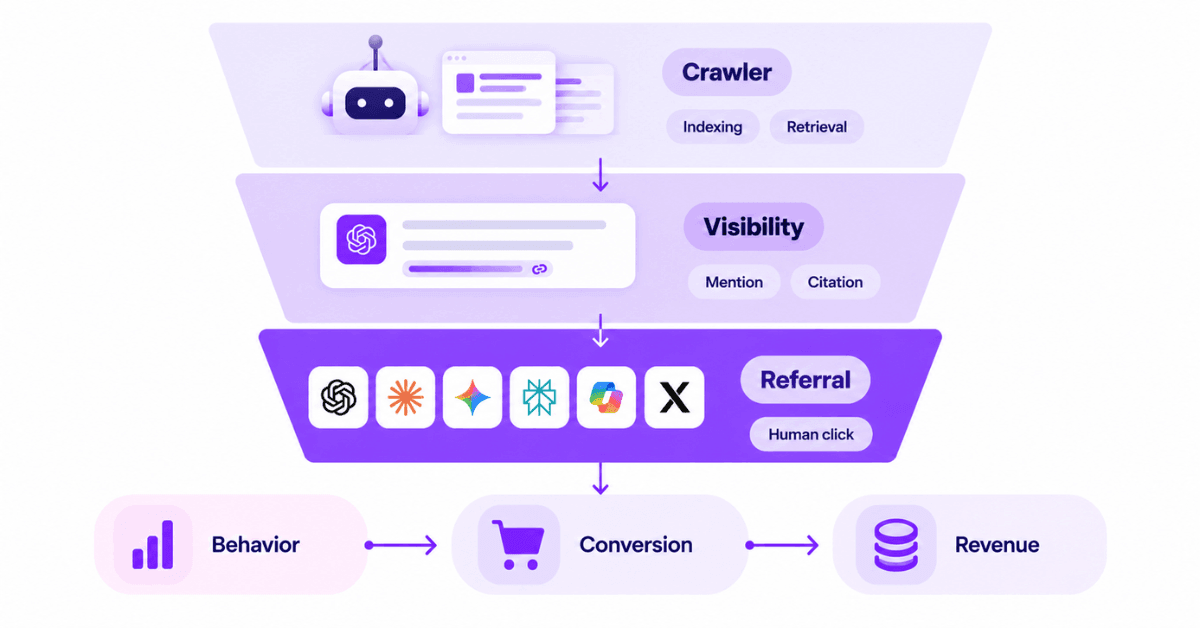
1. AI crawler and retrieval activity
AI crawlers and retrieval systems request website content for indexing, training, answer generation, search, or other automated workflows. These requests are machine activity, not human sessions.
Crawler analytics can reveal which systems access the site, which URLs they request, and how request volume changes. It cannot prove that the content appeared in an answer.
2. AI visibility and citations
A page can be cited, summarized, or mentioned inside an AI-generated answer without generating a click. That is an exposure or visibility signal rather than website traffic.
The measurement problem is similar to AI overview attribution, where visibility can influence discovery even when the user never creates a measurable referral session.
3. Human AI referral traffic
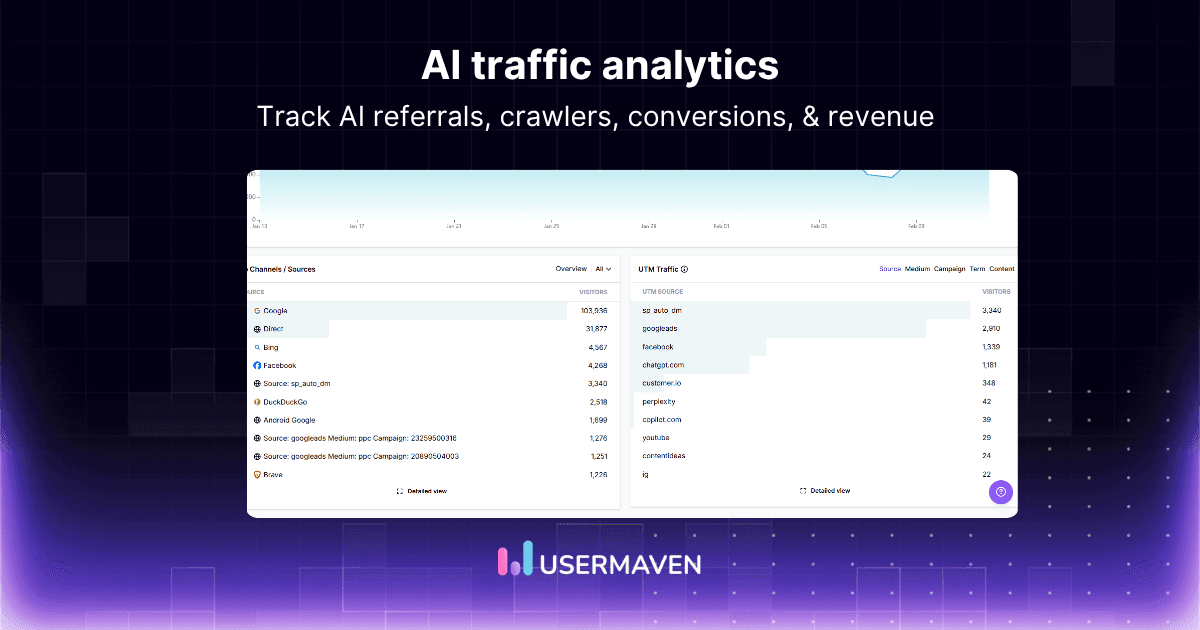
Human AI referral traffic begins when a person clicks from ChatGPT, Perplexity, Claude, Gemini, Copilot, Grok, or another assistant and lands on the website.
This layer can be analyzed like other acquisition traffic: source, landing page, behavior, conversion, return visits, customer journey, and downstream revenue when identity and attribution remain connected.
How AI discovery can turn into revenue
The broad measurement chain is: AI exposure → crawl or retrieval → citation → referral visit → behavior → conversion → revenue. Not every real journey exposes every stage to analytics.
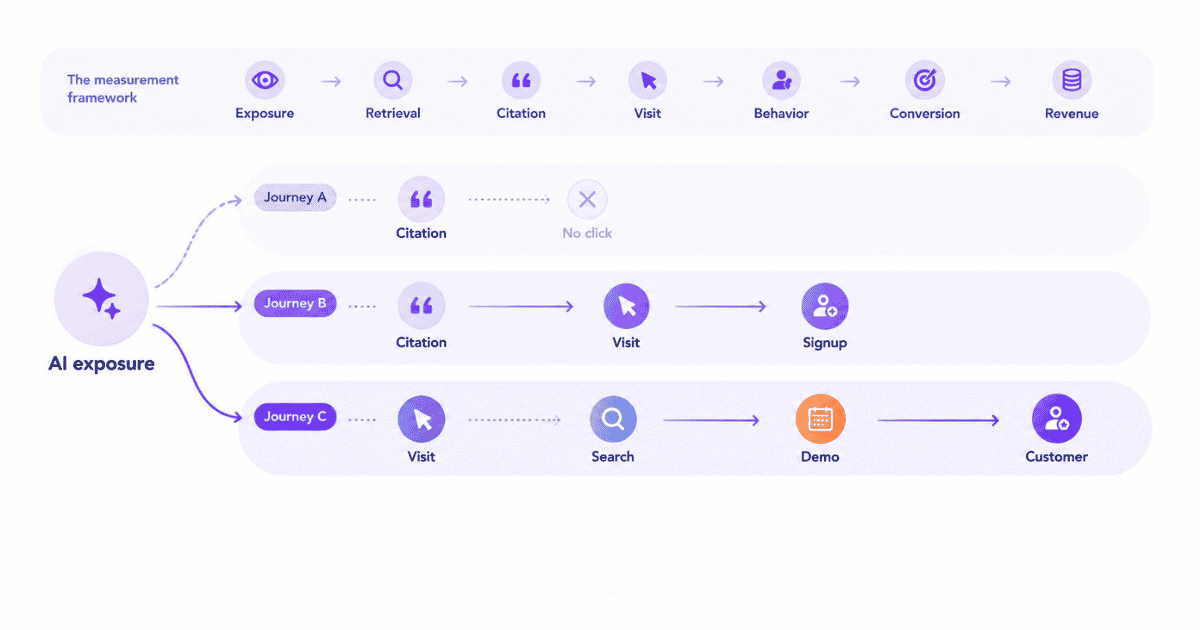
Citation with no click
An AI assistant cites an article, the user gets the answer, and no visit occurs. The brand may gain visibility, but ordinary web analytics has no referral session to measure.
Direct AI referral
Perplexity cites a comparison page, the user clicks, reads the page, and signs up. The AI source can now be evaluated against behavior and conversion quality.
AI-assisted conversion
ChatGPT sends the first visit, the visitor leaves, then returns later through branded search and books a demo.
| Measured AI traffic is not the same as total AI influence. |
Drive business growth
with AI-powered analytics
How to track human traffic from AI platforms
Human AI referrals should be tracked with the same discipline as other acquisition sources. Preserve the source, referrer, landing page, session context, meaningful events, and identity when the visitor later becomes known.
The source list will evolve, but common platforms include ChatGPT, Perplexity, Claude, Gemini, Copilot, and Grok. The important step is grouping recognized AI sources without mixing them with crawler traffic.
Usermaven currently classifies AI Search as a default channel. Recognized sources include ChatGPT, Perplexity, Claude, Gemini, Copilot, Grok, and Meta AI.
For analysis beyond the referral, website analytics should answer which landing pages attract AI visitors and whether those visitors behave differently from Organic Search, Referral, or Direct traffic.
How Google Analytics handles AI traffic
Google Analytics now has a dedicated AI Assistant default channel. Recognized assistant referrals can use the ai-assistant medium instead of being left entirely inside generic referral reporting.
However, the current Google Analytics default channel definition explicitly excludes Google AI Overviews and AI Mode from AI Assistant. Those Google surfaces are classified under Organic Search.
That makes GA4 more useful for recognized AI referrals, but it still does not turn AI discovery into a complete influence report. Citations without clicks remain outside ordinary referral measurement.
For most teams, the immediate GA4 check is simple: verify the AI Assistant channel, inspect source and medium, then compare engagement and conversion quality with other channels.
How to analyze AI crawler traffic
Crawler analytics answers a different question: which AI systems are accessing the website, how often they request pages, and which areas attract machine activity.
Useful crawler metrics include requests by crawler, operator, path, response code, and time. Deep crawler tools can also help teams monitor access controls and robots.txt behavior.
For example, Cloudflare AI Crawl Control exposes AI crawler requests, popular paths, operators, response patterns, and controls for allowing or blocking specific crawlers.
These metrics are valuable for content access and infrastructure decisions, but they should not be treated as customer demand.
| Crawler demand measures machine access, not customer demand. |
AI visibility vs. AI traffic analytics
AI visibility and AI traffic overlap, but they answer different questions. Visibility asks whether the brand or content appears in AI answers. Traffic asks whether a human reached the website.
| Measurement | Question it answers |
|---|---|
| AI visibility | Is the brand or content appearing in AI-generated answers? |
| AI citations | Which pages or sources are being referenced? |
| AI crawler activity | Which AI systems access the website? |
| AI referral traffic | Which AI platforms send human visitors? |
| AI engagement | What do those visitors do after arrival? |
| AI conversion | Do those visitors create meaningful outcomes? |
| AI revenue attribution | Does AI traffic contribute to pipeline or revenue? |
A citation can increase brand exposure without creating a visit. A referral can create a visit without being the final converting touch.
What happens after an AI visitor lands?
Referral counts are only the start. The useful question is whether AI visitors engage, progress, convert, and become valuable customers.
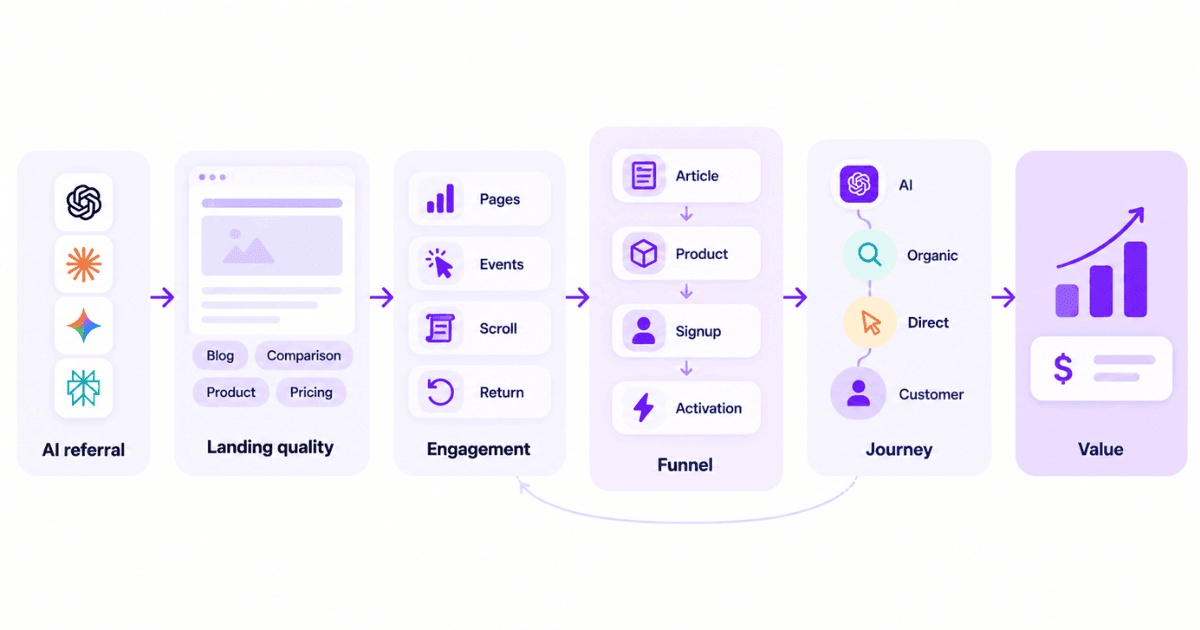
Landing-page quality
Start with the pages that receive AI referrals. Educational articles, comparisons, product pages, documentation, and pricing pages can represent very different intent.
Engagement after arrival
Compare engaged visits, pages viewed, key interactions, repeat visits, and meaningful events. High traffic with weak behavior can be less valuable than a smaller AI source that sends decision-ready visitors.
Funnel progression
A simple PLG path might be AI referral → article → product page → signup → activation. Funnels make it easier to see where AI-referred visitors progress and where they drop.
Customer journey context
AI may start a journey without closing it. Customer journeys help connect the initial AI source with return visits, later channels, product behavior, and the final conversion.
| The value of AI traffic begins after the click, not at the referral count. |
Metrics that show whether AI traffic is valuable
AI traffic should be judged by quality and commercial outcomes, not only by visitor volume. The right metrics depend on whether the business sells subscriptions, demos, products, or another outcome.
| Metric | What it answers |
|---|---|
| AI visitors | How many human visitors arrived from AI platforms? |
| AI visitor share | How much acquisition currently comes from measurable AI referrals? |
| AI landing pages | Which pages capture AI-driven demand? |
| Engagement rate | Do AI visitors interact meaningfully after arrival? |
| Signup rate | Does AI traffic create new users? |
| Demo rate | Does AI traffic create B2B demand? |
| Purchase rate | Does AI traffic generate customers? |
| Activation rate | Do AI-acquired users reach product value? |
| Revenue per AI visitor | How much commercial value is created per AI-referred visitor? |
| Assisted conversions | Does AI appear earlier in journeys that close elsewhere? |
| Pipeline | Does AI traffic contribute to qualified opportunities? |
| Attributed revenue | How much model-assigned revenue involves AI traffic? |
Two useful formulas keep the analysis grounded in outcomes:
| AI traffic conversion rate = AI-sourced conversions ÷ AI-referred visitors × 100 |
| Revenue per AI visitor = Revenue attributed to AI-involved journeys ÷ AI-referred visitors |
How to connect AI traffic with revenue
For a deeper understanding of AI traffic attribution, examine how first-touch, last-touch, and multi-touch models assign conversion and revenue credit to identifiable AI referrals across returning customer journeys.
Consider a B2B path: ChatGPT → comparison article → pricing page → demo → opportunity → Closed Won. A referral report sees one visit. A commercial report follows the journey into pipeline and revenue.
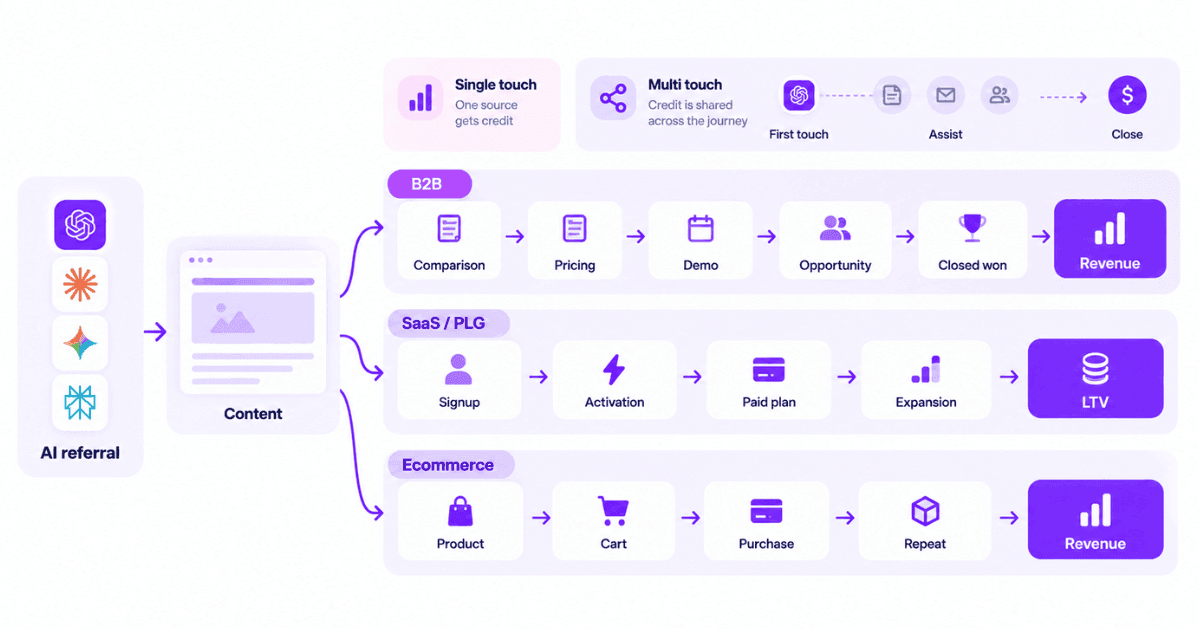
Connecting acquisition sources with downstream commercial outcomes is the core purpose of revenue attribution, especially when the channel that starts the journey is different from the one that closes it.
In B2B, the useful chain is AI referral → content → demo → CRM lead → opportunity → Closed Won → revenue. For PLG, it can be AI referral → signup → activation → paid plan → expansion.
Ecommerce teams can follow AI referral → product → cart → purchase → repeat order. The measurement principle is the same: traffic quality is determined by what happens downstream.
AI traffic attribution has blind spots
AI referral analytics can be useful without being complete. The main limitations should stay visible so teams do not turn partial measurement into false certainty.
Zero-click AI discovery
A user can see a brand, product, or source inside an AI answer and never visit the site. No referral session exists, even though discovery happened.
Lost or incomplete referrers
Some journeys can lose source context because of platform behavior, redirects, privacy controls, or later visits that arrive through another channel.
Later branded or direct returns
A user may discover the brand through an AI answer, then return later through branded search or Direct traffic. The later session can hide the original discovery source in last-click reporting.
Cross-device behavior
Discovery can happen on one device and conversion on another. Without identity continuity, one real customer journey can appear as two unrelated visitors.
Identity gaps
Anonymous AI visits may not connect cleanly with later known users, opportunities, or purchases. The result is unattributed value even when the commercial event is correct.
Attribution is not incrementality
If AI Search receives attributed revenue, that does not prove the same revenue would disappear without AI. Attribution assigns credit to observed journeys; incrementality asks what marketing caused.
| Observable AI referrals are measurable. Total AI influence is not fully observable. |
How Usermaven analyzes AI traffic
Usermaven is an AI marketing attribution platform that connects marketing, website, product, CRM, and revenue data. Its AI traffic workflow extends beyond identifying a referral source.
Identify AI referral traffic
Usermaven maps recognized AI sources into an AI Search channel. Recognized sources include ChatGPT, Perplexity, Claude, Gemini, Copilot, Grok, and Meta AI.
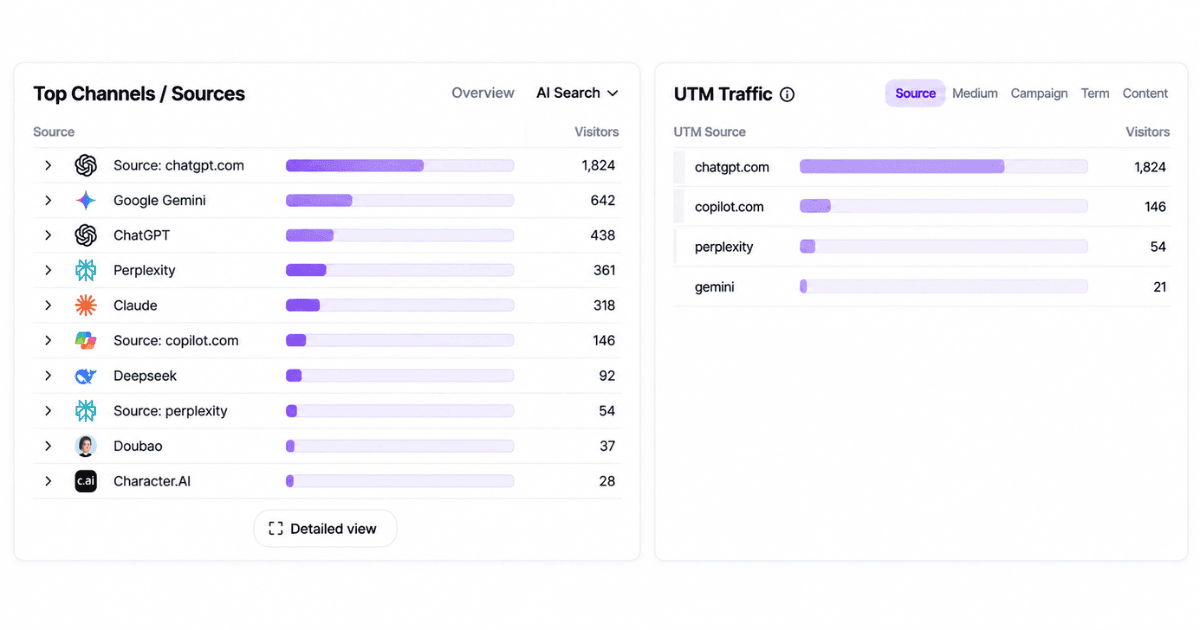
The analytics dashboards library also includes an AI Traffic template for monitoring AI referrals and recognized crawler activity alongside other acquisition and performance metrics.
Separate people from crawler activity
The AI Traffic dashboard is designed around two views: human visitors arriving from AI assistants and chatbots, and web scraper or bot activity from AI search engines.
That separation prevents crawler requests from inflating human acquisition reporting and keeps machine access useful as its own operational signal.
Follow AI visitors through behavior
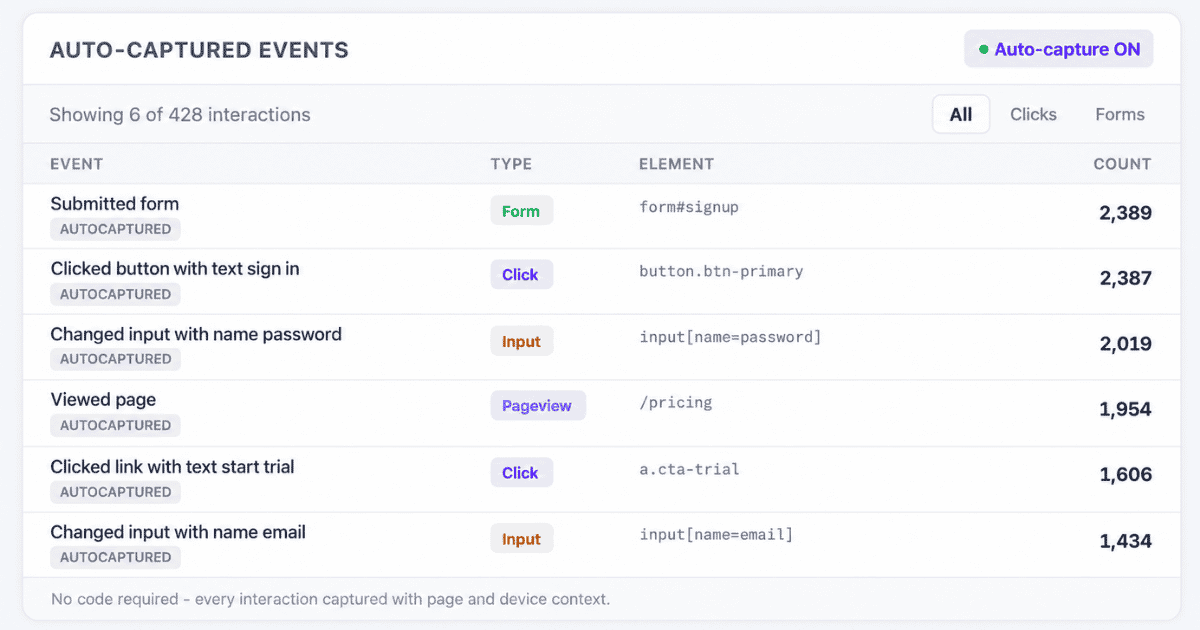
Once a visitor lands, Events and behavioral analytics can connect page interactions, signups, demos, purchases, or other meaningful actions with the acquisition context that preceded them.
Connect AI with attribution and revenue
AI Search can be an acquisition source, an assisting touch, or the final measurable interaction.
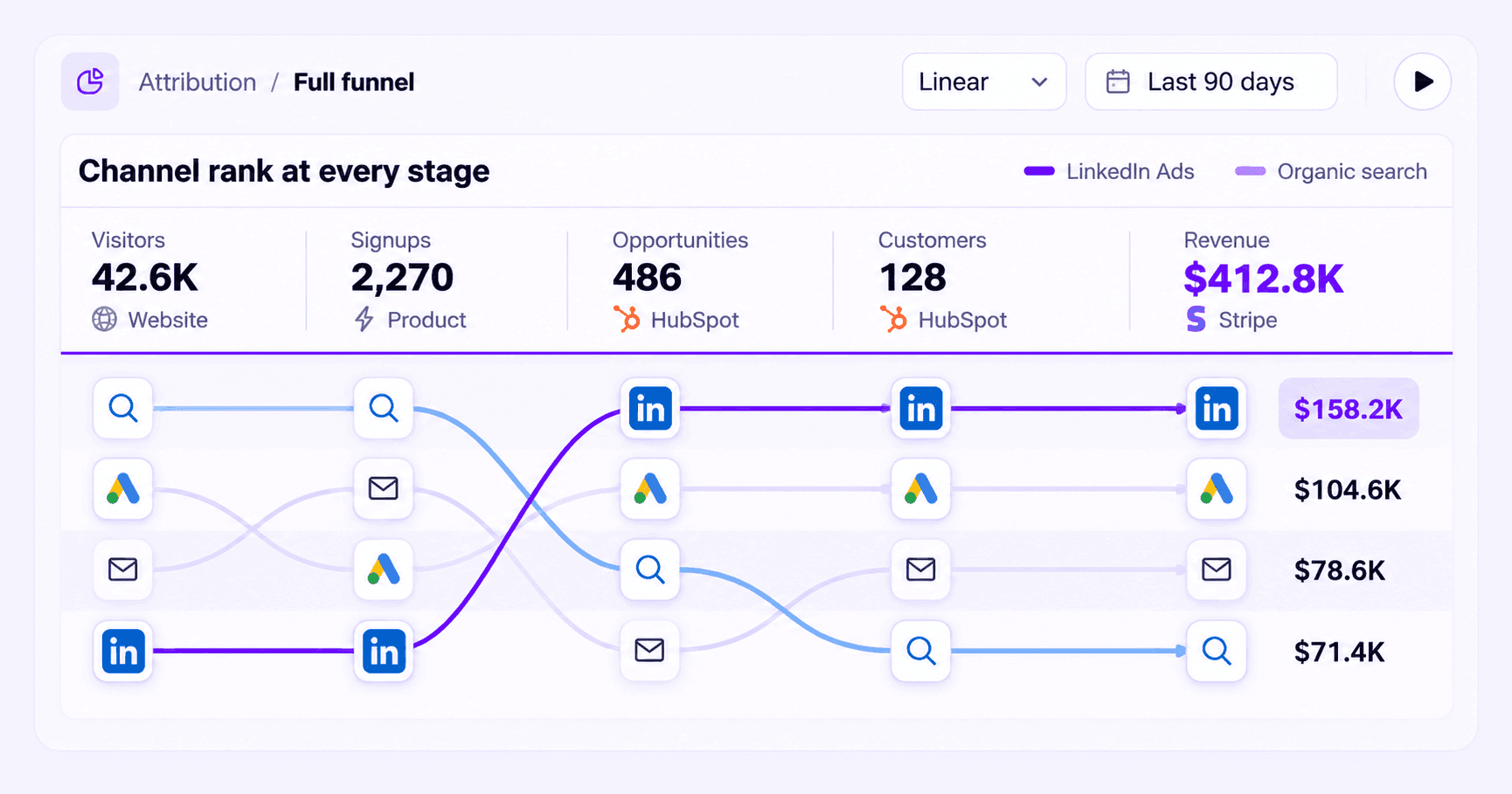
For longer commercial journeys, full-funnel revenue attribution connects acquisition with conversion, pipeline, customer status, and revenue instead of stopping at the first web goal.
Check whether the measurement is trustworthy
The Measurement Trust Center checks collection, identity, integrations, delivery, and reliability so teams can see measurement gaps before acting on an attribution report.
Investigate patterns with Maven AI
Maven AI can investigate questions such as which AI sources send the highest-converting visitors, which landing pages attract AI traffic but underperform, or whether AI Search appears before high-value journeys.
With Usermaven, authorized analytics can also be queried from compatible external AI clients through MCP. AI can speed up investigation, but it cannot repair missing source data or identity gaps.
First-party evidence: Contentpen
Contentpen is a strong example because its team already had organic traffic but lacked a clear view of what users did after landing, which content led to conversion, and where journeys broke.
After adopting Usermaven, the Contentpen case study reports that separating users from organic and AI search was a major win because the team could compare acquisition sources with real user behavior.
The published results include a 30% to 32% increase in conversions, 25% to 28% growth in engagement, 50% less analysis time, and full visibility into user journeys and drop-offs.
Those outcomes should not be attributed to AI traffic analytics alone.
AI traffic analytics workflow
Use this workflow to keep AI measurement consistent as sources and platforms change.
1. Define the signals: Separate crawler activity, AI visibility, human referrals, on-site behavior, conversions, and revenue before building a dashboard.
2. Create AI source rules: Identify the AI assistants and search experiences relevant to the business and keep the source list current.
3. Preserve source context: Keep referrer and source information attached to the visit and later customer journey whenever the tracking architecture allows it.
4. Track meaningful events: Use signup, demo, purchase, activation, opportunity, or revenue events rather than relying on pageviews alone.
5. Inspect landing pages: Find which pages receive AI referrals and compare the intent of educational, comparison, documentation, and product traffic.
6. Compare behavior: Measure engagement and funnel progression against Organic Search, Referral, Paid, and Direct traffic.
7. Resolve identities: Connect anonymous visits with known users, accounts, or customers when consent and identifiers make that possible.
8. Follow assisted journeys: Do not assume the final channel is the only source that mattered when AI appeared earlier in the path.
9. Connect commercial outcomes: Bring CRM, subscription, payment, or purchase data into the measurement layer so AI traffic can be evaluated against value.
10. Separate visibility from traffic: Do not claim that an AI citation created a visit unless a measurable referral or other defensible evidence exists.
11. Monitor crawlers separately: Keep bot requests out of human visitor metrics and use crawler data for content access and infrastructure questions.
12. Reconcile attribution: Confirm how AI receives credit under the selected model before reallocating spend or changing acquisition strategy.
When AI traffic analytics matters most
Content and SEO teams
AI traffic analytics shows whether AI discovery produces meaningful website engagement, which pages attract AI referrals, and whether high-visibility content also contributes to conversion.
B2B SaaS teams
For B2B SaaS, AI discovery can happen weeks before a commercial outcome.
Product-led SaaS
PLG teams can compare whether AI-referred users activate, adopt important features, upgrade, and remain retained after signup. That makes AI acquisition quality more useful than traffic volume.
Ecommerce teams
Ecommerce teams can evaluate which AI sources send shoppers, what products or content they land on, and whether those visits lead to purchases, repeat orders, or higher-value customers.
What AI traffic analytics cannot tell you
Even a strong measurement setup cannot perfectly reconstruct every AI-influenced journey. Some questions remain partially or completely outside observable analytics.
Every AI mention: Not every assistant exposes citation or impression data to site owners.
Every zero-click influence: A user can discover the brand through AI without creating a measurable visit.
Why a model chose a source: A crawler request or referral does not reveal the full ranking, retrieval, or generation logic behind the answer.
True causal lift: Attributed conversions show credit, not the exact incremental outcome created by AI discovery.
Commercial value of crawler requests: Crawler activity can matter strategically, but a request alone has no verified customer value.
| Measure what is observable, and label what is inferred. |
Final verdict
AI traffic analytics should not be reduced to “How many visitors came from ChatGPT?” The useful model separates crawler activity, AI visibility, human referrals, on-site behavior, conversion, and revenue.
That separation prevents bot requests from inflating traffic, prevents citations from being mistaken for visits, and helps marketers judge AI discovery by the customer journeys it creates.
The winning metric is not AI traffic volume. It is whether measurable AI-originated discovery produces engaged visitors, conversions, qualified pipeline, customers, and revenue.
Book a demo to see how Usermaven connects AI traffic with website behavior, customer journeys, conversions, and revenue.
FAQs
1. What is AI traffic analytics?
AI traffic analytics measures website activity associated with AI systems. It can include human referrals from AI assistants, AI crawler activity, and downstream behavior, conversions, and revenue connected with measurable AI-referred visits.
2. What counts as AI traffic?
AI traffic can mean human visitors arriving from AI assistants or machine activity from AI crawlers and retrieval systems. Report them separately because one represents people and the other automated requests.
3. How can I track traffic from ChatGPT and other AI tools?
Track recognized AI referrers and sources, preserve landing-page and session context, then follow meaningful events after arrival. Group AI sources consistently so engagement and conversions can be compared with other acquisition channels.
4. Can Google Analytics track AI traffic?
Yes. Google Analytics has an AI Assistant default channel for recognized assistant referrals. Google AI Overviews and AI Mode are classified under Organic Search, so the channel does not represent every AI-influenced journey.
5. AI traffic vs. AI crawler traffic: What is different?
AI referral traffic represents human visitors who click through from an AI experience. AI crawler traffic represents automated systems requesting website content. Crawler requests should not be counted as human sessions.
6. Is AI visibility the same as AI referral traffic?
No. AI visibility means a brand or source appears inside an AI-generated answer. Referral traffic begins when a person clicks through to the website, so visibility can exist with zero measurable visits.
7. Which AI traffic metrics should I track?
Updated

Written by
Junaid Ahmed
Content Writer & Digital Marketer
Junaid Ahmed is a content and copywriter with 3+ years of experience creating research-driven content across SaaS, B2B, ecommerce, and digital marketing. He specializes in turning complex topics into clear, practical content that helps marketers better understand their challenges, evaluate solutions, and make informed decisions. His work spans educational content, industry insights, and actionable marketing guides.
All articles by Junaid →