Which analytics platform should you trust when traffic, conversions, and revenue tell different stories? Fathom, GA4, and Usermaven answer different parts of that question.
Fathom simplifies website reports. GA4 provides detailed event analysis. Marketing attribution software such as Usermaven connects campaigns with product behavior, pipeline, and revenue.
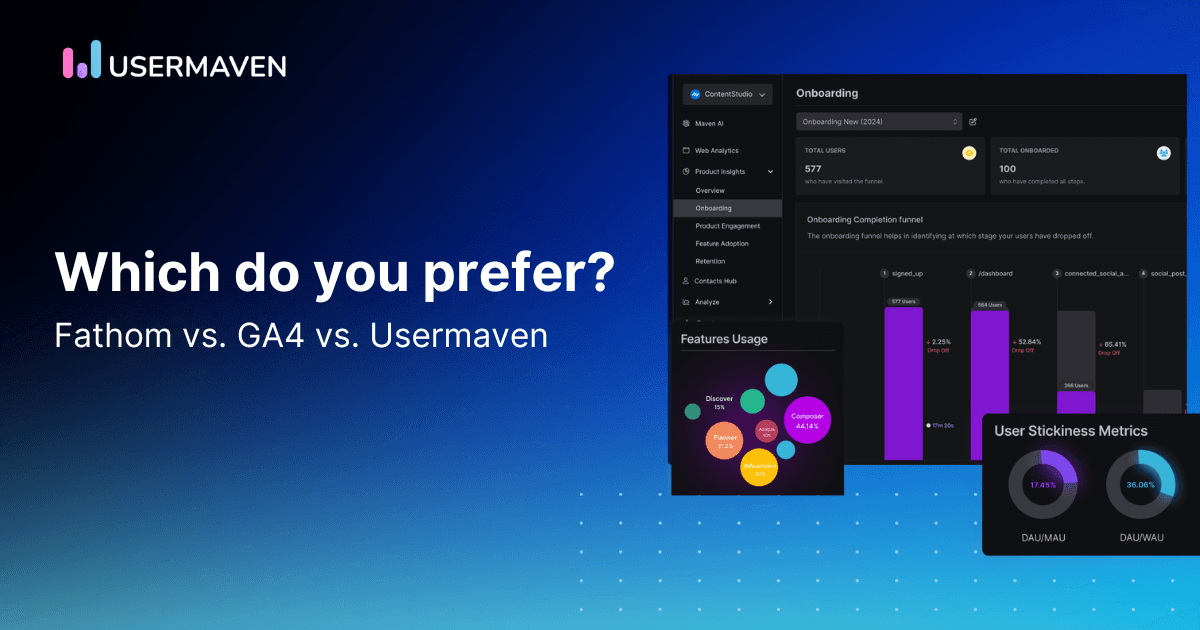
This Fathom vs. GA4 vs. Usermaven comparison examines tracking, attribution, AI, privacy controls, pricing, and the workflow each platform suits best.
Key takeaways
- Choose Fathom for lean, cookieless website analytics, campaigns, custom events, and straightforward revenue totals.
- Choose GA4 for granular event analysis, Google Ads integration, ecommerce, funnels, and data-driven attribution.
- Consider Usermaven when marketing teams must link acquisition, conversion paths, CRM stages, and revenue in one reporting workflow.
Which platform fits each measurement goal?
| Primary need | Fathom | GA4 | Usermaven |
| Simple traffic and referrers | Core strength | Supported; more configuration | Supported alongside attribution |
| Web/app product events | Website events | Detailed web and app events | Web and product behavior |
| Conversion funnels | Event goals; no equivalent deep funnel workspace | Funnel explorations | Funnels and journey analysis |
| Marketing attribution | UTM/referrer and goal reporting | Data-driven and last-click models | Multi-touch, paid ads, CRM revenue |
| AI assistance | Luna analytics assistant | Generated and predictive insights | Maven AI, scheduled Agents, MCP |
| Best-fitting buyer | Lean site owner or publisher | Google-centered analytics team | SaaS, marketing, growth, agency teams |
What Fathom, GA4, and Usermaven actually do
Fathom: simple website reporting
Fathom offers cookieless website analytics with live traffic, referrers, campaigns, custom events, and revenue totals. Its focus is clarity rather than detailed product behavior.
It also supports Google Search Console data, saved views, dashboard sharing, and a Google Analytics historical-data importer. This makes it useful for publishers and smaller marketing teams.
GA4: flexible event and acquisition analytics
Google Analytics 4 measures website and app events, ecommerce actions, audiences, conversion paths, and campaigns. It integrates closely with Google Ads and BigQuery.
GA4 provides automatic events and enhanced measurement, but business-specific conversions and reliable campaign naming still need a thoughtful implementation plan.
Usermaven: attribution connected to revenue
Usermaven is an AI marketing attribution platform combining website analytics, product activity, conversion funnels, and multi-touch reporting with marketing and CRM data.
Its reporting connects early touchpoints to signups, pipeline stages, and customer revenue. That is different from reading website referrers or product behavior in isolation.
For longer sales cycles, its B2B SaaS solution links acquisition, activation, retention, and revenue questions in the same workflow.
Privacy, consent, and data reliability

All three platforms offer privacy controls, but their collection models differ. Legal compliance depends on implementation, consent requirements, regional law, and data-processing settings.
Fathom uses cookieless measurement and privacy-focused infrastructure. GA4 supports Consent Mode and privacy settings. Usermaven offers optional cookieless and server-side tracking.
No analytics tool can guarantee complete measurement through every ad blocker. For tracking quality, verify missing events, attribution gaps, bot filtering, and identity matching.
How privacy and measurement differ
| Decision factor | Fathom | GA4 | Usermaven |
| Browser cookies | Cookieless by design | First-party cookies typically used; Consent Mode available | Optional cookieless tracking |
| Hosting model | Vendor-hosted, EU data isolation | Google-managed infrastructure | Hosted; advanced deployment options on Enterprise |
| Real-time view | Yes | Yes, separate Realtime reports | Yes; live contacts and event views |
| Event-level exploration | Custom events and filtered reports | Detailed events and explorations | Events, contacts, segments, funnels |
| Measurement trust checks | Review traffic and goal data | Implementation/DebugView and diagnostics | Measurement Trust Center and tracking diagnostics |
| Retention | Full history while subscribed | 2 or 14 months for standard-property exploration data | Contract and plan dependent |
In Usermaven, the Measurement Trust Center audits tracking, campaign tagging, customer matching, connected data, and conversion feedback.
Setup and event tracking
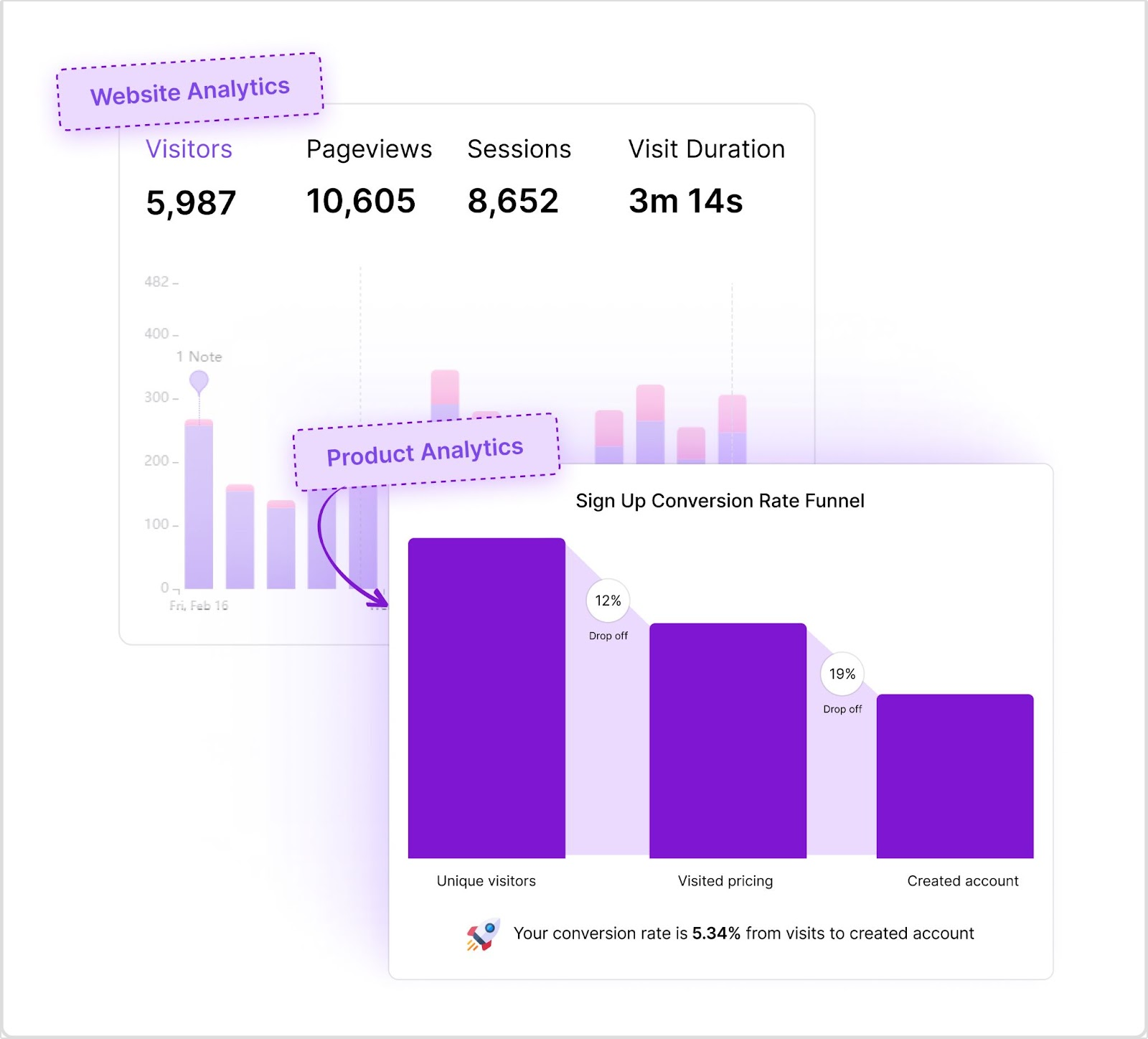
Fathom typically needs a lightweight site snippet or integration. Page traffic is captured automatically; meaningful business actions require configured events.
GA4 automatically records selected interactions and supports enhanced measurement. Complex purchases, lead stages, and custom parameters still need an event plan and validation.
Usermaven autocaptures common activity and supports custom and server-side events. CRM integrations add business context after a visitor becomes a lead or customer.
Implementation decisions that matter
| Requirement | Fathom | GA4 | Usermaven |
| Basic installation | Single snippet or integration | Google tag or tag manager | Tracking script or integration |
| Automatic web events | Pageviews and core traffic | Automatic and enhanced events | Automatic event capture |
| Custom business actions | Custom events | Recommended/custom events | Custom events and conversion goals |
| Technical work to expect | Event setup for key goals | Tagging and event taxonomy for depth | CRM mapping and attribution rules for depth |
| Cross-team use | Simple shared dashboards | Reports and explorations | Dashboards, attribution, contact profiles |
Attribution: traffic vs. pipeline and revenue
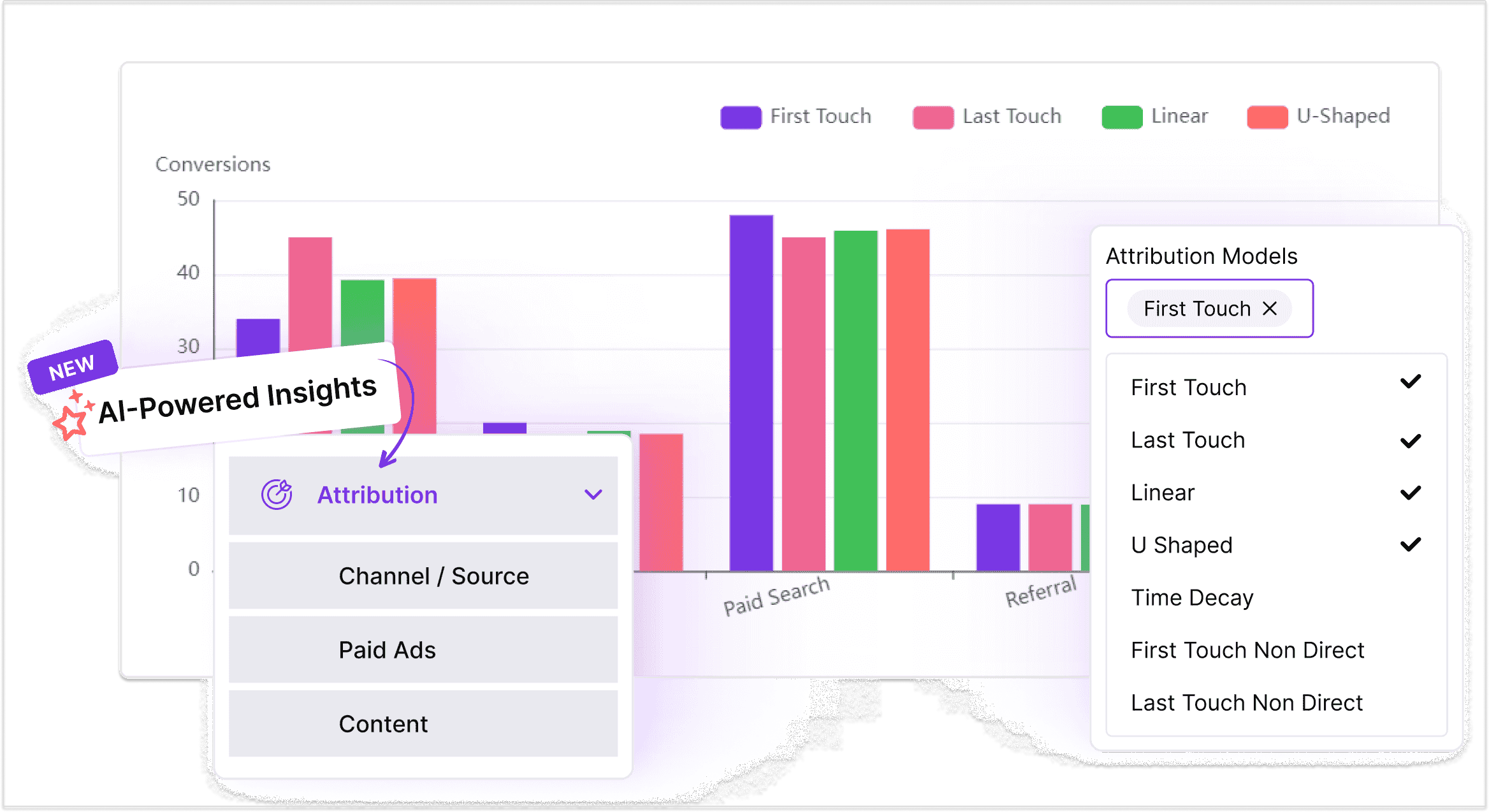
All three products report acquisition sources, but they answer different questions about conversion credit. Website referrers are not the same as multi-touch revenue attribution.
Fathom connects page visits, UTM campaigns, and custom goals or sales totals. It is useful for source performance, but not positioned as a full CRM revenue-attribution platform.
GA4 supports data-driven, paid-and-organic last-click, and Google paid-channel last-click attribution. Standard key-event lookback options reach 90 days.
Usermaven connects paid channels and multi-touch attribution to conversion paths, CRM leads, opportunities, and downstream revenue. Enterprise workspaces also support custom models.
What can each platform attribute?
| Attribution requirement | Fathom | GA4 | Usermaven |
| UTM and source analysis | Yes | Yes | Yes |
| Goal or purchase value | Custom event revenue | Key events and ecommerce revenue | Conversions, deals, and revenue |
| Multi-touch credit models | Not a core capability | Data-driven and last-click attribution | Standard multi-touch; custom models by eligibility |
| Lookback settings | Not a comparable model window | Up to 90 days for most key events | Up to 365 days where supported |
| CRM opportunity reporting | Requires external workflow | Requires CRM/data integration | HubSpot and Salesforce integrations |
| Ad spend and revenue analysis | Campaign referrers and UTM | Ads integrations and reporting | Paid ads and CRM revenue attribution |
If pipeline decisions matter, validate the measurement chain: ad click → identified lead → CRM stage → closed deal → attributed revenue. A channel report alone cannot complete it.
Funnels, journeys, and product activation
Fathom records conversion events and their sources, but does not center its product on granular multi-step activation funnels or individual product journeys.
GA4 provides funnel and path explorations, audiences, and event analysis. Its flexibility is useful when teams can maintain consistent conversion and user definitions.
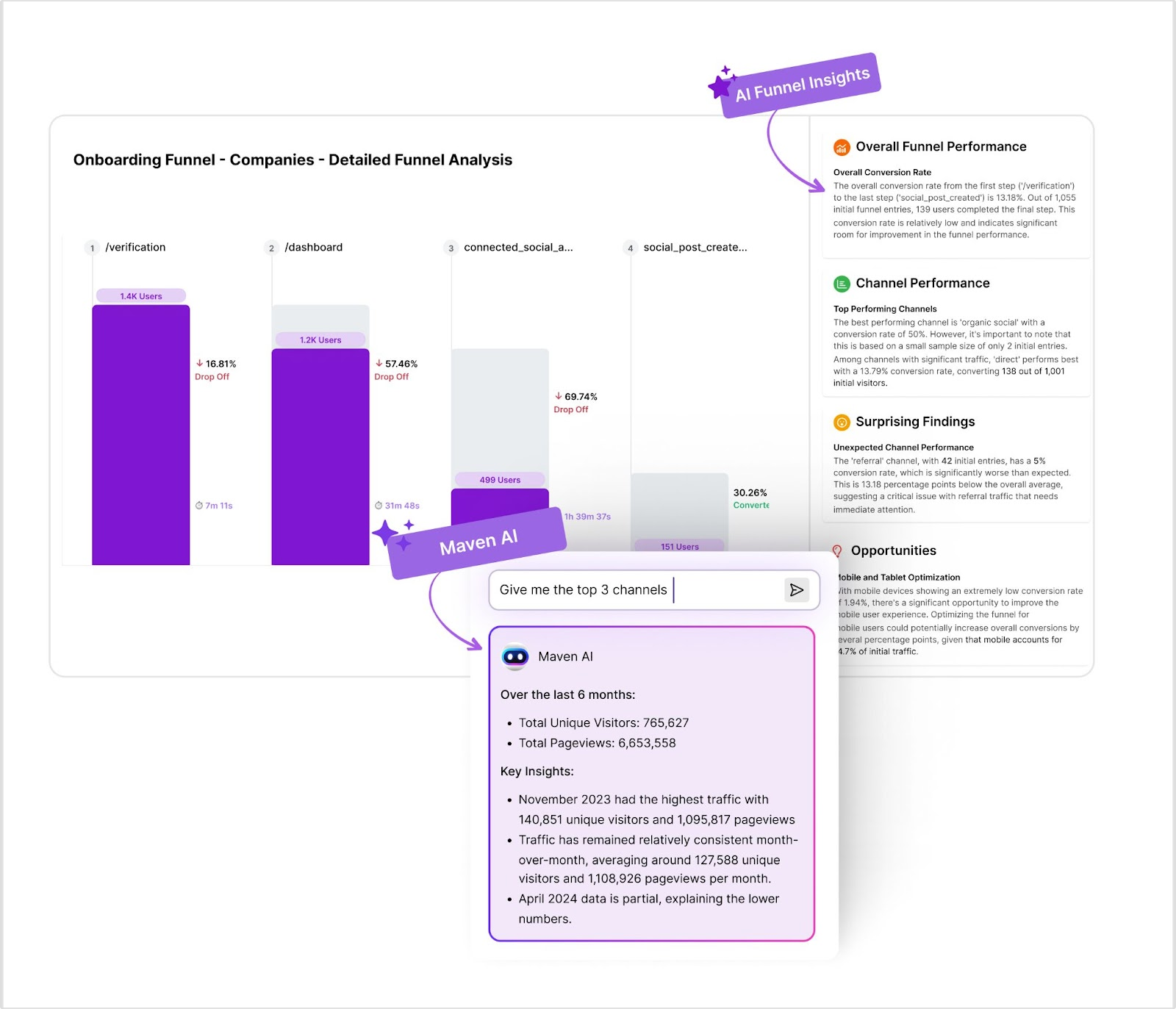
Usermaven connects funnels with user journeys, segments, feature adoption, and acquisition sources. Teams can investigate where high-intent visitors leave before signup or activation.
Where funnel tools differ
| Workflow | Fathom | GA4 | Usermaven |
| Goal completions | Custom events and revenue | Key events | Goals and conversions |
| Multi-step funnel analysis | Not a primary product feature | Funnel explorations | Dedicated funnel reports |
| Path exploration | Traffic and page breakdowns | Path explorations | User journey analysis |
| Cohorts and retention | Not a main use case | Audiences and explorations | Segments, cohorts, retention |
| Best use | Site signup and sales totals | Detailed web/app behavior | Acquisition through activation |
AI features are no longer a one-tool story

AI is a meaningful difference, but claiming that GA4 or Fathom have no AI is outdated. The question is what each assistant can analyze and how it fits your team’s workflow.
Fathom launched Luna on October 6, 2026. With permission, Luna can answer questions about traffic, events, and sources; it also helps users navigate Fathom’s documentation.
GA4 offers predictive metrics and generated insights highlighting anomalies, changes, and trends. Its AI is integrated into the Google Analytics reporting environment.
Usermaven’s Maven AI supports questions about analytics data, charts, and funnels. Scheduled Agents can revisit defined analyses and surface changes without repeated prompts.
Its MCP capabilities connect AI clients to Usermaven data, while external connectors can bring additional context into Maven AI. Scope and permissions should be checked during evaluation.
AI capability and workflow comparison
| AI workflow | Fathom | GA4 | Usermaven |
| Natural-language questions | Luna, with permission for stats | Generated insights; other AI functions | Maven AI assistant |
| Insights from own metrics | Traffic, goals, sources | Trends, anomalies, predictive signals | Attribution, funnels, journeys |
| Recurring autonomous analysis | Not a central Luna function | Automated platform insights | Scheduled Maven AI Agents |
| External AI-client integration | API for analytics workflows | APIs and Google integrations | MCP connections with permissions |
| Primary outcome | Fast website answers | Report interpretation | Cross-workflow attribution and behavior analysis |
Pricing and total cost
Fathom begins at $15 per month for up to 100,000 monthly pageviews, with 50 sites included. Its plans scale with pageviews and custom events, plus optional extra-site packs.
GA4 has a free standard edition; Google Analytics 360 is enterprise-priced. Internal setup, debugging, warehouse processing, and reporting effort may affect total cost.
Usermaven offers Business and Enterprise plans with custom quotes. Confirm event volumes, integrations, onboarding, workspaces, and enterprise controls before comparing totals.
Check Fathom’s pricing page for current tiers; Usermaven’s plan information describes its tailored business offering.
Current pricing models side by side
| Pricing question | Fathom | GA4 | Usermaven |
| Entry price | $15/month (100k monthly pageviews) | Free standard edition | Custom sales quote |
| Higher capacity | Pageview-based tiers | GA4 360 for enterprise needs | Business / Enterprise requirements |
| Trial or evaluation | 7-day free trial | Free standard property | Product demo and scoping |
| Usage unit | Pageviews + custom event allowance | GA4 event/data property limits | Quote-specific event and workspace scope |
| Potential extra costs | Extra websites / higher tiers | Implementation and external services | Setup, white label, or export add-ons |
Do not compare the three only by starting price: pageviews, events, CRM integrations, user-level reporting, and implementation are different cost drivers.
Customer evidence: from arrival to activation
PostNitro, a SaaS content-creation platform, previously relied on GA4 for traffic visibility. Its team needed better answers about onboarding behavior and the actions leading to signup.
After using Usermaven for behavioral and funnel analysis, PostNitro reported that about 70% of visitors who engaged with its demo experience signed up.
It also reported around 50% less reporting time. These are PostNitro’s observed results, not guaranteed outcomes or a direct controlled comparison with GA4.
The detailed PostNitro case study illustrates why traffic measurement and product activation measurement answer different business questions.
How to choose the right analytics platform
- Choose Fathom if speed, lightweight implementation, cookieless traffic analytics, and easy campaign reporting are the priorities.
- Choose GA4 if your stack depends on Google Ads, app and ecommerce events, BigQuery, or advanced event exploration.
- Consider Usermaven if the marketing team needs to see how channels influence signups, opportunities, revenue, and product engagement.
- Before deciding: run the same test conversion and compare source capture, identity matching, CRM linkage, reporting effort, and total price.
For agencies measuring multiple client funnels, the marketing agency solution can be evaluated alongside Fathom’s straightforward multi-site dashboards.
Make data-driven decisions
faster with Maven AI
Conclusion
Fathom makes website traffic easier to understand. GA4 provides detailed Google-connected event reporting. Usermaven connects acquisition and behavior to a broader revenue story.
If the missing answer is which campaigns create qualified customers—not merely visits—book a Usermaven demo to review attribution, CRM integration, and measurement needs.
FAQs
1. Which is easier to use: Fathom, GA4, or Usermaven?
Fathom is designed for quick website reporting. GA4 offers more configuration and analysis depth. Usermaven is aimed at teams that need marketing attribution with behavioral reports.
2. Does Fathom Analytics have AI?
Yes. Fathom introduced Luna in October 2026. With permission, it can answer questions about traffic, events, and acquisition sources, and it can help explain the product.
3. Does GA4 offer real-time analytics?
Yes. GA4 Realtime reports show recent events and visitor activity. GA4 also supports automatically collected and enhanced-measurement events.
4. Which platform supports multi-touch attribution?
GA4 provides data-driven and last-click attribution. Usermaven offers multi-touch marketing attribution connected to paid campaigns and CRM revenue. Fathom focuses on UTM and referrer reporting.
5. Does Usermaven offer automatic event tracking?
Yes. Usermaven autocaptures common visitor interactions and supports custom conversion goals. CRM and revenue workflows still require configuration and integration.
6. How much do Fathom, GA4, and Usermaven cost?
Fathom starts at $15 per month for 100,000 pageviews. GA4 has a free standard edition and paid Analytics 360. Usermaven Business and Enterprise pricing is quote-based.
7. Which tool is better for SaaS revenue analysis?
Usermaven fits SaaS teams needing campaign-to-CRM and revenue attribution alongside product analytics. GA4 supports detailed event and ecommerce analysis, while Fathom covers website conversions and revenue totals.
Updated

Written by
Adeel Khan
Growth Marketing Expert
Adeel Khan is a full-stack SaaS marketer with 10+ years of experience in content marketing, paid advertising, analytics, and conversion rate optimization. He shares practical insights and strategies drawn from hands-on experience, helping B2B SaaS marketers improve performance and make better marketing decisions.
All articles by Adeel →