Usermaven and HockeyStack both help teams connect marketing activity with revenue, but they now solve different versions of the problem. Teams comparing marketing attribution software should look beyond attribution checkmarks and ask what happens before and after the attributed conversion.
HockeyStack has expanded into enterprise GTM intelligence, account scoring, incrementality, and AI-driven revenue workflows. Usermaven combines attribution with website analytics, native product behavior, funnels, CRM revenue, retention, and LTV in a more self-serve analytics environment.
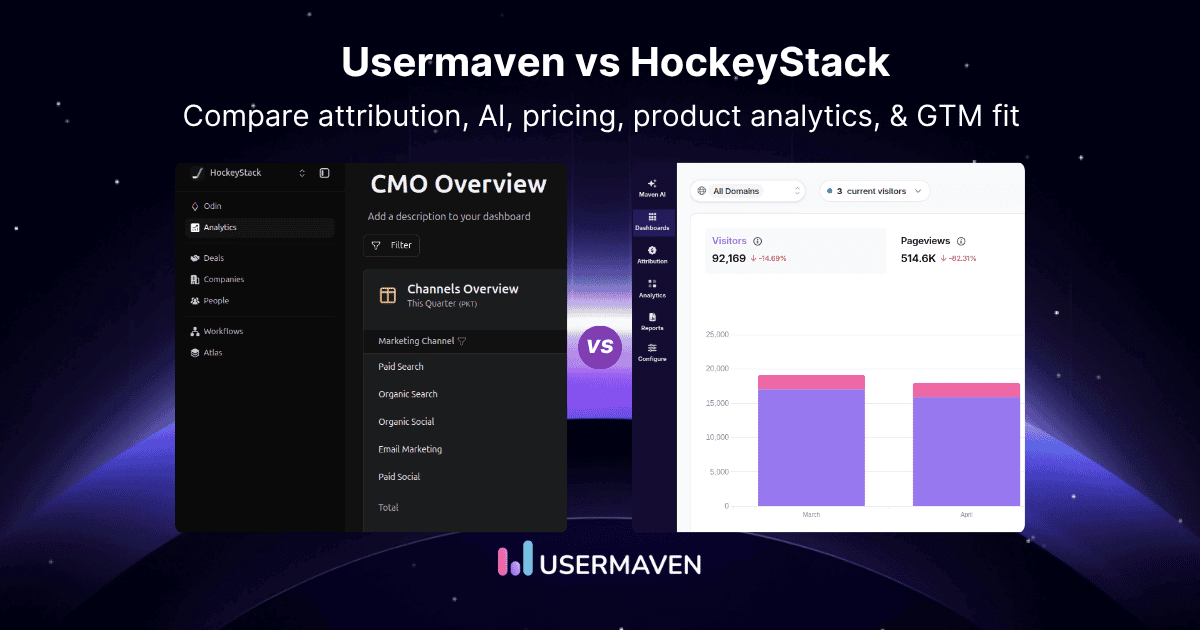
This comparison of Usermaven vs. HockeyStack evaluates pricing, attribution, product analytics, buyer journeys, CRM, AI, external AI workflows, setup, reviews, and real use cases so the final choice reflects the operating model rather than the length of a feature list.
Usermaven vs. HockeyStack at a glance
Bottom line: Usermaven is generally the better fit for SaaS, PLG, ecommerce, agencies, and B2B teams that want attribution connected with behavioral analytics through its Business and Enterprise plans. HockeyStack is generally stronger for enterprise RevOps and GTM teams that need deep account intelligence, incrementality, highly customizable attribution, and AI-driven revenue execution.
Usermaven vs. HockeyStack comparison
| Area | Usermaven | HockeyStack | Practical edge |
|---|---|---|---|
| Marketing attribution | Strong multi-touch + revenue attribution | Strong multi-touch + custom attribution | Depends on required customization |
| Product analytics | Native product usage, adoption, funnels, retention | Product signals can feed GTM context | Usermaven |
| Account intelligence | User/company profiles + CRM context | Intent scoring, stakeholder maps, account plans | HockeyStack |
| Incrementality | No dedicated Lift product | Dedicated Lift Reporting | HockeyStack |
| CRM revenue attribution | Yes | Yes | Different operating models |
| AI | Maven AI for marketing + product analytics | Odin + GTM recommendations and agents | Different strengths |
| Pricing | Business and Enterprise; request a quote | Official site is sales-led | Compare quotes and included features |
| Ease of setup | Self-serve orientation | Guided enterprise implementation | Usermaven for smaller teams |
| Enterprise GTM depth | Moderate | Deep | HockeyStack |
For readers who want the shorter product-level version of this decision, Usermaven also maintains a dedicated HockeyStack alternative comparison. This article goes further into architecture, use cases, user reviews, customer outcomes, and where HockeyStack is genuinely the stronger option.
Key takeaways
Usermaven is broader across the customer lifecycle: Attribution can sit beside website behavior, product usage, CRM revenue, retention, and LTV in one analytics environment.
HockeyStack is deeper in enterprise GTM intelligence: Its public platform now spans Atlas, Account Intelligence, Lift Reporting, Blueprints, Odin, and agentic GTM workflows.
Attribution is strong on both: The real comparison is how much customization is required and what other data needs to surround the attribution result.
HockeyStack has the stronger incrementality layer: Lift Reporting explicitly estimates incremental impact and complements its multi-touch attribution workflow.
Both vendors use sales-led pricing: Usermaven lists Business and Enterprise without fixed public prices, while HockeyStack’s official pricing page also routes buyers through sales.
Product analytics changes the SaaS decision: Usermaven natively measures activation, feature adoption, retention, and product usage instead of treating product activity mainly as GTM context.
There is no universal winner: Enterprise ABM and RevOps teams may prefer HockeyStack, while SaaS, PLG, ecommerce, agencies, and lean growth teams may get more value from Usermaven.
Usermaven and HockeyStack serve different measurement architectures
The cleanest way to compare these products is to look at the path each one is designed to understand and improve. Both can connect marketing to revenue, but their center of gravity is different.

Usermaven’s operating center
Usermaven is strongest when the team needs a continuous analytics path from acquisition into what users do after they arrive and after they sign up.
| Usermaven measurement chain Acquisition → website behavior → signup → product usage → CRM pipeline → revenue → retention → LTV |
That architecture is useful when marketing quality cannot be judged at the lead or signup alone. A channel may generate fewer trials but stronger activation, more upgrades, or higher retention, which changes the economic conclusion.
HockeyStack’s operating center
HockeyStack positions its platform around complete B2B buyer journeys, account intelligence, revenue measurement, and forward-looking GTM action. Its Marketing Intelligence layer includes Odin, attribution, Lift Reporting, and Buyer Journeys.
| HockeyStack GTM chain Account → buying committee → intent → pipeline → revenue intelligence → next action |
Its Account Intelligence layer adds customizable intent scoring, account plans, and stakeholder maps. Blueprints then pushes the product further toward repeatable programs and workflows based on patterns in Closed Won deals.
The practical difference
A useful shorthand: Usermaven is primarily an analytics platform with attribution at the center, while HockeyStack increasingly behaves like an enterprise GTM intelligence and execution platform whose measurement layer includes sophisticated attribution.
Usermaven vs. HockeyStack pricing
Both products currently use a sales-led pricing process. Usermaven lists Business and Enterprise plans without public numeric prices, while HockeyStack’s official pricing page asks teams to contact sales and describes plans around custom setups for complex data environments.
Current pricing comparison
| Pricing area | Usermaven | HockeyStack |
|---|---|---|
| Entry model | Business and Enterprise; book a demo | Sales-led / request pricing |
| Attribution tier | Business (attribution included) | Platform / negotiated package |
| Published price | No numeric price published; request a quote | No numeric price on current official pricing page |
| Third-party benchmark | Request an official Usermaven quote | G2 currently lists Platform from $2,200/month |
| Trial | Interactive demo available; no public trial listed | No public self-serve trial shown on official pricing page |
| Enterprise | Enterprise; quote-based | Custom / sales-led |
The Usermaven Business plan includes paid ads attribution, channel revenue attribution, content and landing-page attribution, CRM pipeline/revenue attribution, customer journeys, Maven AI, MCP access, and retention analysis. Pricing is available through a demo and quote.
The current HockeyStack pricing page, by contrast, emphasizes integrations, hands-on success support, custom setups, and real-time ROI reporting without publishing a numeric package price.
G2 currently lists HockeyStack Platform at $2,200/month and includes multi-touch attribution, paid ads analysis, content/events reporting, Lift Reports, Buyer Journeys, funnels, visitor identification, and integrations.
That figure is a third-party pricing reference, not a substitute for the current HockeyStack quote.
If pricing structure is the main buying question, the dedicated HockeyStack pricing analysis covers the sales-led model in more detail without forcing this comparison to repeat the whole pricing article.
Total cost is more than subscription price
A useful marketing attribution software cost comparison should include implementation, integrations, CRM governance, administration, support needs, and ongoing measurement maintenance.
A cheaper tool can still be expensive if the team cannot trust or operate it; a more expensive platform can be justified when enterprise complexity is genuinely required.
Unlock insights that drive growth
Attribution capabilities
Attribution alone is not a reason to choose one product over the other. Both are serious B2B attribution platforms, and both can connect multi-step journeys with pipeline and revenue.
Usermaven attribution
Usermaven’s marketing attribution platform supports seven attribution models overall and gives teams multiple ways to analyze channels, campaigns, content, conversion paths, and CRM revenue. Its multi-touch attribution workflow is designed to sit beside behavioral analytics rather than operate as a separate revenue-intelligence layer.
The Business plan also includes content attribution and customer-journey attribution, which lets teams compare how acquisition and educational content participate before a revenue outcome.
HockeyStack attribution
HockeyStack’s public Marketing Intelligence page says teams can switch between nine attribution models and customize reporting around campaigns, channels, asset types, funnels, groupings, and exclusions. Buyer Journeys applies first-touch, last-touch, and multi-touch views to the complete account timeline.
This is a genuine strength for enterprises that want attribution to mirror a highly specific GTM process rather than primarily work from a predefined analytics layer.
Which attribution layer is stronger?
Verdict: HockeyStack has the edge when the requirement is highly customizable enterprise GTM attribution. Usermaven has the edge when attribution needs to remain connected to website, product, funnel, retention, and lifecycle analytics in one day-to-day workspace.
Incrementality and Lift Analysis
This is one of the clearest areas where HockeyStack offers a capability Usermaven does not currently replicate as a dedicated product.
HockeyStack Lift Analysis
HockeyStack explicitly separates multi-touch attribution from Lift Analysis. Its documentation describes MTA as directional journey credit and Lift as a way to estimate incremental impact by comparing exposed and unexposed groups.
That distinction matters when a team needs to validate whether a campaign, event, content program, or other activity increased the probability of a business outcome rather than merely appeared in many successful journeys.
Usermaven’s current approach
Usermaven provides multiple attribution models, conversion paths, revenue context, and model comparison, but it does not currently publish an equivalent dedicated Lift Analysis product for incremental causal validation.
Winner for incrementality
HockeyStack wins this category. Teams that specifically require MTA plus built-in Lift/incrementality analysis should treat that as a material product advantage, not a minor feature difference.
See what's working. Fix what's not. Grow faster.
Product analytics and post-conversion behavior
For SaaS and PLG teams, the comparison changes after signup. Marketing attribution can identify which sources create customers, but the product still needs to show which customers activate, adopt features, retain, and expand.
Usermaven product analytics
Usermaven has a native product analytics layer. Its product analytics documentation covers DAU/WAU/MAU, feature adoption, power users, slipping users, and cohort retention, while the main platform connects those behaviors with acquisition and attribution.
That means a growth team can move from “Which campaign generated a signup?” to “Which campaign generated users who activated a core feature, retained, and eventually upgraded?” without moving into a separate product analytics platform.
HockeyStack product signals
HockeyStack can ingest website, CRM, warehouse, and other GTM data into its Atlas foundation, and product activity can be useful account context. Its public positioning, however, is centered on revenue intelligence and GTM action rather than a dedicated product-analytics workspace for feature adoption and product retention.
Winner for product analytics
Usermaven wins this category when native feature adoption, product engagement, activation, retention, and post-signup behavior are core requirements rather than supporting signals for a sales or RevOps workflow.
Customer journeys and buying committees
Both products provide journey visibility, but they emphasize different units of analysis.

Usermaven customer journeys
Usermaven customer journey analytics can follow visitors, users, and companies across pages, sessions, and product interactions. The journey can continue from first acquisition through signup, product use, and downstream conversion.
HockeyStack buyer journeys
HockeyStack Buyer Journeys is more explicitly B2B account-oriented. Its public materials emphasize time-stamped journeys from first touch to close, buying-committee activity, impression tracking, revenue stages, and account-level context.
Journey fit by question
| Question | Better fit | Why |
|---|---|---|
| What did this user do from acquisition through product usage? | Usermaven | Native website + product behavioral path |
| Which stakeholders are active in this buying account? | HockeyStack | Buying-committee and account-intelligence focus |
| Which campaign contributed to CRM revenue? | Both | Both connect marketing with revenue |
| Which acquisition source drives stronger retention? | Usermaven | Lifecycle and cohort analytics |
| Which account should sales prioritize next? | HockeyStack | Intent scoring and account plans |
Account intelligence and ABM
Account intelligence is another category where HockeyStack is deeper, particularly for mature ABM and enterprise sales motions.
HockeyStack account intelligence
The current Account Intelligence product combines first- and third-party data with customizable scoring, Account Plans, and Stakeholder Maps. HockeyStack can score accounts using CRM activity, website behavior, external intent, firmographics, hiring signals, and AI research.
The goal is not merely to report engagement. The system is designed to identify which accounts are heating up, who matters inside the deal, and what the next best action should be.
Usermaven company and account context
Usermaven’s Contacts Hub brings user and company profiles together with engagement context, while segments help teams analyze meaningful groups alongside CRM-enriched account data. That is enough for many SaaS and B2B analytics workflows, but it should not be presented as equivalent to HockeyStack’s broader third-party intent and ABM operating layer.
Winner for account intelligence
HockeyStack wins this category for enterprise ABM, third-party intent, stakeholder mapping, and account prioritization.
CRM and revenue attribution
CRM integration is strong on both sides, so a useful comparison needs to ask what each platform does with the CRM record rather than treating “Salesforce supported” as the finish line.
Usermaven
Usermaven can read Salesforce contacts, accounts, leads, opportunities, stage history, and related data, then enrich tracked user and company profiles. That makes revenue attribution more useful because the pre-conversion marketing journey can be evaluated against pipeline and Closed Won outcomes.
The broader B2B marketing attribution problem is therefore handled as a chain from anonymous behavior to known contact, company, opportunity, revenue, and eventually customer value.
HockeyStack
HockeyStack makes CRM data central to its GTM model. Marketing Intelligence, Account Intelligence, scoring, Buyer Journeys, and agent workflows all use CRM context to understand pipeline, buying committees, and recommended actions.
The practical distinction
Usermaven uses CRM data to extend attribution and behavioral analytics into commercial outcomes. HockeyStack uses CRM data as a core component of a broader GTM intelligence and action architecture.
AI comparison: Maven AI vs Odin and GTM agents
Both vendors now treat AI as an operating layer rather than a small assistant feature. The useful question is what data the AI understands and what it is expected to do next.

Maven AI
Maven AI answers analytics questions across marketing and product data. It can investigate attribution, traffic, journeys, funnels, retention, campaign performance, conversion paths, and revenue, and it can build reports and analytics dashboards from natural-language requests.
This is strongest when the user wants one AI layer across acquisition, behavior, conversion, retention, and customer value.
Odin, Blueprints, and HockeyStack agents
HockeyStack’s Odin is positioned as an AI analyst for funnel performance, campaign ROI, pipeline trends, and next-step recommendations. Blueprints goes further by identifying engagement patterns behind Closed Won deals and turning them into repeatable programs and workflows.
HockeyStack’s newer agent direction is explicitly GTM-execution oriented: account research, intent, prioritization, tasks, CRM updates, messaging, ad audiences, and other revenue workflows can move from insight toward action.
AI verdict
| AI need | Better fit |
|---|---|
| Ask questions across marketing + product analytics | Usermaven |
| Investigate attribution + retention + LTV | Usermaven |
| Enterprise GTM intelligence and recommendations | HockeyStack |
| Account-level next actions and revenue workflows | HockeyStack |
| Build analytics reports/dashboards from natural language | Usermaven |
| Run agentic sales/marketing workflows | HockeyStack |
There is no useful “AI winner” here. HockeyStack is moving AI toward enterprise GTM execution; Usermaven is using AI to make a broader marketing-and-product analytics workspace easier to interrogate and operate.
MCP and external AI workflows
External AI access is one area where buyers should look at documentation depth, permissions, and what the connected AI can actually read or change.
Usermaven MCP
Usermaven MCP publishes a remote MCP server that exposes authorized CAC, LTV, ARR, revenue, attribution, conversions, funnels, journeys, retention, and other analytics to compatible AI clients. The same interface supports read actions and approval-gated writes for objects such as funnels, segments, reports, dashboards, and attribution views.
HockeyStack external AI surface
The HockeyStack public materials reviewed for this article focus much more heavily on Odin, Blueprints, Account Intelligence, and Revenue Agents than on a detailed public external-AI-client permission model. Teams for whom MCP client compatibility, scopes, and write approval are procurement requirements should verify HockeyStack’s latest supported interface directly during evaluation.
Practical takeaway
Usermaven currently provides the clearer public documentation for analytics-focused MCP access. HockeyStack presents the stronger in-platform and GTM-agent execution story.
Website analytics
Both platforms can use website behavior, but website analytics plays a different role in each product.
Usermaven website analytics
Usermaven has a dedicated website analytics workspace for traffic, sources, UTMs, pages, user paths, real-time behavior, conversions, and reporting. That data can then connect directly with attribution and post-signup analytics.
HockeyStack website data
HockeyStack uses website activity as part of its account and buyer-journey model. Oneflow, for example, used HockeyStack as a GA4 replacement while connecting website behavior to companies, pipeline, and buying committees.
Website analytics verdict
Usermaven is the more natural fit when website analytics is itself a daily operating workspace. HockeyStack is stronger when website activity is primarily one signal inside the broader enterprise GTM model.
Funnels, activation, and retention
The comparison becomes more asymmetric after acquisition because Usermaven has dedicated product and lifecycle analysis in the same platform.
Funnels
Funnels can be built around website or product events to identify conversion drop-offs, segment performance, and activation friction. This gives teams a direct behavioral layer between acquisition and revenue.
Activation and feature adoption
Usermaven can connect a campaign or source with whether users reach the product actions that represent activation. For PLG companies, that often matters more than optimizing raw signup volume.
Retention and LTV
The Business plan includes revenue retention and cohort analysis plus customer lifecycle and expansion analysis. This supports a longer question: which sources create customers who continue creating value after the initial conversion?
HockeyStack can ingest downstream lifecycle data, but its public product center remains GTM intelligence, pipeline, and account action rather than native product-retention analysis.
Integrations and data architecture
The integration decision should follow the architecture. Lean SaaS teams and complex enterprise RevOps organizations often need very different levels of data customization.

Usermaven
The Business plan includes HubSpot, Salesforce, Google/Meta/LinkedIn Ads tracking, Conversion Sync, Reverse ETL audience syncs, and other marketing/product integrations. Events can also bring meaningful first-party actions into the analytics model without requiring every analysis to start in the CRM.
HockeyStack
HockeyStack is built for a broader enterprise GTM data environment. Atlas ingests CRM, marketing automation, ad-platform, website, and warehouse data, resolves identities, applies business definitions, and makes the unified timeline available to reporting and AI workflows.
Which architecture fits?
Choose based on the data job: Usermaven is more attractive when the goal is to unify analytics across acquisition, behavior, product, and revenue. HockeyStack is more attractive when the team needs a highly customized enterprise GTM data foundation that also powers account intelligence and revenue execution.
Ease of use, setup, and administration
Independent review data is useful here because both vendors naturally describe their own onboarding positively. G2 currently shows a clear difference in usability, while HockeyStack slightly leads on ongoing support and overall business partnership.
What G2 reviewers say
| G2 metric | Usermaven | HockeyStack |
|---|---|---|
| Overall rating | 4.8/5 (93 reviews) | 4.6/5 (79 reviews) |
| Meets requirements | 9.3 | 9.0 |
| Ease of use | 9.6 | 7.9 |
| Ease of setup | 9.6 | 8.0 |
| Ease of admin | 9.5 | 8.5 |
| Quality of support | 9.3 | 9.4 |
| Good partner in business | 9.6 | 9.8 |
| Product direction | 9.8 | 9.6 |
These are reviewer scores from the current G2 comparison, not controlled product benchmarks. They still support a useful interpretation: Usermaven is generally easier to use, set up, and administer, while HockeyStack’s reviewers slightly prefer its support and business partnership.
Interpretation
Usermaven is better suited to a team that wants to self-serve and reach useful reporting quickly. HockeyStack is better suited to organizations comfortable with a more guided enterprise configuration when the added GTM depth justifies it.
Usermaven vs. HockeyStack feature summary
A feature table is most useful after the differences are clear. “Yes” does not mean the capability has the same depth, target user, or workflow in both products.
Feature comparison
| Capability | Usermaven | HockeyStack |
|---|---|---|
| Marketing attribution | Yes | Yes |
| Attribution models | 7 overall | 9 reported on Marketing Intelligence |
| Custom enterprise attribution | Moderate | Deeper customization |
| Lift / incrementality | No dedicated Lift product | Yes |
| Website analytics | Native workspace | Yes, tied to GTM/account context |
| Product analytics | Native | Product signals as GTM context |
| Funnels | Native | Yes |
| Retention / cohorts | Native | Not primary product center |
| CRM pipeline/revenue | Yes | Yes |
| Account intelligence | User/company + CRM context | Deep intent, scoring, stakeholders |
| Third-party intent | Not core | Yes |
| Built-in AI | Maven AI | Odin |
| GTM execution agents | Not core | Yes |
| Public MCP documentation | Detailed | Verify current scope |
| Public paid pricing | No numeric price published | No on official pricing page |
| Self-serve trial | No public trial listed; interactive demo available | Sales-led |
Usermaven vs. HockeyStack by use case
The most useful comparison is not “Which product has more features?” but “Which product matches the operating problem in front of this team?” Four common scenarios make the differences easier to see.

SaaS and PLG
Likely fit: Usermaven. A SaaS or PLG team often needs to connect campaign source with onboarding, activation, feature adoption, upgrade, and retention. That lifecycle is native to Usermaven’s marketing + product analytics architecture.
PostNitro is a concrete example. In the PostNitro case study, behavioral analysis guided onboarding changes and a demo flow that converted roughly 70% of engaged users to signup, while the team cut reporting time substantially.
Enterprise B2B and RevOps
Likely fit: HockeyStack. When the key problem is buying committees, enterprise account journeys, pipeline, intent, incrementality, and sales prioritization, HockeyStack’s deeper GTM architecture is more directly aligned.
HockeyStack’s Oneflow case study reports 6.5× paid ROI in pipeline, 2× form submissions, and a 2× visitor-to-MQL increase. The workflow used account-level journeys, LinkedIn impression tracking, cohort reports, Lift, and multi-touch attribution.
Ecommerce
Likely fit: Usermaven for ecommerce analytics + attribution. Ecommerce teams usually care about campaign → product page → funnel → checkout → purchase → repeat behavior. Usermaven has native ecommerce, funnels, attribution, and real-time behavioral analysis in the same product.
Our Taap used that workflow to centralize campaign attribution, funnel analysis, and checkout visibility. The Our Taap case study reports 31% faster campaign analysis, 3+ hours saved per week switching between tools, and twice-as-fast identification of funnel and checkout issues.
Agencies
Likely fit: Usermaven. Agencies often need repeatable setup, multiple workspaces, cross-domain tracking, and client reporting. Usermaven offers additional workspaces and white-label analytics as optional add-ons, with pricing discussed through a demo.
Salt Marketing Group standardized attribution across 15+ client accounts. Its Salt Marketing Group case study documents more than 10,000 attributed conversions across client domains and a repeatable cross-domain tracking standard.
Use-case verdicts
| Use case | Likely better fit | Why |
|---|---|---|
| PLG SaaS | Usermaven | Attribution + product behavior + retention |
| Mid-market B2B SaaS | Usermaven | CRM revenue + behavioral analytics with lower complexity |
| Enterprise RevOps | HockeyStack | Deep GTM intelligence and customization |
| Mature ABM | HockeyStack | Intent, stakeholder maps, account plans |
| Built-in incrementality required | HockeyStack | Dedicated Lift Reporting |
| Ecommerce growth | Usermaven | Campaign + funnel + checkout + ecommerce analytics |
| Agency / multi-client analytics | Usermaven | Workspaces, cross-domain tracking, white-label option |
| GTM execution agents | HockeyStack | Revenue-agent and workflow direction |
Teams comparing HockeyStack with other enterprise B2B attribution architectures can also use the Dreamdata vs HockeyStack vs Bizible comparison to separate GTM intelligence from CRM-native and attribution-specialist approaches.
Customer evidence from both platforms
A fair comparison should use customer outcomes from both products and label them correctly. The examples below are vendor-published case-study results, not independent experiments or universal benchmarks.
Usermaven evidence: SecurityHive
SecurityHive is a useful Usermaven example because the challenge crossed both marketing and product. Its SecurityHive case study describes a SaaS team that had website analytics, product analytics, and marketing attribution in disconnected systems.
After connecting acquisition, website behavior, and in-product engagement, SecurityHive reported 17% lower wasted ad spend and 50% less time spent on analysis. The important point is the operating model: acquisition quality could be judged against downstream engagement and product behavior.
HockeyStack evidence: ActiveCampaign
ActiveCampaign is a strong HockeyStack example because its demand generation team needed to connect paid, organic, website, and account-level activity with pipeline and revenue. HockeyStack’s ActiveCampaign case study reports a 50% cut in advertising spend while still hitting 100% of monthly revenue targets, plus a 900% increase in target-market coverage.
The workflow connected CRM and paid-media data, used attribution and Lift Reports, tied LinkedIn impressions to revenue, and gave multiple teams a shared view of campaign and buyer-journey performance. This demonstrates HockeyStack’s strength in enterprise B2B revenue measurement and multi-channel journey analysis.
What the evidence actually shows
| Platform | Customer problem | Reported outcome | What it demonstrates |
|---|---|---|---|
| Usermaven | Disconnected website + product + attribution data | 17% lower wasted ad spend; 50% less analysis time | Marketing and product behavior in one lifecycle view |
| HockeyStack | Fragmented campaign and account revenue visibility | 50% lower ad spend while still hitting monthly revenue targets; 900% increase in target-market coverage | Multi-channel revenue measurement and account-level journey visibility |
When should you choose Usermaven?

Choose Usermaven for Business and Enterprise options: Both plans cover core analytics and attribution needs, with white-label analytics and additional workspaces offered as add-ons. Teams can book a demo to request pricing.
Choose Usermaven for marketing + product analytics: Acquisition, website behavior, product usage, CRM revenue, retention, and LTV can be investigated inside the same analytics environment.
Choose Usermaven for SaaS and PLG: It is particularly strong when the quality of an acquisition source becomes clearer after onboarding, feature adoption, upgrade, and retention.
Choose Usermaven for leaner deployment: Current G2 reviewers score it materially higher on ease of use, setup, and administration.
Choose Usermaven for agencies and ecommerce: Multiple workspaces, cross-domain attribution, ecommerce analytics, funnels, and optional additional workspaces are more natural for these workflows than a heavy enterprise GTM deployment.
Choose Usermaven when AI should operate across analytics: Maven AI and MCP can work across attribution, funnels, journeys, product behavior, retention, revenue, and reusable analytics objects.
When should you choose HockeyStack?
Choose HockeyStack for enterprise GTM intelligence: Atlas, Marketing Intelligence, Account Intelligence, and agentic workflows are designed for organizations where marketing and sales operations need one enterprise data and action layer.
Choose HockeyStack for incrementality: Lift Reporting is a meaningful advantage when the team needs more than directional multi-touch attribution.
Choose HockeyStack for mature ABM: Third-party intent, custom scoring, stakeholder maps, and account plans give sales and marketing a deeper account-prioritization workflow.
Choose HockeyStack for highly customized attribution: Its public Marketing Intelligence positioning emphasizes custom models, report logic, groupings, exclusions, and enterprise data flexibility.
Choose HockeyStack for GTM execution agents: Odin, Blueprints, and the agent roadmap move beyond analytics toward recommended actions, CRM tasks, research, and revenue workflows.
Choose HockeyStack when guided enterprise implementation is acceptable: The product makes more sense when the organization is comfortable with a sales-led purchase and a more customized data environment.
Usermaven vs. HockeyStack: Final verdict
Usermaven and HockeyStack are both legitimate B2B attribution platforms, but their 2026 product directions are increasingly different. HockeyStack has moved deeper into enterprise GTM intelligence, account prioritization, incrementality, and AI-driven revenue execution.
HockeyStack is the stronger choice when the center of the problem is enterprise RevOps, ABM, complex account journeys, Lift Analysis, and highly customized GTM workflows. Those capabilities justify a more sales-led buying motion when the organization genuinely needs them.
Usermaven is the stronger fit when the team needs attribution alongside website analytics, product behavior, funnels, CRM revenue, retention, and LTV with Business and Enterprise plan options and a simpler operating model. That combination is particularly compelling for SaaS, PLG, ecommerce, agencies, and mid-market B2B growth teams.
If neither operating model fits, the broader HockeyStack alternatives shortlist compares attribution, ABM, account intelligence, CRM-native, and paid-media options without forcing every buyer into the same category.
Ready to see Usermaven in action? Explore the platform or book a demo for a closer look.
FAQs
1. Is Usermaven better than HockeyStack?
Usermaven is generally better for SaaS, PLG, ecommerce, agencies, and teams that want attribution plus website and product analytics in one platform. HockeyStack is stronger for enterprise GTM intelligence, ABM, Lift Analysis, account prioritization, and agentic revenue workflows.
2. What is the main difference between Usermaven and HockeyStack?
Usermaven centers on acquisition, website behavior, product analytics, CRM revenue, retention, and LTV. HockeyStack centers on B2B buyer journeys, enterprise GTM data, account intelligence, incrementality, and next-action workflows.
3. Is Usermaven cheaper than HockeyStack?
Usermaven lists Business and Enterprise without numeric public pricing and directs buyers to book a demo for a quote. HockeyStack’s current official pricing page is sales-led and does not publish a numeric package price. G2 currently lists HockeyStack Platform starting at $2,200/month, but current quotes from both vendors are needed to determine which is cheaper.
4. Which platform has better multi-touch attribution?
Both support serious multi-touch attribution. HockeyStack is stronger for highly customized enterprise attribution and report logic. Usermaven is stronger when attribution needs to remain natively connected with website analytics, product behavior, funnels, CRM revenue, retention, and customer value.
5. Does HockeyStack support incrementality?
Yes. HockeyStack provides Lift Reporting, which it positions as a complement to multi-touch attribution for estimating incremental impact. Usermaven does not currently publish an equivalent dedicated Lift Analysis product.
6. Which platform is better for product analytics?
Updated

Written by
Ryan Mitchell
Marketing Analytics Strategist
Ryan Mitchell is a marketing analytics strategist specializing in campaign measurement, customer journeys, and marketing performance. He writes about analytics, reporting, and data-driven marketing strategies, helping SaaS and B2B teams measure what matters across every stage of the customer journey.
All articles by Ryan →