Choosing a HockeyStack alternative is no longer a simple attribution-tool swap.
HockeyStack now covers attribution, buyer journeys, GTM intelligence, account scoring, AI, lift reporting, and workflow automation. But not every team needs that full GTM stack. Some need deeper revenue attribution, while others prioritize ABM intent, product analytics, paid-media measurement, or call tracking.
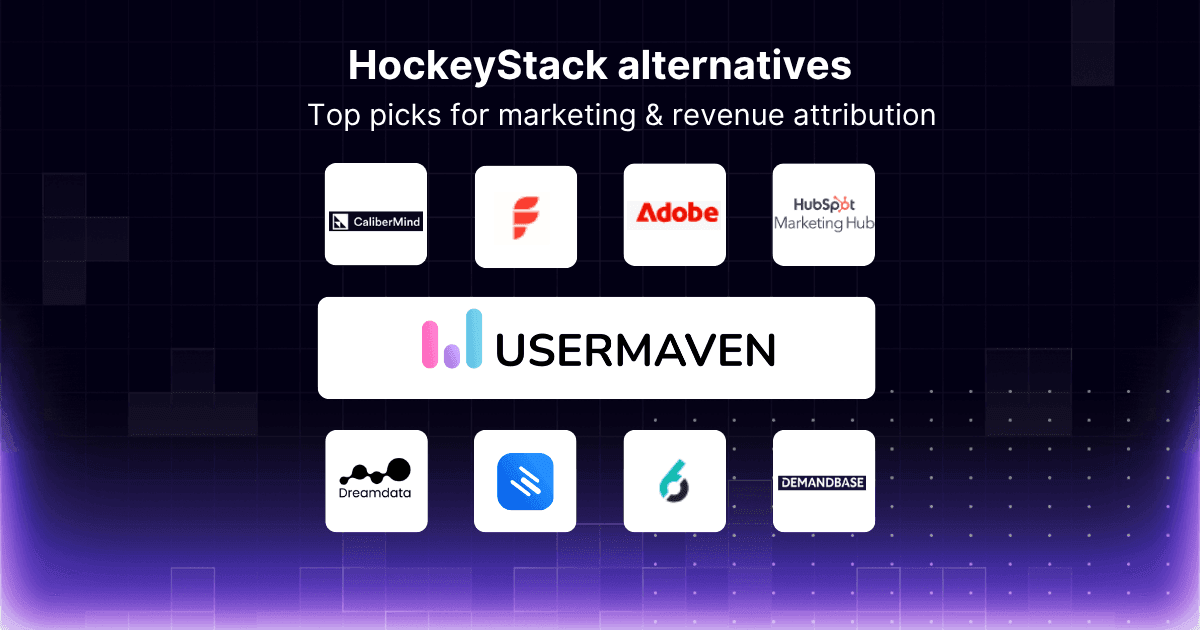
This guide compares 10 HockeyStack alternatives by attribution depth, GTM scope, CRM fit, behavioral visibility, AI capabilities, pricing, and best-fit use case. For teams focused specifically on connecting marketing activity to pipeline and revenue, our guide to revenue attribution tools provides a more focused comparison.
Key takeaways
- Best overall for growing SaaS teams: Usermaven combines marketing attribution with website behavior, product usage, customer journeys, CRM pipeline, revenue, and AI analysis through Business and Enterprise plans with custom pricing based on requirements.
- Best for B2B revenue attribution: Dreamdata is a specialist for account-level B2B journeys, CRM-connected pipeline, and revenue attribution.
- Best for enterprise ABM and intent: 6sense and Demandbase are stronger fits when predictive account intelligence, buying groups, third-party intent, and orchestration matter more than a pure attribution workflow.
- Best for LinkedIn and account journeys: Factors.ai is compelling for teams that want account identification, LinkedIn influence, intent, ABM analytics, and activation.
- Best for enterprise attribution: Adobe Marketo Measure and CaliberMind are built for mature B2B organizations with complex CRM data and revenue-accountability requirements.
- Choose by scope, not feature count: HockeyStack now spans attribution, incrementality, account intelligence, AI, and GTM workflows, so the right replacement depends on which of those functions is actually essential.
HockeyStack alternatives at a glance
Use this table to narrow the field before reading the detailed profiles. Pricing reflects publicly available access as of August 2026; quote-based platforms can vary materially by data volume, seats, integrations, and implementation scope.
| Tool | Best for | Core strength | Pricing access |
| Usermaven | SaaS + B2B growth teams | Attribution + behavior + CRM revenue | Business + Enterprise; custom pricing |
| Dreamdata | B2B revenue attribution | Account journeys + pipeline + revenue | Free plan; advanced custom |
| 6sense | Enterprise ABM + predictive intent | Account intelligence + buying signals | Sales-led / custom |
| Demandbase One | Enterprise ABM orchestration | Buying groups + account GTM | Custom pricing |
| Factors.ai | Mid-market account analytics | LinkedIn + intent + account journeys | Lite $199/mo; paid tiers from $6K/yr |
| Adobe Marketo Measure | Enterprise Adobe/CRM stacks | B2B multi-touch + ROI | Custom / Marketo packaging |
| CaliberMind | B2B attribution + GTM intelligence | Custom attribution + account analytics | Sales-led / custom |
| HubSpot Marketing Hub | HubSpot-native teams | CRM + journey + attribution | Pro $890/mo; Enterprise $3,600/mo |
| Ruler Analytics | Calls + offline revenue | Online-to-offline attribution | From $400/mo monthly |
| Cometly | Paid-media B2B SaaS | Ads-to-pipeline + Conversion API | Usage-based; quote provided by sales |
Best HockeyStack alternatives 2026
The alternatives below are intentionally not identical. They cover the main buying paths visible in the current market: attribution plus behavior, B2B revenue attribution, enterprise ABM, account intelligence, CRM-native measurement, online-to-offline attribution, and paid-media optimization.
1. Usermaven: Best overall for SaaS and B2B growth

Overview
Usermaven is an AI marketing attribution platform that connects paid and organic acquisition with website behavior, product usage, known users and companies, CRM pipeline, revenue, customer journeys, and conversion feedback.
The important difference is scope. Usermaven does not try to replace an enterprise ABM or third-party intent platform. It is strongest when the team wants attribution and behavioral analytics in one daily workflow without a large sales-led implementation.
Best for
Growing B2B SaaS, PLG and hybrid SaaS, performance-oriented marketing teams, agencies, and companies that want marketing attribution connected with product behavior and CRM outcomes.
Pricing
Usermaven offers two plans for new customers: Business and Enterprise. Both use custom pricing based on the team’s requirements, with quotes provided by sales.
The Business plan covers Usermaven’s core analytics and attribution capabilities. Enterprise is built for larger organizations with advanced or custom requirements, including custom integrations, data warehouse exports, tailored reports and dashboards, deployment options, advanced security and privacy controls, and dedicated support.
Current Usermaven pricing is quote-based, so teams should contact sales for pricing based on their requirements.
Key capabilities
- Paid ads, channel, content, landing-page, CRM pipeline, and revenue attribution
- Website and product analytics on the same event dataset
- Anonymous-to-known user and account profiles
- Funnels and customer journeys across acquisition and product behavior
- Google, Meta, LinkedIn, and CRM integrations
- Conversion Syncs back to supported ad platforms
- Maven AI, AI reporting, and MCP access
- Measurement Trust Center for collection, identity, integrations, delivery, and reliability
For teams that need to understand whether acquisition creates activation and durable product usage, product analytics adds a layer HockeyStack alternatives focused primarily on enterprise GTM may not emphasize.
Website analytics keeps landing pages, content, sessions, and conversions in the same environment. Event tracking connects important actions such as demo requests, signups, activation, purchases, and revenue events with the acquisition context that preceded them.
Customer journeys let teams trace first touch through signup, return visits, product behavior, CRM opportunity, and revenue. Funnels show progression and drop-off between the milestones that matter.
Contacts Hub adds the known-user and company layer, which helps teams connect anonymous acquisition history with identified leads, customers, and accounts without turning Usermaven into a third-party intent database.
For B2B revenue teams, CRM context can extend the same journey into opportunity stages and Closed Won.
The Salesforce marketing attribution guide explains that workflow for Salesforce teams, while the HubSpot and Usermaven integration covers the HubSpot path.
Usermaven also keeps AI tied to the measurement workflow. Maven AI can investigate which channels create qualified pipeline, whether low CAC translates into retained customers, or which journeys appear before high-value opportunities.
Usermaven MCP extends authorized analytics into compatible AI clients. Before those answers are trusted, the Measurement Trust Center helps validate collection, identity, integrations, conversion delivery, and overall measurement reliability.
Conversion syncs can return selected downstream outcomes to supported ad platforms, closing the loop between attribution and optimization when qualified leads, customers, or revenue are better signals than raw form fills.
Verdict
Best overall when the replacement goal is not enterprise account-intent infrastructure, but a practical combination of marketing attribution, behavioral analytics, CRM revenue, customer journeys, and AI with pricing tailored to requirements.
2. Dreamdata: Best for B2B revenue attribution

Overview
Dreamdata is a B2B activation and attribution platform built around account-level journeys, company identification, CRM and GTM data, revenue attribution, performance reporting, audiences, and activation.
Its core strength is treating a B2B buying journey as an account and stage problem rather than a collection of isolated form fills.
Best for
Mid-market and enterprise B2B companies with long sales cycles, multiple stakeholders per opportunity, and RevOps teams that want specialized account-level attribution and pipeline reporting.
Pricing
Dreamdata offers a free plan with B2B web analytics, company identification, engagement scoring, audience building, ad spend reporting, and limited history.
Advanced Activation & Attribution uses custom pricing and includes broader attribution, AI, optimization, data controls, and dedicated onboarding.
Key capabilities
- Account-level buyer journeys and company identification
- B2B pipeline and revenue attribution
- Custom and AI-based attribution
- Cross-channel ad spend and performance reporting
- Audience building and activation
- CRM and GTM data unification
- First-party and cookieless B2B tracking
Dreamdata is particularly strong when the commercial unit is the account. Teams comparing that specialized approach with a broader self-serve analytics environment can review the Dreamdata alternative comparison.
Verdict
A strong HockeyStack alternative when the primary requirement is specialized B2B revenue attribution and account journeys rather than a broader enterprise ABM platform.
3. 6sense: Best for enterprise ABM and predictive intent

Overview
6sense is an enterprise revenue-marketing and sales-intelligence platform centered on buyer signals, predictive modeling, intent data, account identification, buying-stage intelligence, advertising, workflows, and AI-assisted GTM execution.
This is a different replacement path from Usermaven or Dreamdata. Teams choose 6sense when the main job is finding in-market accounts, prioritizing buying groups, and orchestrating account-based engagement.
Best for
Large B2B organizations with mature ABM programs, complex buying groups, significant third-party intent requirements, and sales and marketing teams that need shared account prioritization.
Pricing
6sense uses a sales-led buying process for its broader Revenue Marketing platform. Sales Intelligence has packaged options, but full platform cost depends on products, predictive capabilities, data, and activation requirements.
Key capabilities
- Third-party and first-party intent signals
- Web deanonymization and account matching
- Predictive buying stages and opportunity likelihood
- Buying-group and persona intelligence
- Dynamic audiences and omnichannel activation
- Advertising and intelligent workflows
- Pipeline and Closed Won reporting
- RevvyAI for GTM questions
Verdict
Best when the HockeyStack capability you are replacing is account intelligence, predictive intent, and enterprise ABM and not simply attribution reporting.
4. Demandbase One: Best for enterprise ABM orchestration

Overview
Demandbase positions Demandbase One as an account-based GTM platform that unifies first-, second-, and third-party data, buying groups, account intelligence, advertising, sales and marketing workflows, and AI-driven actions.
Best for
Enterprise organizations that want a broad ABM operating system spanning marketing, sales, advertising, account intelligence, and buying-group activation.
Pricing
Demandbase uses custom pricing. Its model combines a platform fee with user fees and is tailored to the organization’s GTM scope. Advertising and data solutions can also be purchased separately.
Key capabilities
- Unified account view across first- and third-party signals
- Buying-group identification and role mapping
- Account-based advertising
- AI-assisted next-best actions
- Sales and marketing alignment workflows
- CRM and marketing automation data
- Account prioritization and orchestration
Verdict
A stronger alternative when the buyer wants a full enterprise ABM and account-orchestration platform rather than attribution as the center of the purchase.
5. Factors.ai: Best for LinkedIn and account journeys

Overview
Factors.ai is a B2B account-intelligence, activation, and attribution platform that combines company identification, LinkedIn and G2 signals, website behavior, intent, scoring, account journeys, ABM analytics, and workflows.
Best for
Mid-market B2B teams that spend heavily on LinkedIn, want to identify companies visiting the website, and need account-level journey and intent data without moving immediately to a larger enterprise ABM suite.
Pricing
Lite is $199 per month after trial. Basic is $6,000 per year, Growth $20,000 per year, and Enterprise starts at $30,000 per year.
Higher plans add deeper buyer journeys, account scoring, ABM analytics, ad activation, and third-party intent.
Key capabilities
- Company identification and account timelines
- LinkedIn impression and influence analytics
- G2 and third-party intent
- Custom and predictive account scoring
- ABM reporting and buyer-stage analysis
- Google and LinkedIn audience activation
- Sales alerts and CRM workflows
- AI-agent-assisted GTM workflows
Verdict
A practical alternative when LinkedIn attribution, account identification, intent, and ABM analytics matter more than product analytics or a generalized revenue-attribution layer.
6. Adobe Marketo Measure: Best for enterprise Adobe stacks

Overview
Adobe Marketo Measure, formerly Bizible, is an enterprise B2B attribution product designed to measure campaign, channel, content, pipeline, revenue, and ROI across marketing and sales touchpoints.
Best for
Large organizations already invested in Adobe Marketo, Salesforce or Microsoft Dynamics, with mature marketing operations and formal enterprise attribution requirements.
Pricing
Adobe does not publish a simple standalone price for Marketo Measure. Marketo Engage uses capability-based packages, and premium attribution is associated with higher-end packaging and sales-led pricing.
Key capabilities
- Every-touch B2B attribution
- Online and offline touchpoint capture
- Campaign, channel, content, pipeline, revenue, and ROI reporting
- Native enterprise CRM integrations
- Cost-per-lead, deal, and opportunity analysis
- Flexible data ingestion and field mapping on Ultimate
Verdict
A strong HockeyStack alternative for enterprises that want attribution embedded in an Adobe/CRM environment and already have the operations resources to support it.
7. CaliberMind: Best for customizable B2B attribution

Overview
CaliberMind is a B2B GTM intelligence and multi-touch attribution platform that unifies marketing and sales engagement, supports account-level analytics, models revenue influence, and adds AI-assisted exploration through Agent Cal.
Best for
Enterprise B2B marketing and RevOps teams that need flexible attribution logic, online and offline touchpoints, account scoring, and auditable revenue-impact reporting.
Pricing
CaliberMind uses a sales-led pricing process rather than a simple public self-serve rate. Final cost depends on data, integrations, attribution scope, and enterprise requirements.
Key capabilities
- Customizable multi-touch attribution
- Online and offline touchpoints
- Account-level engagement and scoring
- CRM-connected revenue analytics
- Chain-based and rule-based attribution approaches
- Role-based dashboards
- Agent Cal conversational analysis
Verdict
A strong fit when the buyer wants enterprise-grade, customizable B2B attribution and GTM intelligence but does not necessarily need HockeyStack’s exact AI and workflow stack.
8. HubSpot Marketing Hub: Best for HubSpot-native teams

Overview
HubSpot Marketing Hub combines marketing automation, CRM records, campaigns, lifecycle stages, journeys, attribution reporting, and revenue context inside the HubSpot ecosystem.
Best for
Organizations already standardized on HubSpot that want to keep marketing measurement close to the CRM instead of adding a separate GTM-intelligence platform.
Pricing
Marketing Hub Professional starts at $890 per month with three Core Seats. Enterprise starts at $3,600 per month with five Core Seats and adds advanced revenue and journey capabilities.
Contact volume and required onboarding can materially increase total cost.
Key capabilities
- CRM-native contact and company records
- Campaign and lifecycle reporting
- Attribution reports on eligible Professional and Enterprise plans
- Customer journey analysis
- Marketing automation and lead management
- Revenue reporting inside the same ecosystem
Verdict
Best when the main alternative to HockeyStack is not another independent attribution platform, but deeper use of the CRM and marketing automation system the team already owns.
9. Ruler Analytics: Best for calls and offline revenue

Overview
Ruler Analytics is a first-party marketing measurement platform built to connect web visits, forms, phone calls, live chat, CRM outcomes, offline conversions, and revenue back to marketing channels and campaigns.
Best for
Lead-generation businesses, agencies, professional services, appointment-based companies, and teams where calls or offline sales are critical parts of the customer journey.
Pricing
The Small plan starts at $400 per month on monthly billing for up to 10,000 visits.
Medium starts at $668, Large at $1,326, and Advanced at $2,000 per month, with lower effective rates on annual billing.
Key capabilities
- First-party visitor tracking
- Forms, dynamic call tracking, live chat, and offsite conversions
- Multi-touch attribution
- CRM opportunity and revenue stages
- Data-driven and impression attribution on higher plans
- Marketing mix modeling on Advanced
- Cross-domain and multi-device reporting
For a detailed cost breakdown, see the Ruler analytics pricing guide. Teams comparing the broader platform fit can also review the Ruler Analytics alternative comparison.
Verdict
A better HockeyStack alternative when online-to-offline measurement, phone calls, lead quality, and closed revenue are more important than account-intelligence breadth.
10. Cometly: Best for paid-media B2B attribution

Overview
Cometly is a B2B SaaS attribution platform built around pixel and server-side tracking, multi-touch attribution, events, account journeys, Conversion API feedback, custom dashboards, AI, and major ad-platform integrations.
Best for
B2B SaaS demand-generation and performance teams that want to connect paid ads directly with leads, pipeline, and revenue and send higher-quality conversion signals back to ad networks.
Pricing
Cometly uses usage-based pricing tied to monthly pageviews. Its current pricing page no longer publishes numerical self-serve rates; Core and Enterprise are quoted based on pageviews and stack requirements.
Enterprise adds CRM and warehouse sync, MCP, API access, higher usage, and dedicated support.
Key capabilities
- Pixel and server-side tracking
- Multi-touch attribution
- Account journeys and Events
- Conversion API for major ad platforms
- Custom dashboards and analytics
- AI Ads Manager and Agent
- 70+ integrations
- Warehouse sync and MCP on Enterprise
Teams evaluating Cometly can use our Cometly pricing guide for plan structure and buying considerations, then confirm the current quote directly with Cometly.
The Cometly alternative comparison gives a direct Usermaven-versus-Cometly view, while the broader Cometly alternatives guide covers additional vendors.
Verdict
Best when the HockeyStack replacement decision is centered on paid-media attribution, conversion feedback, and CRM-connected pipeline rather than enterprise ABM or product analytics.
See what's working. Fix what's not. Grow faster.
Compare HockeyStack alternatives by capability
Use this table to shortlist tools by strengths. Match capabilities to your attribution priorities before committing.
| Platform | Attribution | ABM / intent | Journeys | CRM revenue | Pricing |
| Usermaven | Strong | Light / first-party | Strong web + product | Strong | Custom quote |
| Dreamdata | Strong B2B | Moderate | Strong account journeys | Strong | Free + custom |
| 6sense | Revenue reporting | Very strong | Account/buying journey | Strong | Custom |
| Demandbase | Account/GTM | Very strong | Account-centric | Strong | Custom |
| Factors.ai | ABM attribution | Strong | Strong account journey | Strong | Public annual tiers |
| Marketo Measure | Very strong | Not primary | Touchpoint-centric | Very strong | Custom |
| CaliberMind | Very strong | Strong | Account + touchpoints | Very strong | Custom |
| HubSpot | CRM-native | Buyer intent available | CRM/customer journey | Strong | Public tiers |
| Ruler Analytics | Strong | Not primary | Lead/customer journey | Very strong offline | Public tiers |
| Cometly | Strong paid media | Account journeys | Strong acquisition journey | Strong | Usage-based |
How we evaluated the alternatives
The comparison is based on the jobs buyers now use HockeyStack to solve, not on whether another product copies every feature.
We prioritized current positioning, documented capabilities, pricing access, CRM and data fit, attribution depth, behavioral visibility, and the scope of each platform’s AI and GTM workflow.
- Attribution depth: channel, campaign, pipeline, revenue, multi-touch, and incrementality where supported.
- GTM scope: account intelligence, ABM, buying groups, intent, scoring, activation, and sales-marketing workflows.
- Behavioral context: website activity, product usage, funnels, customer journeys, and anonymous-to-known continuity.
- Commercial data: CRM contacts and accounts, opportunities, lifecycle stages, Closed Won revenue, and offline outcomes.
- Buying experience: pricing transparency, trial or self-serve access, implementation burden, and the amount of RevOps support likely to be required.
The “best for” labels describe fit, not a universal ranking.
A strong enterprise ABM platform can be wrong for a product-led SaaS team, just as a self-serve attribution platform may not replace third-party intent and predictive scoring for a global ABM program.
What HockeyStack is in 2026
HockeyStack is no longer best understood as only a multi-touch attribution product. Its current platform combines a GTM data foundation, identity resolution, attribution, lift and incrementality reporting, buyer journeys, account intelligence, scoring, AI analysis through Odin, and workflows designed to turn insights into action.
That evolution matters because “HockeyStack alternative” can now mean several different things. A company may want to replace its attribution layer, its account-intelligence layer, its ABM workflow, its buyer-journey reporting, or the broader enterprise GTM stack.
HockeyStack’s live pricing page is sales-led rather than publishing a simple self-serve rate. If cost is part of the evaluation, our HockeyStack pricing guide gives additional buying context, while the detailed HockeyStack alternative comparison focuses specifically on Usermaven versus HockeyStack.
Why teams compare HockeyStack alternatives
Teams usually compare alternatives because their GTM motion, measurement scope, data architecture, or budget has changed. The right replacement should solve the specific job that matters now.
They need a narrower platform
HockeyStack now covers much more than attribution. That breadth can be useful for enterprise GTM teams, but a growth-stage SaaS company may only need reliable attribution, CRM pipeline, customer journeys, and product behavior without adopting a larger account-intelligence stack.
Their motion is not enterprise ABM
Some organizations do not need predictive account scoring, third-party intent, stakeholder maps, or automated GTM workflows. Product-led and hybrid SaaS companies may care more about activation, feature adoption, funnel conversion, retention, and how acquisition sources create durable customers.
They need a different data architecture
A Salesforce-first enterprise, a HubSpot-first startup, a warehouse-led RevOps team, and a self-serve PLG company can all ask for attribution while needing very different integrations and identity models.
That is why B2B marketing attribution should be evaluated against the actual sales motion rather than a universal feature checklist.
Pricing and implementation matter
A sophisticated platform is only valuable if the organization can implement, maintain, and use it. Public pricing, trial access, onboarding effort, data modeling, user limits, and RevOps ownership all affect the real cost.
The broader marketing attribution software cost guide explains why the billing model and implementation burden can matter as much as the headline subscription price.
What to compare before switching from HockeyStack
A migration should preserve the decisions your team already makes, not just recreate dashboards. Compare definitions, identity, workflows, and commercial data before choosing a replacement.
Rebuild the same business questions first
List the decisions HockeyStack currently supports before comparing feature checklists. Examples include which campaigns create qualified pipeline, which accounts are showing intent, how LinkedIn influences opportunities, which journeys precede Closed Won, and where marketing spend produces revenue.
A replacement should answer those same questions with your real data before you retire the old reporting layer. Otherwise, the migration can look successful technically while leaving marketing and RevOps with less decision context.
Map the identity model
HockeyStack is account-centric by design. Some alternatives are also account-first, while others begin with visitors and known users and then enrich companies through CRM data.
Confirm how anonymous sessions, contacts, companies, buying groups, and opportunities are connected.
This matters most in B2B because one company can contain several stakeholders. A platform that matches people well but cannot preserve account context can produce a fragmented view of the buying journey.
Align attribution definitions
Document conversion definitions, attribution windows, eligible channels, CRM stages, revenue fields, and model rules before migration. Different tools can produce different totals even when both are functioning correctly.
Use a single source of truth for final opportunity and revenue outcomes so the new platform is reconciled against the same commercial record as the old one.
Test workflows, not just dashboards
If the current setup sends audiences, scores, alerts, or conversion signals downstream, evaluate those workflows separately from reporting. A replacement may be strong at attribution but weak at ABM activation, or excellent at account intent but less useful for product analytics.
Run a parallel validation period
Keep the old and new measurement layers running together long enough to compare several real customer journeys. Check acquisition source, identity, CRM matching, opportunity value, attribution credit, and revenue before reallocating budgets or changing executive reporting.
The goal is not identical dashboards. It is a documented explanation for the differences and confidence that the new system preserves the business signals your team actually uses.
How to choose the right HockeyStack alternative
Start with the business problem, then evaluate the data and workflow needed to solve it. This keeps the shortlist focused on fit rather than feature count.

Start with the job you are replacing
Do not start by comparing every HockeyStack feature. Decide whether the purchase is primarily about attribution, ABM, account intelligence, buyer journeys, paid-media optimization, behavioral analytics, or sales and marketing orchestration.
Decide where commercial truth lives
For B2B teams, CRM depth is critical. Confirm whether the platform can use contacts, accounts, opportunities, lifecycle stages, deal values, and Closed Won outcomes.
A useful revenue attribution system should connect marketing activity with the commercial outcome rather than stop at form fills.
Check whether product behavior matters
PLG and hybrid SaaS teams should test whether the platform can connect acquisition with signup, activation, feature adoption, expansion, and retention. A GTM-intelligence platform can be excellent for accounts and still be the wrong daily analytics layer for product-led growth.
Separate attribution from ABM intent
Attribution asks which recorded touchpoints contributed to an outcome. ABM intent asks which accounts are showing signals that they may buy.
They overlap, but they are not the same job. Teams that need account prioritization may value 6sense or Demandbase more than a pure attribution tool.
Compare AI by the decision it improves
AI now means very different things across this market. HockeyStack uses Odin for GTM analysis and recommendations, while 6sense applies AI to account prioritization and predictive buying stages.
Factors uses AI agents around intent and activation. Usermaven uses AI to investigate attribution, funnels, journeys, product behavior, and revenue. Compare the actual decision each system improves, not the AI label.
Evaluate measurement trust
Before switching platforms, test tracking, identity, CRM matching, conversion definitions, and revenue reconciliation on real journeys. An attribution checklist helps expose definition and integration gaps before the new dashboard becomes a budget source of truth.
Model the total cost
Subscription price is only one part of the cost. Include onboarding, implementation, RevOps ownership, seats, tracked users or pageviews, data-warehouse work, custom integrations, and the time required to maintain models and dashboards.
Which HockeyStack alternative fits?
Choose by the job you need to replace, not by the longest feature list.
For SaaS and B2B: Choose Usermaven for attribution, website and product behavior, journeys, CRM revenue, and AI in one platform.
For B2B revenue: Choose Dreamdata when specialized account-level revenue attribution is the main job.
For enterprise ABM: Choose 6sense when predictive account intelligence, third-party intent, and enterprise ABM are central.
For ABM orchestration: Choose Demandbase for a broad GTM platform spanning sales, marketing, advertising, and buying groups.
For LinkedIn and intent: Choose Factors.ai when LinkedIn influence, company identification, intent, and account journeys are the priority.
For Adobe stacks: Choose Adobe Marketo Measure if you need enterprise B2B attribution inside an Adobe or Marketo environment.
For custom attribution: Choose CaliberMind when flexible B2B attribution and GTM intelligence are the main requirements.
For HubSpot teams: Choose HubSpot when you want attribution and journey reporting to stay close to the CRM.
For calls and offline: Choose Ruler Analytics when calls, forms, offline sales, and closed-loop revenue are central.
For paid media: Choose Cometly when paid-media attribution and conversion feedback dominate the growth motion.
Final verdict
HockeyStack is a capable enterprise GTM platform, so the best alternative depends on which part of its expanding scope your team actually needs.
Attribution, ABM, account intelligence, product analytics, call tracking, and paid-media optimization are different buying problems.
For large enterprise ABM motions, 6sense and Demandbase are natural alternatives. Dreamdata and CaliberMind are stronger specialized B2B attribution options.
Factors.ai is compelling for account and LinkedIn intelligence, while Ruler and Cometly serve more focused offline-lead and paid-media workflows.
For growing SaaS and B2B teams that want attribution connected with website behavior, product usage, customer journeys, CRM pipeline, and revenue without adopting a large GTM-intelligence suite, Usermaven is the strongest overall marketing attribution software alternative.
Ready to see Usermaven in action? Explore the platform or book a demo for a closer look.
See Usermaven in action
Book a free demo and discover how powerful analytics can grow your business.
FAQs
1. What is the best HockeyStack alternative?
Usermaven is the best overall alternative for growing SaaS and B2B teams that want attribution connected with website and product behavior, customer journeys, CRM pipeline, and revenue. Enterprise ABM teams may prefer 6sense or Demandbase, while specialized B2B attribution teams may prefer Dreamdata or CaliberMind.
2. Why are companies looking for HockeyStack alternatives?
Teams compare alternatives because HockeyStack now spans attribution, GTM intelligence, account intelligence, AI, lift reporting, buyer journeys, and workflows. Some buyers need only part of that stack, want a different CRM or data architecture, or prefer more transparent pricing and a lighter implementation.
3. How does Usermaven pricing compare with HockeyStack?
Usermaven offers Business and Enterprise plans for new customers, with custom pricing based on requirements. HockeyStack also uses a sales-led pricing model, so teams should compare quotes based on data volume, implementation, integrations, and required capabilities.
4. What is the best HockeyStack alternative for B2B attribution?
Dreamdata and CaliberMind are strong specialists for B2B revenue attribution. Usermaven is a broader choice when attribution also needs website analytics, product behavior, funnels, journeys, CRM revenue, and AI in one platform.
5. What is the best HockeyStack alternative for ABM?
6sense and Demandbase are the strongest alternatives when predictive account intelligence, buying groups, third-party intent, advertising, and enterprise ABM orchestration are the main requirements.
6. What is the best HockeyStack alternative for LinkedIn marketing?
Updated

Written by
Imrana Essa
SaaS Marketing Lead
Imrana Essa is a marketing lead and content strategist with 8+ years of experience creating and leading content for B2B and SaaS brands. She specializes in marketing analytics, attribution, content strategy, and organic growth, translating complex marketing concepts into clear, actionable insights. Her work focuses on helping marketers understand performance, make data-informed decisions, and build strategies that contribute to sustainable growth.
All articles by Imrana →