Rockerbox pricing is not published through fixed self-serve tiers, which makes early budget planning difficult.
The final quote can depend on monthly marketing spend, data volume, connected channels, measurement products, and the level of support required.
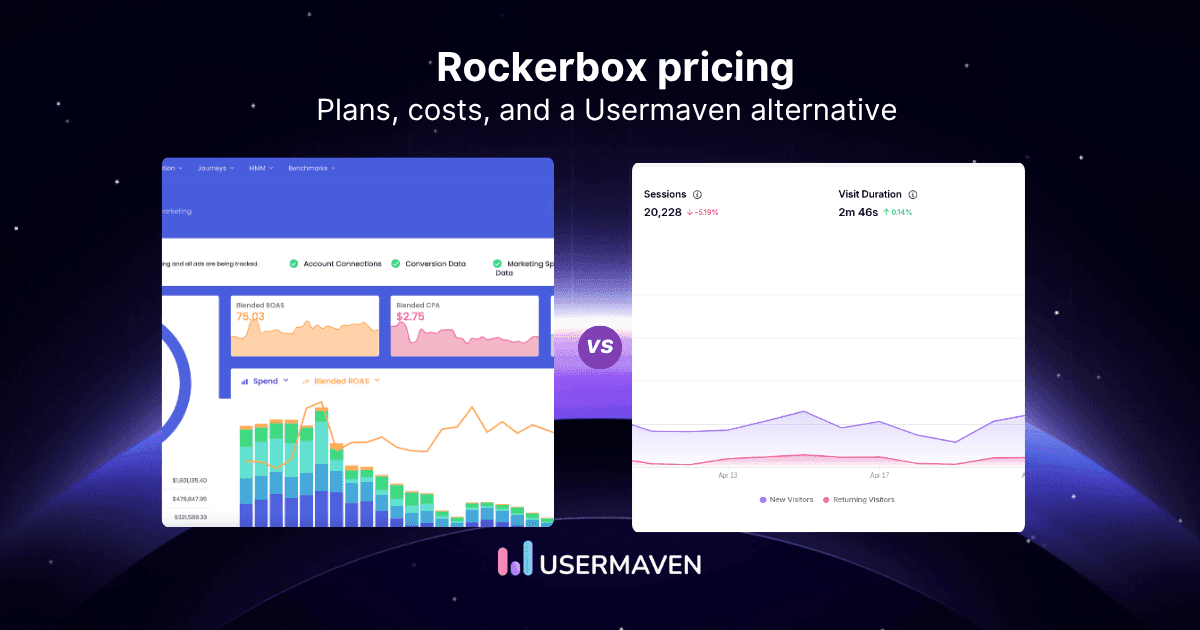
This guide explains how Rockerbox pricing works, what affects the quote, typical contract ranges, possible additional costs, negotiation points, and when another platform may offer better value.
For broader context, this comparison of marketing attribution tools can help before evaluating a single vendor.
Key takeaways
- Rockerbox uses custom pricing: Quotes usually reflect marketing spend, data complexity, connected channels, and service requirements.
- Contracts can vary significantly: Smaller deployments may sit in the five-figure annual range, while complex enterprise implementations can cost more.
- The subscription may not be the only cost: Implementation, custom integrations, managed services, overages, and extended data retention can affect the total investment.
- Rockerbox is designed for advanced measurement: Its strongest fit is brands that need multi-touch attribution, marketing mix modeling, and incrementality testing.
What is Rockerbox and who is it built for?
Rockerbox is a marketing measurement and attribution platform for brands running complex campaigns across digital and offline channels.
Its official plans page presents multi-touch attribution, marketing mix modeling, and incrementality testing on a shared data foundation.
Typical customers include ecommerce brands, direct-to-consumer companies, enterprise marketing teams, and some SaaS companies with substantial multichannel budgets.
This advanced measurement focus shapes Rockerbox pricing. The quote may reflect the channels being measured, the analysis products selected, and the support required from its team.
What does Rockerbox measure?

Rockerbox measures the customer path across channels rather than assigning every conversion to the final click.
Its measurement approach can be understood through four main layers.
- Data foundation: Collects and standardizes information from advertising platforms, ecommerce systems, analytics tools, CRMs, and data warehouses.
- Multi-touch attribution: Estimates how different interactions contribute to conversions. It can also reveal channel overlap and differences in customer behavior.
- Marketing mix modeling: Uses historical data to estimate the contribution of channels that are difficult to measure at the individual-user level.
- Incrementality testing: Uses controlled experiments to estimate whether a campaign generated additional conversions that would not otherwise have occurred.
This combination also explains how multi-touch attribution and marketing mix modeling serve different measurement needs.
How does Rockerbox pricing work?
Rockerbox uses a custom-quote model instead of a simple public price per user or workspace.
Monthly marketing spend is an important part of the quote because larger budgets usually create more data, campaigns, channels, and reporting requirements.
The selected measurement products also matter. A company using attribution alone may receive a different quote from one combining attribution, marketing mix modeling, testing, and managed support.
Two brands with similar ad spend can therefore receive different prices when their channel mix, integrations, data volume, or service requirements differ.
Factors affecting a Rockerbox quote

Rockerbox pricing generally rises as the measurement scope, data volume, and required service level increase.
- Monthly marketing spend: Larger advertising budgets usually create broader measurement requirements and higher platform costs.
- Connected channels: Adding paid social, search, affiliate, connected TV, podcast, direct mail, and offline data increases the implementation scope.
- Data and conversion volume: High-traffic stores and businesses recording frequent purchases or micro-conversions generate larger event streams.
- Measurement products: Using attribution, marketing mix modeling, and incrementality together creates a broader engagement than attribution alone.
- Service level: Managed support, strategic guidance, custom reporting, and frequent planning sessions can increase the contract value.
- Custom work: Non-standard integrations, warehouse pipelines, and bespoke reporting requirements may require additional implementation work.
Clarifying the business’s main attribution challenges before the sales process can prevent unnecessary products or services from being added to the quote.
Rockerbox pricing benchmarks
Rockerbox does not publish standard contract prices, so third-party procurement data provides only a broad reference point.
Vendr’s Rockerbox marketplace data indicates that many contracts sit in the five-figure annual range, while complex enterprise deployments can reach six figures.
These figures are not official price tiers. Actual quotes can vary by marketing spend, selected products, integrations, service level, and contract terms.
| Measurement scope | Indicative annual pattern | Likely deployment |
|---|---|---|
| Smaller multichannel setup | Often lower five figures | Primarily self-service |
| Scaled paid media program | Often mid-to-high five figures | Self-service or managed |
| Complex enterprise measurement | Can reach six figures | Managed and customized |
The value of the platform depends on whether its insights improve budget allocation enough to justify the contract and implementation costs.
Hidden Rockerbox costs to consider

The platform subscription may not represent the complete first-year cost.
These additional items should be discussed before signing a contract.
- Implementation and onboarding: Connecting platforms, deploying tracking, validating data, and configuring reports may involve separate project costs.
- Custom integrations: Proprietary CRMs, offline systems, or non-standard warehouse connections may require additional engineering work.
- Managed services: Dedicated analysts, strategic support, testing guidance, and custom reporting can become recurring contract items.
- Marketing-spend overages: A growing advertising budget may move the account beyond the spend level defined in the original agreement.
- Data storage and retention: Longer lookback windows or unusually high data volumes may affect storage and processing requirements.
- Training and premium support: Additional workshops, documentation, response-time commitments, or team enablement may cost extra.
These costs are common in enterprise analytics, but they should still be documented clearly in the proposal.
Teams requiring specialized credit rules should also understand whether a custom attribution model requires additional implementation or consulting.
How to negotiate Rockerbox pricing

A structured procurement process can improve the quote and reduce unexpected costs later.
- Define the required measurement scope: Separate essential products and integrations from capabilities that may not be needed immediately.
- Compare credible alternatives: Evaluate other attribution platforms based on measurement depth, implementation effort, support, and total cost.
- Negotiate implementation separately: Ask for a detailed onboarding scope, defined milestones, and clear fees for work outside the original agreement.
- Set overage terms in advance: Request written examples showing how charges change when marketing spend or data volume exceeds the contracted level.
- Evaluate contract length carefully: A longer agreement may improve pricing, but it also reduces flexibility if measurement needs change.
- Start renewal discussions early: Review platform usage, performance, additional costs, and competing options before the renewal deadline approaches.
See Usermaven in action
Book a free demo and discover how powerful analytics can grow your business.
Usermaven as a Rockerbox alternative
Rockerbox is built for brands that need enterprise measurement across attribution, marketing mix modeling, and incrementality testing.
Teams that need attribution alongside website analytics, product analytics, funnels, journeys, retention, and AI may prefer a broader analytics platform.
Usermaven offers Business and Enterprise plans, bringing marketing attribution and behavioral analytics together as teams grow.
Business brings together paid-ad and channel attribution, CRM revenue reporting, conversion paths, custom attribution models, and Maven AI. Enterprise extends those capabilities with custom integrations, deployment options, advanced security, and dedicated support.
The platform also combines website analytics, SaaS product analytics, ecommerce revenue attribution, funnel analysis, and Maven AI.
Teams can explore an interactive demo to get a feel for the dashboards, then book a walkthrough to discuss which plan suits their measurement needs.
The complete Rockerbox alternative comparison covers setup, attribution, analytics, pricing, and revenue visibility in more detail.

Flexible attribution models
Usermaven supports several marketing attribution models, including first-touch, last-touch, linear, time-decay, and data-driven approaches.
Teams can compare models to see how channel performance changes when credit is distributed differently.
Broader channel visibility
Usermaven brings paid, owned, and earned channels into one reporting environment.
This can include Google Ads, Meta, email, organic search, and LinkedIn attribution alongside CRM and website activity.
AI-assisted analysis
Maven AI lets teams ask questions about campaigns, journeys, funnels, product activity, and revenue in plain language.
It can help surface patterns and reporting changes without requiring a new dashboard for every question.
Automatic event capture
Usermaven automatically records common interactions such as clicks, form submissions, signups, and page activity.
Custom events remain available for more specialized product, revenue, and conversion tracking.
Website and product analytics
Usermaven connects acquisition data with onsite behavior, funnels, product engagement, retention, and customer journeys.
This makes it more suitable than a measurement-only platform for SaaS, product-led, and mixed digital businesses.
Rockerbox vs. Usermaven pricing
The two platforms use different pricing and product strategies, so the lower price is not the only consideration.
| Area | Rockerbox | Usermaven |
|---|---|---|
| Pricing model | Custom quote based on spend, data, products, and services | Business and Enterprise plans |
| Starting price | Provided after sales evaluation | Explore plan options in a demo |
| Attribution plan | Custom quote | Business includes attribution; Enterprise adds advanced options |
| Buying process | Demo and discovery process | Book a demo |
| Core measurement | MTA, MMM, and incrementality testing | Attribution, website analytics, product analytics, and journeys |
| Product analytics | Not a core focus | Included |
| AI analysis | Depends on selected products and services | Maven AI in Business |
| Evaluation option | Not presented as a standard self-serve trial | Interactive demo available |
| Best fit | Enterprise brands needing advanced measurement | Growing teams wanting attribution and analytics together |
Final verdict on Rockerbox pricing
Rockerbox pricing reflects its focus on advanced marketing measurement for brands with significant multichannel budgets.
The final quote can increase with marketing spend, integrations, data complexity, selected measurement products, and managed services.
Before signing, teams should evaluate implementation, overages, retention, training, support, and the expected impact on budget allocation and Return On Ad Spend.
For organizations that need MTA, MMM, and incrementality together, Rockerbox may justify its enterprise buying process.
For teams that want attribution, website analytics, product analytics, journeys, and AI in one workspace, Usermaven offers a strong operational fit.
Ready to see Usermaven in action? Explore the platform or book a demo for a closer look.
Unlock insights that drive growth
FAQs
1. Does Rockerbox publish its pricing publicly?
No. Rockerbox does not present fixed prices for its advanced measurement products. Prospective customers generally complete a sales and discovery process before receiving a quote based on their measurement requirements.
2. What affects Rockerbox pricing?
There are many factors to consider for Rockerbox pricing in 2026. Important factors include monthly marketing spend, connected channels, data volume, selected measurement products, integrations, service level, and custom implementation work.
3. What is the minimum budget needed to use Rockerbox?
Rockerbox does not publish a universal minimum marketing budget. The platform is generally better suited to organizations with meaningful multichannel spend and a clear need for advanced attribution, modeling, or experimentation.
4. How long does a Rockerbox contract last?
Contract length can vary by customer and agreement. Buyers should confirm the initial term, renewal process, cancellation notice, annual increases, and any commitments linked to discounted pricing.
5. What is the difference between self-service and managed service?
Self-service access gives the internal team greater responsibility for configuration, reporting, and analysis.
Managed service adds strategic guidance, custom reporting, analyst support, and deeper help with measurement planning, usually at a higher cost.
6. Can Rockerbox pricing be negotiated?
Custom software contracts often allow some negotiation around scope, implementation, service level, overages, contract length, and renewal terms.
A clear requirements document and credible vendor comparison can strengthen the buying position
Updated

Written by
Ryan Mitchell
Marketing Analytics Strategist
Ryan Mitchell is a marketing analytics strategist specializing in campaign measurement, customer journeys, and marketing performance. He writes about analytics, reporting, and data-driven marketing strategies, helping SaaS and B2B teams measure what matters across every stage of the customer journey.
All articles by Ryan →