Choosing marketing attribution software gets harder when ad clicks, website visits, CRM stages, and revenue sit in separate systems.
A campaign may create demand months before a deal closes. Without a connected journey, teams can over-credit the last interaction and misread pipeline impact.
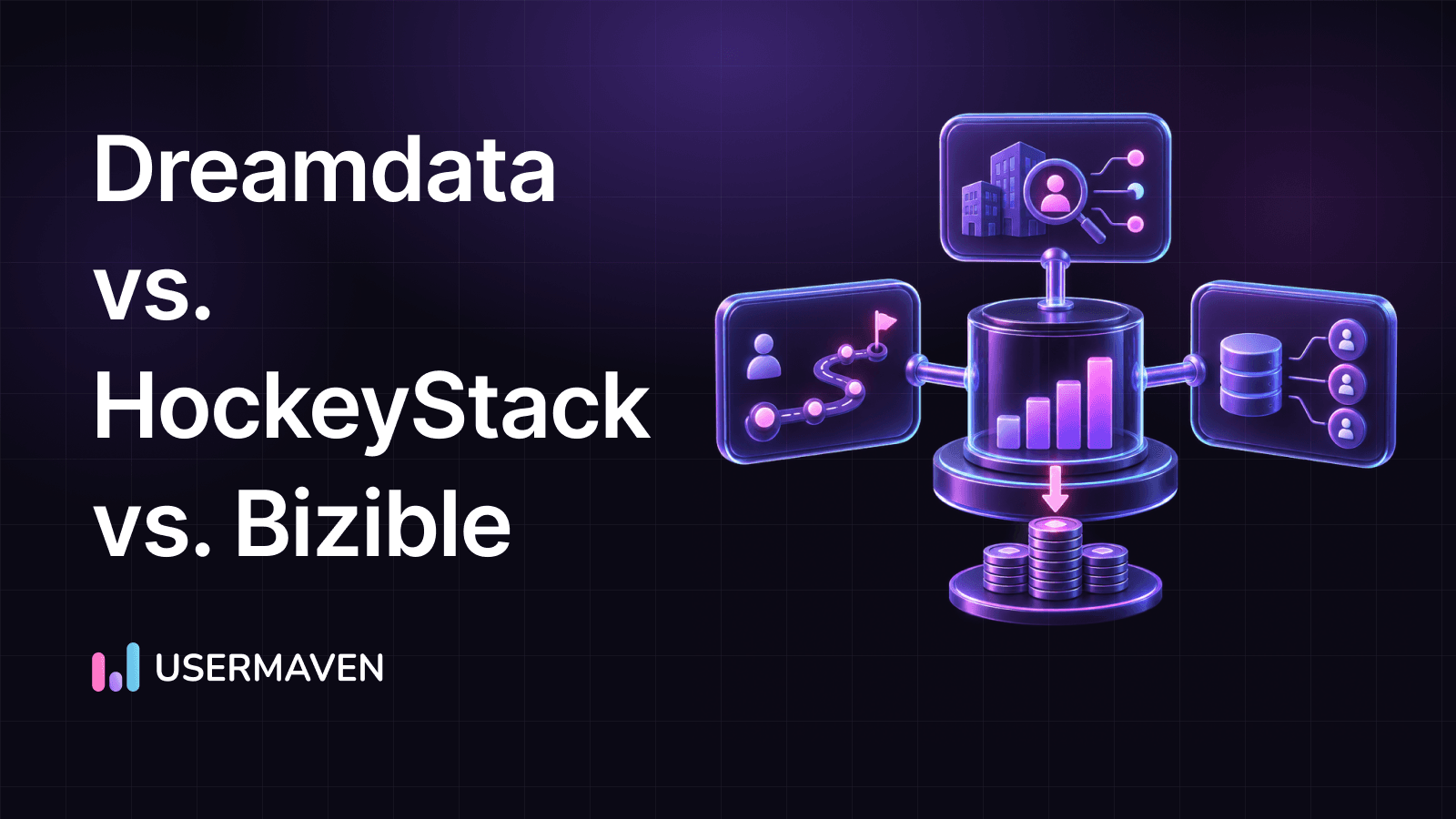
Dreamdata vs. HockeyStack vs. Bizible comes down to how each platform connects buyer interactions to opportunities, pipeline, and revenue.
This guide compares attribution models, AI, integrations, pricing, and implementation. It also explains when Usermaven may be worth evaluating alongside these tools.
Understanding B2B marketing attribution
B2B marketing attribution is the process of understanding how marketing contributes to the pipeline and revenue. It helps teams move beyond surface-level performance and get a clearer view of how growth actually takes shape.
B2B journeys often involve multiple people at one account. Marketing might influence the first visit, while a separate stakeholder books a demo weeks later.
A reliable model needs to connect the path to purchase with CRM stages, contact relationships, and revenue outcomes, not just the last form submission.
When attribution is done well, it becomes much more than a reporting exercise. It helps teams see what is creating momentum, where marketing is making an impact, and how to make smarter decisions about future investment.
Breaking down each attribution platform
Here’s a quick overview of what each platform offers and where it may be a better fit.
1. Dreamdata
Dreamdata is a B2B attribution and activation platform for teams measuring account journeys, pipeline, and revenue. Its current offering also includes an AI Analytics Agent and MCP server.
It fits teams that need account-level attribution alongside audience activation. Its free Starter option supports foundational B2B analytics; advanced attribution uses custom pricing.
Advantages
- Built specifically for B2B attribution use cases.
- Includes buyer journey and revenue reporting features.
- Connects CRM, marketing, and other GTM data for account-level measurement.
Disadvantages
- The learning curve can be steep, which may slow the time to value for smaller teams.
- Account data modeling and attribution setup may take more time than basic channel reporting.
- Its broader product scope can feel heavier for teams without dedicated ops support.
- Advanced Attribution & Activation requires a tailored commercial discussion rather than a published monthly amount.
On Dreamdata’s pricing page, Starter is free, while advanced Attribution & Activation has custom pricing. The paid offering lists AI-assisted attribution, activation, an Analytics Agent, and MCP.
Related: 8 Dreamdata alternatives you should know
2. HockeyStack
HockeyStack is a GTM intelligence platform for B2B buyer journeys, pipeline, and revenue analysis. It offers Odin AI for natural-language analysis and HockeyStack MCP for connected AI clients.
It is often evaluated by revenue and marketing operations teams that need connected campaign, account, and CRM reporting. Its official pricing page uses a consultation process rather than a public rate card.
Advantages:
- Built around B2B attribution, buyer journey reporting, and pipeline visibility.
- Supports LinkedIn impression tracking and multiple attribution models.
- Provides account intelligence, attribution reporting, and AI-supported GTM analysis.
Disadvantages:
- The learning curve can be steep, especially for teams getting started with attribution.
- Teams should evaluate how easily non-technical stakeholders can validate the buyer journey behind each report.
- Initial setup may take more time for teams with more specific reporting needs.
- The official pricing page does not publish a fixed subscription price; cost depends on the proposed setup.
Quick note: If you find the reporting logic too complex, you may want to evaluate a HockeyStack alternative designed for quicker analysis.
3. Adobe Marketo Measure (Bizible)
Bizible is now Adobe Marketo Measure. It connects online and offline marketing touchpoints with B2B pipeline, revenue, and ROI, including account- and opportunity-stage attribution.
Adobe positions Marketo Measure around prebuilt, custom, and AI-informed attribution models. It is especially relevant to organizations that already use Adobe Marketo Engage and complex CRM reporting.
Advantages:
- Offers prebuilt, custom, and AI-informed attribution models across buying stages.
- Connects closely with Adobe’s Marketo ecosystem.
- Aggregates online, offline, sales, and marketing interactions for pipeline measurement.
Disadvantages:
- Adobe does not publish a standalone monthly price; buyers need a tailored commercial discussion.
- Setup may take more time for teams with more complex reporting needs.
- Evaluators should assess CRM field mapping, model configuration, and ongoing data governance.
- It tends to be a better fit for larger teams with more established marketing operations.
Dreamdata vs. HockeyStack vs. Bizible at a glance
To make the differences easier to compare, let’s look at the three tools side by side.
| Evaluation area | Dreamdata | HockeyStack | Adobe Marketo Measure (Bizible) |
| Primary focus | Account-based B2B attribution and activation | GTM intelligence, buyer journeys, and pipeline | Enterprise B2B attribution in Adobe workflows |
| Buyer journey | Account identification and unified GTM interactions | Account intelligence and connected buyer journeys | Online, offline, and sales touchpoints by stage |
| Attribution models | Custom and AI-assisted models in advanced offering | Multiple models for campaign and pipeline measurement | Prebuilt, custom, and AI-informed models |
| Pipeline and revenue | Account- and revenue-level reporting | Opportunity, pipeline, and revenue analysis | Stage progression, pipeline, and ROI reporting |
| AI capabilities | Dreamdata Analytics Agent and AI summaries | Odin AI for GTM analysis | Attribution AI and model guidance |
| MCP | MCP server listed for advanced offering | HockeyStack MCP connects compatible AI clients | Not specified on the reviewed product page |
| Data activation | Audience building; activation options in advanced offering | Account intelligence and GTM workflows | CRM, marketing automation, and BI reporting |
| Implementation priority | CRM identity stitching and account data model | GTM integration scope and reporting logic | Adobe/CRM setup, stages, and attribution governance |
| Free option | Free Starter, with stated feature and history limits | No free tier advertised on the pricing page | No free plan shown on the product page |
| Public paid price | Advanced Attribution & Activation: custom | No numerical rate published | No standalone numerical rate published |
| Best fit | B2B teams combining attribution with activation | Revenue teams coordinating marketing and sales | Adobe-centered marketing operations and enterprises |
When evaluating a Dreamdata alternative, compare how account identities, CRM stages, and attribution models work in practice—not just the number of dashboards.
Choosing the right tool for your business
The right tool should match your reporting needs, your workflow, and the level of complexity your team can realistically support.
Here are a few things that tend to matter most during that decision:
- Reporting needs: Think about whether you need basic attribution, fuller journey visibility, or reporting that ties more closely to revenue.
- Implementation: Some tools take more time and support to set up, especially when reporting needs are more involved.
- Usability: If reporting takes too much effort to navigate, the data becomes harder to use in regular decision-making.
- CRM data quality: Confirm that contacts, accounts, opportunities, stages, and campaign events can be connected reliably.
- Total cost: Compare the actual offer, integrations, onboarding, and required services—not just public list prices.
- Team fit: Some tools make more sense for teams with established ops support, while others are easier to manage with fewer resources.
Also read: Multi-touch attribution vs. marketing mix modeling
Maximize your ROI
with accurate attribution
Where Usermaven fits in B2B attribution
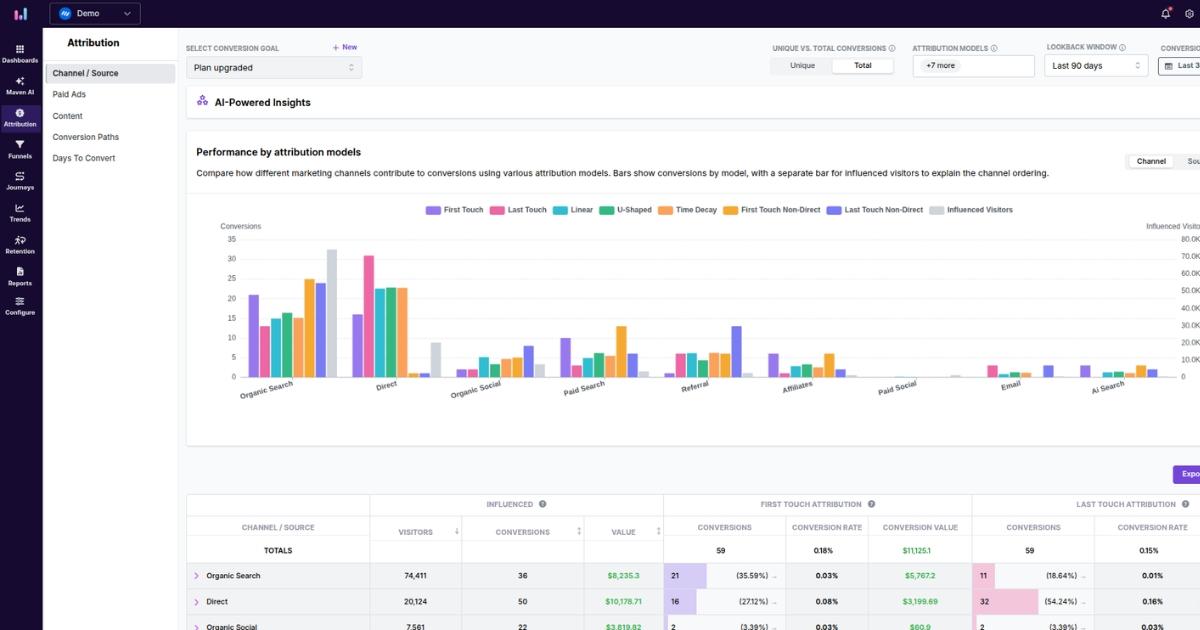
Usermaven is an AI marketing attribution platform connecting campaigns and customer journeys to CRM opportunities, pipeline, and closed revenue.
For B2B SaaS and agency teams, the value is seeing which channels create qualified outcomes—not only which channels generate visits or leads.
Usermaven offers Business and Enterprise plans. Teams can review the included capabilities and book a demo to explore the right fit.
Business combines attribution, CRM and ad integrations, analytics, AI, and reporting. Enterprise adds options for data infrastructure, access controls, deployment, and dedicated support.
Usermaven connects attribution with website analytics, product analytics, funnels, and user journeys.
That lets teams examine what happened before a lead entered the CRM and which behaviors preceded conversion or retention.
Here’s what you get with Usermaven:
- Advanced revenue attribution: Track how marketing efforts contribute to conversions across the full customer journey.
- Flexible attribution models: Compare seven established models, including first-touch, last-touch, linear, time-decay, U-shaped, and non-direct models.
- Long attribution windows: Configure attribution lookback windows to match longer B2B buying cycles.
- Attribution customization: Use custom attribution models and compare how credit changes across customer touchpoints.
- Funnels and journey visibility: See how users move across key steps before conversion happens.
- Conversion path analysis: Understand which pages, channels, and interactions show up across the path.
- CRM and ad integrations: Connect HubSpot or Salesforce CRM outcomes with acquisition activity, including opportunities and deal progress.
- AI analysis and agents: Use Maven AI for questions and Maven AI Agents for scheduled investigation of behavior, funnel, and retention changes.
- MCP connectivity: Connect authorized workspace data to compatible external AI clients through Usermaven MCP.
B2B evidence: Hyperengage
In the Hyperengage case study, attributed channels increased from four to six. Organic search went from zero to eight first-touch conversions.
Hyperengage also reported a 22.19% visitor-to-goal conversion rate. These are customer-specific results, not a promise of identical outcomes for every B2B team.
Wrapping up
Dreamdata is compelling for account-level attribution and activation. HockeyStack is suited to GTM teams linking marketing and sales data. Adobe Marketo Measure offers deep attribution for enterprise and Adobe-centered environments.
Usermaven is worth considering when a team wants pipeline attribution connected with website behavior, product journeys, CRM stages, and revenue.
The practical question is which platform answers your attribution questions using the data and workflows you already have.
If your team wants to connect acquisition with qualified pipeline and closed revenue, book a demo to see how Usermaven fits your CRM and attribution workflow.
FAQs
1. What should you look for in a B2B attribution tool?
Prioritize reliable account and contact matching, CRM opportunity data, multi-touch models, reporting clarity, integration coverage, and the ability to connect marketing activity to pipeline and closed revenue.
2. Why is B2B attribution harder than B2C attribution?
B2B purchases often involve several stakeholders and a longer timeline. Attribution must connect those interactions across people, accounts, CRM stages, and channels before revenue is recorded.
3. How many attribution models does a business really need?
More than one model is usually useful. Compare first-touch, last-touch, and multi-touch views to understand how credit changes, then assess whether custom weighting is needed for your sales process.
4. How do Dreamdata, HockeyStack, and Bizible differ?
Dreamdata combines account-based attribution with activation and AI analysis. HockeyStack emphasizes connected GTM intelligence and pipeline reporting. Bizible, now Adobe Marketo Measure, offers prebuilt, custom, and AI-informed attribution within enterprise marketing workflows.
5. Are Dreamdata, HockeyStack, and Bizible prices public?
Dreamdata lists a free Starter option and custom pricing for its advanced offering. HockeyStack does not publish a numerical subscription rate on its current pricing page. Adobe does not publish a standalone price for Marketo Measure.
6. When should a B2B team consider Usermaven?
Consider Usermaven when the goal is to connect marketing campaigns, CRM opportunities, customer behavior, and revenue in one attribution workflow. It offers Business and Enterprise plans, Maven AI and MCP capabilities, and Maven AI Agents for recurring analysis.
Updated

Written by
Ryan Mitchell
Marketing Analytics Strategist
Ryan Mitchell is a marketing analytics strategist specializing in campaign measurement, customer journeys, and marketing performance. He writes about analytics, reporting, and data-driven marketing strategies, helping SaaS and B2B teams measure what matters across every stage of the customer journey.
All articles by Ryan →