A big B2B deal almost never comes from one click.
A buyer might read your blog, see a LinkedIn ad, and join a webinar. Then four more people from their team visit your pricing page. Sales gets on three calls. Six months later, the deal closes.
So which of those steps earned the money?
That’s the question multi-touch attribution answers. It gives credit to every step that led to a sale, not just the last click.
Enterprise multi-touch attribution tools do this at a much bigger scale. They track whole buying teams, many brands, and long sales cycles across every channel. Then they show which marketing truly drives pipeline and revenue.
In this guide, we compare the 5 best enterprise multi-touch attribution tools for 2026. You’ll see what each tool does well, where it falls short, and who it fits best.
Key takeaways
- Enterprise multi-touch attribution connects marketing to revenue. It helps businesses understand how campaigns and touchpoints contribute to conversions, pipeline, and closed deals.
- The right tool depends on your business model. Usermaven, Adobe Marketo Measure, Dreamdata, and HockeyStack focus on different B2B attribution needs, while Rockerbox is more suited to consumer brands.
- Attribution capabilities vary between platforms. Look for multiple attribution models, CRM integrations, account-level tracking, and support for longer customer journeys.
- Data quality matters as much as reporting. First-party tracking, identity resolution, offline conversions, and reliable integrations help build a more complete picture of marketing performance.
- Evaluate the total cost and implementation requirements. Enterprise attribution software often involves custom pricing, so compare onboarding, integrations, data access, and ongoing support before choosing.
Maximize your ROI
with accurate attribution
The 5 best enterprise multi-touch attribution tools in 2026
Short on time? Here is the quick answer. These are the five best enterprise multi-touch attribution tools we found after testing and research:
- Usermaven: Best for B2B SaaS teams and agencies looking to connect marketing performance with pipeline and revenue.
- Adobe Marketo Measure: Best for B2B teams that run on Salesforce and Marketo.
- Dreamdata: Best for B2B revenue teams that track buying groups at the account level.
- HockeyStack: Best for B2B SaaS companies with complex go-to-market teams.
- Rockerbox: Best for consumer brands that need multi-touch attribution, MMM, and testing in one place.
The table below shows how they compare side by side.
| Tool | Best for | Marketing attribution strength | Data control | Pricing |
|---|---|---|---|---|
| Usermaven | B2B SaaS, agencies, and enterprise marketing teams | 8 attribution models, revenue and pipeline attribution, CRM sync | Warehouse export, private cloud or on-premise | Custom quote |
| Adobe Marketo Measure | B2B teams on Salesforce | Account-based, custom and AI attribution models | Warehouse add-on, Adobe Experience Platform | Custom quote |
| Dreamdata | B2B revenue teams | Account-level journey attribution | Data warehouse sync | Free plan, paid is custom |
| HockeyStack | B2B SaaS with complex GTM teams | Pipeline and buyer journey attribution | CRM and warehouse sync | Custom quote |
| Rockerbox | DTC and consumer brands | MTA plus MMM and incrementality | Warehouse integrations | Custom quote |
How we picked these enterprise attribution tools
Not every attribution tool can handle enterprise scale. A tool that works for a 10-person startup can break when you add 12 brands, 4 regions, and a legal team. So we judged each enterprise multi-touch attribution tool on six things that matter most to companies:
- Attribution model depth: Does the tool offer several multi-touch models, and can you compare them side by side?
- Account-level tracking: Can it group many people from one company into one buying journey?
- Data control and privacy: Does it support first-party tracking, warehouse export, private hosting, and GDPR and CCPA rules?
- Scale: Can it handle many workspaces, brands, users, and high event volume?
- Integrations: Does it connect with your CRM, ad platforms, and BI tools?
- Time to value: How fast can your team go from contract to trusted reports?
We also read real user reviews on G2, Capterra, and GetApp, including our own. Each tool’s rating links to its G2 page, so you can check it yourself. We checked all ratings in October 2026.
This list is built for large companies. If you’re a smaller team, start with our broader list of the best multi-touch attribution tools.
1. Usermaven [Best enterprise multi-touch attribution tool]
Usermaven is AI marketing attribution software for B2B SaaS companies and agencies. It connects marketing, CRM, and revenue data. Then it shows which channels, campaigns, ads, and content drive conversions, pipeline, and revenue.
It brings together website activity, advertising data, and CRM information, helping teams evaluate marketing performance beyond clicks, traffic, and lead volume.
For businesses with longer sales cycles, Usermaven offers a 365-day attribution window, multiple attribution models, and integrations with platforms such as HubSpot and Salesforce.
It offers enterprise-oriented capabilities, including data warehouse integrations, guided implementation, and deployment options for organizations with specific data requirements.
Rating: 4.8/5 on G2 (read reviews). See more on our customer reviews page.
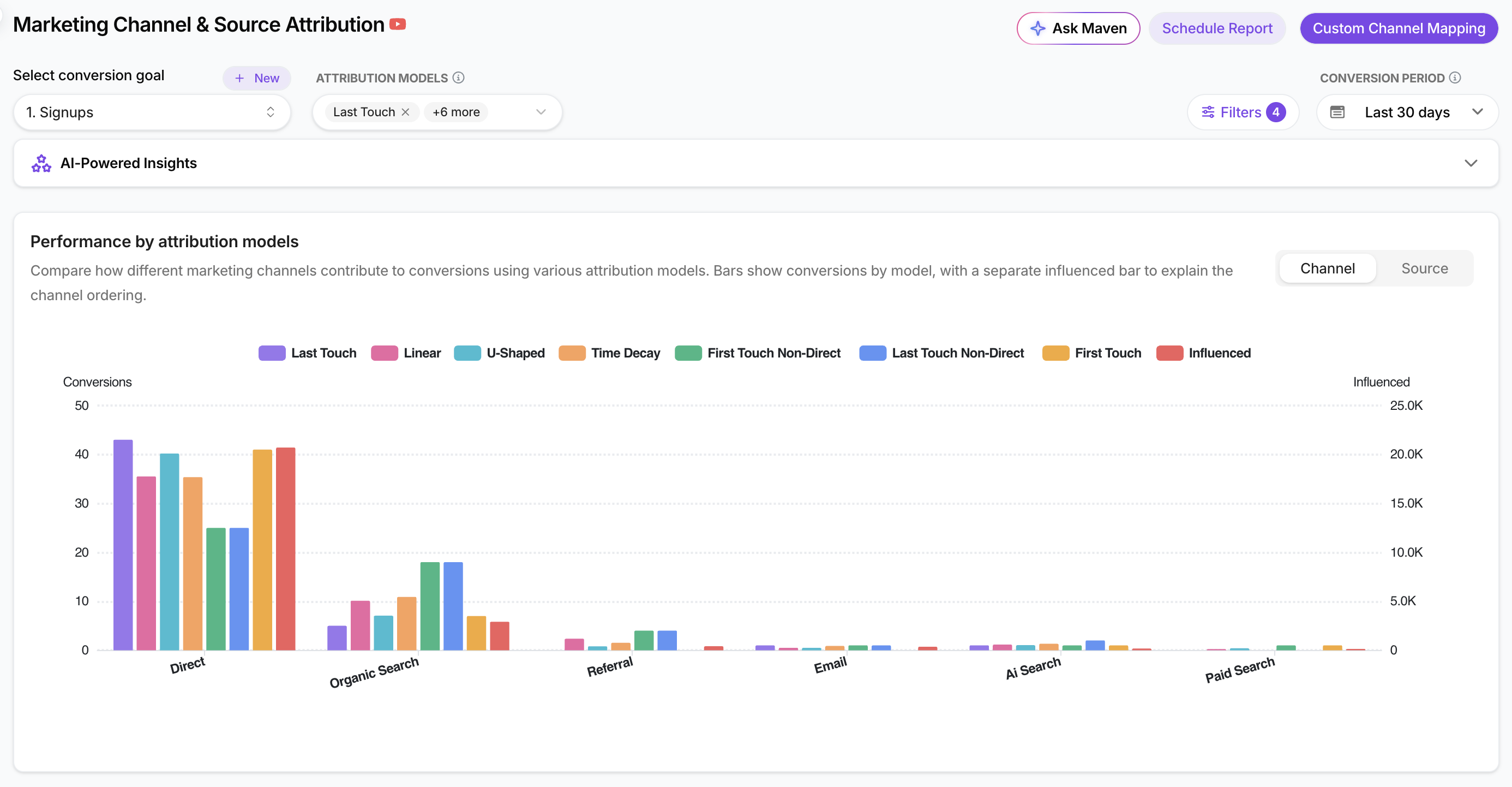
Key features of Usermaven
Here are the features enterprise teams use most inside Usermaven:
- Multi-touch attribution: See how every channel, campaign, ad, and content piece helps a deal close, not just the last click.
- Revenue and pipeline attribution: Tie marketing to real deals and revenue, not just form fills.
- CRM attribution sync: Connect Salesforce and HubSpot so marketing touchpoints line up with deal stages and closed revenue.
- Server-side tracking: Recover conversions that ad blockers and browser limits would normally hide.
- Cross-device identity resolution: Join one buyer’s visits across phones, laptops, and sessions into a single journey.
- AI traffic attribution: See when ChatGPT and other AI tools send buyers your way, instead of lumping them into “direct.”
- Conversion sync: Send clean conversion data back to Google, Meta, and LinkedIn so their ad systems find better buyers.
- Measurement Trust Center: Get a Trust Score that flags tracking and data gaps before they skew your reports.
- Maven AI and MCP: Ask questions about your marketing attribution data in plain English, inside Usermaven or from tools like ChatGPT and Claude.
- Enterprise data controls: Data warehouse export, Reverse ETL, private cloud or on-premise setup, and GDPR and CCPA support.
Attribution models in Usermaven
Different teams ask different questions, so one attribution model is never enough. Usermaven gives you eight models to compare:
- First touch: All credit goes to the first interaction.
- Last touch: All credit goes to the final step before conversion.
- Linear: Credit is split evenly across every touch.
- U-shaped: 40% to the first touch, 40% to the last, and 20% shared by the middle.
- Time decay: Touches closer to the sale get more credit.
- First touch non-direct: Credit goes to the first channel that wasn’t a direct visit.
- Last touch non-direct: Credit goes to the last channel that wasn’t a direct visit.
- Custom attribution model: You set the weights for first, middle, and last touches to match your own sales process.
Usermaven pros
- Easy setup: Reviewers say no-code event tracking removed the need for developer help.
- Built for long B2B cycles: Reviewers call out the 365-day lookback window as a big win when deals take months.
- Clearer than ad platform numbers: Users say it shows which campaigns really drive results, beyond what Google and Meta report.
- First-party data: G2 reviewers point to its first-party tracking and easy-to-read reports.
Usermaven cons
- No public pricing: Usermaven uses custom pricing for its Business and Enterprise plans, so you’ll need to request a quote to understand the total cost.
- Setup depends on your data sources: Businesses with multiple CRM systems, advertising accounts, or custom integrations may need additional configuration to get everything connected..
What customers say about Usermaven
Real results matter more than feature lists. ContentStudio used Usermaven’s paid ads attribution to link ad spend to real sales. After the switch, they saw a 128% rise in signups, 92% more plan upgrades, and 242% more demo bookings.
“Usermaven made it easy for us to see which campaigns are actually bringing signups and paid users.” — Ahmer A., Product Manager at ContentStudio (read the case study)
It also works for long, technical B2B sales. Actisense, which sells marine electronics, used Usermaven to spot 927 high-intent purchase signals across its buyers’ journeys.
Usermaven pricing
Usermaven offers Business and Enterprise plans. Pricing is quoted based on your tracking volume, needs, and setup. The Enterprise plan adds custom integrations, custom reports, warehouse export, and private hosting. See the pricing page for plan details.
Who Usermaven is best for
B2B SaaS companies, agencies, and enterprise marketing teams that want deep marketing attribution without months of setup or a full data team.
Maximize your ROI
with accurate attribution
2. Adobe Marketo Measure
Adobe Marketo Measure was once called Bizible. It is one of the oldest B2B attribution tools on the market. It tracks marketing touches across whole accounts and ties them to Salesforce opportunities and closed deals.
It works best for big B2B companies that already use Salesforce and Marketo Engage. The top tier connects to Adobe Experience Platform, which let firms pull in data from many CRMs at once.
Rating: 4.7/5 on G2 from 147 reviews (read reviews).
Key features of Marketo Measure
Marketo Measure is built for complex B2B sales with many decision-makers. Its main features include:
- Account-based attribution across every contact at a company
- Opportunity-level tracking tied to Salesforce
- Custom stages and custom attribution models
- AI-recommended models and fully algorithmic Attribution AI on the top tier
- Sales activity tracking alongside marketing touches
- Data warehouse add-on for deeper reporting
Marketo Measure pros
Users like a few things most about Marketo Measure:
- Shows what drives revenue: G2 reviewers say it clearly shows which marketing efforts influence deals.
- Strong Salesforce link: G2’s review summary praises its Salesforce integration most of all.
- Flexible attribution models: Higher tiers add custom stages and AI models.
Marketo Measure cons
There are also some common complaints worth knowing:
- Harder to set up: It scores 7.6 out of 10 for ease of setup on G2, below several rivals. (Source: G2)
- Complex for small teams: G2 reviewers say it can feel overwhelming without marketing ops support.
- Manual cost data: One G2 reviewer notes that ad cost data has to be added by hand.
- Locked to an ecosystem: It delivers the most value if you already pay for Salesforce and Adobe tools.
Marketo Measure pricing
Adobe does not publish prices. It comes in three tiers. The top tier, Ultimate, adds Adobe Experience Platform data and Attribution AI. You need to contact Adobe for a quote.
Who Marketo Measure is best for
B2B companies with long sales cycles, big buying groups, and a Salesforce plus Adobe tech stack. See how it stacks up in our Dreamdata vs. HockeyStack vs. Bizible comparison.
Skip it if: your team doesn’t use Salesforce, or you lack a marketing ops person to run it.
3. Dreamdata
Dreamdata is B2B revenue attribution software. It pulls data from your website, CRM, ad platforms, and sales tools. Then it builds a timeline of every account’s journey, from first visit to closed deal.
Its main strength is account-level tracking. Instead of crediting one lead, it shows how a whole buying group moved through your funnel.
Rating: 4.7/5 on G2 (read reviews).
Key features of Dreamdata
Dreamdata focuses on long B2B journeys. Here are its standout features:
- Multi-touch attribution at the account level
- B2B customer journey timelines
- Revenue and pipeline reports
- Ad audience syncing to LinkedIn and Google
- Data warehouse sync
- Native links with Salesforce, HubSpot, LinkedIn Ads, and Google Ads
Dreamdata pros
Reviewers often praise Dreamdata for these reasons:
- Account journey view: G2 reviewers call its account timeline a standout feature.
- Strong support: Reviewers often mention a helpful, fast support team.
- Easy onboarding: A 2026 G2 review says setup was easy thanks to good docs and team help.
Dreamdata cons
A few drawbacks come up in reviews too:
- Customer success could do more: One G2 user wanted more follow-ups and advice after onboarding.
- A bit harder to use: Some reviewers find it takes longer to learn than simpler rivals.
- Cost for smaller teams: The full attribution package uses custom pricing aimed at bigger budgets.
Dreamdata pricing
Dreamdata has a free plan with basic B2B reporting and limits on users and history. Its full Attribution and Activation package uses custom pricing. See our Dreamdata pricing breakdown for details.
Who Dreamdata is best for
B2B SaaS and tech companies that need account-based attribution and journey data for big buying groups. You can also compare Usermaven vs. Dreamdata side by side.
Skip it if: you sell mostly to consumers, not businesses.
4. HockeyStack
HockeyStack is B2B attribution software with a strong focus on go-to-market intelligence. It joins marketing, sales, and intent data so revenue teams can see what moves deals forward.
It’s popular with B2B SaaS firms that have long sales cycles and many touchpoints per deal. Its AI features also flag which accounts look ready to buy.
Reviews: See verified user reviews on G2.
Key features of HockeyStack
HockeyStack aims to give revenue teams one view of the whole funnel. Its key features are:
- Multi-touch revenue and pipeline attribution
- Buyer journey tracking at the account level
- Account intelligence and intent signals
- AI-powered insights and agentic GTM workflows
- Lift reporting
- Salesforce and HubSpot integrations
HockeyStack pros
Users point to several strong points:
- Powerful attribution reports: Reviewers like how well it ties campaigns to pipeline.
- Real-time revenue view: Teams can check performance without building reports by hand.
- Deep GTM features: Account intelligence goes beyond most attribution tools.
HockeyStack cons
Some users also report problems:
- Hard onboarding: A G2 reviewer describes a longer setup than expected.
- Stability issues: Another reviewer mentions slow dashboards and data that didn’t always match.
- Mixed support: One customer says help was slow when technical issues came up.
HockeyStack pricing
HockeyStack does not share public pricing. Plans are custom and based on company size, traffic, and needs. Our HockeyStack pricing guide covers what to expect.
Who HockeyStack is best for
B2B SaaS companies and revenue ops teams that want pipeline attribution plus account intelligence in one tool.
Skip it if: you run an ecommerce or consumer brand with short buying cycles.
5. Rockerbox
Rockerbox is marketing measurement software for consumer brands. It uses three methods to measure results: multi-touch attribution, marketing mix modeling (MMM), and lift tests. In 2025, ad safety company DoubleVerify agreed to buy Rockerbox for $85 million.
That mix of methods helps big brands check their attribution data against other proof. It’s a good fit when you spend heavily on TV, podcasts, direct mail, and digital ads at the same time.
Reviews: See verified user reviews on G2.
Key features of Rockerbox
Rockerbox is built for brands with varied media budgets. Its main features include:
- Multi-touch attribution across paid, owned, and offline channels
- Marketing mix modeling (MMM)
- Incrementality testing
- Customer journey and conversion path reports
- Cross-channel spend tracking
- Data warehouse integrations
Rockerbox pros
Users highlight these benefits:
- Many methods in one tool: You can compare MTA, MMM, and test results side by side.
- Clean dashboards: Reviewers say reports are easy to move through.
- Helpful account teams: Some users praise their account managers during setup.
Rockerbox cons
There are a few limits to keep in mind:
- Mostly click-based: Some users feel upper-funnel channels look weaker than they really are.
- Hard-to-explain math: Reviewers say channel credit and ROAS math can be tricky to follow.
- Less fit for B2B: It’s built for consumer brands, not long B2B sales cycles.
Rockerbox pricing
Rockerbox does not publish pricing. Plans are custom and based on brand size and needs. See our Rockerbox pricing breakdown for more.
Who Rockerbox is best for
DTC and consumer brands with big budgets across online and offline channels. You can also compare Usermaven vs. Rockerbox.
Skip it if: you’re a B2B company that needs account-level tracking.
Maximize your ROI
with accurate attribution
Enterprise vs. regular attribution tools
The gap between a basic tool and an enterprise tool is bigger than most buyers expect. This table shows the main differences:
| Feature | Regular attribution tool | Enterprise attribution tool |
|---|---|---|
| Who it tracks | Single users or leads | Users, accounts, and full buying groups |
| Journey length | Days to weeks | Months to years |
| Channels | Mostly digital | Digital, offline, sales, and events |
| Data setup | One website, one CRM | Many sites, brands, regions, and CRMs |
| Data control | Vendor cloud only | Warehouse export, private cloud, on-premise |
| Governance | Basic user roles | Detailed permissions, audit trails, compliance |
| Support | Help docs and chat | Dedicated success team and custom setup |
When does a company need enterprise attribution software?
Not every business needs an enterprise plan. But some signs show you’ve outgrown basic tools. You likely need enterprise multi-touch attribution software if:
- You spend more than $1 million a year on paid media across several channels.
- Your average deal takes more than 60 days to close.
- Five or more people from one company take part in each purchase.
- You run several brands, products, or regional sites.
- Your finance team or board asks for proof of marketing ROI.
- Your legal team needs strict data rules, like EU hosting or private cloud.
Which multi-touch attribution models do enterprise teams use?
Picking a tool also means picking how credit gets shared. Each attribution model tells a different story, so most enterprise teams compare a few. Here are the models you’ll see most often:
| Model | How credit is split | Best used for |
|---|---|---|
| Linear | Equal credit to every touch | Seeing the full journey with no bias |
| U-shaped | 40% first, 40% last, 20% middle | Valuing both lead creation and closing |
| W-shaped | 30% first, 30% lead, 30% opportunity, 10% rest | B2B funnels with clear sales stages |
| Time decay | More credit to recent touches | Short promos and fast sales pushes |
| Data-driven | Credit set by machine learning | Big data sets with lots of conversions |
| Custom | Weights you choose | Matching your own sales process |
Want a deeper look? Read our full guide to marketing attribution models.
How to choose the right enterprise multi-touch attribution software
A long feature list doesn’t mean a tool fits your company. The best choice depends on your sales model, your tech stack, and your team’s skills. Start with these simple steps:
- Write down your top three questions. For example: “Which channels create pipeline?” or “Which ads bring high-value buyers?”
- Map your data sources. List every website, CRM, ad account, and warehouse the tool must connect to.
- Check your rules. Ask legal and IT about privacy, hosting, and data governance needs early.
- Shortlist three tools. More than three slows the process and confuses stakeholders.
- Run a real pilot. Test each tool with your own data, not a sample demo account.
The enterprise attribution readiness scorecard
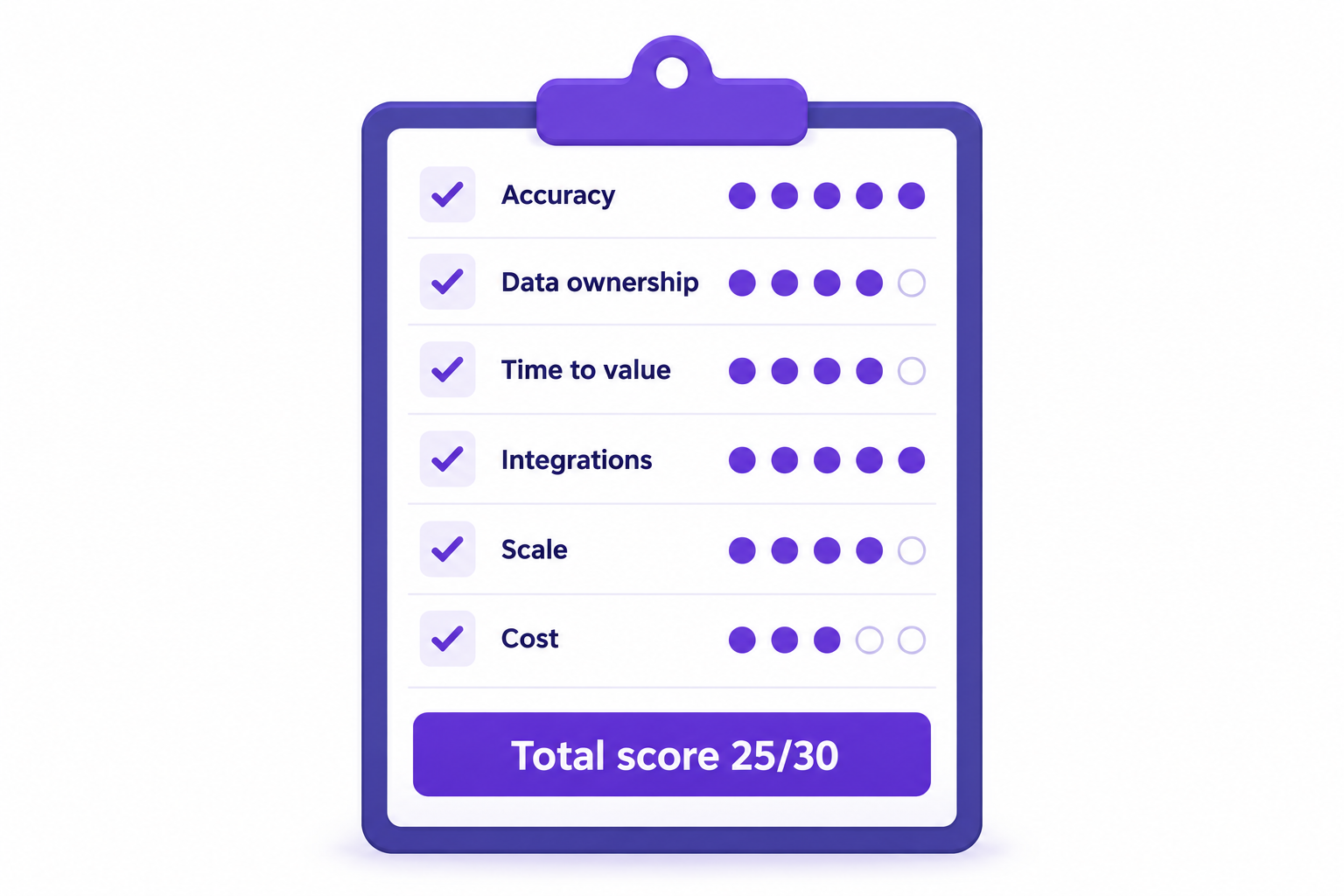
Demos can make every tool look perfect. A simple scorecard keeps your team honest. Rate each tool from 1 to 5 on every row, then multiply by the weight. The tool with the highest total is your best fit.
| Category | Weight | What a 5 looks like |
|---|---|---|
| Attribution data accuracy | 25% | First-party tracking, several attribution models, account-level view |
| Data ownership | 20% | Full warehouse export, private hosting options |
| Time to value | 15% | Trusted reports within 30 days |
| Integrations | 15% | Native links to your CRM, ad platforms, and BI tools |
| Scale and governance | 15% | Many workspaces, roles, and brands with no slowdown |
| Total cost | 10% | Clear pricing with few add-ons or setup fees |
7 questions to ask on every vendor demo
Sales demos are built to impress. These questions help you see past the polish:
- How long did your last three enterprise customers take to get trusted reports?
- Can we export all raw data to our own warehouse, and does that cost extra?
- How do you track visitors who block cookies or ad scripts?
- Can you group many contacts into one account journey?
- What happens to our data if we cancel?
- Which features need a higher tier or a paid add-on?
- Can we talk to a current customer in our industry?
A 90-day rollout plan for enterprise multi-touch attribution
Buying the tool is the easy part. Getting your whole company to trust it is harder.
This simple plan breaks the rollout into three stages:
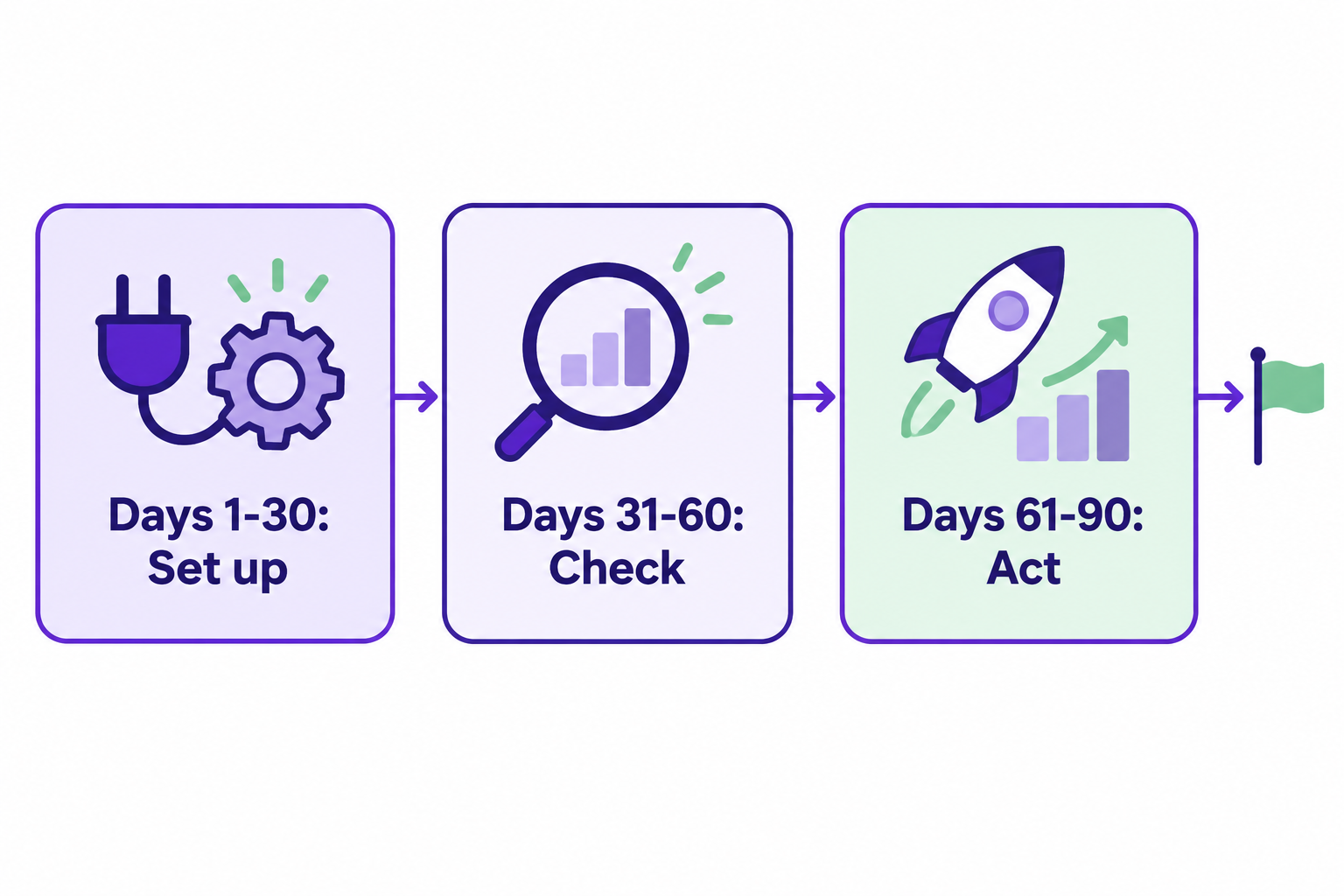
| Stage | Main goals | Done when |
|---|---|---|
| Days 1 to 30: Set up | Install tracking, connect CRM and ad accounts, agree on campaign naming rules | Data flows in from every key source |
| Days 31 to 60: Check | Compare attribution data to CRM and finance numbers, fix gaps | Numbers match within an agreed range |
| Days 61 to 90: Act | Share dashboards with leaders, shift budget based on results | Teams make at least one budget call with the data |
Maximize your ROI
with accurate attribution
Final thoughts
Choosing the right enterprise multi-touch attribution software comes down to your business model, marketing goals, and the complexity of your customer journeys.
Adobe Marketo Measure, Dreamdata, and HockeyStack offer different approaches to B2B revenue attribution, while Rockerbox focuses on broader marketing measurement for consumer brands.
For businesses looking to connect marketing activity with actual business outcomes, Usermaven is an enterprise-level marketing attribution platform that brings together customer journeys, campaign performance, pipeline, and revenue.
With multiple attribution models, CRM integrations, a 365-day attribution lookback window, and AI-powered insights, Usermaven helps marketing teams understand which channels contribute to growth and make more informed budget decisions.
Book a demo to learn how Usermaven can support your enterprise marketing attribution needs.
FAQs
What is an enterprise multi-touch attribution tool?
An enterprise multi-touch attribution tool helps businesses understand how different marketing interactions contribute to conversions, pipeline, and revenue. Compared with basic attribution software, enterprise solutions typically offer more advanced reporting, CRM integrations, longer attribution windows, and support for complex customer journeys across multiple channels and teams.
What is the best enterprise multi-touch attribution tool?
It depends on your setup. Usermaven is the best fit for most B2B teams that want fast setup and full-funnel marketing attribution. Adobe Marketo Measure suits Salesforce-heavy B2B teams. Rockerbox suits consumer brands with big offline budgets.
How much do enterprise multi-touch attribution tools cost?
Most enterprise attribution tools use custom pricing. Costs depend on traffic, data volume, users, and add-ons. Deals often range from a few thousand to well over $50,000 per year. Always ask about setup fees, add-ons, and overage charges.
Is Google Analytics 4 enough for enterprise marketing attribution?
GA4 is a good starting point, but it’s usually not enough for enterprise teams. It struggles with account-level B2B tracking, offline touches, and long sales cycles. Learn more about GA4’s marketing attribution limits.
What is the difference between multi-touch attribution and MMM?
Multi-touch attribution follows each buyer’s path and gives credit to each step. Marketing mix modeling (MMM) uses big-picture data to measure how whole channels affect sales over time. Many enterprise teams use both. Read our full MTA vs. MMM guide.

Written by
Lauren Brooks
Lifecycle Marketing Strategist
Lauren Brooks is a lifecycle marketing strategist with 4+ years of experience helping SaaS businesses create meaningful customer experiences. She specializes in user engagement, retention, and conversion optimization, helping brands build stronger customer relationships beyond acquisition.
All articles by Lauren →