B2B SaaS teams rarely struggle because they have never heard of SEO, LinkedIn, paid ads, ABM, or lifecycle email.
They struggle because they run too many plays at once, use tactics that do not fit the economics of the product, or optimize activity instead of customer value.
The right mix depends on the ideal customer profile, go-to-market motion, annual contract value, sales cycle, demand state, and current growth constraint.
A $29 self-serve product and a $50,000 enterprise platform should not use the same portfolio, even if both are buying marketing attribution software to understand what works.
This guide shows which B2B SaaS marketing strategies fit different business models, when each one is a poor fit, and how to execute and measure it.
It also shows how to prioritize the first 90 days without spreading the team across ten disconnected channels.
Key takeaways
Use these principles to choose a focused strategy mix before adding more channels.
- Strategy starts with economics: GTM motion, ACV, sales cycle, and the current bottleneck should shape the portfolio.
- PLG, sales-led, and hybrid teams need different mixes: The same channel can play a different role depending on how the product is bought.
- Create and capture are different jobs: Thought leadership can create demand, while search and BOFU content capture demand that already exists.
- Customer quality matters more than surface volume: Leads, clicks, and signups become useful only when they progress toward activation, pipeline, revenue, and retention.
- Measurement must match the strategy: SEO, ABM, PLG, paid media, and lifecycle marketing should not all be judged by the same KPI.
- Start narrow: Choose a few strategies that fit the business, establish measurement, then expand from evidence rather than trend chasing.
B2B SaaS marketing strategies at a glance
A B2B SaaS marketing strategy is a coordinated approach for creating, capturing, converting, or expanding demand among business buyers. The right strategy depends on the company’s economics, buying motion, market awareness, and current constraint.
| Strategy | Primary job | Best fit | Better KPI |
| ICP + customer intelligence | Improve targeting | All SaaS | Qualified customer rate |
| Outcome-led positioning | Improve relevance | All SaaS | Progression to meaningful next step |
| SEO + AI search | Capture demand | Existing search demand | Qualified pipeline |
| Research + expert content | Create demand | Complex or emerging categories | ICP engagement / pipeline |
| Product-led acquisition | Convert through product | PLG / hybrid | Activation / paid conversion |
| Paid acquisition | Scale measurable demand | Proven economics | CAC / revenue |
| Account-based marketing | Win high-value accounts | High ACV / narrow ICP | Opportunity / pipeline |
| Lifecycle marketing | Progress and retain | Recurring SaaS | Activation / retention |
| Partnerships | Expand distribution | Ecosystem-led SaaS | Sourced customers / revenue |
| Customer advocacy | Create trust and expansion | Strong customer base | Referral / expansion revenue |
Unlock insights that drive growth
Choose strategy from the business model
The same tactic can be excellent for one SaaS company and economically irrational for another. Before selecting channels, define how the company sells and where marketing has to create leverage.
| Strategy | PLG | Sales-led | Hybrid |
| SEO / content | High fit | High fit | High fit |
| Product-led acquisition | Core | Supporting | High fit |
| Paid search | High fit | High fit | High fit |
| Thought leadership | Useful | High fit | High fit |
| ABM | Selective | High fit | High fit |
| Lifecycle marketing | Core | Useful | Core |
| Partnerships | Useful | High fit | High fit |
| Customer expansion | Core | Core | Core |
A broad saas marketing plan can explain the overall operating model. Strategy selection goes one level deeper by deciding which plays deserve resources now.
ACV and sales cycle should shape the mix
Customer economics change what the company can afford to do. One-to-one account programs may be rational for a six-figure contract and absurd for a low-cost self-serve product.
Long enterprise cycles also need more nurture and multi-touch context than a short trial cycle.
| Business characteristic | Strategy implication |
| Low ACV + self-service | Scalable inbound, product-led acquisition, lifecycle automation |
| Higher ACV | More sales-assisted and account-focused marketing |
| Short trial cycle | Faster testing and optimization loops |
| Long enterprise cycle | Nurture, thought leadership, buying-committee proof, multi-touch measurement |
| Narrow ICP | ABM and targeted distribution become more practical |
| Broad SMB audience | Search, scalable content, and product-led acquisition become more attractive |
| Marketing strategy has to fit customer economics. A play that works for a $50,000 contract can destroy efficiency for a $29 self-serve product. |
Create, capture, convert, and expand demand
A useful portfolio covers more than acquisition. B2B SaaS marketing has four different growth jobs, and companies often overinvest in one while neglecting the others.
| Growth job | Buyer state | Typical plays |
| Create | Problem/category awareness is weak | Research, thought leadership, expert content, events, community |
| Capture | Buyers already search for the problem/category | SEO, paid search, comparisons, review sites, retargeting |
| Convert | Buyers actively evaluate | Trial/demo, case studies, ROI proof, implementation/security evidence |
| Expand | Customer already exists | Activation, lifecycle, adoption, renewal, upsell, advocacy |
| Demand creation makes more buyers aware of the problem and category. Demand capture wins buyers who are already looking. Conversion turns intent into customers. Expansion increases the value of customers already acquired. |
Strategy, channel, and tactic are not the same
Marketing lists often mix SEO, ABM, free trials, LinkedIn, positioning, and referrals as if they were identical units. They are not, but a working plan still needs all of these layers.
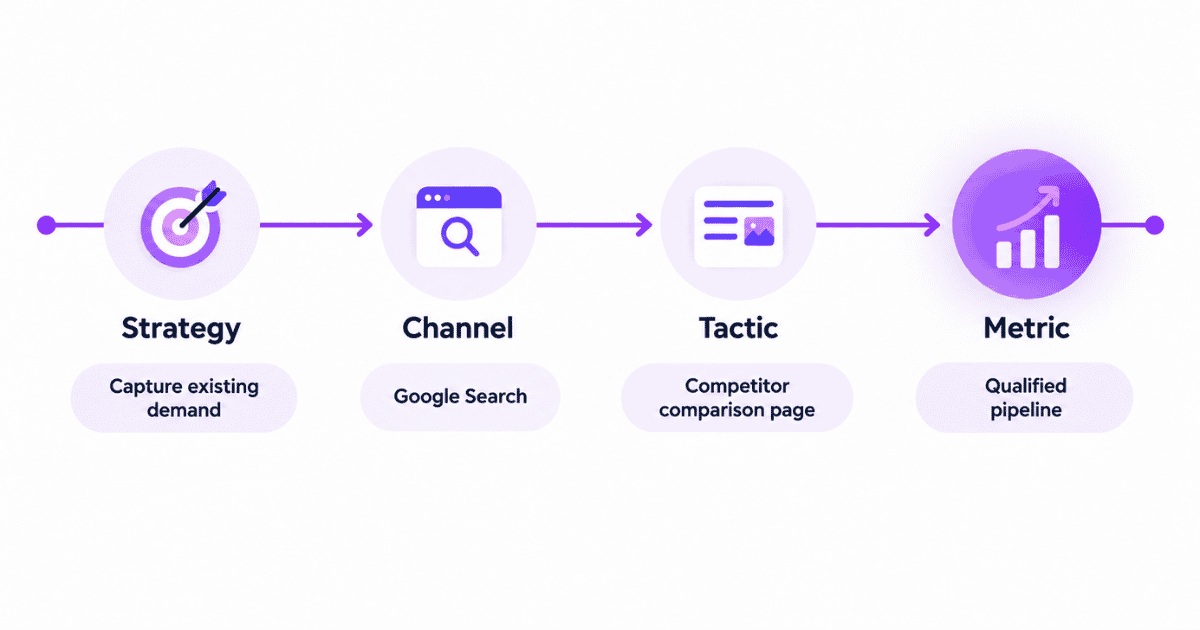
| Layer | Question | Example |
| Strategy | What growth job are we solving? | Capture existing demand |
| Channel | Where do we reach buyers? | Google Search |
| Tactic | What do we execute? | Competitor comparison page |
| Metric | How do we evaluate it? | Qualified pipeline |
The goal is not taxonomy purity. The goal is choosing the right growth job, execution channel, and decision metric.
1. Build ICP from customer quality
Every B2B SaaS company needs an ICP, but the most useful profile comes from customer quality rather than a brainstorming workshop. Start with the accounts and users that actually progress into value.
For a B2B SaaS business, that means looking beyond firmographics to activation, qualification, opportunity creation, retention, expansion, and revenue.
Best fit
All SaaS companies. The maturity of the dataset changes, but the principle does not.
How to execute
Turn the strategy into a repeatable operating process rather than a one-off campaign.
- Segment customers by company size, industry, role, use case, plan, and acquisition source.
- Compare which segments activate or qualify fastest.
- Check opportunity creation, win rate, retention, expansion, and LTV where enough history exists.
- Use customer interviews to explain why the quantitative pattern exists.
- Turn the strongest patterns into targeting, positioning, and qualification rules.
What to measure
Qualified customer rate, activation or SQL rate, win rate, retention, expansion, and customer value by segment.
Common mistake
Defining the ICP around accounts that convert easily but produce weak retention or low commercial value.
| The best ICP is not simply the account most likely to convert. It is the account most likely to become a valuable customer. |
2. Position around outcomes and differentiation
Positioning determines how every later channel performs. Scaling paid media, SEO, or outbound before the message is clear simply distributes ambiguity faster.
Strong B2B SaaS positioning should connect a specific problem with a measurable business outcome and a defensible reason to believe. “AI-powered analytics with advanced dashboards” says far less than “see which campaigns create qualified pipeline and revenue.”
Align proof to the buying committee
Most B2B purchases involve several roles. Salesforce’s current B2B buyer guidance describes roles such as the user, technical evaluator, champion, executive sponsor, economic buyer, and influencer. Each needs different evidence before the purchase can move forward.
| Stakeholder | Evidence needed |
| Champion | Use case, workflow, proof that the problem can be solved |
| End user | Product experience, usability, onboarding |
| Technical evaluator | Security, integrations, architecture |
| Economic buyer | ROI, payback, business case |
| Executive sponsor | Strategic impact and risk |
| Procurement / finance | Pricing, terms, compliance |
What to measure
High-intent page engagement, trial/demo progression, qualified conversion, sales-stage progression, and message performance by ICP segment.
Common mistake
Writing one generic message for every stakeholder and then blaming the distribution channel when the buying committee does not progress.
See what's working. Fix what's not. Grow faster.
3. Capture demand with SEO and AI search
Search is one of the most durable demand-capture channels for B2B SaaS because buyers research problems, categories, alternatives, integrations, pricing, and vendors before they speak with sales.
In 2026, that research increasingly includes AI-powered search experiences as well as traditional results.
Educational and category search
Use educational pages for problems, workflows, definitions, implementation questions, and category education. The goal is not traffic for its own sake. It is to bring the right buyers into a path that can eventually reach product evaluation.
High-intent BOFU content
Treat bottom-of-funnel search as a separate job inside the broader SEO strategy. Competitor alternatives, product comparisons, pricing pages, “best software” queries, integration pages, and specific use cases reach buyers who are already evaluating.
A content marketing funnel helps separate these evaluation assets from awareness content so each page has a clear job.
| Educational content builds understanding and authority. BOFU content captures active evaluation. |
AI-search visibility
Google’s current guidance for generative AI features in Search says traditional SEO fundamentals still matter and emphasizes unique, useful, non-commodity content. It also warns against treating AEO or GEO as a collection of special hacks.
For B2B SaaS, the practical response is to publish original information, clear definitions, and first-party evidence.
Decision frameworks, comparison tables, expert analysis, and technical documentation should still be useful even if AI search did not exist.
What to measure
Qualified organic traffic, high-intent conversion, pipeline, revenue, assisted conversions, and where useful, referral traffic arriving from AI assistants.
Common mistake
Publishing a large volume of generic informational pages while ignoring whether the content attracts the ICP or contributes to evaluation and revenue.
4. Create demand with original research and expert content
Search captures demand that already exists. Original research and expert-led distribution are useful when the market does not yet understand the problem, the category is crowded, or the company needs a stronger point of view than feature-led promotion.
How to execute
Use behavior and stage progression to trigger the next message instead of relying on a fixed calendar.
- Publish benchmark studies, customer-derived patterns, experiments, product data, or market research competitors cannot easily reproduce.
- Turn the findings into executive posts, webinars, sales enablement, PR angles, and search assets.
- Use founders, operators, or subject-matter experts as the distribution layer rather than forcing every founder to become a full-time influencer.
- Connect the research to a category problem the product genuinely helps solve.
A single original dataset can support SEO, AI citations, thought leadership, social distribution, sales conversations, partnerships, and earned links. That makes research one of the few marketing investments that can improve several channels at once.
What to measure
ICP engagement, branded demand, assisted opportunities, influenced pipeline, backlinks, citations, and conversion from research-led journeys.
Common mistake
Measuring thought leadership only through impressions or social reactions without checking whether the right companies engage and return.
5. Use product-led acquisition when product can prove value
Product-led growth works when the product itself can carry part of the acquisition and conversion burden. It is not a universal replacement for sales.
The implement product led growth with examples approach is strongest when users can reach meaningful value quickly, onboarding can happen without extensive services, and product usage creates a credible path toward paid conversion or expansion.
For PLG teams, user activation is the checkpoint that shows whether acquisition reached meaningful product value instead of ending at signup.
Best fit
Product-led acquisition is strongest when users can reach value with limited sales assistance.
- Self-serve or hybrid products with relatively short time to value.
- Products that can expose a meaningful use case before a sales process is required.
- Products where collaboration, usage, or product-qualified signals can indicate purchase intent.
Poor fit
A sales-led or hybrid motion is usually safer when meaningful value depends on heavy implementation or procurement.
- Complex enterprise implementation before value can be experienced.
- Heavy security, procurement, or custom-contract requirements.
- Products that require professional services before the customer can achieve an outcome.
What to measure
Signup rate, activation, time to value, PQL rate, trial-to-paid conversion, product adoption, retention, and expansion.
Common mistake
Calling a free trial “PLG” while still optimizing success around signup volume instead of activation and paid customer quality.
6. Use paid acquisition for a defined demand job
Paid acquisition becomes easier to manage when each channel has a specific job. Paid search is usually strongest at capturing existing intent.
Paid social can distribute ideas, create awareness, and retarget. LinkedIn can reach professional audiences, companies, and buying groups with more precision than many consumer networks.
Paid search
Use it for high-intent category, problem, competitor, and solution searches where commercial economics can support the cost.
Paid social and LinkedIn
Use paid social for distribution, retargeting, account penetration, and demand creation. LinkedIn becomes more attractive as ACV rises and professional targeting improves the economics.
The paid ads attribution question should continue past clicks and form fills into the outcomes that make the customer valuable.
| Channel | Leads / trials | Customers | What the surface metric misses |
| Campaign A | 120 | 20 | More volume, weaker downstream conversion |
| Campaign B | 80 | 35 | Less volume, stronger customer progression |
| Paid acquisition should be judged by customer economics, not the cheapest click or lead. |
Supporting evidence: ContentStudio
ContentStudio ran Google and Meta campaigns while also testing channels such as LinkedIn and X.
After connecting paid activity with signups, demo bookings, upgrades, and revenue, the team could re-evaluate campaigns using cost per paying customer and downstream revenue rather than platform conversions alone.
In the ContentStudio case study, the company reports 128% growth in signups, 92% more plan upgrades, and 242% more demo bookings after broader attribution and funnel work.
Those outcomes reflect the company’s overall implementation and decisions, not a universal causal effect of any one channel or tool.
7. Use ABM when account value justifies the effort
Account-based marketing becomes more economically attractive when a relatively small set of accounts can create substantial revenue. High ACV, narrow ICPs, multi-stakeholder sales cycles, and known target accounts increase the case for coordinated account-level marketing.
| ABM model | Best fit |
| 1:1 | Highest-value named accounts with custom coordination |
| 1:few | Small clusters sharing industry, use case, or buying context |
| 1:many | Larger ICP segments that still justify account-aware targeting |
Execution can combine account ads, email, executive content, sales outreach, events, customer proof, and stakeholder-specific landing pages. The strategy is the coordination around the account, not simply choosing an account-targeting filter in an ad platform.
What to measure
Engaged target accounts, opportunity creation, account pipeline, sales-stage progression, win rate, and revenue.
Common mistake
Running resource-heavy one-to-one programs for low-value accounts where the potential contract cannot justify the personalization cost.
| ABM is a resource-allocation strategy, not a mandatory B2B marketing checkbox. |
8. Use lifecycle marketing to progress and retain demand
Recurring revenue changes the role of marketing. Acquisition is only the beginning if the customer still has to activate, adopt the product, renew, expand, and potentially become an advocate.
For PLG, the lifecycle may run from trial onboarding to activation, adoption, upgrade, retention, and expansion. For sales-led SaaS, it may include lead nurture, qualification, opportunity support, onboarding, renewal, and expansion.
A Retention analytics view helps teams see whether acquisition sources bring customers who actually keep using the product rather than customers who convert once and disappear.
How to execute
Start with partners that share the ICP and can create a measurable joint path to revenue.
- Trigger onboarding and education from behavior rather than sending the same sequence to everyone.
- Use activation milestones to identify users who need help before they churn.
- Align lead nurture with real stage progression instead of arbitrary email dates.
- Create adoption and expansion campaigns around features or use cases that correlate with value.
What to measure
Activation, stage progression, feature adoption, retention, churn, expansion revenue, and customer value by acquisition source or segment.
Common mistake
Treating lifecycle marketing as a broadcast email calendar instead of a system for moving customers toward the next valuable behavior.
9. Build partnerships and ecosystem distribution
Partnerships are strongest when the product sits inside a broader workflow or when trusted intermediaries already have access to the ICP. The channel can include integration partnerships, agencies, technology partners, marketplaces, affiliates, communities, and co-marketing.
How to execute
Ask for advocacy after customers have reached a meaningful success milestone.
- Prioritize partners with real audience overlap and a clear joint value proposition.
- Create co-marketing assets that solve a shared customer problem rather than promoting both logos.
- Instrument partner links, lead sources, referral codes, CRM stages, or revenue events so partner value can be measured.
- Review customer quality and revenue, not just referral volume.
What to measure
Partner-sourced qualified leads, opportunities, customers, revenue, win rate, and customer quality.
Common mistake
Signing a long list of partners without measuring whether any of them consistently produce qualified customers.
10. Turn customers into a growth channel
Customer advocacy compounds when existing customers create proof for new buyers and expansion value for the business. Reviews, referrals, case studies, community participation, and customer stories reduce perceived risk during evaluation.
How to execute
- Ask for reviews or referrals after customers reach a meaningful success milestone.
- Build case studies around the problem, decision, implementation, and measured outcome rather than generic praise.
- Use customer advocates in webinars, peer discussions, events, and sales conversations.
- Pair advocacy with expansion programs so the same customer relationship creates both proof and additional revenue.
What to measure
Referral customers, review-assisted conversion, customer-sourced pipeline, expansion revenue, retention, and LTV.
Common mistake
Trying to manufacture advocacy before the product reliably creates customer value.
Which strategy should come first?
The correct first move depends on the current constraint. More traffic is not automatically useful if the funnel is already full of poor-fit prospects, just as more nurture cannot fix a market that has never heard of the problem.
| Current constraint | Prioritize first |
| Market does not understand the problem | Original research, thought leadership, category education |
| Buyers search but cannot find the brand | SEO + AI-search demand capture |
| Traffic exists but customer quality is weak | ICP + positioning + targeting |
| High-value named accounts matter | ABM |
| Product proves value quickly | PLG / product-led acquisition |
| Leads enter but fail to progress | Lifecycle + qualification + sales alignment |
| Paid acquisition has weak economics | Targeting + conversion + downstream measurement |
| Customers churn | Activation + lifecycle + customer-quality analysis |
| Ecosystem influences purchase | Partnerships |
| Happy customers already exist | Advocacy + referral loops |
| Choose the strategy from the constraint backward, not from the trend forward. |
Match strategy to growth stage
A strategy that is efficient at $1M ARR may not be the right operating model at $20M ARR. Growth stage changes the amount of specialization, automation, budget, and account coordination the team can justify.
| Stage | Primary marketing jobs |
| Early / pre-PMF | Customer learning, founder-led distribution, ICP refinement, positioning, manual outreach, product proof |
| Early growth | SEO/content, repeatable PLG or sales motion, lifecycle, paid tests, partner experiments |
| Scaling | ABM, larger paid programs, original research, ecosystem marketing, advanced measurement, expansion programs |
This is where b2b growth marketing becomes useful as an experimentation discipline: the portfolio should evolve as the company learns which growth loops can scale.
Measure each strategy by the outcome it should create
The easiest metric is rarely the best decision metric. A strategy should be evaluated by the downstream outcome it was selected to create.
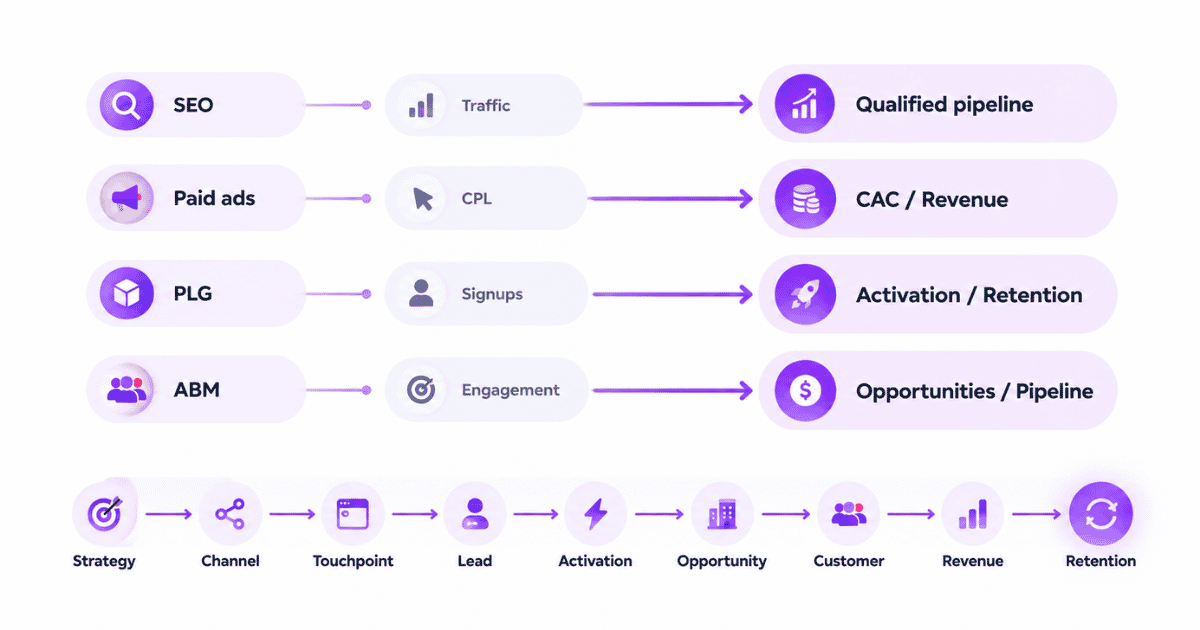
| Strategy | Surface metric | Better decision metric |
| SEO | Traffic | Qualified pipeline / revenue |
| Thought leadership | Impressions | ICP engagement / influenced pipeline |
| Paid ads | CPL | CAC / cost per opportunity / revenue |
| PLG | Signups | Activation / paid conversion / retention |
| ABM | Account engagement | Opportunities / win rate / pipeline |
| Lifecycle | Opens / clicks | Activation / retention / expansion |
| Partnerships | Referral leads | Qualified customers / revenue |
| Customer advocacy | Reviews | Referral customers / LTV |
A useful measurement chain is: strategy -> channel -> touchpoint -> signup or lead -> activation or qualification -> opportunity or customer -> revenue -> retention.
For non-linear B2B buying paths, a customer journey funnel pairs stage progression with the sessions and touchpoints behind it.
This is the point where b2b marketing attribution becomes useful. It helps explain which observed channels and touchpoints contributed to downstream outcomes, while saas marketing attribution adds the product-led and recurring-revenue context common in SaaS.
Attribution is useful, but it is not causality
Attribution distributes credit across observed interactions. It does not automatically prove that those interactions caused the entire outcome. A channel can receive substantial attributed revenue even when some customers would have converted without it.
That is why incremental revenue attribution answers a different question: what additional business outcome occurred because the marketing activity ran?
| Use attribution to understand observed contribution. Use incrementality when the decision requires a causal estimate of lift. |
How Usermaven measures strategy performance
Usermaven is an AI marketing attribution platform that connects marketing, product, and CRM data so B2B SaaS teams can see which strategies progress from acquisition into conversions, pipeline, customers, and revenue.
The product section is most useful when organized around decisions rather than features.
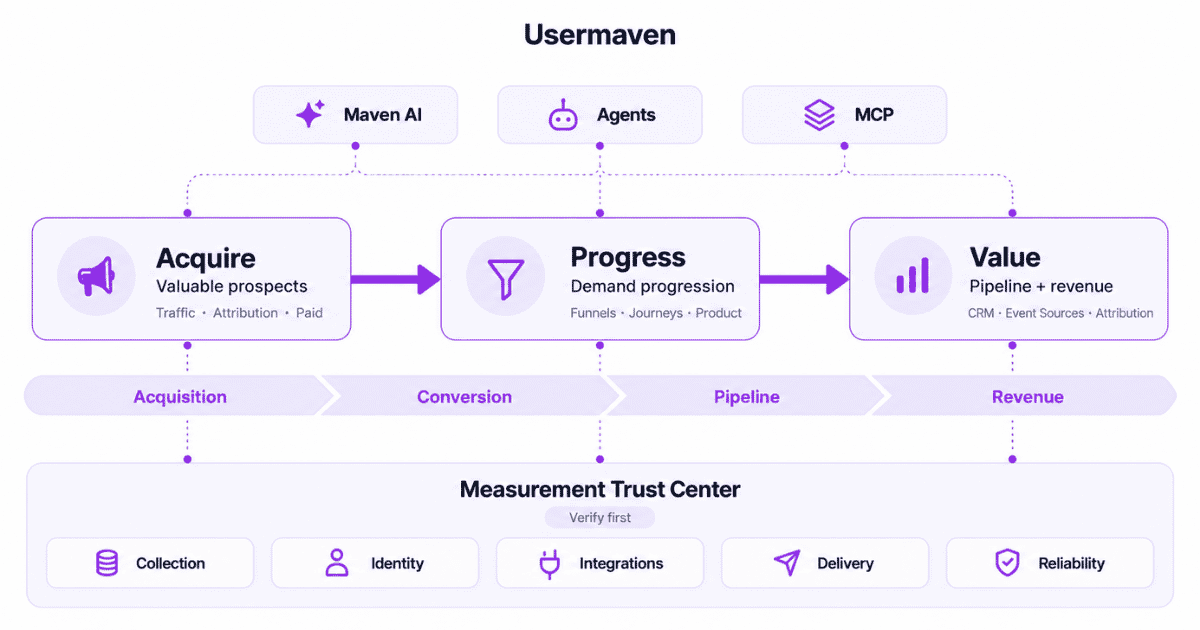
Understand acquisition
The first question is which strategies bring valuable prospects, not simply which channel sends the most sessions. Website behavior, source data, paid acquisition, AI referral traffic, and attribution can be compared against meaningful conversion goals.
The AI Traffic Dashboard can also separate human visitors arriving from AI assistants from bot and crawler activity, which helps teams measure AI-driven discovery without pretending that analytics can guarantee citations or rankings.
Understand conversion
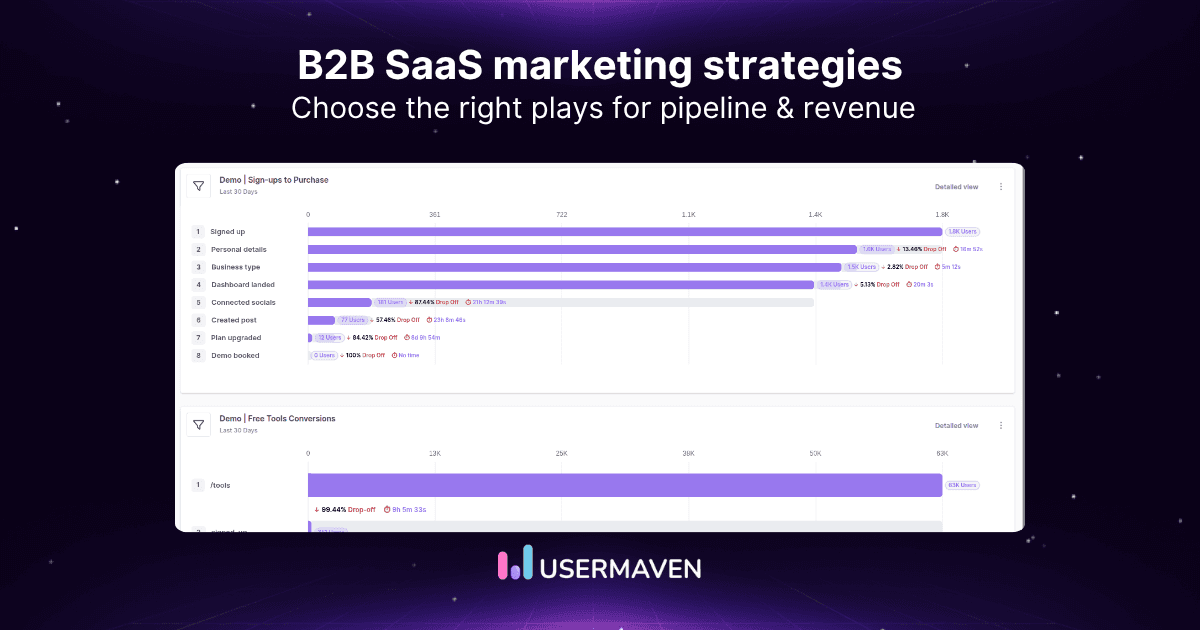
When the problem is stage progression, funnel analysis helps locate where conversion stalls.
In Usermaven, Funnels shows stage conversion, drop-offs, and time between steps, while User Journeys adds behavioral context. For PLG teams, Product Analytics adds activation, adoption, and post-signup behavior.
Connect marketing to commercial outcomes
For sales-led and hybrid SaaS, the useful chain continues into CRM stages, pipeline, and revenue. pipeline attribution helps connect marketing with opportunity progression, while full-funnel revenue attribution keeps the focus on commercial outcomes instead of lead volume.
When meaningful outcomes happen outside the website, Event Sources can bring supported payments, CRM updates, webinar activity, webhooks, and imported events into the same analytical journey.
Investigate performance with Maven AI
Maven AI can investigate questions such as which channels generated the most qualified pipeline, which campaigns create signups but weak activation, and which acquisition sources produce customers with stronger retention.
Maven AI also supports real-time monitoring and AI-generated insights, helping teams spot changes in funnel progression, customer behavior, and campaign performance as experiments run.
Monitor with Maven AI Agents
Maven AI Agents extend this into recurring analysis by monitoring signals such as funnel drop-offs, product adoption, retention changes, and slipping accounts as campaigns and experiments run.
Work with external AI agents through MCP
MCP lets compatible AI tools such as ChatGPT, Claude, Cursor, and Codex query authorized Usermaven data. Current MCP workflows support analysis across attribution, revenue, CAC, LTV, funnels, journeys, and retention, with approval required for supported write actions.
Verify the data before changing strategy
Before killing or scaling a strategy, validate the measurement foundation. The Measurement Trust Center checks Collection, Identity, Integrations, Delivery, and Reliability and surfaces report readiness so teams can see where data gaps may affect a decision.
| Do not kill a strategy because of data you have not verified. |
Evidence: Hyperengage measured the full strategy mix
Hyperengage is a useful first-party example because its B2B SaaS marketing mix spans content, organic search, podcast-led distribution, LinkedIn, email, and partnerships.
The challenge was not a lack of channels. It was understanding which channels contributed to qualified pipeline across long, multi-touch journeys.
| Reported outcome | Result |
| Visitor-to-goal conversion rate | 22.19% |
| Channels now attributed | 4 → 6 |
| Organic first-touch conversions | 0 → 8 |
| New sources uncovered | 2 |
In the Hyperengage case study, the team reports that fuller journey measurement changed how it evaluated content, SEO, paid campaigns, partnerships, and budget allocation.
Organic search moved from zero attributed first-touch conversions to eight, while attribution coverage expanded from four channels to six.
The evidence should not be read as proof that Usermaven caused every growth metric.
The useful lesson is narrower: once the team could connect channels with qualified conversions and pipeline, it could separate activity from contribution and invest with more confidence.
| A broad strategy portfolio becomes useful only when the team can distinguish reach from meaningful customer progression. |
Build a focused 90-day B2B SaaS marketing plan
The article lists ten strategies, but launching all ten simultaneously would make learning slower. A 90-day plan should build the foundation, establish a small number of growth engines, and expand only after the data shows where leverage exists.
Days 1-30: Build the foundation
Use the first month to define the market, message, measurement, and baseline before scaling acquisition.
- Define or refine the ICP using customer-quality evidence.
- Clarify positioning and the proof required by the buying committee.
- Set meaningful conversion goals and downstream business outcomes.
- Validate analytics, CRM, and product measurement.
- Establish baseline metrics for acquisition, conversion, pipeline, and retention.
Days 31-60: Build two acquisition engines
Choose the pair based on the business model rather than copying another SaaS company. A PLG team might combine SEO with product-led acquisition.
A sales-led company might pair paid search with LinkedIn. An early-stage founder might use expert-led content with targeted outbound.
The point is to create enough focus that the team can understand whether each engine is working.
Days 61-90: Optimize and expand
Use the final month to improve the first two engines and add complexity only where the evidence supports it.
- Improve conversion paths and activation.
- Strengthen lifecycle or lead nurture where progression stalls.
- Compare customer quality and commercial outcomes across the first two engines.
- Reallocate time and budget toward the stronger evidence.
- Add a third strategy only when the existing motion can be measured and managed.
| Do not launch ten strategies simultaneously. Pick the few that fit the GTM motion, establish measurement, then expand from evidence. |
B2B SaaS marketing strategy checklist
Before adding another tactic, check whether the underlying strategy is ready.
| Check | Question |
| ICP | Are target accounts based on customer quality, not assumptions? |
| GTM | Is the company PLG, sales-led, or hybrid? |
| ACV | Does customer value justify the strategy cost? |
| Sales cycle | Does the play fit the time required to convert? |
| Demand state | Are we creating, capturing, converting, or expanding demand? |
| Positioning | Is the outcome and differentiation clear? |
| Buying committee | Do key stakeholders have the evidence they need? |
| Search | Can active buyers discover us? |
| Product | Can product experience support acquisition or activation? |
| Paid | Are campaigns measured beyond CPL? |
| ABM | Is account personalization economically justified? |
| Lifecycle | Does marketing continue after lead or signup? |
| Partnerships | Are ecosystem channels measurable? |
| Advocacy | Are satisfied customers creating proof and referrals? |
| Measurement | Does every strategy have a business KPI? |
| Data quality | Can the underlying measurement be trusted? |
| Focus | Are we running a manageable number of strategies? |
Common B2B SaaS strategy mistakes
Most strategy failures come from a mismatch between the business model, the growth job, and the metric used to judge success.
Running every popular channel
A long channel list looks diversified but often prevents the team from learning what works. Focus creates cleaner feedback loops.
Choosing channels before defining ICP
Distribution cannot compensate for unclear targeting. A strong channel aimed at the wrong accounts still produces weak customers.
Scaling weak positioning
More impressions do not fix a message that fails to explain why the product matters. Paid distribution can simply make the problem more expensive.
Optimizing lead volume instead of customer value
The cheapest lead can become the most expensive customer-acquisition strategy if qualification, conversion, retention, or revenue is poor.
Treating PLG as universally applicable
PLG is most effective when the product can prove value before a complex sales process becomes necessary.
Using ABM without enough account value
Account-level personalization is costly. The expected contract value must justify the coordination.
Stopping marketing at acquisition
Subscription economics continue through activation, retention, expansion, and advocacy. Marketing should not stop at the first conversion.
Measuring every strategy with the same KPI
SEO, ABM, lifecycle, PLG, and thought leadership solve different jobs. Judging all of them by leads or clicks creates bad resource decisions.
Final verdict
B2B SaaS marketing strategy is not about finding one universally best channel. The strongest portfolio reflects the ICP, GTM motion, customer economics, buying cycle, demand state, and current growth constraint.
That portfolio should balance demand creation, demand capture, conversion, and expansion rather than overinvesting in whichever tactic is fashionable. Every major play also needs a business-level success metric, whether that is activation, qualified pipeline, revenue, retention, or expansion.
Start with a small number of strategies, connect them with downstream customer outcomes, and expand investment only when the evidence shows which plays create durable growth.
Book a Usermaven demo to see which B2B SaaS marketing strategies are driving qualified customers, pipeline, and revenue.
FAQs
These common questions cover strategy selection, channel fit, measurement, and Usermaven’s role in connecting marketing with business outcomes.
1. What are the best B2B SaaS marketing strategies?
There is no universal best mix. Most B2B SaaS teams need some combination of ICP and positioning work, demand creation, SEO or paid demand capture, conversion support, lifecycle marketing, and customer expansion. The right mix depends on GTM motion, ACV, sales cycle, market awareness, and the current bottleneck.
2. How is B2B SaaS marketing different from B2C SaaS marketing?
B2B SaaS usually involves longer evaluation cycles, higher account value, several stakeholders, product or sales qualification, and more need to connect marketing with CRM pipeline and revenue. Consumer SaaS often has simpler buying decisions and fewer people involved.
3. How should a startup choose its first SaaS marketing channels?
Start with the ICP, buying motion, demand state, and strongest current constraint. Choose one or two channels that match those conditions, define the business outcome each should create, and expand only after the team can measure the result.
4. Is product-led growth right for every B2B SaaS company?
No. PLG fits best when users can reach meaningful product value without a complex sales or implementation process. Enterprise products with heavy procurement, security, services, or custom contracts may need sales-led or hybrid motions.
5. When should a SaaS company use ABM?
ABM is most attractive when account value is high, the target-account universe is relatively concentrated, several stakeholders influence the purchase, and the revenue opportunity justifies account-level personalization and coordination.
6. How should B2B SaaS companies use SEO in 2026?
Use SEO to capture real buyer demand across educational, category, use-case, comparison, pricing, and integration queries. AI-search visibility should build on the same fundamentals: original, useful, expert-led content that is easy to understand and backed by evidence.

Written by
Junaid Ahmed
Content Writer & Digital Marketer
Junaid Ahmed is a content and copywriter with 3+ years of experience creating research-driven content across SaaS, B2B, ecommerce, and digital marketing. He specializes in turning complex topics into clear, practical content that helps marketers better understand their challenges, evaluate solutions, and make informed decisions. His work spans educational content, industry insights, and actionable marketing guides.
All articles by Junaid →