Startups rarely need more dashboards. They need one clear answer: which ads create customers and revenue?
A lean team should connect spend with signups, qualified leads, product activity, pipeline, and purchases without turning measurement into an engineering project. The right marketing attribution software should make that path easier to see and act on.
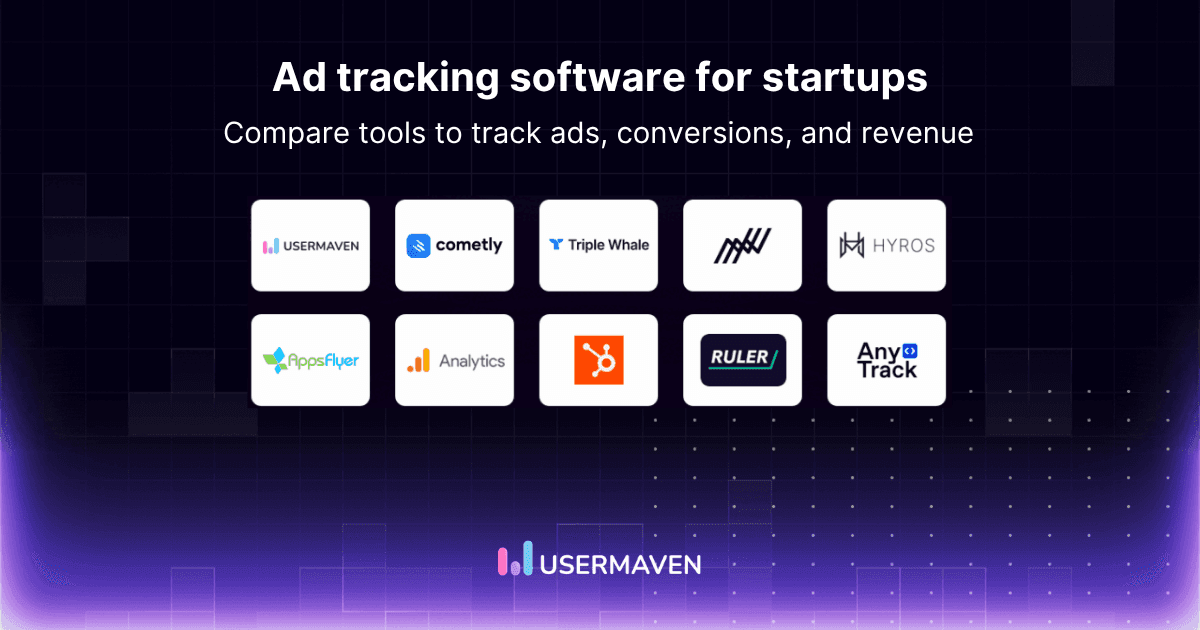
This guide compares 10 ad tracking tools by business model, attribution depth, setup effort, pricing, behavioral visibility, and scalability. The goal is to match the tool to your startup’s stage and conversion path, not the longest feature list.
Ad tracking software for startups at a glance
| Startup type | Best fit | Why |
| SaaS / B2B | Usermaven | Ads + behavior + CRM revenue |
| Paid acquisition | Cometly | Server-side paid attribution |
| Shopify ecommerce | Triple Whale | Ecommerce-native measurement |
| Scaling DTC | Northbeam | Attribution + incrementality |
| High-ticket | Hyros | Long journeys + sales calls |
| Mobile apps | AppsFlyer | Mobile attribution |
| Bootstrapped | Google Analytics 4 | Free measurement baseline |
Key takeaways
- Best overall for SaaS startups: Usermaven combines paid attribution with website and product behavior, customer journeys, CRM outcomes, and revenue in one self-serve environment.
- Business model matters: A Shopify startup, mobile app, B2B SaaS company, and high-ticket service business should not buy the same tracking stack by default.
- Start simple: Native ad platforms and GA4 can be enough while a startup is testing one channel and validating demand.
- Measure beyond clicks: As the company grows, ads should be connected with activation, qualified pipeline, purchases, and revenue rather than judged only on platform conversions.
- Watch implementation cost: The cheapest subscription can become expensive if it requires engineering time, RevOps ownership, or several supporting tools.
- Avoid premature complexity: Enterprise ABM, MMM, or sophisticated identity infrastructure is valuable only when the startup has the volume and decisions to justify it.
Best ad tracking software for startups
The tools below solve different startup tracking problems. The right choice depends less on feature count and more on your acquisition model, customer journey, revenue event, and operating resources.
1. Usermaven: Best overall for SaaS and B2B startups

Overview
Usermaven connects paid and organic acquisition with website behavior, product usage, known users and companies, CRM pipeline, and revenue.
It suits lean teams that want attribution and behavioral context in one workflow instead of separate tools for every stage.
Best for
B2B SaaS, PLG and hybrid SaaS, lean growth teams, agencies, and startups running several acquisition channels that need to judge ads by activation, pipeline, paid customers, or revenue.
Pricing
Growth starts at $84/month for 250,000 events and focuses on website, product, and ecommerce analytics.
Scale starts at $199/month for the same event volume and is the attribution-ready plan. It adds paid ads, channel and content attribution, CRM pipeline and revenue attribution, conversion paths, Conversion Syncs, Maven AI, and MCP.
You can see current Usermaven pricing for live limits and event tiers.
Key capabilities
- Paid ads, channel, content, landing-page, CRM pipeline, and revenue attribution
- Google, Meta, and LinkedIn Ads tracking with conversion sync back to supported ad platforms
- Website analytics and product analytics on the same event dataset
- Funnels, customer journeys, profiles, segments, and event tracking
- HubSpot and Salesforce CRM context for pipeline and revenue analysis
- Maven AI for natural-language investigation and MCP access for compatible AI clients
- Measurement Trust Center for collection, identity, integrations, delivery, and reliability
For teams that need to see whether acquisition creates activation and durable usage, product analytics connects campaign context with feature adoption and product behavior.
Customer journeys help trace the path from first visit through return sessions, signup, product behavior, CRM opportunity, and revenue, while Funnels show where those paths convert or drop.
Verdict
Best overall when a startup needs paid attribution connected with what users do after the click and does not want to assemble a separate ad tracker, product analytics tool, funnel tool, and CRM reporting layer.
2. Cometly: Best for paid-acquisition-focused B2B SaaS

Overview
Cometly is a B2B SaaS attribution platform built around pixel and server-side tracking, multi-touch attribution, events, account journeys, conversion feedback, custom dashboards, and AI-assisted analysis. Its center of gravity is paid acquisition connected to pipeline and revenue.
Best for
Demand-generation and performance teams that spend heavily across paid channels and want server-side tracking plus conversion feedback to ad platforms.
Pricing
Because costs scale with usage and requirements, the Cometly pricing breakdown helps startups understand how traffic and stack requirements can affect the final cost.
Startups weighing Cometly’s paid-media focus against a broader behavioral and revenue workflow can compare the approaches directly in the Cometly alternative comparison.
Key capabilities
- Pixel and server-side tracking
- Multi-touch attribution and account journeys
- Conversion API for major ad platforms
- Events and customizable dashboards
- AI Ads Manager and conversational agent
- CRM, ad platform, and data integrations
Verdict
Best when the startup’s main problem is paid-media attribution and conversion feedback rather than broad product analytics or a wider startup analytics stack.
3. Triple Whale: Best for Shopify startups

Overview
Triple Whale is an ecommerce analytics and measurement platform centered on first-party tracking, attribution, blended performance, ecommerce data, creative insights, and AI workflows. Its product and pricing are designed around commerce rather than B2B SaaS or CRM-led sales cycles.
Best for
Shopify and ecommerce startups, especially brands with meaningful Meta, Google, TikTok, email, and creator spend that want commerce-native reporting.
Pricing
Because plans scale with GMV and package, Triple Whale pricing can change considerably as an ecommerce startup grows.
Triple Whale offers a free tier and paid plans that scale with annual GMV and package. Paid entry options start around $299/month, with higher tiers increasing by GMV and measurement scope.
Key capabilities
- First-party ecommerce tracking
- Multi-touch and first/last-click attribution options
- Blended channel and store performance
- Post-purchase survey support
- Creative and marketing channel reporting
- AI-powered ecommerce analysis
If you are comparing a broader attribution and behavioral stack against an ecommerce-first platform, see the Triple Whale alternative.
Verdict
Choose Triple Whale when the business is fundamentally an ecommerce store and the marketing team wants commerce economics, ad performance, and store data in one environment.
4. Northbeam: Best for scaling DTC startups

Overview
Northbeam is an ecommerce measurement platform for teams that need independent multi-touch attribution, advanced media measurement, creative analysis, and optional incrementality as spend grows. It is better suited to scaling brands than very early startups testing their first campaigns.
Best for
DTC and ecommerce companies with meaningful paid-media budgets that need more advanced attribution and measurement than native ad-platform reporting.
Pricing
Northbeam is sales-led. Its current pricing page lists Starter at about $1,500/month for brands spending under roughly $1.5M per year on ads, Professional at about $3,500/month for larger growth teams, and custom enterprise options.
Key capabilities
- Independent first-party multi-touch attribution
- Omnichannel dashboards
- Custom attribution optimization
- View-through revenue attribution
- Creative and media strategy support
- Optional incrementality measurement
Verdict
A strong option when a DTC startup has moved beyond basic attribution and has enough spend to justify more sophisticated measurement.
The Northbeam alternative comparison helps scaling DTC teams weigh Northbeam’s advanced ecommerce measurement against a broader attribution and analytics workflow.
5. Hyros: Best for high-ticket funnels

Overview
Hyros focuses on ad tracking for long, paid customer journeys where calls, funnels, sales conversations, subscriptions, or high-ticket purchases make browser-only tracking incomplete. Its current positioning also includes AI-assisted ad optimization and business-model-specific setups.
Best for
High-ticket services, education and coaching businesses, SaaS companies with sales calls, and startups where the revenue event happens well after the first ad click.
Pricing
As costs vary with business model and tracked revenue, Hyros pricing becomes an important consideration as paid acquisition and revenue scale.
The Hyros alternative comparison is relevant when the choice is between call-heavy paid attribution and a broader website, product, CRM, and revenue stack.
Key capabilities
- Server-side and deterministic tracking
- Long customer-journey tracking
- Call, funnel, subscription, and revenue tracking
- Conversion feedback and ad optimization
- AI-assisted analysis and remarketing features
- Business-model-specific onboarding
Verdict
Best when ads create revenue through long consideration cycles, calls, or high-ticket sales rather than a short self-serve checkout.
6. AppsFlyer: Best for mobile app startups

Overview
AppsFlyer is a mobile measurement platform designed around app installs, paid acquisition, in-app events, deep linking, privacy-aware mobile measurement, and cross-platform attribution. Mobile startups should treat this category separately from ordinary website attribution.
Best for
Mobile app startups running paid user-acquisition campaigns and needing install-to-in-app measurement, SKAN support, deep linking, and mobile lifecycle reporting.
Pricing
AppsFlyer offers a free Zero plan for owned-media activity, but it does not provide paid attribution. Growth is pay-as-you-go and currently includes a welcome allowance of 12,000 measured conversions; after that, the published rate is $0.07 per conversion. Enterprise is custom-priced.
Key capabilities
- Mobile attribution and real-time reporting
- Configurable in-app events and lookback windows
- SKAN measurement support
- Deep linking and user journeys
- Cross-platform attribution on higher tiers
- Fraud, privacy, and data-management capabilities
Verdict
Best when the startup’s customer journey primarily lives inside a mobile app. A web-focused ad tracker is usually the wrong primary measurement layer for this use case.
7. Google Analytics 4: Best free starting point

Overview
Google Analytics 4 is a free analytics baseline for connecting traffic sources with website and app events.
It is not a dedicated startup attribution platform, but it can be enough while a company is validating demand across a small channel mix.
Best for
Very early-stage startups, small budgets, one or two acquisition channels, and teams that need a free measurement baseline before paying for dedicated attribution software.
Pricing
A free license does not mean zero operating cost. Our breakdown of is Google Analytics free covers the implementation and maintenance tradeoffs that matter as measurement grows more complex.
A Google Analytics 4 alternative becomes more relevant when the startup needs stronger attribution, identity continuity, product context, or downstream revenue measurement.
Key capabilities
- Traffic source and campaign reporting
- Event and conversion measurement
- Exploration and funnel analysis
- Google Ads integration
- Website and app measurement
- Custom reporting and audiences
GA4 becomes less comfortable when teams need stronger identity continuity, CRM revenue, paid conversion feedback, or a combined marketing-and-product workflow.
Google’s Analytics attribution documentation explains how current attribution reports assign credit across eligible touchpoints.
The easiest GA4 alternative for marketers and product teams
Verdict
Start here when the startup is too early to justify dedicated attribution software. Move up when budget decisions depend on cross-channel reconciliation or downstream customer and revenue quality.
8. HubSpot Marketing Hub: Best for CRM-native startups

Overview
HubSpot Marketing Hub combines CRM records, forms, campaigns, lifecycle stages, automation, reporting, and revenue context inside the HubSpot ecosystem. The appeal is not pure ad tracking; it is keeping acquisition and lifecycle measurement close to the CRM the team already uses.
Best for
Sales-led startups and HubSpot-first teams that want marketing, CRM, lifecycle automation, and reporting inside one operating system.
Pricing
HubSpot has free and Starter options, but advanced marketing reporting and automation are concentrated in higher tiers. Marketing Hub Professional is currently listed around $890/month and also requires paid onboarding, while Enterprise starts around $3,600/month.
Key capabilities
- CRM-native contact and company records
- Campaign and lifecycle reporting
- Ad management and audience tools
- Marketing automation
- Customer journey and revenue reporting on eligible tiers
- Sales and marketing workflow integration
For HubSpot-first startups, the HubSpot and Usermaven integration connects richer pre-lead behavior and attribution context with contacts, deals, lifecycle stages, pipeline, and revenue.
Verdict
Best when the startup already lives in HubSpot and values CRM-native operations more than an independent attribution platform.
9. Ruler Analytics: Best for calls and offline sales

Overview
Ruler Analytics connects web visits, forms, calls, chat, CRM outcomes, offline conversions, and revenue back to marketing channels.
It is especially useful when the customer journey leaves the website before the sale happens.
Best for
Lead-generation startups, service businesses, appointment-led companies, and sales-assisted teams where calls or offline outcomes are major conversion events.
Pricing
Ruler lists its Small plan from about $400/month on monthly billing for up to 10,000 visits, with higher tiers scaling by traffic and measurement requirements.
Ruler’s traffic-based plans can become more expensive as visitor volume grows, so Ruler Analytics pricing is worth evaluating against expected traffic rather than only the initial tier.
The Ruler Analytics alternative comparison helps teams choose between Ruler’s call and offline specialization and a broader SaaS attribution workflow.
Key capabilities
- First-party visitor tracking
- Form, call, chat, and offsite conversion tracking
- Multi-touch attribution
- CRM opportunity and revenue stages
- Data-driven and impression attribution on higher tiers
- Marketing mix modelling on advanced plans
Verdict
Best when the journey is ad → form or call → salesperson → CRM → revenue and the startup needs to close the online-to-offline measurement gap.
10. AnyTrack: Best lightweight conversion tracking

Overview
AnyTrack is a conversion tracking platform focused on connecting paid traffic, ecommerce, affiliate networks, CRM outcomes, and ad-platform conversion signals. It offers a smaller entry footprint than enterprise attribution platforms and can suit lean performance teams.
Best for
Startups that mainly need conversion tracking, server-side data, campaign reporting, and conversion feedback without adopting a broader analytics suite.
Pricing
AnyTrack currently has a free plan for one site and limited sessions, Starter at $100/month, Personal at $150/month, and Advance at $300/month. Paid tiers add more traffic, integrations, Conversion API, cross-domain tracking, and team capacity.
Key capabilities
- Server-side and cookieless tracking
- Identity resolution and journey logs
- First/last ad-click attribution
- Campaign and ROAS reporting
- Conversion API and audience sync on paid tiers
- Cross-domain and custom integrations on higher tiers
Verdict
A practical choice when the startup wants focused conversion tracking and ad-platform signal quality without a large analytics or GTM platform.
Compare startup ad tracking tools
Use this table to shortlist the problem you need to solve. Pricing access describes how easy it is to understand the entry cost, not the total cost at scale.
| Tool | Best for | Attribution depth | Behavioral analytics | CRM / revenue | Pricing access |
| Usermaven | SaaS / B2B | Strong multi-touch | Strong web + product | Strong | Public |
| Cometly | Paid B2B acquisition | Strong paid media | Journey-focused | Strong | Usage-based |
| Triple Whale | Shopify / ecommerce | Strong ecommerce | Commerce-focused | Order revenue | Public / GMV-based |
| Northbeam | Scaling DTC | Advanced | Commerce-focused | Strong ecommerce | Sales-led |
| Hyros | High-ticket | Strong paid journey | Funnel-focused | Strong | Revenue / quote-based |
| AppsFlyer | Mobile apps | Strong mobile | App behavior | Mobile revenue | Free + usage + custom |
| GA4 | Bootstrapped | Baseline | Web + app events | Limited without setup | Free |
| HubSpot | CRM-native | CRM-oriented | Lifecycle behavior | Very strong CRM | Public tiers |
| Ruler Analytics | Calls / offline | Strong | Lead journey | Very strong offline | Public tiers |
| AnyTrack | Lean tracking | Focused | Journey logs | Good via integrations | Public tiers |
What startups need from ad tracking software
Startups rarely need the most sophisticated attribution platform on day one. They need enough measurement depth to make better budget decisions without turning analytics into another operational burden.
For a market-wide comparison beyond startup-specific needs, see our ad tracking software guide.

Fast setup
A founder or small growth team should be able to get useful data without waiting weeks for engineering. Installation, event setup, ad integrations, and validation should be clear enough that the team can start answering campaign questions quickly.
Clear pricing
Compare the attribution-ready plan, not the cheapest plan. Include usage limits, seats, onboarding, overages, retention, and required add-ons.
Check whether CRM revenue attribution, paid-media reporting, or conversion sync is locked behind a higher tier.
Multi-channel tracking
Startups often experiment aggressively across Google, Meta, LinkedIn, TikTok, organic search, email, partners, and referrals. A useful tool should help reconcile those channels rather than force the team to optimize each platform from its own self-reported numbers.
Revenue connection
The measurement chain should eventually move from ad click to a real business outcome: ad → signup or lead → customer → revenue.
For sales-led teams, that can mean pipeline and Closed Won. For PLG, it may mean activation and paid subscription; for ecommerce, purchase revenue and repeat value.
Behavioral context
For SaaS startups, acquisition quality is often visible only after the click. Behavioral analytics can show whether traffic reaches pricing, activates, adopts a feature, returns, or drops before the moment that matters.
Easy reporting
A lean team should not need a dedicated analyst to answer basic questions such as which campaign created customers, which channel has the lowest CAC after activation, or why a source produces many leads but weak opportunity conversion.
Room to scale
The platform should survive more ad spend, more channels, a CRM rollout, longer sales cycles, and more complex customer journeys. Replacing the measurement layer during rapid growth is expensive, so startups should buy enough headroom without overbuying enterprise complexity.
When does a startup need ad tracking software?
Dedicated attribution software is not automatically the right answer for every early-stage startup. The need usually appears when acquisition complexity grows faster than native platform reporting can explain.
Testing one channel
If the startup runs one paid channel with a simple conversion and is still validating demand, native platform tracking plus GA4 may be enough.
The priority at this stage is reliable event capture and disciplined campaign naming, not sophisticated attribution.
Running multiple channels
The case for independent tracking strengthens when Meta, Google, LinkedIn, or other platforms begin reporting conflicting conversions. Cross-platform ad tracking helps create a shared view of the journey instead of letting every ad network grade its own performance.
Optimizing for customers
Once the company needs to optimize for activated users, qualified opportunities, purchases, or revenue rather than clicks and leads, the measurement layer must connect acquisition with a deeper business outcome.
Connecting CRM or product data
Dedicated software becomes much more valuable when the revenue event occurs days or weeks after the click, or when product usage and sales qualification determine whether the original conversion was actually valuable.
Native tracking vs dedicated software
Native ad reporting is not bad; it simply answers a narrower question. Dedicated tools become useful when the startup needs an independent view across channels and downstream outcomes.
| Native ad tools | Dedicated tracking software |
| Platform-specific view | Cross-channel or independent view |
| Usually free | Usually paid |
| Fastest setup | More implementation and validation |
| Optimizes its own ad platform | Can compare multiple platforms |
| Limited downstream context | Can connect CRM, product, and revenue |
What to compare before buying
Startup teams should compare operational fit as carefully as attribution features. A powerful tool that takes months to implement can be a worse investment than a simpler platform the team actually uses.
Setup effort
How long will it take to install tracking, connect ad platforms, configure conversions, and validate the data? Ask whether a marketer can maintain it or whether every change requires engineering.
Attribution-ready price
Compare the tier that includes the capabilities you actually need. A cheap analytics plan is not an ad-attribution plan if paid media, CRM revenue, or conversion feedback sits on a higher tier.
Channel support
Check current support for the ad networks you use today and the ones you are likely to test next. Avoid buying around a hypothetical channel mix that may never happen.
Revenue connection
Decide whether the tool can connect ads with subscription revenue, opportunity value, Closed Won, ecommerce orders, or another business outcome rather than only form fills.
Identity
Understand how anonymous activity becomes a known user or account, how cross-domain journeys work, and what happens when a person changes devices or browsers.
The guide to ad tracking without third-party cookies explains why first-party identity and durable conversion signals matter as browser restrictions increase.
Product behavior
For SaaS, ask whether campaign data can be analyzed beside signup, activation, feature adoption, upgrades, retention, or other milestones that reveal customer quality.
Conversion feedback
If ad optimization matters, check whether the platform can return qualified conversions or revenue signals to supported ad networks.
Google Ads documents enhanced conversions for leads as a way to use first-party data with offline conversions to improve measurement and bidding.
Scaling cost
Model how pricing changes with events, sessions, pageviews, tracked revenue, ad spend, seats, contacts, workspaces, or implementation support.
Measurement trust
Do not buy a dashboard without a validation plan. When platform totals diverge, understanding why ad tracking is inaccurate helps separate real collection or identity failures from expected differences caused by attribution windows and reporting rules.
Usermaven’s Measurement Trust Center brings collection, identity, integrations, conversion delivery, and reliability into the same measurement workflow.
What should startups measure?
The right metrics change with the business model. A startup should connect ads with the deepest outcome it can measure reliably, then keep earlier funnel metrics for diagnosis rather than treating them as the final business result.

SaaS / PLG
Track cost per signup and activation, signup-to-paid conversion, CAC, MRR or ARR, retention, and LTV. For tool selection specific to this model, see ad attribution software for SaaS.
Average customer acquisition cost covers the cost side of growth, while calculating SaaS LTV compares acquisition cost with recurring customer value.
Sales-led B2B
Track cost per qualified lead, lead-to-opportunity rate, pipeline value, win rate, sales-cycle length, CAC, and Closed Won revenue. When the goal is to connect campaigns with commercial outcomes, revenue attribution provides the deeper measurement framework.
Ecommerce
Track CAC, ROAS, AOV, repeat purchase revenue, refund-adjusted revenue, and LTV. Effective ad tracking solutions for ecommerce connect those store outcomes back to campaigns instead of treating the first purchase as the entire customer-value story.
Use how to calculate ROAS to compare attributed revenue with ad spend consistently, but do not confuse ROAS with profit.
Why delayed conversions matter
Startups often judge campaigns too quickly because the ad click and the valuable conversion can be separated by days or weeks. A short reporting window can make a campaign look weak even when it eventually creates paying users.
In Usermaven’s ContentStudio case study, the team found that many paid conversions completed 7–14 days after the original ad click.
Usermaven connected Google and Meta campaigns with downstream signups, upgrades, and demo bookings instead of judging performance only from early platform signals.
| Real-world evidence ContentStudio reported 128% growth in signups, 92% more plan upgrades, and 242% more demo bookings after improving paid attribution and funnel analysis. The broader lesson for startups is timing: attribution should reflect the normal conversion cycle before a campaign is cut or scaled. |
If customers regularly convert later, document the attribution window used for decision-making so early campaign reports are not mistaken for the final outcome.
How Usermaven fits startup ad tracking
For a startup, the useful question is not whether an attribution tool has every possible model. It is whether the tool can preserve a practical path from spend to behavior to customer and revenue with low operational overhead.

Track acquisition
Paid channels, organic sources, campaigns, and landing pages can be compared in the same measurement layer instead of reviewed as separate platform reports.
See behavior
Website and product signals reveal whether paid traffic actually reaches the actions that predict value, such as pricing engagement, activation, key feature adoption, demos, purchases, or upgrades.
Measure progression
Funnels and journeys help a lean team see where customers move forward or drop, making it easier to separate an acquisition problem from an onboarding, product, or sales-process problem.
Connect revenue
CRM and revenue context makes it possible to compare campaigns by qualified pipeline, Closed Won, subscriptions, or other commercial outcomes instead of treating every lead as equally valuable.
Improve ad platforms
Conversion Syncs can send selected downstream conversion outcomes back to supported ad platforms, which helps bidding systems learn from qualified leads, customers, or revenue rather than the easiest event to collect.
Where AI helps lean growth teams
The value of AI for a startup is not producing another dashboard. It is reducing the analyst time required to investigate what changed and where the team should look next.
Find wasted spend
Maven AI can help a growth team investigate questions such as:
- Which campaign should we stop before it consumes another $5,000?
- Which channel creates cheap signups but expensive customers?
- Which campaigns generate strong lead volume but weak opportunity rates?
- Which paid source creates customers with the highest LTV?
- Which campaigns convert slowly and look weak if we judge only the first week?
- Where did ROAS fall after a landing-page or funnel change?
Ask from AI clients
Usermaven MCP can expose authorized analytics to compatible AI clients so technical or AI-native teams can ask questions about campaigns, journeys, product behavior, and revenue without rebuilding every report manually.
Keep human judgment
AI can surface patterns, anomalies, and journey differences. Humans still need to define the business conversion, decide whether a channel is strategically important, understand attribution assumptions, and approve budget changes.
Which ad tracking tool fits your startup?
Choose by the job you need to solve today, while keeping enough room for the next stage of growth.
For SaaS and B2B: Choose Usermaven when you need paid attribution connected with website behavior, product usage, CRM pipeline, and revenue in one self-serve environment.
For paid acquisition: Choose Cometly when server-side ad attribution and conversion feedback are the priority.
For Shopify: Choose Triple Whale when ecommerce attribution, store economics, and channel performance are the core workflow.
For scaling DTC: Choose Northbeam when ad spend and measurement complexity justify advanced attribution and incrementality.
For high-ticket funnels: Choose Hyros when calls, long consideration cycles, and sales-assisted revenue dominate the journey.
For mobile apps: Choose AppsFlyer when paid acquisition and conversion measurement primarily happen inside a mobile app.
For bootstrapped teams: Start with GA4 when you are validating demand and do not yet need independent cross-channel attribution.
For HubSpot-first startups: Choose HubSpot when CRM-native lifecycle management matters more than adding a separate attribution platform.
For calls and offline sales: Choose Ruler Analytics when online marketing needs to connect with calls, CRM stages, and closed revenue.
For lightweight conversion tracking: Choose AnyTrack when you need focused tracking, Conversion API, and campaign reporting without a broader analytics suite.
Final verdict
There is no universal winner for startup ad tracking. The right platform depends on company stage, business model, channel mix, customer journey, budget, and how much measurement complexity the team can realistically operate.
Very early startups may be better served by native ad tools and GA4. Once acquisition becomes multi-channel and the valuable conversion happens after signup, product usage, CRM qualification, or a delayed purchase, independent attribution becomes much more useful.
For growing SaaS and B2B teams, Usermaven balances attribution, behavioral analytics, product measurement, CRM revenue, and AI without requiring an enterprise measurement stack.
The value is a clearer connection between campaign spend and what happens after the click.
Ready to see Usermaven in action? Explore the platform or book a demo for a closer look.
Drive business growth
with AI-powered analytics
FAQs
1. What is the best ad tracking software for startups?
For growing SaaS and B2B startups, Usermaven is a strong overall choice because it connects paid attribution with website and product behavior, customer journeys, CRM pipeline, and revenue. Ecommerce, mobile, and high-ticket startups may be better served by specialist platforms.
2. Do startups need dedicated ad tracking software?
Not always. A very early startup running one channel can often begin with native ad-platform tracking and GA4. Dedicated software becomes more useful when channels disagree, conversions happen later, or the team needs to connect ads with product, CRM, or revenue outcomes.
3. What is the best free ad tracking tool for startups?
GA4 is the most practical free baseline for general web and app measurement. AppsFlyer and AnyTrack also offer free entry options for narrower use cases, but their free tiers have limits around paid attribution, traffic, or advanced integrations.
4. What should startups look for in ad tracking software?
Prioritize fast setup, clear attribution-ready pricing, support for your actual ad channels, reliable conversion tracking, downstream revenue connection, identity continuity, and a scaling model your team can afford and maintain.
5. What is the best ad tracking software for SaaS startups?
Usermaven is well suited to SaaS startups that need to connect paid acquisition with signup, activation, product usage, CRM stages, paid subscriptions, and revenue. Cometly is a strong alternative when the workflow is more narrowly centered on paid-media attribution.
6. What is the best ad tracking software for ecommerce startups?
Updated

Written by
Ryan Mitchell
Marketing Analytics Strategist
Ryan Mitchell is a marketing analytics strategist specializing in campaign measurement, customer journeys, and marketing performance. He writes about analytics, reporting, and data-driven marketing strategies, helping SaaS and B2B teams measure what matters across every stage of the customer journey.
All articles by Ryan →