Third-party cookies are no longer dependable enough to carry ad measurement on their own.
Ad tracking remains possible, but marketers need a different foundation. Modern ad tracking connects campaign parameters, click identifiers, first-party events, consented customer data, CRM outcomes, and server-side conversion feedback.
The key is to separate measurement from targeting. Tracking asks whether an ad contributed to a visit, lead, purchase, opportunity, or revenue. Targeting asks who should receive the ad. The methods overlap, but they solve different problems.
This guide explains how ad tracking works when third-party cookies are unavailable, which signals still work, how to build a durable tracking architecture, and where Usermaven fits into a first-party measurement system.
Key takeaways
- Third-party cookies are unreliable: Chrome still allows them for many users, while Safari, Firefox, privacy controls, and extensions restrict them in different ways.
- First-party data becomes the foundation: Campaign parameters, click IDs, website events, known-user identifiers, and CRM outcomes create a more durable measurement system.
- Server-side tracking improves control: It can validate and route important events, but it does not bypass consent or recreate unrestricted cross-site tracking.
- Tracking and targeting must be separated: Contextual advertising may help place ads, but it does not independently connect those ads with conversions and revenue.
- Commercial outcomes matter most: The goal is not simply to preserve clicks or front-end forms; it is to connect advertising with qualified pipeline, customers, and revenue.
- No replacement is perfect: View-through, cross-device, and anonymous cross-site journeys become less deterministic, so teams need validation and honest limits.
What is ad tracking without third-party cookies?
Ad tracking without third-party cookies is the process of measuring ad interactions and outcomes using first-party campaign data, click identifiers, website events, consented customer information, server-side signals, and CRM results rather than cross-site browser cookies.
A useful system should preserve the path from an ad impression or click to a website visit, conversion, qualified lead, opportunity, customer, and revenue.
The journey will not always be complete, but the objective is to retain enough trustworthy evidence to guide spending decisions.
First-party vs third-party cookies
A first-party cookie is created in the context of the website a person is visiting. It can support sessions, preferences, authentication, analytics, and conversion measurement on that owned property.
A third-party cookie is created or accessed by another domain and has historically supported recognition across different websites.
Losing third-party-cookie access does not automatically eliminate first-party analytics or conversion measurement. It mainly removes a shared cross-site identifier once used for audience recognition, retargeting, and attribution.
This is why cookieless tracking is better understood as a change in measurement architecture rather than the end of measurement.
Cookieless does not always mean cookie-free
Marketers often use “ad tracking without cookies” as shorthand for measurement that does not depend on third-party cookies, even when consented first-party storage remains part of the setup.
The term “cookieless” is used loosely. Some implementations store no cookies at all. Others avoid third-party cookies while still using consented first-party storage. A third group relies on server-side events, known-user IDs, or aggregated platform measurement.
Marketers should therefore describe the actual setup instead of assuming every cookieless method works the same way. The relevant questions are which data is collected, where it is stored, how identity is connected, what consent applies, and which outcomes can be verified.
What were third-party cookies used for?
Third-party cookies supported several advertising functions at once. Understanding those functions makes it easier to decide which replacements are relevant and where measurement will remain incomplete.

Cross-site audience recognition
Ad networks could recognize the same browser across participating websites and use that history to build or update an audience profile.
Behavioral targeting
Advertisers could reach people based on activity that occurred beyond the advertiser’s own website or application.
Retargeting
A visitor who viewed a product or landing page could later be reached with an ad on another site.
View-through measurement
An ad impression could receive credit when a conversion happened later, even if the person never clicked the ad.
Cross-site attribution
Advertising interactions across publishers could be connected with later outcomes through the shared browser identifier.
What changes without third-party cookies
| Capability | What changes | What can support it? |
|---|---|---|
| Ad-click tracking | Mostly remains available | UTMs and click IDs |
| Website conversions | Remain measurable | First-party events |
| Cross-site recognition | Becomes limited | Consented identifiers |
| Retargeting | Observable audiences shrink | First-party audiences |
| View-through attribution | Becomes less deterministic | Modeled or aggregated measurement |
| Offline outcomes | Remain measurable | CRM and conversion imports |
| Revenue attribution | Remains possible | First-party journeys and CRM data |
Why cookie-independent tracking matters
Cookie-independent tracking matters because third-party cookies are no longer a dependable cross-browser foundation. The strategic problem is not one universal deprecation date.
It is fragmentation across browsers, privacy settings, consent states, extensions, mobile platforms, and advertising systems.
Google’s April 2025 Google Privacy Sandbox update confirmed that Chrome would maintain its existing third-party-cookie approach rather than introduce a new standalone prompt.
Cookies therefore remain available to many Chrome users, although users can block them and restrictions remain active for a testing cohort.
Safari takes a different position. WebKit Tracking Prevention blocks third-party cookies by default, with limited access available through browser mechanisms such as the Storage Access API.
Firefox applies its own tracking protections and cookie partitioning, while extensions can block scripts or requests even when the browser itself permits them.
Mobile privacy controls and consent decisions create additional gaps. An advertiser that depends on one browser policy will therefore inherit that policy’s volatility.
The better approach is to build measurement around data the business can collect and validate directly. The broader cookie apocalypse is less about a single deadline and more about moving away from fragile, opaque cross-site dependencies.
Ad tracking without cookies vs targeting
Search results frequently mix tracking, targeting, attribution, retargeting, and optimization. Separating them prevents marketers from choosing a targeting tactic and assuming it has also solved measurement.
Tracking vs targeting without cookies
| Area | Primary question | Relevant methods |
|---|---|---|
| Ad tracking | Did an ad contribute to a result? | UTMs, click IDs, events, CRM data |
| Attribution | Which interactions deserve credit? | First-click, last-click, multi-touch |
| Targeting | Who should receive the ad? | First-party audiences, contextual targeting |
| Retargeting | Can previous visitors be reached again? | Consented first-party audiences |
| Optimization | Which outcomes should train the platform? | Conversion APIs and conversion syncs |
Contextual advertising, for example, helps determine where an ad appears based on page content. It can reduce dependence on behavioral profiles, but it does not independently show whether that placement generated a qualified lead or customer. Measurement still requires campaign context and outcome data.
How to track ads without third-party cookies
A durable setup combines several methods because no individual technology replaces every function third-party cookies once supported. The following eight methods form a practical measurement stack.

1. Collect consented first-party data
First-party data comes from direct interactions with the business: website visits, forms, signups, demo requests, purchases, subscriptions, account activity, product usage, and CRM outcomes. It can include behavioral data, user-provided information, account identifiers, and commercial records.
The value of first party data is not simply ownership. It gives the company a consistent way to connect advertising with outcomes it can verify. Collection still needs a clear purpose, appropriate consent, access controls, retention rules, and transparent disclosure.
2. Preserve UTMs and ad-click identifiers
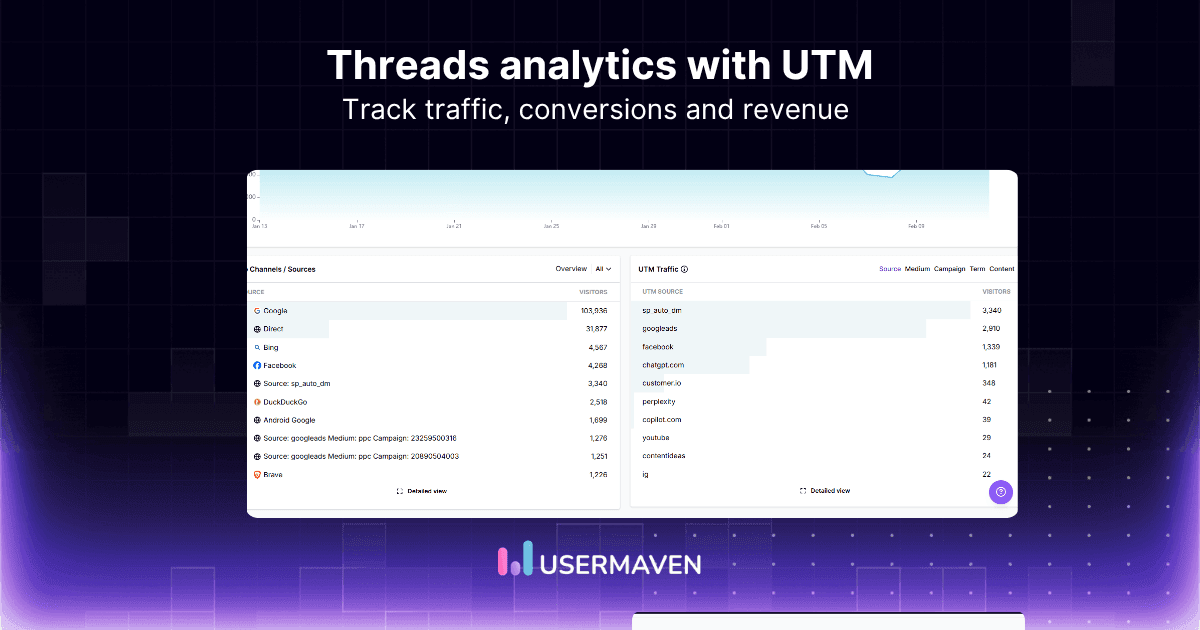
Campaign parameters preserve the acquisition context attached to a visit. A reliable setup records source, medium, campaign, ad, content, landing page, referring page, and available click identifiers such as GCLID.
Consistent UTM parameters make paid campaigns easier to compare across analytics, attribution, and CRM reports. Click identifiers can also support platform-specific conversion matching, but teams should not treat them as universal cross-channel identity.
3. Record first-party conversion events
Events show what happened after acquisition. Useful events include CTA clicks, form submissions, trial signups, demo bookings, purchases, upgrades, and product activation. The objective is to record meaningful progression rather than every possible interaction.
A clear event tracking plan defines names, properties, ownership, and validation. Usermaven Events can then connect those actions with the acquisition source and the broader journey, giving marketers a first-party view of conversion behavior.
4. Use server-side tracking
Server-side tracking routes selected measurement data through an endpoint controlled by the business before it is sent to analytics or advertising destinations. This creates an opportunity to validate requests, remove unnecessary fields, enforce consent rules, deduplicate events, and reduce direct browser communication with third-party vendors.
Server side tracking can improve the reliability of important events and reduce dependence on browser-only collection. It does not, however, make consent requirements disappear. Moving an event to a server changes the delivery path, not the organization’s responsibility to respect user choices.
5. Send conversions back to ad platforms
Conversion APIs and server-to-server feedback allow businesses to return selected outcomes to advertising platforms. Those outcomes can include purchases, qualified leads, opportunities, subscription activations, and closed-won revenue.
The deeper the signal, the more useful it becomes for optimization. Sending every form as an equal conversion may train the platform to find inexpensive but low-quality leads.
Sending verified commercial outcomes can better align optimization with business value. Usermaven conversion syncs support this feedback loop using selected first-party outcomes.
6. Connect CRM and offline outcomes
The lead conversion should be treated as a milestone, not the end of measurement. CRM data can append lifecycle stage, company context, opportunity value, deal progression, and closed revenue to the original acquisition journey.
A useful B2B path may look like ad click → content visit → demo → CRM contact → SQL → opportunity → closed won.
Usermaven’s read-only Salesforce integration can sync Accounts, Contacts, Leads, Opportunities, stage history, and contact roles, with per-organization field mapping and sandbox support.
That makes it possible to compare campaigns by qualified pipeline rather than front-end form count alone.
7. Resolve identity with consent
Known identifiers such as account IDs, CRM contact IDs, consented email information, and assigned user IDs can connect activity across sessions or devices where the organization’s rules allow it.
The critical transition occurs when an anonymous visitor becomes a known customer or lead.
Identity resolution should be conservative. It must avoid duplicate profiles without quietly converting limited signals into a claim of certainty. It also cannot legitimately reproduce unrestricted cross-site surveillance.
Unknown portions of the journey should remain unknown when there is no permitted connection.
8. Apply cookieless attribution
Once acquisition, event, identity, and CRM data are connected, teams can compare marketing attribution models across eligible first-party touchpoints.
First-click highlights discovery and last-click highlights the final recorded trigger. Linear, time-decay, position-based, and custom models preserve more of the journey.
Cookieless attribution does not remove uncertainty. Attribution becomes weaker when source data is missing, identities are fragmented, conversions are duplicated, or CRM stages are incomplete. Models should be treated as decision lenses rather than perfect causal truth.
A cookieless ad-tracking architecture
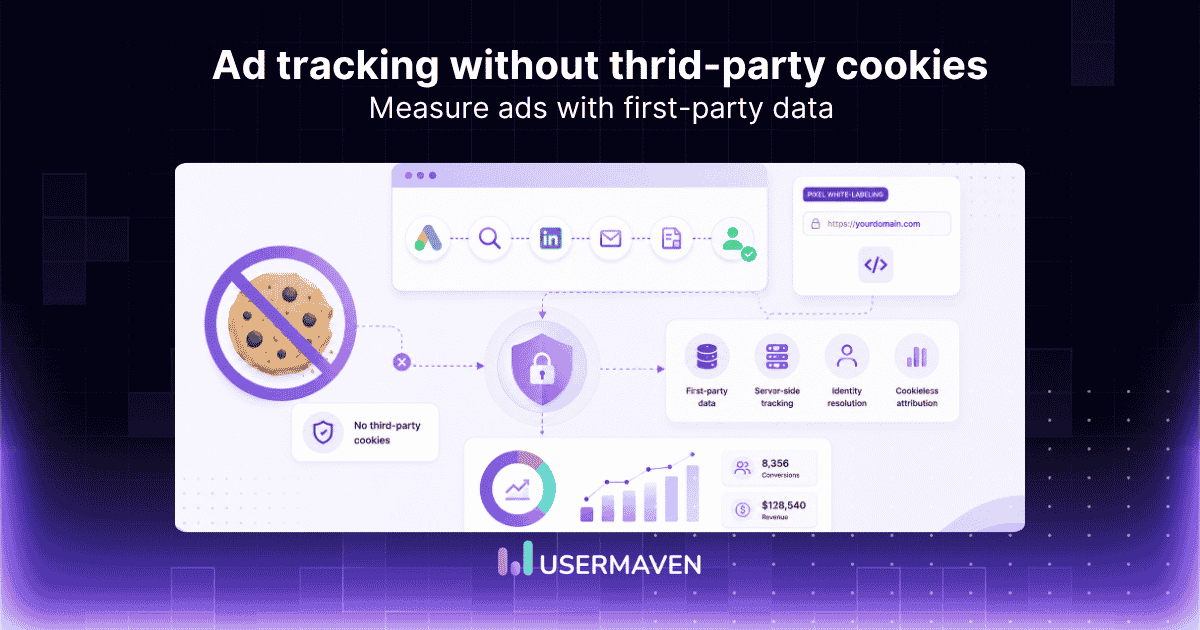
The methods above become more useful when they operate as one connected system. A practical implementation moves through six stages.
A connected marketing attribution software foundation helps keep acquisition, behavior, identity, CRM, attribution, and feedback stages aligned.
- Capture acquisition. Preserve campaign parameters, click IDs, landing pages, referrers, and the first known source.
- Record behavior. Collect meaningful first-party events that show progression toward a conversion.
- Identify the customer. Connect anonymous activity with a known person or account only where permitted.
- Add CRM outcomes. Append qualification, opportunity, pipeline, customer, and revenue context.
- Assign attribution. Compare models using the same connected journey and eligibility rules.
- Return conversion feedback. Send selected commercial outcomes back to advertising platforms for reporting and optimization.
This architecture turns conversion tracking from a browser event into a controlled chain of evidence. Each stage should have an owner, validation rule, and clear failure state so missing data can be investigated rather than silently accepted.
How accurate is cookieless ad tracking?
Cookie-independent tracking can remain commercially useful, but no implementation captures every interaction perfectly. Accuracy depends on the question being asked and the completeness of the underlying data.
Methods and limitations
| Method | What it measures well | Main limitation |
|---|---|---|
| UTMs | Campaign and source context | Can be removed or misconfigured |
| Click IDs | Ad-click conversions | Platform-specific |
| First-party events | Owned-site behavior | Limited outside owned properties |
| Server-side tracking | Reliable event delivery | Requires technical setup |
| Known-user IDs | Cross-session activity | Requires identification and consent |
| CRM data | Lead quality and revenue | Depends on clean CRM processes |
| Modeled conversions | Estimated missing outcomes | Not deterministic |
| Self-reported attribution | Hard-to-track influence | Relies on memory |
The largest remaining gaps often involve view-through attribution, anonymous cross-device journeys, dark-social influence, and interactions that occur outside connected properties.
Ad platforms may model some missing conversions, but modeled results should not be presented as deterministic observations.
Different systems will also report different totals because they use different attribution windows, identity rules, time zones, conversion definitions, and modeling methods.
A structured process for investigating ad platform discrepancies is more useful than forcing every dashboard to match.
How Usermaven tracks ads without third-party cookies
The practical goal is to connect acquisition, behavior, identity, CRM outcomes, and revenue within an independent measurement layer. Usermaven brings those elements together so teams can evaluate more than the conversion count reported by an advertising platform.

Preserve acquisition context
Usermaven preserves source, medium, campaign, landing page, and paid-channel context so the journey begins with usable acquisition data. Original discovery can remain available even when the same person returns through another channel.
Track meaningful first-party events
Forms, signups, product activity, purchases, and other conversion events can be connected with the acquisition source and known-user context. This helps marketers understand what occurred between the ad click and the commercial outcome.
Reconstruct customer journeys
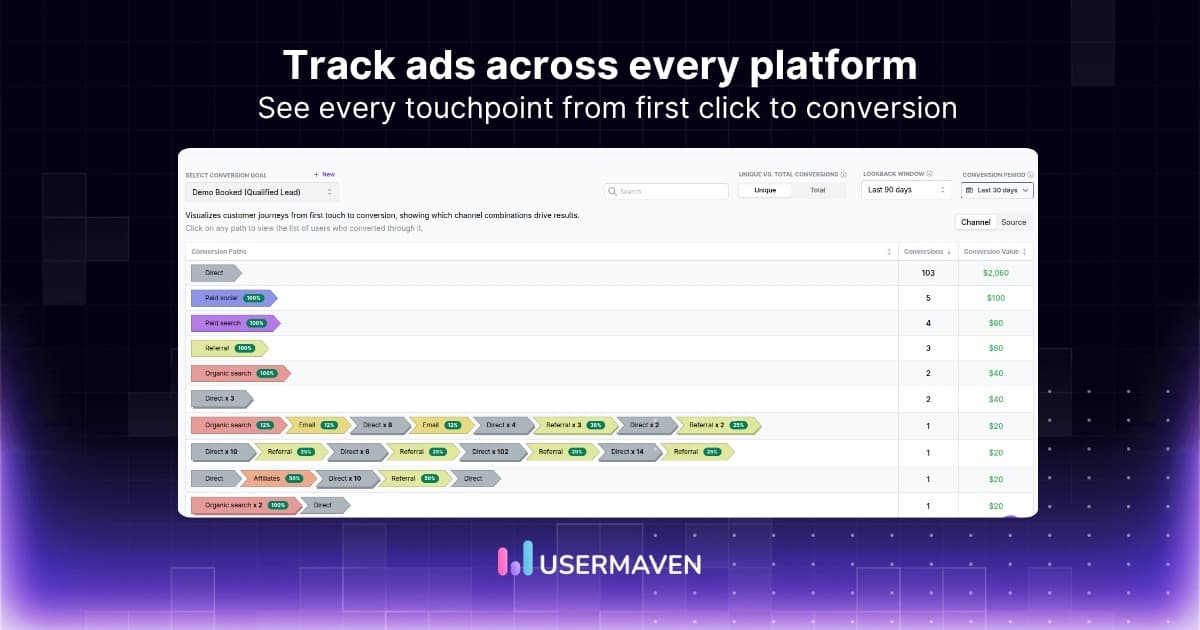
With customer journey analytics software, teams can see the sequence of touchpoints across channels and sessions rather than reducing each person to one source field. The journey can preserve both initial acquisition and later interactions.
Measure funnel progression
Usermaven’s funnel analytics software can measure stages such as visit → content engagement → form → demo → activation → revenue. This separates campaigns that produce surface-level conversions from campaigns that produce progression.
Connect CRM, pipeline, and revenue
CRM-connected attribution adds lifecycle and commercial context. Salesforce data can be used to compare which sources produce qualified leads, opportunities, and revenue, while maintaining read-only access for the initial integration release.
Connected customer profiles in Usermaven keep known-user activity and commercial outcomes accessible in one view.
Compare attribution views
Teams can compare first-click, last-click, multi-touch, pipeline, and revenue outcomes in centralized analytics dashboards. This provides an independent view alongside each advertising platform’s own attribution rules.
Improve paid-ad feedback
Selected first-party outcomes can be returned to connected advertising platforms through conversion syncs. That allows optimization to learn from meaningful results rather than treating every captured conversion as equally valuable.
Activate first-party audiences
Reverse ETL extends the workflow from measurement to activation. Usermaven audiences can be synchronized to HubSpot and Customer.io through a guided setup flow.
Teams can use audience segmentation software to define membership before activating owned behavioral and customer data. Consent, destination rules, and clear criteria should govern every sync.
Where AI helps with cookieless tracking
AI can reduce reporting effort and surface patterns, but it should sit on top of trustworthy tracking rather than compensate for missing or duplicated data.
Ask performance questions naturally
Maven AI can help teams investigate campaign performance, conversion paths, lead quality, journey differences, and revenue contribution without manually rebuilding every report.
Investigate journeys through MCP
The Usermaven MCP server connects authorized Usermaven data with compatible clients such as ChatGPT, Claude, Codex, and Cursor. Teams can explore campaigns, events, funnels, journeys, and conversions through a conversational workflow.
External MCP connectors can extend analysis beyond Usermaven when appropriate connections and permissions are enabled workspace-wide.
Detect anomalies and tracking gaps
AI can flag sudden conversion declines, missing campaign parameters, unusual source shifts, CRM outcome gaps, or a widening difference between clicks and revenue. These signals prioritize investigation; they do not prove the cause.
Teams can use the Measurement Trust Center to verify tracking quality and investigate data issues before acting on AI-generated findings.
Keep human judgment responsible
Marketers still need to decide whether consent is valid, which conversion matters, which attribution model fits the sales cycle, and whether a reported pattern reflects causality or coincidence. Human review is also required before budgets or audience rules change.
Unlock insights that drive growth
Best practices for cookie-independent tracking
Durable measurement depends less on one advanced feature than on consistent implementation and governance across the full data flow.
- Define valuable conversions: Choose outcomes that reflect intent, qualification, or commercial value before implementing tools.
- Standardize campaign naming: Use consistent source, medium, campaign, ad, and content values across channels.
- Preserve original acquisition: Do not replace first-known context every time a person returns.
- Track meaningful events: Prioritize events that represent progression rather than collecting noise.
- Resolve identity carefully: Connect anonymous and known activity without inventing certainty or creating duplicates.
- Deduplicate event delivery: Use stable event IDs and validation rules when browser and server events overlap.
- Integrate CRM outcomes: Make qualification, opportunity, and revenue stages available to attribution.
- Respect consent: Honor visitor preferences regardless of whether collection occurs in the browser or on a server.
- Compare reporting views: Use platform and independent reports as different lenses, not interchangeable truth.
- Audit regularly: Revalidate tracking after campaign, website, form, CRM, or integration changes.
For multi-channel teams, a broader cross-platform ad tracking process helps standardize definitions and reconcile performance across Google, Meta, LinkedIn, Bing, and other connected sources.
Common mistakes to avoid
Several implementation mistakes can create confident-looking reports that are still incomplete or misleading.
Treating first-party cookies like third-party cookies
They differ technically and functionally. Removing every cookie is not the only way to eliminate reliance on third-party cross-site tracking.
Assuming server-side means consent-free
A server endpoint does not override privacy requirements or a person’s choices.
Confusing tracking with targeting
Contextual or first-party targeting does not automatically connect an ad with pipeline and revenue.
Optimizing around raw lead volume
Cheap forms can look successful even when they rarely become qualified opportunities or customers.
Ignoring event deduplication
Browser and server delivery can count the same conversion twice when stable event IDs are not shared.
Relying entirely on ad-platform reports
Platforms use their own windows, models, identity rules, and eligibility criteria.
Trying to recreate cross-site surveillance
The objective should be durable measurement from owned and consented data, not hiding the same tracking behavior behind a new label.
Final verdict
Third-party cookies are no longer a reliable universal measurement foundation. Browser policies, consent states, extensions, and platform rules create a fragmented environment even though Chrome has not removed third-party cookies for every user.
Effective ad tracking now depends on first-party acquisition data, meaningful events, server-side signals, consented identity, CRM outcomes, and attribution.
The strongest systems preserve the journey from campaign to qualified pipeline and revenue while documenting what remains unobservable.
The objective is not to recreate unrestricted cross-site tracking. It is to build a more durable, controlled, and commercially useful connection between advertising investment and customer outcomes.
Ready to see Usermaven in action? Explore the platform or book a demo for a closer look.
See what's working. Fix what's not. Grow faster.
FAQs
Updated

Written by
Ryan Mitchell
Marketing Analytics Strategist
Ryan Mitchell is a marketing analytics strategist specializing in campaign measurement, customer journeys, and marketing performance. He writes about analytics, reporting, and data-driven marketing strategies, helping SaaS and B2B teams measure what matters across every stage of the customer journey.
All articles by Ryan →