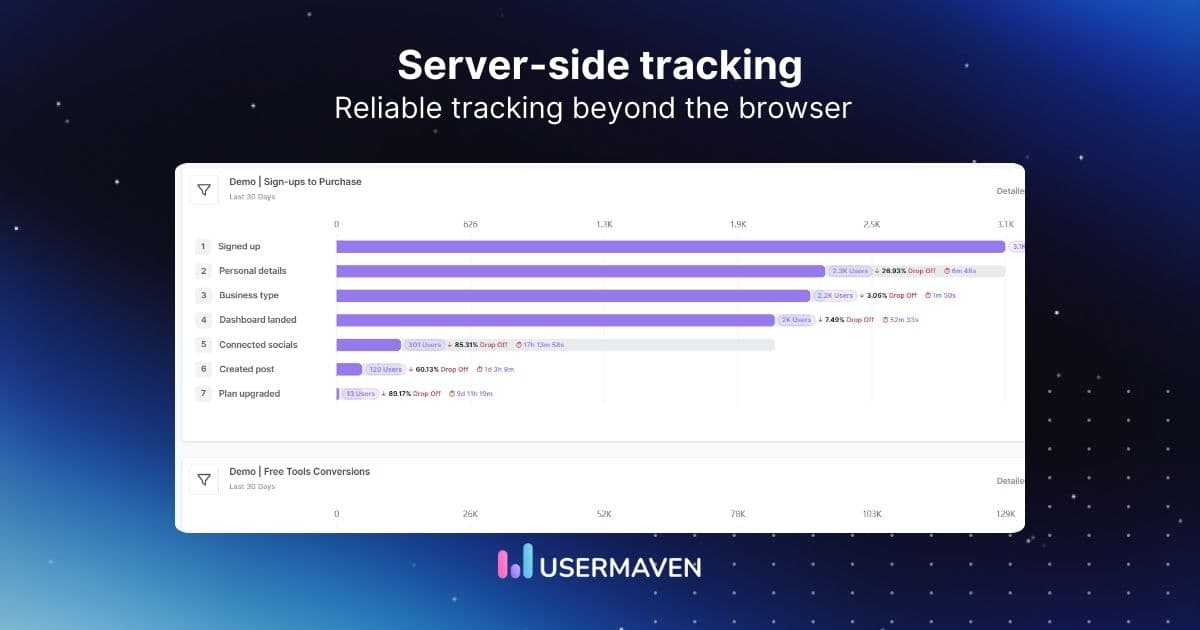
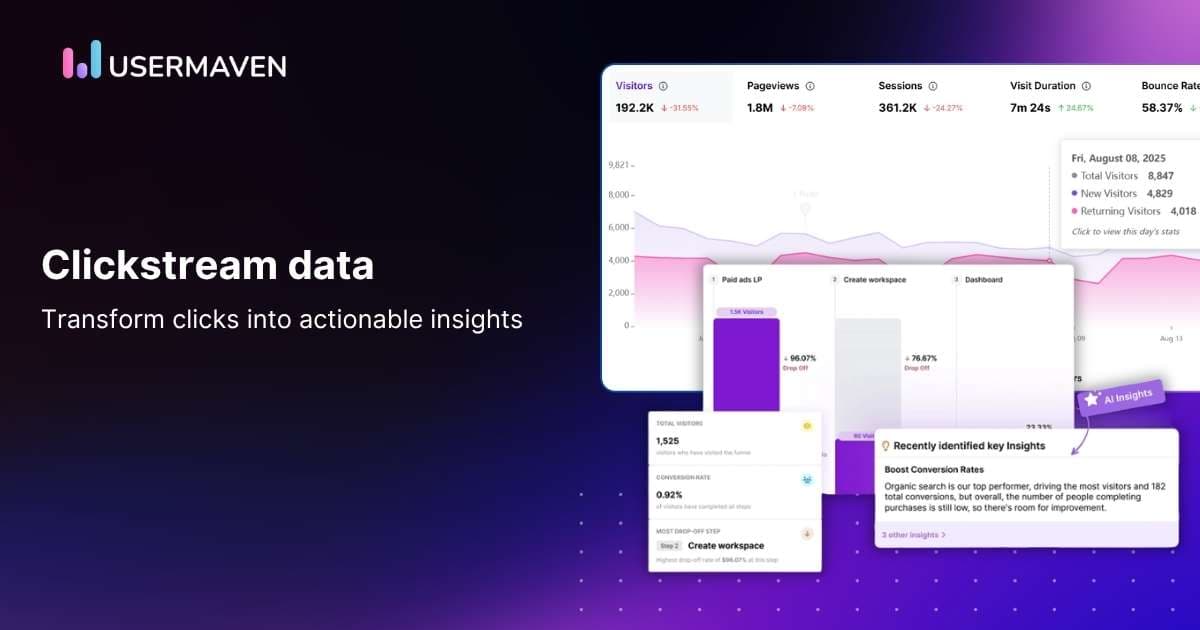
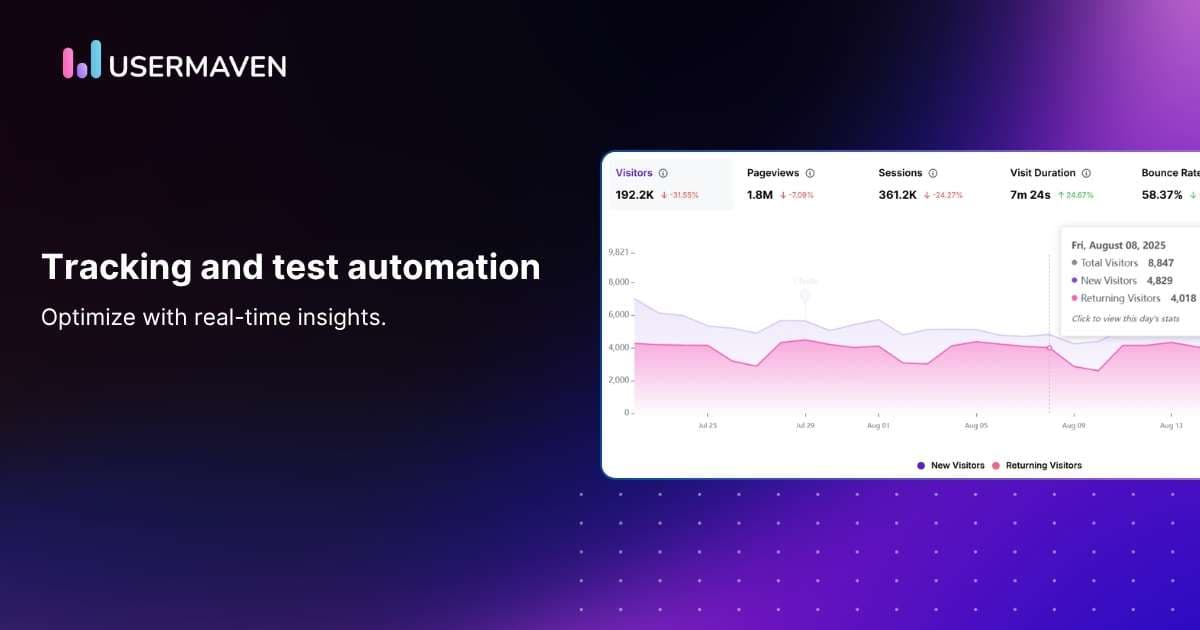
Browser-only tracking can lose context when conversions happen after the original session, inside a product, in a CRM, or on a payment system.
Server-side tracking adds a controlled path for important events, making marketing attribution software more useful because campaign activity can connect with outcomes the business can verify.
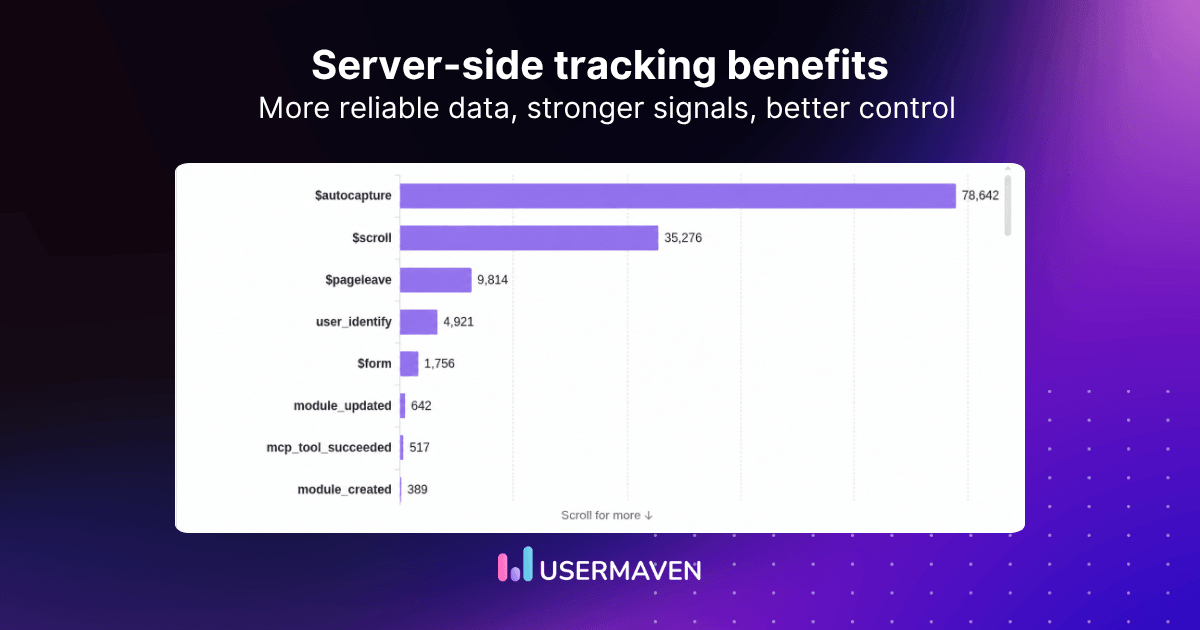
This guide focuses on what server-side tracking improves, why those benefits happen, where the limits still apply, and when the extra measurement layer is worth maintaining.
Key takeaways
Best fit: Server-side tracking is most valuable when important business outcomes cannot be measured reliably from browser activity alone.
Main gains: Stronger conversion data, better data control, backend outcomes, and more reliable signals for advertising and attribution.
Not a cure-all: Server-side tracking improves measurement inputs, but it does not automatically fix identity, consent, attribution logic, or poor event definitions.
Hybrid usually wins: Keeping browser behavior client-side and verified outcomes server-side is usually more practical than moving every interaction to the server.
B2B value comes later: CRM stages, pipeline, Closed Won, and revenue often create the biggest server-side measurement value after the lead.
Identity and deduplication matter: More events are not useful if the same conversion is counted twice or cannot be tied to a customer journey.
Server-side tracking benefits at a glance
Server-side tracking benefits come from moving part of measurement collection, processing, or delivery away from browser-only scripts and into an environment the business controls.
The result is not simply “more tracking.” It is a stronger path from customer activity to verified business outcomes.
| Benefit | Why it happens | Marketing impact |
|---|---|---|
| More reliable conversion data | Critical outcomes can come from backend systems | Stronger attribution inputs |
| Less browser-side signal loss | Fewer events depend entirely on browser scripts | More complete measurement |
| Better advertising signals | Verified conversions can be sent server-to-server | Better optimization inputs |
| Greater data control | Data can be filtered before it is forwarded | Better governance |
| Backend conversion visibility | Payment, CRM, and product events can be captured | More complete journeys |
| Potential site-performance gains | Some tag processing moves away from the browser | Lower client-side workload |
| Stronger first-party continuity | Backend events can carry stable identity and campaign context | Better customer histories |
| Better privacy controls | Data can be transformed or suppressed before sharing | More controlled vendor access |
| Server-side tracking improves the measurement inputs. It does not automatically make every marketing conclusion correct. |
See what's working. Fix what's not. Grow faster.
Why server-side tracking improves measurement
In a browser-only setup, a page or app sends measurement data directly to analytics and advertising vendors. If a tag fails, the event may never arrive.
A server-assisted setup adds a controlled layer between the user and those destinations. Our server-side tracking guide explains that architecture in more detail.
The controlled layer can validate an event, enrich approved fields, remove unnecessary fields, and route the event to the systems that need it.
It can also accept events that never happen in the browser, such as a payment confirmation or CRM opportunity stage change.
| Measurement problem | Server-side change | Result |
|---|---|---|
| Purchase pixel fails | Backend confirms the purchase | The conversion can still be measured |
| CRM opportunity occurs later | CRM stage enters the measurement layer | Marketing can connect with pipeline |
| Vendor needs fewer fields | Controlled layer removes unnecessary data | Less data leaves the business |
| Several ad platforms need the outcome | One verified event feeds supported destinations | More consistent optimization signals |
8 benefits of server-side tracking
The strongest benefits are easiest to understand when each one is tied to the mechanism that creates it, the business decision it improves, and the limitation that still remains.
1. More reliable conversion data
A browser event often records that someone reached a page or clicked a button. A backend system can record that the business outcome actually happened.
That distinction matters for purchases, successful subscriptions, refunds, upgrades, qualified leads, demo bookings, and closed deals.
When those confirmed outcomes enter the analytics layer, attribution can evaluate marketing against a stronger conversion signal instead of relying only on the final browser interaction.
This is especially important when the event that matters occurs after the original session.
The limitation is context. A server can confirm a conversion but still fail to explain where it came from if campaign data and identity are not preserved.
Reliable delivery and reliable attribution are related, but they are not the same thing.
2. Less dependence on browser-side tracking
Client-side tracking depends on code executing successfully in the visitor’s browser. Browser restrictions, blocked scripts, navigation timing, implementation errors, and other client-side conditions can interrupt that flow.
Server-side tracking reduces the number of important outcomes that depend entirely on that browser execution. The correct framing is not that it makes tracking unstoppable.
It gives critical events another, often more reliable, delivery path.
For advertising teams, this is one reason to combine first-party acquisition data with the methods in our guide to ad tracking without third-party cookies.
The objective is durable measurement, not a workaround for user choice or consent.
3. Better conversion signals for ad platforms
Tracking a conversion and feeding a conversion back to an ad platform are separate jobs. The first improves measurement.
The second gives the network a deeper signal that can influence bidding and optimization.
A common sequence is ad click → signup → qualified customer → paid plan. If the ad platform only sees the signup, its optimization system learns from an early event.
When supported, a verified downstream event can give it a better signal of customer quality.
This matters most when cheap conversions and valuable conversions are not the same thing. A lower-cost signup campaign can still be worse if another campaign produces more paying customers or higher revenue.
Our guide to conversion syncs explains how verified first-party outcomes can be returned to supported ad platforms for optimization.
4. Greater control over shared data
Server-side processing creates a controlled point between collection and vendor delivery.
Google’s server-side tagging guidance describes this layer as a place to validate, parse, anonymize, transform, or block requests before forwarding them to marketing partners.
That can help a team standardize event names, remove fields a destination does not need, enrich approved values, restrict destinations, and apply consent-aware rules before data is shared.
The benefit is control, not automatic compliance.
Privacy obligations still depend on what is collected, the legal basis or consent model, retention, access controls, regional requirements, and how each downstream system uses the data.
5. Visibility into backend conversions
Many of the events that matter most to a business never occur on a page the analytics script can see.
A Stripe payment, Salesforce opportunity, renewal, refund, webinar attendance record, or manually closed sale may happen in another system entirely.
Bringing these events into the same measurement layer extends the journey beyond the website.
In Usermaven, Events and Event Sources can bring payment, CRM, webhook, CSV, webinar, and other off-site events into goals, funnels, journeys, and attribution.
| Track behavior where it happens, but use the system of record for business outcomes. |
See Usermaven in action
Book a free demo and discover how powerful analytics can grow your business.
6. Lower client-side measurement workload
Server-side tracking can reduce browser workload when third-party processing or requests are actually moved away from the client.
Fewer browser-side tags and fewer repeated vendor requests can mean less JavaScript and less measurement work on the visitor’s device.
The benefit is conditional. Moving one tag to a server does not automatically make a site fast. The implementation has to remove or consolidate meaningful client-side work before performance improves.
7. Stronger first-party journey continuity
A server event becomes much more useful when it joins the customer’s earlier journey. The ideal chain is anonymous visitor → campaign/source → signup → identified user → backend event → customer or revenue.
That continuity depends on identity resolution. A stable user ID, anonymous ID, or another defensible identifier needs to connect systems without guessing.
In Usermaven, identity resolution links anonymous activity with a known profile when the identification flow is implemented correctly.
| More events without identity can create more data without creating more understanding. |
8. Better privacy and governance controls
A controlled server layer can support data minimization, consent-aware routing, vendor restrictions, and more deliberate handling of first-party information.
It also reduces the number of direct browser-to-vendor connections when the architecture is designed that way.
That can make governance easier to operate, but the architecture should never be described as a compliance shortcut.
Server-side tracking can improve control over data flows; the organization still remains responsible for the rules governing those flows.
Where AI helps server-side measurement
AI can speed up investigation only when the underlying measurement is trustworthy. A missing purchase, disconnected opportunity, duplicated conversion, or broken identity link gives an AI system an incomplete story too.
Once first-party journeys, backend events, CRM outcomes, and revenue are connected, Maven AI can investigate which campaigns create paying customers or where qualified pipeline is slipping.
With tools like Usermaven, you can also query your analytics directly from compatible external AI clients through MCP.
Server-side tracking benefits for B2B SaaS
B2B SaaS often gets the largest value from server-side measurement after the lead is created. A demo form is only an early milestone.
The commercial outcome may arrive weeks later in the CRM as a qualified opportunity, stage change, Closed Won deal, or revenue record.
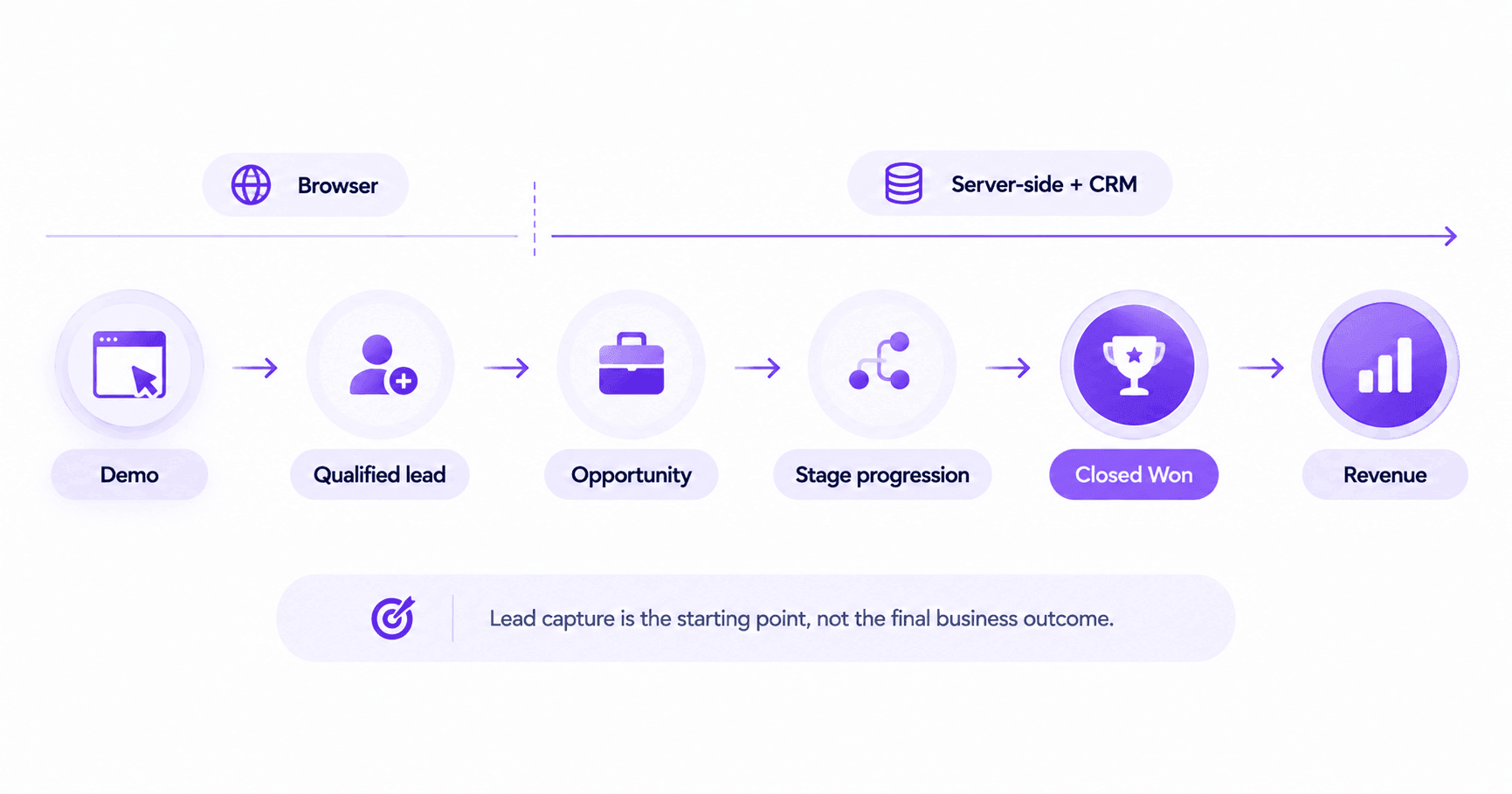
That makes server-side and CRM data especially useful for B2B marketing attribution, where marketing needs to explain more than lead volume.
| Stage | Typical source | Why server-side data matters |
|---|---|---|
| Demo | Website | Usually visible in browser tracking |
| Qualified lead | CRM | Often happens after the web session |
| Opportunity | CRM | Adds sales qualification and value |
| Stage progression | CRM | Shows movement through the pipeline |
| Closed Won | CRM | Confirms the commercial outcome |
| Revenue | CRM or payment system | Supports revenue attribution |
For teams with long cycles, the B2B SaaS workflow becomes more useful when acquisition continues into product and CRM outcomes.
Pipeline attribution connects marketing with qualified opportunities, while revenue attribution follows those journeys into closed revenue.
Server-side tracking benefits for ecommerce
Ecommerce journeys are usually shorter than enterprise B2B, but the highest-value event still often belongs to the payment or commerce system. A browser can see checkout activity.
The backend can confirm whether payment succeeded, the order value, whether a refund happened, and whether the customer returned.
That distinction helps ecommerce brands evaluate acquisition against purchase revenue, repeat behavior, and customer value instead of stopping at an add-to-cart or checkout-page event.
| Browser-visible signal | Stronger backend outcome | Decision improved |
|---|---|---|
| Checkout started | Payment completed | Real conversion rate |
| Order confirmation page | Verified order value | Attributed revenue |
| Initial purchase | Refund or cancellation | Net revenue quality |
| New customer | Repeat purchase | Customer value |
What server-side tracking does not solve
Server-side tracking is often oversold. The architecture can make measurement more durable and controllable, but it does not remove the need for sound definitions, identity, consent, attribution rules, or browser-aware implementation.
| Common claim | More accurate framing |
|---|---|
| It bypasses every ad blocker | It reduces dependence on browser execution, but it does not make tracking unstoppable |
| It eliminates cookies | Server-side systems can still use cookies and first-party storage |
| It automatically creates cross-device identity | Identity still requires a reliable identifier and stitching logic |
| It guarantees longer cookie life | Browser rules and implementation details still matter |
| It makes tracking compliant | It improves control, not automatic compliance |
| It fixes attribution | It improves inputs; attribution rules still determine credit |
| It replaces client-side tracking | Hybrid tracking is often more practical |
| It guarantees accurate conversions | Bad event definitions can still produce bad data |
| More events are always better | Duplicate or low-quality events can make reporting worse |
Cookie durability also needs nuance.
WebKit’s tracking-prevention documentation shows that browser protections can cap some script-writeable storage and certain cloaked first-party-looking cookies.
“First party” should not be treated as a guarantee that every browser will preserve every identifier indefinitely.
Client-side vs. server-side vs. hybrid tracking
The choice is rarely all-or-nothing. Browser interactions and backend outcomes are different classes of data, so the strongest architecture usually gives each event to the system best positioned to observe it.
| Approach | Best at | Main limitation |
|---|---|---|
| Client-side | Clicks, page views, scrolls, forms, browser interactions | Depends on the browser and client execution |
| Server-side | Payments, subscriptions, CRM stages, verified conversions | Requires identity and implementation discipline |
| Hybrid | Connecting behavior with confirmed outcomes | Needs clear source-of-truth and deduplication rules |
Google also treats server-side tagging as a complement to client-side tagging rather than a universal replacement.
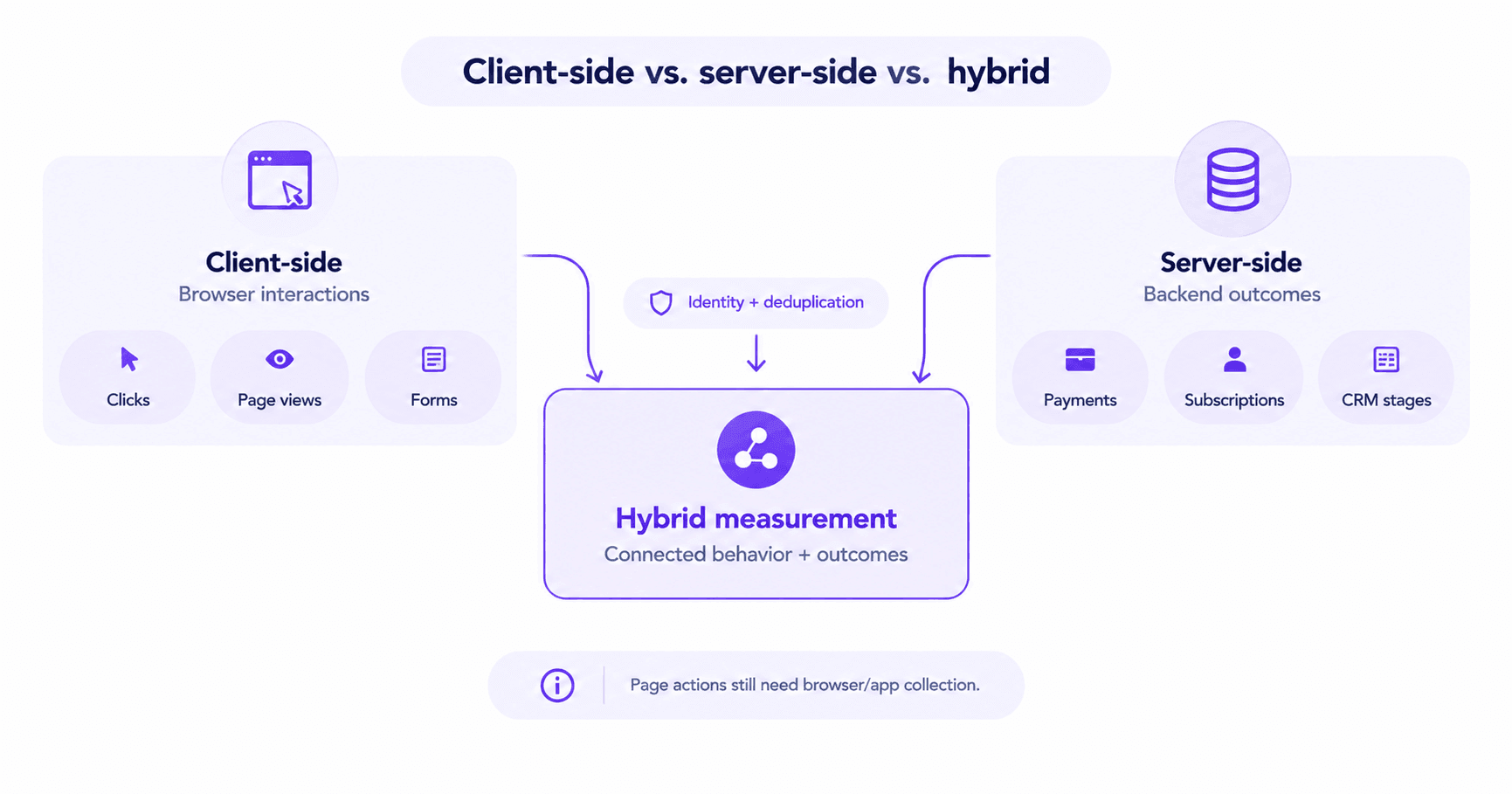
Browser events still need a browser or app collection layer when the action only exists on the page.
Which events should be tracked server-side?
A practical priority rule is to keep lightweight behavioral signals close to where they happen and move authoritative business outcomes to the system that can verify them.
| Event | Preferred source | Priority |
|---|---|---|
| Page viewed | Client | Normal |
| Button clicked | Client | Normal |
| Scroll depth | Client | Normal |
| Signup confirmed | Server or hybrid | High |
| Payment completed | Server | Very high |
| Subscription started | Server | Very high |
| Plan upgraded | Server | High |
| Refund issued | Server | High |
| Qualified lead | CRM/server | High |
| Opportunity created | CRM/server | Very high |
| Closed Won | CRM/server | Very high |
| Use the system of record for the outcome that changes the business decision. |
Server-side tracking can still produce bad data
A server can reliably send the wrong event just as easily as the right event. Four failure modes matter most because they can make a technically successful implementation misleading.
Broken identity stitching
If the anonymous visitor, known user, and backend event do not share a stable identity path, the conversion may appear in totals without joining the customer journey that produced it.
Usermaven’s identity-resolution guidance specifically requires the correct anonymous and known-user identifiers for complete stitching.
Duplicate conversions
Hybrid setups can send the same purchase or signup through both browser and server paths. Without a stable external ID or another deduplication rule, one customer can become two conversions.
Event Sources exposes duplicate handling and encourages a stable external event or order ID.
Missing campaign context
A payment can be accurate and still be unattributed if it cannot connect back to the visit, click ID, consistent UTM parameters, or identified customer.
Conversion coverage and attribution coverage should therefore be checked separately.
Wrong event definitions
The most dangerous error is semantic. If “Customer created” fires before payment succeeds, or “Qualified lead” is defined differently across CRM teams, the server makes that inconsistency more reliable, not more correct.
This is why the Measurement Trust Center belongs in a server-side workflow.
It checks campaign tracking, customer matching, connected platforms, conversion feedback, and data confidence before teams use reports to move budget.
| Server-side delivery does not automatically mean trustworthy measurement. |
When server-side tracking is worth it
The value rises as the cost of missing or unreliable conversions rises.
A simple content site may not need the same infrastructure as a paid-acquisition SaaS company or an ecommerce brand where every missed purchase distorts ROAS.
| Situation | Expected value |
|---|---|
| Significant paid-media spend | High |
| Long B2B sales cycle | High |
| Revenue happens in CRM | High |
| Payments happen outside analytics | High |
| Subscription or recurring revenue model | High |
| Multiple ad platforms need feedback | High |
| Simple content-only site | Lower |
| Minimal marketing stack | Lower |
| Team cannot maintain the implementation | Evaluate carefully |
There is also a maintenance cost. Server environments, webhooks, API payloads, identity rules, consent logic, and conversion syncs need monitoring.
The implementation is justified when the measurement value is larger than the operational burden.
| Server-side tracking is most valuable when the cost of missing or unreliable conversions is higher than the cost of maintaining the measurement layer. |
How Usermaven supports server-side measurement
Usermaven is an AI marketing attribution platform that connects marketing, website, product, CRM, and revenue data.
Its server-side workflow helps teams capture verified outcomes, stitch journeys, validate measurement, attribute value, and send supported conversion signals back to advertising platforms.
Capture confirmed events
Usermaven supports a server-side Events API, Node.js and Python SDKs, Segment, incoming webhooks, and no-code Event Sources.
That gives teams several ways to bring backend, billing, CRM, webinar, or offline events into the same analytics layer.
Stitch the customer journey
Identity resolution connects anonymous activity with known-user and backend events when IDs are passed correctly. That lets customer journeys retain the acquisition and behavioral context that existed before the conversion.
Verify measurement quality
The Measurement Trust Center surfaces problems across collection, identity, integrations, delivery, and reliability so a server-side event is not assumed to be trustworthy simply because it arrived.
Attribute events to marketing
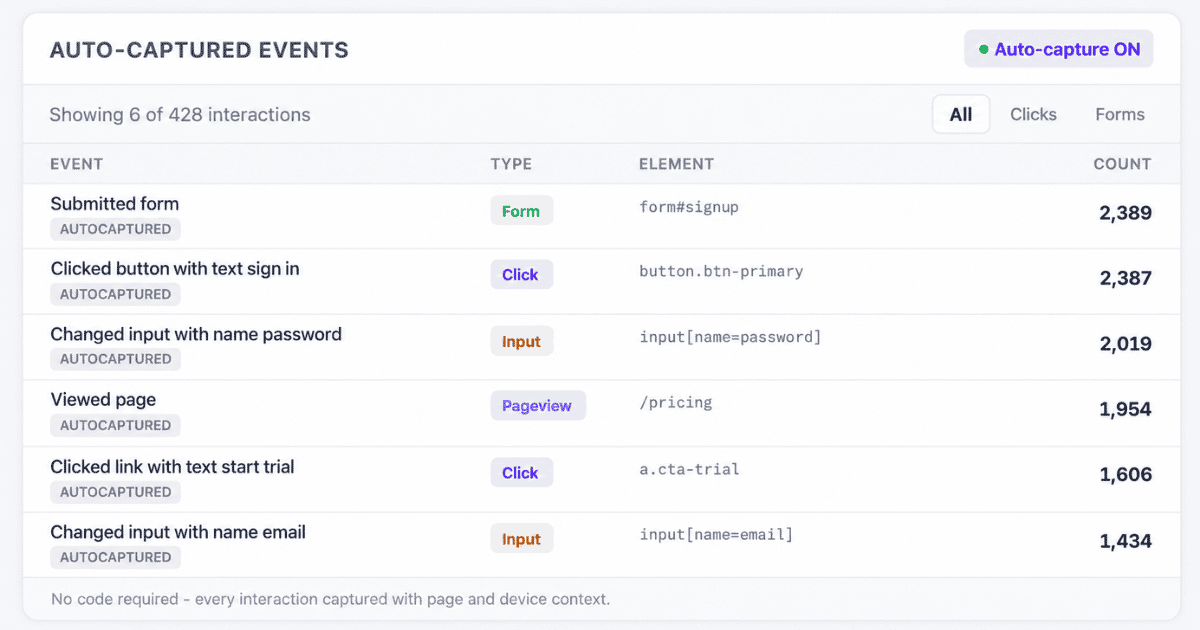
Once deeper events are connected to the same person or account, marketing attribution can evaluate campaigns, channels, content, pipeline, and revenue against those outcomes.
Send conversion signals back
Conversion Sync can send supported first-party outcomes back to Google Ads and Meta.
Usermaven’s current Meta Conversions API flow includes validation, sync monitoring, error visibility, and run history so teams can see whether the feedback loop is actually working.
Analyze the trusted data with Maven AI
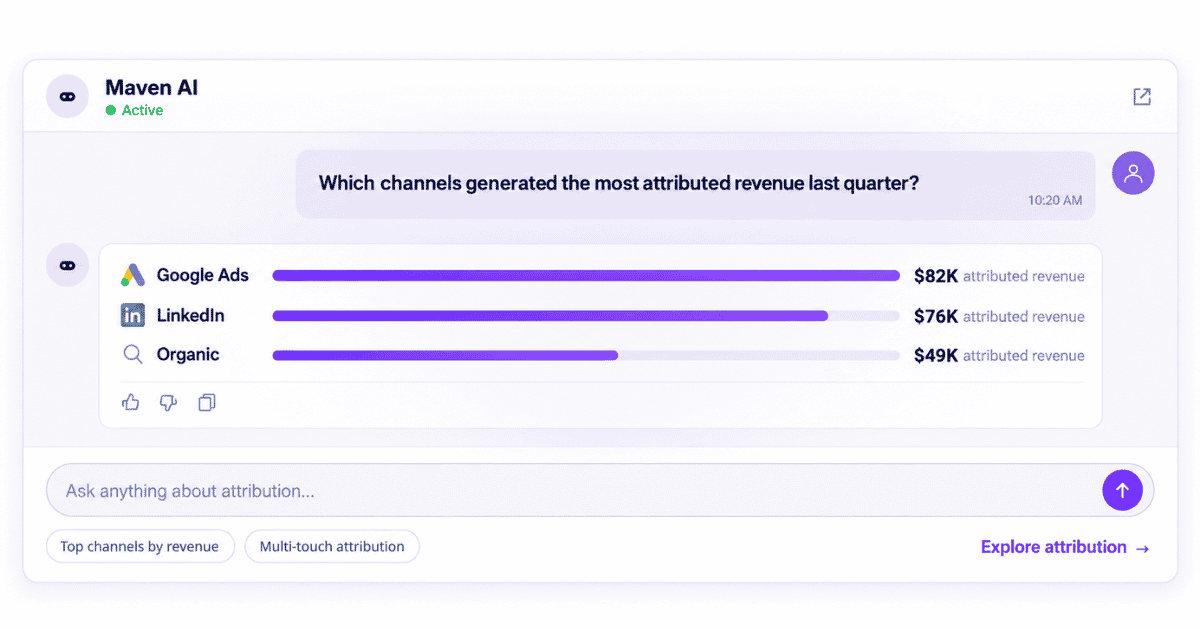
Maven AI can investigate attribution, funnel, journey, retention, and revenue questions once the underlying event and identity data is connected. The advantage is analytical speed, not a substitute for measurement design.
First-party evidence: ContentStudio
ContentStudio shows the business value of connecting acquisition with downstream outcomes, although it is not an isolated test of server-side tracking.
The team ran paid campaigns across Google and Meta while signups, demo bookings, upgrades, and revenue lived deeper in the funnel.
After implementing Usermaven, the ContentStudio case study reports 128% signup growth and a 92% increase in plan upgrades.
It also reports 242% more demo bookings and a 30% ROAS improvement as the team connected campaign data with paying-user outcomes and reallocated budget.
Those results should not be attributed to server-side tracking alone.
The defensible lesson is that better measurement changes the decision surface: campaigns can be judged against verified downstream value instead of platform-reported activity.
Server-side tracking implementation checklist
Use this checklist before treating server-side reporting as a budget source of truth.
Define the business outcomes worth tracking.
Choose the authoritative source for each event.
Keep campaign parameters and ad click IDs intact where relevant.
Establish identity rules for anonymous and known users.
Decide which events should remain client-side.
Prevent browser/server duplicate conversions.
Apply consent, data-minimization, and vendor-routing rules.
Validate payloads, timestamps, values, and currency.
Reconcile payment and CRM outcomes against the system of record.
Test conversion feedback to supported ad platforms.
Check measurement health after launch.
Monitor failures instead of assuming server events always work.
Metrics used
| Metric | Definition / use |
|---|---|
| Conversion coverage | Share of known business conversions represented in the analytics layer |
| Attribution coverage | Share of conversions that retain enough campaign or journey context to receive attribution |
| Customer match rate | Share of server/off-site events resolved to a known user or account |
| Duplicate-event rate | Share of incoming events rejected or reconciled as duplicates |
| Conversion sync success rate | Share of eligible conversion feedback events successfully delivered to supported ad platforms |
| Attributed revenue | Revenue assigned to eligible marketing touchpoints under the selected attribution rules |
| Unattributed conversion rate | Share of conversions with insufficient acquisition context to assign marketing credit |
Final verdict
Server-side tracking matters most when important business outcomes cannot be measured reliably from browser activity alone.
Its biggest benefits are stronger conversion signals, greater data control, backend outcomes, and a more complete measurement chain from acquisition to revenue.
It does not replace sound event design, identity resolution, consent management, or attribution logic.
The strongest setups are usually hybrid: browser tracking captures behavior, while server and system-of-record events confirm the outcomes that change a marketing decision.
Ready to connect browser activity, server-side events, CRM outcomes, and revenue in one attribution workflow?
Book a demo to see how Usermaven can support the measurement chain.
FAQs
1. What are the main benefits of server-side tracking?
The main benefits are more reliable conversion data, less dependence on browser-only execution, better advertising signals, greater control over shared data, visibility into backend conversions, lower client-side measurement workload, stronger first-party journey continuity, and better privacy and governance controls.
2. Is server-side tracking more accurate than client-side tracking?
It can make important conversion data more reliable because backend systems can confirm outcomes that do not depend on a browser tag firing. Accuracy still depends on event definitions, identity, campaign context, deduplication, and the source of truth used for the conversion.
3. Does server-side tracking bypass ad blockers?
Not universally. Server-side tracking reduces the number of important events that depend entirely on browser scripts, but it should not be treated as a way to make tracking unstoppable or ignore user consent and browser controls.
4. Does server-side tracking improve website speed?
It can improve client-side performance when third-party scripts and repeated vendor requests are actually reduced or moved away from the browser. The benefit depends on the implementation and is not automatic.
5. Does server-side tracking extend cookie lifespan?
It can support more durable first-party cookie handling in some architectures, but browser rules still apply. Safari and other browsers can restrict script-writeable storage or certain first-party-looking tracking patterns, so cookie longevity should not be treated as guaranteed.
6. Is server-side tracking GDPR compliant?

Written by
Ryan Mitchell
Marketing Analytics Strategist
Ryan Mitchell is a marketing analytics strategist specializing in campaign measurement, customer journeys, and marketing performance. He writes about analytics, reporting, and data-driven marketing strategies, helping SaaS and B2B teams measure what matters across every stage of the customer journey.
All articles by Ryan →