LinkedIn says an ad influenced the conversion. The CRM says the opportunity came from Organic Search. A multi-touch report shows LinkedIn early in the journey and email before the demo. Which source should get credit?
All three can be internally consistent because they may be answering different questions. LinkedIn conversion attribution, LinkedIn revenue influence, and cross-channel credit are separate measurement layers.
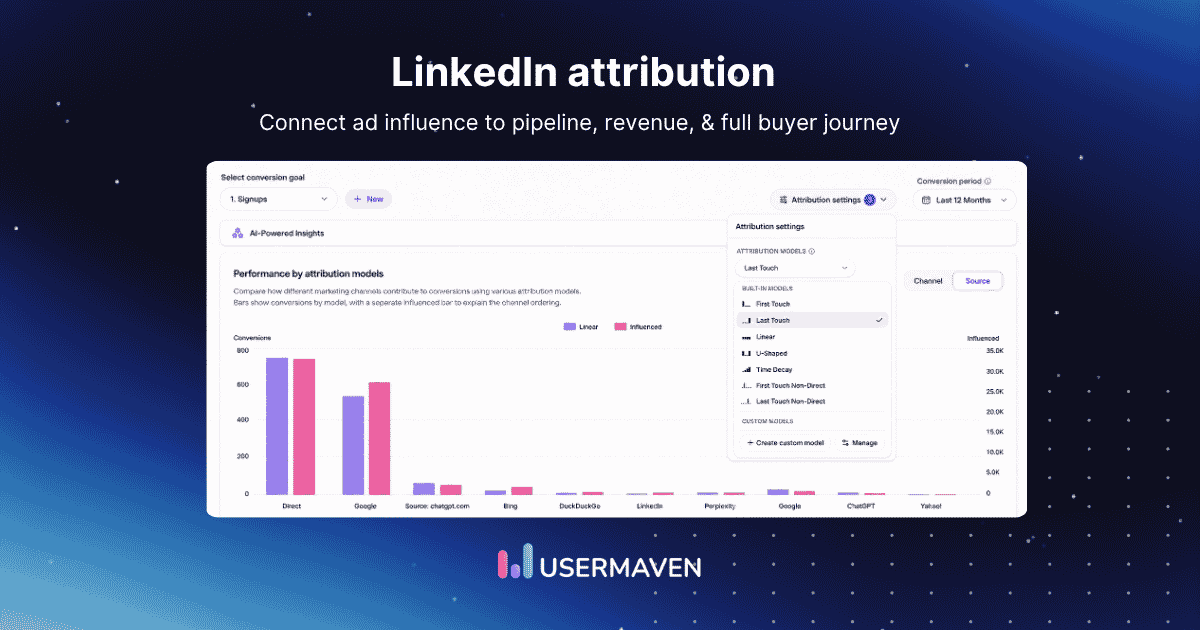
A strong marketing attribution software workflow separates those layers, then connects LinkedIn activity with customer journeys, CRM outcomes, pipeline, and revenue before budget decisions are made.
LinkedIn attribution at a glance
LinkedIn attribution is the process of connecting LinkedIn ad impressions, clicks, campaigns, or engagement with later conversions, pipeline, and revenue so marketers can understand how LinkedIn contributes to business outcomes.
LinkedIn’s native reports measure LinkedIn under LinkedIn’s own rules. Independent attribution evaluates LinkedIn alongside the rest of the measurable customer journey.
| Question | Short answer |
| What does LinkedIn attribution measure? | How LinkedIn ad activity relates to conversions or revenue |
| What does Campaign Manager attribute? | Conversion actions |
| Native conversion model | Primarily last touch |
| Native model options | Last Touch – Each ad set / Last Touch – Last ad set |
| Does LinkedIn track views? | Yes, through post-view attribution |
| What is RAR? | LinkedIn Revenue Attribution Report |
| What does RAR connect? | LinkedIn marketing with CRM leads, opportunities, pipeline, and revenue |
| Which CRMs does RAR support? | Salesforce, HubSpot, and Microsoft Dynamics 365 |
| Can RAR work at company level? | Yes |
| Is LinkedIn-influenced revenue incremental revenue? | No |
| Best cross-channel view | Independent multi-touch attribution |
That distinction matters when evaluating LinkedIn marketing efforts: campaign optimization, CRM influence, and cross-channel attribution should not be judged as if they were the same measurement layer.
Key takeaways
- Three measurement layers: Campaign Manager, Revenue Attribution Report, and independent attribution answer different questions.
- Native model: LinkedIn conversion attribution is primarily last touch and should not be confused with generic linear, time-decay, or U-shaped models.
- Ad-set credit: Each eligible ad set can receive conversion credit under LinkedIn’s Each ad set option, so summed ad-set conversions are not automatically unique customers.
- View-through influence: A buyer can see a LinkedIn ad, search the brand later, and convert without ever clicking the ad.
- Revenue context: RAR moves measurement beyond leads by connecting LinkedIn activity with CRM pipeline, Closed Won revenue, ROAS, win rates, and sales-cycle metrics.
- Influence is not ownership: Other marketing and sales interactions may have participated in revenue that LinkedIn classifies as influenced.
- Account-level context: Several people can contribute to one B2B opportunity, so person-level attribution may fragment the journey.
- Attribution is not causality: Receiving credit does not prove LinkedIn caused the outcome.
The three layers of LinkedIn attribution
Most confusion around LinkedIn attribution comes from using the same word for three different measurement layers. Separating them makes the numbers easier to interpret and the disagreements easier to diagnose.
| Layer | Main question | Best source |
| LinkedIn conversion attribution | Which LinkedIn ad interaction gets conversion credit? | Campaign Manager |
| LinkedIn revenue attribution | Which CRM outcomes were influenced by LinkedIn? | Revenue Attribution Report |
| Cross-channel attribution | How should LinkedIn share credit with other channels? | Independent attribution platform |

These layers are complementary. Campaign Manager supports LinkedIn optimization, while RAR extends the view into CRM outcomes.
Independent attribution becomes useful when the business wants one consistent credit model across LinkedIn, Google, Meta, email, organic, content, and sales interactions.
Where AI helps LinkedIn attribution
AI can compare campaign performance, summarize journey patterns, surface model disagreement, and investigate where cost, pipeline, or revenue diverge. It is especially useful once the measurement system already has reliable campaign and CRM context.
AI cannot recover a missing Creative ID, an untracked conversion, incomplete opportunity data, or a LinkedIn impression that never entered an independent dataset. It accelerates analysis; it does not manufacture missing evidence.
Unlock insights that drive growth
How LinkedIn Campaign Manager attribution works
LinkedIn Campaign Manager does not offer the same attribution-model menu that a general multi-touch attribution platform does. For most conversion types, LinkedIn currently uses last-touch attribution.
LinkedIn’s current conversion attribution documentation explains that the conversion is attributed to the most recent eligible ad click or view, with the model configured at either each-ad-set or last-ad-set level.
Last Touch – Each ad set
If multiple eligible ad sets interacted with the member during the conversion window, every qualifying ad set can receive conversion credit. That is useful when the goal is to understand participation across the LinkedIn funnel.
The tradeoff is that adding ad-set conversions together does not necessarily produce a unique-customer count.
Example: a customer interacts with Ad set A, then Ad set B, and converts. Under Each ad set, A can receive one conversion and B can receive one conversion even though the business recorded one customer conversion.
Last Touch – Last ad set
With the Last ad set, only the most recent eligible LinkedIn ad set receives the conversion. Using the same journey, Ad set A receives zero credit and Ad set B receives one conversion.
This produces a cleaner single-credit view inside LinkedIn when the reporting goal is to avoid multiple ad sets receiving credit for the same conversion.

| LinkedIn model | Credit behavior | Useful when |
| Last Touch – Each ad set | Every eligible ad set receives credit | Understanding ad-set participation |
| Last Touch – Last ad set | Most recent eligible ad set receives credit | Avoiding duplicated ad-set credit |
Post-click vs. post-view LinkedIn attribution
LinkedIn can attribute eligible conversions after both clicks and views. That distinction is one reason LinkedIn numbers can differ from web analytics or CRM source fields.
Post-click attribution
The buyer clicks a LinkedIn ad, lands on the website, and later converts within the eligible window. The measurable LinkedIn interaction is straightforward.
Post-view attribution
The buyer sees a LinkedIn ad but does not click it. Later, they search the brand, visit the website, and convert. LinkedIn may still count the conversion under an eligible post-view window.
That means LinkedIn can report a post-view conversion while website analytics records Organic Search as the return source. Neither observation has to be wrong; the systems are describing different parts of the journey.
LinkedIn attribution windows
Window settings control whether a past LinkedIn interaction remains eligible for credit. The same business can use different windows in Campaign Manager, Revenue Attribution Report, and its independent attribution platform.
Campaign Manager conversion window
LinkedIn supports configurable click and view windows for conversion measurement. Standard setups commonly use 1, 7, 30, or 90 days, while certain conversion categories and data sources can support longer 180- or 365-day windows.
Revenue Attribution Report lookback
RAR uses its own lookback logic for CRM influence. It supports 30, 60, 90, 180, or 365 days, which makes it more appropriate for long B2B sales cycles than a short website conversion window.
Independent attribution window
An independent attribution window should reflect actual conversion delay and the buying cycle rather than simply copying a platform default. The question is how long LinkedIn should remain eligible for cross-channel credit.
Consider a journey with a LinkedIn impression on Day 1, a content visit on Day 22, a demo on Day 67, an opportunity on Day 94, and Closed Won on Day 147.
A 30-day window and a 180-day window will tell very different stories about LinkedIn’s eligibility for credit.
What is LinkedIn Revenue Attribution Report?
LinkedIn Revenue Attribution Report, or RAR, connects CRM records with LinkedIn marketing activity so B2B teams can evaluate LinkedIn against leads, opportunities, pipeline, and revenue rather than stopping at website conversions.
LinkedIn’s Revenue Attribution Report documentation currently supports direct CRM connections with Salesforce, HubSpot, and Microsoft Dynamics 365.
The basic flow is LinkedIn marketing activity → CRM match → opportunity or pipeline → Closed Won revenue. That makes RAR much more commercially useful than a lead-only dashboard for long-cycle B2B teams.
Drive business growth
with AI-powered analytics
What does LinkedIn RAR measure?
RAR combines top-line revenue measures with funnel and sales-cycle metrics. The point is not merely to show that LinkedIn created engagement, but to connect that engagement with downstream commercial outcomes.
| Metric type | Examples |
| Topline | Revenue won, ROAS, LinkedIn ad spend, pipeline amount |
| Funnel | Leads, open opportunities, Closed Won opportunities |
| Conversion | Lead conversion rate, opportunity win rate |
| Sales cycle | Average deal size, average days to close |
For B2B performance evaluation, this is more useful than judging LinkedIn only by lead volume. A campaign can generate fewer leads but contribute to larger opportunities, better win rates, or more Closed Won revenue.
Impression-based vs. engagement-based RAR attribution
LinkedIn RAR can classify CRM outcomes using impression-based or engagement-based influence. The distinction matters because the platform can recognize LinkedIn participation even when the buyer did not complete a direct website conversion after the interaction.
Impression-based influence
A qualifying LinkedIn impression can contribute to the influence criteria when it occurs within the selected lookback and meets the report’s configured threshold.
Engagement-based influence
Engagement-based analysis relies on measurable LinkedIn actions such as social engagement, landing-page clicks, or LinkedIn Page clicks. Teams can also configure the number of interactions required before an outcome is considered influenced.
The important distinction is that LinkedIn-influenced revenue is revenue that met LinkedIn’s influence rules. It is not a claim that LinkedIn alone created 100% of that revenue.
Influenced vs. attributed vs. incremental revenue
These three revenue views are often discussed as if they are interchangeable. They are not.
| Revenue view | What it means |
| LinkedIn-influenced revenue | CRM revenue meeting LinkedIn’s influence rules |
| Fractionally attributed revenue | Revenue share assigned to LinkedIn under a cross-channel attribution model |
| Incremental revenue | Revenue that would not have occurred without LinkedIn |
An incrementality test asks a harder question: how much of that result would disappear if LinkedIn had not run at all? Influence, attribution credit, and causal lift are three different claims.
LinkedIn RAR vs. independent attribution
LinkedIn RAR and independent attribution are strongest at different questions. A fair comparison should start from those jobs rather than treating one system as a replacement for the other.
| Question | LinkedIn RAR | Independent attribution |
| Did LinkedIn influence CRM revenue? | Strong | Yes, if data is available |
| Compare LinkedIn campaigns | Strong | Yes |
| Compare LinkedIn with Google, Meta, organic, email | Limited | Strong |
| See non-LinkedIn journey touches | Limited | Strong |
| Fractionally distribute credit across channels | No | Yes |
| Account/company analysis | Strong | Depends on platform |
| Use LinkedIn impression data directly | Strong | Usually limited |
| Apply one model across all channels | No | Yes |
RAR is strongest when the question is LinkedIn-specific revenue influence. Independent attribution is stronger when the question is how LinkedIn compares with everything else the buyer did.
Person-level vs. company-level LinkedIn attribution
B2B buying rarely belongs to one person. One contact can see the ad, another can read the case study, a third can book the demo, and a fourth can become the opportunity contact.
| Person-level attribution | Company-level attribution |
| Tracks individual engagement | Combines activity around the account |
| Useful for direct conversion paths | Better for buying committees |
| Can fragment multi-person journeys | Consolidates multiple stakeholders |
For B2B SaaS teams, company-level context becomes important when marketing, product, and CRM activity must be connected across several stakeholders rather than one browser identity.
Salesforce LinkedIn Ads attribution
The Salesforce-related search intent is really two workflows: LinkedIn-native revenue attribution and cross-channel Salesforce attribution.
LinkedIn-native Salesforce attribution
When Salesforce is connected to LinkedIn Business Manager, RAR can evaluate CRM leads, opportunities, Closed Won outcomes, pipeline value, revenue, win rates, and other commercial metrics under LinkedIn’s influence rules.
Cross-channel Salesforce attribution
An independent platform can connect Salesforce outcomes with LinkedIn alongside Google, Meta, organic search, email, product behavior, and other measurable sources. That answers how LinkedIn contributed relative to the entire acquisition mix.
A pipeline attribution workflow is especially useful when teams need to follow marketing beyond the lead into opportunity creation, pipeline value, and Closed Won revenue.
Usermaven’s current Salesforce connection is read-only and can sync Accounts, Contacts, Leads, Opportunities, stage history, and contact roles into the analytics environment.
HubSpot LinkedIn attribution
LinkedIn RAR also supports HubSpot, which gives teams a LinkedIn-native route from ad influence into CRM revenue reporting. Independent attribution can then add website behavior and non-LinkedIn channels around the same contact or deal.
A reliable marketing attribution CRM integration keeps LinkedIn campaign context connected with contacts, deals, stages, and revenue instead of leaving acquisition data isolated from CRM outcomes.
For Usermaven workflows, HubSpot data can also be combined with Contacts Hub, conversion goals, and downstream analysis. Keep this distinction clear: CRM connectivity improves observable evidence, but it does not make every off-platform touchpoint visible.
LinkedIn attribution models beyond LinkedIn
Once LinkedIn is evaluated beside other channels, the modeling question changes. It is no longer “which LinkedIn ad set receives credit?” but “how should LinkedIn share credit across the full journey?”
The broader marketing attribution models framework includes single-touch and multi-touch approaches that distribute credit differently across discovery, consideration, and conversion.

| Model | LinkedIn question | Main limitation |
| First touch | Does LinkedIn create discovery? | Ignores later influence |
| Last touch | Does LinkedIn close demand? | Undercredits early-stage influence |
| Linear | Does LinkedIn participate across the journey? | Equal weighting |
| Time decay | Does LinkedIn influence recent conversion? | Underweights earlier demand |
| U-shaped | Does LinkedIn introduce or help close? | Fixed assumptions |
| Data-driven | What contribution patterns appear in the data? | Depends on data and model |
| Custom | How should LinkedIn receive business-specific credit? | Encodes assumptions |
A multi-touch attribution view is useful when LinkedIn frequently participates with search, content, email, webinars, and sales touches rather than acting as a single isolated conversion source.
When custom attribution is useful for LinkedIn
Custom attribution becomes useful when the business already understands where LinkedIn usually participates. A long-cycle B2B company may repeatedly see LinkedIn around first touch, lead creation, or opportunity creation while branded search appears near the final conversion.
A custom attribution model can encode those business assumptions explicitly instead of accepting a generic formula that treats every journey the same.
The caution is equally important: custom attribution replaces generic assumptions with business-specific assumptions. It does not make those assumptions objectively correct, so the model should be compared against alternatives and validated over time.
LinkedIn attribution is not incrementality
Attribution and incrementality answer different questions. A deal can be LinkedIn-influenced without proving the deal would not have happened without LinkedIn.
| Measurement | Question |
| Campaign Manager | Which LinkedIn interaction receives conversion credit? |
| Revenue Attribution Report | Which CRM outcomes were influenced by LinkedIn? |
| Multi-touch attribution | How should LinkedIn share credit with other channels? |
| Incrementality | What happened because LinkedIn ran? |
When the decision is broader than user-level credit, the distinction between multi-touch attribution and marketing mix modeling helps separate journey-level attribution from aggregate measurement methods.
How to build a reliable LinkedIn attribution setup
Reliable LinkedIn attribution starts with the decision the team wants to make and works backward into tracking, CRM, timing, and model choice.
1. Define the business outcome
Choose the real outcome before building the report. Depending on the motion, that can be a signup, demo, MQL, SQL, opportunity, Closed Won deal, or revenue event.
2. Define which LinkedIn question matters
Decide whether the analysis is for Campaign Manager optimization, RAR revenue influence, cross-channel budget allocation, or causal evaluation. Different questions require different measurement layers.

3. Connect LinkedIn Ads
Bring spend, clicks, impressions, campaigns, and creative data into the measurement environment so performance can be tied to the customer journey. Agencies evaluating the best linkedin automation tools for agencies should also consider how these tools fit into their existing reporting workflows and help measure outreach effectiveness.
4. Configure LinkedIn URL tracking correctly
Campaign parameters must preserve both marketing context and the identifiers needed to connect conversions back to the correct ad.
5. Capture the conversion
Track the website, form, product, server-side, or CRM event that represents meaningful progress instead of relying on a convenient button click.
6. Connect CRM outcomes
Bring lead, opportunity, stage, Closed Won, and revenue data into the same analysis when the decision depends on pipeline or customer value.
7. Choose the right attribution window
Use observed time to convert and the real sales cycle to determine how long LinkedIn should remain eligible for credit.
8. Compare LinkedIn-native and independent reports
Do not expect exact equality. Instead, investigate whether differences come from views, windows, identity, influence rules, or model definitions.
9. Compare more than one cross-channel model
Look for conclusions that remain stable across models rather than treating one formula as objective truth.
10. Validate against pipeline, customer quality, and lift
A campaign that creates many leads can still create weak pipeline. Extend the decision toward opportunity quality, Closed Won revenue, CAC, and causal evidence where the stakes justify it.
Recommended LinkedIn tracking parameters
Consistent UTM parameters preserve campaign context, while LinkedIn’s Creative ID gives Usermaven the identifier it needs to connect measurable conversions with the correct ad.
utm_source=linkedin&utm_medium=paid&utm_campaign={{CAMPAIGN_NAME}}&utm_content={{CREATIVE_ID}}&ad_id={{CREATIVE_ID}}
The ad_id={{CREATIVE_ID}} parameter is especially important. Without it, Usermaven cannot reliably associate conversions with the specific LinkedIn creative that drove the measurable visit.
LinkedIn attribution troubleshooting
When reports disagree, start with the likely measurement difference instead of assuming one system is broken.
| Symptom | Likely explanation | First check |
| LinkedIn reports more conversions than CRM | Each-ad-set credit, view attribution, or window differences | Attribution model + conversion window |
| CRM says Organic but LinkedIn claims influence | Post-view or earlier LinkedIn engagement | Journey timeline |
| Clicks exist but Usermaven shows no ad attribution | Missing Creative ID or UTM issue | URL parameters |
| Pipeline is missing | CRM connection or stage mapping | Integration health |
| LinkedIn gets no early-stage credit | Short lookback or identity gap | Window + source capture |
| RAR and independent attribution differ | Different attribution rules | Model definitions |
| Lead volume is strong but pipeline is weak | Lead quality issue | Opportunity conversion |
| Company view is stronger than member view | Buying committee behavior | Account-level analysis |
What should a LinkedIn attribution platform do?
The commercial question is not whether a tool can show LinkedIn clicks. It is whether the tool can preserve campaign context, connect the wider journey, and carry outcomes into pipeline and revenue.
| Capability | Why it matters |
| LinkedIn Ads integration | Import spend and campaign data |
| Creative-level tracking | Tie conversion behavior to ads |
| Post-click journey analysis | See what happens after arrival |
| Multiple attribution models | Test credit assumptions |
| Long lookbacks | Support B2B sales cycles |
| Company/account context | Handle buying committees |
| CRM integration | Connect leads to opportunities |
| Pipeline/revenue attribution | Move beyond form fills |
| Cross-channel comparison | Evaluate LinkedIn against alternatives |
| Data-quality checks | Know whether reporting is complete |
| AI-assisted analysis | Speed investigation |
Teams comparing software should evaluate marketing attribution tools against the measurement decision they actually need to make rather than choosing only on the length of the feature list.
For marketing teams, the practical requirement is to compare LinkedIn spend with the pipeline and revenue outcomes that follow, while keeping the rest of the channel mix visible.
How Usermaven measures LinkedIn attribution
Usermaven is an AI marketing attribution platform that evaluates LinkedIn as part of the wider customer journey, connecting paid media spend and measurable LinkedIn visits with website behavior, CRM pipeline, and revenue.
Its role is different from LinkedIn’s native reporting. LinkedIn sees its own impressions and engagements directly; Usermaven is strongest once LinkedIn traffic and identifiers enter the measurable website, product, CRM, or imported event journey.
Compare LinkedIn spend with attributed outcomes
The paid ads attribution workflow puts LinkedIn beside Google, Meta, and Microsoft so spend, clicks, influenced conversions, conversion value, and attributed outcomes can be compared on one measurement layer.

The campaign view also helps separate spend from eventual value. That is useful when LinkedIn conversions arrive after the budget was spent or when campaign volume and commercial value point in different directions.
Preserve creative-level attribution
For LinkedIn specifically, the Creative ID in the destination URL is critical because it ties measurable user activity back to the ad that generated the visit.
Compare LinkedIn across attribution models
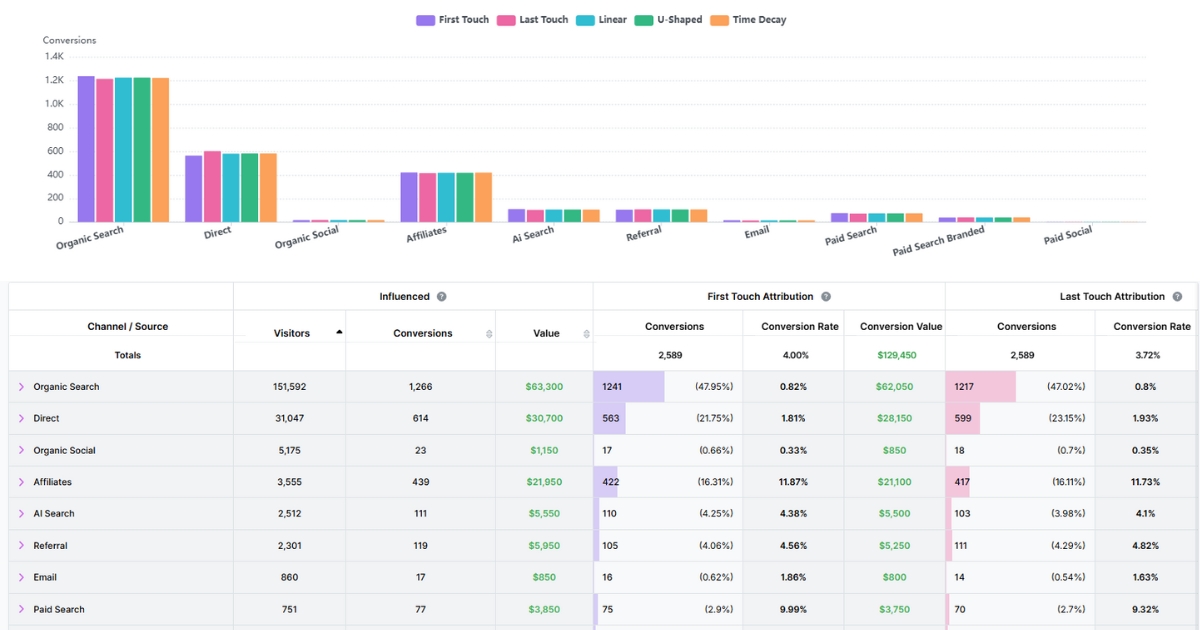
A cross-channel attribution view shows whether LinkedIn behaves differently under first-touch, last-touch, linear, U-shaped, and time-decay models instead of relying on one credit rule.
Follow LinkedIn visitors beyond the landing page
A prospect can move from LinkedIn to pricing, leave, return through search, read a comparison page, and then book a demo.
Customer journey analytics explains the behavior around that conversion, while User Journeys can surface the measurable paths visitors take after the original LinkedIn visit.
Connect CRM pipeline and revenue
For revenue-focused teams, full-funnel revenue attribution extends channel analysis through pipeline and Closed Won outcomes so LinkedIn can be judged against business value instead of lead volume alone.
Connect LinkedIn with Salesforce pipeline
Usermaven’s current Salesforce integration is read-only and brings Accounts, Contacts, Leads, Opportunities, stage history, and contact roles into the analytics environment. That gives LinkedIn analysis richer account and pipeline context without writing back to Salesforce.

Keep CRM integrations connected to the journey
HubSpot and Salesforce integrations keep contacts, companies, deals, opportunities, and pipeline activity connected with the earlier acquisition journey instead of restarting attribution at lead creation.

Contacts Hub then gives teams a person- and company-level place to inspect the customer context behind those measurable attribution and CRM outcomes.
Compare standard and custom attribution models
LinkedIn often appears at a different stage from branded search or sales outreach. Comparing standard models can reveal whether it behaves mainly as a discovery, assist, or closing channel.
For Enterprise teams that use custom attribution, business-specific weights can make those assumptions explicit. The model should still be compared against alternatives so one preferred weighting does not become unquestioned truth.
Capture what happens after the LinkedIn click
Events can capture measurable on-site actions such as page views, form submissions, button clicks, and other interactions that show what LinkedIn visitors actually do after arrival.

Bring off-site outcomes in with Event Sources
When the meaningful outcome happens elsewhere, Event Sources can bring CRM updates, payments, webinar activity, webhook events, and other accepted outcomes into the same analytics environment.
That is especially useful for LinkedIn B2B campaigns where the marketing click happens on the website but the commercial outcome appears weeks later in another system.
Check measurement quality before changing LinkedIn budget
The Measurement Trust Center gives teams a data-health view across Collection, Identity, Integrations, Delivery, and Reliability. That matters because attribution can look precise even when a critical source, identifier, or CRM outcome is missing.
Before reducing LinkedIn spend because attributed pipeline looks weak, verify that campaign parameters, identity, CRM data, and conversion delivery are complete.
Investigate LinkedIn performance with Maven AI
Maven AI can help investigate questions such as which LinkedIn campaigns created the most qualified pipeline, where LinkedIn appears early in high-value journeys, and how campaign credit changes across attribution models.

Query attribution through MCP
Usermaven’s MCP connection lets authorized analytics data be queried through compatible clients such as ChatGPT, Claude, Claude Code, Cursor, and Codex, while respecting the workspace permissions granted through the connection.
First-party evidence: Hyperengage
Hyperengage is a strong example of the underlying LinkedIn-attribution problem because its acquisition mix includes content, organic search, podcast-led distribution, LinkedIn, email, and partnerships. Buyers often return through several channels before converting.
Before Usermaven, the team relied on Google Analytics, CRM data, platform dashboards, and manual tracking. The picture was fragmented.
Early-stage channels such as podcasts, blogs, and LinkedIn rarely received credit when the final interaction dominated the report.
After unifying attribution and customer journeys, Hyperengage expanded attributed channel coverage from four to six and recorded a 22.19% visitor-to-goal conversion rate. The team also surfaced two additional acquisition sources that had previously been buried in incomplete reporting.
The Hyperengage case study shows why an early-stage channel can disappear when performance is judged too heavily by the final interaction rather than by the full measurable journey.
The evidence should not be interpreted as proof that LinkedIn alone created those gains. It demonstrates the broader measurement issue: LinkedIn can contribute to a qualified customer journey long before another channel receives the closing credit.
LinkedIn attribution checklist
- Goal: Is the analysis about conversion, pipeline, revenue, or channel comparison?
- Native model: Is Campaign Manager using Each ad set or Last ad set?
- Views: Are post-view conversions included?
- Window: Does the LinkedIn window match the sales cycle?
- RAR: Is CRM data connected if revenue influence matters?
- Level: Should the analysis be person or company based?
- Tracking: Are LinkedIn UTMs and Creative IDs complete?
- Identity: Can visitors be stitched across measurable sessions?
- CRM: Are opportunity and stage records complete?
- Cross-channel: Is LinkedIn compared under the same model as other channels?
- Model: Have multiple attribution models been tested?
- Trust: Are collection and integration gaps understood?
- Revenue: Does reporting reach Closed Won?
- Causality: Is influence being mistaken for incremental lift?
Final verdict
LinkedIn attribution is useful only when the team is clear about which measurement layer it is using and what that layer can actually prove.
Use Campaign Manager for LinkedIn conversion credit, Revenue Attribution Report for LinkedIn-influenced CRM outcomes, and independent attribution for LinkedIn’s role across the full measurable marketing journey.
The strongest B2B measurement extends beyond clicks and leads into journey, opportunity, pipeline, and Closed Won revenue while keeping platform influence, fractional attribution, and incrementality conceptually separate.
Ready to see Usermaven in action? Explore the platform or book a demo for a closer look.
FAQs about LinkedIn attribution
1. What is LinkedIn attribution?
LinkedIn attribution connects LinkedIn ad activity with later conversions, pipeline, or revenue. Native LinkedIn reports measure the platform under LinkedIn’s own rules, while independent attribution compares LinkedIn with the rest of the measurable customer journey.
2. What attribution model does LinkedIn use?
For most conversion types, LinkedIn uses last-touch attribution. Advertisers can configure credit at Each ad set or Last ad set level, which changes whether multiple eligible ad sets or only the most recent one receives conversion credit.
3. What is LinkedIn Revenue Attribution Report?
LinkedIn Revenue Attribution Report connects LinkedIn marketing activity with CRM records so teams can evaluate influenced leads, opportunities, pipeline, Closed Won revenue, ROAS, win rates, and sales-cycle metrics.
4. What is the difference between LinkedIn RAR and Campaign Manager attribution?
Campaign Manager focuses on conversion credit inside LinkedIn Ads. RAR goes further downstream by linking LinkedIn influence with CRM leads, opportunities, pipeline, and revenue.
5. What is LinkedIn’s attribution window?
LinkedIn Campaign Manager offers configurable click and view windows, while RAR uses separate CRM influence lookbacks. The right setting depends on the conversion type and actual sales cycle.
6. Does LinkedIn count view-through conversions?
Yes. LinkedIn can count eligible conversions after an ad view even when the buyer never clicked the ad, which is one reason LinkedIn attribution can differ from website source reports.
7. How does Salesforce LinkedIn Ads attribution work?
Updated

Written by
Junaid Ahmed
Content Writer & Digital Marketer
Junaid Ahmed is a content and copywriter with 3+ years of experience creating research-driven content across SaaS, B2B, ecommerce, and digital marketing. He specializes in turning complex topics into clear, practical content that helps marketers better understand their challenges, evaluate solutions, and make informed decisions. His work spans educational content, industry insights, and actionable marketing guides.
All articles by Junaid →