Enterprise marketing data rarely lives in one place. A large organization may operate several websites, products, regions, advertising accounts, CRM pipelines, sales teams, and offline channels.
Each system reports its own version of performance. Marketing sees campaign conversions, sales sees opportunities, finance sees recognized revenue, and leadership is left deciding which number to trust.
Enterprise marketing attribution software must do more than distribute credit across clicks. It must connect identities, accounts, campaigns, CRM stages, revenue, product activity, offline interactions, warehouses, and governance requirements.
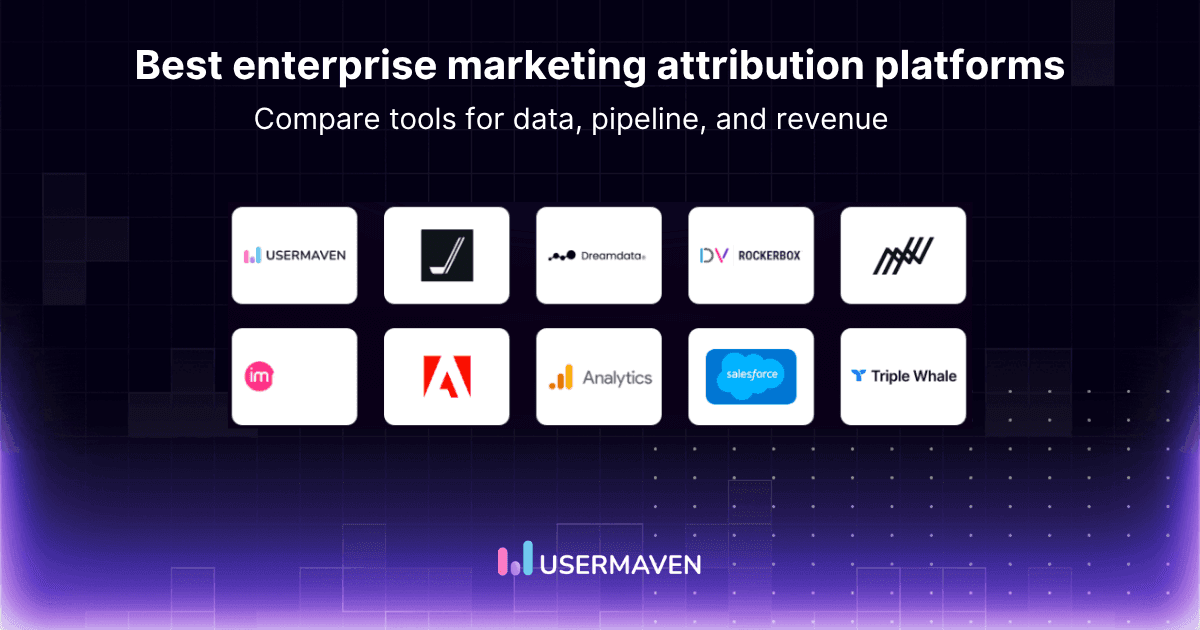
This guide compares ten enterprise marketing attribution platforms across attribution depth, data coverage, CRM and revenue measurement, MMM and incrementality, identity resolution, enterprise controls, implementation demands, pricing access, and best-fit use case.
Key takeaways
Enterprise attribution platforms differ significantly in focus. Some prioritize B2B pipeline, some ecommerce media measurement, and others enterprise data infrastructure or cross-channel analytics.
The number of attribution models is not enough to determine platform quality. Data collection, identity resolution, CRM connection, governance, and revenue accuracy matter just as much.
Multi-touch attribution, marketing mix modeling, and incrementality answer different questions. Enterprises with large media budgets may need more than one measurement method.
The best platform depends on the organization’s business model, technology stack, data maturity, implementation resources, reporting goals, and procurement requirements.
Enterprise marketing attribution platforms at a glance
| Platform | Best for | Platform type | Pricing access |
|---|---|---|---|
| Usermaven | Unified attribution for SaaS, B2B, and agencies | Attribution and analytics platform | Public plans and enterprise option |
| HockeyStack | Enterprise B2B GTM intelligence | B2B attribution and account intelligence | Demo-led |
| Dreamdata | B2B revenue and account attribution | B2B activation and attribution | Free access and custom paid plans |
| Rockerbox | MTA, MMM, and incrementality | Unified measurement platform | Demo-led |
| Northbeam | High-spend ecommerce brands | Ecommerce attribution and media measurement | Published entry tier and custom plans |
| Improvado | Warehouse and BI-centered enterprises | Marketing data and attribution infrastructure | Custom quote |
| Adobe Customer Journey Analytics | Adobe-centered global organizations | Enterprise journey analytics suite | Custom quote |
| Google Analytics 360 | Google-centered web and app measurement | Enterprise digital analytics suite | Custom quote |
| Salesforce Marketing Intelligence | Salesforce-centered organizations | Marketing intelligence and attribution suite | Published enterprise pricing |
| Triple Whale Enterprise | Large DTC and multi-brand ecommerce businesses | Ecommerce measurement platform | Custom enterprise pricing |
These platforms are not direct substitutes in every situation. The detailed reviews explain which measurement problem each product is designed to solve and the organizations it is most likely to suit.
What is an enterprise marketing attribution platform?
An enterprise marketing attribution platform connects marketing interactions with conversions, accounts, pipeline, customers, and revenue across the systems used by a large organization.
Unlike a basic campaign dashboard, enterprise attribution may need to combine:
Multiple brands, regions, websites, and business units
Long buying cycles and buying committees
CRM contacts, accounts, opportunities, and custom objects
Advertising, website, product, ecommerce, sales, and offline activity
Data warehouses, BI tools, billing systems, and finance records
Privacy, governance, security, and controlled access
Large customer, event, and transaction volumes
A reliable cross-platform marketing attribution system must fit the organization’s data architecture and preserve consistent definitions across marketing, sales, product, and finance.
Organizations that also need broader operational and executive reporting may compare enterprise performance analytics tools, but attribution still requires a direct connection between marketing touchpoints and commercial outcomes.
10 best enterprise marketing attribution platforms
Each platform is assessed according to its primary use case, attribution capabilities, data coverage, enterprise controls, implementation model, pricing access, and important limitations.
1. Usermaven: Best overall for connected attribution and analytics

Overview: Usermaven is an attribution-first platform that connects marketing channels with website behavior, product activity, customer journeys, CRM pipeline, and revenue.
Best for: Enterprise SaaS businesses, B2B teams, product-led organizations, agencies managing multiple workspaces, and companies replacing separate attribution, website, and product analytics tools.
Why it stands out: Usermaven does not stop at the lead or purchase. It connects acquisition with what users do after arrival, including signup, activation, product engagement, opportunity progression, conversion, retention, and expansion.
Key enterprise capabilities:
Paid, organic, content, and channel attribution
CRM pipeline and closed-revenue attribution
Multi-touch conversion paths and adjustable attribution windows
Anonymous-to-identified customer journeys
Website, product, funnel, cohort, and retention analysis
Server-side and first-party tracking
Revenue, lifecycle, and expansion reporting
Custom dashboards and AI-assisted analysis through Maven AI
Warehouse export, private cloud, on-premises deployment, SAML SSO, RBAC, audit logs, and enterprise support options
Pricing and access: Growth starts at $84 per month. Scale starts at $199 per month and adds paid-ad attribution, CRM revenue and pipeline attribution, conversion paths, customer-journey attribution, retention reporting, and Maven AI. Enterprise pricing is customized. A 14-day free trial is available.
2. HockeyStack: Best for complex enterprise B2B GTM teams

Overview: Hockeystack is an enterprise B2B attribution and account-intelligence platform designed to connect marketing, sales, product, intent, and CRM activity with pipeline and revenue.
Best for: Large B2B organizations, revenue operations teams, account-based marketing programs, complex Salesforce environments, and companies with long, multi-stakeholder buying journeys.
Why it stands out: HockeyStack emphasizes account-level visibility rather than treating every contact as an isolated journey. Its enterprise positioning centers on governed definitions, complex account structures, identity resolution, and connected GTM reporting.
Key enterprise capabilities:
Account-level buyer journeys
Multi-touch attribution and model comparison
CRM, product, web, advertising, intent, email, and sales data
Custom objects, fields, stages, and enterprise data definitions
Pipeline, ROI, account scoring, and lift reporting
Audience synchronization and conversion APIs
Regional governance, role-based controls, and enterprise hierarchies
AI-assisted GTM analysis
Pricing and access: HockeyStack uses a demo-led, custom-pricing process. Plans include integrations, hands-on support, custom setup for complex data environments, and enterprise reporting requirements.
Teams comparing platform scope, deployment, pricing access, and behavioral analytics can review the dedicated HockeyStack alternative page.
3. Dreamdata: Best for B2B revenue attribution

Overview: Dreamdata is a B2B activation and attribution platform built around account journeys, buying committees, pipeline, and revenue.
Best for: B2B SaaS companies, revenue marketers, account-based programs, and organizations with long sales cycles involving several contacts.
Why it stands out: Dreamdata is purpose-built for B2B journeys. It connects anonymous activity with known contacts, groups stakeholders under accounts, and evaluates marketing activity against pipeline and revenue rather than only lead generation.
Key enterprise capabilities:
Anonymous-to-known journey tracking
Contact-to-account mapping
Multi-stakeholder customer journeys
Pipeline and revenue attribution
First-click, last-click, linear, U-shaped, W-shaped, and data-driven views
Customer-journey timelines and content analytics
Audience activation and account identification
Custom data controls, multiple business units, SSO, and dedicated onboarding on advanced plans
Pricing and access: Dreamdata offers a free plan with B2B web analytics, company identification, engagement scoring, audience building, ad-spend reporting, and limited history. Its advanced Activation and Attribution package uses custom pricing and includes broader attribution, AI features, advanced controls, and dedicated support.
The Dreamdata alternative comparison is useful for teams deciding between specialized B2B attribution and a broader platform that also includes website and product analytics.
4. Rockerbox: Best for unified measurement

Overview: Rockerbox combines multi-touch attribution, marketing mix modeling, and incrementality testing on a shared marketing-data foundation.
Best for: Mature consumer brands, retail organizations, ecommerce companies, and enterprises that need tactical attribution, strategic budget modeling, and causal testing.
Why it stands out: Rockerbox treats MTA, MMM, and incrementality as complementary methods. This lets teams use granular journey reporting for daily optimization, MMM for budget planning, and controlled tests for causal questions.
Key enterprise capabilities:
First-party multi-touch attribution
Customizable attribution models and conversion-funnel analysis
Marketing mix modeling and scenario planning
Managed incrementality testing
Online and offline data collection
Deduplicated marketing-data foundation
Channel-overlap and new-versus-repeat-customer reporting
Warehouse, spreadsheet, and external data exports
Pricing and access: Rockerbox uses custom pricing and a sales-led onboarding process. Organizations select the data and analysis products needed for their measurement program.
The Rockerbox alternative page compares its enterprise-oriented measurement approach with Usermaven’s self-serve attribution, behavioral analytics, public pricing, and faster deployment model.
5. Northbeam: Best for high-spend ecommerce attribution

Overview: Northbeam is an ecommerce-focused marketing measurement platform built around first-party attribution, paid-media optimization, deterministic view measurement, and media mix modeling.
Best for: DTC brands, ecommerce companies, performance-marketing teams, multi-region stores, and organizations with substantial monthly media spend.
Why it stands out: Northbeam gives media teams an independent view of cross-channel performance and emphasizes new-customer revenue, creative performance, product-level analysis, and the difference between clicks and ad views.
Key enterprise capabilities:
Multi-touch attribution using first-party data
Clicks and deterministic views
New-customer revenue, ROAS, CAC, and profitability views
Creative and product analytics
Media Mix Modeling+
Correlation analysis and media-strategy support
Unlimited integrations, users, and saved views on enterprise plans
Optional multi-region instances, faster refreshes, and touchpoint-level exports
Pricing and access: Starter begins at $1,500 per month. Professional and Enterprise use custom quotes. Northbeam positions Enterprise for organizations spending more than $500,000 per month on media, with pricing affected by data volume, processing frequency, service level, and advanced capabilities.
For a closer comparison of platform access, ecommerce focus, product analytics, and cost, review the Northbeam alternative page.
6. Improvado: Best for warehouse and BI-centered enterprises

Overview: Improvado is broader than a standalone attribution tool. It operates as a marketing-data pipeline and analytics infrastructure layer that can centralize, transform, govern, model, and export enterprise marketing data.
Best for: Large enterprises, agencies with complex client data, companies with established warehouse and BI teams, and organizations where the main challenge is fragmented marketing infrastructure.
Why it stands out: Improvado combines attribution with data extraction, transformation, governance, warehouse delivery, reporting, and professional services. Its attribution layer can connect marketing, sales, finance, online, and offline activity.
Key enterprise capabilities:
Data extraction from more than 1,000 online and offline sources
Warehouse-ready transformation and normalization
Snowflake, BigQuery, and BI connectivity
Multi-touch and account-based attribution
User and account identity resolution
CRM, ecommerce, paid-media, sales, finance, and offline data
Revenue, LTV, ARR, and bidding analysis
Data governance, security controls, AI analysis, and professional services
Pricing and access: Improvado uses custom pricing and a demo-led buying process. Total cost depends on data sources, volume, destinations, governance needs, services, and the complexity of the enterprise data model.
7. Adobe Customer Journey Analytics: Best for the Adobe ecosystem

Overview: Adobe Customer Journey Analytics is an enterprise cross-channel analytics platform built on Adobe Experience Platform. It connects identities and interactions across channels, devices, and time for customer-level analysis.
Best for: Existing Adobe Experience Cloud customers, global consumer organizations, omnichannel retail, advanced analytics teams, and companies combining web, app, CRM, point-of-sale, call-center, and offline data.
Why it stands out: Adobe allows attribution to be applied beyond paid-media clicks. Teams can assign credit using any relevant dimension, metric, channel, content interaction, support event, or offline touchpoint available in the connected data.
Key enterprise capabilities:
Online and offline customer-level journey analysis
Graph-based identity stitching across channels and devices
Algorithmic, rules-based, and participation attribution models
Side-by-side attribution-model comparison
Web, app, CRM, point-of-sale, call-center, content, and offline data
Journey canvas, cohorts, flow, fallout, segmentation, and guided analysis
B2B account, buying-group, opportunity, and revenue analysis through the B2B edition
Enterprise governance, role-based permissions, and data-usage controls
Pricing and access: Adobe uses custom enterprise pricing. The overall investment can include Adobe Experience Platform, related Adobe products, implementation services, data preparation, and specialist resources.
8. Google Analytics 360: Best for Google-centered web and app measurement

Overview: Google Analytics 360 is an enterprise web and app analytics suite with attribution reporting, higher data limits, BigQuery connectivity, and tighter integrations across Google’s advertising and cloud ecosystem.
Best for: Large websites and applications, Google Ads-heavy organizations, BigQuery users, digital analytics teams, and companies that need enterprise-scale GA reporting.
Why it stands out: Analytics 360 places attribution inside a familiar web and app analytics environment. It is especially useful when Google Ads, Search Ads 360, Display & Video 360, Google Cloud, and BigQuery already form the center of the measurement stack.
Key enterprise capabilities:
Cross-platform attribution reporting
Data-driven attribution
Conversion-path and model-comparison reports
Google BigQuery export
Unsampled explorations, automatic custom tables, and higher reporting limits
Continuous intraday data and enhanced freshness
Subproperties and roll-up properties for organizational control
Enterprise support and service-level commitments
Pricing and access: Analytics 360 uses custom pricing through Google or an authorized reseller. Buyers should account for implementation, governance, tagging, BigQuery usage, and ongoing analytics resources in addition to the license.
Google’s official Analytics 360 feature overview details its attribution reports, BigQuery export, enhanced limits, automation, and advertising integrations.
9. Salesforce Marketing Intelligence: Best for Salesforce-centered attribution

Overview: Salesforce Marketing Intelligence is a marketing-data, reporting, AI, and attribution environment that connects campaign activity with Salesforce customer, lead, account, opportunity, and revenue data.
Best for: Salesforce CRM customers, Marketing Cloud users, large B2B organizations, and companies that want attribution anchored to Salesforce objects, identity rules, and lifecycle stages.
Why it stands out: Salesforce supports both touch-based attribution and funnel-based attribution. Touch-based reporting evaluates individual interactions across the journey, while funnel-based reporting measures how prospects progress through ordered lifecycle stages.
Key enterprise capabilities:
CRM-connected campaign attribution
Touch-based and funnel-based attribution
First-click, last-click, linear, time-decay, and U-shaped models
Configurable lookback windows and identity-resolution rules
Campaign Members, Leads, Opportunities, Account Stages, and custom touch objects
Custom objects and external data through Data 360
Tableau Next dashboards, AI campaign summaries, and Agentforce capabilities
Paid, owned, earned, CRM, and third-party marketing data
Pricing and access: Salesforce’s Marketing Intelligence pricing currently lists Marketing Intelligence at $10,000 per organization per month and Marketing Cloud Intelligence+ at $11,000 per organization per month, billed annually.
Additional Data 360 usage, Tableau licenses, credits, apps, or implementation services may add to the total cost.
10. Triple Whale: Best for large DTC and multi-brand ecommerce

Overview: Triple Whale is an ecommerce measurement, business-intelligence, and AI platform. Its Enterprise package adds unified measurement, multi-brand support, custom integrations, and enterprise services.
Best for: Large DTC brands, multi-brand ecommerce groups, retail and wholesale businesses, performance-media teams, and companies managing several stores or regions.
Why it stands out: Triple Whale combines first-party ecommerce attribution with post-purchase survey data, business intelligence, product and creative reporting, and Compass, which brings MTA, MMM, and incrementality into one decision system.
Key enterprise capabilities:
First-party multi-touch attribution and configurable windows
Post-purchase survey and Total Impact attribution
Compass measurement across MTA, MMM, incrementality, and GeoLift
Multi-brand, multi-store, multi-region, retail, wholesale, and marketplace reporting
Product, creative, cohort, LTV, profitability, and operations analysis
Data-in, data-out, ecommerce, advertising, email, subscription, and warehouse integrations
Moby AI analysis, reports, automations, and governed actions
SOC 2 Type 2 compliance, dedicated success coverage, and custom security review
Pricing and access: Pricing is based on annual GMV and package selection. Enterprise uses custom pricing and is generally designed for businesses with approximately $10 million or more in annual GMV, although business complexity and measurement requirements also affect fit.
Buyers should confirm the availability of specific enterprise security controls, including SSO and audit logs, during procurement.
The Triple Whale alternative page compares ecommerce-focused attribution with Usermaven’s broader coverage of SaaS journeys, CRM pipeline, product behavior, and revenue.
Detailed enterprise attribution platform comparison
The table below compares the platforms by their primary market and measurement scope. “Integration-dependent” means the capability can require an additional product, custom data work, or a connected warehouse rather than being the platform’s central out-of-the-box function.
| Platform | Primary market | MTA | CRM & pipeline | MMM | Incrementality | Warehouse | Identity/account | Pricing model |
|---|---|---|---|---|---|---|---|---|
| Usermaven | SaaS, B2B, product-led, agencies | Yes | Yes | Not primary | Not primary | Enterprise export | User and account journeys | Public plans + custom Enterprise |
| HockeyStack | Enterprise B2B GTM | Yes | Strong | Not primary | Lift/incrementality reporting | Yes | Enterprise identity graph and accounts | Custom |
| Dreamdata | B2B revenue teams | Yes | Strong | Not primary | Not primary | Yes | Contact-to-account mapping | Free and custom |
| Rockerbox | Consumer, retail, omnichannel | Yes | Integration-dependent | Yes | Yes | Yes | Customer journey, first-party | Custom |
| Northbeam | High-spend ecommerce | Yes | Not primary | Enterprise option | Via MMM+ | Enterprise export | Device and identity graph | From $1,500 + custom |
| Improvado | Data infrastructure-heavy | Yes | Yes | Model-dependent | Model-dependent | Strong | User and account resolution | Custom |
| Adobe CJA | Adobe-centered global orgs | Yes | Via connected data + B2B edition | Integration-dependent | Experiment analysis | Adobe Experience Platform | Graph-based stitching | Custom |
| Google Analytics 360 | Google-centered web/app | Data-driven | Integration-dependent | Not primary | Not primary | BigQuery | Web/app identity config | Custom |
| Salesforce MI | Salesforce-centered orgs | Yes | Strong | Not primary | Not primary | Data 360 + connected | Identity-resolution rules | Published enterprise |
| Triple Whale Enterprise | Large DTC, multi-brand ecommerce | Yes | Not primary | Yes | Yes | Export/API | Ecommerce identity, first-party | GMV-based + custom |
Capabilities and packages change over time. Enterprise buyers should confirm the exact integrations, limits, add-ons, governance controls, and implementation responsibilities included in a written proposal.
Best enterprise attribution platform by use case
The right enterprise attribution platform depends on what your team needs to measure, how your data is structured, and which decisions attribution must support. Use this table as a quick way to match each enterprise use case with the platform that fits best.
| Use case | Recommended platform | Reason |
|---|---|---|
| Unified SaaS attribution and product analytics | Usermaven | Connects acquisition, website behavior, product activity, CRM, journeys, and revenue |
| Complex enterprise B2B GTM | HockeyStack | Account intelligence, enterprise journeys, and governed GTM reporting |
| B2B revenue attribution | Dreamdata | Built for multi-stakeholder journeys, accounts, pipeline, and revenue |
| MTA, MMM, and incrementality | Rockerbox | Combines three measurement methods on a shared data foundation |
| High-spend ecommerce media | Northbeam | First-party ecommerce attribution, deterministic views, and media planning |
| Enterprise data infrastructure | Improvado | Broad source coverage, transformation, governance, warehouses, and BI |
| Adobe ecosystem | Adobe Customer Journey Analytics | Cross-channel journey analysis and attribution within Adobe Experience Platform |
| Google ecosystem | Google Analytics 360 | Web, app, Google Ads, BigQuery, and enterprise GA reporting |
| Salesforce ecosystem | Salesforce Marketing Intelligence | CRM-anchored touch and funnel attribution |
| Multi-brand DTC ecommerce | Triple Whale Enterprise | Ecommerce attribution, Compass unified measurement, and multi-brand reporting |
Ecosystem convenience can reduce implementation friction, but it should not be the only selection criterion. The platform must still support the company’s actual conversion, account, revenue, and budget decisions.
What makes an attribution platform enterprise-ready?
Enterprise readiness is not defined by a large contract or a long feature list. It depends on whether the platform can handle the organization’s data, identities, reporting decisions, controls, and operating model.
| Capability | Why it matters | Question to ask |
|---|---|---|
| Data-source coverage | Enterprise journeys span many systems | Can it connect ads, web, product, CRM, billing, and offline data? |
| Identity resolution | One customer may use several devices and identities | Can anonymous and identified activity be connected? |
| Account-level attribution | B2B purchases involve several people | Can contacts be grouped under accounts and opportunities? |
| Attribution flexibility | Different decisions require different models | Can teams change models, windows, and weighting rules? |
| CRM and revenue attribution | Leads alone do not show business impact | Can campaigns be connected with pipeline and closed revenue? |
| Offline attribution | Events, calls, retail, and sales activity may occur offline | Can offline interactions be included in journeys? |
| MMM and incrementality | Attribution does not prove causal lift | Does the platform include or integrate these methods? |
| Warehouse and BI support | Enterprises often maintain their own data layer | Can data be imported, exported, or queried externally? |
| Governance and security | Several teams need controlled access | Does it support SSO, roles, audit logs, and data controls? |
| Scalability | Data and organizational structures can be large | Can it support multiple regions, brands, and workspaces? |
| Implementation requirements | Complex deployments can delay value | What engineering, onboarding, and maintenance are required? |
| Support and SLAs | Measurement affects major budget decisions | Are dedicated support, uptime commitments, and training available? |
A platform should also make its measurement logic visible. Teams need to understand how marketing attribution models, lookback windows, identity rules, and eligible touchpoints affect the result.
For longer journeys, multi-touch attribution can provide a broader view than assigning all credit to one interaction. It still depends on connected data and should be reconciled with CRM, billing, or finance totals through a documented revenue attribution process.
How to choose an enterprise marketing attribution platform
A platform shortlist should begin with the decision the organization needs to improve, not with a feature-count comparison.
1. Start with the decision the platform must support
Different decisions require different measurement methods and reporting depth.
Daily media-budget allocation
Pipeline and revenue reporting
Account-based marketing analysis
Ecommerce profitability
Executive marketing reporting
Long-term media planning
Incremental-lift validation
Select the relevant marketing attribution metrics only after defining the business question. A dashboard should not dictate the decision.
2. Define the primary business outcome
Document whether the platform will optimize leads, qualified accounts, opportunities, closed revenue, purchases, subscriptions, renewals, expansion, or customer lifetime value.
A tool that performs well for ecommerce purchases may not support account-level pipeline. A B2B platform may not provide the creative and product-level reporting a large DTC brand needs.

3. Map the systems that must be connected
List every system that contains a relevant interaction or outcome:
Advertising platforms
Websites and applications
Product analytics
CRM and marketing automation
Billing and ecommerce systems
Call tracking and point of sale
Events and offline records
Warehouses and BI tools
The value of cross-platform marketing attribution depends on whether these systems can be connected without losing campaign, customer, account, conversion, and revenue context.
4. Decide whether account-level attribution is required
A reliable B2B marketing attribution setup should determine whether individual contacts must be grouped into accounts, buying committees, opportunities, and deals.
Individual-user attribution is insufficient when several stakeholders research, evaluate, trial, approve, and purchase the same solution.
5. Decide whether MTA is sufficient
Multi-touch attribution, marketing mix modeling, and incrementality answer different questions:
MTA: How did recorded touchpoints participate in individual journeys?
MMM: How did channel investments and external factors affect performance over time?
Incrementality: Did the marketing activity create outcomes that would not otherwise have occurred?
A multi-touch attribution platform may be enough for journey and channel analysis. Enterprises making large strategic media decisions may require a combination of methods.
6. Evaluate implementation and maintenance
Ask practical questions before signing a contract:
Does deployment require engineering?
How is historical data handled?
How long does onboarding take?
Who owns data definitions and identity rules?
What happens when CRM stages or schemas change?
Is ongoing professional service required?
7. Review governance and procurement requirements
Enterprise evaluation should cover:
SAML SSO
Role-based access
Audit logs
Data residency and retention controls
Security documentation and DPA support
Service-level agreements
Support coverage
Contract and data-export terms
8. Run a proof of concept with real data
A proof of concept should verify:
Conversion totals
Revenue reconciliation
Identity stitching
Contact-to-account mapping
Model and window differences
Dashboard usability
Data exports
Time required to answer a real business question
A documented SaaS marketing attribution strategy can help product-led and sales-led organizations define these requirements before vendors are evaluated.
See what's working. Fix what's not. Grow faster.
Common mistakes when comparing enterprise attribution platforms
Enterprise attribution platforms often look similar on comparison pages, but they can solve very different measurement problems. These mistakes usually happen when teams compare feature lists before clarifying their business model, data quality, revenue source, and attribution question.
Comparing unlike platform categories
A B2B revenue-attribution platform, ecommerce media-measurement product, data infrastructure layer, and enterprise analytics suite should not be scored as though they solve the same problem.
Start by identifying the category that matches the organization’s business model and measurement decision.
Choosing based only on the number of attribution models
More models do not repair missing identities, inconsistent campaign names, duplicated conversions, incomplete CRM data, or unreliable revenue fields.
Different attribution models answer different questions rather than producing one objective truth.
Buying the existing ecosystem option automatically
An existing Adobe, Google, or Salesforce relationship can simplify procurement and integration, but the product must still support the required attribution scope.
Do not assume that a broader analytics or CRM suite provides every capability of a specialized attribution platform.
Treating MTA, MMM, and incrementality as interchangeable
MTA distributes credit across recorded journeys. MMM estimates aggregate channel effects over time. Incrementality tests estimate whether marketing caused additional outcomes.
A platform should be evaluated according to the question each method must answer.
Ignoring implementation costs
The subscription is only one part of the total investment.
Engineering
Consulting and onboarding
Data cleanup
Warehouse processing
Training
Ongoing maintenance
Additional product licenses or usage credits
Failing to reconcile revenue
Attribution should distribute credit for known commercial outcomes. It should not create a second, conflicting revenue total.
CRM, billing, ecommerce, and finance systems can use different dates, identities, stages, and revenue definitions. Review marketing attribution discrepancies between tools before treating every reporting difference as a tracking failure.
Adding advertising-platform conversions together
Several advertising platforms can claim the same conversion under their own windows and identity rules.
Adding their reported totals can produce more conversions and revenue than the business actually recorded. The guide to ad platform discrepancies explains why these claims overlap and how to reconcile them.
Why Usermaven is a practical enterprise attribution choice
Usermaven is designed for organizations that need marketing attribution connected with the behavior and commercial outcomes that occur after acquisition.

Unified attribution and behavioral context
Usermaven connects every layer of your marketing and revenue data into one place:
Paid and organic acquisition: See which channels actually drive pipeline
Website behavior: Track how visitors engage before they convert
Product activity: Understand what users do inside your product
Customer journeys: Map every touchpoint from first click to closed deal
Funnels and conversion paths: Spot where prospects drop off and why
CRM pipeline and deals: Connect marketing efforts directly to sales outcomes
Revenue, retention, and expansion: Tie attribution to long-term business growth
This context helps teams distinguish channels that generate visits or signups from channels that generate activated users, qualified accounts, revenue, and retained customers.
Attribution without a disconnected analytics stack
An enterprise can otherwise end up combining a dedicated attribution tool, website analytics platform, product analytics product, customer-journey tool, CRM dashboard, and separate reporting layer.
Usermaven brings these views into one connected platform. Its marketing attribution dashboard can connect acquisition, conversion paths, journeys, pipeline, revenue, and retention for shared decision-making.
Self-serve access with enterprise options
Growth and Scale have public pricing and a 14-day free trial, allowing teams to test the platform without beginning with a long procurement process.
Enterprise adds custom integrations, warehouse exports, tailored reporting, private-cloud and on-premises options, custom retention and residency, SAML SSO, role-based controls, audit logs, security review support, concierge onboarding, a dedicated customer success manager, and an SLA.
Full-funnel SaaS measurement
Usermaven can evaluate the journey from:
First visit → signup → activation → opportunity → customer → retention → expansion
This makes it particularly relevant for B2B SaaS analytics, where campaign activity needs to be evaluated alongside account behavior, product adoption, pipeline, and recurring revenue.
AI-assisted investigation
Maven AI helps teams ask questions about attribution, campaigns, funnels, customer journeys, product behavior, and revenue without manually creating a new report for every investigation.
AI can accelerate analysis, but it does not replace shared conversion definitions, reliable tracking, CRM governance, or revenue reconciliation.
Best-fit organizations
B2B SaaS companies
Product-led SaaS businesses
Revenue and growth teams
Agencies managing several clients
Businesses connecting acquisition with product adoption, pipeline, and revenue
Final verdict
No enterprise marketing attribution platform is best for every organization, but Usermaven is the strongest choice for teams that want attribution connected to the full customer journey, not isolated campaign reporting.
While tools like HockeyStack, Dreamdata, Rockerbox, Northbeam, and Improvado can fit specific enterprise use cases, they often focus on one narrower problem such as B2B account intelligence, MMM, ecommerce media measurement, or governed data pipelines.
Usermaven gives enterprises a more balanced attribution layer by connecting campaigns, website behavior, product activity, customer journeys, CRM pipeline, and revenue in one platform.
For enterprises that want campaigns connected with website behavior, product activity, customer journeys, CRM pipeline, and revenue, Usermaven’s marketing attribution platform provides a connected alternative to stitching together several separate analytics products.
Ready to see Usermaven in action? Explore the platform or book a demo for a closer look.
See Usermaven in action
Book a free demo and discover how powerful analytics can grow your business.
FAQs
1. What is an enterprise marketing attribution platform?
An enterprise marketing attribution platform connects marketing interactions with conversions, accounts, pipeline, customers, and revenue across the systems used by a large organization.
It may also provide identity resolution, account-level reporting, custom models, offline attribution, warehouse connectivity, governance controls, and enterprise support.
2. How is enterprise attribution software different from standard attribution software?
Enterprise attribution software must support higher data volumes, more systems, several brands or regions, complex identities, long journeys, buying committees, custom revenue definitions, security controls, and governed access. Standard attribution tools may focus mainly on digital campaigns and individual conversions.
3. Which enterprise marketing attribution platform is best?
The best platform depends on the use case. Usermaven is a strong overall choice for connected SaaS attribution and B2B enterprise attribution needs. HockeyStack and Dreamdata specialize in B2B journeys. Rockerbox combines MTA, MMM, and incrementality. Northbeam and Triple Whale focus on ecommerce, while Adobe, Google, Salesforce, and Improvado fit specific enterprise ecosystems and data architectures.
4. What is the difference between MTA, MMM, and incrementality?
MTA assigns conversion credit across recorded customer touchpoints. MMM estimates how marketing investment and external factors affect aggregate performance over time. Incrementality testing estimates the additional outcomes caused by marketing activity.
5. Do enterprise attribution platforms need CRM integration?
Updated

Written by
Junaid Ahmed
Content Writer & Digital Marketer
Junaid Ahmed is a content and copywriter with 3+ years of experience creating research-driven content across SaaS, B2B, ecommerce, and digital marketing. He specializes in turning complex topics into clear, practical content that helps marketers better understand their challenges, evaluate solutions, and make informed decisions. His work spans educational content, industry insights, and actionable marketing guides.
All articles by Junaid →